INTRODUCTION
Eremotherium laurillardi (Lund, 1842) was a Megatheriinae giant ground sloth that lived in the late Pleistocene of a great part of America and was the only species of the genus that had a distribution from the southern United States to the south of Brazil (Cartelle and De Iuliis, Reference Cartelle and De Iuliis1995, Reference Cartelle and De Iuliis2006; Cartelle et al., Reference Cartelle, De Iuliis and Pujos2015; Dantas et al., Reference Dantas, Cherkinsky, Bocherens, Drefahl, Bernardes and de Melo França2017). There are at least two other species, Eremotherium eomigrans De Iuliis & Cartelle, 1999 and Eremotherium sefvei De Iuliis & St-André, Reference De Iuliis and St-André1997, but these were geographically restricted to the United States and Bolivia, respectively (De Iuliis and St-André, 1997; De Iuliis and Cartelle, Reference De Iuliis and Cartelle1999).
Eremotherium laurillardi could reach 2360 kg (Dantas, Reference Dantas2022) and its diet is known mainly by data from Brazil through stable carbon isotopes (Oliveira et al., Reference Oliveira, Asevedo, Cherkinsky and Dantas2020; Asevedo et al., Reference Asevedo, Ranzi, Kalliola, Pärssinen, Ruokolainen, Cozzuol and Rodrigues do Nascimento2021; Lopes et al., Reference Lopes, Dillenburg, Pereira and Sial2021; Omena et al., Reference Omena, Silva, Sial, Cherkinsky and Dantas2021 and references therein), microwear analysis (Oliveira et al., Reference Oliveira, Asevedo, Cherkinsky and Dantas2020), and relative muzzle width (Dantas and Santos, Reference Dantas and Santos2022), but there are additional isotopic data from Mexico (Pérez-Crespo et al., Reference Pérez-Crespo, Carbot-Chanona, Morales-Puente, Cienfuegos-Alvarado and Otero2015) and Belize (Larmon et al., Reference Larmon, Mcdonald, Ambrose, DeSantis and Lucero2019). All this information allows us to attribute a mixed-feeder diet to this species.
In general, studies of stable carbon isotopes represent the average diet of the individual's life; however, Larmon et al. (Reference Larmon, Mcdonald, Ambrose, DeSantis and Lucero2019) showed that it is possible to examine the annual diet of this species through a serial analysis in the molariform's tissue, allowing better understanding of its diet and the environmental conditions in the area in which it lived.
Thus, using the same approach as Larmon et al. (Reference Larmon, Mcdonald, Ambrose, DeSantis and Lucero2019), we examine the annual isotopic diet of an individual of E. laurillardi found in a cave in Bahia Brazil to evaluate whether the annual climate seasonality influenced its diet and habitat and the environmental conditions that prevailed through the late Pleistocene in the cave region where its fossil and other fossil taxa were found.
MATERIAL AND METHODS
Study area
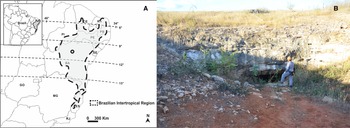
The studied material was collected in Toca dos Ossos cave (6°40′24.56″S, 35°22′34.89″W), Ourolândia Municipality, Bahia State (BA; Fig. 1). This is an unmapped cave formed in (possibly) late Tertiary Caatinga limestone; it comprises a major stream passage with an adjacent floodwater maze of spongework patterns (Auler et al., Reference Auler, Piló, Smart, Wang, Hoffmann, Richards, R. Lawrence Edwards, Neves and Cheng2006).
(A) Location map of the Brazilian Intertropical Region (BIR; sensu Dantas et al., Reference Dantas, Silva, Pansani, Franca, Aragao, Santos, Fernandes, Waldherr and Ximenes2022), highlighting the municipality of Ourolândia, Bahia, Brazil (white circle). BA, Bahia; CE, Ceará; ES, Espírito Santo; MG, Minas Gerais; PB, Paraíba; PE, Pernambuco; PI, Piauí; RN, Rio Grande do Norte; SE, Sergipe. (B) The entrance of Toca dos Ossos cave. (Image: Ricardo Fraga, 2015)

As Ourolândia, BA, does not have a meteorological station, we downloaded information relative to temperature and precipitation from the meteorological data bank (Banco de Dados Meteorológicos para Ensino e Pesquisa) from the Instituto Nacional de Meteorologia collected by the meteorological station no. 83186 in Jacobina, BA (~66 km from Ourolândia, BA), from 1964 to 2021. On average, this region exhibits an annual temperature of 24°C and annual precipitation of 831 mm.
Study material and serial analysis
The studied material is part of the scientific collection of the Laboratório de Ecologia e Geociências (LEG) of the Universidade Federal da Bahia, Instituto Multidisciplinar em Saúde, campus Anísio Teixeira (UFBA/IMS-CAT).
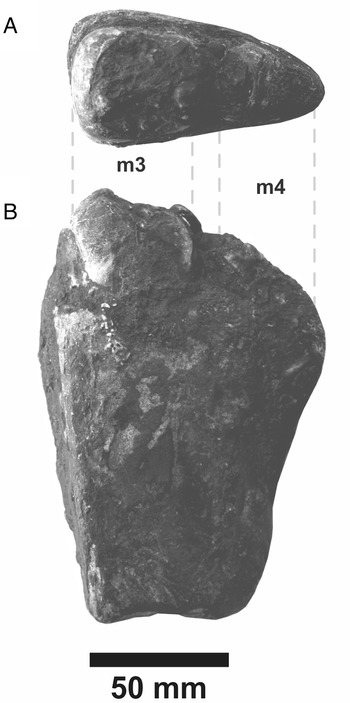
We analyzed the values of the isotopic ratios of carbon (δ13C) and oxygen (δ18O) through the extension of the third inferior molariform, which was inserted in a dentary fragment of Eremotherium laurillardi (LEG 0742; Fig. 2). This type of tooth is hypselodontic and grows continuously throughout the life of the animal (Paula Couto, Reference Paula Couto1979). These analyses were performed on the inner orthodentin, because Larmon et al. (Reference Larmon, Mcdonald, Ambrose, DeSantis and Lucero2019) suggest that this tissue suffers minimal diagenetic changes.
Dentary fragment of Eremotherium laurillardi (LEG 0742) in occlusal view (A) showing the third and fourth inferior molariforms (m3, m4); and in medial view (B).

The serial analysis consists of sampling the tissue sequentially along the direction of tooth growth and inferring changes in feeding with seasonal variations and environmental and habit changes (e.g., Higgins, Reference Higgins, Croft, Su and Simpson2018; Larmon et al., Reference Larmon, Mcdonald, Ambrose, DeSantis and Lucero2019). Each sample was collected along the height of the tooth crown, starting at the occlusal area. A total of 12 samples were taken from the m3 (Table 1).
Distance of each serial sample to the occlusal face, carbon isotopic values (δ13CVPDB), food resource proportions, standard niche breadth (BA), oxygen isotopic values (δ18OVSMOW), and radiocarbon dating for Eremotherium laurillardi (LEG 0742) from Ourolândia, BA.

An annual cycle can be inferred in hypselodontic tooth based on maximum and minimum oxygen isotope values, the distance between two maximum or minimum peaks representing growth during 1 year. In proboscideans, an annual cycle is represented by every ~15 mm (e.g., Metcalfe and Longstaffe, Reference Metcalfe and Longstaffe2012), in toxodonts, at 11–17 mm (Gomes et al., Reference Gomes, Lessa, Oliveira, Bantim, Sayão, Bocherens, Araújo and Dantas2023), and in giant ground sloths (E. laurillardi), at ~70 mm (Larmon et al., Reference Larmon, Mcdonald, Ambrose, DeSantis and Lucero2019).
Isotopic analyses (δ13C, δ18O) were performed using the carbonate (CO32−) present in the mineral fraction of hydroxyapatite. They were carried out at the Center for Applied Isotope Studies, University of Georgia, USA. Laboratory data are calibrated in delta (δ) notation, [(Rsample/Rstandard − 1)*1000] (Coplen, Reference Coplen1994), using the Vienna Pee Dee Belemnite (VPDB) scale for δ13C, and the Vienna Standard Mean Ocean Water (VSMOW), an international isotopic standard distributed by the International Atomic Energy Agency, for δ18O (Coplen, Reference Coplen1994; Higgins, Reference Higgins, Croft, Su and Simpson2018).
Radiocarbon dating (14C AMS)
For radiocarbon dating, the quoted uncalibrated dates are given in radiocarbon years before 1950 (yr BP), using the 14C half-life of 5568 years. The error is quoted as 1 standard deviation and reflects both statistical and experimental errors. The date has been corrected for isotope fractionation. The reliability of the applied technique for purification of hydroxyapatite was previously demonstrated (Cherkinsky, Reference Cherkinsky2009); however, the radiocarbon dating in bioapatite provides younger ages than those made using collagen (Zazzo and Saliège, Reference Zazzo and Saliège2011; Zazzo, Reference Zazzo2014).
Thus, we used here the correction of radiocarbon dating of bioapatite to a collagen pattern (Eq. 1) proposed by Dantas and Cherkinsky (Reference Dantas and Cherkinsky2023), and later calibrated the radiocarbon dates as calendar ages before the present, using the CALIB 8.1 program (Reimer et al., Reference Reimer, Austin, Bard, Bayliss, Blackwell, Ramsey and Butzin2020) and the same standard error found in the 14Cbioapatite and the SHCal20 curve (Hogg et al., Reference Hogg, Heaton, Hua, Palmer, Turney, Southon and Bayliss2020); the 2σ measured ages are reported in Table 1. This regression presents a high correlation (R 2 = 0.98), a low percent predicted error (%PE = 0.01), and a moderate standard error of the estimate (%SEE = 25.00).

Enrichment and consumption of food resources (δ13C)
The interpretation of carbon isotopic values for mammals is generally based on the known average for C3 plants (μδ13C = −27 ± 3‰), C4 plants (μδ13C = −13 ± 2‰), and CAM plants (intermediate values between the δ13C of C3 and C4 plants) (e.g., MacFadden, Reference MacFadden2005).
Based on the regression presented by Tejada-Lara et al. (Reference Tejada-Lara, Macfadden, Bermudez, Rojas, Salas-Gismondi and Flynn2018) and using 2014 kg as the mean weight of adult individuals of E. laurillardi (Dantas, Reference Dantas2022), we estimated the isotopic enrichment (ɛ*diet-bioapatite) of this taxon to be 14‰. Adding the enrichment value of 14‰, δ13C values more negative than −13‰ indicate that this taxon lived in a habitat dominated by C3 plants; in contrast, those higher than +1‰ indicate a habitat dominated by C4 plants.
Such values will establish the end-member values to interpret the isotope abundances recorded in the material. The proportion of the food ingested can be established with the carbon isotopic ratios using Eqs. 2 and 3 of the mathematical model proposed by Phillips (Reference Phillips2012). Thus, ƒ represents the proportion of the two types of food (1, C3 plants; 2, C4 plants); δ13Cmix represents the carbon isotopic abundance found in each dentin sample; and, the δ13C values used for the interpretation were δ13C1 = −13‰ and δ13C2 = 1‰.


Width of isotopic ecological niche
According to Pianka (Reference Pianka1973), ecological niche dimensions allow us to infer explored habitats, consumed resources, and so on, and the variation in these dimensions interferes with the structure and diversity of communities. Based on the values obtained for the resources, the isotopic niche width was calculated (Eq. 4), where B = isotopic niche width and pi = proportion of resources consumed. The ecological niche width values found can be standardized using the Levins measure (Eq. 5; Levins, Reference Levins1968), where the results must vary between 0 and 1, indicating whether the animal is a specialist (0) or a generalist (1). Where: BA = standardized niche width; n = number of resources consumed.


Oxygen 18 (δ18O) in tropical regions
Oxygen is absorbed mainly through water intake in obligatory drinkers and through food consumption in nonobligatory drinkers (Bocherens and Drucker, Reference Bocherens, Drucker, Elias and Mock2013). The δ18O in these mammals could be comparable, because the oxygen isotopic values of plant tissues, in most cases, are similar to those from the local precipitation found in ponds, rivers, and lakes (Sponheimer and Lee-Thorp, Reference Sponheimer and Lee-Thorp2001).
The δ18O in mammal fossil tissues allows inference of variations in temperature and aridity, In temperate regions, the temperature is the main factor driving the variations of δ18O values, while in tropical regions with temperatures above 20°C, the amount of precipitation is the main driving factor, with δ18O values becoming lower with increasing amounts of precipitation (Dansgaard, Reference Dansgaard1964), allowing a marked seasonal variation of the δ18O records in mammal fossil tissues. Thus, in tropical regions, higher δ18O values indicate drier periods, while lower values indicate increased humidity due to high precipitation.
RESULTS AND DISCUSSION
Radiocarbon dating and isotopic diet (δ13C)
The specimen LEG 0742 lived in Ourolândia, BA, between40,779 and 39,617 cal yr BP (14Cbioapatite = 28,460 ± 270 yr; converted to 14Ccollagen = 35,085 ± 270 yr; Table 1). This is the second-oldest radiocarbon date found for this species in the Brazilian Intertropical Region (BIR) and is in agreement with previously available radiocarbon dates (40–10 cal kyr BP; Dantas and Cherkinsky, Reference Dantas and Cherkinsky2023).
The inner orthodentin band exhibited δ13C values ranging from −18.3‰ to −12.4‰ (μδ13C = −13.9 ± 1.8‰; Fig. 3, Table 1). This individual had a diet almost exclusively composed of C3 plants (pi = 99%), being a specialist (BA = 0.02). The diet of this giant ground sloth does not show variations over the analyzed cycles, maintaining the high consumption of C3 plants, but presenting an exclusive consumption of C3 plants in wet months. This is the first attempt to access the seasonal isotopic diet pattern through serial isotopic analyses of E. laurillardi in the BIR.
Carbon isotopic values (δ13C; blue line) and oxygen isotopic values (δ18O; red line) variation recorded in inferior third molariform inner orthodentin of Eremotherium laurillardi from Ourolândia, Bahia, Brazil (LEG 0742). The orange arrows show the most negative values of δ18O; an annual cycle occurs in a length of 67 mm in the tooth.

The mean δ13C values of E. laurillardi (LEG 0742) are similar to two published samples from Ourolândia, BA (μδ13C = −12.7 ± 0.1‰; ANOVA, F obs = 0.79, p = 0.39; Pansani et al., Reference Pansani, Muniz, Cherkinsky, Pacheco and Dantas2019; Table 2), one of these being dated to 17,352–17,072 cal yr BP (14Cbioapatite = 12,400 ± 30 yr; converted to 14Ccollagen = 14,185 ± 30 yr). However, the carbon isotopic values of this sample are more negative than in other localities of the BIR (μδ13C = −5.4 ± 2.8‰; ANOVA, F obs = 92.53, p < 0.05; Omena et al., Reference Omena, Silva, Sial, Cherkinsky and Dantas2021 and references therein).
Carbon isotopic values (δ13CVPDB), food resource proportions, standard niche breadth (BA), oxygen isotopic values (δ18OVSMOW), and radiocarbon dating for mammal taxa from Ourolândia, BA.

Oxygen isotopes (δ18O) and tooth growth
The δ18O recorded in the inner orthodentin of E. laurillardi (LEG 0742) varied between 17.0‰ and 26.2‰ (μδ18O = 22.5 ± 2.9‰; Table 1) and is similar to the δ18O recorded in other E. laurillardi fossils found in the same cave, one being from 15 cal ka BP (μδ18O = 24.2 ± 0.5‰; ANOVA, F obs = 0.62, p = 0.44; Pansani et al., Reference Pansani, Muniz, Cherkinsky, Pacheco and Dantas2019). However, in comparison with several localities of the BIR, Ourolândia looks like it had more precipitation and lower temperatures (μδ18O = 30.0 ± 1.7‰; ANOVA, F obs = 129.70, p < 0.05; Omena et al., Reference Omena, Silva, Sial, Cherkinsky and Dantas2021 and references therein).
A 1-year dry period cycle was recorded in the m3 (LEG 0742) in a length of 67 mm (growth rate of ~5.6 mm/month; Fig. 3), similar to the 70 mm/yr found by Larmon et al. (Reference Larmon, Mcdonald, Ambrose, DeSantis and Lucero2019) in an individual of Eremotherium laurillardi from Belize.
Climatic seasonality
Considering that the lower δ18O values recorded in the tooth represent the wetter period in half of 1 year (June/July), plus the growth rate per month, we suggest that this sample could represent nearly 20 months between two different years (Fig. 4). The first year shows environmental conditions through 8 months (tentatively attributed to May–December; Fig. 4), while the second year represents 11½ months (January-November; Fig. 4).
Average precipitation (blue bars) and temperature (red line) for the municipality of Jacobina, Bahia, Brazil (1964–2021), and the δ18O values of Eremotherium laurillardi during the late Pleistocene of Ourolândia, BA, Brazil. In the orange dotted lines, a–b is the representation of 8 final months of the first year of LEG 0742, while b–c is the representation of 11½ months of the second year of LEG 0742.

The δ18O values of the second half of the first and second years allow us to suggest a drier condition in comparison with the first half of each of these years, similar to the present pattern in Ourolândia, BA (Fig. 4). The precipitation maximum in Ourolândia, BA, presently occurs between November and April. During the late Pleistocene, it looks like this occurred in the middle of the year (May–August; Fig. 4). Another feature observed is that the second year was wetter than the first one recorded in this tooth (Fig. 4).
The carbon and oxygen isotopic values present a strong correlation (R 2 = 0.77, p < 0.05), suggesting that the oxygen was acquired mostly by the consumption of C3 plant resources and that the wet climate in the region influenced E. laurillardi's diet of C3 plants.
Correlation between δ18O from mammals to δ18O from stalagmites
In Ourolândia, BA, there are radiocarbon dates associated with carbon and oxygen isotopic values for E. laurillardi (two samples, UGAMS 42447 and the mean values of UGAMS 53717; Table 2), plus Notiomastodon platensis and Toxodon platensis (one sample each, UGAMS 42448 and 42449, respectively; Table 2), revealing the occurrence of these taxa in Ourolândia, BA, between ~14 cal ka BP and ~40 cal ka BP, at least.
The E. laurillardi and T. platensis individuals demonstrated a major consumption of C3 plants (pi = 91–99%; Table 2) and acquired their main oxygen isotopic signature from the water present in C3 plant tissues they fed on, while the N. platensis individual demonstrated a major consumption of C4 plants (pi = 93%; Table 2) and acquired its oxygen isotopic signature mainly from the water available in the region, that is, ponds, lakes, and rivers.
The oxygen isotopic signatures of these mammals (δ18Omammals), although limited and acquired from different sources, could be similar because the isotopic values found in plant tissues, in most cases, are similar to those of the local precipitation (Sponheimer and Lee-Thorp, Reference Sponheimer and Lee-Thorp2001 and references therein; Marshall et al., Reference Marshall, Brooks and Lajtha2007); thus, these values could represent the variation of the oxygen isotopic values found in meteoric water through time in Ourolândia, BA (Fig. 5A).
Comparison of the oxygen isotopic values through 40 ka in the late Pleistocene recorded in mammalian tissues (dark line; A) and in stalagmites from Lapa sem Fim cave, Luizlândia, Minas Gerais, Brazil (red line; B) and Botuvera cave, Botuvera, Santa Catarina, Brazil (orange line; C). Light blue represents the complete δ18Ostalagmites distribution observed in Botuvera cave; light green represents the complete δ18Ostalagmites distribution observed in Lapa sem Fim cave.

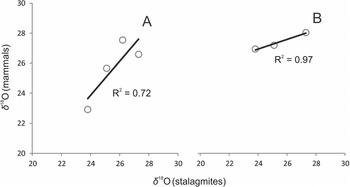
In fact, when we compare the distribution of δ18Omammals with the most complete oxygen isotopic variation recorded in stalagmites (δ18Ostalagmites) from two Brazilian caves—Lapa sem Fim, Minas Gerais State (Strikis et al., Reference Stríkis, Cruz, Barreto, Naughton, Vuille, Cheng and Voelker2018), and Botuvera, Santa Catarina State (Cruz et al., Reference Cruz, Burns, Karmann, Sharp, Vuille, Cardoso, Ferrari, Silva Dias and Viana2005; Fig. 5B and C, Table 3)—during the same period, a clear similarity is noted (Lapa sem Fim cave, R 2 = 0.72, p = 0.14; Botuvera cave, R 2 = 0.97, p = 0.10; Fig. 6), although the number of samples do not allow the comparison to be statistically significant.
Correlation between oxygen isotopic values recorded in mammals (δ18Omammals) and the oxygen isotopic values recorded in stalagmites (δ18Ostalagmites) in Lapa sem Fim cave (Luizlândia, Minas Gerais, Brazil; A) and Botuvera cave (Botuvera, Santa Catarina, Brazil; B).

Dated mean oxygen isotopic values (δ18OVSMOW) recorded in mammalian taxa fossils from Ourolândia, BA, and in stalagmites from two Brazilian caves.

The δ18Omammals from Ourolândia, BA, has good correlation with the isotopic data from Lapa sem Fim cave (Luizlândia, MG) and Botuvera cave (Botuvera, SC), even though these localities were influenced by two different climatic conditions, the first by the Intertropical Convergence Zone (Strikis et al., Reference Stríkis, Cruz, Barreto, Naughton, Vuille, Cheng and Voelker2018) and the second by the South American Summer Monsoon and South Atlantic Convergence Zone (Cruz et al., Reference Cruz, Burns, Karmann, Sharp, Vuille, Cardoso, Ferrari, Silva Dias and Viana2005).
CONCLUSIONS
Eremotherium laurillardi was the largest giant ground sloth in the late Pleistocene of the Brazilian Intertropical Region. Its diet has been investigated over the last decade, allowing us to know better its paleoecology, which the present paper amplifies through the investigation of the isotopic diet of one individual from ~40 cal ka BP, recorded in an inferior third molariform found in Toca dos Ossos cave (Ourolândia, BA).
The m3 was examined through 13.5 mm of crown height, and 1 year of its life was recorded in a length of 67 mm, a similar value found for an Eremotherium in Belize (70 mm). Almost 2 years were recorded in this sample, and its isotopic diet does not vary much (−18.3‰ to −12.4‰; μδ13C = −13.9 ± 1.8‰), being rich in C3 plants. The oxygen isotopic values of this individual show lower values (17.0‰ to 26.2‰; μδ18O = 22.5 ± 2.9‰), but are comparable with those of other taxa found in the same cave, which allows us to suggest that this region had more precipitation and lower temperatures than other localities in the BIR. During the late Pleistocene, the substantial precipitation occurred in the middle of the year, in contrast to the current pattern.
The oxygen isotopic values found in dated fossils of E. laurillardi, T. platensis, and N. platensis had good correlation with the oxygen isotopic values found in stalagmites from the Lapa sem Fim cave, thus adding to our understanding of the climatic variation that occurred in the region.
Acknowledgments
The authors thank the Coordenação de Aperfeiçoamento de Pessoal de Nível Superior (CAPES) for the master's scholarship granted to VSG (process no. 1843306/2019), the Conselho Nacional de Desenvolvimento Científico e Tecnológico (CNPq) for the MATD (PQ/CNPq 311003/2019-2) and HIAJR (PQ/CNPq 305576/2021-6) research grants, and the Fundação de Amparo à Pesquisa do Estado do Rio de Janeiro (FAPERJ) (grant E-26/203.176/2017). Thanks are also extended to the anonymous reviewers and editors whose criticism helped to improve the quality of the article.