Implications
Neonatal calves are highly susceptible to various diseases, both because of immature immune system and high stress sensitivity. High morbidity and mortality of neonatal calves due to microbial infection cause substantial economic loss to producer. Therefore, the administration of effective dietary immune enhancer or stress reducer as feed additive in calf starter may be considered. Hydrolyzed yeast contains cell wall components and extracts of cell constituents, which possess various functional molecules. Therefore, hydrolyzed yeast could be considered as effective immunemodulator for calves. These studies could be useful for the development of functional calf feed.
Introduction
Neonatal calves are highly susceptible to a variety of diseases, both because of the immaturity of their immune systems and because a variety of stresses can attenuate immune activity during the early phase of calf life (Hickey et al., Reference Hickey, Drennan and Earley2003; Godbout and Glaser, Reference Godbout and Glaser2006). Therefore, the administration of an effective dietary immune enhancer or stress reducer may be beneficial for early development of the immune system, strengthening of immune competence and prevention of immune attenuation caused by various stressors of neonatal calves. Although the efficacy of administration of yeast (Saccharomyces cerevisiae) culture on growth performance and production traits has been studied for mature ruminants (Seymour et al., Reference Seymour, Nocek and Siciliano-Jones1995; Kumar et al., Reference Kumar, Sareen and Singh1997; Lesmeister et al., Reference Lesmeister, Heinrichs and Gabler2004; Daniele et al., Reference Daniele, Jair, Daniele and Polyana2009), studies on the effects of yeast culture on growth performance and blood parameters in neonatal calves are not readily available in the literature. Hydrolyzed yeast (HY) contains cell wall components and extracts of cell constituents, which possess various biological functions. Yeast cell wall products such as mannoproteins and β-glucans may improve performance and overall health by preventing pathogenic bacteria from binding to intestinal epithelial cells or by modulating immune function (Spring et al., Reference Spring, Wenk, Dawson and Newman2000; Davis et al., Reference Davis, Maxwell, Erf, Brown and Wistuba2004; Wang et al., Reference Wang, Guo, Yuan and Zhang2008). In addition, HY contains a high amount of soluble, bioactive particles that modulate the immune system (Jensen et al., Reference Jensen, Patterson and Yoon2008). Young calves are typically challenged by a variety of microbial infections, but studies on the effects of yeast-based products on immune-related serum proteins in neonatal calves with microbial infections are not readily available in the literature.
Thus, the objective of this study was to evaluate the effects of yeast supplementation on growth performance, health and immune-physiological parameters in calves experimentally challenged with microbes. We used HY in our study and hypothesized HY in the calf diet of neonatal calves would improve immunocompetence against microbial infection through facilitation of immune-related serum protein production and modulation of leuckocytes composition.
Material and methods
Animals and diets
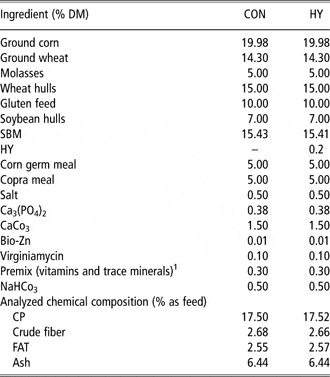
All experiments were carried out in the Dairy Science Division at the National Institute of Animal Science, South Korea. All experimental procedures were reviewed and approved by the Ethics Committee on the Use of Animals in Research of the National Livestock Research Institute, South Korea. Holstein calves (n = 12, BW = 36.23 ± 3.01 kg) were separated from their mothers within 2 h of birth, weighed and moved into indoor individual pens (1.5 × 2.5 m; bedded with wood shavings), where they were fed colostrum of similar nutritional quality (protein, 13.15 ± 0.34%; fat, 6.84 ± 0.21%; lactose, 2.87 ± 0.04%) in the amount of 10% of their body weight (BW) for the first 3 days. Percentages of total protein, fat and lactose in colostrum were measured by a Milkoscan 104 (Foss Electric, HillerØd, Denmark). The pens had solid iron rod sides with openings in the front and rear to allow calves free access to calf starter, chopped mixed grass hay (43% orchard grass, 43% tall fescue and 14% white clover on dry matter basis) and water from a bowl drinker in each pen. Calf starter and mixed grass hay were given from the 1st and 4th weeks of age, respectively. All calves were fed whole milk using 2-l calf bottle, using the step-down milking method (Khan et al., Reference Khan, Lee, Lee, Kim, Kim, Ki, Ha, Lee and Choi2007). The amount of milk provided was 20% of BW until 28 days of age, and then at between 29 and 30 days old, the amount of milk was gradually reduced to 10% of BW, which was maintained until the end of the experiment. The ingredients and chemical composition of the diets are presented in Table 1. Soybean meal (SBM) was replaced with HY. Both starter diets were formulated to contain identical nutrients except that the treatment diet contained 0.2% HY. Calves were fed calf starter supplemented with no HY (control) or 0.2% HY (Progut™, Suomen Rehu Co. Ltd, Esbo, Finland) from the 1st week after birth. Composition of Progut™ is 7% to 9% mannose, 10% to 12% betaglucan, 700 to 900 mg/kg free mono nucleotides.
Ingredients and nutrient composition (%) of CON and HY calf starters

CON = control; HY = hydrolyzed yeast; DM = dry matter; SBM = soybean meal.
1Premix supplied the following nutrients per kg mixed feed: vitamin A, 4400 IU; vitamin D, 733 IU; vitamin E, 11 IU; CuSO4·5H2O, 85.73 mg; zinc oxide, 55 mg; MnO2·H20, 55 mg; MgO, 1.86 g.
Feed intake
Intakes of starter, milk and forage were recorded from 2 to 5 weeks of age. Overall average BW gain, total dry matter intake (DMI; milk solids, calf starter and forage) and feed efficiency (kg of BW gain/kg of total DMI) were also calculated.
Fecal and health scoring
The scoring system used to monitor the overall health conditions of the calves was as follows: for respiratory scoring, the following scale was used: normal, 1; slight cough, 2; moderate cough, 3; moderate to severe cough, 4; severe and chronic cough, 5. Fecal scoring as determined by checking fecal fluidity, consistency and odor was conducted daily (0800 h) using the procedure of Larson et al. (Reference Larson, Owen, Albright, Appleman, Lamb and Muller1977). Fecal scoring was performed as follows: for fecal fluidity, normal, 1; soft, 2; runny, 3; watery, 4; for fecal consistency, normal, 1; foamy, 2; mucous-like, 3; sticky, 4; constipated, 5; for fecal odor, normal, 1; slightly offensive, 2; highly offensive, 3. When the fecal score exceeded 3 (average of fluidity, consistency and odor for two consecutive days) or when a calf exhibited other signs of disease (fever or cough), antibiotic therapy (sulfadimethoxine sodium, 55 mg/kg of BW daily; Green Cross Veterinary Products Co. Ltd, Yongin, South Korea) was initiated, and the therapy was continued until all visual signs of disease disappeared or for a maximum of 5 days. Scours were also treated with electrolyte therapy (Eltradd, 3 g/l in drinking water; Bayer Animal Health Co., Suwon, South Korea). Health score was determined as sum of the mean of respiratory score and mean fecal score was multiplied with days of antibiotic and electrolyte therapy.
Experimental infection and blood sampling
In order to investigate the immune response after microbial infection, all calves were challenged with 1-ml porcine Hog cholera and Erysipelothrix insidiossa live vaccine (Green Cross Veterinary Products Co. Ltd, Yongin, South Korea) by intramuscular injection at 3 weeks of age (0 days post-vaccine challenge (DPVC): days post-microbial infection). The challenge method was determined from a previous study (Kim et al., Reference Kim, Yun, Ko, Kang, Kim, Kang, Lee, Kim and Ha2009). Blood samples were collected from jugular veins at 19 (−2 DPVC), 26 (5 DPVC), 35 (14 DPVC) and 40 (19 DPVC) days of age. For the determination of lactoferrin and haptoglobin (Hp) concentrations, additional blood samples (10 ml) were collected into evacuated tubes coated with the anti-coagulant lithium-heparin (BD vacutainer, Plymouth, UK) at 22 (1 DPVC) and 24 (3 DPVC) days of age.
Hematology
Plasma was harvested from anti-coagulated blood after centrifugation at 1600 × g at 4°C for 15 min and stored at −80°C until subsequent assays were conducted. Neutrophil (NE), lymphocyte (LY), platelet, monocyte and leukocyte populations in whole blood were measured on an automatic analyzer (Hemavet 850. Drew Scientific, Portsmouth, RI, USA).
Enzyme-linked immunosorbent assay (ELISA)
Plasma Hp (Life Diagnostics, Inc. West Chester, PA, USA), lactoferrin and total serum immunoglobulin (both from Bethyl Laboratory, Montgomery, TX, USA) were measured using ELISA kits according to the manufacturer's instructions.
Levels of antigen-specific Ig in the serum samples were determined by indirect ELISA. H. cholera and E. insidiossa live vaccine dissolved in PBS (Gibco, Invitrogen, Cergy Potoise, France) (1 ml) was centrifuged at 13 000 × g for 1 min. The supernatant was harvested and transferred into new tubes for virus collection, and the pellet was dissolved in PBS (1 ml) for the isolation of bacteria. Bacteria were sonicated (Vibracell, Danbury, CT, USA) and centrifuged at 50 000 × g for 2 h at 4°C, and protein concentration in the supernatant was determined using a Bradford assay (Bradford, Reference Bradford1976). Each well of a microtiter plate was coated with bacterial antigen (10 μg/ml) or viral antigen (1 : 100 dilution). Antigen-specific IgG and IgA concentrations were measured using bovine IgG and IgA ELISA kits (Bethyl Laboratory) according to the manufacturer's recommendations. In brief, the wells of 96-well immunoplates (Nalgene Nunc International, Rochester, NY, USA) were coated with bacterial or viral antigens and incubated overnight at 4°C. The plates were then washed with washing buffer (0.05% Tween 20 in PBS) three times and blocked with blocking buffer (1% BSA in PBS) for 2 h. After washing, the plates were incubated with diluted bovine serum for 3 h at room temperature. Anti-bovine IgG (or IgA) HRP-conjugated antibody was added to the plates after washing, and the plates were incubated for 2 h. Specific binding was detected using streptavidin–HRP and TMB substrate (Sigma–Aldrich, St. Louis, MO, USA). The reaction was stopped with 2N H2SO4. The absorbance was measured at 450 nm using a microplate reader (Molecular Devices, Sunnyvale, CA, USA).
Quantification of CD4+ and CD8+ T cells
Peripheral blood mononuclear cells (PBMCs) were separated from buffy coat using Ficoll-Paque™ plus (GE Healthcare, Piscataway, NJ, USA) density gradient centrifuged at 1300 × g for 20 min at 18°C with no break. The PBMCs were washed twice with PBS and were used to analyze the composition of lymphocytes. A single-color flow cytometric analysis was used to determine the proportion of CD4+ and CD8+ lymphocytes. 5 × 10⁵ PBMCs suspended in 0.1 ml PBS were incubated for 20 min at 4°C with 1 μl of mAbs to CD4-APC or CD8-APC (peak emission of 660 nm with 633 nm excitation wavelengths). Then, the cells were washed three times with PBS, suspended in 0.2 ml PBS and examined for fluorescence using an FACScanto flow cytometer (BD Biosciences, San Jose, CA, USA). All data acquired was analyzed using FACSDiva™ software program (BD Biosciences).
Statistical analysis
Data from hematology and ELISA assay were analyzed using the Proc Mixed procedure (SAS Institute Inc., 2001). The model contained the effects of time, diet and the interaction of time × diet. When a significant effect of time or diet was found, differences among means were tested using the least significant difference procedure of SAS (1996). Data from growth performance, feed intake, efficiency, health monitoring and flow cytometry were analyzed separately at each time point. Data represents mean ± s.e. Effects were considered significant at P < 0.05.
Results
Growth performance, feed intake and health
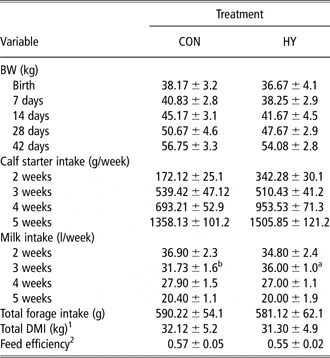
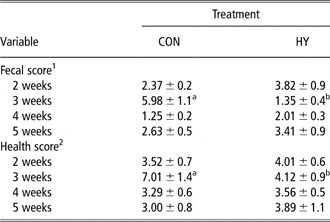
BW of calves fed two different calf starters was similar throughout the experiment (Table 2). Both feed intake and efficiency were also similar between groups, except that milk intake was lower in calves fed control (CON) calf starter compared to that of the HY group at 3 weeks of age (31.73 l v. 36.00 l; P < 0.05; Table 2). As shown in Table 3, calves fed HY calf starter had significantly lower (P < 0.05) fecal scores at 3 weeks than did the CON calves. Calves on HY starter also had lower (P < 0.05) health scores, due to lower respiratory scores, at the same time.
BW and intake of calf starter, milk, forage, total DMI and feed efficiency in calves fed CON or HY calf starter (mean ± s.e.)

DMI = dry matter intake; CON = control; HY = hydrolyzed yeast.
1Total DMI = milk solid, starter and forage DMI during the whole experimental period.
2Feed efficiency = kg of BW gain/kg of total DMI.
a,bMeans with different letters differ significantly between groups (P < 0.05).
Fecal and health scores in calves fed CON or HY calf starter (mean ± s.e.)

CON = control; HY = hydrolyzed yeast.
1Fecal score = sum of fecal consistency, fluidity and odor.
2Health score = sum of fecal score and respiratory score × mean of days of therapy.
a,bMeans with different letters differ significantly between groups in each week (P < 0.05).
Hematology
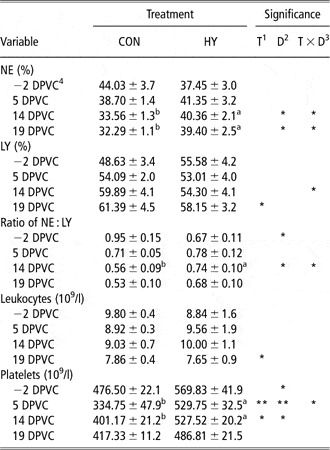
Dietary treatment influenced percentages of leukocytes and platelet level after vaccine challenge (Table 4). Calves fed control calf starter decreased (P < 0.05) NE (%) and increased LY (%) at 14 and 19 DPVC when compared to those at −2 DPVC. Calves in control group also decreased (P < 0.05) NE : LY at 5, 14 and 19 DPVC when compared to those at −2 DPVC due to higher LY and lower NE. However, similar tendency for the changes of leukocyte population was not observed in calves fed HY starter. Platelet concentration decreased (P < 0.05) only in the control group at 5 DPVC, and returning to the initial level thereafter. However, similar tendency was not observed in HY group. Concentration of leukocytes at 19 DPVC was lower in both groups compared to those at −2 DPVC.
Changes in leukocytes and platelet levels in calves fed CON or HY calf starter (mean ± s.e.)

CON = control; HY = hydrolyzed yeast; NE = neutrophil; LY = lymphocyte; DPVC = days post-vaccine challenge.
1T = time effect.
2D = dietary effect.
3Interaction between time and diet effect.
4DPVC 0 at 21 days of age.
a,bMeans with different letters differ significantly between CON and HY group (P < 0.05).
*P < 0.05, **P < 0.01.
Lactoferrin and Hp concentrations
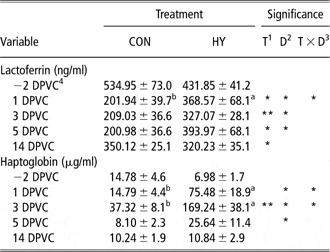
Vaccine challenge induced significant decrease of serum lactoferrin concentrations with a more drastic decrease in the CON group (Table 5). The lactoferrin levels of the CON group dropped (P < 0.05) from 534.95 ± 83.0 ng/ml before the vaccination (−2 DPVC) to 201.94 ± 39.7 ng/ml at 1 DPVC. There was a significant interaction of time and diet effect. A similar reduction was observed for HY calves.
Changes in lactoferrin and haptoglobin levels in serum obtained from calves fed CON or HY calf stater (mean ± s.e.)

CON = control; HY = hydrolyzed yeast; DPVC = days post-vaccine challenge.
1T = time effect.
2D = dietary effect.
3Interaction between time and diet effect.
4DPVC 0 at 21 days of age.
a,bMeans with different letters differ significantly between CON and HY group (P < 0.05).
*P < 0.05, **P < 0.01.
It was noting that the lactoferrin levels of CON group were significantly (P < 0.05) lower than HY group at 1, 3 and 5 DPVC. In the contrary, vaccine challenge induced crease of serum Hp concentrations. It was significantly (P < 0.01) elevated at 3 DPVC compared to those at −2 DPVC (Table 5). It is to note that there was a dietary effect on Hp production after vaccine challenge. At 1 and 3 DPVC, levels of Hp in calves fed HY calf starter were significantly (P < 0.05) higher than those of calves fed CON calf starter.
Total and antigen-specific immunoglobulin production
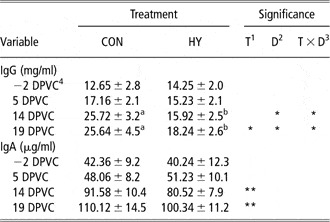
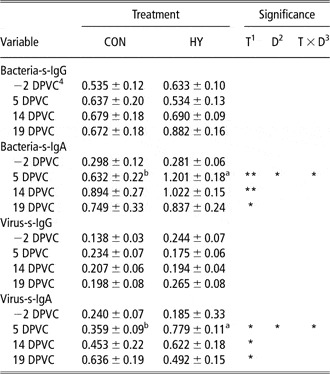
Vaccine challenge increased (P < 0.05) concentration of total serum IgG at 19 DPVC (Table 6). At 14 and 19 DPVC, total IgG level of CON group was significantly (P < 0.05) higher than HY group. The concentration of total serum IgA was increased in a time-dependent manner at 14 and 19 DPVC, level of total serum IgA significantly (P < 0.01) higher than those at −2 DPVC. However, dietary effect was not observed. The vaccine challenge did not influence the level of bacteria (E. insidiossa)-specific or virus (H. cholera)-specific IgG in either group. There was a difference (P < 0.05) in antigen-specific IgA between calves fed different starters at 5 DPVC (Table 7). Antigen-specific IgA concentrations increased after vaccine challenge, with a more noticeable increase in the HY group. Calves fed HY-supplemented calf starter showed drastic elevation at an earlier time compared to the CON group. It is to note that significant differences in bacteria- and virus-specific IgA concentrations between the groups were observed at 5 DPVC (0.632 ± 0.22 v. 1.201 ± 0.18 and 0.359 ± 0.09 v. 0.779 ± 0.11). Bacteria-specific IgA concentrations reached their highest levels at 5 DPVC and 14 DPVC in the HY and CON group, respectively. Virus-specific IgA concentrations reached their highest levels at 5 DPVC and 19 DPVC in the HY and CON group, respectively.
Changes in total serum antibodies in calves fed calf starter with or without HY (mean ± s.e.)

CON = control; HY = hydrolyzed yeast; DPVC = days post-vaccine challenge.
1T = time effect.
2D = dietary effect.
3Interaction between time and diet effect.
4DPVC 0 at 21 days of age.
a,bMeans with different letters differ significantly between groups (P < 0.05).
*P < 0.05, **P < 0.01.
Change in relative concentrations of bacteria-specific antibodies and virus-specific antibodies in serum obtained from calves fed CON or HY calf starter during the experimental period (mean ± s.e.)

CON = control; HY = hydrolyzed yeast; DPVC = days post-vaccine challenge.
1T = Time effect.
2D = Dietary effect.
3Interaction between time and diet effect.
4DPVC 0 at 21 days of age.
a,bMeans with different letters differ significantly between groups (P < 0.05).
*P < 0.05, **P < 0.01.
Change in T cells
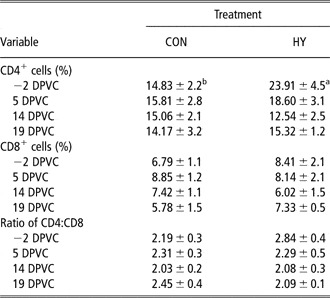
Calves fed HY calf starter had higher (P < 0.05) CD4+ T cell levels before vaccine challenge (−2 DPVC) than did those in the CON group. The percentage of CD4+ T cells in the HY group tended to be reduced until 14 DPVC, followed by a slight increase. However, vaccine challenge did not influence CD4+ T cell levels of calves in the control group (Table 8). Significant differences in the CD4+ and CD8+ cell populations between groups after vaccine challenge were not detected (Table 8). The CD4+/CD8+ ratio also did not differ between groups during the experimental period. The CD4+/CD8+ ratio in the HY group showed a reduction tendency until 14 DPVC.
Changes in the phenotypic composition of CD4+ and CD8+ cells in the serum from calves fed with CON or HY calf starter during the experimental period (mean ± s.e.)

CON = control; HY = hydrolyzed yeast; DPVC = days post-vaccine challenge.
a,bMeans with different letters differ significantly between groups (P < 0.05).
Discussion
Growing concern over the use of antibiotics and other growth promoters in the animal feed industry has resulted in global research efforts to find alternative microbial feed additives. Brewer's yeast or live yeast has been considered as possible candidates. Yeast has been typically included in calf diets at levels between 0.001% and 1.00%, with some positive effects on DMI, rumen pH and nutrient digestibility (Wagner et al., Reference Wagner, Quinonez and Bush1990; Quigley et al., Reference Quigley, Wallis, Dowlen and Heitmann1992; Callaway and Martin, Reference Callaway and Martin1997; Kumar et al., Reference Kumar, Sareen and Singh1997; Dann et al., Reference Dann, Drackley, McCoy, Hutjems and Garrett2000). Previous studies have explained the beneficial effects of yeast products as due to yeast cell components and fermented products such as organic acids, vitamins and nucleotides. However, inconsistent results due to the level and the source of the yeast culture product also have been reported (Williams et al., Reference Williams, Tait, Innes and Newbold1991; Lesmeister et al., Reference Lesmeister, Heinrichs and Gabler2004). In this study, inclusion of hydrolyzed yeast at 0.2% in calf starter did not have any influence on the growth performance of calves. This is probably because the amount of calf starter consumed by the calves during the early phase of growth was not enough to make an appreciable impact on growth. Therefore, growth of calves might depend more on intake of milk rather than that of calf starter. In addition, the supplementation level of 0.2% might not have been high enough to make a significant difference in growth performance. Moreover, calves fed control calf starter showed lower milk intake at 3 weeks. This lower intake of milk could be explained that calves fed control diet showed more diarrhea symptom at the same period. Components of the yeast cell wall, such as oligosaccharides, β-glucan and mannan or the many metabolites contained in yeast culture, might not only benefit local and systemic immune responses, but might also have antimicrobial activities against pathogens (Murphy et al., Reference Murphy, Davis, Brown, Carmichael, Ghaffar and Mayer2007; Jensen et al., Reference Jensen, Patterson and Yoon2008). Some studies reported that yeast cell wall components interact with immune systems, stimulating macrophage activation (Selijelid et al., Reference Selijelid, Rasmussen, Larm and Hoffman1987; Djeraba and Quere, Reference Djeraba and Quere2000). Previous studies also reported that supplementation with 2% yeast culture improved fecal scores, reduced days with watery feces and reduced risk of health disorders in Holstein calves, and also that incorporating live yeast into the grain feed reduced the number of days the calves were afflicted with diarrhea (Galvão et al., Reference Galvão, Santos, Coscioni, Villasenor, Sischo and Berge2005; Magalhães et al., Reference Magalhães, Susca, Lima, Branco, Yoon and Santos2008). Nevertheless, few studies on the efficacy of yeast or yeast products on health or immune activity in young calves are available (Seymour et al., Reference Seymour, Nocek and Siciliano-Jones1995). In this study, at 3 weeks of age, calves fed HY calf starter showed lower fecal scores and health scores than did those calves fed an HY-absent diet, indicating that HY had positive effects on the prevention of diarrhea as well as on the improvement of general health conditions. Although it is not apparent from our study how HY improved the health condition of calves, it can be postulated that some yeast cell wall components such as mannoproteins, β-glucan and oligosaccharides might have decreased the attachment and invasion of intestinal cells by pathogens because pathogenic bacteria might be directed to bind to cell wall components (White et al., Reference White, Newman, Cromwell and Lindemann2002). Attachment of a pathogen to the cell wall of S. cerevisiae and subsequent reduction in the attachment and invasion by the pathogen to intestinal cells has been proposed (Pérez-Sotelo et al., Reference Pérez-Sotelo, Talavera-Rojas, Monroy-Salazar, Lagunas-Bernabé, Cuarón-Ibargüengoytia, Jiménez and Vázquez-Chagoyán2005).
In this study, all calves were challenged with porcine live bacterial and viral vaccine by intramuscular injection at 3 weeks of age in order to evaluate the effect of HY supplementation on the systemic immune response against vaccine challenge. Vaccination induced increase of total serum IgA and antigen-specific IgA in both groups. However, vaccine challenge did not influence total or antigen-specific IgG. These results suggest that porcine attenuated live vaccine preferentially induced the IgA immune response. Our previous study showed that porcine attenuated live vaccine challenge induced effective B-cell immune responses in calves, however control animals did not show such response (Kim et al., Reference Kim, Yun, Ko, Kang, Kim, Kang, Lee, Kim and Ha2009). It is notable that bacterial- and viral-specific IgA levels in the calves fed with HY calf starter were significantly higher than those of the control group at 5 DPVC. These results suggest that calves on HY calf starter produced antigen-specific IgA more efficiently against vaccine contained microbes compared to those on control calf starter without HY. A direct explanation on these effects is not possible from data obtained in this study. However, it is possible that β-glucan, nucleotides or small peptides in HY contributed to the production of serum IgA. Many studies have reported the relationship between small-sized peptide ingestion and Ig concentration in blood. Wang et al. (Reference Wang, Yong-Ming and Jun-Long2003) demonstrated that adding 3 g of small peptides per kilogram BW to the basal diets of piglets increased the concentration of immunoglobulin, and Feng et al. (Reference Feng, Liu, Xu, Lu and Liu2007) showed that fermented SBM having small-sized peptides increased the level of IgA and IgM, but not IgG, in broiler chickens. In chickens, IgG concentrations were greater in animals receiving mannan-oligosaccharide (MOS) compared with those of control animals (Savage et al., Reference Savage, Cotter and Zakrzewska1996). In addition, it has been reported that yeast contains a variety of bioactive components, such as MOS, which might have positive effects on IgG concentrations and lymphocyte transformation (Savage et al., Reference Savage, Cotter and Zakrzewska1996; Davis et al., Reference Davis, Maxwell, Brown, de Rodas, Johnson, Kegley, Hellwig and Dvorak2002; White et al., Reference White, Newman, Cromwell and Lindemann2002).
Acute phase proteins (APPs) provide enhanced protection against microorganisms and modify inflammatory responses through cell trafficking and mediator release (Suffrendini et al., Reference Suffrendini, Fantuzzi, Badolato, Oppenheim and O'grady1999). Hp is considered to be a representative APP in cattle. Although there was large variation among individual calves, the average concentration of Hp increased significantly in both groups in response to vaccine challenge. It is to note that levels of Hp in HY group were significantly higher than those of CON group at 1 and 3 DPVC. Emmanuel et al. (Reference Emmanuel, Jafari, Beauchemin, Leedle and Ametaj2007) proposed a mode of action for probiotics in the elevation of APP. It is of note that the production of efficient Hp after vaccine challenge is thought to provide beneficial effects on immune responses against incoming pathogens through modulation of inflammatory activities.
Lactoferrin (Lf), an iron-binding glycoprotein, is known to exert bactericidal activity as well as immunoregulatory functions upon microbial challenge by modulating interleukin (IL)-1, IL-2 and tumor necrosis factor-α (Caccavo et al., Reference Caccavo, Pellegrino, Altamura, Rigon, Luigi, Amoroso and Jirillo2002). Although the effect of lactoferrin as an immune enhancer has been well studied, lactoferrin levels in the blood circulation and its relevance during vaccine challenge has not been assessed in cattle. In this study, a significant reduction of Lf levels in the control group and a non-significant reduction in the HY group were observed. Previous study suggested that reduction of Lf levels in blood circulation might be explained by Lf migrating into the local site of infection to participate in an immune response, resulting in the reduction of circulating Lf (Kim et al., Reference Kim, Yun, Ko, Kang, Kim, Kang, Lee, Kim and Ha2009). Further studies on the role of circulating Lf after vaccine challenge are necessary.
Many studies have reported that yeast or yeast products influence blood cell composition in weanling pigs or lipopolysaccharide-challenged piglets (Davis et al., Reference Davis, Maxwell, Erf, Brown and Wistuba2004; Shen et al., Reference Shen, Piao, Kim, Wang, Liu, Yoon and Zhen2009). Davis et al. (Reference Davis, Maxwell, Erf, Brown and Wistuba2004) found a tendency toward a lower level of neutrophils and a greater proportion of lymphocytes in blood of mannan-fed weanling pigs. In addition, Nonnecke et al. (Reference Nonnecke, Foote, Smith, Pesch and Van Amburgh2003) reported that total numbers of blood leukocytes and the composition of the mononuclear leukocyte population from neonatal calves were affected by level of energy and protein intake. To obtain more insight into the effects of yeast products on blood cell composition in an experimental infection model using neonatal calves, we conducted blood cell composition analysis. A previous study reported that cattle infected with Mycoplasma bovis showed systemic responses, including leukopenia, lymphopenia, neutropenia and thrombocytopenia, during the first few days of the infection, and it has also been reported that leukopenia occurs early in bacterial infections in ruminants (Kahn and Line, Reference Kahn2005; Kauf et al., Reference Kauf, Rosenbusch, Paape and Bannerman2007). In this study, different tendencies for changes in blood cell composition were observed between groups after vaccine challenge. Neutropenia, lymphophilia, thrombocytopenia and reduction of NE : LY were observed only in the control group, whereas these symptoms were absent in the HY group. This suggests that HY improved the prognosis after the vaccine challenge, as suggested by Kahn and Line (Reference Kahn2005).
Davis et al. (Reference Davis, Maxwell, Erf, Brown and Wistuba2004) reported a lower CD3+CD4+ : CD3+CD8+ T lymphocyte ratio in jejunal lamina propria tissue of mannan-fed pigs compared with pigs fed the basal diet. In our study, significant differences between groups after vaccine challenge were not observed except for a lower CD4+ T cell percentage in the CON group. Further studies on change of cytokines level and lymphocyte population after vaccine challenge are necessary in order to investigate the mechanism of the effects of yeast products on immune response against vaccine challenge.
Conclusion
Our data suggest that supplementation with HY at the 0.2% level in calf starter improved general health conditions during the neonatal period. Hydrolyzed yeast had positive hematological prognostic signs and promoted the production of immune-related serum proteins, particularly IgA and Hp after the vaccine challenge. This may be considered to be an indication of better immunocompetence against vaccine challenge. Further studies are necessary in order to identify the exact components of hydrolyzed yeast that have a positive effect on immune response in neonatal calves.
Acknowledgements
This work was supported by the Korea Science and Engineering Foundation (KOSEF) grant by the Korean government (MEST; R01-2008-000-10854-0) and the authors wish to express gratitude to Suomen Rehu Co. Ltd (Esbo, Finland) and Milltech Co. Inc., Korea for providing progut™.