Is there a relationship between entrepreneurial philanthropy and competitive advantage? At first sight, the answer to this question would seem to be no or at least negate typical definitions of pure philanthropy, which naturally eschew donor self-interest. Accordingly, the wider philanthropy literature has regarded competitive success and individual wealth accumulation as precursors to charitable activities.Footnote 1 The transition from entrepreneurship to philanthropy is thus a function of wealth and stage of life.Footnote 2 These philanthropic investment decisions may be consequentially designed to achieve wider objectives beyond the entrepreneur's normal business horizon, including returns on social and environmental investments.Footnote 3 Pure philanthropy implies voluntarism, a concept that has evolved from classical notions of individual charitable donations to nineteenth-century socially and institutionally embedded humanitarian responses to poverty, effectively financializing charitable activity and uniting the social status offered by philanthropy with the financial and moral virtues of judicious investments.Footnote 4 As part of this institutionalization, we argue, distinctively, that entrepreneurial philanthropy is inseparable from competitive processes in which entrepreneurs participate. Entrepreneurial philanthropy is thus defined as the creation of new social relations, in the form of opportunity and moral obligation, to meet an expressed need.Footnote 5 In this formulation, the creation of opportunity is commensurate with widely endorsed theories of entrepreneurship.Footnote 6 Implicit in such opportunities are corresponding obligations arising from the reordering of resources and claims upon them. Entrepreneurial philanthropy then, is motivated by an “interested disinterestedness.”Footnote 7 It is thus distinct from pure philanthropy, or altruism without ulterior motives. Consistently, business ethics accommodates the notion of doing well by doing good.Footnote 8 Entrepreneurs pursue and balance returns on economic and social capital, but in our formulation they are motivated systemically by the competitive process and by Hobbesian individual egoism.Footnote 9 Altruism might thus be linked to deferred self-interest; moral rewards associated with assuaging guilt, conferring legitimacy, or enhancing social status; and an attempt to impose moral values on proximate communities through gift giving or on heterogeneous and anonymous communities through coercion (legislation), when considered in the context of entrepreneurial philanthropy.Footnote 10
These assumptions allow us to consider the possible relationship between entrepreneurial philanthropy and competitive advantage and, specifically, the article's main empirical question: What were the determinants of differential entrepreneurial attitudes toward philanthropy? This is investigated below using the case of a highly competitive industry, early nineteenth-century cotton textiles, at a time when voluntary philanthropy had reached its pinnacle.Footnote 11
Our focus on the competitive process develops Karl Polanyi's notion of the “double movement” outlined in The Great Transformation, which characterizes tension in market economies as, on the one hand, a movement to disembed the economy from society and, on the other, a countermovement to promote resistance and regulation.Footnote 12 The double movement provides the basis for understanding not just the market society dynamic as a whole but also a spectrum of entrepreneurial approaches to philanthropy. The movement to expand the market economy, driven by the ideology of laissez-faire, characterized the behavior of the typical entrepreneur.Footnote 13 In one interpretation, historical variation reflected the organization of production and subsumption of labor.Footnote 14 We address this literature by considering strategies involving philanthropy that, in varying degrees, specified the direction of the countermovement and that also pushed for various forms of employee protection promoting a more stable competitive environment. The evidence below illuminates the dynamic tension between these opposing entrepreneurial approaches, as governed by the competitive process.
During the early decades of the nineteenth century, millowners were divided over employment practices, how they should be regulated, and the related question of trade-union recognition. Some, such as Robert Peel and Robert Owen, promoted regulation of working time and of female and child labor. Although child labor was in decline by the 1830s, campaigns to reduce the length of the workday intensified.Footnote 15 Pressure for new legislation came from public opinion, which was heavily influenced by the publication of the memoirs of Robert Blincoe, an abused factory child; the operatives, who were represented by the Short Time Committees; and Tory radicals such as Richard Oastler, who was suspicious of rapid industrialization.Footnote 16 In response, laissez-faire millowners argued that long hours were essential to profitable operation and, indeed, their mills’ survival in the face of threats from overseas competition.Footnote 17 The consequences were a series of parliamentary debates and commissions and a progressive tightening of regulation through successive Factory Acts.Footnote 18 Following the limited legalization of trade unions in 1825, the laissez-faire entrepreneurs demonstrated a similarly motivated opposition to trade-union recognition, although other entrepreneurs were more favorably disposed.Footnote 19 Alternative attitudes toward regulation and collective bargaining thus created a range of philanthropic options for entrepreneurs.
Using the example of factory regulation and employment relations to investigate the relationship between entrepreneurial philanthropy and competitive advantage in cotton textiles is useful for several reasons. First, entrepreneurial motives can be considered absent established regulatory structures. An important specific aspect of entrepreneurial philanthropy relates to employment conditions, including the application of ethical codes to vulnerable groups, such as women and children. In industries where exploitation is common, and unregulated, adoption of these codes is a matter of entrepreneurial discretion. Such circumstances prevailed in the early nineteenth century in the textile mills of the British Industrial Revolution.
A second reason for our early nineteenth-century focus is that social problems caused by rapid and unregulated urbanization created a range of entrepreneurial opportunities to adopt secular, business-related, philanthropic policies beyond the workplace.Footnote 20 These policies had a secular nature, distinct from the religious nature of charity.Footnote 21 Cases of specific forms of entrepreneurial philanthropy have been well documented, including the economic rationales for paternalistic employment policies.Footnote 22 Even so, there has been no systematic exploration hitherto of the relationship between the philanthropic activities of textile entrepreneurs and the competitive process. Such an exploration is useful because social historians recognize the proliferation of philanthropy juxtaposed against the rise of laissez-faire in the field of economics in this period. In the social-history literature, the initial spread and subsequent historical transformation of philanthropy was a function of changing moral values.Footnote 23 For us, by contrast, the moral behavior of entrepreneurs reflected transformations in the competitive process. The gap in the literature addressed by putting forward such an argument is important, in view of the substantial literature on nineteenth-century paternalism, utilitarianism, and utopian socialism and the associated prominence of individuals like Titus Salt, Jeremy Bentham, and Robert Owen.Footnote 24 The article builds on this research by considering specifically how the resource combination available to entrepreneurs, and hence the ability to compete, determined their ideological and ethical attitudes toward their employees and their working conditions.
Notwithstanding the prominence of industrial philanthropists, the literature on the nineteenth-century textile industry, in particular cotton textiles, has depicted a highly competitive atomized structure in which labor exploitation was the norm in the face of unrelenting international competition underpinned by laissez-faire ideology.Footnote 25 A third justification for our empirical focus is, therefore, that cotton exemplifies a highly competitive industry in which voluntary adoption of philanthropic employment practices would pose a significant financial risk if unrelated to rational business behavior.
A final justification is that by reevaluating these competitive processes and range of business strategies, we offer new insights into the history of cotton as a leading sector of the British Industrial Revolution. Literature to date has grouped supporters and opponents of factory regulation according to political and religious affiliation.Footnote 26 Charitable acts thus legitimated the social status of elites as governed by religious and social backgrounds, particularly where factory communities provided a model for the entrepreneur's social and moral vision, reinforced by preindustrial, aristocratic modes of paternalism that promoted protectionism, social responsibility, and government regulation as counters to the rise of laissez-faire.Footnote 27 Economic motives for philanthropy toward employees, in the form of paternalism, have been debated extensively. Patrick Joyce suggests that paternalism was more common in larger mills containing family groups, but Michael Huberman points out that coordinated agreements between groups of employers and their employees on short-time working during downturns supplanted these arrangements, thereby promoting a stable workforce, particularly in cities where employee turnover was higher compared with more isolated rural districts. For Harry Dutton and John King, paternalism was an expensive distraction for most employers, who found it difficult to guarantee employment in such a highly cyclical industry.Footnote 28 Another suggestion is that the geographical location of entrepreneurs’ factories determined their paternalism, as did their often-related choice between steam power and waterpower. In the latter case, the remote location of factories created pressure for employers to provide housing and, in some instances, shops and schools in the form of factory communities.Footnote 29 Whereas this literature addresses certain motives for philanthropic behavior manifesting as paternalism, further examination of firm-level determinants focusing on competitive behavior of individual entrepreneurs and their attitudes not just toward paternalism but also toward regulation and trade-union recognition offers a new and crosscutting perspective. In this sense, paternalism can be seen as a specific form of philanthropy, of entrepreneurial moral leadership emerging as a function of employer monopoly control. However, other forms of philanthropy are suitable courses of action where such control is less complete and competitive responses to labor-market conditions are required.Footnote 30
Building on these justifications, we return to our empirical question, introduced earlier, of what determines differential entrepreneurial attitudes toward philanthropy. Specifically, the article examines the material conditions of the competing businesses, reflecting how they recruited and retained labor, and the adoption of technical innovations, particularly in spinning and weaving processes, as motivators of differing styles of philanthropic behavior. Using archival and contemporary documents, the article investigates entrepreneurs’ motives for philanthropy with particular reference to their treatment of employees. The prime focus of the evidence is the period between c. 1815 and 1860, when conflicts between entrepreneurs intensified over issues of workers’ rights.Footnote 31 Case study selection is governed by two criteria: first, the prominence of individual entrepreneurs in the prior literature; and second, survival of evidential sources, including contemporary pamphlets, publications, parliamentary committees and debates, and business records. For present purposes, we contrast philanthropic engagement styles with one another and with laissez-faire, which acts as a base case characterized by the exploitative, nonphilanthropic “hard headed, hard-nosed Victorian employer, who regarded his workers as instruments of production.”Footnote 32 Grouping the remaining entrepreneurs’ contrasting approaches according to attitude toward regulation, the most hostile were the paternalists, who believed that their philanthropy rendered regulatory intervention unnecessary. For other entrepreneurs, the movement for the regulation of cotton textile mills complemented their attitudes toward philanthropy, which could be sustained only if other less scrupulous competitors were forced to adopt them through regulation. A final group also supported regulation but went beyond this, calling for the institutionalization of progressive employment practices. These groups coexisted between 1815 and 1860, with greater emphasis on paternalism in the earlier years and more on institutionalization in the latter, but for the most part represented strategic alternatives for entrepreneurs. Each group is discussed in turn in the following sections. A further section draws together the contrasts and commonalities in the form of a conceptual typology of entrepreneurial behavior in competitive industries, drawing out possibilities of application in other contexts. A final section concludes.
Paternalistic Antiregulation Philanthropists
The paternalistic variant of nineteenth-century philanthropy featured voluntary measures adopted by entrepreneurs, which they then used to justify opposition to factory regulation. Leading advocates included at first Sir George Philips of the firm Philips & Lee and, subsequently, in the early 1830s, Holland Hoole of the successor firm Lambert Hoole & Jackson, along with Robert Hyde Greg, the brothers Edmund and Henry Ashworth, and successive owners of the Ashton, Coats, and Horrockses Miller businesses.Footnote 33
All were prominent in the campaign against factory regulation but, at the same time, adopted philanthropic policies to benefit their otherwise unprotected workforce. At Philips & Lee, George A. Lee introduced one of the first contributory sickness funds, which successfully protected workers’ living standards in the depression of 1815–1816.Footnote 34 Accordingly, Philips noted that good employers, like his own firm, provided adequate security for their employees.Footnote 35 His successor, Holland Hoole, enforced contributions to the sickness fund and attendance at Sunday school.Footnote 36 He regarded such measures, and his scrupulous adherence to existing regulations, as sufficient reason thenceforward for a laissez-faire attitude from the government and organized a petition against M.P. Michael Sadler's proposed restriction on working time in the Ten Hours Bill of 1832, suggesting that philanthropic arguments in favor of reform were misplaced.Footnote 37 To counter the need for further regulation, other entrepreneurs offered appeals to the “good sense and humanity of the masters” and a system of self-policing existing regulations using mill wardens.Footnote 38
Although keen to highlight their own virtues, entrepreneurs were critical of philanthropic arguments for reducing working time. Schemes involving shorter hours were useless, these entrepreneurs argued, because “production is solely determined by the speed of the machine, so that reducing hours reduces wages in proportion.” The proprietor would, for the same reason, also suffer a diminution in profit.Footnote 39 “The greater the capital investment,” Hoole concluded, “the greater the pressure for its continuous employment.”Footnote 40 In the face of this dynamic, competing entrepreneurs reliant on older machines in smaller factories were compelled to work even longer hours.Footnote 41
Entrepreneurs adopted paternalistic strategies in response to labor shortages, problems attracting certain types of workers, and defections to other firms or industries. In some cases, this reflected geographical location, where waterpower dependence meant that mills were in remote rural locations. Firms more distant from Manchester (the center of the Lancashire cotton trade) were under greater pressure to suppress wages to meet higher distribution and market access costs.Footnote 42 The Greg mill at Styal and the Ashworth mill at New Eagley typified such establishments, where philanthropic investment to benefit employees was focused on houses and schools.Footnote 43 Such sunk investments, and associated risks, led Greg and Henry Ashworth to seek maximum financial return, in similar fashion to the laissez-faire factory owners.Footnote 44
In other cases, including larger towns, a single employer became dominant, making employee defection more difficult. These dominant employers (for example Horrockses Miller in Preston; Ashtons in Hyde; and Coats and Clark, the two dominant Paisley textile businesses) adopted laissez-faire attitudes toward regulation and paternalistic attitudes toward entrepreneurship.Footnote 45 Here, philanthropic investments were in public amenities such as parks and libraries. Examples included local institutions: the Mechanics Institute at Hyde, a technical college at Paisley, and employee sports facilities in both towns.Footnote 46 Like Holland Hoole, Greg, and the Ashworths, Thomas Ashton opposed regulation of working hours, citing the need to protect employment from the threat of foreign competition.Footnote 47 The Coats and Clark families also made substantial investments in employee welfare and public projects. They, too, opposed factory legislation and, like Philips, Greg, Ashton, and the Ashworths, emphasized good practice in their own mills. They opposed regulation of working time but recognized that some laws were necessary to constrain unscrupulous employers who mistreated their workers.Footnote 48 Like many other philanthropists, they also opposed trade unions.Footnote 49
Pro-Regulation “Common-Purpose” Philanthropists
The leaders of the campaign for factory reform, Lord Ashley, Oastler, Owen, and Sadler, were routinely described as philanthropists by contemporary media.Footnote 50 Examples of entrepreneurs supporting the campaign besides Owen included John Fielden of Todmorden, William Kenworthy of Blackburn, and other millowners across Lancashire.Footnote 51 Like the paternalists, pro-regulation philanthropist entrepreneurs also made investments in employee welfare. However, this group of entrepreneurs went further: their campaign for regulation of the whole factory system was linked to arguments about economic stability and supported by enterprise-level experiments on the productivity consequences of shorter hours.
Robert Owen demonstrated how entrepreneurial philanthropy encompassed features of paternalism but went beyond it by engaging with the wider competitive environment. Like the paternalists, Owen provided houses and schools at New Lanark. However, his wider objective was linked to the competitive advantages of regulation, founded on the principles of utilitarianism.Footnote 52 Minter Morgan, under the pseudonym of “Philanthropos,” reproduced Owen's views faithfully, noting his complaints of “unequal competition” as a consequence of mechanization and of overproduction.Footnote 53
Owen instigated high labor standards in his factories. He was “continually occupied in training the people,” and his twin objectives were “to improve the condition of the people, and advance at the same time the works and the machinery as a manufacturing establishment.” The “silent monitor,” a visible color-coding system applied to each worker and kept on record, was an important mechanism used to achieve efficiency improvements.Footnote 54 At New Lanark, Owen established the rule that after a 5 percent return on capital had been paid to the owners, all other profits should be applied to the “religious, educational and moral improvement of the workers and of the community at large.”Footnote 55 Owen's schemes featured “villages of unity” combining manufacture and agriculture, which would allow labor displaced by trade depressions to be employed in mechanized agricultural projects. Following deductions for rent and interest on capital, these villages could contribute any surplus to the “speedy abolition of the poor rate.”Footnote 56 Owen thus sought stabilization of profit, retention of workers, and the possibility of reducing working hours. Education, in the form of machine-management training, would thereby create “pleasant or light employment, rather than fatigue and labour.”Footnote 57 Owen's successes at New Lanark gave him a national profile and influence. Henry Houldsworth, a local Glasgow competitor, described Owen as “a dangerous man” who “by pretended philanthropy . . . has great influence.”Footnote 58 Owen believed that system-wide, national solutions were required, proposing remedies for unemployment and poverty and lobbying government to this end.Footnote 59 He also believed that successful experiments would encourage emulation. Owen attacked religious groups for their selective application of charity, which, he argued, was denied to those outside the faith group; he suggested, instead, a universal application. Houldsworth and other rival millowners were concerned by Owen's influence and attempted to undermine him through a contrived scandal.Footnote 60
Owen's experiments attracted substantial attention, and by 1830, prompted by similar arguments about its benefits, several millowners had joined the political movement for factory reform. Richard Arkwright and William Strutt's mills, supporters noted, typically worked shorter hours without impinging on the “advantage and satisfaction of their proprietors.”Footnote 61 Charles Swainson, a Preston master spinner, endeavored to persuade other employers to collectively reduce hours, but they resolved on longer hours instead, leading him to conclude that parliamentary intervention was required.Footnote 62 In 1833, an important meeting took place at the Manchester Exchange, with manufacturers and other opponents of the factory system and long hours taking part. Following the hasty passage of Althorp's Bill in 1833, which placed some restrictions on working hours for children, pro-regulation millowners made a further attempt at organization in the form of the National Regeneration Society, which supported further demands for shorter hours, instruction on productivity improvements, and practical cottage skills and literacy.Footnote 63
A distinctive feature of philanthropy favored by supporters of factory reform, and one that went beyond paternalism and promoted regulation, was an attempt to demonstrate through experiment that reducing working time produced wider benefits, potentially for all firms. Owen first reported the success of such experiments to Parliament in 1816. He stressed that reducing mill working hours by one hour a day, resulting in a workday of 10 3/4 hours, left prime cost unaltered, increased production cost by no more than one farthing per yard, and boosted school attendance.Footnote 64 Supporters of factory reform argued that such productivity gains followed from investments in fixed capital, such that shorter hours were associated with greater prosperity.Footnote 65 Further experiments confirmed these arguments, most notably at the establishments of Robert Gardner and Horrocks & Jackson.Footnote 66 Gardner noted the educational and social benefits of shorter time, which with satisfactory mill management, enabled workers to produce as much in ten hours as in twelve before. He noted that it was incumbent on other leading firms to do the same (referring to Horrocks & Jackson).Footnote 67 Gardner's experimental results were used as evidence by Ashley, who cited similar figures in Parliament in January 1846, along with evidence from other mills: Knowles (Bolton); Scottish weaving mill; and Bradford worsted mill.Footnote 68 In a speech on a Ten Hours Bill in 1844, Ashley drew on evidence from experiments that showed shorter time and further restrictions on child labor would have minimal effects on the prime cost of production.Footnote 69
Along with productivity, there were further economic arguments in favor of regulation, reflecting the competitive positions of the millowners involved. Fielden, who had made significant investment in power looms, believed that long hours led to overproduction and associated problems of “excessive and injurious competition.”Footnote 70 In common with many philanthropists, Manchester mill proprietor David Holt articulated abnegation of self-interest for the benefit of his employees, being the guardian of their “interests and comforts.” He cited fear of anarchy as a consequence of not responding in such fashion. Like Fielden, Holt's core economic argument was that districts had been ruined by rapacious masters working long hours and driving down wages, leading to “further diminution of prices and margins” and leaving millowners to fall prey to speculators and money dealers.Footnote 71 Holt was close to bankruptcy at the time of writing, and this threat may have motivated arguments about the overproduction problem.Footnote 72 Joseph Gillow, a cotton spinner of thirty years’ experience, argued for a four-day week to reduce the demand and hence the price of raw cotton—a measure that would also curtail those manufacturers undermining the industry by extending and overstocking their mills on borrowed capital.Footnote 73
Those who had made the heaviest investment in new technology were most vulnerable to these pressures. Joshua Milne of Oldham, giving evidence in 1833, was another entrepreneur who had invested in the new power looms. He continued to pay almost full wages, even though his mills were working short time, to prevent undernourishment and dissatisfaction generally.Footnote 74 Fielden operated in an area where there was surplus labor arising from the displacement of handloom weavers. Fielden hoped these workers could be absorbed into his new automated factories, without the threat of machine breaking. He criticized the Ashworths for not following a similar approach to the distressed handloom weavers.Footnote 75
As these debates intensified, so too did objections from laissez-faire entrepreneurs. A leading advocate, entrepreneur, and Member of Parliament (M.P.), John Bright, pointed out that Ashley had not mentioned the increase in speed of the mill and that breaks had been reduced to accommodate the general reduction in time.Footnote 76 In Preston, Horrockses Miller increasingly abandoned its earlier paternalistic style as more displaced agricultural labor became available and the business expanded. Horrockses and another leading Preston firm, Napier and Goodair, were now labeled cotton tyrants.Footnote 77 In rural locations especially, where entrepreneurs such as Greg and the Ashworths built their businesses, or in towns like Preston dominated by one large employer like Horrockses, employers were in a good position to retaliate against restrictions of output by employees, increasing rents and prices for housing and company shops.Footnote 78 Horrockses, like Gardner and others, also conducted a short-time working experiment. However, its timing, conduct, and results, which showed losses in production and productivity, aroused at least one journalist's suspicion.Footnote 79
Where entrepreneurs favored regulation, their philanthropy in support of employee welfare took on a different character from that of the paternalists. Typically, it included free banquets or seaside trips linked to productivity improvements announced after successful short-time experiments. Although pro-regulation philanthropists found common cause with the Ten Hours movement, they nonetheless opposed trade unions. They emphasized productivity, factory discipline, and collaboration, with Gardner and others using employee fines to these ends. Along with John Goodair, Gardner undermined trade-union organization by recruiting strikebreakers and interpreted unionization efforts as disloyalty and ingratitude toward his earlier paternalistic endeavors.Footnote 80 Fielden responded to reasonable demands from his workers but insisted on discipline, regarding unions as a threat to trade and the “mutual confidence between employer and employed.”Footnote 81
Institutionalized Philanthropy
Another group of philanthropists not only supported short-time working, as the pro-regulation philanthropists did, but also were prepared to go further and recognize trade unions. Indeed, these philanthropists favored a system of institutionalized collective bargaining involving standardization of prices and wage rates for different classes and qualities of productive inputs and outputs. Their strategy was a natural extension of the competitive process, allowing strategic opportunities arising from innovation to be exploited and threats to be minimized. Like the paternalists, they invested directly in employee welfare, although the nature and purpose of these investments had unique characteristics.
Before 1840, the institutionalization of collective bargaining faced significant barriers. The anti- and pro-regulation philanthropists, as we have seen, were divided on the question of restricting working time but united in their opposition to trade unions. Philanthropists opposed to regulation also demonstrated antipathy, ideologically at least, to the idea of collaboration between millowners. By contrast, the pro-regulation side, as opponents of the factory system, naturally favored such collaboration to force through legislation and to achieve potential agreements on restricting overproduction.Footnote 82
Differences in technology, however, contributed some practical obstacles to collaboration for all entrepreneurs. Writing in 1834, Edward Tufnell doubted the possibility of masters ever combining to pay wages on a uniform scale due to the possession of machinery of differing efficiency and the difficulties faced by firms with large fixed capital, and associated fixed costs, in joining organized lockouts or in holding out against strikes.Footnote 83 Tufnell also noted that strikes were usually conducted by those in receipt of the highest wages and occurred at times of brisk trade, so that they were better able to exploit the potential benefits to rival firms and increase pressure on employers to concede.Footnote 84 Firms introducing new machinery preferred to reach their own deals to share productivity gains. Among these, for example, was Sharples and Co. of Victoria Mills, Preston.Footnote 85 Masters of rival firms using older machines instigated workers to strike against firms using the new mules, arguing that the same rate per piece should be paid.Footnote 86
The destructive nature of these tactics created incentives for entrepreneurs to negotiate common wage lists at local and regional levels. Competitive dynamics arising from differential deployment of capital also created a potential unity of interest between high fixed-capital employers and unions. In some districts, proposals to put out price lists fixing higher wages received almost universal approbation (for example, at Burnley in 1826). Such alliances were potentially at the expense of smaller entrepreneurs using older machinery and relying on an unregulated market. In the Burnley case, only a small number of recusant employers was sufficient to undermine the proposed collaboration.Footnote 87
An example of an entrepreneur ready to engage with the trade unions was William Henry Hornby, cotton master and leader of the Blackburn Tories. William Kenworthy, his business partner, assisted him. They represented millowning entrepreneurs favoring regulated working time, including the Ten Hours proposals. Kenworthy also pointed out that strikes had the compensating effect of increasing prices obtained; in a similar vein, shorter hours restricted supply and maintained market prices.Footnote 88 In Blackburn, Kenworthy was a lone voice in the early 1840s, but by 1850 he observed that all large and influential spinners known to him now favored the 1847 Ten Hours Act and opposed new proposals to allow child relay shifts within its interpretation.Footnote 89
Support for unions followed logically from the collective action that, by the early 1850s, galvanized around support for regulated hours. Innovators like Kenworthy, who had consequently invested in new technology, naturally feared technological unemployment and machine breaking but also recognized that competitive advantage through investment in new capital equipment could be secured if wages were removed altogether from competition as an outcome of collective bargaining.Footnote 90 Such support for union organization was unilateral and went against rival Whig employers. In July 1853, Hornby & Co., Blackburn's largest employer, announced an experimental 5 percent advance in wages, offering a further 5 percent if other mills followed suit. The offer coincided with a large operatives’ meeting in support of a five-week-old strike in Stockport for a 10 percent advance.Footnote 91 Resistance to these demands centered on nearby Preston and, as noted above, was led by employers like Horrockses Miller and Gardner. By contrast, Hornby and Kenworthy's generous settlements undermined their rivals’ position and the employers’ association as a whole.
The Blackburn settlement that followed was a watershed moment in the history of industrial relations. The effect was to “take wages out of competition between the Masters.”Footnote 92 A level playing field was thus created in terms of labor cost, but advantaging more capital-intensive businesses. In Blackburn, other employers now conceded the 10 percent advance and subsequently adopted standard wage rates in the form of the Blackburn list.Footnote 93 These rates had common features with wage lists that emerged locally from the early nineteenth century.Footnote 94 However, there were also major differences. Variations were allowed according to product quality and manufacturing conditions, and the unions had responsibility for reporting noncompliant employers. In nearby Preston, attempts to resolve the bitter strike of 1853–1854 were frustrated by lack of data on wage differentials for comparable work in Blackburn.Footnote 95 After the strike's defeat in May 1854, the practice of using Blackburn-style lists spread to other districts.Footnote 96 Through this mechanism, Hornby's voluntary wage offer became the industry norm.
Hornby and Kenworthy matched their generosity in wage settlements with other philanthropic acts. The Blackburn Commercial Association had been established in 1847 involving Kenworthy and Hornby. Its objects included seeking new sources of cotton supply and “the welfare of the community at large.”Footnote 97 During the commercial crisis that year, rather than dismiss workers, Hornby & Co. adopted a three-day week for its 1,400 hands.Footnote 98 In 1853, Hornby and Kenworthy treated 1,500 people, mostly their Brookhouse Mill employees, to a seaside trip with spending money and a ball in the evening. Their philanthropic actions generated support from their operatives and throughout Blackburn, where there was a large demonstration of support for Hornby at a procession and banquet held in his honor. At this event, Hornby condemned his local Liberal rival, Montague Feilden, for his opposition to a new Combination Act. Hornby was presented with an engraved shield commemorating “his generous support of useful and charitable institutions” as a “faithful, and constant friend of the working classes.”Footnote 99 These philanthropic acts were in part motivated by Hornby's political ambitions. Dutton and King note that as a Conservative candidate for election in Blackburn, Hornby was in competition for operatives’ votes with Feilden, who was also a rival cotton manufacturer.Footnote 100
However, Hornby's business strategy had an equally important influence on his philanthropic actions. The advance of wages and the seaside trip both postdated the election of March 1853. During that campaign, Hornby dismissed potential charges of political opportunism. Addressing his operatives and then a public meeting, he pointed out his consistent backing for the short-time movement, even when other employers had opposed it or only paid it lip service for electioneering purposes. He stressed his support for the working classes, including during the recent (1847) commercial crisis. Such support was made possible by investment in the best machinery, which was “a boon to the working classes,” and for good reasons he was labeled the “poor man's friend.” In the same newspaper edition reporting these comments, an accompanying editorial emphasized that Hornby had used improvements originating at his Brookhouse mill to benefit the town, assisting the establishment of competing mills and providing fifty years of uninterrupted bounty.Footnote 101
In summary, Hornby and Kenworthy's philanthropy extended beyond the paternalists and even their pro-regulation allies in the Ten Hours movement. The Coats family's civic donations were for the express purpose of stabilizing industrial relations, facilitating their opposition to unions.Footnote 102 In contrast to pro-regulation but anti-union employers like Gardner and Fielden, Hornby's donations to his workers were part of a wider investment program based on innovation that, with the institutionalization of list-based bargaining, promoted industrial stability.
Philanthropic Entrepreneurship and the Competitive Process
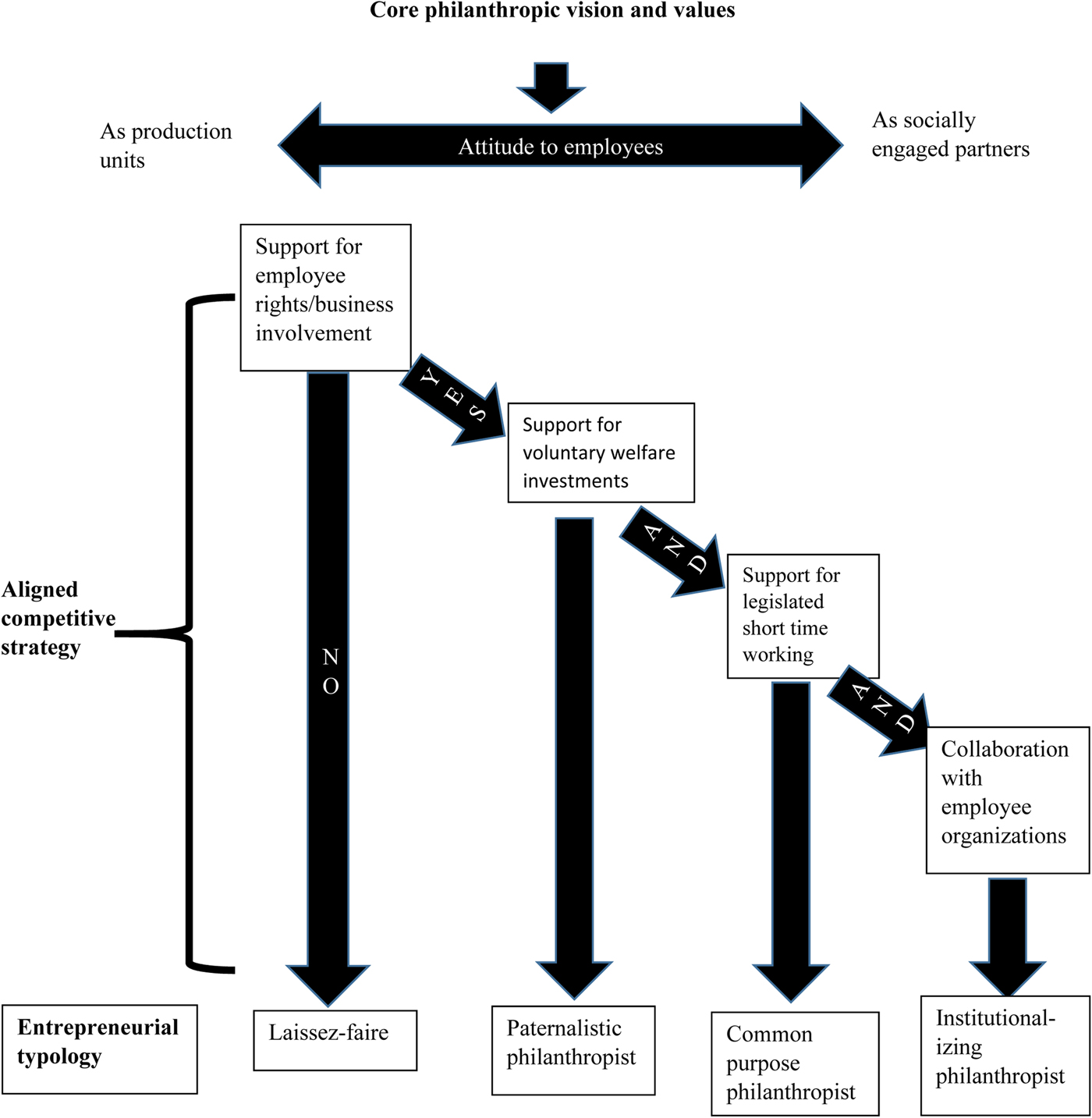
The contrasting styles of entrepreneurial philanthropy discussed in previous sections are summarized in Figure 1. Core philanthropic vision and values form a horizontal continuum, which results in possibilities ranging from the treatment of employees as dehumanized production units to fully engaged business partners. As the above cases have shown, the core vision is aligned so that a competitive strategy implying the degree of engagement can be articulated. Where the entrepreneur rejects employee rights or employees’ involvement as business stakeholders, there is pure laissez-faire, and entrepreneurs are implicated in the pull to disembed economic activity from social constraints. Alternative strategies recognize the socially embedded nature of business activity cumulatively, as the philanthropic core vision strengthens. By degree, this is manifested by support for voluntary welfare investments, support for regulation of employment, and collaboration with employee organizations.
A typology of entrepreneurial philanthropy. Source: Figure by authors.

The result is an entrepreneurial typology of four contrasting styles. First, the laissez-faire entrepreneur is based on ideological opposition to regulation underpinned by profit maximization and the avoidance of embedded social costs. The second type, the “paternalistic philanthropist,” recognizes the value of some social investment, which may also yield an economic return in the form of reduced labor turnover. The third type stresses collaboration with the workforce to achieve greater productivity and might be described, therefore, as a “common-purpose philanthropist.” Finally, at the highest level of engagement, the “institutionalizing philanthropist” collaborates with employee representatives to formalize relationships, often through collective-bargaining arrangements.
Examples of each type also occurred contemporaneously in other industries. In wool and worsted, entrepreneurs provided social infrastructure and in substantial minority supported calls for working time reductions. Elsewhere, notably in mining and engineering, wage lists were widely adopted.Footnote 103 Even so, a systematic and contextualized comparison of the kind developed in our article would require significant further research.
With similar caveats, our typology is potentially generalizable in other contexts. For example, the methods of the paternalist philanthropist have been reincarnated in the “Theory Z” and “Clan Corporation” and their focus on promoting employee loyalty through socialization and reducing transaction costs associated with monitoring.Footnote 104 These approaches show how paternalism's negative image in Western culture today derived from what are now perceived as unenlightened practices in textiles and other industries: company-town monopolies, authoritarianism, and exploitation can be moderated by the importation of cultural practices from Japan and elsewhere. Like the common-purpose philanthropists, innovating firms can pay higher wages by sharing the rents from the enhanced productivity.Footnote 105 In turn, these changes enhance labor productivity through employees’ perception of fairness. George Akerlof and Janet Yellen suggest that adjustments to employee wages and benefits reflect the prevalence of equity in social exchange.Footnote 106 If so, then entrepreneurs have a corresponding rational motive for adopting philanthropic policies in the workplace. Moreover, an entrepreneur with an efficiency advantage can force competitors into costly adoption of similar procedures by lobbying for laws restricting cheaper alternatives. Cases include firms with sunk investments in green technology advocating tighter environmental regulations for more polluting competitors or capital-intensive firms advocating better labor protection laws to undermine competing firms that are using sweatshop arrangements.Footnote 107 Like the common-purpose philanthropists, some of today's entrepreneurs regret the instability, inequality, and threat to social order posed by their more exploitative competitors.Footnote 108 Employer groups supporting regulation against modern slavery in clothing and food supply chains, confronting less scrupulous competitors, have made arguments for the fair treatment of workers similar to those of some of the cotton millowners discussed above. These arguments have promoted calls for regulation that reduces instability, promotes transparency, and creates a level competitive playing field.Footnote 109 By lobbying for and achieving high levels of regulation and institutionalization of employment practices, entrepreneurs are, at first sight, curtailing their own opportunities for entrepreneurship. However, as industries mature, entrepreneurial opportunity becomes embedded in networks of institutional norms in which organizations can nonetheless exploit differing resource endowments, positioning, and alignments.Footnote 110
The typology also allows us to modify traditional definitions of philanthropy and entrepreneurship and develop a new hybrid that explains business leaders’ behavior at the intersection of the two and supports our definition of philanthropic entrepreneurship as the creation of new social relations, in the form of opportunity and moral obligation, to meet an expressed need. These obligations have both a business dimension, to the providers of financial resources that facilitate the entrepreneurial activity, for example, and a moral dimension, to the providers of public goods such as educational and environmental resources, for example, that facilitate the entrepreneurial process.
The reformulated social relations that follow from these pairings of opportunity and obligation meet an expressed need, whether through innovation in the business dimension or through redistribution of the proceeds of innovation in the moral dimension. Our definition builds on common approaches in theories of entrepreneurship and of philanthropy but has the specific advantage of relating both to competitive business behavior. Business objectives and moral obligation are jointly theorized, and expressed need can be mitigated through combinations of wage payments and supplements to wage payments through forms of social provision, discounts to consumers and other stakeholders, and so forth. The moral character of the individual entrepreneur, guided by religious beliefs, also likely impacted the philanthropic outcome in terms of its specific focus; consider, for example, the importance attached to Sunday schools as opposed to civic institutions. Such considerations might offer a refinement of the model, perhaps as a focus of further research. Nonetheless, rooting our definition in the competitive process avoids the problem of philanthropy as a “slippery idea” featuring a diversity and confusion of actors but, as Figure 1 demonstrates, also allows philanthropy to be more firmly conceptualized by its deployment in common business decision-making contexts.Footnote 111
Conclusion
The article has examined philanthropic motives of cotton-factory owners during the British Industrial Revolution, focusing on the relationship between philanthropic behavior and firm-specific competitive advantage. The evidence reviewed above has considered three alternatives to laissez-faire entrepreneurship. In each case, entrepreneurs shift by degree from the economist's base case of treating employees as autonomous units of production, where economic activity is, in Polanyi's sense, disembedded from society. All other strategies involve employee engagement but do not necessarily abstract from the competitive process of profit maximization. Owen was a possible exception, using a 5 percent rate of return as necessary to maintain capital but with surplus beyond that used to maintain employment. In all the other cases, profit remained as much a motive for philanthropy as its consequence.
Paternalistic philanthropists like Greg, the Ashworth brothers, Ashton, and the Coats family provided their employees with welfare assets, but sunk costs associated with such investments motivated them to run their mills for longer hours, stretching the physical capabilities of their often very young operatives. Common-purpose philanthropists like Fielden and Gardner were innovators, but they also feared instability associated with displaced workers and flooded markets and aimed for steady profits while controlling associated risks. For similar reasons, they valued and cultivated the loyalty of their employees to avoid the disruption caused by high turnover rates. Institutionalizing philanthropists like Hornby and Kenworthy shared many of these aims but went even further, recognizing the value of trade unions in providing stability and making it difficult for less capital-intensive employers to undercut them using cheap labor.
All three alternative strategies to laissez-faire offered different approaches to reembedding economic activity within society. Factory-community facilities provided the context for social cohesion; regulated working time provided some limitation on the exploitation of labor, including children; the institutionalization of industrial relations created a system of agreed wage rates as a substitute for market competition for many textile firms. What is striking is that all three strategies were promoted by entrepreneurs in their different competitive behaviors. At a historical watershed, as the age of laissez-faire dawned, so too did voluntarily adopted measures to deal with its social consequences. This dual function of entrepreneurship to simultaneously disembed economic activity from its social constraints while reembedding them in new social institutions can be understood only if considered in relation to philanthropy as part of a competitive dynamic.