In the second half of the 17th century, Bartolomé Esteban Murillo painted “The Young Beggar”, “Boys Playing Dice”, and “Saint Diego of Alcala Feeding the Poor”. The first portrays one boy in front of a window delousing himself, the second depicts three boys also in ragged clothes playing dice on the floor, and the third is of a monk feeding a group of ten adults and four children. In the three paintings, the neediness of the characters is clearly conveyed and would likely elicit some degree of empathic concern among its viewers. There is, however, an important difference between them that can also be noted when observing contemporary representations of people in need. Namely, depictions of victims in newspapers, in magazines, on web pages, and the like can be categorized according to whether they present only one individual, a small number of individuals, or a large group in need. As these are actually the type of images used in the strategies designed by several NGOs aimed at increasing the aid received, analyzing the psychological factors that determine their efficacy comprises both theoretical and applied value.
From a theoretical point of view, these different kinds of presentations have different effects on feelings, motives and decisions related to prosocial action. First, a large body of research shows that eliciting empathic concern for a single individual in need may result in altruism; a motive that promotes action directed to increase this single individual’s welfare (Batson, Reference Batson1991; Reference Batson2011). However, when several individuals in need are presented, the range of effects expands and could be arranged into a continuum that goes from the individual pole to the collective pole. In the individual-pole, according to the identified victim effect (Kogut & Ritov, Reference Kogut and Ritov2005), presenting one victim identified by name and age elicits both a higher vicarious affective reaction and willingness to help, as compared with presenting a group of eight –either identified or unidentified– victims experiencing the same need. In the collective-pole, according to the numbing effect (e.g., Slovic, Reference Slovic2007), observers find it difficult to elaborate an emotional appraisal about entities that are not identifiable in any detail such as a group of victims; and according to the escaping effect (Cameron & Payne, Reference Cameron and Payne2011), observers anticipate an empathic over-stimulation when faced with a crowd of victims and consequently try to stay objective and detached. The identified victim, numbing, and escaping effects propose different mediating processes; however, they all coincide in stating that presenting one is usually more effective than presenting many when the goal is to spark feelings that motivate helping Footnote 1 .
Nevertheless, a recent line of research proposes another possibility that differs from presenting only one or presenting many victims. Specifically, Oceja and collaborators propose that presenting an individual in need (focal victim) along with a reduced number of other needy individuals may increase (a) the awareness that there are other separate individuals who are also in need (Ambrona, Oceja, López-Pérez, & Carrera, Reference Ambrona, Oceja, López-Pérez and Carrera2016; Oceja & Jiménez, Reference Oceja and Jiménez2007), (b) the empathic concern felt towards these other separate individuals (Ambrona et al., Reference Ambrona, Oceja, López-Pérez and Carrera2016), (c) and the motive to help these other individuals (Oceja, Ambrona, López-Pérez, Salgado, & Villegas, Reference Oceja, Ambrona, López-Pérez, Salgado and Villegas2010; Oceja et al., Reference Oceja, Heerdink, Stocks, Ambrona, López-Pérez and Salgado2014). Though the “one-among-others effect” label has been used to refer to these consequences, this does not mean that all have to always take place. Indeed, in this work we focus on the effects of perceiving the victims as separate individuals and the preference to help them individually.
The research on the one-among-others effect advocates for a more nuanced view of the “other victims”, suggesting that they can sometimes be perceived as different individuals (e.g., Athos, Porthos, & Aramis) rather than as a unitary group (e.g., The Three Musketeers). Indeed, decades ago Campbell (Reference Campbell1958) argued that “among actual or potential aggregates of persons, there are certain aggregates which meet criteria of being entities, and other aggregates which do not” (p. 15). However, this other -others-group distinction has been typically overlooked by research on prosocial behavior which, instead, has focused either on the individual victim or on the group of victims. Consequently, the difference between the action of helping several people individually and the action to help them collectively has been overlooked as well. For instance, the inhabitants of a village who have suffered an earthquake could be assisted by providing each family with the resources that they currently need most (running water, medicines, electrical power, etc.), or by building a common well in the center of the square, or by giving them the same amount of money per family member; namely, a relatively more individualized, collective, and equal aid.
Perceiving individuals in need: The perceptual scope
There are basically two sources that determine if an aggregate of people is perceived as either a set of separate and different individuals or as a unitary group: the stimulus and the beholder’s eye. Regarding the characteristics of the stimulus, research on entitativity suggests that a set of individuals will be perceived as a single group when they are presented with sharp boundaries, internal homogeneity, clear internal structure, common goals, or common fate (e.g., Hamilton & Sherman, Reference Hamilton and Sherman1996; Lickel et al., Reference Lickel, Hamilton, Wieczorkowska, Lewis, Sherman and Uhles2010; Rutchick, Hamilton, & Sack, Reference Rutchick, Hamilton and Sack2008) –for a focus on the influence of entititativity on prosocial behavior see Bartels and Burnett (Reference Bartels and Burnett2011) and Smith, Faro, and Burson (Reference Smith, Faro and Burson2013). Indeed, the one-among-others presentation –depicting a victim alongside a reduced number of other needy individuals– refers to a specific characteristic of the stimulus. In other words, the poor of “Saint Diego of Alcala Feeding the Poor” will probably be perceived as a group, whereas the boys of “Boys Playing Dice” may be perceived as three separate individuals.
Regarding the beholder’s eye, the “Boys Playing Dice” can be perceived as either three different and separate boys or, alternatively, as a group of three children depending on the perceptual scope kept by the spectator. Specifically, as Förster (Reference Förster2012) pointed out, there is the fundamental distinction between perceiving an event by focusing on its details (i.e., elemental or local scope) or focusing on it as a whole (i.e., holistic or global scope). Navon’s (1977) classic experiments showed that it is possible to manipulate the perceptual scope and to measure its effect on perception. He presented participants with large letters (target) made up of small letters (local) and found that participants were generally able to identify a global target letter faster than a local letter, providing support for his global-dominance hypothesis. In this sense, Huntsinger, Isbell, and Clore (2014, p. 603) stated that “although people show an astounding ability to mentally zoom in and out, focusing on the forest or on the trees, in the default case a focus on the forest takes precedence”. Despite this global focus dominance, abundant research suggests that local scope can be elicited in observers and, consequently, lead them to focus on independent elements that form the larger structure (Förster, Liberman, & Kuschel, Reference Förster, Liberman and Kuschel2008).
How can perceptual scope influence prosocial decisions? Previous research suggests that, in comparison to global scope, local perceptual scope produces higher contrast in social judgments and a shorter social distance (Förster et al., Reference Förster, Liberman and Kuschel2008; Liberman & Förster, 2009). Nevertheless, so far the closest link was found by Woltin, Corneille, Yzerbyt, and Forster (Reference Woltin, Corneille, Yzerbyt and Förster2011), who proposed that local scope increases the general disposition to feel empathic concern, as measured by the Interpersonal Reactivity Index (IRI; Davis, Reference Davis1980). According to these authors, these results suggest that inducing local scope facilitates the observer’s perception of other people’s states.
Present Research
Research on the one-among-others effect suggests that inducing empathy towards one victim presented alongside other needy individuals increases awareness of those others and willingness to help them as individuals. Research on perceptual scope suggests that local scope leads to focus on independent elements of the larger structure. Based on these two lines of research, we reason that local perceptual scope would boost the one-among-others effect. That is, we hypothesize that sequentially inducing (a) a local perceptual scope and (b) empathic concern towards a victim presented alongside with other individuals in need will yield two effects. First, it will lead the observer to perceive the victim-and-others aggregate as a set of different individuals in need. Second, it will enhance the observer’s preference to help them individually, rather than as a group. Likewise, the global perceptual scope would lessen the one-among-others effect. That is, sequentially inducing a global perceptual scope and empathic concern towards the one-victim-among-others will lead to perceive the aggregate as a group and, consequently, enhance his or her preference to help them collectively, rather than as individuals.
Therefore, while acknowledging its value, our proposal clearly differs from Woltin et al. (Reference Woltin, Corneille, Yzerbyt and Förster2011)’s work. That is, we hypothesize that the combination of both perceptual scope and the induction of situational empathic concern for a concrete individual will influence how the observers perceive the presented victims (individuals vs. group), and how they prefer to help them (individually vs. collectively). Consequently, we are not analyzing the isolated influence of perceptual scope on the general orientation towards people in need. Furthermore, our hypotheses take into account the two-fold character of the influence of perceptual scope: local (vs. global) will boost (vs. lessen) the one-among-others effect.
In two studies, we tested our proposal by presenting participants with a stimulus that depicted a person in need alongside with other needy individuals (i.e., one-among-others presentation) and, afterwards, they were unexpectedly asked to report their perception of the victims and their preference to help them either individually or collectively. Regarding the (local vs. global) perceptual scope, we manipulated it before presenting the stimulus (Studies 1 and 2). Regarding the induction of the situational empathic concern, we either allowed it to occur naturally (Study 1) or manipulated it (Study 2). This procedure allows us to analyze how perceptual scope and empathic concern interrelate to influence (a) the perception of the victim-others aggregate and (b) the preferred kind of assistance. This analysis will shed light on why to present one individual among other individuals in need either increases or decreases the willingness to help.
STUDY 1
The aim in Study 1 was to test whether inducing a local perceptual scope before observing a victim presented as one-among-others provokes two effects: the perception of the victims as a number of different individuals, and the preference to offer individual assistance to each victim. In contrast, we predict that inducing global scope will cause participants to perceive the victims as a unitary group and prefer collective assistance based on a common need.
Method
Participants
Forty-eight students (26 Spaniards, 22 North Americans; 85% women, M age = 25.15, SD = 10.16) participated for course credit; half were randomly assigned to either a local or a global perceptual scope induction. We followed the Simmons, Nelson, and Simonsohn (Reference Simmons, Nelson and Simonsohn2011)’s rule of thumb of using at least 20 participants per cell for lab studies. In this study and the following, the participants completed the material in their native language.
Procedure
Participants were scheduled and run individually through a procedure that lasted approximately 10 minutes. Upon arrival at the laboratory, participants were randomly assigned to one of two conditions (local vs. global) and ushered to a private room where they learned they would participate in two unrelated studies. The local versus global perceptual scope was induced by using Navon’s letters-task (Navon, Reference Navon1977; for detailed description, see Förster, Reference Förster2012). Participants saw on a computer screen a series of images that presented one global letter (e.g., an “H”) formed with local letters (e.g., a set of “x’s”). In the global perceptual scope condition, participants were asked to write down on a sheet of paper the global letter. In the local perceptual scope condition, participants were, instead, asked to write down the local letters. Overall, participants completed 10 trials of Navon letters.
Upon completion, and as part of a different study, participants were given a booklet that contained three pages. The first page presented a brief description of a charity organization called Quality of Life. This organization is actually fictitious and was employed to avoid any potential positive or negative views participants may have held about existing organizations (Oceja, Stocks, & Lishner, Reference Oceja, Ambrona, López-Pérez, Salgado and Villegas2010). The Quality of Life booklet contained a picture of a girl (Guddi) surrounded by other children, and the following text:
The girl in the centre of the picture is Guddi, one of the girls who live under extreme poverty in Sierra Leone. She is 12 years old and is working because she is an orphan and there is no one who can take care of her. She lives in an isolated community without access to basic services such as water, health, and education. Despite the gravity of her situation, she has a strong desire to have a good life, and she would like to have the opportunity to study.
Perception of separate individuals
To assess the effect of the perceptual scope manipulation on the participants’ perceptions of the victims, the second page contained a simplified version of the scale developed and validated by Rutchick et al. (Reference Rutchick, Hamilton and Sack2008). Specifically, this version comprises three items referred to the extent to which the children depicted in the booklet were perceived as either a single unitary group, or as a number of diverse individuals (see Appendix). That is, this measure assessed the extent to which the children were perceived, either as a group or as individuals.
Helping preferences
On the third page of the booklet, participants read that the staff from Quality of Life was interested in knowing people’s opinion regarding different types of assistance. Specifically, if they preferred that the resources obtained by Quality of Life were allocated (a) individually, so each child can be attended depending on his/her necessities; (b) collectively, so a common necessity of the whole group can be solved; or (c) equally, assigning each child the same amount. Note that this measure does not refer to the participants’ preference of helping either Guddi or the other children, but to their preference regarding how all the children are helped.
Results and Discussion
Perception of separate individuals
We formed a perception-of-others scale by averaging the three items noted above (Cronbach’s α = .81). As predicted, a 2 (local vs. global scope) x 2 (Country: Spain vs. USA) ANOVA revealed that participants of the local perceptual scope condition perceived the children as separate individuals (M = 5.06, SD = 1.71) to a greater degree than did participants in the global perceptual scope condition (M = 3.40, SD = 1.61), F(1, 46) = 11.21, p = .002, η p 2 = .203 (95% CI = [0.05, 0.35]. According to the post-hoc effect size index f calculated by G*Power (Faul, Erdfelder, Lang, & Buchner, Reference Faul, Erdfelder, Lang and Buchner2007) this is a large effect (f = .50).
Due to the homogeneity of our samples (all were university students), we did not expect cultural differences; indeed, the country did not yield a main or an interaction effect, Fs < 0.01, η p 2 = .00.
Helping preferences
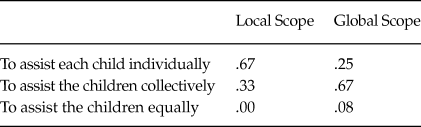
Table 1 presents the proportion of participants that chose each of the three options. Overall, participants typically chose either the individual or the collective option (only two picked the equal option). A Log-linear analysis revealed a main effect of scope (z = 2.08, p = .01). As expected, most participants in the local perceptual scope condition (.67) preferred the individual option, whereas most participants of the global perceptual scope condition preferred the collective option (.67), χ 2 (2, N = 48) = 9.21. The country did not yield a main (z = 1.36, p = .14), or an interaction effect (z = 0.48, p = .50).
Proportion of participants who chose each option in Study 1 (24 per condition)

Therefore, the local (vs. global) perceptual scope led participants to perceive the one-among-others depiction more as a set of separate individuals than as a unitary group, and to prefer assisting them as individually as possible. It is noteworthy that we opted to allow empathic concern to arise naturally and not to measure it. This option was based on two reasons. First, we expected that this Guddi-among-others presentation would provoke empathic concern; previous research supported this expectation: in a 7-point scale (1 = Not at all, 7 = Extremely), M = 4.68, SD = 0.75, N = 30 (Ambrona et al., Reference Ambrona, Oceja, López-Pérez and Carrera2016, Study 2). Second, we wanted to discard that the obtained effects could be due to the participants’ leaning towards showing consistency with their previous self-reported emotions about other individuals. On the other hand, it is important to note that Woltin et al. (Reference Woltin, Corneille, Yzerbyt and Förster2011) found that local scope increases the general disposition to feel empathic concern for people in need. It should be reminded that in this work empathic concern refers to a situational emotion elicited by a concrete individual who is always present (i.e., the focal victim). We do not expect that perceptual scope will affect such emotion because perceptual scope refers to how a structure of elements (not just one of them) is perceived. However, we are very interested in testing whether, when empathic concern is reduced, local perceptual scope would still increase an individualized perception of the one-among-others depiction and the preference for individualized assistance. We test this possibility in Study 2.
STUDY 2
Our main hypothesis in Study 2 is that separately inducing both a local perceptual scope and higher empathic concern for the victim will increase both the perception of the others as separate and different individuals and the preference to assist them individually. These two outcomes are referred as the one-among-others effect. In Study 1, we found that a manipulation of local perceptual scope (i.e., Navon’s letters-task) yielded these outcomes. However, a thorough test of our hypothesis involves manipulating both the perceptual scope and the feeling of empathic concern. Additionally, existing research on the effect of local scope on empathic concern has measured it as a disposition rather than as a situational feeling (Woltin et al., Reference Woltin, Corneille, Yzerbyt and Förster2011, p. 421). The goal of Study 2 is to test whether the combination of local perceptual scope and empathic perspective enhances both the perception of separate individuals and the preference to help them individually.
Method
Participants
Two hundred thirteen students (154 women, M age = 21.40, SD = 6.78) participated for course credit and were randomly assigned to one of the four conditions of a 2 (perceptual scope) × 2 (empathic perspective) between-subjects design (around 53 participants per each condition). One hundred six participants (75 women) were Spaniards, and 107 participants (79 women) were Americans.
Procedure
Participants were randomly assigned to read one of the four versions (global vs. local perceptual scope × low vs. high empathic perspective) of a booklet that contained six pages each. On the first page, they read that:
The study was being conducted in collaboration with a set of Charities that had recently asked us to assess the effectiveness of different kind of appeals. This study is an attempt to better understand how and why different types of appeals can be made more successful. We have received several types of advertisements, and we decided to randomly assign each participant to see one of those advertisements.
Manipulation of perceptual scope
The procedure for Study 2 involved two manipulations and since the Navon’s letter-task used in Study 1 would take about 10 minutes, we designed a new task in order to make the transition from the first manipulation to the subsequent one as smooth as possible. Specifically, the second page of the booklet contained the newly designed perceptual scope induction: a word-completion-task that included three series of four words each. In the global-scope version, participants read that “any object can be part of a bigger unit” and were asked “to figure out the bigger unit in which an object can be included.” Then, after reading an example they completed the three series, each one forming a sequence from the parts to the bigger object (e.g., Leaf → T _ _ e → Fo_ e_ t → M _ u_ ta _ n). In the local-scope version, participants read that “any object can be formed by smaller units” and were asked “to figure out the smaller units that form the larger object.” Participants were then presented with the same example and three series, but in a reverse order from the bigger units to its parts (e.g., Mountain → Fo_ e_ t → T _ _ e →L _ _f).
We conducted a pre-test study to check the effectiveness of this word-completion task to induce the perceptual scope. This study included three conditions: local, global and control (i.e., presenting the stimulus used in Study 2 without previously inducting a perceptual scope). Therefore, a total of 45 participants (M Age = 24.95, SD = 6.46) were randomly assigned to each of the three conditions in which they previously completed either the global scope version (4 men and 11 women), or the local scope version (3 and 12 respectively), or did not complete any version (2 and 13 respectively). They subsequently read the advertisement used in Study 2 and completed the 3-item perception-of-separate-individuals scale (α = .78; 1 = Totally as a group, 9 = Totally as separate individuals). Regarding the local vs. global comparison, as expected, participants in the local perceptual scope condition perceived the girls depicted in the advertisement more as separate individuals (M = 5.16, SD = 0.91), whereas participants in the global perceptual scope condition perceived them more as a group (M = 3.47, SD = 1.14), F(1, 28) = 19.87, p < .001, η p 2 = .415 (95% CI = [0.17, 0.57]). The post-hoc effect size index f revealed a large effect size (f = .82).
Regarding the participants of the control condition, in line with the global-dominance hypothesis, they perceived the girls more as a group (M = 3.91, SD = 1.56); that is, in a way that did not differ from the global condition, F(1, 28) = 0.79, p = .38, η p 2 = .027, (95% CI = [0.00, 0.17]) but it clearly did from the local condition, F(1, 28) = 7.09, p < .001, η p 2 = .202 (95% CI = [0.02, 0.39]); this post-hoc effect size was small-medium (f = .16). Therefore, the results of this study supported the effectiveness of the new task to manipulate the perceptual scope within this experimental context.
Manipulation of the empathic perspective
The third page of the booklet contained a similar picture to the one used in Study 1 and, at the top of the page, the perspective-taking instructions that have been used in previous research on empathic concern (e.g., Batson, Klein, Highberger, & Shaw,1995; Sibicky, Schoroeder, & Dovidio, Reference Sibicky, Schroeder and Dovidio1995). Specifically, participants in the high-empathic perspective were asked to read the booklet while trying to understand the thoughts and feelings of the people described therein; whereas participants in the low-empathic perspective were asked to read the booklet while trying to pay special attention to the technical aspects of the material, such as color, size, and format. We used a different and new one-among-others depiction: a picture of a girl (Alisha) surrounded by other girls, and the following text:
The girl in the center of the picture is Alisha, who lives in India. She is 16 years old and is working because she is an orphan. She lives without access to the basic services of water, health, and education. Despite the gravity of her situation, she has a strong desire to have a good life and she would like to have the opportunity to study.
Assessing empathic concern and perception of separate individuals
The fourth and fifth pages contained the empathic response questionnaire and the measure of the perception of separate individuals, respectively. The empathic response questionnaire (Batson, Fultz, & Schoenrade, Reference Batson, Fultz and Schoenrade1987; Batson, Reference Batson2011) listed 11 emotion adjectives. The list included six terms used in much prior research to assess situational empathic concern: softhearted, compassionate, tender, warm, moved, and sympathetic (Lishner, Batson, & Huss, Reference Lishner, Batson and Huss2011). The structural validity of this scale has recently supported by previous research (Stocks, López-Pérez, & Oceja, Reference Stocks, López-Pérez and Oceja2016, Study 1, Footnote 1). Instructions asked participants to “indicate the extent to which you experienced each of the following feelings while reading the ad” (from 1 = not at all, to 7 = extremely). The perception of the one-among-others depiction was assessed through the same 3-item scale described in Study 1.
Helping preferences
On the sixth page of the booklet, participants were presented with the same cover story and measure used in Study 1. Therefore, participants had to report whether they preferred that the resources obtained by Quality of Life were distributed individually, collectively, or equitably.
Results and Discussion
Once again, we took the advantage of having access to samples from two different universities –located in Spain and the United States – in order to increase the range of diversity among participants. Analyses with Country did not yield a main effect or interactions with the other independent variables, Fs < 0.60, ps > .551, η p 2 = .00. Consequently, we collapsed across Country for the analyses reported below.
Effect of the manipulations on reported empathic concern
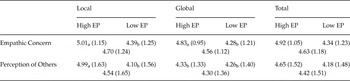
We created an index by averaging the six emotion adjectives included to asses empathic concern (Cronbach’s α = .84) and tested whether it was influenced by the perceptual scope, the empathic perspective, or both. A 2 (perceptual scope) x 2 (empathic perspective) ANOVA revealed a significant effect for empathic perspective, F(1, 209) = 13.89, p < .001, η p 2 = .062 (95% CI = [0.02, 0.12]), whereas the perceptual scope and the interaction were not statistically significant; Fs < 0.90. That is, the empathic perspective was effective: the high-empathic perspective led participants to report higher empathic concern within both the local and the global perceptual scope; Fs (1, 104) = 7.12 and 6.78, ps < .01, η p 2 = .064 and .061 (95% CIs = [0.09, 0.15], [0.08, 0.14], see Table 2). This result rules out the possibility that subsequent effects could be explained by a direct effect of the perceptual scope manipulation on empathic concern.
Means (and standard deviations) on the reported empathic concern and the perception of others indexes across 2 (Scope: local vs. global) x 2 (Empathic Perspective: high vs. low) of Study 2

EP = Empathic Perspective. For the first four means within each row, those with different subscript were significantly different, p < .05.
Combined effect of perceptual scope and empathic perspective
Our main hypothesis is that inducing both a local perceptual scope and higher empathic concern for the main victim will increase (a) perception of the children as separate individuals and (b) preference to assist them individually. We tested the effect on perception through the 3-item scale (Cronbach’s α = .68) used in Study 1. A 2 (perceptual scope) x 2 (empathic perspective) ANOVA revealed a significant effect of empathic perspective, F(1, 209) = 5.44, p = .02, η p 2 = .025 (95% CI = [0.02, 0.07]), and a significant interaction between both experimental manipulations, F(1, 209) = 4.09, p = .04, η p 2 = .019 (95% CI = [0.00, 0.06], see Table 2). Consistent with our hypothesis, participants in the local-scope and high-empathic-perspective condition perceived the children as separate individuals (M = 4.99) at a significantly higher level than the participants in each of the other three conditions, Fs (1, 104) > 5.25, ps < .03, η p 2 > .047 (95% CI = [0.03, 0.13].
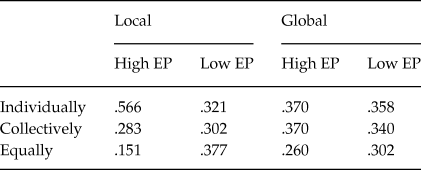
With respect to the preference to help the children individually, a Log-linear analysis revealed that the predicted 1(local-scope & high-empathic-perspective) versus 3 (the remaining conditions) pattern was significant; z = 2.74, p = .003. As it can be seen in Table 3, the highest number of participants who preferred the individual type of assistance was found in the local-scope & high-empathic-perspective condition (30 of 53–56.6%).
Proportion of participants who chose each option across 2 (Scope: local vs. global) x 2 (Empathic Perspective: high vs. low) of Study 2

EP = Empathic Perspective
General Discussion
Overall, the results of the present work show that the combined presence of local perceptual scope and empathic concern increases the perception of the victim-and-others aggregate as a set of different individuals in need, and enhances the observer’s preference to help the other victims individually, rather than as a group. It is important to notice that the predicted effect of scope was obtained in two different settings and with two different inductions. Indeed, taken together, the results of both studies also showed that either inducing a global perceptual scope or reducing the empathic concern decreases these two outcomes. Finally, the results did not suggest that the empathic perspective per se provokes a preference for an individualized type of assistance.
Imagine a situation where empathic concern towards a specific individual in one group is induced and, subsequently, the opportunity to help is unexpectedly given. According to previous research, this situation can lead to take one of two apparently opposite paths. One path would be to favor that individual at the expense of the group as a whole (Batson et al., Reference Batson, Klein, Highberger and Shaw1995; Reference Batson, Ahmad, Yin, Bedell, Johnson, Templin and Whiteside1999; Oceja, Reference Oceja2008,), whereas the other path would be to try to assist all the members of the group (Batson, Chang, Orr, & Rowland, Reference Batson, Chang, Orr and Rowland2002; Oswald, Reference Oswald1996). According to recent research (Oceja et al., Reference Oceja, Ambrona, López-Pérez, Salgado and Villegas2010; Reference Oceja, Heerdink, Stocks, Ambrona, López-Pérez and Salgado2014), the second path is paved by two factors: perceiving the group as a collection of separate individuals and looking for the way to assist them individually. In this vein, the present work is the first to analyze whether the combined influence of perceptual scope and empathic concern rises the presence of these two factors.
Furthermore, our findings may fruitfully connect with three lines of the current research on styles of perceptual processing. First, Förster and collaborators propose that familiarity and threat may be the main factors that increase local processing (for a review see Förster, Reference Förster2012). Second, Woltin et al. (Reference Woltin, Corneille, Yzerbyt and Förster2011) showed that the manipulation of such local processing (by presenting Navon’s letters, inducing prevention motivational state, and priming the concept of low power) enhances the disposition to feel empathic concern. Third, Nisbett and collaborators (Varnum, Grossman, Kitayama, & Nisbett, Reference Varnum, Grossmann, Kitayama and Nisbett2010; and for a review see Nisbett, Reference Nisbett2003) propose that scope can be influenced by cultureFootnote 2. Therefore, from the applied point of view, these three approaches can be combined with our current results in order to better anticipate the reaction provoked by the depiction of a multiple-victims situation. For example, the local scope might prevail if such situation is presented through a familiar stimulus, or to observers that are “analytical” because of either the cultural or the situational context (e.g., induction of a prevention state or a low power status). In those cases, according to our work, inducing a higher empathic concern for a victim presented as one-among-others, plus providing the opportunity to help all the victims in an individual fashion, would increase the actual aid. Future research should clarify whether this reasoning can be sustained and, therefore, useful for charity organizations.
We manipulated the local (global) scope by using two different perceptual tasks: Navon’s letters-task, used in previous research, and the new word-completion-task, tested in an additional study. Nevertheless, the relevance of our findings would be strengthened by convergent results obtained through manipulations at the motivational and social levels (Woltin et al., Reference Woltin, Corneille, Yzerbyt and Förster2011). Regarding the combined effect of perceptual scope and empathic concern, the design of the second study allowed us to clarify two important aspects. First, the presence of empathic concern is necessary to provoke the perception of separate individuals and the preference for individualized help; that is, local scope did not provoke these two outcomes when empathic concern was reduced. Second, previously inducing a global perceptual scope can block the effect provoked by eliciting empathic concern towards an individual presented as one-among-others. However, a thorough test of the relationship between perceptual scope and situational empathic concern awaits further research. Though our objective was not to test whether local scope may increase such feeling or vice versa, these two possibilities are still open.
It is worth noting that we manipulated the empathic concern through the perspective taking. Though Batson and colleagues have consistently proved that this manipulation effectively provokes this emotion (for a review see Batson, Reference Batson2011), a future direction of research could address the possible influence of the cognitive component of perspective taking on both, perception of others and helping preferences.
Another limitation concerns the measure of the separate helping preferences. First, as we did not use a direct measure of actual behavior, the self-reported preference leaves the question open as to whether the perception towards the separate individuals caused by the concurrence of local scope and empathic perspective actually leads to assist the victims in an individualized way –this option being available. Although previous results suggest this is the case (Oceja et al., Reference Oceja, Heerdink, Stocks, Ambrona, López-Pérez and Salgado2014), future research is required. Second, the present work has taken one step further by both distinguishing different ways of helping (collectively, individually, or equally) and measuring the relative preference for them. Indeed, the results suggest that participants understood the difference and made choices coherent with our hypothesized effect. However, new procedures and measures should be used to facilitate a correct comprehension of the different options by, for instance, introducing actual cases.
Thirdly, we did not include a control condition in the manipulation of the perceptual scope in Studies 1 and 2. Therefore, what is the effect of perceptual scope on those who empathize with a victim presented as one-among-others? Both previous research (Navon, Reference Navon1977; Reference Navon1981; Woltin et al., Reference Woltin, Corneille, Yzerbyt and Förster2011) and the results of the pre-test study suggest that the local scope is probably decreasing the general tendency of perceiving a number of individuals as a group and, therefore, enhancing the one-among-others effect; however, future research should be conducted to clarify this issue.
Lastly, research on the one-among-others effect has been focused on relatively moderate multiple-victims situations (i.e., four or five). In this vein, two recent lines of research have paid attention to the effect of the presentation of a reduced number of victims. First, Hsee and Rotternstreich (2004) showed that affect-rich presentation (i.e., a photograph of a cute panda) leads people to be sensitive to the number of victims (i.e., one vs. four). Second, Västfjäll, Slovic, and Mayorga (Reference Västfjäll, Slovic and Mayorga2015) showed that positive emotions and assistance to victims one can help are reduced by knowing there are victims one cannot help (i.e., pseudoinefficacy effect). Therefore, it is worthwhile to investigate how the group size relates to the perceptual scope, the affective reaction, and the other-others-group perception.
Witnessing the suffering of others is a common experience. There is a large amount of evidence that suggests that getting people to experience feelings such as compassion, pity, and tenderness can be a sound strategy to promote helping behavior (Lishner et al., Reference Lishner, Batson and Huss2011). However, this strategy is not always sufficient, and further research is needed to elucidate what factors may make strategies to be not only well-meant but effective. In this sense, our results suggest that leading the observer to see the suffering people as a set of separate individuals –through the combination of local scope and empathic concern– and giving them the opportunity to provide individualized assistance may prove successful.