Introduction
People with psychosis are three to six times more likely to smoke than people without (de Leon & Diaz, Reference de Leon and Diaz2005). Nicotine may relieve stress as well as cognitive symptoms, and counteract the dopamine blockade of antipsychotic medication (Whitton, Green, Pizzagalli, Williams, & Brunette, Reference Whitton, Green, Pizzagalli, Williams and Brunette2018; Winterer, Reference Winterer2010). Smoking may also influence the onset of schizophrenia and other non-affective psychoses, possibly through its impact on neurotransmitter activity in the brain (Gurillo, Jauhar, Murray, & MacCabe, Reference Gurillo, Jauhar, Murray and MacCabe2015; Large & MacCabe, Reference Large and MacCabe2015). However, distinguishing nicotine's effects from cannabis, an established risk factor for schizophrenia (Arseneault, Cannon, Witton, & Murray, Reference Arseneault, Cannon, Witton and Murray2004; Gage, Hickman, & Zammit, Reference Gage, Hickman and Zammit2016; Murray, Bhavsar, Tripoli, & Howes, Reference Murray, Bhavsar, Tripoli and Howes2017), is difficult. We need to know whether smoking tobacco is related to the onset of schizophrenia rather than an associated behaviour once the disorder develops. One way to do this is to use primary care electronic health records in which smoking data, psychiatric diagnoses and a number of other clinical and social variables are recorded over the life course. These clinical data provide a unique resource to test the hypothesis that smoking initiation is associated with an increased risk of developing psychosis.
Research question and hypotheses
Primary research question
Is smoking, as recorded in primary care data, related to the onset of schizophrenia?
Hypotheses
(1) Smoking initiation is associated with an increased risk of developing non-affective psychosis, including schizophrenia.
(2) There is a dose–response relationship between smoking and the risk of schizophrenia
Methods
Data source
We used data from The Health Improvement Network (THIN) primary care database, which contains data on over 12 million patients (including 3.7 million active patients) from over 500 general practices across the UK (https://www.the-health-improvement-network.co.uk/#thin-research). There are currently 8732 general practices in the UK. This database contains real-time clinical data from GPs' electronic records which include symptoms, diagnosis and lifestyle behaviour such as smoking. The database is broadly representative of UK general practices in terms of patients' age and sex, practice size and geographical distribution. Furthermore, THIN practices contain a profile of patients that is representative of the UK population (Blak, Thompson, Dattani, & Bourke, Reference Blak, Thompson, Dattani and Bourke2011).
Recording of smoking in GP records
The UK's quality and outcomes framework (QOF) for primary medical care was introduced in 2004 and rewards practices for meeting agreed performance targets (Taggar, Coleman, Lewis, & Szatkowski, Reference Taggar, Coleman, Lewis and Szatkowski2012). Indicators for recording smoking status and providing advice to smokers have featured since QOF was introduced. Thus, smoking status is relatively well recorded in the UK electronic primary care records. In 2008–2009, smoking status was recorded for 84% of newly registered patients within 1 year of registration (Marston et al., Reference Marston, Carpenter, Walters, Morris, Nazareth, White and Petersen2014).
Cohort
This study included data from all general practices that had contributed data to THIN in accordance with agreed standards. Patients were thus only eligible for entry after the date on which their practice had met the predefined standards for acceptable computer use and acceptable mortality recording (Horsfall, Walters, & Petersen, Reference Horsfall, Walters and Petersen2013; Maguire, Blak, & Thompson, Reference Maguire, Blak and Thompson2009).
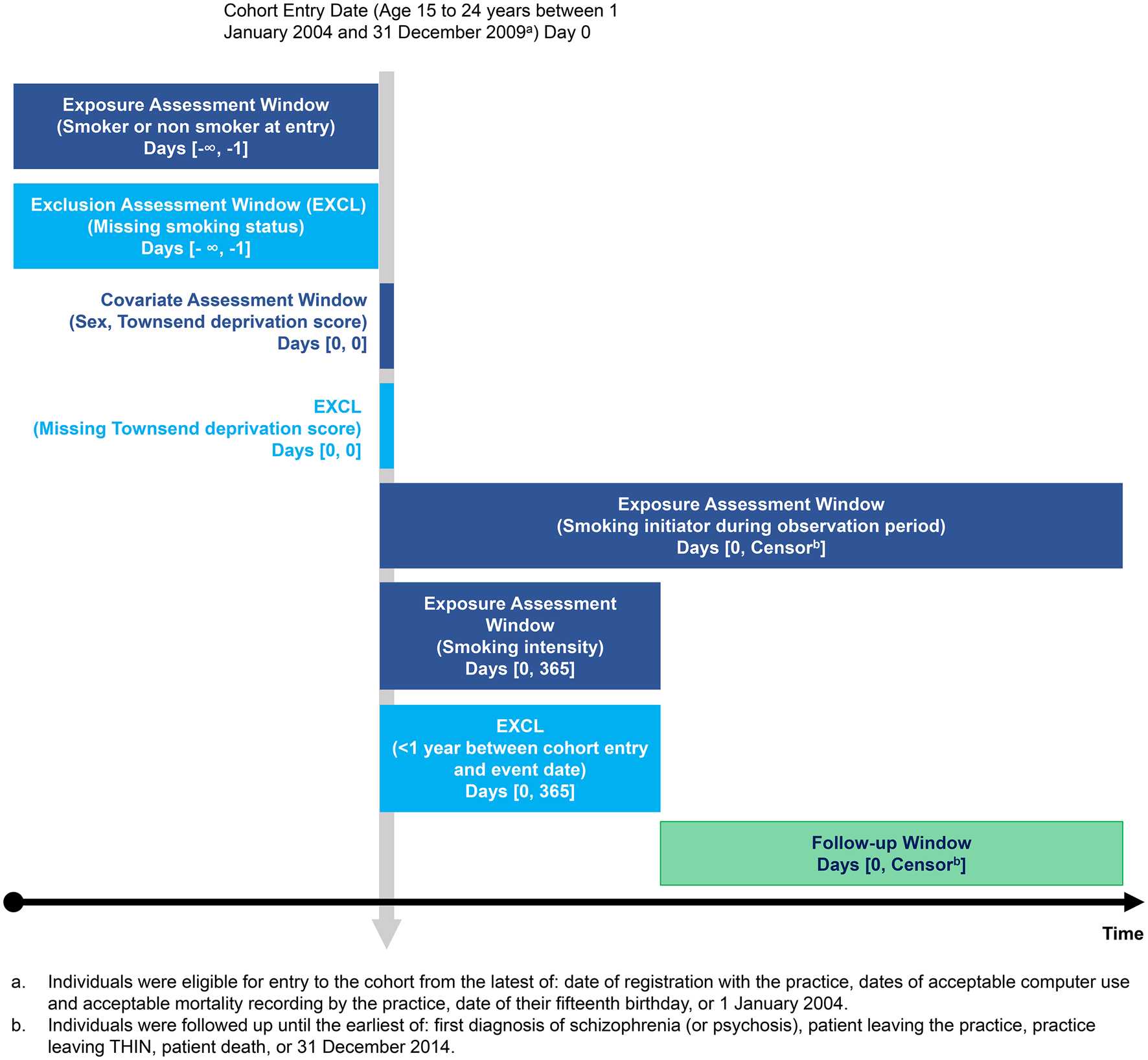
We identified all young people aged 15–24 between 1 January 2004 and 31 December 2009. Individuals were eligible for entry to the cohort from the latest of: date of registration with the practice, dates of acceptable computer use and acceptable mortality recording by the practice, date of their 15th birthday or 1 January 2004.
We followed up individuals until the earliest of: first diagnosis of schizophrenia (or psychosis), patient leaving the practice, practice leaving THIN, patient death or 31 December 2014. Patients were aged between 15 and 34 years on leaving the study (some were in the cohort for less than a year), enabling us to observe them for up to 10 years, depending upon the date they entered the cohort.
Read codes are a list of clinical terms that have been used by the UK's National Health Service since 1985. They provide a standard vocabulary for clinicians to record patient findings and procedures. Our main exposures were smoking status and smoking intensity, which were defined according to Read codes in medical and additional health data records using established methods to compile the code lists (Dave & Petersen, Reference Dave and Petersen2009). We are aware that individuals may have started smoking earlier, but smoking was defined as starting from the date of first record of smoking status. If someone had a record of smoking, they were defined as a smoker; if they had a record of being a non-smoker, they were defined as a non-smoker. People whose status changed from never smoker to smoker during the observation period were classed as smoking initiators. Those who had no record indicating that they were a smoker and no record indicating that they were a non-smoker were excluded from the analysis. Patients were also excluded if they had a record of being an ex-smoker before being a non-smoker or a first smoking record, as this indicated misclassification of smoking status. An indicator of smoking intensity (never, light, moderate, heavy) was used based on the highest recorded smoking intake during the first 12 months of the observation period.
Smoking intensity was classified by GPs as light (1–9 cigarettes per day), moderate (10–19 cigarettes per day), heavy (20–39 cigarettes per day) or very heavy (more than 40 cigarettes per day) when entering data into the system. Our primary outcome was schizophrenia and our secondary outcome was non-affective psychosis including schizophrenia. Clinicians may be reluctant to give a diagnosis of schizophrenia at first presentation and use a wider or less sensitive term. Thus, we also undertook a secondary analysis in which we included non-affective psychosis in addition to schizophrenia. The disorders were defined according to Read codes indicating a new diagnosis. The code list for a diagnosis of schizophrenia and non-affective psychosis was reviewed by two clinicians to ensure that affective and organic psychotic disorders were excluded. This list is available from the authors. Individuals who only had Read code records which were indicative of pre-existing schizophrenia or repeated episodes (such as chronic paranoid schizophrenia) were excluded. We likewise excluded individuals who had a record of a schizophrenia diagnosis or other non-affective psychotic disorder before their first smoking status record or up to 12 months afterwards. We chose 12 months as the entry of a diagnosis of SCZ often occurs after several months of dysfunction. This helped us protect against reverse causality, because we used smoking records from this period to define smoking intensity. For the main analyses, we therefore started the follow-up period at 12 months after entry to the study (see analysis below).
The association between smoking and schizophrenia may potentially be confounded by social deprivation and recreational drug use. The Townsend score has been used for decades in the UK as a measure of social deprivation (Dolan, Jarman, Bajekal, Davies, & Hart, Reference Dolan, Jarman, Bajekal, Davies and Hart1995). It is derived from variables such as car ownership, owner occupier housing and overcrowded housing. We defined social deprivation in quintiles of the Townsend score for an individual up to 12 months after entry to the cohort. We excluded any GP practices where Townsend scores were poorly recorded. We defined a binary indicator of history of recreational drug use on the basis of Read codes, and once again, we used all records up to 12 months after entry to the cohort in generating this variable.
The study design is illustrated in Fig. 1.
Study design.

Analysis
Binary indicator variables were created to identify patients who had ever had a diagnosis of (1) schizophrenia, or more broadly (2) non-affective psychosis (including schizophrenia). The earliest recorded date of either schizophrenia or psychotic disorder was taken as the event date for both schizophrenia and psychosis. Incident rates of schizophrenia and non-affective psychosis (including schizophrenia) were estimated as the number of new diagnoses per 100 000 person years at risk (PYAR) from 12 months after entry to the study until end of follow-up (defined as the earliest of: date of first diagnosis, date of death, date of patient leaving the practice, date of last data collection from practice or 31 December 2014).
We report unadjusted incidence rates by smoking status (non-smoker; smoking initiator; smoker) and by smoking intensity (non-, light, moderate and heavy smokers, smoking respectively 0, 1–9, 10–19 and 20 or more cigarettes per day).
Associations between smoking and incidence of schizophrenia and any non-affective psychosis were examined using multilevel Poisson regression models with (log) age as an offset. A random intercept of practice was specified to account for correlations between patients within practices. Results are reported as incident rate ratios (IRR). Similar models were used to examine the association between smoking intensity and incidence of schizophrenia and any non-affective psychotic disorder. In addition, we report IRR adjusted for quintiles of Townsend deprivation score.
Smoking intensity was defined using records up to 12 months after entry to the study. Individuals who were lost to follow-up or with a first diagnosis during this period were excluded from the analysis. We did not perform any formal tests for a dose–response effect, but rather inferred this relationship from the increasing magnitude of the estimates over the categories of increasing smoking and smoking intensity. A further analysis investigated the sensitivity of results to different methods of defining intensity by using smoking records up to 24 months after patient entry. This was conducted in order to obtain more and better information on smoking intensity.
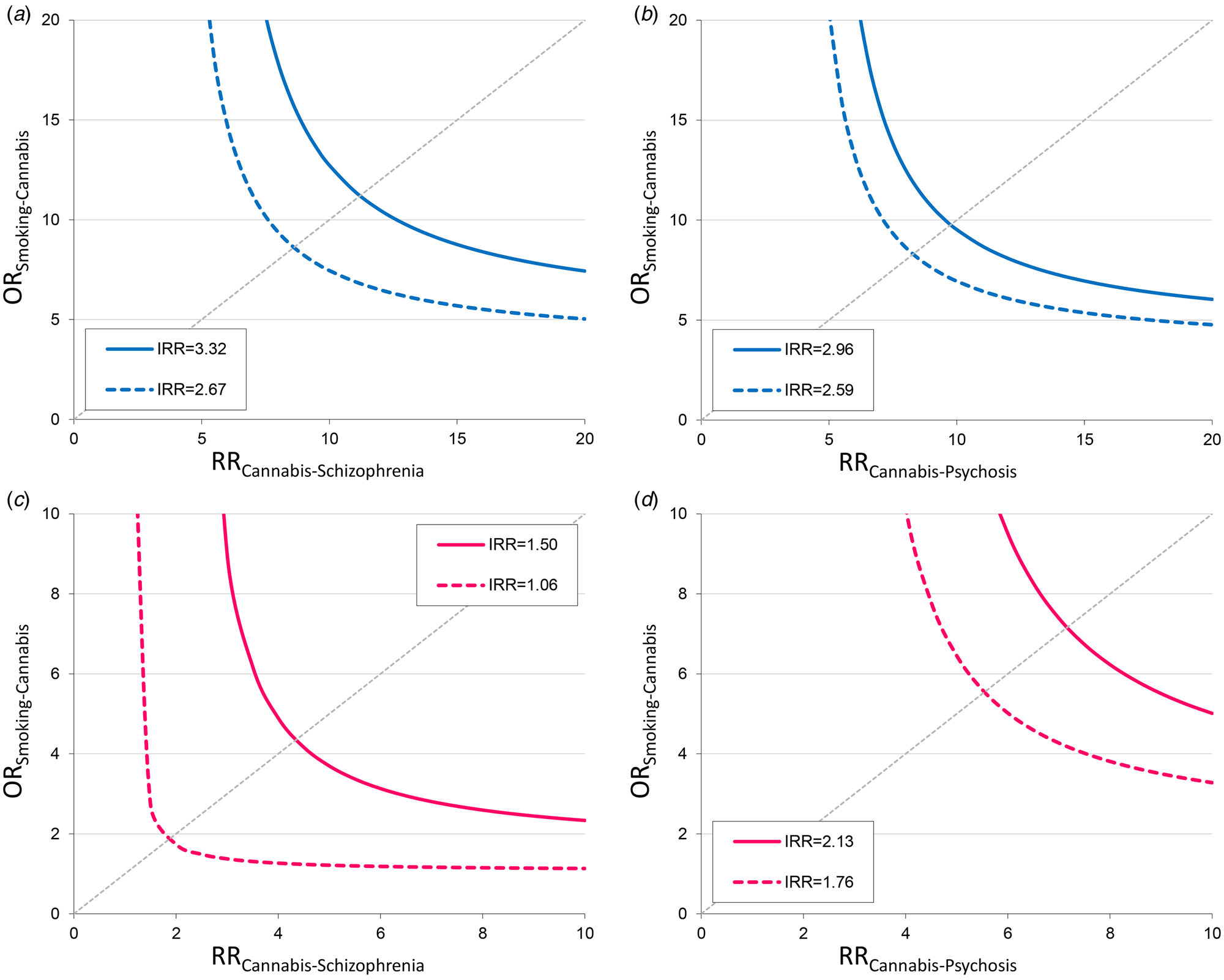
We explored the possibility that confounding by cannabis use could explain associations between smoking and schizophrenia using the rule out method described by Schneeweiss (Reference Schneeweiss2006) (Fig. 2). This is a graphical method that quantifies the strength of confounding (i.e. the association between smoking and cannabis use AND the association between cannabis use and schizophrenia) needed to rule out an observed association. The graphs were informed by data on the prevalence of smoking and the prevalence of cannabis as well as the IRR and 95% CI for the associations between smoking and schizophrenia. We did this using a combination of results from our study and figures reported in the literature. Thus, we estimated the prevalence of smoking from our own data of 31.1% for men and 27.8% for women, and an estimated prevalence of cannabis use of 20.4% for men and 12.8% for women from the 2016–2017 crime survey for England and Wales, which is representative of the UK population (Office, Reference Office2018). These figures were appropriate, as the THIN population is representative of the UK population. The resulting curves divide the graph area into two. The area to the right and above each curve represents when an apparent association could be explained by confounding, i.e. combinations of associations with cannabis use (the potential confounder) which would reduce the IRR or the lower bound of the 95% CI to 1. In contrast, the area to the left and below each curve represents the situations when an association between smoking and schizophrenia/psychosis cannot be ruled out by residual confounding. In Fig. 2, we produced separate graphs for men and women and for the incidence of schizophrenia and non-affective psychosis and interpreted them in conjunction with the associations with cannabis use reported in the literature.
Cannabis use as a potential confounder of the apparent association between smoking and: (a) schizophrenia in men; (b) psychosis in men; (c) schizophrenia in women; (d) psychosis in women.
Note: Solid lines represent the adjusted incident rate ratio (IRR) for the incidence of schizophrenia or psychosis, respectively, in smokers compared to non-smokers. Dashed lines represent the lower bound of the 95% confidence interval (CI) for the IRR. The areas of the graphs above and to the right of these curves indicate combinations of associations with cannabis use (the potential confounder) which would reduce the IRR or the lower bound of the 95% CI to 1, indicating that the confounding by cannabis use eliminates the association between smoking and schizophrenia or psychosis. Conversely, areas below and to the left of the curves indicate combinations which may result in partial confounding, but where cannabis use cannot fully explain the observed association.

The THIN scheme for obtaining and providing anonymous patient data to researchers was approved by the NHS South-East Multicentre Research Ethics Committee in 2002. Approval for this study was obtained from the Scientific Review Committee (protocol reference number 16THIN041).
Results
Identification of cohort
Initially, data on 1 056 176 patients were extracted. Smoking records from within the first 12 months after entry were used to establish smoking status and intensity. The observation period for the incidence of schizophrenia or non-affective psychotic disorder thus started 12 months after entry to the study. A total of 907 586 patients were retained in the analysis data set after excluding those who were lost to follow-up before the start of the observation period (n = 104 937), those with a first diagnosis earlier than 1 year after the date of first record of smoking (n = 392), those missing a Townsend deprivation score (n = 42 990) and patients whose smoking status could not be ascertained from Read codes (n = 271).
Description of cohort
Diagnosis
Of the 907 586 included in the analysis, 536 (0.06%) received a diagnosis of schizophrenia and 1582 (0.17%) received a diagnosis of non-affective psychotic disorder (including schizophrenia). Overall, 258 170 (28.5%) of the cohort were aged 15 years on entry to the study, 267 771 (29.5%) aged 16–20 years, 307 256 (33.9%) aged 21–25 years and 74 389 (8.2%) aged 26–30 years. There were slightly more women (52.6%) than men (47.4%). The mean age of first diagnosis with a non-affective psychotic disorder (including schizophrenia) was 24.0 years (s.d. 4.1) in males and 24.5 years (s.d. 4.5) in females. The median length of follow-up was 6.0 years (inter quartile range: 3.4–9.0 years).
Smoking
A total of 570 457 (62.9%) were classified as non-smokers throughout the whole observation period, 266 396 (29.4%) had started smoking prior to the observation period (smokers) and 70 733 (7.8%) started smoking during follow-up (smoking initiators). The mean age of first record of smoking was 21.1 years (s.d. 3.8) in males and 20.0 years (s.d. 3.6) in females.
Based on smoking records up to 12 months after entry to the study, 465 192 (51.3%) patients were classified as never smokers, 71 503 (7.9%) as light (⩽9 cigarettes per day), 86 473 (9.5%) as moderate (10–19 cigarettes per day) and 31 930 (3.5%) as heavy smokers (⩾20 cigarettes per day). It was not possible to determine the level of smoking for 252 488 young people (27.8%) and these individuals were therefore not included in the analyses of smoking intensity.
Using smoking records up to 24 months after entry to the study, 520 421 (57.32%) of the patients were classified as never smokers, 80 332 (8.85%) as light, 100 631 (11.09%) as moderate and 39 494 (4.35%) as heavy smokers. It was not possible to determine the level of smoking for 166 888 (18.39%) of patients.
Recreational drug use
In total, 33 512 (3.7%) individuals had a record indicating a history of recreational drug use. This is much lower than other estimates of recreational drug use made in other epidemiological studies suggesting that many individuals who had used recreational drugs did not have a record of this in their primary care data and we therefore decided not to adjust for this covariate in our analysis.
Incidence rates by smoking status and intensity
Incidence rates for schizophrenia
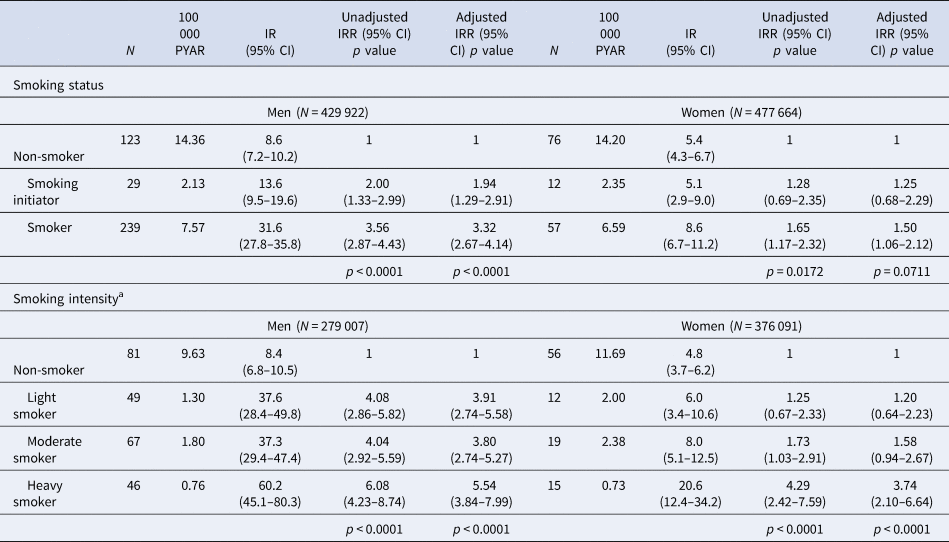
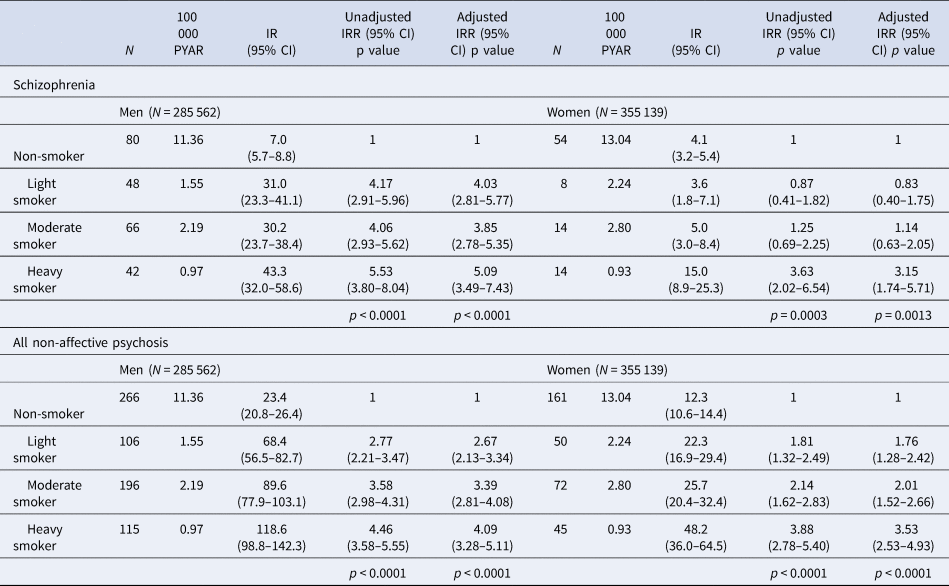
Among men, the incidence rates for schizophrenia per 100 000 PYAR were higher in smoking initiators than in non-smokers (adjusted IRR 1.94; 95% CI 1.29–2.91) and higher still in smokers (adjusted IRR 3.32; 95% CI 2.67–4.14). There was evidence of a dose–response effect for the amount of smoking, with an effect size of markedly greater magnitude in heavy smokers (adjusted IRR 5.54; 95% CI 3.84–7.99) than in moderate smokers (adjusted IRR 3.80; 95% CI 2.74–5.27). Adjustment for deprivation reduced the magnitude of the IRRs very slightly, suggesting only slight confounding (Table 1).
Incidence of schizophrenia by smoking status and intensity

N, number of incident cases; PYAR, person years at risk; IR, incident rate per 100 000 PYAR; IRR, incident rate ratio; CI, confidence interval.
Adjusted IRR control for Townsend deprivation score.
a Smoking intensity was defined using records up to 12 months after entry to the study. Light smoker: ⩽9 cigarettes per day; moderate smoker: 10–19 cigarettes per day; heavy smoker: ⩾20 cigarettes per day.
Among women, there was evidence of an elevated incidence rate of schizophrenia in smokers compared to non-smokers (adjusted IRR 1.50; 95% CI 1.06–2.12), but not in individuals who started smoking during the observation period. Similarly, only heavy smokers showed evidence of elevated rates of schizophrenia incidence compared to non-smokers (adjusted IRR 3.74; 95% CI 2.10–6.64). Again our adjustments had little impact on the result (Table 1).
Incidence rates for non-affective psychosis (including schizophrenia)
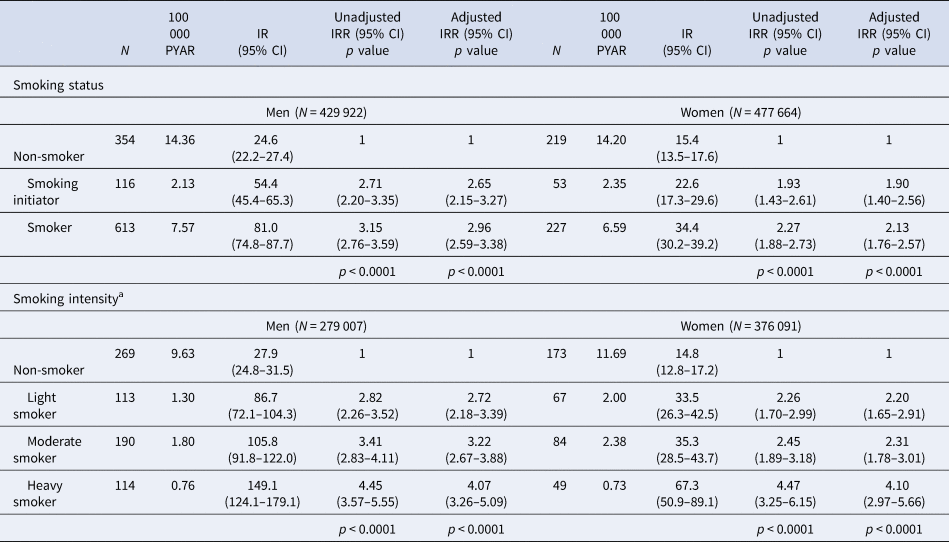
Among men, psychosis incidence rates were higher in smoking initiators than in non-smokers (adjusted IRR 2.65; 95% CI 2.15–3.27) and higher still in smokers (adjusted IRR 2.96; 95% CI 2.59–3.38). There was evidence of a dose–response effect for the amount of smoking, with effect sizes of increasing magnitude in light (adjusted IRR 2.72; 95% CI 2.18–3.39), moderate (adjusted IRR 3.22; 95% CI 2.67–3.88) and heavy smokers (adjusted IRR 4.07; 95% CI 3.26–5.09) relative to non-smokers (Table 2).
Incidence of all non-affective psychosis (including schizophrenia) by smoking status and intensity

N, number of incident cases; PYAR, person years at risk; IR, incident rate per 100 000 PYAR; IRR, incident rate ratio; CI, confidence interval.
Adjusted IRR control for Townsend deprivation score.
a Smoking intensity was defined using records up to 12 months after entry to the study. Light smoker: ⩽9 cigarettes per day; moderate smoker: 10–19 cigarettes per day; heavy smoker: ⩾20 cigarettes per day.
Among women, psychosis incidence rates were higher in smoking initiators than in non-smokers (adjusted IRR 1.90; 95% CI 1.40–2.56) and also in smokers (adjusted IRR 2.13; 95% CI 1.76–2.57). There was likewise evidence of a dose–response effect for the amount of smoking, with effect sizes of increasing magnitude in light (adjusted IRR 2.20; 95% CI 1.65–2.91), moderate (adjusted IRR 2.31; 95% CI 1.78–3.01) and heavy smokers (adjusted IRR 4.10; 95% CI 2.97–5.66) relative to non-smokers (Table 2).
Sensitivity analysis
The impact of smoking intensity was also examined based on smoking records up to 24 months after the start of the observation period (Table 3). This was to allow for a longer period of prodromal symptoms as might be expected before an entry of a diagnosis of schizophrenia or non-affective psychosis was made in the records. Higher smoking intensity in the 24 months before diagnosis is strongly linked in both sexes to an increased likelihood of either schizophrenia or the more inclusive category of non-affective psychosis.
Association between smoking intensity and incidence of schizophrenia or non-affective psychosis based on smoking records up to 24 months after entry to the study

N, number of incident cases; PYAR, person years at risk; IR, incident rate per 100 000 PYAR; IRR, incident rate ratio; CI, confidence interval.
Adjusted IRR control for Townsend deprivation score. Light smoker: ⩽9 cigarettes per day; moderate smoker: 10–19 cigarettes per day; heavy smoker: ⩾20 cigarettes per day.
Sensitivity analysis examining confounding by cannabis use
Based on the information available from our own data and an estimated prevalence of cannabis use in the population, we were able to quantify the likelihood of confounding by cannabis use. The graphs for men in Fig. 2 suggest that unmeasured confounding needs to be substantial to rule out the observed association between smoking and schizophrenia/psychosis. For example, this would be the case if male smokers were 15 times more likely to also use cannabis than non-smokers AND cannabis users were 10 times more likely to develop schizophrenia. Using evidence from the literature, the point represented by an OR of 3.90 for schizophrenia in cannabis users compared to non-users (Marconi, Di Forti, Lewis, Murray, & Vassos, Reference Marconi, Di Forti, Lewis, Murray and Vassos2016) and an OR of 4.13 for cannabis use in smokers compared to non-smokers (Fix et al., Reference Fix, Smith, O'Connor, Heckman, Willemsen, Cummings and Fong2019) falls below and to the left both of the curve for the IRR and the lower bound of its 95% CI. This suggests that cannabis use cannot fully explain the association we found between smoking and schizophrenia. The same is true for the relationship between smoking and psychosis in both men and women. For schizophrenia in women (Fig. 2), the point represented by these two ORs falls below the curve for the IRR, but above the curve for its 95% CI, indicating that the data are compatible with confounding by cannabis use.
Discussion
Findings
Our results show associations between cigarette smoking and the incidence of schizophrenia, as well as non-affective psychoses including schizophrenia, after adjustment for social deprivation. In men, the incidence of schizophrenia was nearly twice as high in smoking initiators as non-smokers, and three times higher in pre-existing smokers, with a dose–response effect of the amount of smoking. This pattern was similar, but less pronounced, in women with evidence for a higher incidence rate in smokers compared to non-smokers, but not for smoking initiators.
In men, the findings for non-affective psychosis (including schizophrenia) were similar to those for schizophrenia. However, for women, the pattern was more marked than in schizophrenia in that the association held for smoking initiators and smokers, and a dose–response relationship occurred across all three categories of a smoker. The greater magnitude of the association/dose–response effect in non-affective psychosis in women may have occurred because of the low numbers of women with a diagnosis of schizophrenia, resulting in lower power to detect an association in that comparison.
The gender differences observed may be an artefact of the generally later onset of schizophrenia in women and the cohort age group.
Our sensitivity analysis revealed that whether smoking intensity was defined using smoking records up to 12 or 24 months after the start of the observation period had little impact on the findings.
Our second sensitivity analysis using the rule out method suggests that it is unlikely that cannabis use can solely explain the association we found between smoking and schizophrenia in men, or between smoking and psychosis in either sex. It is possible that cannabis use could confound the association between smoking and schizophrenia in women; however, very few women were diagnosed with schizophrenia and this rather than a true association may explain this finding.
The context of other research
Our incidence rates for schizophrenia are comparable to the recent overall figure (also from the THIN database) of 9.2 per 100 000 PYAR for people aged 16–65 in the UK (Hardoon et al., Reference Hardoon, Hayes, Blackburn, Petersen, Walters, Nazareth and Osborn2013). Our findings echo the results of other recent studies in this area. In a recent meta-analysis of observational research, Gurillo et al. reported a relative risk of new psychotic disorders in daily smokers v. non-smokers of 2.18 (95% CI 1.23–3.85) (Gurillo et al., Reference Gurillo, Jauhar, Murray and MacCabe2015). Daily smokers developed psychotic illness at an earlier age than non-smokers (weighted mean difference −1.04 years, CI −1.82 to −0.26). There is also a suggestion that people with psychosis may start smoking at an earlier age than healthy controls (−0.44 years, CI −1.21 to 0.34). An association between early age of initiation of smoking and non-affective psychosis has also been reported in an Australian birth cohort study (McGrath et al., Reference McGrath, Alati, Clavarino, Williams, Bor, Najman and Scott2015). Similar (albeit small) associations have been found between the use of nicotine in smokeless form and the onset of schizophrenia (Munafò, Larsson Lönn, Sundquist, Sundquist, & Kendler, Reference Munafò, Larsson Lönn, Sundquist, Sundquist and Kendler2016). Although there are cultural differences in that prevalence of smoking in patients with schizophrenia in non-western countries is lower (at least in women) (Aguocha, Aguocha, Igwe, Uwakwe, & Onyeama, Reference Aguocha, Aguocha, Igwe, Uwakwe and Onyeama2015; Cao et al., Reference Cao, Li, Zhong, Chiu, Ungvari, Ng and Xiang2016; Li et al., Reference Li, Hou, Ma, Zang, Jia, Zhong and Xiang2016), a higher risk in psychotic people persists. In a review of Chinese data (Cao et al., Reference Cao, Li, Zhong, Chiu, Ungvari, Ng and Xiang2016), the prevalence of smoking in women with schizophrenia was 4.3% compared with a general population rate of 3.4%. Although not reported in the publication, this amounts to an odds ratio (OR) of 1.28 for smoking in women with schizophrenia.
Strengths and limitations
This observational study has several strengths in taking account of time from exposure to outcome, magnitude and direction of the association, biological gradient (intensity of smoking), consistency, and specificity. Most important of all our results are generalisable as the analysis was conducted in a very large sample that was representative of the UK population and was longitudinal in nature. Nevertheless, there are limited demographic variables in THIN for which adjustment is possible and we cannot rule out residual confounding. In particular, we cannot be certain whether smoking patterns disguised a potential effect from recreational drugs, especially cannabis (Fergusson, Hall, Boden, & Horwood, Reference Fergusson, Hall, Boden and Horwood2015). The prevalence of data on recreational drug use was considered too low to be plausible in this age group. The 2016–2017 crime survey for England and Wales found that 19% of young people aged 16–24 had taken a drug in the previous year (and the figure is even higher a decade earlier) (Broadfield, Reference Broadfield2017). Thus, primary care records have failed to identify 15% of the young people in our cohort, who have probably used an illegal drug.
We are conscious that we cannot rule out smoking initiation as a part of the prodrome of psychosis, given that prodromal symptoms (social isolation, academic difficulties, odd behaviours and symptoms of depression or anxiety) may precede the appearance of frank schizophrenia by an average of 23 months (Kafali, Bildik, Bora, Yuncu, & Erermis, Reference Kafali, Bildik, Bora, Yuncu and Erermis2019). Our stipulation of at least a year between entry to the cohort and onset of schizophrenia, however, may go some way towards excluding this possibility. Our mean age of ‘first smoking’ may be slightly higher than other estimates, although it depends on how this is defined. Recent estimates suggest the most common age of first trying a cigarette is 10–15 years (West, Reference West2017), while taking up of regular smoking usually continues up to the early 20s (Dierker et al., Reference Dierker, He, Kalaydjian, Swendsen, Degenhardt, Glantz and Merikangas2008). If participants with multiple smoking records had a record of being a smoker followed by a record of being a non-smoker or an ex-smoker, we inferred that they had given up smoking. However, individuals may have stopped smoking but lacked any record of having done so (i.e. becoming an ex- or non-smoker). Finally, smoking was not necessarily recorded during every appointment and, even if it had been, may not have captured every change in an individual's smoking history. Thus, a degree of misclassification of smoking status and intensity is likely in our dataset.
Genetic factors
There is a debate about possible genetic explanations for our observations. For example, it has been suggested that nicotine may overcome an observed dysregulation in schizophrenia in the expression of genes that encode the nicotinic acetylcholine receptor (nAchR) ‘a7’ (Kunii et al., Reference Kunii, Zhang, Xu, Hyde, McFadden, Shin and Lipska2015; Liu & Kenny, Reference Liu and Kenny2017). However, an unbalanced gene expression could precede the onset of psychotic symptoms, with nicotine abuse and dependence merely acting as indicators of future psychosis (Akbarian & Kundakovic, Reference Akbarian and Kundakovic2015). Another polymorphism (rs1051730) in the nAchR gene cluster CHRNA5-A3-B4 has been reported to be associated with schizophrenia and with smoking intensity, but not with smoking initiation or with depression. A further study conducted in Iceland also supports the notion of pleiotropy for the observed comorbidity of addiction (including nicotine) and psychosis (Reginsson et al., Reference Reginsson, Ingason, Euesden, Bjornsdottir, Olafsson, Sigurdsson and Stefansson2018). In another approach to the study of possible causal effects of smoking on schizophrenia, Gage et al. reported little evidence of a causal association between smoking initiation and schizophrenia in a study using Mendelian randomisation (Gage et al., Reference Gage, Jones, Taylor, Burgess, Zammit and Munafò2017). However, they could not exclude the possibility of a causal effect of heavier, lifetime exposure, rather than initiation, on the disorder. A more recent study that also used Mendelian randomisation in the UK Biobank data has indicated that the association between smoking and schizophrenia may be due in part to a causal effect of smoking (Wootton et al., Reference Wootton, Richmond, Stuijfzand, Lawn, Sallis, Taylor and Munafo2018).
Interpretation
The magnitude and strength of the association between smoking and incidence of schizophrenia support suggestions that smoking involves a risk through as yet unknown pathways, or that it is an addictive condition which shares genetic risk with schizophrenia and other non-psychotic psychoses (Reginsson et al., Reference Reginsson, Ingason, Euesden, Bjornsdottir, Olafsson, Sigurdsson and Stefansson2018).
Acknowledgements
MK and RJ acknowledge the support of the UCLH NIHR Biomedical Research Centre.
Financial support
No independent funding was obtained to undertake this study.
Conflict of interest
There are no conflicts of interest for any of the authors.