1 Introduction
Nowadays wireless technologies are widely used in education, changing the conventional education system into “anytime and anywhere education” (Cavus & Ibrahim, Reference Cavus and Ibrahim2009: 79). This unique characteristic of wireless technologies provides learners with the advantage of extending their learning outside the classroom (Kukulska-Hulme & Shield, Reference Kukulska-Hulme and Shield2008; Sharples, Reference Sharples2003), for instance enabling them to review learning materials or stay in touch with their teachers or classmates while sitting in restaurants, public transportation, movie theaters, etc. (Caudill, Reference Caudill2007).
Mobile devices in particular have many useful features which make them well adapted to educational purposes; for example, being portable, small, autonomous, and unobtrusive (Naismith, Lonsdale, Vavoula & Sharples, Reference Naismith, Lonsdale, Vavoula and Sharples2004; Peters, Reference Peters2007; Trifonova, Knapp, Ronchetti & Gamper, Reference Trifonova, Knapp, Ronchetti and Gamper2004). In addition, they allow teachers and learners to choose when, where, and how they want to teach or learn. Such technologies can be adapted to the learners’ abilities, knowledge, and learning styles, and utilized to support personal learning (Walsh, Power, Khatoon, Biswas, Paul, Sarkar & Griffiths, Reference Walsh, Power, Khatoon, Biswas, Paul, Sarkar and Griffiths2013). True, the same might also be said of certain other learning technologies, such as books or flash cards (which also have the additional merit of not requiring batteries or internet connections); however, it is indisputable that mobile devices such as cell phones are currently far more appealing to many learners, a fact which can be exploited to renew interest in course materials (Kiernan & Aizawa, Reference Kiernan and Aizawa2004; Markett, Sánchez, Weber & Tangney, Reference Markett, Sánchez, Weber and Tangney2006).
A number of studies have been carried out on the effectiveness of using mobile devices for teaching and learning educational materials, some of which focus on language skills and subskills (Kiernan & Aizawa, Reference Kiernan and Aizawa2004). Overall, the findings of these studies seem to indicate that mobile assisted language learning (MALL) can positively influence learners’ performance on language skills and components such as listening (Liu, Reference Liu2009), speaking (Lys, Reference Lys2013), reading (Chen & Hsu, Reference Chen and Hsu2008), pronunciation (Saran, Seferoglu & Cagiltay, Reference Saran, Seferoglu and Cagiltay2009), vocabulary (Song & Fox, Reference Song and Fox2008), and grammar (Guerrero, Ochoa & Collazos, Reference Guerrero, Ochoa and Collazos2010). Among those studies focusing particularly on the use of cell phones, there has been an early interest in investigating the impact of text messaging on learners’ language abilities (Levy & Kennedy, Reference Levy and Kennedy2005; Movahedifar, Reference Movahedifar2013; Thornton & Houser, Reference Thornton and Houser2005).
Text messages are enormously popular, especially among the younger generation, partly because they are private and can be read in a peaceful environment (Markett et al., Reference Markett, Sánchez, Weber and Tangney2006; Mellow, Reference Mellow2005). Their private nature gives less confident students a chance of asking questions that they might not feel comfortable asking in class. Furthermore, they are affordable (Mitchell, Heppel & Kadirre, Reference Mitchell, Heppel and Kadirre2002) and easy to use (Divitini, Haugalokken, & Norevik, Reference Divitini, Haugalokken and Norevik2002). They are also suited to teaching/learning experiences due to their asynchronous nature, which allows learners to study the contents they receive wherever they are, ponder over materials before sending them, and most importantly, reply at their leisure (Mitchell et al., Reference Mitchell, Heppel and Kadirre2002).
This is not to deny the potential limitations of using mobile devices for learning purposes. Notably, the presence of the internet, as well as game and social networking applications on learners’ mobile devices, can easily distract them from what they are actually supposed to be doing (Kukulska-Hulme, Traxler & Pettit, Reference Kukulska-Hulme, Traxler and Pettit2007). On the other hand, the current message length limitations of cell phones and their small screens can also be problematic. Similarly, virtual keyboarding and one-finger data entry do not always allow learners to read and complete assigned activities easily (Chinnery, Reference Chinnery2006; Sandberg, Maris & Geus, Reference Sandberg, Maris and Geus2011; Stockwell, Reference Stockwell2007), even though the current rapid growth of technology as well as the creative ways in which “digital natives” (Prensky, Reference Prensky2001) are adapting to such technologies make us optimistic about the future.
All in all, cell phones appear to be an appropriate supplementary tool for language learning, allowing more exposure to language in the time interval between class sessions (Pachler, Bachmair & Cook, Reference Pachler, Bachmair and Cook2010). In this study, therefore, we attempted to investigate whether utilizing text messaging, one of the widely used cell phone applications, has any impact on English as a foreign language (EFL) grammar learning. The answers to the following questions were addressed in this study:
-
1. Is there any significant difference between the grammatical knowledge of learners who practice grammar via cell phone text messages (i.e., short message service or SMS) and those who practice it via paper and pencil?
-
2. What are the stakeholders’ (i.e., the principal, the teacher, the learners, and the parents) beliefs about making use of text messages in order to learn grammatical features?
Before looking at the methodology of this study, it is important to clarify what is meant by “grammar.” Fromkin, Rodman & Hyams (Reference Fromkin, Rodman and Hyams2013: 13) note that “grammar includes the knowledge speakers have about the units and rules of their language.” In the present study, grammar refers to the grammatical features which the English language learners were taught throughout an educational semester; for instance, “simple past tense,” “past continuous,” “modal auxiliary,” “adjectives and adverbs,” and “future tense.”
2 Methodology
This study was conducted in a public junior high school in Tehran, Iran, for a period of three months during the spring term in 2013, and benefitted from a mixed-method research methodology.
2.1 Procedure
The participants in this study were female students studying in eighth grade, and were between 13 to 14 years old. The school had seven eighth-grade classes and there were 30 students in each class. The school’s English classes were 90 minutes each, and were held twice a week. All classes were taught by the same teacher and using the same book (mandated by the Ministry of Education), the Eighth Grade English Book (Birjandi & Soheili, Reference Birjandi and Soheili2011).
The students had previously studied English for only one school year (i.e., in seventh grade), studying the Seventh Grade English Book (Birjandi & Soheili, Reference Birjandi and Soheili2009) in school twice a week, 90 minutes each session. All had received pass grades the previous year, and were therefore considered to be at the same level of English proficiency according to the Ministry of Education and the school’s standards (basic users corresponding to the A1 level of the CEFR). However, as a further safeguard against having students with varying levels of proficiency, the researchers asked the school teacher to select students who were at elementary level and did not have English background knowledge beyond what was generally learned by all seventh grade students at school. Because the same teacher had taught them the Seventh Grade English Book the previous year, she was fully aware of her students’ strengths and weaknesses. Accordingly, from among 210 students who were studying in eighth grade, a hundred students were chosen based on teacher selection. The pool was narrowed to 60 who had never taken additional English classes outside of school and who owned cell phones, but not smartphones. The participants were then randomly divided into experimental and comparison groups, equal in number. The experimental group received grammar exercises based on the textbook materials through text messages, and the comparison group practiced the same grammar exercises via paper and pencil at school or at home. The students in the comparison group received new vocabulary items based on the textbook materials via text messages, as a placebo treatment. To clarify further, as the participants in both groups were studying in the same school and were aware of the other group’s treatment, text messages containing vocabulary instruction were sent to the learners in the comparison group in order to control for the Hawthorne effect (Best & Kahn, Reference Best and Kahn2006), which is broadly defined as an enhancement in the learners’ performance due to their awareness of being observed (Mackey & Gass, Reference Mackey and Gass2016).
The participants in the experimental group received 120 grammar messages during 12 weeks of treatment. They received messages twice a day (the first containing a grammar question and the second providing the correct reply) except Thursdays and Fridays, these being weekend days in Iran.
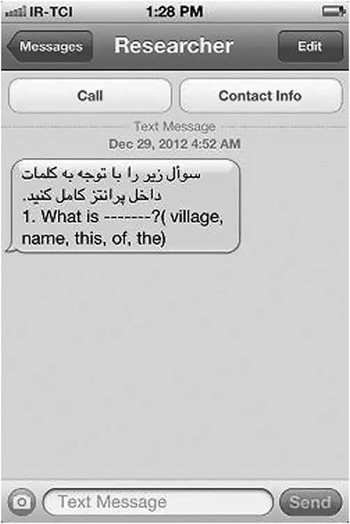
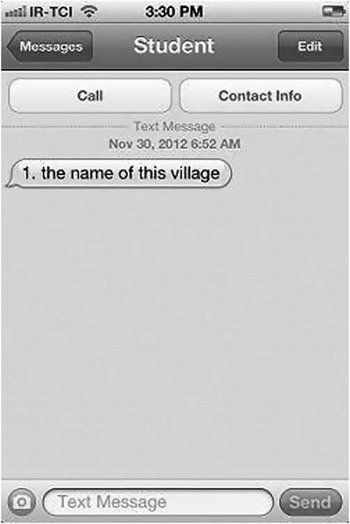
Each message contained a question related to the grammatical feature the students were then learning at school. For example, the grammatical structure of the first lesson was possessive forms; therefore, the participants received one text message similar to the example shown in Figure 1, and they were asked to send back the correct answer, as indicated in Figure 2. The instructions were written in Persian (Farsi), in order to make them understandable to learners at an elementary level. The messages were sent at 5:00 pm, when the students were not at school. They were asked to answer them as soon as they received them. The correct answers were then sent to all participants in the experimental group by 8:00 pm, while they were still awake (Figure 3).
Sample grammar question

Sample student response

Sample correct answer

As mentioned earlier, the participants in the comparison group received the same grammar exercises on paper. For this group, the exercises were distributed at the beginning of each new textbook lesson, and the correct answers were provided at the end of each lesson. The learners in this group were asked to do the exercises at home, but they were allowed to ask any questions about the exercises during an allocated time at the end of each class. Each day the students in this group received text messages containing English vocabulary items, and were asked to send their Persian equivalents. The words were chosen by the teacher based on the lesson being taught at the time. At the end of the day, similarly to the experimental group, they would receive the correct response via a second text message.
To conduct this study, the researchers used the school’s text message panel with software for sending bulk text messages (i.e., SMS) from a computer at predetermined days and times. This software enabled the researchers to store the participants’ cell phone numbers, write messages, select the day/time they wanted to send the messages, and receive/save the responses.
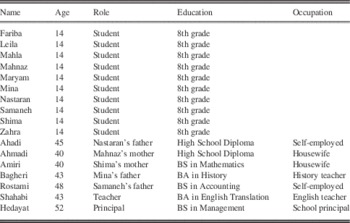
In the second phase, four categories of stakeholders (the principal, the English teacher, ten of the students who received grammar exercises via their cell phones, and five parents) took part in the interview section. The respondents’ characteristics, including their age, degree, profession, and their relationships to the students, are shown in Table 1. It is worth mentioning that the students’ teacher had been an English teacher for 20 years and the principal had 27 years of experience working with students. The students and their parents were all selected randomly and the identities of the respondents are protected through the use of pseudonyms.
Demographics of the interviewees

2.2 Data collection
A researcher-made grammar test and interviews were the instruments used to collect data in the quantitative and qualitative phases of this study.
The test consisted of 30 fill-in-the-blank and multiple-choice items; all the items were prepared according to the grammatical features presented in the eighth grade students’ school textbook (e.g., simple past tense, past continuous tense, modal verbs, adjectives/adverbs, and future tense).
In order to investigate the content validity of the test, the researchers asked a group of English language practitioners including two TEFL university professors, three TEFL PhD students, and the students’ teacher to comment on the relevance of the test items to the learning objectives, and their suitability to the research objectives, as well as the suitability of the test instructions, the number and arrangement of the items, and the points and time allocated to each. All their suggestions were taken into consideration by the researchers. Furthermore, a group of 30 students with similar educational backgrounds took the test, and some items were further modified based on their comments.
To demonstrate the construct validity of the test, the researchers made use of a differential-groups study (Brown, Reference Brown2005). The findings showed that test-takers who had studied the eighth grade school textbooks significantly outperformed those who had not, thus indicating test construct validity.
Test-retest reliability was used to estimate the reliability of the test, since according to Brown (Reference Brown2005: 175) “test-retest reliability is the one most appropriate for estimating the stability of a test over time.” Since the time interval between tests was more than two weeks, the researchers used the same test as both pretest and posttest (Hatch & Farhady, Reference Hatch and Farhady1982). The reliability correlation coefficient turned out to be 0.93, which is suitable from a statistical point of view (Field, Reference Field2009).
As mentioned above, semi-structured, one-on-one interviews with the school principal, the students’ English teacher, ten of the students, and five of their parents were also organized. These interviews were conducted with the aim of gaining a better understanding of the stakeholders’ beliefs about utilizing cell phones, specifically text messages, for doing grammatical activities outside the school environment. Moreover, the researchers tried to understand the stakeholders’ opinions about the problems they encountered during the experiment and their suggestions to overcome these problems.
In designing the interview questions, open-ended items were used (see appendix) in order to provide the stakeholders with more freedom in expressing their viewpoints, and a group of TEFL practitioners consisting of two TEFL university professors and three TEFL PhD students examined the questions. The interviews took place between the first researcher and the interviewees in a quiet room in the school. The interviews were conducted at a convenient time for the stakeholders and lasted about 20–30 minutes. The interviews were recorded and transcribed for later analysis. They were conducted in Persian and then translated into English by the researchers.
2.3 Data analysis
The data from the grammar test were analyzed through the use of Statistical Package for Social Sciences (SPSS, version 18). To detect possible differences between practicing grammar via text messages and via paper and pencil, the gain scores of the experimental and comparison groups were compared through an independent samples t-test.
The researchers further carried out qualitative content analysis on the interview transcripts. After transcribing the interviews, they read the texts several times and underlined the information related to the stakeholders’ points of view about teaching grammar in class, practicing grammar via paper and pencil, practicing grammar via cell phone text messages, as well as any problems encountered by the stakeholders throughout the study. After “pre-coding and coding,” “growing ideas,” and “interpreting the data,” (Dörnyei, Reference Dörnyei2007: 246), the researchers drew conclusions about stakeholders’ perspectives on utilizing cell phones, specifically text messages, for practicing grammatical features.
3 Results
3.1 The impact of text messages on English language learners’ grammar learning
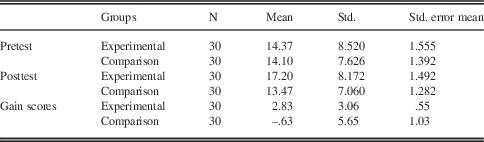
Descriptive statistics for the experimental and comparison groups’ pretest scores, posttest scores, and gain scores are presented in Table 2.
Descriptive statistics for experimental and comparison groups’ pretest, posttest, and gain scores on mobile assisted vs. paper-and-pencil instruction
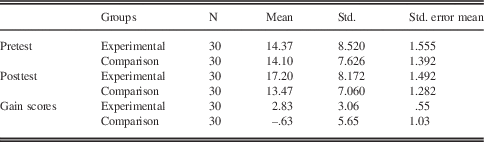
As Table 3 shows, learners who practiced grammar via text messages (M=2.83, SD=3.06) significantly outperformed [t (46.351)=3.214, p=0.002] those who practiced through paper and pencil (M=–0.63, SD=5.65). Cohen’s d was calculated to be 0.08, while Gates’ delta turned out to be 0.61.
T-test for independent samples of gain scores

3.2 Stakeholders’ beliefs about practicing grammar via text messages
As noted before, the stakeholders interviewed consisted of ten language learners, five parents, the teacher, and the school principal. A summary of their opinions about utilizing text messages for practicing grammar points are provided as follows:
3.2.1 Learners’ beliefs
The Iranian language learners in this study believed that receiving grammar points via their cell phones helped them better learn English grammar in comparison to studying these materials through their books or via paper and pencil. Their reasons can be classified as their enthusiasm about using their cell phones, the contents of the text messages they received, and the portability of cell phones.
The learners’ enthusiasm toward learning via cell phones was due to the fact that they were much more interested in their cell phones than their books, and enjoyed using cell phones. According to the interviews, they eagerly read and answered exercises they received through text messages even when they were tired of studying. This enthusiasm toward cell phones persuaded them not only to answer the exercises as soon as they could but also to reply as correctly as possible. For this reason, they put in considerable time and effort, and consulted family members, friends, and their books, to ensure they were sending the correct answers. Leila, for example, said: “When the exercises are hard and I don’t know the answers, I first forward your text to a friend and ask her to send me the answers. Then, I forward her answers to you.”
This eagerness extended beyond the learning of English, as the learners mentioned that they would like to practice not only English through text messages, but also other languages. They believed that learning new subjects with the aid of a device which they really loved to work with (i.e., cell phones) could be very helpful. Samaneh commented: “We’re sick of learning English through the old methods. Personally, I’d rather try new approaches for learning. I love my cell phone and I love learning English with it.” Mahnaz similarly claimed: “I hate English and I hate participating in English classes, but I like learning English via my cell phone.”
The second reason offered in support of MALL was the content of the text messages. The learners were sure that the messages they had received every day were chosen according to their needs and were really important; consequently, they concentrated all their attention on them. Samaneh claimed: “If you gave me an exam consisting of the exercises I practiced in English class and those you sent us via text messages, I’d definitely answer all the ones you sent us correctly, because I pay full attention to the exercises I receive in the text messages, something I never do in class.” Receiving parts of their daily lessons every day via text messages allows learners to review them. Mahla mentioned: “If a friend asks me whether I’d recommend her to participate in this program or not, I’d say yes, because receiving messages with grammar exercises everyday helps me review my school lessons.”
The portability of their cell phones was the third point mentioned by the learners. In comparison to their books, students had their cell phones on them most of the time; as a result, they were able to answer text messages wherever and whenever they received them. Shima, for instance, said: “You don’t know how fun it is to reply to text messages while you’re doing something else!”
Talking about the drawbacks of learning via cell phones, the learners’ biggest problem appeared to be the character limitations in the text messages (i.e., a maximum of 160 English characters), which inevitably led to brief explanations and instructions. For example, Samaneh complained: “I had a problem with the instructions. They were too short and most of the time I answered the questions wrongly just because I didn’t understand the instructions.” On the other hand, the learners did not have any problems with cell phones’ small size and their small keypad. According to them, they could easily read the exercises and type their answers through their cell phones.
3.2.2 Parents’ beliefs
All the parents were strongly in favor of continuing this method of practicing grammar in the future for three main reasons. First, they had noticed how their children’s interest in learning English, particularly grammar, had improved, because they liked working with their cell phones. For example, Mahnaz’s mother declared: “Mahnaz hated English. She didn’t like studying English or participating in English classes at all. After participating in this program, she’s changed a lot. Now she’s become really interested in learning English, and she does the exercises you send her very enthusiastically.”
Furthermore, the parents felt that receiving grammar exercises every day gave their children the opportunity to review the learning materials, since they had observed their children’s efforts to find the correct answers. They also claimed that the integration of technology in teaching and learning would indirectly teach the younger generation that cell phones could be used for learning purposes. Mina’s father mentioned: “Finally, someone has taught the kids that cell phones can be used for something besides sending text messages to their friends and playing games!”
However, in addition to all the advantages noted above, the ability to text only 160 characters was seen as a serious limitation. Nastaran’s mother believed this to be an obstacle to providing sufficient information. Likewise, Shima’s mother suggested: “I think you should have made use of both cell phones and computers. How much information can you send through a text message?”
3.2.3 Teacher’s beliefs
Contrary to the learners and their parents, the students’ teacher was completely against the project. She claimed that using text messages for learning a language could only be useful if this method were conducted in countries equipped with more advanced telecommunication services. She maintained that teaching subjects through text messages in Iran was not a good idea. “It doesn’t make sense. I personally have problems sending text messages to my family members and friends. Telecommunication services in Iran are very poor; how can a teacher count on them for teaching?” However, this claim was very different from what the learners had experienced, as most of them mentioned that they had received all the text messages without delay. It also goes against the personal experience of the researchers, leading us to wonder whether this negative attitude might not have been, at least in part, a defensive reaction to the compelling enthusiasm of the other stakeholders, which the teacher may have perceived as constituting an indirect criticism of her exclusive use of less interesting “traditional” teaching methods.
The school teacher also believed that text messages could not be used effectively as supplementary language learning tools, since one could only work on certain aspects of language, like grammar or vocabulary, and not on other aspects, such as speaking or listening. Finally, she believed using text messages for teaching was not cost-effective.
3.2.4 Principal’s beliefs
The principal showed great interest in cell phones for language learning. Although she admitted that she didn’t have sufficient personal experience of using technology for language learning, she supported any new ideas from which her students could benefit. She said: “When you proposed the study, I said to myself that I should give you permission to do it, because my students would learn at least one new word or one new grammatical structure through this program.” She further claimed: “People usually think that text messages are only good for things like sending each other jokes or for sending advertisements, but I believe teaching English language materials through text messages can broaden young students’ horizons. The kids will learn that text messages can be used for other useful purposes.” She also claimed that students didn’t pay much attention to the materials presented in their books or classes, whereas they paid more attention to the materials they received through text messages. “Without any kind of examination, I can tell you for sure that the participants in this study learned more from your text messages than from their teacher or their books. And they won’t forget the points you mentioned in the texts, since they do your exercises very carefully.”
When asked about the shortcomings of practicing grammar via text messages, the principal suggested that eighth-grade students are not always mature enough to put cell phones to good use, and that they often spend too much time fooling around with them instead. For this reason, she believed that such projects might be more beneficial for older learners, and that younger learners first need to be taught that cell phones are not mere playthings for exchanging texts with their friends, playing online games, tweeting, or updating their Facebook status.
4 Discussion
This study was an attempt to evaluate the use of text messaging to enhance the grammar learning experience of Iranian EFL learners. According to the quantitative analysis of the study, the participants who practiced grammar through text messages significantly outperformed those who practiced grammar points via paper and pencil. Such findings align with the study conducted by Baleghizadeh and Oladrostam (Reference Baleghizadeh and Oladrostam2010), in which they conclude that using cell phones as supplementary learning tools has a positive impact on the English language learners’ grammatical accuracy. However, it must be borne in mind that the Cohen’s d and Gates’ delta values were relatively small; therefore, the results of the qualitative analysis can be helpful in deciding whether using text messages is indeed worth the extra effort and expense, or not.
The qualitative results of this study indicate that receiving grammar exercises via text messages was highly instrumental in increasing the learners’ interest in the grammatical items being taught, a point which was not only repeatedly mentioned by the learners but which was also highlighted by their parents and the school principal. In fact, the project met with so much enthusiasm on the part of the learners that one is tempted to hypothesize that the positive results obtained by the experimental group may have been very largely due to this great increase in motivation. Such results support Hashemi and Ghasemi (Reference Hashemi and Ghasemi2011) and Markett et al. (Reference Markett, Sánchez, Weber and Tangney2006), among others, who emphasize the interest of the younger generation in receiving and sending text messages and claim that presenting learning materials via cell phones enhances learners’ motivation for language learning.
Another merit of the project mentioned by the stakeholders in their interviews was the fact that the text messages often led the learners to refer to their textbooks. Interestingly, however, although they often complained that their general workload at school prevented them from having enough time to study their English lessons, they did not appear to begrudge the daily interruption in the form of text messages, and would review the lessons as soon as they received the texts in order to be able to send the correct response, apparently without even being aware that what they had just done could indeed qualify as “studying.” That is, not only did the portability of their cell phones provide them with the opportunity of answering the messages on receiving them and encourage their reviewing the new lessons they had been taught at school (an advantage which has been mentioned in other studies as well, such as Brett, Reference Brett2011), but it appeared to do so without their being aware of having spent extra, unwanted time on studying. These are merits which cannot always be easily obtained through less innovative methods.
As mentioned earlier, most of the stakeholders interviewed in the current study, such as the principal and the parents, seemed to feel that teenagers pay more attention to materials they receive through their cell phones since they like working with them, and that they do not pay as much attention as they should to the learning materials presented in their classes. Interestingly, this viewpoint is in contrast to Kukulska-Hulme et al. (Reference Kukulska-Hulme, Traxler and Pettit2007), who believe that when students find themselves out of school boundaries, they do not concentrate on the activities as much as they should, and that consequently, cell phones cannot necessarily be effective supplementary tools for out-of-class activities. As one reviewer of this article pointed out, however, this does not appear to be exclusive to tasks requiring the use of cell phones, and similar problems may therefore arise with all forms of out-of-class activities.
Another difference between the current and previous studies is that the participants did not have difficulties in reading the exercises and typing their answers through their cell phones, and that the cell phones’ small screens and virtual keyboarding did not create difficulties for them. This finding is in contrast with those of Sandberg et al. (Reference Sandberg, Maris and Geus2011), Chinnery (Reference Chinnery2006), and Stockwell (Reference Stockwell2007). This could be due to the different nature of the tasks required in the various studies. It could also be partly due to the gradual evolution of new technologies as well as new ways of dealing with them (e.g., the emergence of two-thumb typing), especially among digital natives. On the other hand, however, the language learners in this study mentioned that not being informed of the reasoning behind the correct answers and receiving insufficient instructions – both related to current text messaging length restrictions – were two major problems in the project. This is in line with Sandberg et al.’s (Reference Sandberg, Maris and Geus2011) and Chinnery’s (Reference Chinnery2006) conclusions that cell phones’ limited message length restricts teachers from sending a large amount of information.
5 Conclusion
The current study indicated that learners enjoy working with their cell phones and find text messaging a more useful and motivating method to address grammar than textbooks. Nowadays, cell phone owners are becoming increasingly dependent on their phones and, contrary to their textbooks, willingly carry them around; for many, our cell phones are rapidly becoming an extension of our personality, and it is becoming difficult to imagine life without them. This is usually doubly the case with young learners, who are rarely to be found without their cell phones when the latter are not prohibited. The learners of the present study not only enjoyed receiving grammar text messages, they willingly put in serious time and effort to ensure that their responses were correct, apparently without realizing that they were “studying” or “working” harder than usual. Such positive attitudes should be harnessed for learning purposes more often. This would necessitate a more liberal attitude toward the use of cell phones in educational environments, and would particularly require moving beyond the current prevalent negative attitudes toward school children carrying and using cell phones, an attitude which often dictates that cell phones be forbidden in schools or at least kept in students’ pockets or lockers at all times. And of course, the strong resistance of the school teacher indicates that bringing about such a change will require some amount of teacher training and creating awareness; and preferably better facilities. Nevertheless, considering the positive results achieved in this and previous studies with regard to the practicing and learning of language, one can conclude that portable technologies in general and text messaging in particular can play important roles in language learning. More specifically, it is worth noting that grammar points are often considered among the most tiresome and boring aspects of language learning; thus, we believe that the renewed interest in grammar learning in this study which was brought about by the use of text messaging was a major teaching triumph, one worthy of serious further consideration.
Acknowledgements
We would like to express our gratitude to the anonymous reviewers of the article for their helpful comments on earlier versions of this paper.
Appendix
Interview Questions
Questions asked of learners
-
1. Do you think learning grammar is important when you are learning a language?
-
2. What is your opinion about utilizing cell phones and text messages for learning English skills and/or components, specifically grammar?
-
3. Did you learn new grammatical structures this semester? If so, did you learn them in class or via text messages?
-
4. Did you receive text messages at the scheduled time? (5:00 pm and 8:00 pm)
-
5. Did you have any problems with your cell phones’ small screen for reading or answering exercises?
-
6. How long did you spend answering the grammar exercises you received each day?
-
7. What did you do when you didn’t know the answers? (e.g., Did you ask your teacher? Did you ask your parents? Did you use a dictionary? Did you use your cell phone’s dictionary? Did you search the internet?)
-
8. Do you remember grammatical structures you learned in this semester? Why or why not?
-
9. Would you like to practice other language skills and/or components, specifically grammar via text messages next semester?
-
10. What problems did you face while you were practicing grammar via text messages?
-
11. What are your recommendations for overcoming such problems?
Questions asked of parents
-
1. What is your opinion about making use of cell phones and text messages in learning language skills and/or components, specifically grammar?
-
2. During and after this study, did your child show any interest in language learning, specifically grammar, at home?
-
3. Did your child enjoy using cell phones for learning English grammar?
-
4. Did your child ask you to help her answer text messages?
-
5. Would you like your child to practice language skills and/or components, specifically grammar, via text messages in future?
-
6. What are the factors which hinder the effective use of cell phones in language learning, specifically grammar?
-
7. What are your recommendations for overcoming such barriers?
Questions asked of the principal
-
1. What is your opinion about making use of technology in language learning?
-
2. What is your opinion about making use of cell phones and text messages in learning language skills and/or components, specifically grammar?
-
3. Did you receive any feedback from your students, their parents, and your English teacher, about utilizing cell phones as a complementary tool for learning grammar?
-
4. What are the factors which hinder the effective use of cell phones in language learning, specifically grammar?
-
5. What are your recommendations for overcoming such barriers?
Questions asked of the teacher
-
1. What is your opinion about making use of technology in language learning?
-
2. Do you think teaching grammar is important when you are teaching a language?
-
3. What is your opinion about making use of cell phones and text messages in learning language skills and/or components, specifically grammar?
-
4. During and after this study, did your students show any interest in language learning, specifically learning grammar?
-
5. Did your students talk with you about the merits and demerits of practicing grammar with the use of cell phones and text messages?
-
6. What are the factors which hinder the effective use of cell phones in language learning, specifically learning grammar?
-
7. What are your recommendations for overcoming such barriers?