Introduction
California red scale (CRS), Aonidiella aurantii (Maskell), is one of the most important citrus pests occurring worldwide and is an important economic pest in Spain. Damage caused by this armoured scale, which can be considered as cosmetic, lead to downgrading or rejection of the product at the packing house. Moreover, heavy scale infestations may lead to yellowing of leaves, defoliation, branch dieback and possible tree death (Grafton-Cardwell & Reagan, Reference Grafton-Cardwell and Reagan1995).
The female CRS can give birth to 100 to 150 active crawlers. They emerge from under the female cover in a day or two, depending on the temperature. These crawlers travel short distances and settled onto twigs, leaves or fruits, so as they are the only immature instars capable of movement (Bodenheimer, Reference Bodenheimer1951). During the second instars, females and males begin to develop differently. Adult male emergence coincides with the development of third instar females, which then mate and produce the next generation. Virgin females attract males by releasing a pheromone. Males may crawl to nearby females or fly to other trees (University of California, 1984). The number of generations of CRS that could develop in orange fruits range from three to five, influenced by the degree-day accumulation (Kennett & Hoffmann, Reference Kennett and Hoffmann1985; Grout et al., Reference Grout, Du Toit, Hofmeyr and Richards1989). Under our environmental conditions, CRS shows three complete generations with three male flights, the first of which takes place between mid-April and mid-May, the second between mid-June and late July and the third from mid-August to early-September.
Traditionally, chemical control has been used by growers in order to prevent such damage to citrus. However, since the development of resistances to many insecticides was documented for CRS (Grafton-Cardwell & Vehrs, Reference Grafton-Cardwell and Vehrs1995), other control techniques have been introduced. The use of oil sprays has been expanded although these can be potentially phytotoxic (Grout & Richards, Reference Grout and Richards1991a; Grafton-Cardwell & Reagan, Reference Grafton-Cardwell and Reagan1995; Tan et al., Reference Tan, Sarafis, Beattie, White, Darley and Spooner-Hart2005). Thus, satisfactory management of oil applications is essential in order to prevent these effects and to ensure the efficacy of the treatment. In search of alternative methods of CRS control, the use of insect growth regulators (IGR), such as buprofezin (Grout & Richards, Reference Grout and Richards1991a; Ishaaya et al., Reference Ishaaya, Mendel and Blumberg1992) and pyriproxyfen (Alfaro et al., Reference Alfaro, Esquiva and Cuenca1999; Grafton-Cardwell et al., Reference Grafton-Cardwell, Lee, Stewart and Olsen2006; Eliahu et al., Reference Eliahu, Blumberg, Horowitz and Ishaaya2007), was included even though the effect of these IGR on natural enemies is still not clear (Grafton-Cardwell & Gu, Reference Grafton-Cardwell and Gu2003; Lauziere & Elzen, Reference Lauziere and Elzen2007). Classical biological control also offers an alternative to CRS, being the most successful natural enemy of the parasitoid Aphytis melinus DeBach (Moreno & Luck, Reference Moreno and Luck1992; Hare & Luck, Reference Hare and Luck1994; Murdoch et al., Reference Murdoch, Swarbrick and Briggs2006). However, its effectiveness depends on careful monitoring, in order to establish the exact release date and the use of selective insecticides for other pests which do not affect A. melinus.
In recent years, semiochemical-based pest management programs, such as mass-trapping, have been increasingly used to provide environmentally friendly methods for the control of major insect pests (El Sayed et al., Reference El Sayed, Suckling, Wearing and Byers2006). The production of sex pheromone was demonstrated in CRS years before the chemicals were first reported by Roelofs et al. in 1977. Since then, synthetic sex pheromone traps have been widely employed as a management and detection tool for CRS populations (Moreno et al., Reference Moreno, Carman and Rice1972; Gardner et al., Reference Gardner, Ervin, Moreno and Baritelle1983; Kennett & Hoffmann, Reference Kennett and Hoffmann1985; Moreno & Kennett, Reference Moreno and Kennett1985; Samways, Reference Samways1988; Grout et al., Reference Grout, Du Toit, Hofmeyr and Richards1989; Grout & Richards, Reference Grout and Richards1991b). The CRS sex pheromone was described as 3-methyl-6-isopropenyl-9-decen-1-yl acetate (I) and (Z)-3-methyl-6-isopropenyl-3,9-decadien-1-yl acetate (II) (Roelofs et al., Reference Roelofs, Gieselmann, Carde, Tashiro, Moreno, Henrick and Anderson1977). All possible geometrical and optical isomers of the two compounds were synthesized and tested by Gieselmann in 1980 (Gieselmann et al., Reference Gieselmann, Henrick, Anderson, Moreno and Roelofs1980). The results showed that only one isomer from each compound was significantly more active: (3S,6R)-I and (3Z-6R)-II and the presence of other isomers in the mixture had no effect on trap catches (Tashiro et al., Reference Tashiro, Gieselmann and Roelofs1979; Gieselmann et al., Reference Gieselmann, Henrick, Anderson, Moreno and Roelofs1980). These findings can lead to the development of new methods of control based on pheromones, such as mating disruption. As a pure isomeric pheromone composition is not required, the cost of the pheromone can be reduced to bearable levels. Unfortunately, not many experiments on mating disruption to control CRS have been documented (Barzakay et al., Reference Barzakay, Hefetz, Sternlicht, Peleg, Gokkes, Singer, Geffen and Kronenberg1986; Hefetz et al., Reference Hefetz, Kronengerg, Peleg and Bar-zakay1988), and more extensive studies with different pheromone dosages are necessary in order to establish the potential of this method in controlling A. aurantii.
The final aim of our experiments is to evaluate mating disruption as a possible control method against CRS. The efficacy of mating disruption for this pest has not yet been demonstrated and published in scientific literature; moreover, commercial dispensers are not currently available in Spain. Therefore, the main aim of this work is to develop a new biodegradable dispenser for this purpose. Two new formulations for dispensers with several CRS sex pheromone loads were tested during two years of field trials. These trials were designed to check the efficacy of the dispensers and to select the most suitable one. Further field trials will be carried out to evaluate the mating disruption technique as a CRS control method using the dispenser obtained in this study.
Materials and methods
Field trials
During the years 2006 and 2007, field trials were carried out in a citrus orchard in Alicante, Spain.
First trial year
An initial study, to evaluate our CRS mating disruption dispensers, was conducted in a ten-year-old orchard in 2006 using sweet oranges from the Navel group, Citrus sinensis Osbeck. The trees were spaced 6×4 m apart. Two mesoporous dispensers based on the technology of inorganic molecular sieves (Corma et al., Reference Corma, Munoz Pallares and Primo-Yufera1999, Reference Corma, Munoz Pallares and Primo-Yufera2000) with 8 and 20 mg (a.i.) pheromone loads (which will be called D8 and D20 throughout the paper) were tested in two plots, both approximately 1.5 ha in size. A third 1.5 ha plot was left without treatment as an untreated plot. Separation between plots was 50 m, using a Cupressus sempervirens L. barrier as a boundary. On 7 April 2006, before the occurrence of red scale second flight, dispensers were hung with a density of one dispenser per tree (nearly 400 dispensers per ha). The number of pheromone point sources employed in our trials was decided upon according to the biology of the pest, concentrating on CRS dispersion characteristics, so diaspidids maintain a relatively intimate relationship with a single host-plant (McClure, Reference McClure and Rosen1990). Mesoporous dispensers were placed inside small micro-perforated polyethylene bags, supplied by Ecología y Protección Agrícola (Valencia, Spain), hanging from internal branches at a height of 1.5–2.0 m. These mesoporous dispensers inside the bags were not replaced through the season.
Second trial year
In a second trial in 2007, dispensers were developed using a new formulation with 50 and 100 mg (a.i.) pheromone loads (which will be called D50 and D100 throughout the paper). D50 and D100 dispensers were tested under the same field conditions as in the first trial year, and they were effective during the whole season without replacement. On this occasion, on 14 March 2007, dispensers were placed inside small perforated cotton bags and hung one per tree. The cotton bags were manufactured using a cotton mesh (1×1 mm), supplied by Bi-Medica (Barcelona, Spain), and were 5 cm long by 3.5 cm wide. The change in dispenser bag material from polyethylene to cotton was made in order to obtain a totally biodegradable pheromone release device. Previous laboratory studies demonstrated that there were no differences in emission between dispensers placed in micro-perforated polyethylene and cotton bags.
Evaluation of treatment efficacy
In order to evaluate the efficacy of mating disruption, three commercial white sticky pheromone traps (PHEROCON® V Trap), supplied by Trécé (Oklahoma, USA), were placed in each treated and untreated plot. This evaluation was made by comparing CRS male trap catches from the untreated plots with those obtained from the treated plots. Sticky traps were revised and replaced weekly, whereas the monitoring lures, loaded with 250 μg pheromone, were replaced every 40 days. The absence of trap catches during mating disruption treatment is a good indication of the technique effectiveness, but crop damage assessment provides the ultimate proof (Howse et al., Reference Howse, Stevens, Jones, Howse, Jones and Stevens1998). To assess crop damage, 40 fruits per tree were evaluated, ten fruits per orientation. Ten trees per plot were randomly selected and evaluated. Infestation levels of zero, 1–2 and >2 scales per fruit were recorded. Treatment efficacy results were given as a percentage of damaged fruit. We considered a fruit to be damaged when more than two scales were present.
The assessment of fruit damage was carried out both in the inner and buffer areas of each treated plot. We considered the buffer area to be 15 m from the plot border.
Mesoporous pheromone dispensers
New mesoporous pheromone dispensers were developed for the field trials carried out in 2006 and 2007, described above. These were elaborated based on a mesoporous material (Corma et al., Reference Corma, Munoz Pallares and Primo-Yufera1999, Reference Corma, Munoz Pallares and Primo-Yufera2000). The dispensers were cylindrical tablets 9 mm in diameter, with several sizes and loads (D8, D20 and D50) and 15 mm in diameter for the 100 mg pheromone load (D100). The formulations contained the diastereomeric mixture (3S,6R and 3S,6S) of the 3-methyl-6-isopropenyl-9-decen-1-yl acetate compound from the A. aurantii sex pheromone (74% purity). This mixture was supplied by Ecología y Protección Agrícola (Valencia, Spain).
Pheromone release profiles
In parallel with the field trials, all dispensers were simultaneously aged in a nearby area, over 150 days in 2006 and 210 days in 2007. Residual pheromone content was extracted at different ageing times: 0, 7, 15, 30, 45, 60, 90, 120, 150, 180 and 210 days of ageing, and then quantified by Gas Chromatography using a flame ionization detector (GC/FID). Three replicates for ageing time were extracted by solvent-extraction, at 40°C, with a 3:2 methanol and dichloromethane mixture.
Red scale pheromone content was measured by GC/FID analyses (Clarus®500 gas chromatograph from PerkinElmer, Wellesley, USA) of the extracts using pentanol as the internal standard. All injections were made onto a ZB-5MS (30×0.25 mm×0.25 μm) column, held at 160°C for 5 min and then programmed at 2°C min−1 up to 180°C, where it was held for 1 min, and then programmed at 45°C min−1 up to 250°C. The carrier gas was helium at 1.2 ml min−1. The amounts of pheromone and the responses were connected by fitting a linear regression model, y=a+bx, where y is the ratio between pheromone and pentanol responses and x is the amount of pheromone remaining in the dispensers.
Pheromone release for each dispenser type was represented by fitting an exponential model, y=a×e bx, where y is the remaining pheromone load and x represents the ageing days. Pheromone emission values were obtained with the following formula:

where x is the pheromone emission value for a time period, e is the residual amount of pheromone in a dispenser for a given aging time and t is the number of aging days.
Statistical analysis
Male catches in pheromone-baited traps, per trap per week, were analyzed using data from the entire study period. In a second analysis, data from the three different flights were used: the first flight included trap catches from one to 48 days, the second flight from 49 to 130 days and the third flight from 131 days to the end of the CRS season. The log-transformed total male counts per trap per week for each type of pheromone dispenser, ln(N+1), was analyzed using a one-way ANOVA model, followed by an LSD test at P=0.05, to assess the significance of differences in male captures among treatments.
In order to test the significant differences in fruit damage between pheromone treatments and untreated plots, a one-way ANOVA model was employed.
The Statgraphics 5.1 package was used for all the statistical analyses (Statpoint Inc., 2000).
Results
Dose-response trial: 2006
Male catches
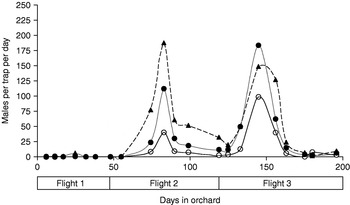
Figure 1 shows the male flights throughout the season from the untreated plot compared to those obtained from the pheromone treated plots. When analyzing data from the entire study period, male catches decreased significantly if we compare D20 treatment (20 mg dispenser) to the untreated plot, but there were no statistical differences between D8 (8 mg dispenser) treatment and the untreated plot (F=3.41, df=181, P=0.035). Male catches analyzed using data from the first and second flights gave the same result (flight 1: F=4.22, df=60, P=0.020; flight 2: F=3.18, df=53, P=0.049) while in the third flight any differences were not found between untreated and both treatments (F=1.32, df=66, P=0.27). As a consequence of these results, we observed a preliminary male disorientation effect in line with the reduction in captures with the D20 treatment. However, during the third flight this effect disappeared. This may be due to the fact that the pheromone release rate was diminishing at the end of the season.
Male CRS catches per trap per day during the 2006 trial for pheromone treated plots, D8 and D20, and the untreated plot [····•····, D8 (8 mg dispenser); —○—, D20 (20 mg dispenser); ----▴----, untreated plot].

Fruit damage
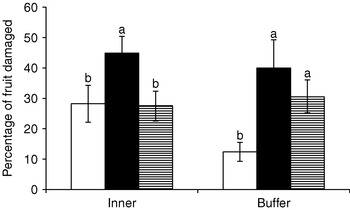
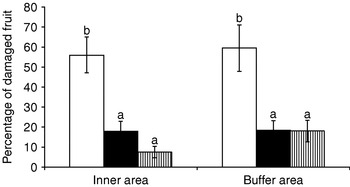
Fruit damage assessment was made at the end of the season in order to evaluate the performance of the dispensers. Data from trees located inside the plot (inner area) and from trees in the buffer area (15 m from the plot border) were analyzed separately. Fruit damage is shown in fig. 2. The results indicated that the percentage of damaged fruit from the D8 treatment was significantly higher than that of the D20 and the untreated plot in the inner area (F=3.86, df=17, P=0.044). The D20 treatment displayed similar levels of damage to those returned by the untreated plot. However, in the buffer area, there was no sign of any mating disruption effect (F=6.16, df=11, P=0.020), so fruit damage in both treated plots (D8 and D20) was higher than in the untreated plot. As observed in these field trial results, D8 dispensers were not capable of interfering with normal CRS chemical communication. In contrast, D20 dispensers had an effect on CRS mating disruption; but, unfortunately, this treatment was not capable of reducing damage on fruits.
Mean percentage of damaged fruits observed inside the untreated and pheromone treated plots, D8 and D20, (inner area) at the end of the season. Fruit damage in the buffer area (15 m from the plot border) is also represented. Bars with the same letter do not differ significantly (ANOVA test, P>0.05) [□, untreated plot;  , D8 (8 mg dispenser);
 , D20 (20 mg dispenser)].

Pheromone release profiles
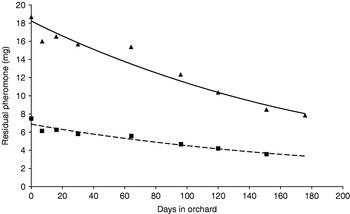
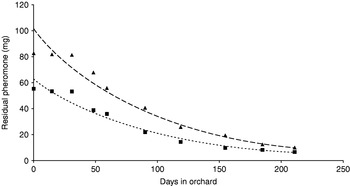
During the first year, we developed two types of pheromone dispensers with 8 and 20 mg pheromone loads (D8 and D20). Figure 3 gives the pheromone release profiles for both dispensers. From this data, we calculated the mean pheromone emission values for each type of dispenser, and it was observed that the D20 dispensers released CRS pheromone at a faster rate (90 μg day−1) than the D8 dispensers (40 μg day−1).
However, none of the dispensers emitted adequate amounts of pheromone to enable a viable mating disruption treatment. Furthermore, both types of pheromone dispensers had a high residual pheromone amount at the end of the CRS season. Because male catches seem to decrease significantly under the D20 treatment, a new formulation with two pheromone loads was developed to improve the dispensers, achieving a better pheromone release rate. These new dispensers were put to use in the 2007 field test.
Dose-response trial: 2007
In 2007, a new formulation was tested under field conditions with pheromone loads of 50 mg (a.i.) (D50) and 100 mg (a.i.) (D100) to control CRS by mating disruption. These new dispensers were formulated in order to increase the mean pheromone release rate, avoiding the replacement of the dispensers along the season.
Male catches
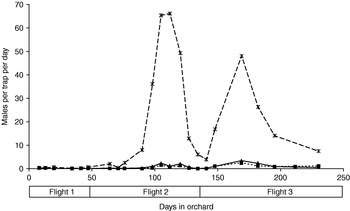
The biological effects of the treatments applied during the 2007 trial are shown in fig. 4, and the results of statistical analysis are given in table 1. The analysis with average male CRS catches, per trap per week, during the whole season showed statistical differences between the untreated plot and both treatments, but no differences were observed between pheromone treated plots. When focussing on the second and third flights, the main male flights, it was noted that the depression of trap catches, in both the D50 and D100 treated plots, was significant compared to the untreated plot.
Relation between the amount of residual pheromone (in mg) and days of field exposure for the two types of dispensers (D8 and D20) tested in the 2006 trial. Signification of the exponential model for the D8 treatment was R2=0.9511 and R2=0.9564 for the D20 treatment [, D8 (8 mg dispenser); ▴, D20 (20 mg dispenser)].

Mean±SE males per trap per week for each dispenser during the whole season and over separate flights. Means in a column followed by the same letter are not significantly different (ANOVA test, P>0.05).

Fruit damage
A damage survey was conducted at the end of the season in order to test the operation of the dispensers. The level of fruit damage reduction achieved in the treated plots is illustrated in fig. 5. In both the inner and buffer areas, we observed a reduction of almost 70% in damaged fruit without significant differences between treated plots D50 and D100 (inner area: F=24.69, df=17, P=0.000; buffer area: F=11.28, df=14, P=0.002). Given that both treated plots returned the same values for damage reduction, dispensers with loads greater than 50 mg would not be necessary given the CRS densities recorded in these trials.
Male CRS catches per trap per day during the 2007 trial for the pheromone treated plots, D50 and D100, and the untreated plot [------, D50 (50 mg dispenser); —▴—, D100 (100 mg dispenser);  , untreated plot].

Pheromone release profiles
The pheromone profiles studied for the two dispensers tested in 2007 are shown in fig. 6. If we combine the results obtained in the field trials with the pheromone release rate of the dispensers employed, we can observe that an emission value approximating that obtained with the D50 and D100 dispensers (above 250 μg day−1) is suitable for conducting an effective CRS control using the mating disruption technique. This emission value was set according to the mean emission value of D50 dispenser along the season. The mean emission value of D100 dispenser was 390 μg day−1. As seen on the efficacy results, we consider that emission values above 250 μg day−1 are adequate to maintain a suitable amount of pheromone in the atmosphere.
Mean±SE percentage of damaged fruit observed inside the untreated and pheromone treated plots, D50 and D100, (inner area) at the end of the season. Fruit damage in the buffer area (15 m from the plot border) is also represented. Bars in each group labelled with the same letter do not differ significantly (ANOVA test, P>0.05) [□, untreated plot; , D50 (50 mg dispenser);  , D100 (100 mg dispenser)].

Relation between the amount of residual pheromone (in mg) and days of field exposure for the two types of dispensers (D50 and D100) tested in the 2007 trial. Signification of the exponential model for the D50 treatment was R2=0.9826 and R2=0.9846 for the D100 treatment [, D50 (50 mg dispenser); ▴, D100 (100 mg dispenser)].

The D50 and D100 treatments provided hopeful results in the field trials. In addition, both types of dispensers contained low amounts of residual pheromone at the end of the CRS season. This is a key factor in dispenser cost and, consequently, in the cost of the control method. It is also an essential feature of a good pheromone dispenser (Munoz Pallares et al., Reference Munoz Pallares, Corma, Primo and Primo-Yufera2001; Stelinski et al., Reference Stelinski, Gut, Mallinger, Epstein, Reed and Miller2005).
Discussion
In the first experiment, we examined two new CRS pheromone dispensers (D8 and D20). None of these pheromone dispensers were efficient to control scale populations. Despite the poor performance of 8 and 20 mg treatments, a slight reduction in male catches was noticed. This encouraged us to continue testing new dispensers capable of disrupting chemical communication between scales. For successful mating disruption to occur, sufficient quantities of the artificial pheromone must be present in the air for the entire sexually active period of these insects (Carde et al., Reference Carde, Doane, Granett and Roelofs1975; Howse, Reference Howse, Howse, Stevens and Jones1998). Therefore, a dispenser that remains releasing adequate amounts of pheromone during the seven months on which the CRS reproductive cycle takes place is needed. According to the results for the first year trial, it was observed that these dispensers had high levels of residual pheromone at the end of the trial. Moreover, we considered that the poor efficacy achieved by D8 and D20 treatments was mainly due to insufficient pheromone emission levels. During the second and third flights, the amount of pheromone emitted was very low and the inhibition of male catches was not achieved. Male catches were higher in the treated plots during the third flight, which may be due to the possible cumulative effect of the population, so in the second flight there was not a satisfactory disruption. Considering these two factors, low emission and high residual pheromone, we decided to change the initial pheromone load and the formulation used for the dispensers.
In the second year, we developed a new formulation with two different pheromone loads, 50 and 100 mg (D50 and D100). The pheromone profiles of the two dispenser types were studied under field conditions. We found that both dispenser types achieved very low residual pheromone amounts. This goal has been successfully accomplished using the mesoporous dispenser technology described by Corma in 1999 and 2000 (Corma et al., 1990, Reference Corma, Munoz Pallares and Primo-Yufera2000).
The reduction in trap catches obtained with the D50 and D100 treatments was an indicator of the possibility of achieving a satisfactory control of CRS using the mating disruption technique. Fruit damage assessment in the 2007 trial indicated that chemical communication was greatly affected by both treatments. The level of scale control was similar for both D50 and D100. Therefore, both dispensers would be operationally viable in ensuring an efficient treatment procedure. Due to the high cost of the pheromone and the need for economical pest treatments to improve the cost-effectiveness of the fruit growers, we selected the D50 dispenser for enhancement in further trials.
An ideal pheromone-release device should remain effective for a prolonged period and not waste active ingredients. In addition, production and implementation costs should be low and the device should be non-toxic (Stelinski et al., Reference Stelinski, Gut, Mallinger, Epstein, Reed and Miller2005). The D50 dispenser, proposed in this paper, meets all the aforementioned requirements. Furthermore, this dispenser has been developed based upon a biodegradable matrix, giving it added value, as this feature contributes towards providing an environmentally friendly control method.
In our opinion, both larger and isolated orchards are needed mainly to avoid pest intrusion from neighbouring orchards and, thereby, to guarantee an efficient mating disruption treatment. However, this is not a key factor for CRS. As the A. aurantii crawlers are the only stage capable of locomotion, other than males which can not initiate new infestations by themselves, the crawlers represent the principal stage enabling the dispersal of the pest (Greathead, Reference Greathead and Rosen1990). After emergence, crawlers wander until they settle, but the total distance travelled is no greater than 50 cm. This could explain their dispersal into the tree canopy but not at longer distances (Bodenheimer, Reference Bodenheimer1951). In compliance with the biology of this pest (McClure, Reference McClure and Rosen1990), our trials were designed in 1–2 ha plots, although for other pests, such as moths, larger plots must be selected. The extent to which aerial dispersal takes place is unclear (Greathead, Reference Greathead and Rosen1990) although it has been demonstrated that the wind affects aerial dispersal of the pest. For this reason, we evaluated the fruit damage in the buffer and inner areas separately; and we tried to use natural barriers, such as C. sempervirens, in order to avoid any possible intrusion of the pest.
Previous works tried to perform the mating disruption technique for the control of CRS using rubber pheromone dispensers. The results showed a male catch reduction, but the effectiveness of the technique was not clearly demonstrated (Barzakay et al., Reference Barzakay, Hefetz, Sternlicht, Peleg, Gokkes, Singer, Geffen and Kronenberg1986; Hefetz et al., Reference Hefetz, Kronengerg, Peleg and Bar-zakay1988). In these trials, rubber septa were loaded with six or less mg per dispenser. This pheromone amount was clearly insufficient to reach a good efficiency, as it was demonstrated in our first year of trials with the dose of 8 mg. Moreover, the rubber dispensers release high amounts of pheromone in the first weeks, showing worse performances than the mesoporous dispensers during long periods. Rubber septa emission is highly temperature dependent (McDonough et al., Reference McDonough, Brown and Aller1989), whereas the mesoporous dispenser release rate is rather temperature independent (Domínguez-Ruiz et al., Reference Domínguez-Ruiz, Sanchis, Navarro-Llopis and Primo2008), wasting a high amount of pheromone in the warmer part of the day and therefore losing efficacy, as CRS males flight activity occurs in the afternoon or evening, depending on temperature among other factors (University of California, 1984; Gieselmann, Reference Gieselmann and Rosen1990). In addition, the rubber septa were not biodegradable and needed to be replaced every two months throughout the season. We consider that the availability of a non-replacement, biodegradable dispenser is essential in reducing the economic, as well as the ecological, cost of the treatment; the D50 dispenser, developed for this work, has these two key features.
Currently, this type of mesoporous dispenser is being commercially developed by Syngenta as part of the Adress System® against Ceratitis capitata (Wiedemann) (Navarro-Llopis et al., Reference Navarro-Llopis, Sanchis, Primo-Millo and Primo-Yufera2007), and D50 dispensers are being tested for product registration. We are of the opinion that mating disruption to control CRS could become a potentially beneficial method, providing citrus growers with an alternative in the integrated pest management of CRS.
Acknowledgements
We are grateful to Francisco Cuenca, Juan Franch and Rogelio Serrano (Servei de Sanitat Vegetal, Conselleria d'Agricultura, Pesca i Alimentació, Generalitat Valenciana) for assisting with the collection of trapping data. This research has been supported by ‘Fundación José y Ana Royo’, ‘Conselleria d'Agricultura, Pesca i Alimentació, Generalitat Valenciana’ and the Agroalimed Grant program. We would like to thank the R&D&I Linguistic Assistance Office, Universidad Politécnica de Valencia (Spain), for granting financial support for the linguistic revision of this paper.