I. INTRODUCTION
Because of their excellent nonlinearity, ZnO-based ceramic varistors are used to protect electrical circuits against dangerous overvoltage surges. Reference Matsuoka1 The trend toward miniaturization and higher performance of digital equipment continues to accelerate. The integrated circuits (ICs) used in this equipment are very susceptible to damage and easily destroyed by electrostatic discharge (ESD). Reference Koga and Sawada2 To protect ICs against ESD, ZnO-based multilayer ceramic varistors (MLCVs) are widely used, due to their very good protection performance combined with small size. Reference Matsuoka1 The effect of ESD suppression is generally improved by lowering the varistor voltage; therefore, to improve protection performance, MLCVs with a lower varistor voltage are required. Conventionally, two types of Pr- and Bi-doped ZnO varistors are used for practical applications. The lower limit of varistor voltage in commercial MLCVs is about V 1 mA = 6.8–8 V for Pr-doped and 12 V for Bi-doped MLCVs, since usually both nonlinearity and stability against ESD are degraded with decreasing varistor voltage. Reference Koga and Sawada3,Reference Koga, Sawada, Amisawa, Minami and Okimoto4 The authors have recently found devices using ZnO + SrCoO3 ceramics that, despite having V 1 mA = 5.6 V, which is below the conventional lower limit for MLCVs, have excellent nonlinearity and stability against ESD. Reference Koga and Sawada3
Conventional MLCVs are produced using precious metals, such as Ag, Pd, Au, and Pt, as internal electrodes, which can be sintered with ZnO varistors in air. As numbers of stacked layers increase, to assist miniaturization and higher performance, the proportional cost of the internal electrodes to the overall cost sharply increases. This makes reducing their cost in MLCVs a major challenge. To reduce the cost of internal electrodes, base metals, such as Cu or Ni, should be used for MLCVs instead of precious metals. However, to use base metals as internal electrodes, since Ni and Cu are easily oxidized in air at high temperatures, MLCVs need to be sintered in a reducing atmosphere so as not to cause oxidation of the electrodes. Usually, the nonlinearity of ZnO varistors is very sensitive to any variation in oxygen or composition at grain boundaries. Reference Stucki and Greuter5 After sintering in a reducing atmosphere, conventional Pr- and Bi-doped ZnO varistors become semiconductive and show linearity, owing to the reduction of grain boundaries and evaporation of additives, such as Bi2O3. To resolve the issue for cofiring with base metal electrodes, ZnO-based varistors will need to show high nonlinearity after sintering in a reducing atmosphere. However, to the best of the authors' knowledge, no research on MLCVs cofired with base metal electrodes has yet been carried out. This prompted us to study MLCVs, which can be cofired with base metal electrodes in a reducing atmosphere by using SrCoO3-doped ZnO varistors, which have a lower varistor voltage. We found that SrCoO3-doped ZnO varistors that are sintered in a reducing atmosphere can show highly nonlinear V–I properties. On the basis of this procedure, for the first time, MLCVs with Cu-internal electrodes were successfully obtained that showed high nonlinearity and stability against ESD.
This study is the first report on MLCVs cofired with base metal internal electrodes. In it, we describe the electrical characteristics of SrCoO3-doped ZnO varistors and MLCVs cofired with Cu-internal electrodes, both of which are sintered in a reducing atmosphere.
II. EXPERIMENTAL
All the samples used in the present study were prepared by the solid-state reaction method. Our samples were produced from reagent-grade powders of ZnO and additives. The nominal composition in this paper is ZnO + 2 mol% SrCoO3. First, SrCoO3 as a precursor was synthesized from SrCO3 and Co3O4· ZnO and SrCoO3 were then weighed in stoichiometric ratio and ball milled in polyethylene bottles with zirconia balls and water. After drying in air, the powder was granulated with an organic binder using a mesh screen. The powder was then pressed into cylindrical shapes by uniaxial pressing and sintered at 1000–1050 °C for 5 h in a reducing atmosphere. After annealing at 400–1000 °C in air or N2 (O2 = 0.02%), electrical measurements of the disk-shaped bulk bodies without Cu electrodes were performed with an alloy of In/Ga on their upper and lower surfaces. MLCVs using Cu as internal electrodes were produced using the conventional multilayer ceramic process. Details on the synthesis condition of sintered bulk samples and MLCVs are given in our previous paper. Reference Koga and Sawada3 The green chips were constructed into 1.17 mm in length, 0.6 mm in width, and 0.6 mm in height and sintered at 1010–1030 °C for 5 h in various reducing atmospheres. The sintered MLCVs were postannealed at 700 °C for 0.5 h in air and were then grinded with SiC sandpaper and terminated with In/Ga alloy-electrodes. Electrical measurements were performed to obtain their V–I characteristics and capacitance. Their V–I properties were evaluated using DC current from 1 μA–1 mA, and voltages at the measured currents were defined as V 1 μA, V 10 μA, V 100 μA, and V 1 mA, respectively. Here, V 1 mA is usually termed varistor voltage, meaning breakdown voltage. The nonlinearity index is defined as α10 μA = V 1 mA/V 10 μA. Porosity is calculated from relative density of specimens and theoretical density (5.65 g cm−3) of ZnO. As the theoretical density of SrCoO3 is 5.59 g cm−3, the addition to ZnO cannot have little effect on the density. Reference Takeda and Watanabe6,Reference Karzel, Potzel, Potzel, Moser, Schäfer, Steiner, Peter, Kratzer and Kalvius7 Capacitance at 1 MHz was measured at room temperature without DC bias voltage. The stability against ESD was evaluated from the change in properties before and after applying an ESD pulse. ESD for MLCVs was applied at 8 kV by contact discharge, in accordance with International Electrotechnical Commission (IEC) 61000-4-2, using an ESD simulator. The values of the charged capacitor and discharge resistor were 150 pF and 330 ohm. Reference Koga and Sawada3 For microstructural observations, fabricated Cu-MLCVs were ground to approximately the midplane with SiC papers and finally polished with alumina powders. Using an optical microscope and an electron probe microanalyser (EPMA), the microstructure was analyzed to investigate structural defects, the diffusion of compositional elements, and the vaporization in Cu-MLCVs. Grain size was measured by the intercept method from the cross-sectional surface of the scanning electron microscope (SEM) images of Cu-MLCVs.
III. RESULTS AND DISCUSSION
A. Nonlinear property of SrCoO3-doped ZnO varistors sintered in a reducing atmosphere
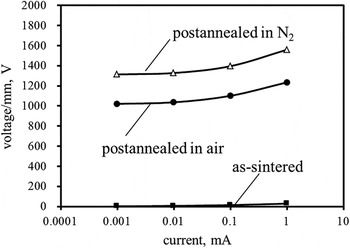
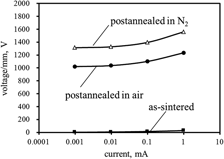
To produce MLCVs cofired with base metals, it is necessary that the varistor ceramics with nonlinear property can be sintered in a reducing atmosphere not causing oxidation of the internal electrodes. In the present study, we examined nonlinear V–I characteristics of SrCoO3-doped ZnO varistors, which were produced by a combination of sintering in a reducing atmosphere and post-sinter annealing. The results showed that SrCoO3-doped ZnO varistors sintered in a reducing atmosphere can have highly nonlinear properties after postannealing in air or in N2 with low oxygen concentration (O2 = 0.02%). The V–I properties of bulk bodies sintered at 1010 °C in P O2 = 1.6 × 10⁻⁹ MPa are shown in Fig. 1, which are taken from both as-sintered and postannealed bulk disks. Nonlinearity was not observed in as-sintered specimens, since they had become low resistance and linear over a wide current range (1 μA–1 mA). The slope of ohmic behavior in the V–I property indicated the resistivity of as-sintered disks to be about 1.4 × 10³ Ω·cm as a semiconductor. However, after postannealing the as-sintered samples at 400 °C in air or N2, we found them to have very high nonlinearity. The effect of postannealing on nonlinearity is evident here, clearly demonstrating that postannealing causes electrical barriers to be formed in varistors sintered in a reducing atmosphere. Their nonlinear V–I characteristics were similar, irrespective of whether they had been postannealed in air or N2. The nonlinear indices were α10 μA (=V 1 mA/V 10 μA) of 1.19 in air and 1.18 in N2, with breakdown voltages (V 1 mA/mm) of 1240 and 1560 V, respectively. These values are almost same as those for bulk body sintered in air, which is generally sufficient for practical use in devices to provide ESD protection. Reference Koga and Sawada3 These results reveal that due to postannealing effects, SrCoO3-doped ZnO varistors with highly nonlinear properties can be sintered in a reducing atmosphere.
V–I properties of bulk bodies of SrCoO3-doped ZnO varistors, taken from as-sintered and two postannealed specimens [700 °C in air and 900 °C in N2 (O2 = 0.02%)].

The electrical barrier and the grain boundary regions of SrCoO3-doped ZnO varistors sintered in air have been examined previously by means of C–V measurements and microstructural analysis using transmission electron microscopy and energy-dispersive x-ray spectrometry. Reference Karzel, Potzel, Potzel, Moser, Schäfer, Steiner, Peter, Kratzer and Kalvius7 The former study indicated that SrCoO3 in the sintered varistors shows a higher concentration (over an approximately 7 nm width) at the grain boundary regions, so that potential barriers will be comprised of heterojunctions comprising n-p (ZnO/SrCoO3) and p-n (SrCoO3/ZnO) between ZnO grains. Reference Koga, Hogiri and Higashi8 Since SrCoO3 has a certain degree of oxygen deficiency, due to being a perovskite-like compound with the formula SrCoO x , it is very sensitive to thermal treatment conditions, such as annealing, Reference Takeda, Kanto, Takada and Yamamoto9 suggesting that the formation of electrical barriers is closely related to variations in oxygen nonstoichiometry in SrCoO3 at the grain boundaries. It, therefore, seems likely that SrCoO3 in a higher oxidation state in the sintered ceramics will bring potential barriers at grain boundaries, resulting in enhanced nonlinearity. For this reason, we conclude that the key to obtaining high nonlinearity of SrCoO3-doped ZnO varistors is to control the oxygen deficiency in SrCoO3 at the grain boundaries.
B. Effects of postannealing and cofiring with Cu electrodes on the electrical properties of bulk body
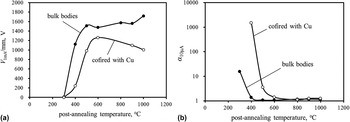
Two types of bulk body using SrCoO3-doped ZnO varistors were prepared using various postannealing temperatures (300–1000 °C) to elucidate the effects on their electrical properties of postannealing and cofiring with Cu electrodes. One type was bare bulk disks sintered without electrodes, and the other was cofired with Cu electrodes on their top and bottom surfaces. From their V–I measurements, we were able to evaluate the influence of these different treatments on their nonlinear characteristics. Figures 2(a) and 2(b) show V 1 mA/mm and α10 μA as a function of postannealing temperature, comparing the two types of sintered disks. Their nonlinear V–I properties started to appear at about 400 °C, which then were gradually enhanced with rising postannealing temperature. This suggests that the electrical barriers causing nonlinearity begin forming at about 400 °C. However, the behavior of the two types during postannealing was not consistent with each other over the range of temperatures in the present study. We conclude that cofiring with Cu electrodes probably affects the nonlinearity of SrCoO3-doped ZnO varistors. In Cu-cofired specimens, both V 1 mA/mm and α10 μA up to 500 °C shifted simultaneously to a higher temperature (about 100 °C) than seen with the sintered disks. Therefore, when postannealing at 400 °C, the resultant V 1 mA/mm and α10 μA of Cu-cofired disks showed lower and shorter values (240 V and 3.6) than those of bulk disks (1120 V and 1.39) without cofiring. Additionally, above 500 °C, a significant difference between the two types was found in the variation of nonlinearity with temperature. V 1 mA/mm of bulk disks showed saturation at approximately 1500 V in this temperature region, whereas that of the Cu-cofired specimens reached its highest value (1260 V) at about 600 °C, gradually decreasing with temperature above 600 °C. The different behaviors according to annealing temperature are probably attributable to the slight diffusion of copper into the sintered varistors during the sintering process. However, we could not elucidate the influence of Cu diffusion on nonlinearity in the present study. This will need to be further investigated by means of precise compositional analysis of the microstructure. Nevertheless, when postannealing was carried out between 600 and 1000 °C, both types of disks were able to attain α10 μA < 1.3 simultaneously, indicating saturation at a highly nonlinear level. The obtained nonlinear characteristics of these varistors make them potentially useful for ESD protection. Postannealing between 600 and 800 °C was found to bring useful breakdown voltages (V 1 mA/mm = 1000–1260 V for Cu cofiring) for MLCVs; thus, we can determine that the optimal postannealing temperature is around 700 °C for both types of disks. In consequence, we emphasize that bulk bodies sintered in a reducing atmosphere are able to acquire usable V 1 mA/mm and highly nonlinear indices (α10 μA < 1.3) by postannealing, regardless of whether cofiring with Cu electrodes on disk surfaces was conducted or not. This means that MLCVs with Cu-internal electrodes can be produced using SrCoO3-doped ZnO varistors.
Varistor properties of bulk bodies of SrCoO3-doped ZnO varistors postannealed at various temperatures (300–1000 °C) in N2 (O2 = 0.02%), (a) V 1 mA/mm and (b) α10 μA. Two types of sintered sample are shown: the bare bulk disk and a cofired disk with Cu on its upper and lower surfaces.

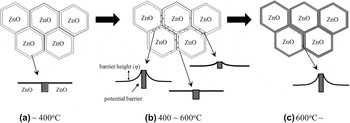
On the basis of this postannealing effect on nonlinearity, the barrier-forming process can be understood to be an increase in the barriers formed in the microstructure at high temperatures during postannealing. Shown in Fig. 3 is a schematic of the barrier-forming process for postannealing temperature. The process can be divided into the following three temperature regions: (a) below 400 °C, (b) 400–600 °C, and (c) above 600 °C. First, in region (a), potential barriers should not be formed at grain boundaries in the microstructure, since nonlinearity never appears as a result of postannealing. It was conceivable from the results that the oxygen deficiency in SrCoO3 within the varistors cannot be oxidized below 400 °C. On the other hand, postannealing in region (b) causes an improvement in nonlinearity at temperatures up to 600 °C. Thus, a limited number of barriers in the microstructure would be formed with rising temperature, as schematically shown in Fig. 3 Finally, in the case of postannealing in region (c), due to the saturation of nonlinearity at temperatures above 600 °C, we believe that almost all potential barriers have been generated at grain boundaries in the ceramic.
Schematic of the barrier-forming process of SrCoO3-doped ZnO varistors at various postannealing temperatures.

C. Variation of electrical characteristics on grain growth and porosity of Cu-MLCVs
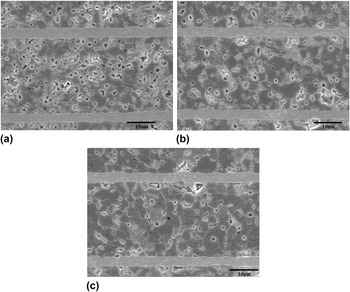
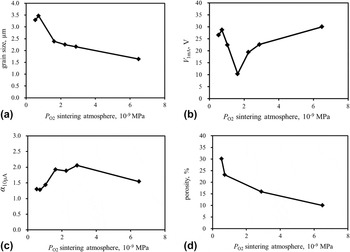
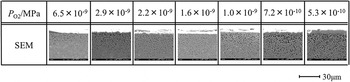
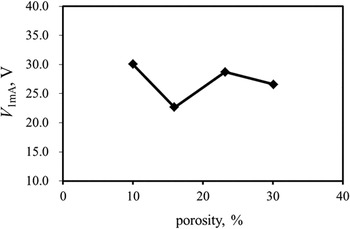
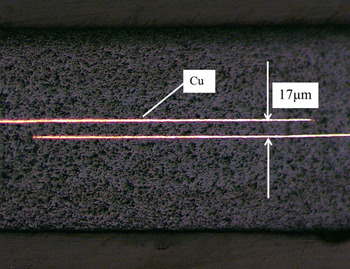
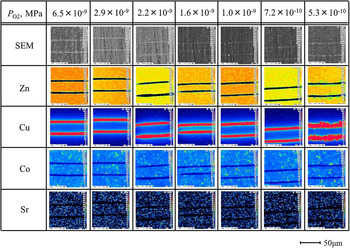
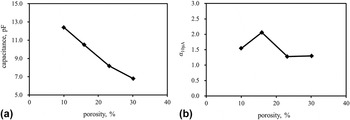
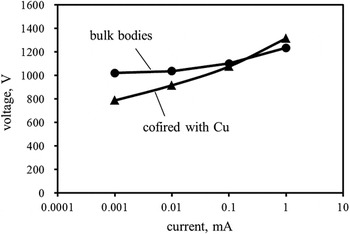
We fabricated Cu-MLCVs using SrCoO3-doped ZnO ceramics with a functional layer thickness of about 17 μm between the internal Cu electrodes. Each was sintered in different partial pressures of oxygen, P O2 = 5.3 × 10⁻¹⁰–6.5 × 10⁻⁹ MPa at 1030 °C, and then postannealed at 700 °C in air. Electrical measurements and microstructural observations were conducted on them. Shown in Fig. 4 is SEM images for the etched cross section of Cu-MLCVs. Grain sizes and numbers of grain boundaries between internal electrodes were determined from the observation. The properties in the V–I curves and microstructures as a function of P O2 are shown in Fig. 5 [(a) grain size, (b) V 1 mA, (c) α10 μA, and (d) porosity]. In general, the varistor voltage of ZnO varistors is directly dependent on the microstructure as the grain size. Reference Koga and Sawada3 Thus, we first examined the effect of grain size on nonlinearity of Cu-MLCVs sintered in various P O2 levels. As shown in Fig. 5(a), grain growth is clearly observed with a decrease in P O2 during sintering. Reference Quadir and Readey10 On the other hand, V 1 mA decreased with P O2 values of 6.5 × 10⁻⁹–1.6 × 10⁻⁹ MPa and then increased above 1.6 × 10⁻⁹ MPa in a relatively weak reducing atmosphere showing the same level of α10 μA. The lowest V 1 mA (10.4 V) in the resultant Cu-MLCVs is obtained by sintering in a P O2 of 1.6 × 10⁻⁹ MPa. The decrement of V 1 mA is believed to be responsible for the grain growth. However, irrespective of grain growth, an increment of V 1 mA, occurs by sintering in P O2 above 1.6 × 10⁻⁹ MPa after falling to the minimum value (=10.4 V). Since V 1 mA increases commonly depending on numbers of grain boundaries, the enhancement of V 1 mA with grain growth cannot be explained by the effect. This suggests that increasing V 1 mA was caused by the other reason. Hence, we investigated the influence of porosity as well. Assuming that the porosity affects the oxygen deficiency in SrCoO3 when postannealed, due to the percolation effect, the variation of the state in SrCoO3 at grain boundaries would have an influence on nonlinearity. As can be seen in Fig. 5(d), the porosity of Cu-MLCVs increases significantly with decreasing P O2 levels, which is evaluated for specimens when sintered in P O2 = 6.5 × 10⁻⁹, 2.9 × 10⁻⁹, 7.2 × 10⁻¹⁰, and 5.3 × 10⁻¹⁰ MPa. As shown in Fig. 6, the concentration of Zn is found to decrease around the surface regions of the Cu-MLCVs. This enhancement of porosity is likely to be caused by the vaporization of ZnO and the decrement of densification rate, due to sintering in a reducing atmosphere. The influences of porosity on the varistor property could be discussed in detail below. Figure 7 indicates relation between V 1 mA and porosity of Cu-MLCVs sintered in various P O2 . V 1 mA decreases with porosity in the first stage, showing the minimum (22.6 V) for porosity = 15.9% when sintering in P O2 = 2.9 × 10⁻⁹ MPa. On the contrary, porosity above 15.9% provides an enhancement of V 1 mA. Shown in Fig. 8 is a polished cross section around the midplane of a Cu-MLCV with high nonlinearity at the lowest varistor voltage in Fig. 5(a). Observation of the internal structure reveals the Cu-MLCV to have been successfully produced, without any oxidation of the Cu-internal electrodes or structural defects. And more, the midregion in Cu-MLCVs with metallic copper is found to be oxidized by postannealing, demonstrating varistor behavior. It is evident that the dominant oxidation giving rise to varistor property should occur along the grain boundaries rather than through open pores, which air can move. Thus, it is not assumed from the result that the porosity directly affect the deficiency in SrCoO3 bringing nonlinear property. Further, the compositional analysis using EPMA was also performed. Figure 9 shows the EPMA mapping results on Zn, Cu, Co, and Sr for the Cu-MLCVs. A certain amount of Cu diffusion into ZnO grains in the varistor layer can be detected from the element mapping analysis. Although the presence of metallic Cu is observed in ZnO grains over a wide range of P O2 values (5.3 × 10⁻¹⁰–6.5 × 10⁻⁹ MPa), this Cu diffusion could not be quantitatively clarified. Nevertheless, it appears from the EPMA analysis that the Cu diffusion is enhanced with porosity levels, having the considerable effect on varistor voltage and capacitance of Cu-MLCVs. Figure 10(a) demonstrates capacitance of Cu-MLCVs as a function of porosity. Capacitance decreased remarkably with an increase of the porosity level. The result on capacitance implies that the effective Cu-internal electrodes decreased owing to the enhancement of Cu diffusion. As the non-effective region around the internal electrodes would have some degree of resistance instead of metallic copper. Thus, variation in V 1 mA probably is provided by grain growth and Cu diffusion with porosity. Meanwhile, as presented in Fig. 10(b), α10 μA is seen to be independent of porosity, exhibiting the almost same values of about 2.0 in a wide porosity range. The reason would be that the addition of ohmic resistance by Cu diffusion has very little effect on α10 μA as nonlinear index. From the obtained results, sintering in a P O2 of 2.9 × 10⁻⁹ MPa is the most appropriate in the present study. The V gb (=V 1 mA/numbers of grain boundaries) of Cu-MLCV by the sintering condition is estimated to be about 1.0 V, which is close to that (0.7 V) of sintered in air. Reference Koga and Sawada3 This shows that sintering in a reducing atmosphere, even with porosity, could give the original state in SrCoO3 and varistor behavior of grain boundaries as sintered in air. Further, to compare the intrinsic nonlinearity of bulk bodies without Cu and Cu-cofired MLCVs, V–I curves were normalized according to their unit thickness. The intrinsic V–I curve of Cu-MLCVs corresponded closely to that of bulk bodies without Cu electrodes, under sintering conditions comprising a higher temperature and a stronger reducing atmosphere than those for bulk bodies. As indicated in Fig. 11, for instance, Cu-MLCVs when sintered at 1030 °C and 1.0 × 10⁻⁹ MPa showed approximately the same nonlinearity (V 1 mA/mm = 1320 V, α10 μA = 1.44) as those of bulk bodies (1240 V and 1.12) sintered at 1010 °C and 1.6 × 10⁻⁹ MPa. The difference between them in optimal sintering conditions is likely caused by the diffusion effect of cofired internal Cu electrodes, as described above.
SEM images for the etched cross section of Cu-MLCVs sintered at P O2 between 5.3 × 10⁻¹⁰ and 6.5 × 10⁻⁹ MPa. (a) 6.5 × 10⁻⁹ MPa, (b) 1.6 × 10⁻⁹ MPa, and (c) 7.2 × 10⁻¹⁰ MPa.

V–I characteristics and microstructures of Cu-MLCVs fabricated by sintering at various P O2 levels, followed by postannealing at 700 °C: (a) grain size, (b) V 1 mA, (c) α10 μA, and (d) porosity.

SEM images of the surface region of the Cu-MLCVs.

V 1 mA of Cu-MLCVs sintered in different reducing atmospheres between 5.3 × 10⁻¹⁰ and 6.5 × 10⁻⁹ MPa and then annealed as a function of porosity.

Polished cross-sectional view of Cu-MLCVs exhibiting high nonlinearity with the lowest varistor voltage in Fig. 5(b).

EPMA mapping results on Zn, Cu, Co, and Sr for the Cu-MLCVs.

Variations electric characteristics of Cu-MLCVs by sintering at P O2 = 5.3 × 10⁻¹⁰–6.5 × 10⁻⁹ MPa and postannealing at 700 °C in air: (a) capacitance and (b) α10 μA.

V–I properties of bulk disks and Cu-MLCVs, normalized according to the thickness of the functional layer.

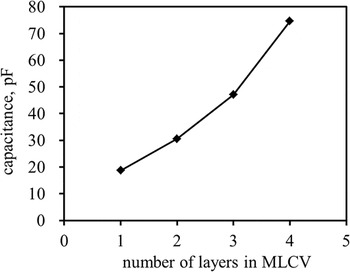
The effect of layer numbers on capacitance was also examined in Cu-MLCVs with 1–4 functional layers. Here, numbers of functional layers are represented as n − 1 (n = number of internal electrodes) because in the same way as in MLCCs, each functional layer consists of one varistor layer between two internal electrodes. Figure 12 shows capacitance as a function of layer numbers in the Cu-MLCVs. As seen in this Figure, they show an almost linear enhancement of capacitance in proportion to increasing numbers of laminated layers, as expected in theory. The experimental results confirm that all the internal Cu electrodes and varistor layers can fully function within the structure.
Capacitance as a function of number of layers in Cu-MLCVs with 1–4 functional layers.

D. ESD stability of Cu-cofired MLCVs
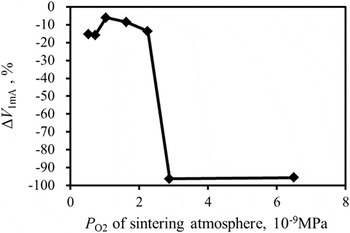
And more, to examine stability against ESD, one of the most important indices for practical use in conformance with the IEC61000-4-2 standard on ESD, we evaluated the V–I properties of our fabricated Cu-MLCVs before and after applying an ESD pulse. Assuming that MLCVs were remarkably unstable against ESD, as the electrical stress would cause characteristic degradation, leading to short out at worst (e.g., from V 1 mA of 22.6 to 0.8 V). The test on stability against ESD was performed on Cu-MLCVs sintered at 1030 °C in various reducing atmospheres (P O2 = 5.3 × 10⁻¹⁰–6.5 × 10⁻⁹ MPa). The degree of degradation was determined as the rate of change (ΔV 1 mA) of varistor voltage before and after applying ESD at 8 kV. Their ΔV 1 mA as a function of P O2 is presented in Fig. 13. As shown in Fig. 5(a), V 1 mA decreases with P O2 up to 1.6 × 10⁻⁹ MPa, showing the lowest value of 8.4 V, and is then seen to gradually increase. On the other hand, ESD stability was found to be greatly dependent on P O2 in the sintering process. ΔV 1 mA exhibits a very small rate (−15.8 to −6.1%) between 5.3 × 10⁻¹⁰ and 1.6 × 10⁻⁹ MPa, whereas, as the data indicates, drastic degradation is caused if sintered in a P O2 above 2.9 × 10⁻⁹ MPa. It was seen from the results of the present study that the variation in ΔV 1 mA for P O2 is not consistent with that of V 1 mA. Usually, in the case of conventional by a decrease in V 1 mA, no correlation between V 1 mA and ΔV 1 mA can be found in tests on Cu-MLCVs. Nevertheless, it is noteworthy that Cu-MLCVs with the lowest V 1 mA (=10.4 V), which were sintered in P O2 = 1.6 × 10⁻⁹ MPa, show little degradation (ΔV 1 mA = −8.5%). High stability against ESD appears to be conferred by sintering in P O2 below 2.2 × 10⁻⁹ MPa, especially between 1.0 × 10⁻⁹ and 1.6 × 10⁻⁹ MPa. Note that the resultant degradation of electrical properties shows a very low ΔV 1 mA of approximately −10% or less. This stability against ESD satisfies the highest standard of level 4 in IEC61000-4-2. As stated by the authors, MLCVs with Au internal electrodes using SrCoO3-doped ZnO varistors, which are sintered in air, are found to have excellent ESD stability. Reference Koga and Sawada3 In the case of Cu-MLCVs as well, it was found that not only nonlinearity but also stability can be obtained by sintering in a suitable reducing atmosphere. Thus, we assume that the high stability of MLCVs to ESD is due to the use of SrCoO3-doped ZnO varistors.
Rate of change, ΔV 1 mA, after applying an 8 kV ESD pulse from initial values for Cu-MLCVs sintered in different reducing atmospheres between 5.3 × 10⁻¹⁰ and 6.5 × 10⁻⁹ MPa and then annealed.

To clear the effect of P O2 on stability against ESD, we characterized the correlation between stability and microstructures of Cu-MLCVs. Their ΔV 1 mA of varistor voltage before and after applying ESD is shown in Fig. 13. As described above, numbers of grain boundaries are found to decrease by microstructural development with a decrease in P O2. Additionally, the resistivity of ZnO usually decreases by annealing in a reducing atmosphere. Reference Schmidt, Kiesel, Walle, Johnson, Nause and Dӧhler11 The generation of heat bringing thermal breakdown must decrease within the microstructure, due to the lowering of ZnO resistivity. Therefore, the improvement of stability against ESD by sintering over a P O2 range of 6.5 × 10⁻⁹–1.6 × 10⁻⁹ MPa would be mainly attributed to by a decrease of resistivity of ZnO grains. Conversely, Cu-MLCVs sintered in P O2 = 1.6 × 10⁻⁹–7.2 × 10⁻¹⁰ MPa exhibited the significant degradation of stability. The degradation when sintering in a relatively strong reducing is probably a cause of an enhancement of electric stress per a grain boundary by decreasing numbers of grain boundaries. From their results, we would conclude that stability against ESD is closely related to the lowering of ZnO grain resistivity and to the increasing number of grain boundaries.
In conventional ZnO varistors, it is generally accepted that stability against overvoltage surges is significantly degraded due to the high resistivity of ZnO that is caused by a small amount of Cu1+ diffusion. Reference Furukawa, Ogasawara, Yokozawa and Tokunaga12 Hence, we can speculate from this that Cu used as internal electrodes in MLCVs would similarly lead to the degradation of stability against ESD. Reference Koga and Sawada3 Since this degradation occurs when sintering in a relatively weak reducing atmosphere (e.g., above a P O2 of 2.9 × 10⁻⁹ MPa, as in Fig. 13), Cu may be slightly oxidized to Cu2O on the surfaces of electrodes, despite sintering below the equilibrium oxygen partial pressure. In this case, it appears that a slight diffusion of Cu1+ into ZnO grains is caused during the sintering process, resulting in low stability against ESD. Reference Quadir and Readey10 However, on nonlinearity, including stability against ESD, there is little information available on the role of the atmosphere in MLCVs cofired with Cu-internal electrodes. The mechanism by which high stability is conferred by sintering in a strongly reducing atmosphere will be a key focus of our continuing studies.
IV. CONCLUSIONS
In this paper, we studied the nonlinear characteristics of SrCoO3-doped ZnO ceramics produced by a combination of sintering in a reducing atmosphere and postannealing. Additionally, for the first time in MLCVs, using SrCoO3-doped ZnO varistors, Cu-MLCVs were fabricated by sintering under controlled oxygen partial pressure. Their electrical properties and microstructure were then evaluated. Our findings are listed below: (i) SrCoO3-doped ZnO ceramics sintered in a reducing atmosphere can obtain high nonlinearity by postannealing above 400 °C at an oxygen concentration above 0.02%. (ii) Regardless of cofiring or not with Cu, the optimal temperature for postannealing was found to be about 700 °C, owing to the excellent nonlinearity of V 1 mA (e.g., 1600 V for bulk bodies and 1200 V for Cu cofiring) and α10 μA < 1.3. (iii) Using this procedure, Cu-MLCVs with nonlinearity could be successfully produced without causing oxidation of the Cu-internal electrodes or developing structural defects. (iv) Sintering in a reducing atmosphere, even with porosity, could give the original state and varistor behavior of grain boundaries as sintered in air. (v) The stability against ESD of Cu-MLCVs was found to be significantly dependent on P O2 during sintering. Not only were useful nonlinearity (V 1 mA = 10.4 V and α10 μA = 1.93) but also high stability were conferred by the control of P O2. The resultant stability satisfies the highest standard of Level 4 in IEC61000-4-2. Then the ESD stability is closely related to the lowering of ZnO grain resistivity and to the increasing number of grain boundaries. However, the present study does not fully explain the improvement of stability in Cu-MLCVs due to controlling the sintering atmosphere. The mechanism will need to be uncovered to permit the development of MLCVs with a lower varistor voltage and high stability. Nonetheless, the newly developed Cu-MLCVs achieved in the present study will simultaneously allow us to improve the protection performance and reduce the cost of internal electrodes.