I. Modern American Liberals as Socialists
The short answer to the title question of this essay is “Yes, both.” The longer answer is given in what follows. The essay is divided into two sections: the first argues that modern American liberals are really socialists; the second argues that they are also social democrats. Along the way, I shall offer some reasons why these commitments might be objectionable. Historically, the relationship between American citizens and the state was Lockean. The main purpose of the state was to give legal expression to natural rights to life, liberty, and the pursuit of happiness. One purpose of this essay is to explain how modern liberal ideas have strayed from those of the American Founding.
As we shall see, there are common historical roots to socialism and social democracy. What about modern liberalism? Not to paint with too broad a brush, but modern liberal politicians comprise the left wing of the Democratic Party. These days they call themselves “progressives”; modern liberal political philosophers include John Rawls,Footnote 1 Ronald Dworkin,Footnote 2 and Bruce Ackerman.Footnote 3 I hesitate to list others because doing so might involve disputes that are not central to the purposes of this essay. Modern American liberalism is the political ideology of the idealized welfare state, and “modern American liberalism,” as the term is used here, includes most mainstream left-of-center contemporary American political philosophers, ranging from communitarians to civic republicans to Rawlsians. Of course, there are significant differences among representatives of these different schools of thought, but they all have in common the belief that American society should be more egalitarian than it is. The grounds for that egalitarianism differ, but that belief unites these thinkers and constitutes the essence, if one may speak that way, of modern American liberalism.
What must one believe to be a socialist? All can agree that socialists believe in social or collective ownership of the means of production. Social ownership can take a number of different forms; typically, it has been identified with central planning and complete state ownership of the means of production, but there are forms of social ownership compatible with a fully functioning market economy.Footnote 4 On October 3, 2008, the U.S. government purchased a significant ownership stake in a number of large banks, and on June 1, 2009, the U.S. government purchased a controlling ownership stake in two major automobile companies, but this cannot be taken as evidence of the socialistic tendencies of modern liberalism. The American economy is very large, and it is doubtful that these ownership stakes even rise to the level of seizing the “commanding heights” of the economy, a typical first step on the path to socialism. Besides, these investments in the banks and in the automobile companies have been defended on pragmatic grounds, accompanied by protestations that these moves are not precursors to any form of socialism. Moreover, these moves were not based on any deeper philosophical principles.
In what follows, I offer two complementary arguments for the claim that modern liberals believe in social or collective ownership and thus are socialists. One of these is based on A. M. Honoré's conception of ownership as a bundle of rights. The fundamental claim of this argument is that the state has effectively taken control of this bundle of rights from private owners. The other argument is adapted from an essay first published in the mid-1980s by Sanford Grossman and Oliver Hart, in which they distinguish specific rights from residual rights.Footnote 5 The basic idea behind this argument is that, because of the various regulatory regimes that have been imposed on the private sector without compensation, residual rights of control effectively reside with the state. Let us consider each of these arguments in more detail.
A. The first argument
In his 1961 essay “Ownership,” A. M. Honoré observes that ownership—at least full, liberal ownership—is actually a complex of rights, terms, and conditions. They include the items in the following “bundle”:
(1) The right to exclusive physical possession;
(2) The right to manage, which includes the right to use or modify, as well as the right to enter into contractual relations with others to use or modify;
(3) The right of disposition, which includes the right to alienate or destroy;
(4) The right to the income and to the capital value;
(5) The right to bequeath;
(6) A prohibition on harmful use;
(7) The right to security, that is, immunity from expropriation;
(8) Absence of term (that is, the other incidents of ownership do not automatically expire at a specified time);
(9) Liability to execution of debt (alternatively, the right to pledge as security for debt).Footnote 6
Let us consider for a moment item (4): the right to the income and to the capital value. What is the nature of the state's claim on the income and wealth of a society in light of its taxing and spending authority? On behalf of modern liberals, it could be argued that the state has a kind of priority of ownership (in a sense to be explicated as this argument unfolds) on an indeterminate portion of citizens' income and wealth. This priority of ownership is based on the fact that the state has wide discretion in how it exercises its taxing and spending authority. Consider, first, taxation. The state can use the tax code for a variety of purposes other than raising revenue, including changing the distribution of wealth and income. In contrast, if private individuals have this priority of ownership, the state is more constrained in what it can legitimately do through its tax policy. Classical liberals, who represent the other side in this debate about the proper role of government, believe that the state must provide something in exchange for the taxes it raises, because they believe that priority of ownership resides with private parties.
Modern liberals believe that it is perfectly appropriate for the state to manipulate the tax code for various social purposes. They believe that the tax code is an important vehicle by which government can achieve a variety of objectives. One of these is the redistribution of after-tax income through a progressive income tax. Some economists have argued, however, that the state is much more limited than one might suppose in its ability to change the distribution of income through progressive taxation on income. Roughly, the idea is that labor markets tend to adjust so as to offset the degree of progressivity of an income tax and to reestablish income differentials that would have existed in the absence of a progressive income tax.Footnote 7 In addition, it has long been observed that the estate tax is not a very effective vehicle for changing the distribution of wealth.Footnote 8 For various reasons, taxes on the capital value of assets that are bequeathed to heirs tend to be ineffective. Finally, there is the familiar public choice argument that once the tax code is open to manipulation through the political process, the powerful and the organized will benefit at the expense of the powerless and the unorganized, and that redistribution from the rich to the poor will be, at best, incidental.
Changes in the tax code are also used as a tool of macroeconomic policy. Tax cuts are sometimes instituted in an attempt to stimulate economic activity, as are adjustments in depreciation schedules. Tax increases are used in an attempt to lower government deficits and thereby lower interest rates. Tariffs and “voluntary” import quotas are used to protect jobs from foreign competition. Finally, political leaders change the tax code to encourage behaviors they think should be encouraged and to discourage behaviors they think should be discouraged. For example, “tax shielding” for funds spent on medical care or on higher education are designed to encourage spending on medical care and higher education at the expense of spending on other things.Footnote 9 On the other side, increases in taxes on tobacco are seen as a useful vehicle for discouraging smoking, as well as for allocating the alleged social costs of smoking to smokers, though that has turned out to be mostly fiction.Footnote 10 The use of the tax code to change the distribution of income, to promote macroeconomic goals, and to encourage or discourage certain forms of spending are reflective of the attitude that a portion of citizens' income fundamentally belongs to society at large, for which the state acts as an (often imperfect) agent.
Further evidence for this conception of ownership can be found in a widely shared attitude among modern liberals toward proposed tax cuts and toward how resources are allocated by the market. Modern liberal politicians and policy analysts label proposed tax cuts as “tax expenditures,” which are conceived of as fully equivalent to government subsidies. That is, tax cuts are viewed as subsidies to their beneficiaries, and the question then becomes whether such subsidies are a better use of society's wealth than other things on which these funds might be “spent.” For example, in 2001, the U.S. government was trying to determine what to do with actual and projected budget surpluses. For modern liberals, the question was how best to spend this money—society's money. On their view, one way to spend it was to give tax cuts (or welfare payments such as the Earned Income Tax Credit), preferably targeted to those with low incomes (or to some more narrowly delimited segment of the population in order to achieve some other worthy objective).
Negative pronouncements about how society allocates “its” resources abound among those with modern liberal sensibilities, and this provides a further window on modern liberal attitudes about the ownership of income and wealth. Consider the following quotation from Arthur Caplan, in which he reflects on the wisdom of using society's resources to treat infertility:
[A]ssisted reproduction, unlike sexual reproduction, is a social enterprise. It requires the involvement of many third parties as well as significant amounts of social resources…. What level of help society is willing to tolerate, provide or pay for moves assisted reproduction beyond the boundaries of personal choice and individual liberty.Footnote 11
What is especially telling about this example is that infertility treatments are not paid for by the government, and are normally not even covered by private insurance plans, a fact of which Caplan is surely aware. To say that the amount of “social resources” that are allocated to assisted reproduction should be subjected to society's (i.e., the state's) judgment about what it “is willing to … pay for” implies pretty clearly that Caplan regards the funds that infertile couples might spend on infertility treatments out of their own pockets as belonging in the first instance to society, in which case society must consider other goods or services on which these funds might be spent; that is, it must consider the opportunity costs. Modern liberals might object that the source of Caplan's observation is the fact that the state directly and indirectly heavily subsidizes medical care. It is not that the state is claiming ownership over the resources private couples would spend on infertility treatments, but that it is simply exercising its ownership rights over the resources it has provided to the medical community. This reply, however, will not do, since it assumes that in any arena in which public and private funds mix, the state should determine how private resources can be spent in the course of deciding how resources controlled by the state can be used. If the state is big enough and ubiquitous enough (as indeed it is in contemporary American society), almost anything a person spends his or her money on will be in a place where public and private funds mix. This reduces to the view that the state has an ownership stake in the resources people use to purchase just about anything, which is exactly the view I have been attributing to modern liberals. More precisely, what stands behind the view of Caplan and countless others who question how scarce resources are being allocated in a market society is a conception of ownership in which society has, through the state, a kind of priority claim on an indeterminate portion of all wealth and income.
The priority of society's claim on a portion of social wealth is given further expression in the writings of leading modern liberal political philosophers on the fundamental problem of distributive justice. This is clearest in John Rawls's A Theory of Justice, where Rawls defines the problem of distributive justice as the problem of determining how the benefits and burdens of social cooperation should be distributed.Footnote 12 Given that it is the state's job to ensure (distributive) justice, this assumes, as Robert Nozick has pointed out, that the state has the right to determine how those benefits and burdens are to be distributed.Footnote 13
Of course, anyone who is not an anarchist, including Nozick, would admit that the state has some legitimate claim on a person's income and wealth; thus, by itself, this proposition cannot be the basis for the claim that modern liberals are socialists. But it should not be taken by itself; it must be considered in light of other propositions about the taxing and spending authority of the modern state. Among those propositions are (1) the claim that it is up to the state to decide, within fairly broad limits, what proportion of people's income to take in taxes, and (2) the claim that the state can expend resources on pretty much whatever programs it believes to be worthwhile.
Rawls is not the only modern liberal theorist who believes that society has some sort of antecedent claim on assets found within a state's borders. Ronald Dworkin, in his exposition of his theory of distributive justice, asks us to consider a hypothetical auction in which all of society's (nonhuman) resources are to be bid upon by people with equal wealth.Footnote 14 Bruce Ackerman poses the problem of distributive justice in the context of a story about people in a spaceship trying to decide how to divide up a valuable commodity that they are about to acquire on a planet they are approaching.Footnote 15 All of these conceptions of the problem of distributive justice clearly presuppose that the community, for which the state acts as agent, has a prior ownership claim on all natural resources and productive assets, which it then has to decide how to distribute.
To articulate further this view about the modern liberal conception of ownership, more needs to be said about the notion of priority. What does “priority” mean in this context? I would answer that it consists of two things. First, in the language of social contract theory, it means that society, or the community, would have an enforceable, morally legitimate claim on some of people's income and wealth in a state of nature. This does not mean that the community has full, liberal ownership of all productive assets in a state of nature. That might be one conception of communism. The claim only extends to an indeterminate portion of the income those assets generate or to a portion of the wealth those assets represent, and not to control of the assets themselves. Second, and perhaps more importantly, it means that the extraction of revenue from individuals by the state need not be conceived of as a (forced) exchange for which the state must provide something of comparable value in return, since that revenue did not, at the most fundamental level, belong to individuals in the first place. On this conception of ownership, if the state takes from Peter and gives to Paul, Peter has no legitimate complaint that he does not benefit. The state, acting as an agent for the community at large, is simply taking what antecedently and rightfully belongs to its principal—society—and is using it in ways that it sees fit. Possible foundations for these propositions will be investigated shortly.
The best explanation for this view about ownership is that the state has a claim on the relevant income or on the assets themselves, which it can choose to exercise or not as it sees fit. The question at issue is whether modern liberalism is committed to the view that the state (or society as a whole, for whom the state acts as agent) has a prior ownership claim on some part of the income associated with productive assets. It seems that an affirmative answer to this question cannot be avoided as long as modern liberals maintain that the state has wide discretionary authority both to tax and to spend.
Other considerations support this notion. Notice that private individuals, who also have (partial) income rights in productive assets, are relatively unconstrained in how they can acquire income from employing those assets and what they can spend that income on. The state is similarly unconstrained; it can exercise its income rights in productive assets through myriad forms of taxation and even more multifarious forms of spending. Of course, private individuals, unlike the state, cannot exercise their income rights through coercion. In a corresponding manner, the state faces some modest legal constraints, as well as more substantial political constraints, on its taxing and spending authority, though the political constraints on spending seem to have evaporated in recent years. The only constitutional constraint on private property in the United States is that the state cannot take possession of a parcel of real property, or effectively seize the entire value of someone's property, without compensating the owner.Footnote 16
The assumption or presupposition of social ownership best explains the modern liberal attitude that it is up to the state to decide, within fairly broad limits, what proportion of the total wealth and income of a society to take in the form of taxes, how those tax burdens should be allocated, and how the revenues collected should be spent. That spending, on the modern liberal view, can, at least in theory, include selective tax cuts, as well as government spending. In light of these considerations, it is hard to deny that modern liberalism is committed to the view that the state has wealth and income rights in productive assets. What about the other incidents of ownership?
Government regulation is another way in which the state can exercise its ownership rights in productive assets, especially when it effects a regulatory taking for which compensation is typically not owed. Perhaps the most significant Supreme Court case in this regard was Penn Central Transportation Co. v. New York City (1978).Footnote 17 New York City's Landmarks Preservation Law allowed the Landmarks Preservation Commission to designate buildings and the sites on which they are located as historic landmarks. Among other things, this law required owners of designated properties to get permission before they made major changes to the structure's facade. Penn Central's Grand Central Terminal was designated a landmark. The company wanted to build a multistory office tower in the space above the terminal. The Landmarks Preservation Commission prohibited the proposed development and refused to pay compensation; the company ultimately challenged that refusal in the Supreme Court under the due process clause of the Fourteenth Amendment and the takings clause of the Fifth Amendment, and lost. The denial of compensation is significant, since it shows that the state is under no obligation to pay for development rights it takes from a private party. Of course, if the Penn Central Transportation Company did not own these rights in the first place, then the state took nothing from the company, and indeed, on the modern liberal view, it did not. There is a line of other cases that confirms this ruling.Footnote 18
On what grounds might this presumption of social ownership be based? One might take the view that there is a primordial social obligation to share the fruits of one's labor, land, and capital with the community at large. This might, in turn, depend on deeper principles of moral philosophy, which take a presumption of equal treatment as fundamental to the moral point of view.Footnote 19 Alternatively, as sociologist L. T. Hobhouse has argued, society contributes in innumerable ways to the value of productive assets and to what entrepreneurs and capitalists are able to earn in a market economy.Footnote 20 A more direct argument, also suggested by Hobhouse, drops the presumption that the state acts as an agent for society (its principal). The state itself is responsible for a substantial portion of the value of land, labor, and capital, since it provides a stable framework within which its citizens can use their property to further their own ends.Footnote 21 It defines and enforces property rights, which involve expensive and complex criminal and civil justice systems, and it provides for the common defense against external enemies. After all, it is the state that allows us to pass from a state of nature into civil society. It might be argued that the marginal difference the state makes in the value of all forms of property is so substantial that it justifies the partial-ownership claim the state makes on the income and wealth of a society.
B. The second argument
The second argument for the claim that modern liberals are socialists is adapted from an essay by two economists, Sanford Grossman and Oliver Hart, written in the mid-1980s.Footnote 22 Their argument begins with the observation, which is foundational for transaction-cost analysis, that complete, costlessly enforceable contracts cannot be written. Also foundational is the proposition that there are asset specificities—that is, some assets are worth considerably more than they otherwise would be when combined with other assets that are fixed as to location, specific use, etc. Finally, transaction-cost analysis presumes that economic actors are inclined to be opportunistic, that is, to take advantage of opportunities to renegotiate contracts to the detriment of other parties when they find that they are able to do so. These conditions combine to create what is called in the literature an “expropriation hazard.” That is, some of the value of an asset can be leached away when that asset is tied down to a specific use for which it is particularly valuable.
Part of Grossman and Hart's contribution to this discussion is to distinguish between what they call “specific rights” and “residual rights”:
When it is too costly for one party to specify a long list of the particular rights it desires over another party's assets, it may be optimal for [the first] party to purchase all the rights except those specifically mentioned in the contract [i.e., rights purchased from the seller]. Ownership is the purchase of these residual rights of control.Footnote 23
Grossman and Hart's interest is to explain the determinants of vertical integration. It permits the theorist to discover the factors that determine how far back into the supply chain a firm can profitably go, as well determining how far a firm can profitably go forward into the distribution of the product. Ronald Coase inaugurated this line of research by asking a simple question: “Why are there firms?” Or, alternatively, “Why is it that some transactions take place across markets and others take place internally within a firm?” The general answer that Grossman and Hart offer is that some transactions are best (i.e., most efficiently) organized within the firm and some are most efficiently carried out across markets. The rest of their essay attempts to elucidate the conditions under which the firm or the market does a better job of handling these transactions.
It should be reasonably clear how this distinction between specific rights and residual rights can be adapted to show that modern liberals favor some form of socialism. For modern liberals, residual rights of control reside with the state. The main reason for this is that the state is entitled to impose, without compensation, a variety of regulatory restrictions on private property—restrictions that exactly parallel those placed on income rights and the rights to the capital value of productive assets. These restrictions are so comprehensive that it is fair to say that the state de facto possesses residual rights of control, though of course it does not possess them de jure. The legal fiction that private parties have ownership rights is maintained, but it is merely a fiction. For example, government restricts management rights by determining the terms and conditions of the employment relation in the form of minimum-wage and antidiscrimination laws; state governments further restrict employment rights by regulating occupations through occupational licensure laws. Health and safety regulations comprehensively regulate the right to dispose of the product. This includes the requirement that most drugs be prescribed by a physician and the requirement that pharmaceutical products be shown to be safe and effective before being put into the stream of commerce. Initially, these restrictions were unilaterally imposed by the Food and Drug Administration (FDA), though they were later codified in the 1951 Humphrey-Durham amendment to the Food, Drug, and Cosmetic Act of 1938. There is also regulation of health and safety conditions in the workplace by the Occupational Safety and Health Administration (OSHA) and the Mine Safety and Health Administration (MSHA). Nonmedical consumer products are regulated by the Consumer Product Safety Commission (CPSC), which is empowered to issue recalls of dangerous products. Finally, there is environmental regulation, notably the Endangered Species Act of 1973, which prohibits the taking of members of endangered animal (and plant) species, and Section 404 of the Clean Water Act of 1972, which regulates wetlands. Both are designed to protect and enhance biodiversity, and neither requires that compensation be paid. The right to the income and capital value of assets has already been discussed, as has the right to bequeath. As I noted above, prima facie violations of the right to security of possession for which compensation is owed have been limited to physical possession or seizure by the state or to the expropriation of essentially all the value of private property.
To this argument it might be objected that these regulations are restrictions on the associated rights and thus do not imply the reassignment of residual rights of control to the government. The problem with this objection begins with the open-ended character of government regulation. The state can impose on owners of private property pretty much whatever regulatory regime it wants, subject to the exceptions just noted; those exceptions can be conceived of as a residuum of nostalgia for the days when full, liberal ownership rights were more fully respected. Restrictions on any of the other incidents of ownership are permissible—and compensation need not be paid. The state can even impose comprehensive wage and price controls, which it did under President Richard Nixon from 1971 through 1974.Footnote 24 Although Nixon is usually thought of as a conservative, this policy is thoroughly consistent with modern liberal principles. Indeed, it is difficult to imagine a more comprehensive regulation of the right of disposition than wage and price controls, and, of course, no compensation was offered when those controls were put in place. Because of the open-ended character of government regulation and because compensation need not be paid in most cases, property rights have effectively been eroded to the point where the state has in fact, though not in law, assumed residual rights of control. It just chooses to exercise those rights across a broader or narrower range of circumstances and conditions.
C. Summary
The foregoing two arguments establish that modern liberals are socialists who have not yet come out of the closet. To summarize, the first argument is based on the proposition that the state, through its taxing and spending authority, has a kind of priority of ownership on the income and wealth associated with private property. The second argument extends this to government regulation, which typically imposes uncompensated burdens on owners of private property.
In passing, one might ask: What is the harm? What is objectionable about the taxing and spending authority of the state and about all forms of government regulation? Some of these regulatory restrictions, after all, do some good. Nonetheless, taxation and spending, as well as the associated regulatory regimes, fundamentally change the relationship between citizens and the state. The Internal Revenue Service (IRS) is privy to the most intimate details of citizens' lives. Because these regulatory regimes are open-ended, people appear before the various regulatory bureaucracies as supplicants and not as citizens with private property rights and the independence those rights ensure.Footnote 25 Regulatory bureaucracies can delay permits, withhold approvals, etc., and suffer no adverse consequences. They do not have to pay, even through the state, for the regulatory restrictions they impose. Moreover, because of the nature of their mission, regulatory bureaucracies must be given broad discretionary power, which will be—indeed must be—exercised in essentially arbitrary ways. The language of the mandates of regulatory agencies such as the Environmental Protection Agency (EPA) and the Fish and Wildlife Service (FWS) is vague and aspirational.Footnote 26 It must be filled in through the rule-making process. Of course, there is an opportunity for public comment on any proposed rules, but the various regulatory bureaucracies can proceed in the face of public opposition to proposed rules or rule changes. Finally, the existence of regulatory agencies with broad discretionary power makes property rights relatively ill-defined, and this leads property owners to conceive of their world as one of threats and opportunities. They have an incentive to hire lobbyists to block the threats and seize the opportunities that government regulation and tax policies present. This is a recipe for deadweight welfare losses all the way around.
II. Modern American Liberals as Social Democrats
How can social democracy best be characterized? It is probably most fruitful to characterize it in terms of a set of particular social institutions. These institutions are intended to support people, who, through no fault of their own, are unable to support themselves. Everyone ages; everyone needs health care; some workers get injured on the job and are unable to work; some workers are victims of involuntary unemployment. The institutions of social democracy are designed to deal with these permanent features of the human condition.
The primary historical influence on socialist theorizing is, of course, Karl Marx, and central to Marx's ideas were the claims of historical materialism, specifically the claims that the relations of production are determined by the extant technology and that the economic base determines the legal, moral, and political superstructure of a society. The deterministic cast of Marx's ideas was reflected in the practice of the SPD (Sozialdemokratische Partei Deutschlands, the Social Democratic Party of Germany), which counseled passivity in light of its belief in the inevitable collapse of capitalism. Each crisis of capitalism was supposed to involve its death throes.
Marx's theorizing about the natural history of capitalism eventually gave rise to an alternative understanding of history and historical change. Perhaps the central figure—the founding father—of social democratic thought was Eduard Bernstein (1850–1932). Early in his career, Bernstein was an orthodox Marxist, but later he came to reject key tenets of Marxism. Fundamentally, the problem for Bernstein was that Marx's predictions did not seem to be coming true, though Marx's followers continued to plot out the theory's epicycles. There had been an obvious improvement in the workers' standard of living, so Bernstein rejected the claim that the working class was being progressively impoverished by the capitalist system. He also rejected the propositions that capitalism was becoming dominated by fewer and fewer firms and that the ownership of capital was becoming more and more concentrated.Footnote 27 More generally, a central element of Bernstein's heresy was the fact that he made room for human volition, beliefs about morality, and sheer contingency as historical forces. His cardinal sins were to jettison Marx's determinism to make a place for moral beliefs and beliefs about social justice as motivators of collective action. As social democrats rose to power in the first decades of twentieth-century Germany and elsewhere, the dominant ideas were no longer those of the ruling class. Bernstein believed that the central problem with capitalism was the unjust distribution of the social product.Footnote 28 This view undercut the radical character of Marx's critique of capitalism, since it suggested, especially to trade union leaders, that capitalism could be reformed by forcing a redistribution of the social product in a more egalitarian direction. This also meant that capitalism was not by its very nature an exploitative mode of production, which significantly undermined Marx's critique of capitalist society.
All this, of course, was heresy from a Marxist perspective. Orthodox Marxism held that the political and legal superstructure of society was largely epiphenomenal (that is, a mere by-product of more fundamental processes). As capitalists pursued “the boundless thirst for surplus value,” they substituted capital for labor, which, given the labor theory of value (which Bernstein also rejected), meant that the proletariat would become increasingly impoverished, since capitalists had to squeeze more and more surplus value out of fewer and fewer workers. In the ensuing crises, workers would be laid off and would swell the ranks of the Reserve Army of the Unemployed. But this did not happen. While it is true that capitalism had periodic crises in the form of the business cycle, it was a genuine cycle, which meant that layoffs did not steadily increase, and hiring ultimately picked up. Other factors that did not fit the Marxist worldview were the passage of factory legislation standardizing working conditions, the democratization of local governments, and the legalization of trade unions.Footnote 29 On the Marxist worldview, it is hard to see how trade unions could be legalized, if the legal structure of a society were genuinely epiphenomenal. The apocalyptic collapse of capitalism had receded into the future.
Bernstein was an SPD member of the German parliament (the Reichstag) beginning in 1902. In April 1917, however, he formed a new party, the antiwar Independent Social Democratic Party of Germany (Unabhängige Sozialdemokratische Partei Deutschlands—USPD), though in 1919 he rejoined the SPD. Although he had voted for war credits in 1914, from 1915 onward he opposed German participation in World War I. He served in the Reichstag through the late 1920s, until his retirement from political life in 1928. He died four years later in 1932.
After National Socialist rule in Germany in the 1940s, Bernstein was ultimately vindicated in the dawn of the postwar period in Western Europe. From the mid-1940s to the mid-1970s, social democracy was triumphant, though questions about its sustainability began to arise round the early 1980s. Since that time, unemployment has remained consistently high in Western Europe, and this has put a strain on the welfare systems of the European Union countries. Nevertheless, from the mid-1940s to the mid-1970s, the standard of living rose dramatically, unemployment was low, and the inequality of material condition that characterized the American postwar boom was largely absent. Western European nations were able to combine democracy and a nominally capitalist system with significant redistribution of income. This was effected by highly progressive personal income taxes and nakedly redistributive social welfare programs.
With this historical background in view, it is possible to identify the central elements of social democracy. The word “elements” is used advisedly, because a choice has to be made about how to characterize social democracy. There are different ways to do this; one way is in terms of its social institutions, but another is in terms of its underlying political philosophy. The latter might well involve some difficulties, however, since there is no guarantee that there is a single political philosophy that underlies social democracy. There is nevertheless a commonality of social institutions, which can serve as the basis for identifying social democracies. More will be said about these institutions shortly.
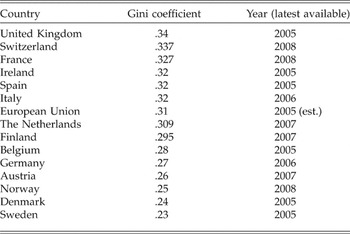
Which nations can be characterized as social democracies? By any plausible account, the countries of Western Europe should be included in any list of social democratic regimes. Others might also be included (e.g., Canada, Australia, New Zealand), but nearly everyone can agree that social democratic regimes dominate Western Europe. Western European countries include the United Kingdom, Switzerland, France, Ireland, Spain, Italy, the Netherlands, Finland, Belgium, Germany, Austria, Norway, Denmark, and Sweden. One descriptive criterion, which permits identification of the extension of the term “social democracies” is the Gini index. According to the Central Intelligence Agency's World Factbook, the Gini
index is calculated from the Lorenz curve, in which cumulative family income is plotted against the number of families arranged from the poorest to the richest. The index is the ratio of (a) the area between a country's Lorenz curve and the 45 degree helping line to (b) the entire triangular area under the 45 degree line. The more nearly equal a country's income distribution, the closer its Lorenz curve to the 45 degree line and the lower its Gini index…. If income were distributed with perfect equality, the Lorenz curve would coincide with the 45 degree line and the index would be zero; if income were distributed with perfect inequality, the Lorenz curve would coincide with the horizontal axis and the right vertical axis and the index would be 100.Footnote 30
The expression “the 45 degree helping line” makes the basic idea harder to understand than it should be. The main idea is given in the sentence following the ellipses: if all families' incomes were equal, the index would be zero; if one family had all the income, the index would be 100. The Gini coefficient, which is also sometimes cited, is just the Gini index with the decimal point moved two places to the left. Table 1 gives the Gini coefficients for the social democratic regimes of Western Europe:
Gini coefficients for selected Western European countries

Of 134 countries listed in the CIA's World Factbook, Sweden has the lowest Gini coefficient.Footnote 31 Notice also the compression among the nations of Western Europe: no Western European nation has a Gini coefficient greater than .34 (the United Kingdom), and Sweden has the lowest at .23. The gap between the lowest and the highest Gini coefficients for the European Union, then, is only .11. By contrast, the United States ranks forty-second out of 134 countries, with a Gini coefficient of .45 (2007), while Namibia has the largest Gini coefficient at .707 (2003).Footnote 32 The American ranking more or less accurately reflects the political division in the United States between the left and the right, in the sense that those on the left favor a more progressive income tax while those on the right favor a less progressive income tax. Those on the right have been more successful over the past two decades. If modern American liberals had their way, however, the Gini coefficient of the United States would be much lower than it currently is. That state of affairs would comport best with modern liberal theories of distributive or social justice, which contain a strong egalitarian component.
Marxist theory never had much influence on the Democratic Party in the U.S., or on the theoreticians of the (idealized) American welfare state.Footnote 33 Modern liberals are, after all, liberals, and liberalism can be broadly characterized in terms of commitments to individual liberty, equal rights, and a more or less free-market economy,Footnote 34 which, as the argument of Section I makes clear, is consistent with effective social ownership of the means of production. Contemporary social democrats in Western Europe trace their roots to Bernstein and conceive of themselves as heirs to that tradition, which was first articulated as an alternative to Marx, though it involves Marxist categories to a greater or lesser degree. Although these categories differ systematically from their modern American liberal counterparts, their vision of the institutions of the good society, especially those pertaining to social justice, is essentially the same as that of modern liberalism. This is evident in the tax structure of social democratic regimes and in the American tax code. Both have progressive personal income taxes, though the top marginal rate in America (for married couples) is only 35 percent.Footnote 35 The countries listed in table 1 have top marginal rates ranging from 40 percent in the UK and Norway to 59 percent in Denmark.Footnote 36 The relatively flatter slope of the progressive tax code in the United States reflects the influence of the conservative or supply-side case against higher marginal tax rates.
What explains the apparent convergence of contemporary welfare states? Though ideology doubtless plays some role, other factors are likely at work. In the mid-1970s, the American organizational sociologist Harold Wilensky argued that this convergence is best explained by the “logic of industrialism.”Footnote 37 Briefly, Wilensky's view is that, within the framework of a functionalist sociology, the rise of the interventionist state and the blocking of the excesses of liberal capitalism are responses to the new needs implicit in modern industrial societies. On his view, once an economic system reaches a certain gross national product (GNP), it is almost inevitable that the associated social welfare schemes will become pervasive, more elaborate, and better defined. Other researchers, however, have rejected Wilensky's findings. Sociologists Jerald Hage and Robert Hanneman and historian Edward T. Gargan found that “previous research [i.e., Wilensky's] has overestimated the importance of GNP in welfare state development.”Footnote 38 Not all social democratic regimes are the same, however. A leading theoretician of social democracies is the sociologist Gøsta Esping-Andersen.Footnote 39 He identifies three basic types of social democracies or welfare states. One type is the liberal welfare state, characterized by modest universal social transfer programs, which primarily benefit low-income workers. Here, welfare rights are based on need, and there is a social stigma attached to the receipt of benefits, which are typically relatively meager. Examples include systems in the United States, Canada, and Australia. A second type is the compulsory state social insurance model, which has fairly strong entitlements, though there are elaborate eligibility and benefit rules which depend almost entirely on contributions and thus on labor-market participation. Examples include Austria, Germany, France, and Italy. A third type of system assigns benefits to all citizens or long-term residents, irrespective of need or work performance (though this is subject to a qualification to be explained shortly). In such systems, coverage for health care is universal. Examples of this type include Great Britain, Spain, most of Scandinavia, and New Zealand.Footnote 40
What all these welfare states/social democracies have in common, however, is the same set of social institutions. In particular, all have forms of compulsory social insurance.Footnote 41 This is true even of the United States. Participation in Social Security is mandatory, and the benefit formula is mildly progressive. Employer participation in unemployment insurance and workers' compensation insurance are also mandatory, though there is some variation depending on the state in which one lives. As I have noted, the social democracies of Western Europe also have forms of compulsory social insurance. Because of this commonality of social institutions, it is fair to say that modern American liberals are social democrats.
The commitment of modern American liberals to the reduction of inequalities in wealth and income has already been noted, but there are other close parallels between social democracy and modern liberalism that allow us to conclude that they are substantially the same at the level of social institutions. There is a willingness to subordinate the market to politics in both social democracy and modern liberalism. One might say that according to modern liberalism and social democracy, the market is to be society's servant and not its master. For both viewpoints, this means that the state must correct for various real and perceived failings of the market. These failings involve problems with particular markets for which state action is seen as the proper corrective. Social democrats and modern liberals also believe that an almost irrational adherence to the ideology of laissez-faire is the primary motivation for the opposite preference—that is, a preference for markets over politics. This in part explains why social democrats and modern liberals both have an almost instinctive mistrust of markets.Footnote 42 The inequalities that emerge in a free market economy (e.g., inequalities in health care) further explain this mistrust.
For example, in a standard insurance contract, those with preexisting medical conditions would be charged a higher premium or would not be able to get insurance at all. Modern American liberals, as events in 2010 make clear, believe that health care should be heavily regulated to the point where markets have effectively ceased to exist. Underlying this objection to using markets is an egalitarian ideal which holds that the provision of health care should be (1) relatively equal and (2) not based on ability to pay. It would be hard to find a modern liberal or a social democrat who would dissent from either of those propositions. For many years, social democracies have had egalitarian health care systems not based on ability to pay, though there have been variations in the funding mechanisms.
The take-over of health care by the state is part of a larger strategy to immunize workers from the discipline of the market. As Esping-Andersen has written,
the commodity status of labor in the market was always recognized as an impediment to collectivism. It nurtured competition and uncertainty, and it strenghtened the hand of the employer in bargaining…. [S]ocial reform could help free the workers to the extent that it de-commodified their status; i.e. reduced their dependence on market exchange. Guaranteed adequate benefits in the event of sickness, old age, and unemployment would naturally weaken the power of market exchange… .Footnote 43
Talk of the commodification of labor—or, to be more exact, of labor power—reflects a Marxist way of thinking that would not occur to modern American liberals (unless they had read Marx!), but the basic problems and the social institutions intended to deal with those problems are essentially the same. The U.S. government has taken over the health care system, which has resulted in the further de-commodification of labor power. What would complete the process would be to remove the requirement that welfare benefits be means-tested. In light of the success of the Personal Responsibility and Work Opportunity Reconciliation Act of 1996 in the United States, however, this is not likely to happen. The main components of that act include ending welfare as an entitlement program. An entitlement program is an open-ended commitment on the part of the government to fund that program for all who are eligible. The act also requires welfare recipients to begin working no more than two years after receiving benefits and places a five-year limitation on benefits that one can receive from the federal government. It encourages two-parent families and discourages out-of-wedlock births. Finally, it includes a provision to enhance the enforcement of child support. Esping-Andersen has pointed out that in social democratic regimes,
every nation has some type of means-tested social assistance or poor-relief arrangement. What counts most heavily in this type of regime are the restrictiveness of the means/incomes tests and the generosity of benefits…. [A]lmost all countries dominated by a people's welfare approach have developed earnings- and work-related schemes to complement the usually modest benefits awarded by the flat-rate universal plans. In short, every country today presents a system mix [i.e., a system which is in part means-tested].Footnote 44
Some sort of means-testing, then, is a common feature of what used to be called “poor relief.”
Nevertheless, there are new problems for the welfare state to deal with. Professor of social policy Giuliano Bonoli discusses what he calls the “new social risks.”Footnote 45 In his essay “New Social Risks and the Politics of Post-Industrial Social Policies,” he identifies five such risks or emerging social problems: (1) reconciling work and family life; (2) being a single parent; (3) having a frail relative; (4) possessing low or obsolescent skills; and (5) having insufficient social security coverage due to uneven labor-force participation.Footnote 46 Notice that Bonoli simply assumes that the government should deal with or address these social problems. The idea that there are some aspects of social life that are off limits to state involvement is foreign to the social democratic mind-set. With the rise of the nanny state in the U.S., the idea has become increasingly foreign to the thinking of modern American liberals as well. The U.S. government, however, has not explicitly addressed any of these social problems—but that may be a reflection of the political divisions in this country that have become progressively sharper in recent years. In the end, modern American liberals and European social democrats favor the same social institutions to deal with similar social problems.
III. Conclusion
The charge that modern American liberals are really socialists has often been made, but has not been well supported. The basis for this charge is that the incidents of ownership that comprise full liberal ownership have been gradually weakened to the point where they reside only nominally with private parties. When the state can tax and spend with impunity, and when it can impose whatever regulatory regimes it chooses without compensation, this is a clear indication that effective control of the means of production has passed from private hands to the state.
The case for the claim that modern American liberals are also social democrats is only slightly more controversial. This case rests on the fact that the institutions of social democracy are essentially the same as the institutions favored by modern American liberals. These institutions have been created to deal with specific problems of old age, unemployment, occupational health and safety, health care, and the relief of poverty among society's least advantaged members. This institutional agreement is best explained by the hypothesis that the welfare state favored by modern American liberals is, in reality, a form of social democracy.