Introduction
In past decades a rise has been observed in the prevalence of allergic disease, most noteworthy in westernized populations (Bach, Reference Bach2002; Okada et al., Reference Okada, Kuhn, Feillet and Bach2010). Within the important role of environmental factors suggested as an explanation, the hygiene hypothesis has received outstanding attention (Strachan, Reference Strachan1989). It has been postulated that diminished exposure to infectious or commensal agents in the first years of life could be associated with a higher risk of atopic disease, but also with autoimmune and chronic inflammatory disease, such as type 1 diabetes mellitus, inflammatory bowel disease or multiple sclerosis (Maizels, Reference Maizels2005; Okada et al., Reference Okada, Kuhn, Feillet and Bach2010). Whereas initial disequilibrium in the balance of Th1/Th2-mediated immunologic response has been proposed to be responsible for the rise in allergic disease, epidemiological evidence demonstrated that Th1-associated inflammatory disease was also rising (Sheikh et al., Reference Sheikh, Smeeth and Hubbard2003). Thus, in recent years the revised hygiene hypothesis states a defect in regulatory features of an evolved immunologic system, which needs input from evolutionary co-evolved micro-organisms or parasites (Yazdanbakhsh & Matricardi, Reference Yazdanbakhsh and Matricardi2004; Rook, Reference Rook2007).
Toxoplasma gondii is a cosmopolitan intracellular protozoan parasite, which affects more than 30% of the human population (Matowiccka-Karna et al., Reference Matowicka-Karna, Dymicka-Piekarska and Kemona2009). Its prevalence depends on geography, age and eating habits, and is generally considered a marker of poor hygiene (Linneberg et al., Reference Linneberg, Ostergaard, Tvede, Andersen, Nielsen, Madsen, Frølund, Dirksen and Jørgensen2003). In immuno-competent hosts, infection by T. gondii is chronic and mainly asymptomatic. Several orofecally transmitted infectious agents have been associated with a diminished allergic response, but in the case of T. gondii this fact has not been currently demonstrated (Ellertsen et al., Reference Ellertsen, Hetland and Lovik2008; Fenoy et al., Reference Fenoy, Giovannoni, Batalla, Martin, Frank, Piazzon and Goldman2009).
Chronic urticaria (CU) is a common and disabling disease characterized by recurrent appearance of wheals. A recent epidemiological survey described a lifetime prevalence rate of CU of up to 1.8% and it has repeatedly been shown to affect quality of life (Zuberbier et al., Reference Zuberbier, Balke, Worm, Edenharter and Maurer2010). Whereas previous studies did not establish the association of CU with a polarized Th1 or Th2 milieu but demonstrated a mainly Th0 or mixed Th1/Th2 profile (Ferrer et al., Reference Ferrer, Luquin, Sanchez-Ibarrola, Moreno, Sanz and Kaplan2002), a recent study proposed that CU is associated with changes in the Th17/Treg axis (Daschner et al., Reference Daschner, Rodero, De Frutos, Valls, Vega, Blanco and Cuéllar2011). Further, an autoimmune basis can be observed in a high proportion of patients (Grattan et al., Reference Grattan, Francis, Hide and Greaves1991). The aetiology of CU is mainly unknown and has not been analysed regarding the hygiene hypothesis, but there is epidemiological evidence for an association of subgroups of CU with infectious agents, such as Helicobacter pylori or Anisakis simplex (Wedi et al., Reference Wedi, Raap and Kapp2004; Daschner et al., Reference Daschner, Rodero, De Frutos, Valls and Cuéllar2010a).
As in our region a high proportion of CU is associated with A. simplex sensitization (Daschner & Pascual, Reference Daschner and Pascual2005; Cuéllar et al., Reference Cuéllar, Rodero and Daschner2010, Reference Cuéllar, Daschner, Valls, De Frutos, Fernández-Fígares, Anadón, Rodríguez, Gárate, Rodero and Ubeira2012), we hypothesized that Th2-associated A. simplex sensitization and Th1-associated T. gondii infection could be negatively associated. Therefore we studied patients with CU with respect to these immunologically antagonistic infectious agents.
Materials and methods
Collection of serum samples
We included prospectively 42 patients with chronic urticaria (CU). Chronic urticaria patients were included if recurrent wheals were present at least twice weekly for a minimum of 6 weeks. Patients were not included in this study if physical stimuli were the main eliciting agents of the urticarial reaction. If patients displayed positive skin prick test (SPT) and specific IgE against A. simplex, they were included in the CU+ group. CU − patients showed neither a positive SPT nor detectable specific serum antibodies against A. simplex. Eighteen patients belonged to the A. simplex sensitization associated CU group (CU+) and 24 were not sensitized (CU − ). Nineteen native subjects without a history of urticaria served as controls. Patients were assessed for atopy from SPT and for physician-diagnosed respiratory symptoms. Natives were compared to immigrants from tropical and subtropical regions of South America. Written consent was obtained from all studied subjects.
Skin Prick Test (SPT)
The SPT was performed with A. simplex (Lab. ALK-Abelló, Madrid, Spain) and against the most frequent aeroallergens in our area: animal dander (cat, dog), house-dust mites (Dermatophagoides pteronyssinus, Dermatophagoides farinae), pollen of Cupressus arizonica, Olea europea, Lolium perenne, weed mix and mould Alternaria alternata (Lab. ALK-Abelló). SPTs were performed by standard technique and considered positive with a mean wheal diameter of 3 mm or more. Histamine at 1% concentration and saline solution 0.9% (NaCl) were positive and negative controls, respectively. Wheal diameter was measured 15 min after treatment.
Serology
Specific IgE against A. simplex and total IgE were assessed by CAP fluoro-enzyme immunoassay (CAP-FEIA; Phadia, Uppsala, Sweden). In order to reduce false-positive results, patients were only included in the Anisakis sensitization associated group if they displayed specific IgE >1.5 kU/l.
For the determination of T. gondii infection, specific IgG levels were measured by the NovaLisaTMToxoplasma gondii IgG enzyme-linked immunosorbent assay (ELISA) system (NovaTec Immundiagnostica GmbH, Dietzenbach, Germany) according to the test procedure. Briefly, serum samples were diluted at 1/100. In order to obtain quantitative results in IU/ml the (mean) absorbance values of the four Standards A, B, C and D were plotted on a standard calibration curve against their corresponding concentrations (0, 50, 100 and 200 IU/ml). According to WHO guidelines, sera with values ≥ 35 IU/ml were considered positive.
Data analysis
Statistical analysis was performed using SPSS version 15.0 for Windows (SPSS Inc., Chicago, Illinois, USA). Prevalences were calculated for sex, atopy, respiratory symptoms, sensitization against A. simplex (comparing CU − and CU+) and immigrant status, and compared by chi-square test and odds ratio (OR) with 95% confidence interval (CI). Mean age was calculated in all studied groups and compared by ANOVA (normal distribution of data). For total and specific IgE, median and interquartile range (IQR) were calculated for and compared by Mann–Whitney analysis. A logistic regression model was performed, including variables that reached a significance level of P< 0.05.
Results
Mean age in all studied subjects was 43.2 ± 14.6 years and the proportion of women was 62.3%. According to atopic condition, 37.7% had physician-diagnosed rhinoconjunctivitis and/or bronchial asthma, and 60.7% had at least one positive SPT against aeroallergens. When the origin of population was investigated, we observed that 16.4% were immigrants.
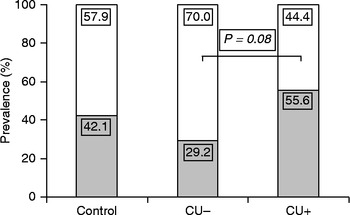
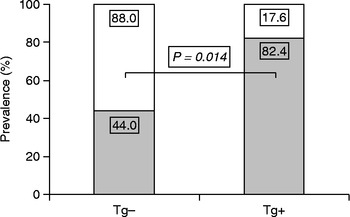
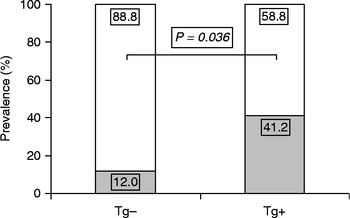
Median anti-Anisakis specific IgE in the CU+ group was 5.6 kU/l (IQR, 2.1–12.3 kU/l). Expectedly, total IgE serum levels were also higher in the CU+ group (median, 240; IQR, 60.8–601 kU/l) than in the CU − group (median, 103.5; IQR, 36.5–157 kU/l; P =0.03). The prevalence of T. gondii infection, measured as specific IgG levels ≥ 35 IU/ml by ELISA, was 42.1% in the control population and 40.5% in all CU patients (not significant). There was a higher prevalence of T. gondii infection in the CU+ than in the CU − group; however, the difference did not reach statistical significance in this bivariate analysis (P =0.08; fig. 1). Patients with IgG anti-T. gondii levels ≥ 35 IU/ml had a higher prevalence of sensitization against aeroallergens than seronegative patients (82.4% versus 44%, P =0.014; fig. 2). Also these patients were mainly sensitized against pollen (58.8% versus 32%, P= 0.08), and less against house-dust mites, mould or animal dander, when compared with the T. gondii-negative group. The prevalence of respiratory symptoms did not differ between the studied groups. Patients with CU and T. gondii infection were more likely to be immigrants (41.2%) than non-infected CU patients (12%, P= 0.036; fig. 3).
The prevalence (%) of Toxoplasma gondii infection assessed by ELISA; Anisakis simplex sensitization associated with chronic urticaria (CU+) and without sensitization (CU − ), positive (grey), negative (white).

The prevalence (%) of atopy relative to Toxoplasma gondii infection in patients with chronic urticaria and independent of Anisakis simplex sensitization; no T. gondii infection (Tg–), seropositivity with T. gondii infection (Tg+), positive (grey), negative (white).

The prevalence (%) of Toxoplasma gondii infection in South American immigrants with chronic urticaria showing seropositivity (Tg+) or no T. gondii (Tg − ); immigrants (grey), non-immigrants (white).

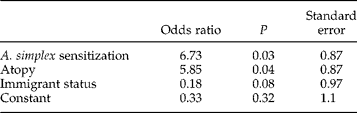
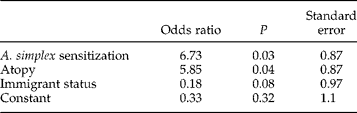
Immigrants in our region are mainly from South America and probably do not have the same fish-eating habits as natives. Since frequent contact with larvae of A. simplex could be less likely in these subjects, a logistic regression model was performed in order to analyse the relationship between A. simplex sensitization, immigrant status and atopy. In this analysis A. simplex sensitization as well as atopy reached statistical significance in explaining a higher probability to be also infected with T. gondii, and the significance of a positive association between immigrant status and T. gondii maintained only a near significant level (table 1). Although, according to Flegr & Stříž (Reference Flegr and Stríž2011), women had the highest probability of T. gondii infection, in our study there were no significant differences regarding sex between both seropositive and seronegative groups. For this reason, this variable was not included in the logistic analysis as an independent variable.
Variables explaining Toxoplasma gondii infection in a logistic regression model.
Discussion
The data of seropositivity as assessed by anti-T. gondii specific IgG determination by ELISA were in accordance with those obtained in previous studies carried out in a European population (50–80%) (Hill & Dubey, Reference Hill and Dubey2002). The comparison of the prevalence of T. gondii infection showed no significant differences between CU patients and controls. When the prevalence of IgG anti-T. gondii was analysed with respect to immigrant status, 70% seropositivity was obtained. This percentage was much higher than the 40.5% obtained in the total group of CU patients. It should be noted that 23.8% of CU patients of the study were Latino-American immigrants. This high prevalence of IgG anti-T. gondii observed in our study is similar to that reported by others in immigrants from tropical countries and is consistent with known higher prevalence rates in regions with ‘poorer’ hygiene. Previous studies have provided significant data on the high seroprevalence of T. gondii in Central and South America (Montoya & Liesenfeld, Reference Montoya and Liesenfeld2004; Ramos et al., Reference Ramos, Milla, Rodríguez, Padilla, Masiá and Gutiérrez2011). Likewise, Ramos et al. (Reference Ramos, Milla, Rodríguez, Padilla, Masiá and Gutiérrez2011) found 41.1% of T. gondii-positives in a study conducted on pregnant immigrants in Spain, compared to 12% of positives in Spanish women. Thus, the Toxoplasma seropositivity data in our CU patients parallel previously known data in the general population.
However, in the study group we detected an unexpected positive association of chronic infection by T. gondii measured by IgG determination and specific IgE against A. simplex as a marker of previous parasitism by this nematode. A synergism between both parasites was observed since 58.82% of T. gondii-positive sera were A. simplex positive. Thus the likelihood of chronic urticaria is enhanced when specific antibodies against A. simplex and T. gondii occur simultaneously. Anisakis simplex is a cosmopolitan fish parasite which is able to produce allergic reactions when fish is consumed raw or undercooked (López-Serrano et al., Reference López Serrano, Moreno-Ancillo, Alonso Gómez and Daschner2000; Alonso-Gómez et al., Reference Alonso-Gómez, Moreno-Ancillo, López-Serrano, Suarez-de-Parga, Daschner, Caballero, Barranco and Cabañas2004). Whereas gastro-allergic anisakiosis (GAA) is accompanied by acute urticaria, angioedema or anaphylaxis in the context of an acute parasitism, in A. simplex associated CU (CU+), the moment of parasitism can not be elucidated by clinical history (Daschner et al., Reference Daschner, Alonso-Gómez, Cabañas, Suárez de Parga and López-Serrano2000, Reference Daschner, De Frutos, Valls and Vega2010b). In any case, a long-term parasitism by this nematode is not possible in humans, as the third-stage larva is not able to survive in the human host for more than a few days. Nevertheless, even in short-lived parasitism as in GAA, where the larva is rapidly expelled, the immunological response produces an important elevation of specific and total IgE and the SPT remains afterwards positive in all forms of human parasitism (Daschner et al., Reference Daschner, Cuéllar, Alonso-Gómez, Pascual and Martín-Esteban2001). This demonstrates the typical Th2-driven immunological feature elicited by helminth parasites, to which A. simplex belongs. However, T. gondii is associated with a Th1-driven immunological response before it produces chronic infection. Thus, our data show that known Th1 response by T. gondii infection is not able to inhibit the Th2 response by A. simplex. For the establishment of the chronic phase of the infection, T. gondii induces the secretion of leukotriene A4, the potent anti-inflammatory action of which decreases interleukin (IL)-12 production (Aliberti et al., Reference Aliberti, Serhan and Sher2002). These low levels of IL-12 could result in increased Th2 cytokines and, therefore, an increased presence of allergic reactions (Yazdanbakhsh & Matricardi, Reference Yazdanbakhsh and Matricardi2004), as occurs after infection by A. simplex. However, the Th2 response by A. simplex is an evolutionarily conserved mechanism that cannot be regarded as an atopy marker (Daschner & Cuéllar, Reference Daschner and Cuéllar2010).
In fact, it is not to be expected that different environments would prevent infectious agents belonging to one Th1 or Th2 associated immune response, to prevent the host from mounting a sufficiently effective immune response to organisms belonging to the other immune response type. Janson et al. (Reference Janson, Asbjornsdottir, Birgisdottir, Sigurjonsdottir, Gunnbjörnsdottir, Gislason, Olafsson, Cook, Jögi, Gislason and Thjodleifsson2007) found no association between levels of IgG antibodies to T. gondii, H. pylori and hepatitis A virus, and total IgE levels in a group of subjects from Iceland, Estonia and Sweden. Similarly, Fernandes et al. (Reference Fernandes, Taketomi, Mineo, Miranda, Alves, Resende, Ynoue, Sung and Silva2010) found no significant differences in total IgE levels measured in T. gondii-positive and T. gondii-negative subjects, although the total IgE levels were significantly higher in atopic individuals of both T. gondii-tested groups. Matricardi et al. (Reference Matricardi, Rosmini, Riondino, Fortini, Ferrigno, Rapicetta and Bonini2000) found no differences in total IgE levels among T. gondii-positive and T. gondii-negative subjects, but different levels of specific IgE aganist different inhalant allergens were observed. Consequently, they proposed that total IgE levels are controlled by different regulatory mechanisms than those that are regulating the levels of specific IgE. However, our results are in accordance with those of Seiskari et al. (Reference Seiskari, Kondrashova, Viskari, Kaila, Haapala, Aittoniemi, Virta, Hurme, Uibo, Knip and Hyöty2007), who found a positive association between total IgE levels and positivity to T. gondii in patients from Finland and Russia. This correlation could be a consequence of the deviation of the immune response towards a Th2 response, resulting from a reduction of the Th1 response, which occurs during the chronic phase of toxoplasmosis. In spite of this immunological explanation, the association of both Toxoplasma and Anisakis parasites is related to environmental factors and dietary habits. Supporting this hypothesis, Jones et al. (Reference Jones, Kruszon-Moran, Won, Wilson and Schantz2008) postulated an association of anti-T. gondii IgG with anti-Toxocara IgG antibodies by a common soil-transmitted infection route. In this case, T. gondii infection was not able to inhibit atopy and, interestingly, our results showed an association between atopy with T. gondii infection. In addition to the previously reported low IL-12 levels in chronic T. gondii infection (Yazdanbakhsh & Matricardi, Reference Yazdanbakhsh and Matricardi2004), Perona-Wright et al. (Reference Perona-Wright, Mohrs, Szaba, Kummer, Madan, Karp, Johnson, Smiley and Mohrs2009) identified the same effect induced by natural killer (NK) cells that rapidly express IL-10 during acute toxoplasmosis.
Two arguments highlight the straightforward positive association of atopy and T. gondii infection in CU patients. The multivariate analysis demonstrates that atopy and A. simplex sensitization are both independent variables explaining risk of T. gondii infection. Further, even if A. simplex sensitization has previously been associated with house-dust mite (HDM) sensitization (Daschner et al., Reference Daschner, Cuéllar and Valls2008), in the present study HDM sensitization did not account for the atopic sensitization, which was due mainly to pollen sensitization (data not shown). We observed a positive association close to significance between positivity to T. gondii and pollen sensitization. On the other hand, positivity to T. gondii has been reported to reduce allergic sensitisation against the major allergen of birch pollen (Bet v 1), determined by the levels of specific IgE to Bet v 1 in BALB/c mice experimentally infected before sensitization (Wagner et al., 2009). Our results suggest that the presence of IgG anti-T. gondii is a risk factor for atopy in patients with chronic urticaria. When analysing with respect to the hygiene hypothesis, our results would render both analysed organisms as associated with ‘poor’ hygiene, thus conferring A. simplex, like T. gondii, a possible anti-inflammatory role, consistent with the better prognosis of sensitized versus non-sensitized CU patients (Daschner & Pascual, Reference Daschner and Pascual2005). On the other hand, whereas helminth parasitism has mainly been associated with protection against atopy in developing countries, A. simplex only produces acute parasitism and is not able to produce sufficient regulatory features, an equivalent to sporadic parasitism, proposed to be positively associated with atopy (Yazdanbakhsh & Matricardi, Reference Yazdanbakhsh and Matricardi2004).
The study protocol was not designed to assess the described associations in the general population, so we can not generalize our results and have to interpret them in the context of our studied patients. There is not sufficient knowledge of immunological mechanisms associated with CU in order to characterize this entity as a well-defined immunological abnormality. CU has not been associated with a Th1 or a Th2 phenotype, and in the present study, as a whole group, T. gondii sero-positivity was similar to that of our control group. Higher pro-inflammatory cytokines such as IL-6 and tumour necrosis factor (TNF)-α have been associated with disease severity (Dos Santos et al., Reference Dos Santos, Azor, Nojima, Lourenço, Prearo, Maruta, Rivitti, da Silva Duarte and Sato2008). A possible dysregulation in the Th17/Treg axis rather than the Th1/Th2 axis has also been proposed (Daschner et al., Reference Daschner, Rodero, De Frutos, Valls, Vega, Blanco and Cuéllar2011). Thus, we can not rule out that the, up to now poorly characterized, immunological features of CU are associated with both a Th1 and Th2 response against infectious agents.
Toxoplasma gondii belongs, together with hepatitis A virus and H. pylori, to the food-borne, orofecal micro-organisms, which have been associated with a lower prevalence of atopy (Ellertsen et al., Reference Ellertsen, Hetland and Lovik2008). In contrast, Bodner et al. (Reference Bodner, Anderson, Reid and Godden2000), Linneberg et al. (Reference Linneberg, Ostergaard, Tvede, Andersen, Nielsen, Madsen, Frølund, Dirksen and Jørgensen2003) and Janson et al. (Reference Janson, Asbjornsdottir, Birgisdottir, Sigurjonsdottir, Gunnbjörnsdottir, Gislason, Olafsson, Cook, Jögi, Gislason and Thjodleifsson2007) observed no differences between the percentages of T. gondii-positive individuals in groups of patients diagnosed as atopic and non-atopic in studies in Iceland, Estonia, Sweden, Denmark and Scotland. The opposite finding in our studied group gains special interest, as H. pylori is one of the infectious agents for which a possible aetiological role has emerged in the study of CU (Wedi et al., Reference Wedi, Wagner, Werfel, Manns and Kapp1998). Thus, future studies should focus not only on the possible positive association of infectious agents with CU, but also on the possible different prognosis (mainly severity and duration) and its relationship with distinct pro- or anti-inflammatory cytokine production (Bermudez et al., Reference Bermudez, Covaro and Remington1993). We previously compared pro- and anti-inflammatory as well as Th1- and Th2-associated serum cytokine levels in CU+ and CU − patients. Although serum levels of IL-10 and interferon (IFN)-γ were lower in CU+ and CU − subjects with respect to the control group, CU+ patients displayed higher transforming growth factor (TGF)-β levels than CU − subjects and controls (Daschner et al., Reference Daschner, Rodero, De Frutos, Valls, Vega, Blanco and Cuéllar2011). Furthermore, cytokine production of peripheral blood mononuclear cells from CU+ and CU − patients was studied, observing that after stimulation with A. simplex extract IL-2, IL-4 and IFN-γ production was higher in CU+, while Concanavalin A-induced IL-6 and IL-10 production was also higher in CU+ (Daschner et al., Reference Daschner, Fernández-Fígares, Valls, de Frutos, Rodero, Ubeira and Cuéllar2013). Both studies demonstrated that different clinical and immunological phenotypes of urticaria are associated with distinct cytokine levels. For this reason the role of cytokines in protection against atopy in the course of T. gondii infection or A. simplex parasitism need to be clarified. In conclusion, our data show in CU a positive and independent association of T. gondii infection with past A. simplex parasitism as well as with an atopic status.
Financial support
This study was supported partly by Mutua Madrileña (A.D.), Sociedad Española de Alergología e Inmunología Clínica (A.D.) and Fundación Ramón Areces (C.C.).
Conflict of interest
None.
Ethical standards
The authors assert that all procedures contributing to this work comply with the ethical standards of the relevant national and institutional committees on human experimentation and with the Helsinki Declaration of 1975, as revised in 2008. The project was approved by the Ethics Committee of the University Hospital de la Princesa, Madrid.