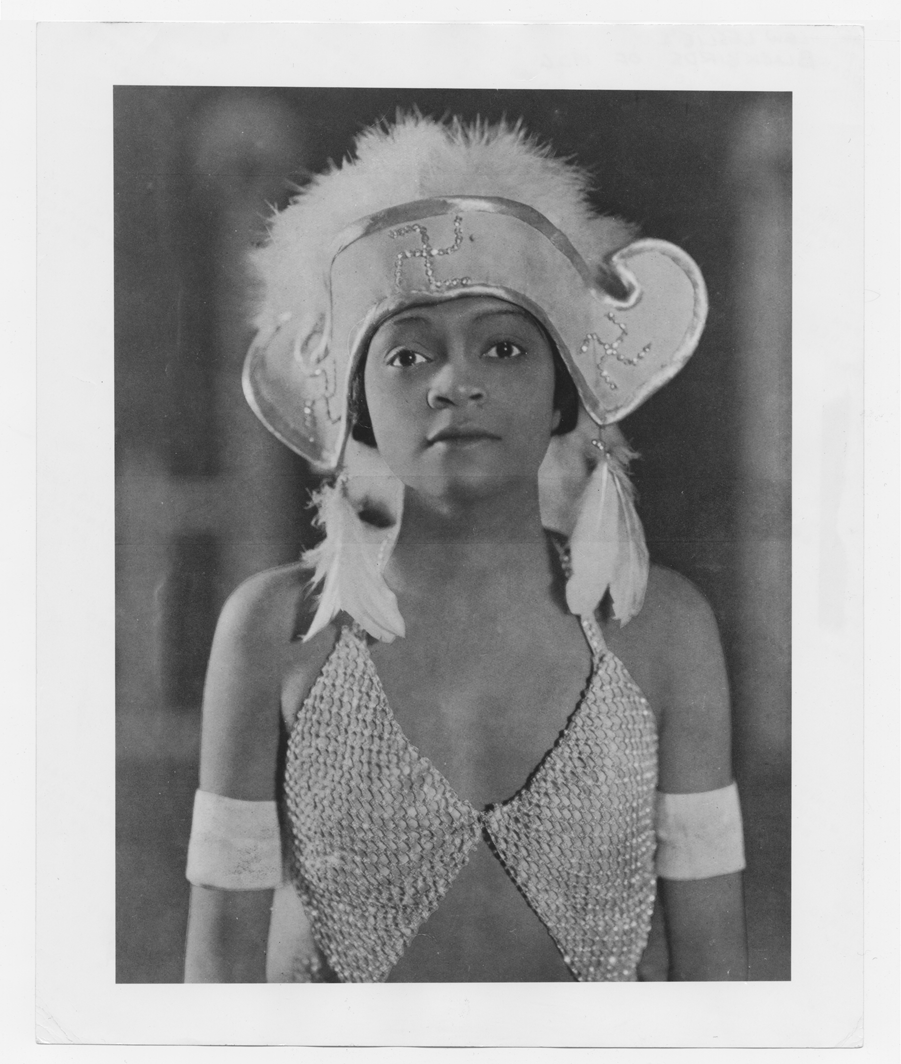
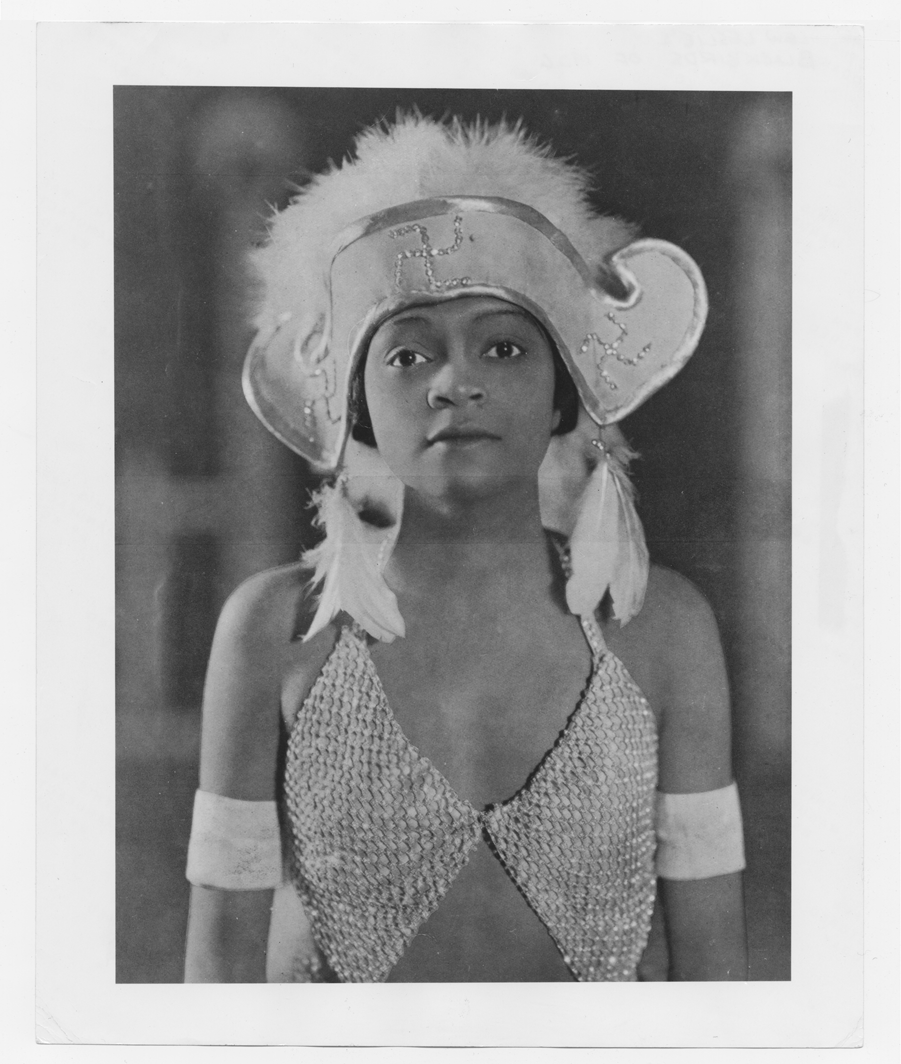
When Florence Mills died in 1927, her funeral drew the largest crowd Harlem had ever seen.Footnote 1 Over one hundred thousand people lined the streets to honor the first Black entertainer to achieve international success. She was known as the “Queen of Jazz,” and her music represented what the Baltimore Afro-American described as “the spirit of youth struggling against oppression.”Footnote 2 Her legacy inspired elegies such as Fats Waller's “Bye, Bye Florence” (1927) and Duke Ellington's “Black Beauty” (1928). Mills was an icon of the New Negro Renaissance, and she shaped the movement's political and international scope. Her career started at the age of five, when she won a cakewalk contest at a Black Patti Troubadours performance in Washington, DC in 1900. She was then added to Bert Williams's and George Walker's Sons of Ham singing “Hannah From Savannah,” a song Aida Overton Walker made famous. By 1916, she was performing regularly with Ada “Bricktop” Smith and Cora Green at the Panama Café in Chicago and joined the Tennessee Ten, an early jazz band, one year later. She debuted on Broadway in 1921, performing the lead female character in Noble Sissle's and Eubie Blake's Shuffle Along—the first all-Black musical since Bert Williams's and George Walker's Bandanna Land (1908). Mills then acquired international fame with her overseas performances in the musicals Dover Street to Dixie (1923), Dixie to Broadway (1924), and Blackbirds (1926–27) (Figure 1).Footnote 3
Publicity photograph of Florence Mills in costume for the stage production Blackbirds of 1926. Billy Rose Theatre Division, The New York Public Library. “Florence Mills.” New York Public Library Digital Collections.
She used her fame as a political platform to articulate the ambitions of Black Americans.Footnote 4 Beginning in 1924, Mills became increasingly vocal about racial inequality after spending time in London, where, like many Black artists, she laid claim to greater freedom and less discrimination.Footnote 5 Stories circulated in the Black press about her courageous challenges to Jim Crow segregation in the music theater industry. For example, she declined to take the lead in a play that reportedly “degraded the race.”Footnote 6 At an after party celebrating Blackbirds, she also refused to leave her Black cast members at dinner to join the white guests, saying “I am coal Black and proud of it.”Footnote 7 Just before her death, she wrote an article, “The Soul of the Negro,” addressing the effects of white supremacy on the day-to-day realities of Black lives. Echoing W. E. B. Du Bois's “double consciousness” theorized in his similarly titled book, The Souls of Black Folk (1903), Mills wrote: “It is the eternal burden of the coloured people—the penalisation for an accident of birth—to be made to feel out of focus with the rest of humanity. . . . How absurd it all is—how utterly unfair!”Footnote 8 Ten years prior, Aida Overton Walker extoled the virtues of Black American performance to the Black press. Likewise, Mills made racial equality integral to her star persona, but her writing directly confronted white supremacy, reflecting the political tenor of the New Negro movement.
So, too, did her music. As Zakiya Adair and Jayna Brown have argued, Mills used her songs as well as her costumes and choreographies to radically negotiate and resist vaudeville's slave culture constructions of race and gender stereotypes.Footnote 9 Her most famous song, “I'm a Little Blackbird” (1924) by Grant Clark and Roy Turk, parodied racist misconceptions about Black entertainers (Appendix). In it, Mills mocks stereotypes of Black musicians with a direct confrontation of one of the most pejorative terms associated with her profession: jazzbo, a racial slur used to mark Black musicians, in particular, and Black Americans, in general, as vulgar and less human. Verse two challenges reigning concepts of racial difference: “Tho’ I'm of a darker hue, I've a heart the same as you.” Biographer Bill Egan incisively described this song as a “powerful protest against racial intolerance.”Footnote 10 Mills agreed. In “The Soul of the Negro,” she said the song represented “the inner feeling of the colored people” and likened these feelings to the experience of “a small boy flattening his nose against a pastry-cook's window and longing for all the good things on the side of the pane.” She linked this imagery to the first verse in “I'm a Little Blackbird.” “Never had no happiness. Never felt no one's caress. I'm just a lonesome bit of humanity. Born on Friday, I guess. … If the sun forgets no one, why don't it shine on me. I'm a little blackbird looking for a bluebird, too.” “[The boy],” she says, “wants so badly to ‘belong’—and as yet there is no place for him.”Footnote 11 Mills incisively writing about Black life in the Jim Crow United States extends a tradition of Black women intellects such as Ida B. Wells, Gwendolyn B. Bennett, and Zora Neal Hurston. Mills used both her singing and writing voices to express “the higher and more modern ambitions of Negro Youth.”Footnote 12
Despite her fame, there are no extant recordings of her voice. Following the international success of Dixie to Broadway, Mills was invited to Victor Recording Studios. On December 12, 1924, she recorded “Blackbird” and “Dixie Dreams,” but, according to blues singer Edith Wilson, “her tiny voice didn't register well on the primitive recording equipment and sounded nasal [sic] and tinny.”Footnote 13 Wilson's comment says less about Mills's voice and more about 1920s acoustic recording technology, which was less favorable toward soprano voices or anyone not willing to place their head very close to, if not inside, the phonograph horn.Footnote 14 As a result of the poor sound quality, no pressings were made. There are no other known instances of Mills recording, and she died in 1927 at the early age of thirty-one from complications following a surgery to treat her pelvic tuberculosis.
Mills left traces of her voice in other places, however. Beyond the countless vaudeville numbers written for her voice, she drew the attention of music critics, fans, socialite columnists, and New Negro intellects that wrote extensive descriptions of her vocal capacities. These descriptions, as I demonstrate below, serve as a cartography of her voice. Many, written by white listeners especially, were shaped by gendered and racialized biases, making it hard to hear her voice otherwise. I consider the sound of Florence Mills's voice in other primary texts: Edmund Thornton Jenkins's Afram (1924), an unfinished operetta with a lead part written “for the likes of Florence Mills” and never performed, and William Grant Still's Levee Land (1925), written for and performed by Mills for an International Composers’ Guild concert. Afram narrates an African diasporic love story. Levee Land is a four-song suite featuring vaudeville numbers backed by a jazz chamber ensemble. Both are vocal, jazz-based compositions, which merge Black popular music and high art compositional techniques. Both challenge the boundaries between music coded “white” and music coded “Black.” Acutely aware of the limitations placed on Black musicians and performers, Jenkins and Still actively debunked stereotypes of Black musicality and self-expression through their approaches to style, genre, and representation of the Black characters in their works.Footnote 15 For this reason, their works offer insight into the sonic properties of Mills's voice. I argue that Jenkins and Still sought to depict a voice that could betray the reductive stereotypes of her reception in print and strengthen her position as a New Negro leader.
The absence of recordings has not inhibited scholars from speculating about what performers sounded like. To the contrary, it has inspired quite imaginative scholarship. Curiosity about male originality and virtuosity has recently driven countless articles and monographs seeking to resuscitate the lost sounds of men—Nicolo Paganini and Farinelli among them. Historians of early jazz portray Buddy Bolden, who made no sound recordings, as “the father of jazz.”Footnote 16 Bolden is regularly mythologized from Jelly Roll Morton's song “Buddy Bolden Blues” (1939) to Daniel Pritzker's 2019 film Bolden. Wynton Marsalis claims he “could play so loud, he could make the rain stay up in the sky.”Footnote 17 Donald Marquis spent a decade researching In Search of Buddy Bolden, which provides meticulous accounts on where and when Bolden might have played in order to hypothesize about how he sounded.Footnote 18 Though these speculations about Bolden work to reconstruct a history lost to white supremacy, as records of Black lives were not often preserved, they also serve mythological narratives about great men by fetishizing reconstructions of sound through lore.
Recent scholarship by Daphne Brooks, Paige McGinley, and Saidiya Hartman challenges this myopic perspective by making legible the ephemeral performances of Black women in the early twentieth century. Hartman, in Wayward Lives, Beautiful Experiments, sutures together unfathomable narratives about Ida B. Wells and Billie Holiday, among others, from her deep knowledge of Black culture in spite of the dearth of archives. Hartman “elaborates, augments, transposes, and breaks open archival documents so they yield a richer picture of the social upheaval that transformed black social life.”Footnote 19 McGinley, in Staging the Blues, centers women in blues history by tracking choreographies, costumes, and scenic design of live theatrical performances, a tradition dominated by women, instead of analyzing fixed musical and lyrical texts, which often center around men.Footnote 20 In Bodies in Dissent, Brooks analyzes the dissonance between white audience expectations and the brilliant self-fashioning of Black performers such as Aida Overton Walker.Footnote 21
Like Brooks, McGinley, and Hartman, I read against the gendered limits of the archive, locating the alternative ways Black women made their voices audible. I am not pursuing an authoritative recovery of Mills's voice. Instead, I want to draw attention to its significance just as Daphne Brooks and Bonnie Gordon shift focus to the sounds of Zora Neale Hurston's archive—her recordings and her “stunningly sonorous” writing, as Gordon puts it.Footnote 22 I do this by examining how other members of the New Negro movement, in this particular instance, two men, heard and responded to Mills's voice. To pursue her voice in the compositions of men may seem to risk reinforcing the very androcentric project I critiqued above. However, as much of the research on the New Negro Renaissance demonstrates, Black men and women worked jointly toward achieving the movement's goals through expressive culture.Footnote 23 Furthermore, as bell hooks trenchantly states, “Despite sexism, black women have continually contributed equally to anti-racist struggle, and frequently, before contemporary black liberation effort, black men recognized this contribution.”Footnote 24 Just as Hartman creates an imaginary Oscar Micheaux film to explore Gladys Bentley's queer masculinity, and as Brooks turns to George Walker's and Bert Williams's Bandana Land to argue that Aida Overton Walker refashions the Black female sexual body in her Salome dance, I too demonstrate that these compositions, though certainly part of a racialized, classed, and gendered matrix, have much to offer in the way of hearing Mills's voice. In Jenkins's and Still's political and musical interactions with Mills, I suggest they heard in her a capacity to “disturb” (following Brooks) racist Black female stereotypes.
Jenkins and Still composed for Mills according to how they regarded her—as a Black feminist leader, whose voice reverberated the ethos of the New Negro Renaissance and the movement's capacity to bridge Black culture and politics. However, Still and Jenkins do this in different ways, requiring different methodological approaches. Because Levee Land was written for Mills and performed by her for an International Composers’ Guild concert, I treat Still's score as a vocal recording, gleaning information about Mills's vocal range, weight, timbre, and passaggi. I compare this “recording” to contemporary reception of Mills's voice. My music analysis shows a difference between the ways 1920s audiences wrote about her voice and how Still imagined her voice in his piece. Afram was incomplete and never performed, and only the vaudeville section of the operetta was written “for the likes of Mills,” as Jenkins wrote in his manuscript. Unlike Levee Land, this composition does not serve as an avenue for exploring the technical capacities of her voice. It only features a few stock vaudeville musical numbers she might have sung had it been performed and had she been hired to perform it. Instead the composition reveals more about her as a political icon of the New Negro movement because the character, as leader of the Charleston troupe, carries great narratological weight when she guides and unites Black migrating subjects across the Atlantic Ocean. I argue, however, that Jenkins's decision to position Mills as a Black diasporic leader is not divorced from the sonic properties of her voice but rather intrinsically linked to them. By putting these two works in dialogue with one another, I examine how the sound of her voice helped further the goals of the New Negro movement. While scholars have written about how Mills's interviews and repertoire made her central to 1920s Black political life, I suggest the sonic properties of her voice also facilitated her unique political position.Footnote 25 Before turning to Levee Land and Afram, I discuss written commentary on Mills to establish the ways her voice might have sounded and might have been misheard by Jim Crow audiences.
“Throbbing Like a Bird”: Writing Mills's Voice
Descriptions of Florence Mills appeared frequently between 1921 and 1927 in the Black and white press, in US and European publications, and in personal accounts and works of literature. Writers most often compared her voice to birds and sometimes flutes—highlighting both her high range and pure timbre. American critic Paul Rosenfeld said her voice was so pure “it was not a human voice at all.”Footnote 26 Mills was a soprano, and many listeners commented on her “sweet,” “pure,” and “delicate” voice, indicating that she did not have noticeable passaggi and relied mostly on her “head voice” register—or what is now more commonly referred to, among vocal pedagogues, as CT dominance.Footnote 27 Critics wrote about Mills's wide range and the ease with which she navigated it.Footnote 28 Like the flute to which she was compared, her attack was gentle, her vocal weight was light, suggesting her pitch was precise, and florid vocal lines came easily. Her voice stood in contrast to other singers such as Bessie Smith and Josephine Baker, to whom she was compared. For Alberta Hunter, Mills “was a hummingbird and dainty and lovely. Her little voice was as sweet as [Bessie Smith's] was rough.”Footnote 29
Some listeners describe a “bubbling” sound in her voice—a “little pulse in her throat, throbbing like a bird,” which I interpret as referring to her vibrato.Footnote 30 One critic claimed she had “heart-taking bubbles of sound thronging out of her throat like champagne from a bottle.”Footnote 31 These descriptions imply that her vibrato was fast and narrow. Since Mills's voice was quiet, she would naturally have a smaller vibrato. Hers did not disturb the pitch but rather enhanced it, giving her flute-like voice depth and warmth.Footnote 32 British author Beverly Nichols said her voice was “distinctly silvery” and described her singing as “high silver notes like beams of light, floating into the dark auditorium.”Footnote 33 Such a description elucidates the way in which her vibrato created a luscious tone.
These descriptions do not come without bias; the racial logic of Jim Crow structured how audiences listened to and consumed music. Jennifer Stoever, in The Sonic Color Line, calls this “willful white mishearings and auditory imaginings of blackness” designed to keep the racial status quo intact.Footnote 34 She argues that listening operated “as an organ of racial discernment.”Footnote 35 This prejudice ran deep within the music industry, too. According to Karl Hagstrom Miller, in Segregating Sound, Northern recording industry men believed Black and white musicians sounded demonstrably different from each other, so much so that they recorded and marketed “race” and “hillbilly” records separately, despite commonalities between Black and white musicians.Footnote 36 This imposed musical color line was successful, in part, because consumers believed they could hear race.
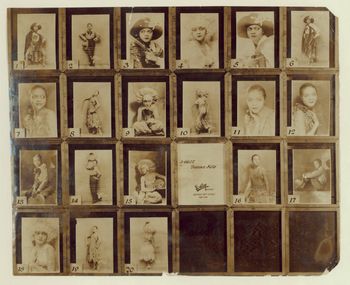
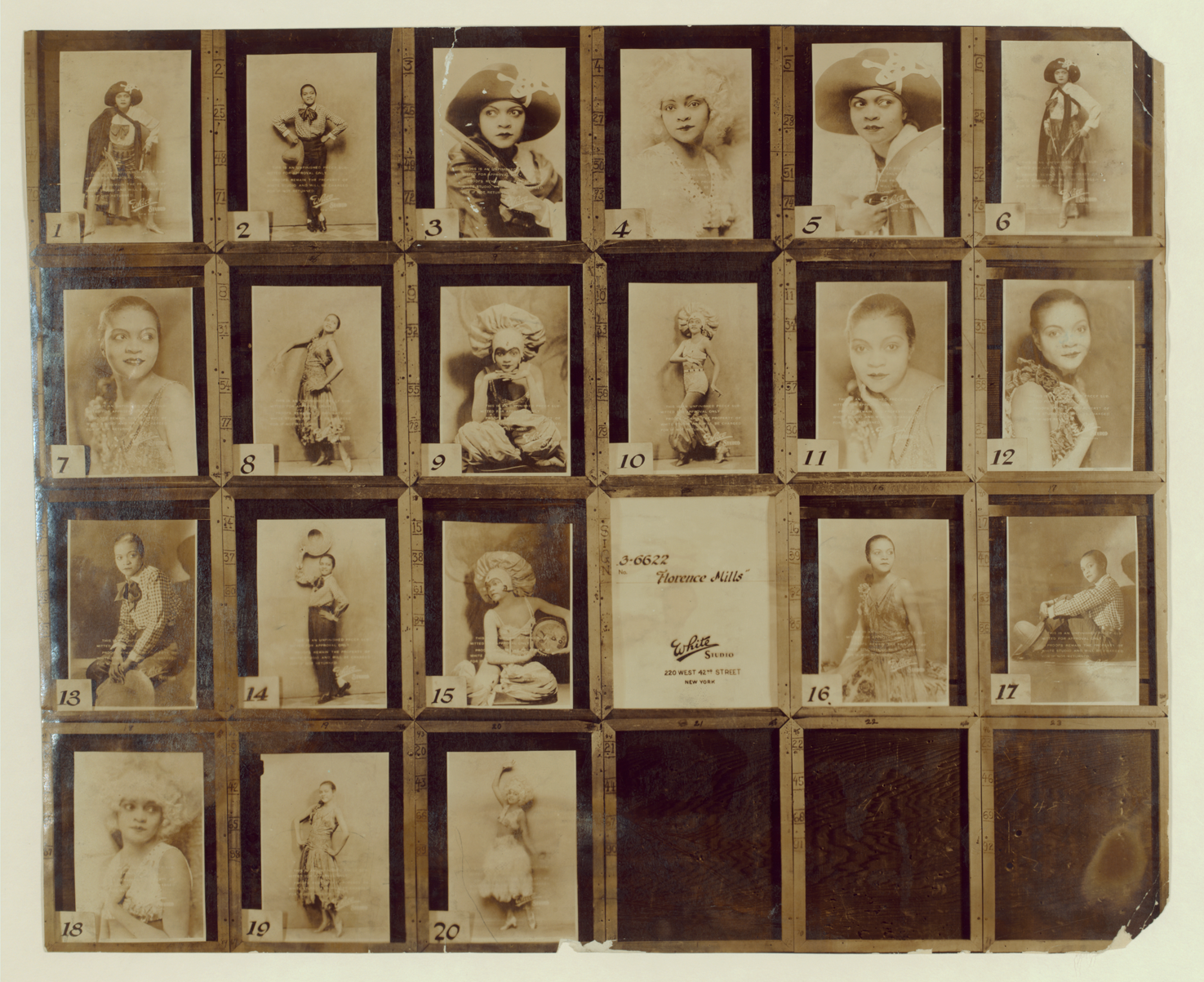
Mills's reception, rife with gendered and racialized stereotypes, reflects these biases. As Daphne Brooks has argued, Black women's bodies are “systematically overdetermined and mythically configured.” Drawing on Hortense Spillers, Brooks continues: “Hegemonic hermeneutics consistently render black women's bodies as ‘infinitely deconstructable “othered” matter’.”Footnote 37 Oversignified, Black women are interpreted through one-dimensional tropes. Mills was considered “boyish,” making her cross-dressing more convincing. She played a plantation boy with a hobo's bundle in Dover Street to Dixie's “Down Among the Sleepy Hills of Ten-Ten-Tennessee” and a groom, wearing a tuxedo, in Dixie to Broadway's “Mandy, Make Up Your Mind” (Figure 2). About her androgyny, the New Statesmen wrote: “She is a fascinating creature to look at with those skinny legs and the body of some athletic boys of thirteen or fourteen, black smoothed bobbed hair and a large, very large, Negro mouth. Perhaps her chief charm is that she is neither man nor woman nor boy nor girl but adolescent.”Footnote 38 Audiences interpreted Mills's androgyny through the lens of sexuality. Pitted against other Black performers such as Josephine Baker and Mamie Smith, whose sexuality was a key feature of their personas, Mills toggled between childlike sexuality and sophisticated virtue. According to Andy Fry's study of her reception, Mills was a “chaste and modest” “black fairy”—“most civil and most civilized”—while Baker was a “demon”—“wild and impromptu,” “barbaric and hot.”Footnote 39 Literary scholar Jayna Brown astutely points out that Mills's petite, angular body, brown skin, and lack of overtly sexual songs in her performances led some white critics to interpret her within the lens of primitivist modernism.Footnote 40 The Evening Mail writes about her as if she is a pre-modern figure in one of Pablo Picasso's paintings or an Umberto Boccioni sculpture. She is “strung on fine and tremulous wires” with a “grace of grotesque.” “She is an exotic done in brass.”Footnote 41
Florence Mills in various costumes. Billy Rose Theatre Division, The New York Public Library. “Florence Mills.” New York Public Library Digital Collections.
Mills's brown skin and petite frame had nothing to do with the physiological properties of her vocal folds. Or, to put it in the words of musicologist Nina Sun Eidsheim: “the sound of the voice is not the emission of an a priori essence.”Footnote 42 But many believed a singer's timbre was related to the melanin levels of their skin—a holdover from nineteenth century pseudo-science, in which intellectuals such as Manuel García and François-Joseph Fétis devised race-based hierarchies to determine what they perceived to be essential aural differences between cultures.Footnote 43 Originally designed to justify colonialism, pseudo-scientific hierarchies were revised to reinforce segregation in the United States during Mills's lifetime.Footnote 44 These ideologies shaped responses to Mills's voice. The focus on purity in her reception might very well be a response to her androgyny, petite stature, and omission of overtly erotic songs instead of a feature of her voice. The compositions of Jenkins and Still offer a more nuanced avenue for listening to the sound and syntax as well as the symbolic meanings of Florence Mills's voice.
Modernist Mills
When William Grant Still (1895–1978) asked Mills if he could compose a concert music piece for her, he was deeply seated in the Black entertainment industry but also gaining acceptance in white ultra-modernist circles. In the 1920s, Still arranged and orchestrated for Will Vodery, Eubie Blake, Sophie Tucker, James P. Johnson, Donald Voorhees, and Paul Whiteman.Footnote 45 He played in and helped orchestrate and direct Shuffle Along (1921), The Plantation Revue (1922), Runnin’ Wild (1923), Dixie to Broadway (1924), Earl Carroll's Vanities of 1926, and Rain or Shine (1928).Footnote 46 The multi-instrumentalist taught himself how to play the saxophone, oboe, and clarinet, among other instruments and played in the Clef Club Orchestra, Fletcher Henderson's dance orchestra, Will Vodery's Plantation Orchestra, and the Harlem Symphony Orchestra. He worked for W. C. Handy's Pace & Handy Publishing Company from 1919 to 1920 and the Black Swan Phonograph Company from 1922 to 1925. At the same time, he had a budding composition career. After studying with George Whitefield Chadwick in the 1910s, he began studying with Edgard Varèse in 1922. Two years later, he had composed three experimental compositions: From the Land of Dreams (1924), Darker America (1924), and From the Journal of a Wanderer (1924). The first of these was a three-movement work for chamber orchestra and three voices, “used instrumentally,” and it premiered in 1925 at a concert for the International Composers’ Guild (ICG), an organization Varèse and Carlos Salzedo created in 1921 to foster “vital and progressive” music.Footnote 47 The premiere's audience featured many prominent white men in the world of classical music, including Carl Van Vechten, George Gershwin, and Arturo Toscanini.Footnote 48
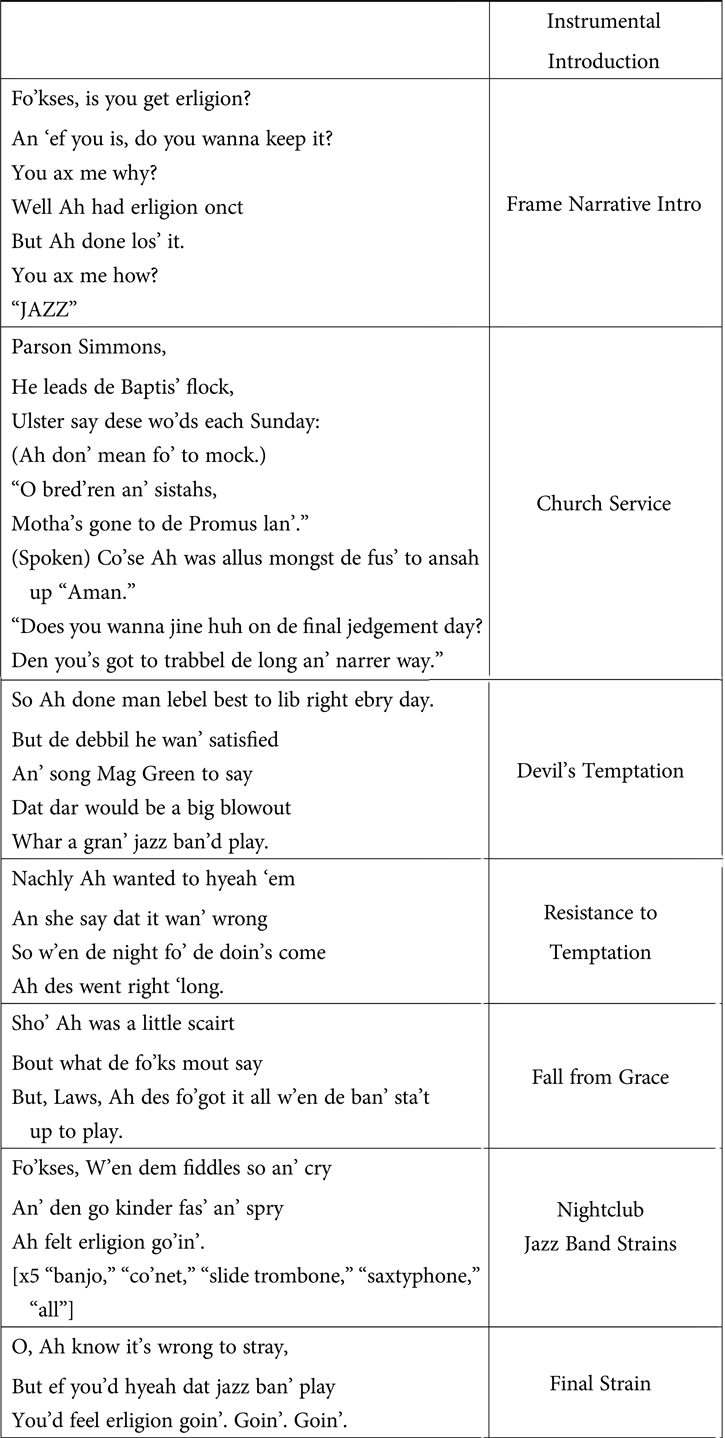
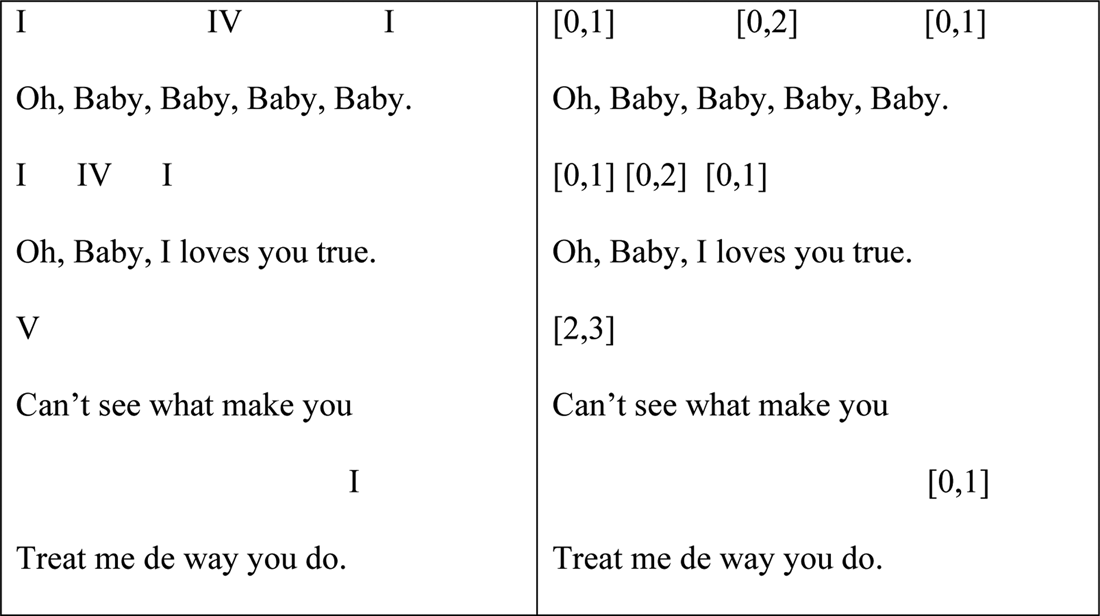
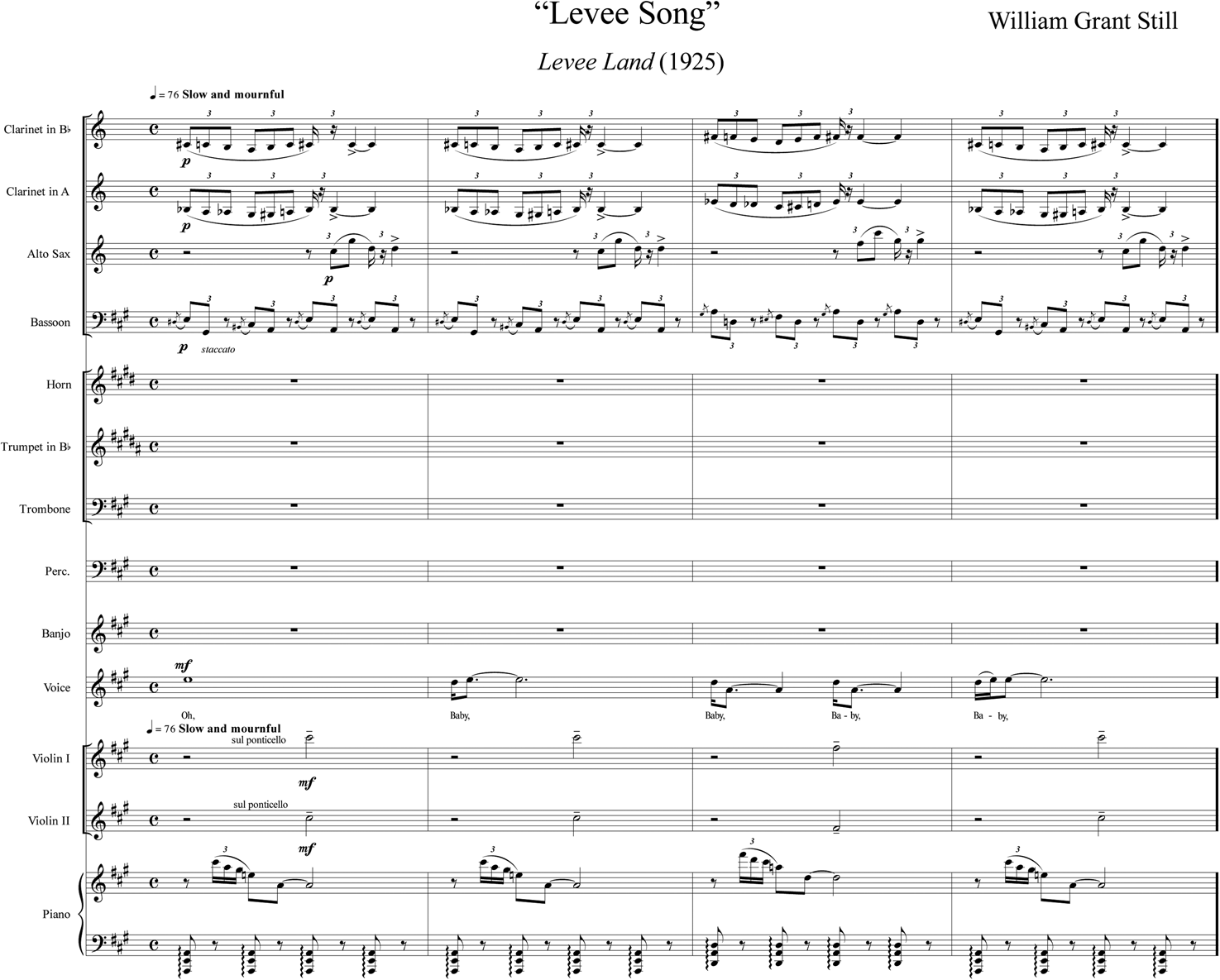
After this performance, he wrote Levee Land—a four-song suite for soprano and “jazz orchestra” (two violins, two clarinets, bass clarinet, alto saxophone, bassoon, horn, trumpet, trombone, tenor banjo, piano, and an onslaught of percussion).Footnote 50 It was modernist to its core; the piece featured octatonicism, experimental forms, and an avant-garde approach to scoring the voice. The first song, “Levee Song,” is a blues number about a woman being mistreated by her lover. It is chalk full of jazz band riffs common in 1920s arrangements, and Still uses the three octatonic scales as if they are the I, IV, and V7 chords of a blues number (Figure 3). “Hey-Hey” is a very short song—under a minute long—with three iterations of the same spoken text “HEY-HEY” dividing the through-composed piece into three phrases. Much like the percussion in Varèse's Amériques (1921) and Hyperprism (1924), rapid changes in articulation and instrumentation pack the measures full of directives: the woodblock in one measure, the tom-tom and bass drum (struck with a snare drum stick) in the next, then the gong immediately after with only a measure rest before the wind whistle enters.Footnote 51 These minute gestures create a mercurial landscape redolent of Alban Berg's Seven Early Songs (1905–1908). Still continues to use the voice as an instrument in the ensemble in “Croon,” where the soprano hums a mostly monophonic texture with the violin for nearly four minutes. The final number, “The Backslider,” draws on a host of vaudeville norms, as it tells the story of the sinful proclivities of a young Christian woman, who blames jazz for her fall from grace (Appendix). Its parody of white misconceptions about Black music reveals a striking connection to Mills's signature song “I'm a Little Blackbird.” Here, again, Mills plays a Black entertainer poking fun at her white audience. Mills's performance of this last song was so successful at its premiere in 1926 at Aeolian Hall for the ICG that the audience asked her to sing it again.Footnote 52
Octatonic Collections Representing a Blues Harmonic Progression, “Levee Song,” Levee Land (1925), William Grant Still.Footnote 49
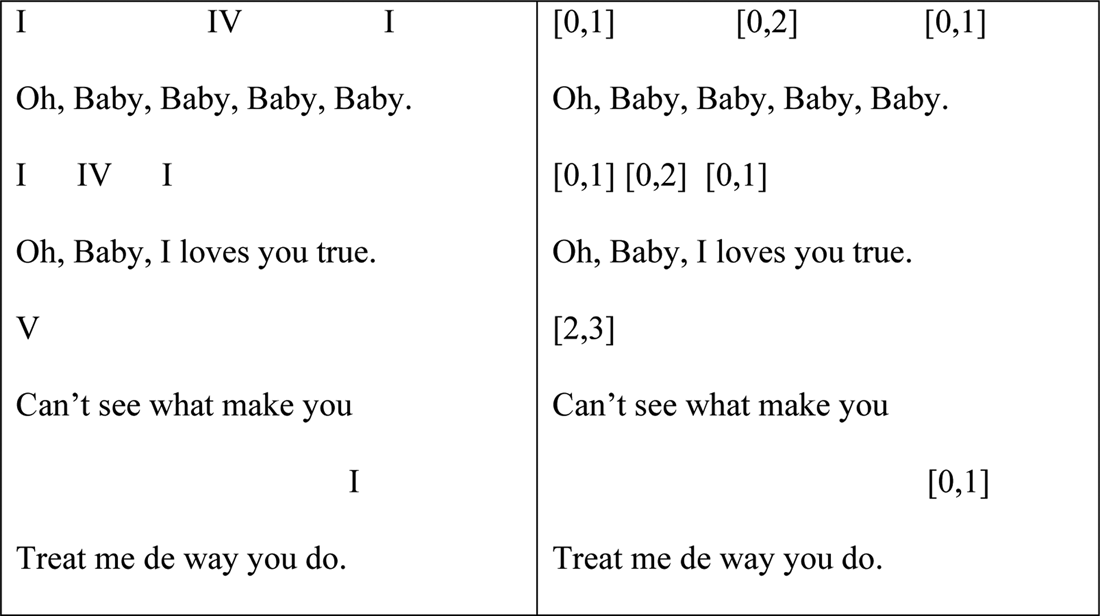
Mills's commitment to racial equality, and her sophisticated appropriation of vaudeville stereotypes made her a logical choice for Still's vocal composition, which emphasized the artistic merit of jazz and blues. Yet the role of entertainment in the fight for equality was a contested issue in Black communities, because its roots were woven deeply into the soil of slavery. “The union of theatrical display and constructions of blackness is deeply related to the philosophical enterprise of slavery,” writes performance studies scholar Soyica Diggs Colbert.Footnote 53 Black elites might have been tempted to write Mills off as a cheap entertainer performing for racist white audiences, especially as she moved from Black-produced US entertainment (Shuffle Along) to white-produced entertainment overseas (From Dover Street to Dixie). This was not the case. As Jayna Brown observes: “[Mills's] outspoken race loyalty seemed to quiet black anxieties about the deleterious effects of cosmopolitanism and commercialism.”Footnote 54 New Negro editor Alain Locke, who was especially critical of commercial culture, hailed the dramatic gifts of Mills for “gleaming through” the “slag and dross” of the vaudeville stage.Footnote 55 Locke, among others, especially praised Mills for developing a more respectable approach to sexually elicit and primitivist stock characters. James Weldon Johnson writes: “She could be whimsical, she could be almost grotesque; but she had the good taste that never allowed her to be coarse. She could be risqué, she could be seductive; but it was impossible for her to be vulgar, for she possessed a naiveté that was alchemic.”Footnote 56
By the time Still composed Levee Land, Mills's performances occupied the interstitial spaces of the high-low cultural divide, and she had created a star persona centered on equal rights. To articulate connections between Black popular and modernist concert music, Still scored Mills in ways that were both consistent with and a challenge to stage theater norms. Levee Land elucidates characteristics of Mills's voice that betray the limited focus in written commentary on her pure timbre and high range. Instead he emphasizes her intonation, wide range (on both ends of the spectrum), improvisational skills, and timbral diversity. Still's scoring was informed by working with Mills in Shuffle Along and Dixie to Broadway, and the positive press she received after the performance suggests that he knew Mills's voice well and that she can hold court in a high modernist context.Footnote 57
Levee Land relied more heavily on blues and jazz idioms than did the previous pieces Still wrote while studying with Varèse. This shift might have been a response to the less-than-favorable reviews he received from his first concert with the ICG. Olin Downes had “hoped for better things from [Still]” since he was so familiar with “the rollicking often original and entertaining music performed at negro revues.” Sardonically, he asked: “Is Mr. Still unaware that the cheapest melody in the revues he has orchestrated has more reality and inspiration in it than the curious noises he has manufactured?”Footnote 58 However, Still does not simply quote more revue melodies in Levee Land; instead, he eradicates the distinction between Black music and modernist composition altogether. Though Still exploited the dual stereotypes of both Black music and modernist compositions being noisy, his methodical approach to Levee Land suggests he felt a genuine kinship between the two musics that prods at the notion they were ever antithetical: the instrumentation extends traditions of the Second Viennese School as well as 1920s jazz orchestras; the distinction between the octatonic and blues scales is elided and chromaticism can just as easily be heard as the flexible intonation of Black folk music; instrumental approaches to the voice reflect the influences of both jazz and Schoenberg (this is Still's Pierrot Lunaire, according to Gayle Murchison); and rapid shifts in texture, articulation, and dynamics were integral to both ultra-modernism and Black entertainment.Footnote 59 Still's composition definitively asserts: Jazz is modernist.
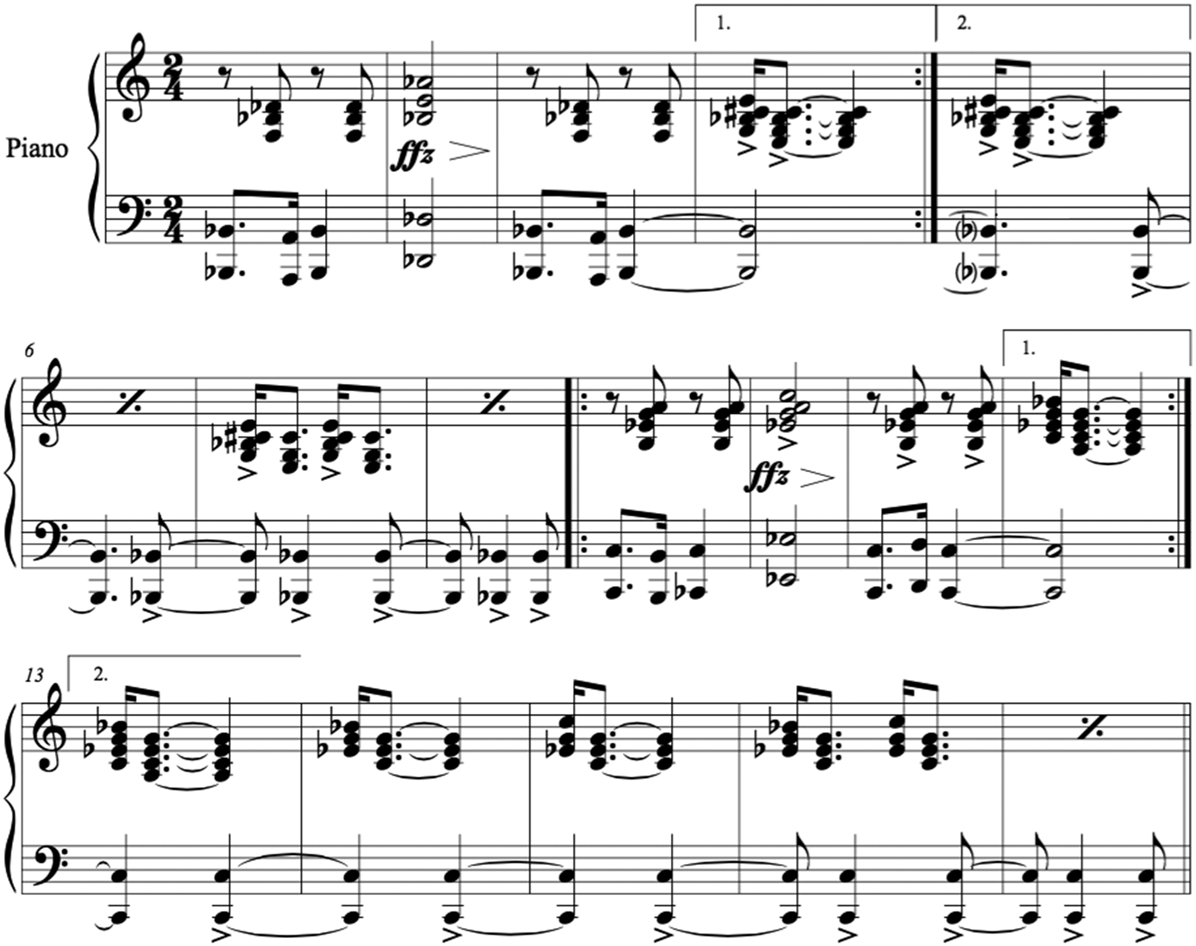
Levee Land attests to the Broadway singer's faultless intonation. Still uses her precise pitch to communicate the similarities between blues harmonies and a modernist pitch collection. Mills sang either a pentatonic or blues-based melody while the jazz band drew on the octatonic scale and other atonal pitch collections. In “Levee Song,” the melody uses a blues scale while the ensemble travels through all three octatonic scales in a mere eleven measures (Figure 4). Though her relatively pentatonic melody shares pitches with the octatonic scale, Mills was not accustomed to singing with this particular harmonic backdrop.
A section, “Levee Song,” mm. 26–29. Transcribed by author. Levee Land (1925), William Grant Still.
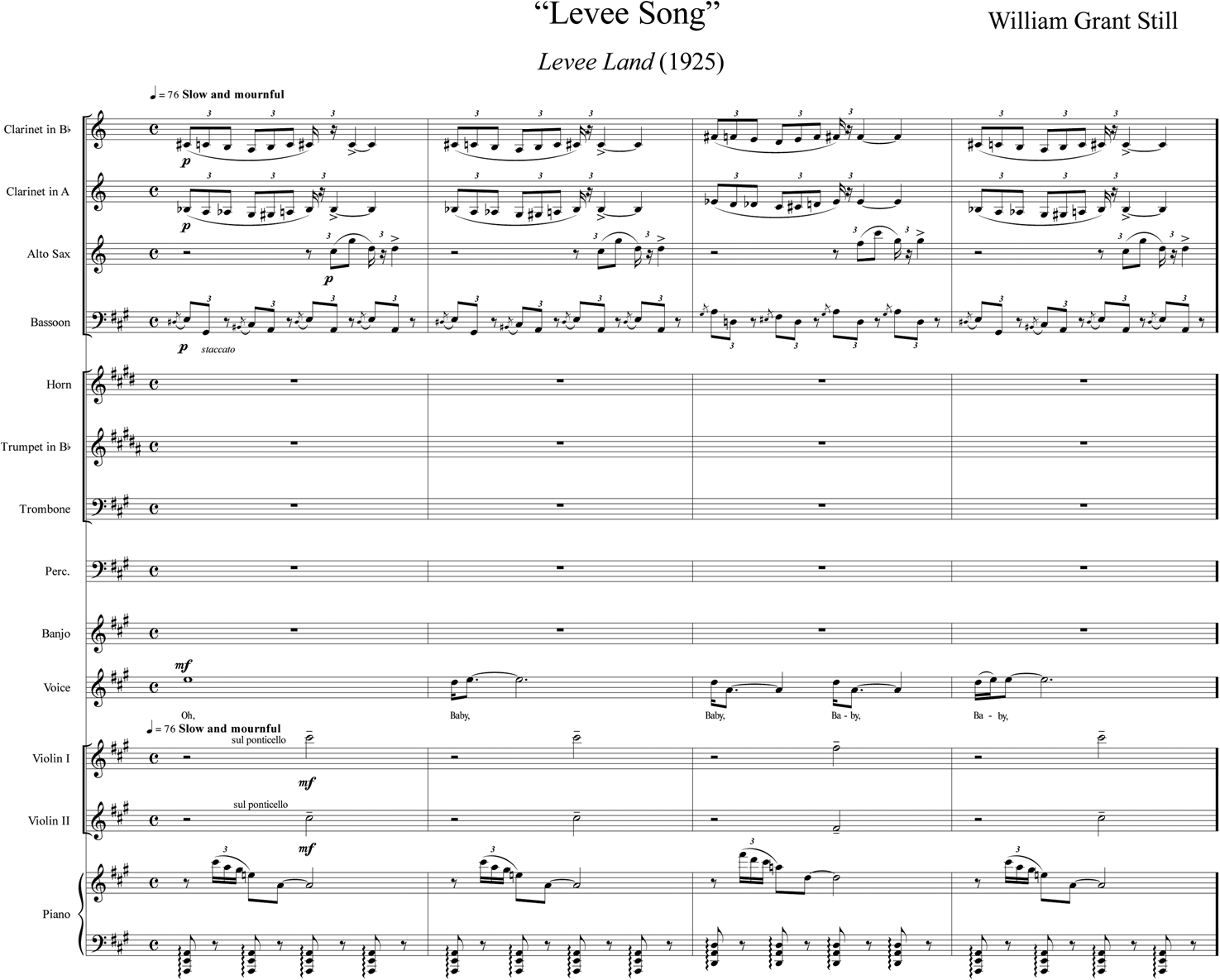
The range and tessitura of Levee Land are markedly different than any song Mills sang in her revues. “Down Among the Sleepy Hills of Ten-Ten-Tennessee,” “Mandy, Make Up Your Mind,” and “I'm a Little Blackbird Looking for a Bluebird” very rarely exceed an octave. Though it is not certain in what key they were performed live, all three pieces have a range of roughly D4 to D5 with a tessitura that hovers around G4, according to the published sheet music. Still wrote a voice part demanding a much wider range as well as continuity between and agility throughout the singer's registers. For example, the first verse of “Levee Song” begins on a G5 and is sustained for the full measure. The difficulty of sustaining this pitch is assuaged by the text; the word “oh” makes it easier to sustain air flow. It is a diphthong, but a closed one where air can be pushed to the front of the mouth for maximum volume and control. At the same time, large intervallic leaps of octaves and sevenths confirm what some critics wrote about her ability to seamlessly shift between registers. The melody of “Croon,” which Mills simply hums, lies primarily between D5 to F5. Humming makes this high and demanding tessitura easier, though emitting sound with closed lips requires consistent air flow and strong breath support. As if the range of “Croon” was not difficult enough, Mills ends the song on an A5, held for two measures and sung at pianissimo. Levee Land significantly extended the set of skills Mills mastered for the popular stage. A review by a critic, who attended the premiere, attests to her vocal strength, agility, and weight, writing, “Her coloratura is as wide in range, as flexible in movement, as clean and sure in flight and descent as that of any ascetic prima donna.”Footnote 60
Mills was a skilled improviser, and Still highlights this in Levee Land. Her reputation for making all sorts of noises predates Louis Armstrong's “Heebie Jeebies” (1926), misattributed as the first example of scatting. Critic Gilbert Seldes asserted that it was Paul Whiteman, in his popular jazz arrangements, who imitated Mills, because her “voice could equally imitate the saxophone” with its “shakes, thrills, vibratos, smears, and slides.”Footnote 61 About her “power of improvisation,” Irish composer Herbert Hughes revealed that “she never sings two verses alike, and frequently interpolates embellishments that would make many a prima donna green with envy—belong to genius, and that she has in her very eyelids.”Footnote 62 One critic wrote she “plays with half tones and quarter tones” and another described her notes as “molten” with “jazz slides and minors.”Footnote 63 Still composed melodies that highlighted this skillset—melodies that demanded glissandos, scoops, and rhythmic playfulness. In the beginning of “Levee Song,” for example, Mills hums a repeated minor third so much it seems to necessitate variation to avoid monotony. Sixteenth-note ornaments prompt scoops, large leaps require glissandos, and the third and fifth are used so repeatedly so as to encourage a more complicated approach to pitch.
Finally, Levee Land speaks to Mills's versatile timbre, calling into question critics’ myopic focus on her vocal sweetness and purity. In the final song, “The Backslider,” Still shows a different side of Mills—a singer with a gritty and gutsy timbre. Recall the vaudeville-esque tune tells the story of a woman who falls from grace because she loves jazz. The character playfully narrates her own dissent. She leads the listener through a sermon, in which she imitates the deep and resonant voice of her male pastor; then her friend's invitation to a nightclub, a temptation by the devil, according to the protagonist; and finally, a re-enactment of her increasing pleasure as she lets the jazz band penetrate her ears in a nightclub. In this final section, what sometimes sounds like a chamber ensemble in Levee Land becomes an all-out jazz band, and Mills sings a repeated strain, mimicking caricatures of each instrument in the band—her voice personifying the very sounds that caused her to stray from her god. She sings about the “sob and cry” of the fiddles, the “plunk plunk and brunk” of the banjo, and the “sob and moan” of the trombone as the instruments solo. Given what critics say about her uncanny ability to entertain, it is likely she played this instrument imitation to the hilt, manipulating her timbre in divergent ways to sound like a saxophone or banjo or male preacher. By the third repetition of the stanza, Mills sings forte over the full ensemble and the rhythm section's dense texture. In the middle-to-lower part of her range, this melody might have been belted by Mills to sing over the loud dance band. Such an approach would have given her voice a timbral quality rarely mentioned in reviews—a strong and robust tone belying stereotypes her audiences held about petite, light-skinned Black women.
In Levee Land, Mills and Still make a distinctly New Negro statement about jazz and racial equality. During and after Reconstruction, many educated Black men and women felt it was their responsibility to “uplift the race” through a “politics of respectability,” or a set of class-based behaviors and values.Footnote 64 Many Black intellectual leaders believed composers were the “best of this race,” or what DuBois called The Talented Tenth, and charged them with transforming Black folk materials such as the spirituals into elaborate works of art to be beacons of race progress.Footnote 65 Jazz complicated this racial uplift strategy because of its commercial and working-class associations (not to mention its tie to nightclub culture and sexual connotations). After the First World War and the race riots of 1919, some New Negroes embraced jazz as a point of racial pride and to challenge what they perceived as the cultural elitism of older generations and the servility of the “Old Negro.”Footnote 66 Archibald Motley's paintings of dance clubs and Claude McKay's novel Banjo (about a drifter musician) combated racist representations by forging radically new depictions of blackness through jazz that directly opposed minstrelsy stereotypes. They used jazz to experiment with and create new formal rules of modernism, too. At the forefront of a musical statement challenging racially segregated music, Mills illustrated that her musical competency exceeded audience expectations of Black women vaudeville singers while also communicating some of the central political tenets of the New Negro Renaissance.
“The Likes of Mills”: The Sound of the New Negro Movement
When composer and jazz clarinetist Edmund Thornton Jenkins (1894–1926) imagined Mills as one of the leads in his operetta Afram, he had an established career as a jazz recording artist, dance-band leader, and concert music composer. He grew up in Charleston, South Carolina, playing clarinet in his father's jazz band. The Jenkins Orphanage Band was a bastion of early jazz which launched the careers of many jazz legends including Jabbo Smith and Freddie Green. He studied composition with Kemper Herrald at Morehouse College and then went to London in 1914 to play in his father's orphanage band, billed as The Famous Piccaninny Band, at the Anglo-American Exhibition of the World's Fair. He stayed in London to study composition at the Royal Academy of Music, receiving numerous scholarships for teaching. The year 1925 marked the precipice of his career; he won a Holstein prize for his African War Dance and his Sonata in A minor for violincello, and he premiered Charlestonia: A Folk Rhapsody in Belgium. He died one year later, due to complications following an appendectomy.Footnote 67
Jenkins was equally committed to his popular music career, and, like Still, Jenkins shifted between these two racially coded worlds with ease. In 1920 and 1921, he led and recorded with one of the earliest integrated jazz bands, The Queen's Dance Orchestra. By 1923, he directed an Art Hickman orchestra called the International Seven which performed in an elite Parisian nightclub. He left Paris to conduct Will Marion Cook's Negro Nuances and lived with Will Vodery in Harlem, where he might have bumped elbows with Mills in Vodery's Plantation Club.Footnote 68 Here, he began to conceive of Afram, seeing the potential for Black American entertainment to advance the political causes of the Black diaspora. For his composition, he turned to blues, jazz, and Florence Mills.
Jenkins never performed with Mills, but they were both cosmopolitan New Negroes connected to the same international foot traffic of Black musicians and political leaders. Though the movement is often associated with a bevy of artists, intellects, and socialites centered in Harlem, scholars such as Davarian Baldwin have drawn attention to Black Americans, who traipsed the globe, mapping topographies of racial solidarity within new cultural contexts.Footnote 69 Jenkins served as a committee member of the African Progress Union, a London-based association dedicated to the “welfare of African and Afro-peoples,” and he helped Du Bois arrange musical programming for Pan-African Congresses.Footnote 70 He also formed a fraternity for elite Black Europeans, The Coterie of Friends, which educated its members about the achievements of people of color. Mills was a featured guest at one of his concerts celebrating Black composers.Footnote 71 Mills uplifted Black communities in a different way—through donations and benefit concerts, mostly for Black children.Footnote 72 This work became a part of her star persona. One newspaper called her “foolishly generous” because she reportedly gave away fifty pounds a week.Footnote 73 Both Jenkins and Mills helped create a Black international movement of racial awakening committed to equality.
Afram is a theatrical materialization of the political work they did, sometimes together, and it was an aspiration, on the part of Jenkins, to collaborate once more. The work is a three-act operetta featuring two distinct subjects: African nobility, who use traditional operatic forms and sing in French, and Black American entertainers, who perform syncopated Broadway tunes and sing blues songs in English. Housed at the Center for Black Music Research, the piano and vocal manuscript, albeit incomplete, tells a love story about an African prince and princess.Footnote 74 In the first act, the (unnamed) Prince has won a war for the King of Dahomey and confesses his love for the King's daughter, Princess Bella Twita. Traditional operatic forms—arias, recitatives, duets, and choruses—feature distinct character themes. For unspecified reasons, the two lovers become separated by the Atlantic Ocean as the Prince travels to the United States in act 2 and asks the Princess to come to him in a reprise of his aria: “Do not let yourself be discouraged, put off by the seas and the mountains.” While waiting for her in a nightclub, he watches a variety stage show, functioning here as the opera's interlude with plantation scenes, spirituals, and slave dances. The Princess finally arrives at the club in act 3, comprised almost entirely of “The Charleston Revue”—an eight-number variety show of jazz and blues songs performed by a Charleston vaudeville troupe featuring “the likes of Florence Mills” (Appendix). Mills likely would have been featured in many of the numbers, but “Kentucky Kate” stands as a fitting example. The strong, itinerant character proclaims her “identity is [her] invention,” and that if someone messes with her, she “gives the bird” (Appendix). When the revue concludes, the African prince grows frustrated with the “empty spectacle” and storms out only to run into Bella Twita in the nightclub.Footnote 75 They express their immense love for one another in a reprise of their duet, then everyone comes together for a foxtrot and final chorus.
Afram's plot and music articulate racial awakening through a diasporic lens. Act 3, for example, not only moves away from operatic forms but also from older representations of Black music rooted in slave culture and adopts more modern representations of Black culture—namely, jazz and blues. The act concludes, however, by hybridizing popular and classical music, which has thus far been separate, when all the Black characters sing the final song, symbolizing global Black solidarity. After “The Charleston Revue” ends, a “Foxtrot for Jazz Orchestra” is performed. It is unwritten in the incomplete manuscript, but a note indicates it is based on the rhythm of the Prince's aria. Here, the music of African royalty (opera) serves as a rhythmic foundation for the music of Black entertainers (jazz). After the foxtrot, a final chorus concludes the work. Everyone—the performance troupe, the cabaret audience, and the African couple—come together and sing the final chorus: “Long live the African country from which the lovers have come to this American land where they found each other.” National fault lines erode, and a vision of Black solidarity materializes, as reverence for Africa becomes the foundation on which to fasten new modern, diasporic subjectivities in the United States.
In Afram, Mills represents a musical and political leader of the African diaspora. She leads the vaudeville troupe, which serves as the musical backdrop uniting the lovers and, in the end, uniting all of the operetta's diverse Black subjects. But what makes her roll so powerful is the work's depictions of Africa, which worked against primitivist tropes in popular media. For Jenkins, Africa was not a playground for white audiences to act out their racial fantasies but rather rich symbolic territory on which to construct modern Black identities rooted in histories that were lost to what Stephanie Smallwood calls “saltwater slavery.”Footnote 76 To make this political statement, he used the very musical that facilitated Mill's international acclaim—Dover Street to Dixie (1923). Afram has a striking resemblance to it, and through its intertextual relationship, it offers a radical revisioning of African imaginary within the New Negro Renaissance as well as Mills's position as a cultural leader of the Black diaspora.
Like Afram, Dover Street to Dixie is bifurcated into two distinct parts with different casts, scenery, and plot lines. The first half is set in London and features white fashionable aristocrats who live on Dover street and know all the hip jazz clubs. The second half is set on a US southern plantation, and Black entertainers perform Will Vodery's revue for The Plantation Club. The dénouement circles around the white protagonist, John Gay, author of The Beggar's Opera (1728), who has traveled in time. Though, in the first act, he is averse to the sights and sounds of modern London and complains about jazz lacking “dignity” and “grace,” he draws the musical to a close by mastering the foxtrot.Footnote 77 Like Dover Street to Dixie, Afram concludes with a revue of Black southern American music (“The Charleston Revue”), but Jenkins supplants white Londoners singing Broadway tunes with African royalty singing arias and recitatives in the first half. Black American entertainment in Afram is a modern cosmopolitan product, unifying Black citizens of the world not fodder for ostentatious displays of white men “mastering” Black culture. And where Mills would perform a stock “African number” called “Jungle Nights,” rife with primitivist stereotypes, in Dixie to Broadway one year later, Jenkins wrote a composition, titled after a Ghanaian river and based entirely on the lives of wealthy, autonomous African subjects.
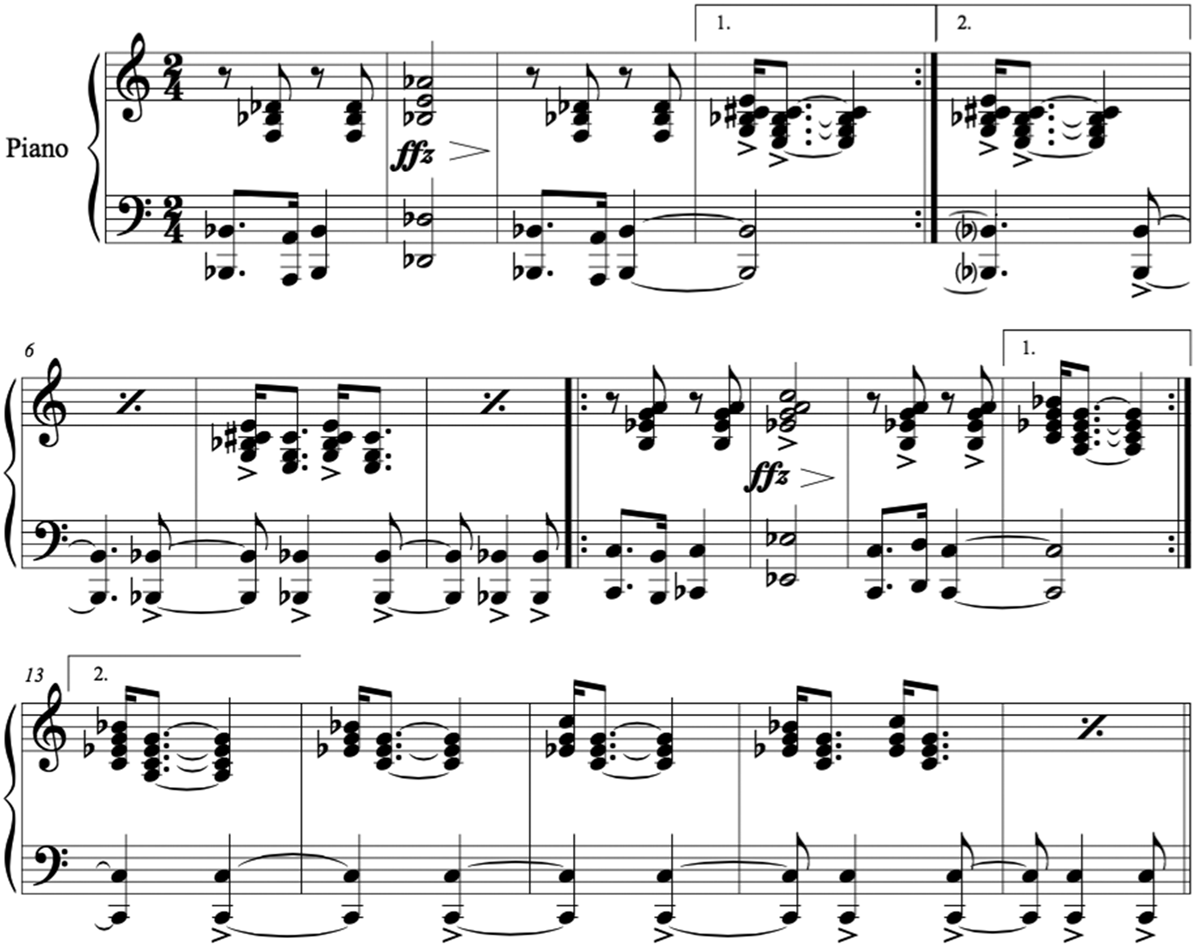
This desire to portray Africans in a more honorable light is particularly palpable in Afram's first act featuring a Zulu war song, “Danse de Guerre,” to celebrate the King of Dahomey's victory (Figure 5). Sung by the Prince's soldiers, it features plodding bass lines, clamorous dynamics, and harmonic dissonance. The melody and text appear in a popular collection of African songs entitled Songs and Tales from the Dark Continent, compiled by folklorist Natalie Curtis. She collected the song from Madikane Čele, who belonged to the Zulu of South Africa. She not only transcribed the melody but also provided its anticolonialist context: “The white man is apt to think of the black man as a yoked and subjected being. But when first encountered by the British, the Zulus were a strong and proudly militant people whose highly trained armies were the pride and glory of their kings. . . . It cannot be forgotten how, with only the [short javelin and shield], the naked hosts kept at bay the firearms of the English.”Footnote 78 The legacy of songs such as these was a point of racial pride for New Negroes. Afro-Puerto Rican Arthur Schomburg, in “The Negro Digs Up His Past,” published in Alain Locke's The New Negro (1925), celebrated the recent deluge of African histories: “Already the Negro sees himself against a reclaimed background, in a perspective that will give pride and self-respect ample scope and make history yield for him the same values that the treasured past of many people affords.”Footnote 79 The song, according to Čele, energized soldiers before battle, but Jenkins used it as a celebration of a war won. Within the pan-Africanist framework of Afram, depictions of Black Africans with warlike fortitude symbolized resistance to white supremacy's violent formations.
Piano reduction of “Danse de Guerre.” Transcribed by author. Afram (1924), Edmund Jenkins.
Jenkins forms a “reclaimed background” through African folklore and depictions of royalty, romance, and military victories to serve as a foundation for modern diasporic communities to mobilize and flourish. Afram is fundamentally about migration and what rich cultural changes occur in the process. As African royalty migrate to the United States in act 3, to the sound of Mills's voice, the music of Black US modernity replaces the minstrelsy skits of act 2's interlude. Yet, the classical idioms defining the expression and movement of African royalty do not disappear but rather provide the rhythmic foundation of Afram's concluding number—a foxtrot featuring a jazz orchestra. Taken as a whole, however, the operetta stands as an example of what Paul Gilroy calls The Black Atlantic. Africa, the Atlantic Ocean, and the United States become a transnational habitus traversed by Black subjects to “form a compound culture from disparate sources.”Footnote 80 The Black Atlantic defined the musical and political careers of both Jenkins and Still.
Jenkins used Mills's voice in ways that challenged the stock jungle numbers of Dover Street to Dixie. Her voice resounded across the globe to strengthen ties among Black citizens of the world, as her leadership in “The Charleston Revue” enabled movement among and unity within the Black diaspora. In a sense, Jenkins used Mills's voice to call Black migrants to America. “The likes of Mills” written into the manuscript of Afram, therefore, referenced more than just her political and performance persona; it referenced the stunning and powerful voice—her timbre, register, weight, and range—that had to match her character's essential role. Though her tasteful approach to vaudeville tropes, her public critiques of white supremacy, and her distinct approach to jazz inspired Jenkins's music—especially since he formulated the idea for this piece after visiting Harlem—it was also the sound of her voice that inspired Afram, reaffirming her as a vocal icon of the New Negro Renaissance.
Conclusion
Jenkins and Mills both died prematurely from complications following surgery—Mills for her tuberculosis in 1927 while in the United States and Jenkins for appendicitis in 1926 while in France. Black people died every day because of the prejudices structuring healthcare in those countries often times through sheer denial of treatment based on segregationist practices.Footnote 81 Was this the case for these two artists? Certainly, Mills's fans speculated so.Footnote 82 Up until his death, Jenkins had been working to make Afram a reality since he left Harlem and returned to Paris in 1924. According to one of his obituaries, it had been accepted for production in Paris in 1925.Footnote 83 Yet, in 1926, he wrote to his father, saying he struggled financially to “back [his] ideas properly.”Footnote 84 With their untimely deaths, Jenkins and Mills never had an opportunity to collaborate on Afram.
Their abbreviated lives require historians to dig deeper in the even smaller number of boxes that comprise their archival collections. Michel-Rolph Trouillot, in Silencing the Past: Power and the Production of History, writes: “Power begins at the source,” and that “any historical narrative is a particular bundle of silences.”Footnote 85 Yet he argues that archival absences and critical attention to silences in contemporary histories have the potential to tell new stories, something he does with his work on the Haitian Revolution. However, “the unearthing of silences … request not only extra labor at the archives—whether or not one uses primary sources—but also a project linked to an interpretation.”Footnote 86 The research of Saidiya Hartman and Daphne Brooks, among others mentioned, illustrates what this extra labor and interpretation must look like to listen to the aurality of Black women's archives from the early twentieth century.
One silence this article's narrative has yet to address concerns how Mills herself conceived of the sound of her voice as a tool for Black freedom. There are no documents directly addressing this question in the archives. However, a closer reading of her 1927 article, “The Soul of the Negro,” opens up one way to interpret her perspective. “There are some people I have met who find it difficult to credit a Negro with a soul,” she laments. Refuting this egregious idea, she states: “For, when it comes down to a matter of solid fact, divorced from prejudice, the Negro instincts, all his feelings are white to the core.” A contemporary reader might find her use of whiteness as a universal standard unsettling, but it was one framework for Black intellectuals to convince racist readers of the validity of Black equality. To provide evidence of this soul, Mills leads with her voice: “There is a song I sing.”Footnote 87 Of course, the content of the song matters, as she goes on to describe the lyrics of “I'm a Little Blackbird,” but the syntax of this sentence emphasizes the act of singing. Her voice stood as proof she deserved equal treatment, and that the color of her skin—“an accident of birth,” as she describes it—should not determine her value within society. Mills knew her voice was a valuable apparatus for racial equality. Jenkins and Still knew this too. By this point in her career, she started to see less distinction between her singing and writing voices in their capacious power to articulate the political ambitions of Black women.
Appendix
Lyrics, “I'm a Little Blackbird Looking for a Bluebird” by Grant Clark & Roy Turk
Lyrics, “The Backslider,” Levee Land (1925), William Grant Still