Austria emerged in 1955 from a ten-year occupation administered by the four major powers of the successful anti-Third Reich coalition of World War II—France, the Soviet Union, the United Kingdom, and the United States—as a united, independent state. The 15 May 1955 State Treaty signed by these countries and Austria spared Austria the fate of Cold War division suffered by Austria's neighbor to the north (in the ultimate East-West breakdown of Germany's parallel postwar quadripartite occupation).Footnote 1 Paving the way for Austria's good fortune was a political quid pro quo agreed between Austrian leaders and their Soviet counterparts in Moscow the previous April. In the 15 April 1955 Moscow Memorandum, Austria consented to becoming a permanently neutral state modeled on Switzerland. This neutrality precluded a possible Austrian membership in NATO in exchange for a long-delayed Soviet assent to an end of Austria's occupation regime with a concomitant abandonment of the Soviet occupation zone and the withdrawal of all occupation troops.Footnote 2 After the completion of this withdrawal, a fully sovereign Austria made good on its pledge with the passage on 26 October 1955 of a constitutional law declaring Austria to be “permanently neutral” and foreswearing all military alliances.Footnote 3
Even before the end of the occupation and Austria's declaration of neutrality, though, Austria's experience with Marshall Plan aid and its attendant restrictions designed to prevent Soviet Bloc enrichment indicated that Austria would have difficulty being truly neutral in the marketplace. Austrian adherence to western Cold War export controls only continued a pattern of support for western trade embargoes against the Communist Bloc by a self-proclaimed neutral country. Irrespective of Austrian wishes, though, Austria's great and growing interdependence with Western economies throughout the Cold War left Austria with little choice but to countenance such embargoes lest Western sanctions impede Austrian prosperity and thereby weaken Austria's commitment to neutrality.
Even as Austria became increasingly economically integrated with its European neighbors and the wider Western world, Austria also had to contend with significant energy dependencies, both upon coal and oil supplies from the Communist Bloc and upon the world's leading oil-producing nations. The latter dependency prompted Austrian involvement in the 1974 International Energy Program (IEP), a consortium of Western oil-consuming nations designed to counter any future oil shock like that caused by previous Organization of Petroleum Exporting Countries (OPEC) oil embargoes. Despite Austria's enormous dependence upon global trade flows, meanwhile, stockpiling measures in Austria for withstanding any cutoffs during a crisis situation remained deficient.
None of these facts of Austria's economy technically violated Austrian neutrality, a status according to international law and Austrian conceptions concerning only military matters and only operational during any given conflict. In contrast, Soviet conceptions of a “total” neutrality policy rejected by Austrian leaders during State Treaty negotiations encompassed political and economic aspects of a neutral country as well.Footnote 4 Nonetheless, such lopsided trade flows called into question Austria's ability to maintain, in various potential conflicts, the neutrality law's requirement that any economic sanctions be impartial, particularly in any escalation in Europe of the very Cold War that gave rise to Austrian neutrality. Commonly accepted notions of permanent neutrality expressed in the Swiss Vorwirkungslehre demanded that a permanently neutral country like Austria pursue a peacetime “neutrality policy” designed to make credible any possible wartime institution of neutrality. As some commentators noted, though, integrated global markets made this task akin to squaring the circle.Footnote 5
Not Trading with the Enemy, I: The Curious Case of Austria under the Marshall Plan
Austrian desires to participate fully in the economic life of the Western world ultimately presented problems for the West's drive to hinder the Soviet Bloc from strengthening itself at the West's expense, both before and after the State Treaty. Austria, for example, was among the sixteen European countries meeting in Paris from 12 July to 22 September 1947 to establish a plan for American aid, under the European Recovery Program (ERP or Marshall Plan), to flow to Europe.Footnote 6 After participating in the founding of the Committee of European Economic Cooperation that summer, Austria was also a signatory to the 16 April 1948 agreement founding the Organization of European Economic Cooperation (OEEC) to administer the ERP.Footnote 7 Austrian foreign minister Karl Gruber, whose 1988 memoirs record him signing in Paris “with a certain pride” for Austria, remembered that the “imposing treaty text” in French alphabetically listed Autriche first among the OEEC countries, given that Albania and a divided Germany (Allemagne) were not present in Paris. Thus, Gruber signed first, and “Austria stood in the birth certificate of the united Europe of the future with its signature at the very top.”Footnote 8 Austria subsequently complemented its participation in the ERP by helping to establish the multinational payments system of the European Payments Union in September 1950.Footnote 9
The participation of a united but nonetheless quadripartite-controlled Austria in the ERP and wider European economic developments was by no means a sure thing, however. The Austrian diplomat Hans J. Thalberg remembered in his 1984 memoirs that:
for Austria new and outright existence-threatening questions developed through the insistence of the American authorities to allow Marshall Plan aid to benefit only the American occupation zone, perhaps the English and French zones as well, but under no circumstances the part of Austria standing under Soviet control. Large-scale and long lasting diplomatic and political efforts were necessary to illustrate to American authorities, the competent departments, and the Congress the seriousness of a threatened division of our country along the lines of Germany.Footnote 10
A key sticking point for the Americans, remembered Gruber, was that the Marshall Plan allowed aid only “where American inspectors could control the distribution,” something “out of the question” in the Soviet zone. Gruber's memoirs recounted that “to our great luck” an “especially intensive lobbying of the White House and the Congress,” aided by the American high commissioner Lieutenant General Mark Clark, “ultimately made understandable to everyone that the control reports of Austrian authorities” would have to suffice.Footnote 11 Gruber wrote in 1953:
The State Department, meanwhile, showed great understanding for our situation. We worked out together a process by which trusted Austrians were supposed to act as commissioners of the Americans and to deliver the necessary control reports. The American representatives began, moreover, to understand very quickly that in our system of free democracy, free press, and free public criticism the utilization of Marshall Plan resources was an open book for every observer and that therefore special controls were not necessary. For our part, we were naturally very concerned to prevent Soviet authorities from diverting American aid into their own pockets.Footnote 12
Internal State Department documents in the National Archives reveal that the Americans had good reason not to restrict Marshall Plan aid to Western Austria. Even though some “leakage” of raw materials and products from the Soviet zone in Austria to the Soviet Bloc would occur, according to a late 1940s memorandum on the ERP and Austria, this “would represent the relatively small price which would be entailed in preserving the unity of Austria and thereby its independent orientation.” The memorandum furthermore observed:
It has been the policy of the United States to treat Austria as a political and economic unity and accordingly to provide assistance to the Austrian Government of all the territory and population under its jurisdiction. Moreover, four-power agreements governing the powers and functions of the Allied Council in Austria stipulate that indigenous or imported supplies are to be pooled regardless of zonal boundaries and that restrictions are to be lifted from the movement of persons, goods, and traffic between the zones. Under the circumstances, an attempt to confine United States assistance to the Western zones would be inconsistent with agreements to which we are a party, would encourage and possibly lead to partition, and afford the Soviets an opportunity to place the onus on the United States for partition. If developments threatened partition, the Austrians might finally in desperation submit to Soviet pressures and join the Eastern bloc in order to preserve national unity.Footnote 13
The memorandum also worried about possible effects on western Austria of any discrimination against the Soviet zone, given that this zone supplied Austria with food and oil supplies.Footnote 14 Soviet-run USIA firms, meanwhile, also had an important role in the Austrian economy. The Austrian economic historian Wilfried Mähr, for example, recalled that USIA was the largest Austrian “producer of electrical appliances and installations,” the withdrawal of which “from the entire Austrian market could have a negative effect upon reconstruction.”Footnote 15
Thus, a process was necessary for enabling USIA firms to receive “very specific ERP goods.” Formed by American authorities, the Vienna Screening Committee “reviewed requests of USIA firms in light of macroeconomic effects.” The committee supported the request if it involved “a product important for Austria” and the Austrian federal government confirmed “that no other firm could produce the same product more economically.” The Austrians also had to obtain Soviet assurance that the USIA product made with American assistance would remain available for Austria and not for export to Eastern Europe.Footnote 16
With American objections out of the way, Gruber recalled in his memoirs that the Soviets had little objection to the Marshall Plan in Austria and “seemed ultimately only concerned about securing American aid deliveries for the Soviet zone without discrimination.”Footnote 17 This was ironic given strong prior Soviet opposition to the Marshall Plan in Austria and elsewhere.Footnote 18 Thus, the Soviet zone in Austria was the only area administered by the Soviets ever to receive Marshall Plan aid.Footnote 19 As the Austrian journalist Fritz Molden recalled, though, Soviet sensibilities prevented “the marking of factories rebuilt or newly installed through the Marshall Plan” to the same degree as in the western occupation zones of Austria. “This small gesture,” commented Molden, “for the reassurance of Soviet mistrust or, more appropriately, as compensation for Soviet inferiority complexes cost no one anything and was gladly accepted if Austria's eastern zone could thereby enjoy Marshall Plan funds.”Footnote 20
American authorities still remained reticent, however, to invest Marshall Plan funds in Soviet-occupied territory. The previously cited State Department memorandum noted that “as for capital equipment sent to Austria under the ERP, informal approaches to the Austrian government could assure that this would for the most part be installed and utilized in the Western zones.”Footnote 21 The net result noted by Austrian scholars like Michael Gehler is that eastern Austria participated in the Marshall Plan only to a limited degree. In 1953, for instance, only 18 percent of Marshall Plan funds in Austria went to the Soviet zone.Footnote 22 In all, 13 percent of ERP aid in Austria went to the Soviet zone and 6 percent to Vienna, Soviet sectors included.Footnote 23 The Austrian scholar Hannes Hofbauer noted that:
in Vienna and Lower Austria there were 5,000 Schillings of ERP monies for every employed person while in Salzburg 66,000 Schillings per worker came from ERP funds. Salzburg was the secret capital of Austria between 1945 and 1955. In this period a structural gap also developed between western and eastern Austria that continued decades later.Footnote 24
Not Trading with the Enemy, II: Austria and the COCOM Embargo
Restrictions on ERP funds in Austria's Soviet zone were part and parcel of overall Western embargo policies against the Soviet Bloc. Austrian participation in the Marshall Plan therefore meant that Austria had to monitor not only the use of American aid in eastern Austria, but also Austrian exports to Soviet Bloc countries. With two-thirds of Austrian imports coming from the ERP than from Eastern Europe, it was only logical that Foreign Minister Gruber agreed in October 1948 to coordinate the control of Austrian exports with Washington, DC. In the words of Gehler, though, Gruber evinced “subliminal resistance” to export controls. To the dismay of American officials, he insisted that the Austrians would only become active in export controls when they had “concrete information” about violations but would not undertake independent investigations of suspicious firms.Footnote 25
Western Cold War export controls took on formal shape the following year with the formation of the Coordinating Committee for Multilateral Export Controls (COCOM) on 22 November 1949. COCOM included all NATO countries (except Iceland) and, later, Japan. The Mutual Defense Assistance Control Act (Battle Act) of 1951 imposed even tighter export controls in the United States.Footnote 26 Although not formally a COCOM member, Austria allowed American authorities to review its planned economic agreements with, and export licenses to, Eastern Europe.Footnote 27 Thus, American ambassador Llewellyn S. Thompson cabled to Washington, DC, from Vienna on 27 May 1953, that:
despite the special circumstances in Austria vis-à-vis the Soviets, an effective control system has been devised in which the United States participates directly. A close but highly secret liaison with the Austrian Government has been developed which enables the United States to maintain an informal but direct control over strategic shipments of Austrian origin.Footnote 28
A CIA report dated 22 January 1954 explained that “occupied Austria, for obvious reasons, is not a member of this group of sovereign states [COCOM] but it participates in all measures adopted by this body.” According to the CIA, therefore, “Austria's controls are roughly equal in scope to those prevailing in the United States; they exceed by far the control obligations undertaken by members of COCOM, the informal international control organization, located in Paris.” The CIA report elaborated:
Cooperation between the US authorities in Vienna and the Austrian Government is very close and comprehensive but of necessity completely informal and confidential. US officials sit in on the deliberations of Austria's interministerial Trade Advisory Board when it discusses licensing problems and questions of commercial policy; US officials follow step by step all trade negotiations with Soviet bloc countries and keep a close watch on the kind and quantity of strategic goods which Austria must agree to deliver in order to obtain certain essential counterdeliveries; US officials exerted their influenced on the composition of the commodity lists which are subject to Austrian export license and which include—but do not reveal—all items on the US and the international strategic lists; US officials intervene in cases of economic hardship caused to individual firms by the blocking of Eastern trade; US officials also review all important export applications for shipments to the Soviet bloc and keep informed on all USIA license requests.Footnote 29
A fall 1955 State Department memorandum added that during the occupation a “joint Embassy-Foreign Office screening session twice weekly” reviewed strategically sensitive trade issues. “Informally and secretly inaugurated to assist Austria in determining whether proposed shipments would contravene COCOM or U.S. Battle Act standards,” these meetings “enabled an Embassy Officer to screen Austrian export applications of strategic goods.”Footnote 30
Austrian cooperation with Western trade controls was not always effective in the face of Soviet occupation. The American diplomat W. Averell Harriman explained to President Harry Truman in a 7 November 1952 memorandum that a 1948 Austrian Foreign Trade Law “subjects deliveries of certain commodities to export licensing regardless of country of destination.” This allowed Austria “in administering this law” to be “cooperative with respect to all problems relating to U.S. aid” even though “as a country occupied by four powers, one of which is the Soviet Union, Austria is not in a position to enact or enforce export controls which specifically prohibit deliveries to the USSR or its allies.” Nonetheless:
Soviet Occupation forces have to date refused to observe the Law and regularly take goods out of Austria without complying with the licensing requirements or subjecting the goods to Austrian customs inspection. The Austrian Government has repeatedly protested Soviet evasions of Austrian trade and customs legislation but these protests have been unavailing.Footnote 31
The Austrians, moreover, had sometimes granted the Soviets export licenses for strategically sensitive goods because refusals of the licenses would probably not have prevented delivery of the commodities to the countries concerned. In all probability, the Soviet authorities would have designated the goods as “Soviet Military Property” and transported them out of Austria without clearance by the Austrian authorities if the license application had been rejected.Footnote 32
Ambassador Thompson noted in his 27 May 1953 cable that such Soviet removals would be “without clearance by the Austrian authorities, without payment of duties and other fees, and without the benefit of foreign exchange earnings to the Austrian economy.” Thompson also emphasized American understanding for Austria's continuing dependence on traditional trade with Eastern Europe even though, contrary to prewar trade patterns, “the Soviet bloc has been reluctant to supply material unless considerable quantities of heavy manufactured goods—some of them strategic—were offered in return.” Thompson explained that:
the continuing need for Eastern products, coupled with the tightening of Western export controls and Soviet occupation of part of the country, has placed Austria in a difficult position. The problem was partially met by American aid, which made it possible for Austria to purchase most of its foodstuffs and an important part of its vital coal requirements in the dollar area. But despite this aid, Polish and Czech coal and Rumanian grain imports continue to make important contributions to the Austrian economy. If these imports should be further reduced, double pressure on Austria would result. Additional dollar exchange would be required to buy the substitute imports. In addition, the exports intended for Eastern markets would be difficult to dispose of elsewhere, and substantially increased unemployment could be expected.Footnote 33
“A final reason for not entirely curtailing all shipments of strategic goods to the Soviet bloc,” Thompson cited:
is that the U.S.S.R. is an occupying power. Obvious discrimination against the Soviet bloc could result in direct retaliatory measures by the Soviets in Austria. The Soviet Union actually exercises the power of controlling the movement of goods from the Eastern to the Western Occupation Zones of Austria. This power often has been used for Soviet political reasons, including the extortion of desired concessions from the Austrian government. The intensification of Soviet controls to the point of a complete blockade would completely disorganize the Austrian economy, and in effect would result in an economic, if not political, partitioning of the country. Austria is an integrated economic unit with the basic industries chiefly in the Western Zones, and the processing industries and chief food crops in the Eastern Zone. The consequences of such a blockade would be a heavy decline in production, a reduction in exports, increased unemployment, and a substantially increased level of import needs in the Western Zones from the Eastern Zone of Austria.Footnote 34
Austrian and Western officials emphasized the need for secrecy in the implementation of trade controls during the occupation, whatever their effectiveness. Gehler recounted that “in 1951, Gruber secretly told the American ambassador, Walter Donnelly, that there should be no publicity concerning Austria's cooperation with the West in restricting exports to the East.”Footnote 35 Thompson as well referred in his May 1953 cable to the “highly secret nature of our relations with the Austrian government in export control matters” and warned that “publicity would have an unfortunate effect not only on our relations with the Austrians, but would also make it difficult for the Austrians vis-à-vis the Soviet occupation forces.”Footnote 36 The CIA's January 1954 report also warned that:
since Austria's controls are directed against one of the four powers which occupy the country jointly and with equal rights, all controls activities have to be handled with special care and discretion to achieve the desired goal and protect the personal safety of the officials involved.Footnote 37
Although the need for secrecy may have subsided, Austria continued to restrict trade in strategically sensitive goods to the Soviet Bloc after the four-power occupation ended in 1955. Writing after the State Treaty, the 1955 State Department memorandum noted that “thus far the Embassy-Foreign Office screening sessions have continued.”Footnote 38 Such trade restrictions, however, were extremely questionable for the newly neutral Austria under international law norms. Article 9 of the 1907 Convention Respecting the Rights and Duties of Neutral Powers and Persons in Case of War on Land (Hague Convention V) stipulates that a neutral country's restrictions on relations with warring countries “must be impartially applied by it to both belligerents.” This stipulation applied not just to means of communication between belligerents under the convention's Article 8, but also to Article 7, which stated that “a neutral Power is not called upon to prevent the export or transport, on behalf of one or other of the belligerents, of arms, munitions of war, or, in general, of anything which can be of use to an army or a fleet.”Footnote 39
Clearly, though, COCOM regulations administered by Austria did not “impartially” stop “the export or transport” of “anything which can be of use to an army or a fleet.” Perhaps the only loophole for Austria was the fact that the Cold War did not become hot and therefore COCOM remained a peacetime embargo not invoking Hague Convention provisions for wartime neutrality. According to the letter of neutrality law, Austria could unilaterally embargo the Soviet Bloc in peacetime but not during a war, provided that international trade still existed during a possible East-West war of however long duration.
Whether Austria adhered to the spirit of neutrality, though, was no mere academic matter. Commonly accepted understandings of neutrality under international law as expressed in the Official Swiss Conception of Neutrality promulgated on 26 November 1954 included the obligation of permanently neutral countries “to conduct a policy of neutrality” as part of a neutral's efforts “to do everything so that the neutral is not drawn into war and to abstain from anything which might draw the neutral into war.”Footnote 40 Austrian legal scholar Hanspeter Neuhold explained that “permanent neutrality entails the obligation to practice a policy of neutrality. The objective of this policy is to strengthen this status in the eyes of the other states beyond compliance with the legal obligations.” Echoing the Official Swiss Conception of Neutrality's own language, Neuhold recognized that the formulation of this policy is “left to the discretion of each government concerned,” but warned that “ultimately the success of this policy depends on the response of the rest of international society to it.”Footnote 41
Austria was not the only neutral country to cut legal corners in the area of trade. Even the classically neutral Switzerland agreed to abide by COCOM regulations in the informal Hotz-Linder Agreement of 23 July 1951 [named after its American, Harold Linder, and Swiss, Jean Hotz, negotiators].Footnote 42 The Austrian People's Party (Österreichische Volkspartei or ÖVP) politician Andreas Khol later noted in 1985 that the Swiss had displayed their traditional “pragmatism” by declaring that “considerations of neutrality policy” actually forbade a neutral country from “bypassing a trade embargo.”Footnote 43 A 1959 State Department memorandum later even offered this argument as justification for Austrian cooperation with COCOM. The memorandum observed:
Failure to cooperate might endanger the neutral status of Austria since the Austrian economy would then be taking advantage of the self-denial of Western Free World countries to increase Austrian trade with bloc countries. (This is the rationale on which the Swiss Government bases its controls on strategic goods).Footnote 44
COCOM successively reduced its lists of restricted goods in 1954 and 1958. The Export Administration Act of 1969, meanwhile, loosened the stricter American export controls.Footnote 45 As the Cold War entered a phase of renewed intensity in the late 1970s, though, the United States reimposed stricter export controls on the Soviet Bloc. Under pressure from the Reagan Administration, COCOM also reviewed its list of sensitive products in the fall of 1982, resulting in new controls for computer and information technology in July 1984. At the same time, criticism of Austria and other Western countries for their laxity with respect to high technology transfer to the Soviet Bloc appeared at the Pentagon, in United States Senate Subcommittees, and in American publications like Business Week and the Wall Street Journal.Footnote 46 According to one estimate in the mid 1980s in particular, continental Europe's four neutral states (Austria, Finland, Sweden, and Switzerland) were responsible for 18 percent of Soviet high technology imports. Sweden, for example, delivered in the early 1980s the Soviet Union's only floating dry dock capable of serving Kiev-class aircraft carriers, promptly put into operation by the Soviet Northern Fleet.Footnote 47
Such trade concerns led the United States in the 1980s to seek stricter trade regulations from neutral countries such as Austria, Finland, Sweden, and Switzerland, as well as from India and Hong Kong.Footnote 48 As Austrian international relations scholar Paul Luif noted, various individuals in neutral countries, such as Austrian and Swedish politicians, “refused the demands by the Western allies” as “a first reaction.” They objected that:
neutrals would not be able to participate in a politically motivated embargo. But their industries required secure access to Western, especially US, high technology. The United States threatened to reduce or even stop the exports of high technology to countries not complying with the COCOM controls. The “high technology vulnerability trap” would have made any prolonged resistance impossible.Footnote 49
In Austria's particular case, an American delegation visiting Austria in October 1984 achieved an agreement to expand Austrian trade controls. Austria subsequently amended the Austrian Foreign Trade Act on 12 December 1984 to allow the Austrian Trade Ministry to monitor Austrian importers of high technology so as to prevent illegal re-exportation. The new amendment also made computer exports subject to a license. An additional amendment to the Foreign Trade Act passed by the Nationalrat on 9 January 1985 applied criminal penalties to violations of Austrian trade law previously treated purely as matters of civil contract.Footnote 50 Austria also signed a U.S.-Austrian Customs Mutual Assistance Agreement in 1986 and made COCOM lists part of the Foreign Trade Act in 1987.Footnote 51
Enforcement of these Cold War trade regulations presented Austria with various problems and irritations. Interviewed in 2005, former Austrian foreign minister Erwin Lanc (SPÖ), for example, expressed resentment that American officials had committed a “violation of sovereignty” against Austria by visiting Austrian factories to determine what they were exporting. Lanc also took exception to American companies outwitting their Austrian competitors by being better positioned to obtain export approval under American and COCOM trade regulations.Footnote 52 Luif also noted in 1986 that:
the Austrians still insist on the free export of their own high technology. But what is genuine Austrian technology? Today's international division of labor implies that one product will include parts from various countries. Therefore, a satisfactory definition of Austrian technology has not been found yet. To reduce its technological dependence on the US, Austria, together with the other EFTA countries, now tries to cooperate more closely with the EC on high technology research.Footnote 53
While restricting technology exports to the Communist Bloc, meanwhile, Austria actually participated in many European research initiatives, a contrast that could only cast on Austrian neutrality policy more of the doubts indicated by Neuhold. Austria, for example, joined the European atomic research organization CERN on 10 November 1959 and became a full member of the European Space Agency (ESA) in 1987.Footnote 54 Austria also received in 1985 an invitation from the American Secretary of Defense, Caspar Weinberger, to participate in the Strategic Defense Initiative (SDI) but rejected the offer outright, along with Greece and the Netherlands. French President François Mitterand, however, proposed in April 1985 an initiative to strengthen European civil technology, resulting in the European Research Coordination Agency (EUREKA) supported by the EC and EFTA, as well as Turkey. Austria became the third largest participant after Sweden and Finland. As the American historian Thomas O. Schlesinger, once a U.S. Army intelligence officer stationed in occupied Austria, wrote:
the point was to counteract the opening of a technology gap as a result of “civilian” spin-offs from the potentially large investments of resources in SDI. In the absence of an integrated European approach to research, it was feared, that the large funds that were to flow from Washington's SDI would lead to excessive American government influence on the flow of research investments in Europe. Great advantage might have accrued to those favored by, and politically able, to accept the SDI contracts.Footnote 55
After the Cold War's end, COCOM itself went out of existence on 31 March 1994. Yet this was not the end of export controls among the world's democracies. Austria and other neutral countries joined control regimes such as those against the proliferation of atomic, biological, and chemical (ABC) weapons and their delivery systems. Accordingly, in December 1995, twenty-eight countries including Austria, all fourteen of its new partners in the European Union, Canada, Norway, Russia, Switzerland, and the United States signed the Wassenaar Arrangement on Export Controls for Conventional Arms and Dual-Use Goods and Technologies. “In a somewhat historical irony,” Luif observed, “the countries agreed to locate the secretariat of the Wassenaar Arrangement in Vienna, Austria.”Footnote 56
Trading with the West: Austria's Economic Integration into the West
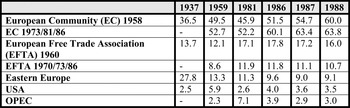
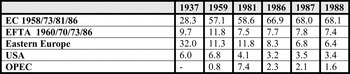
Austria's dependence on high technology from COCOM nations was part of a wider trend of Austrian postwar integration into economies of Western Europe and the wider industrialized world. As an example of this, the Austrian diplomat Thomas Nowotny referred in 1986 to Vienna's airport. “In fact,” he pointed out, “the lion's share of flights go to the West—where the actual relationships are the closest. Austria is hardly a country ‘between the blocs’ or ‘in the heart of Europe.’ Austria is much more the easternmost state of Western Europe.”Footnote 57 The following 1990 graphs showing Austrian trade flows through the years, expressed in percentages, bears out Nowotny's assessment.Footnote 58
Austrian Exports According to Country Groups

Austrian Imports According to Country Groups

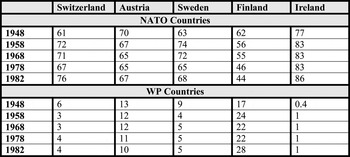
This phenomenon of Western economic integration was not limited to Austria, but affected all of Europe's neutral states as Finnish scholar Harto Harkovirta calculated in 1988.Footnote 59
Shares of NATO and Warsaw Pact Countries in the European Neutrals' Foreign Trade (percent of Total Trade)

Indeed, the trade flows of Europe's neutral states were not fundamentally different from those of a NATO state, as shown by the following 1982 graph.Footnote 60
Percentage of Total Import/Exports to Organization for Economic Cooperation and Development (OECD) Countries

Among Europe's neutral states, however, Austria's trade with the European Community (EC) throughout the years was particularly pronounced.Footnote 61
Percentage of Total Austrian, Swedish, and Swiss Exports to the European Community

Among various non-Communist, non-EC European states in 1987, Austria had the highest percentage of total foreign trade with the EC. Finland (43 percent), Iceland (55 percent), Norway (57 percent), Sweden (54 percent), Switzerland (64 percent), and Turkey (46 percent) all had less significant trade relationships with the EC than did Austria (66 percent).Footnote 62 Austria in 1987 even had stronger trade relationships with the EC than many members of the EC itself. Austrian scholar Manfred Rotter calculated that among EFTA and EC states that year, only Switzerland and Belgium/Luxemburg had higher percentages of total imports from the EC (both 72 percent) than did Austria (68 percent). Only the EC members Belgium/Luxemburg (74 percent), Greece (67 percent), Ireland (73 percent), the Netherlands (75 percent), and Portugal (71 percent) exported more of their total exports to the EC than did Austria (64 percent).Footnote 63
For Austria, economic integration with Western Europe and the wider Western world represented a shift from traditional markets in the former parts of the Austro-Hungarian Empire and other areas of Eastern Europe. “In the Cold War,” noted Gehler in 1994, “Austria's foreign trade with the Soviet satellites was considerably reduced.” Imports from these countries fell to 8 percent of all Austrian imports in 1955 from 32 percent in 1937. Despite USIA exports, Austrian exports to Soviet satellites also fell to 8 percent of all Austrian exports in 1955 from 28 percent in 1937. During this same period, Austrian imports from the countries of the Organization of European Economic Cooperation (OEEC) grew from 40 percent to 75 percent of all imports, whereas Austrian exports to the OEEC grew from 53 percent to 71 percent of all exports. Scholars like Gehler, though, have observed that the westward trend of Austrian trade had already begun before World War II and only intensified under the Third Reich.Footnote 64 Luif, for example, has calculated that the percentage of Austrian exports going to the Austro-Hungarian successor states fell from 46.7 percent in 1924 to 38.7 percent in 1929 and finally to 31.8 percent in 1937.Footnote 65
As noted by several scholars, the Federal Republic of Germany (FRG) was most pronounced among Austria's postwar trade partners.Footnote 66 In 1988, for instance, 35 percent of all Austrian exports went to the FRG, whereas 45 percent of all Austrian imports came from there. This was new in Austrian history, for according to Luif, “in the interwar period this extreme concentration on Germany was not there. At that time foreign trade was relatively equally distributed among the neighbors.”Footnote 67 Similarly, 75 percent of all tourists visiting Austria and 37 percent of all industry investment (itself three-fourths foreign in origin) came from the FRG.Footnote 68
Neuhold concluded in 1982 that “if the economy of FRG sneezes, its Austrian counterpart will suffer from pneumonia.”Footnote 69 In this respect, various analysts have noted deliberate policy linkages with the FRG by the Austrian central bank and government since 1955. Monetary policies closely tied to Germany, for example, allowed for long-standing Austro-German currency exchange stability. Many other Austrian economic policies concerning prices, wages, and fiscal planning also remained intentionally linked to a wealthier and more stable German economy during the Cold War. Austrian economic indicators such as inflation, unemployment, and gross national product (GNP) accordingly often fluctuated in tandem with those of Germany.Footnote 70
Thalberg ironically observed in reference to the Third Reich's annexation of Austria in 1938:
The Anschluß was dead, but many of my countrymen stared as if enchanted at the FRG that had risen like a phoenix out of the ashes. Politically the State Treaty and, above all, permanent neutrality had set limits to Austria's relationships with Germany that could not be overstepped. Economically and culturally, however, the FRG proved to be a magnet of continually growing attractive force.Footnote 71
Not only was Austrian trade oriented to the West, but the Austrian economy as a whole was also quite dependent upon trade, as the following 1978 chart illustrates (see Figure 6).Footnote 72
Austrian Foreign Trade measured as a Percentage of Gross National Product (GNP) (1964 Prices)

The Austrian legal scholar Waldemar Hummer observed in 1977 that the importance to Austria of goods exports was “considerable,” making up “longterm” around 20 percent of Austrian GNP. This was higher than for the FRG (19 percent), Japan (10 percent), the United Kingdom (16 percent), and the United States (6 percent).Footnote 73 In 1974, the percentage share of Austrian GNP in goods exports (22.7 percent) was the sixth largest in the world, only smaller than that of Belgium (53.6 percent), Canada (23.7 percent), the FRG (23.1 percent), the Netherlands (48 percent), and Sweden (28.7 percent).Footnote 74 Noting in 1991 that Austria exported more per capita than France, Italy, Japan, the United Kingdom, the United States, or Taiwan, Die Presse editor Andreas Unterberger concluded that Austria was “extremely dependent on foreign trade.”Footnote 75
Squaring the Circle: Neutral Independence and Economic Interdependence
The lopsided pro-Western nature of trade relationships between Europe's neutral countries like Austria and the rest of the world was suspect to many from the perspective of Austria's international obligations. Christian Democratic publicist Ludwig Reichhold wrote in 1968 that neutrality “demands an approximate balance of Austria's economic contacts with the West and the East, including the world across the seas.” Reichhold added:
Only to the extent in which the West is interested in respecting Austria's economic ties with the East, and only to the extent in which the East is interested in respecting Austria's economic ties with the West, can one speak of respect for neutrality, which must have not least an economic basis. Conversely, the maintenance of neutrality also in an economic sense is an essential criteria against which Austria's will to be neutral will be judged in the East and in the West.Footnote 76
West Germany's strong economic presence in Austria throughout the Cold War (and beyond) also raised concerns with respect to the State Treaty's prohibition of any kind of new Anschluss in Article 4. Although Neuhold in 1983 dismissed talk of a “violation of Article 4 in the Austrian State Treaty and ‘an Anschluß through the backdoor,’” he could not ignore that “the domination of the FRG in Austria's trade ties, a domination which is also present in tourism and other economic sectors, would have to give pause from the perspective of neutrality politics.”Footnote 77 Whether Austria maintained trade ties with West Germany or any other country, however, the problem of economic dependence with the resulting potential for political pressure remained the same. Swiss legal scholar Dietrich Schindler observed in 1970 that “the credibility of permanent neutrality would be damaged if it became evident that a state would not be capable of maintaining neutrality because of economic reasons.”Footnote 78
“Austria as a permanently neutral state,” noted Neuhold, was “actually commanded under international law to strive for an independence, whose realization is today no longer even possible for Great Powers.” Yet efforts to remain independent “ran counter above all to the growing interdependence in international society in the economic realm. A state that wants to expand the wealth of its inhabitants cannot exclude itself from the international integration and division of labor, although this increases the state's vulnerability to the use of pressure.”Footnote 79
The American scholar and former Pentagon official Joseph Kruzel at a November 1986 conference agreed:
Today's neutral states are obliged to maintain an economic posture in peacetime that will give maximum credibility to their desire to remain neutral in wartime. In other words, no neutral can compromise its capacity to remain neutral in wartime through its economic activities in peacetime. This general principle, so easily enunciated, has become increasingly difficult to follow in an international economic system whose primary feature is growing interdependence.Footnote 80
Like many others, the Austrian international relations scholar Hans Mayrzedt described in 1970 a
quickly increasing interdependence that has taken the place of the traditional, i.e., “qualified” independence of states. In other words: Through interdependence the substance of individual state independence is reduced. Interdependence consists of the restriction of the freedom of action of individual states—conditioned by the increasing factual dependency on one another. The observable system of interdependence distinguishes itself by a great—and moreover, increasing—variety. This system stretches across the most varied areas of politics, economics, and scholarship. The needs of states have led to the conclusion of numerous international treaties—at times containing substantial obligations—and to the foundation of many international organizations. Almost simultaneously, the economic integration of national economies—and thereby also the dependency of business cycles—have gained strength. The action radius of an individual state's foreign policy is being strongly restricted with respect to the need for increasing consideration of the interests of other states and of facts created outside one's own area of influence.Footnote 81
In a 1988 review of neutrality, a group of scholars addressed what exactly interdependence meant for Europe's neutral nations vis-à-vis the EC. “In Sweden, Austria and Switzerland,” they observed, “the process is already advanced of their major industries merging or locating within the Community and, effectively, creating a situation where industrially they already belong to the Community but politically they are committed, by their neutrality, to remain outside it.” The scholars concluded that “there is no doubt that in a number of ways neutrality tends to be backward-looking and not altogether in touch with today's realities of the international environment such as nuclearism, interdependent economic relations, and increased dependence on military technology.”Footnote 82
Thus, throughout the years many analysts rejected any notion of conforming Austrian trade to the demands of neutrality. Austrian scholar Gerhard Rosegger, for example, wrote in 1964 that to argue:
as the Soviet Union and the Austrian Communist party have done on occasion—that the geographic structure of trade ought to be a dependent variable of a policy of ‘economic neutrality’—is clearly an impossible demand upon an economy such as Austria's, which is oriented so considerably toward foreign trade. In today's highly competitive world markets, a small country has to trade where it can find partners.Footnote 83
Similarly, Nowotny argued in 1989 that even though Austria's “close economic integration with the West doubtlessly increased the ‘Western economic potential,’” there was “without a doubt no alternative to this ‘tie to the West [Westbindung].” “An ‘equidistance’ in economic and foreign trade policy,” stated Nowotny, “would not allow itself to be realized, even if this were desired. Austria could never increase its eastern trade to 50 percent or lower the ‘West portion’ to 50 percent.” Nor could Austria do without trade. Nowotny explained:
Understood in the sense of the largest possible autarchy, the concept of economic neutrality is senseless. The proportion of foreign trade in Gross National Product is growing in all industrial states. It is growing especially strong among the small industrial states and has reached 40 percent in Austria. Economic autarchy is therefore, particularly for a small state, not a realistic option.Footnote 84
Rotter described the problem of neutral countries having “to deal with two strongly opposed goals,” namely, the “trend of the global economy towards ever stronger integration of the national economies” and the preservation of “the highest possible autonomy of one's own economic system,” as proverbially “approaching the squaring of the circle.”Footnote 85 In a case of “damned if you do, damned if you don't,” moreover, a lack of economic integration and attendant economic growth could pose its own dangers to neutrality. Bruno Kreisky wrote in a 1959 edition of Foreign Affairs that “we should not forget that a nation which withholds cooperation in a necessary venture in economic integration may suffer some degree of economic atrophy and in consequence, as recent history has shown, lose its independence.”Footnote 86 Expressing similar sentiments during an earlier 20 June 1958 address in Vienna, Kreisky speculated:
whether economic backwardness and hindered economic development do not lead to economic dependence, which in the final analysis hinders a state in the effective representation of its sovereignty. Increasing economic prosperity as the consequence of a strengthened European integration can, at any rate, contribute more to the independence of a state than economic underdevelopment.Footnote 87
Throughout the Cold War, many Austrians, such as the diplomat Hellmuth Strasser in 1972, wondered whether the Austrian people would continue to support their country's neutrality policy if it entailed economic costs.Footnote 88 Likewise, an October 1961 report of the ÖVP's foreign policy committee stressed the:
necessity for Austria to keep up with the advances in living standards and/or wealth of the highly developed nations, because any regression in this respect would probably in the long run endanger sovereignty and neutrality more than would complete participation in the strictest form of integration. This means that sovereignty and neutrality are most endangered when economic policy is not capable of maintaining full employment, financial stability, and economic growth, whereby extremist tendencies would be furthered. This means in the present economic situation that Austria must participate in the economic integration of the Western lands if Austria does not want to be economically isolated and consequently pushed towards the east in economic and political terms.Footnote 89
An official Austrian briefing memorandum prepared for the September 1967 visit of French Prime Minister Georges Pompidou and Foreign Minister Maurice Couve de Murville echoed and gave historical context to the ÖVP's views. With respect to Austrian efforts at the time to achieve an “arrangement of a special nature” with the Common Market, the memorandum warned that:
should Austria, however, remain excluded from participation in the large market of the EEC [European Economic Community] with which Austria is particularly tightly bound on the basis of the traditional structure of its foreign trade and trade flows which cannot be changed at will, so would the Austrian economy gradually fall victim to a shrinking process with very disturbing social effects and consequences, a process which would be not at all propitious for the economy's viability and independence, but rather, quite the opposite, would have to strengthen the economy's actual dependency, be it on Germany, be it on the Communist economic block, something which could not at all be in the interest of France or Europe. Specifically in Paris, where a special understanding for historical reminiscences and contexts is gladly invoked, one might not forget and overlook that precisely the hopeless situation of the Austrian economy in the interwar period—still long before the seizure of power by Hitler—was without a doubt one of the strongest roots of the Anschluß movement at the time. The fact that Austria today is thoroughly viable and possessing a will to live is certainly no reason to neglect Austria, though, and deny it the means and possibilities for a lasting stability and further development of its viability.Footnote 90
Foreign observers as well recognized the problematic relation of economic concerns to Austrian neutrality. The father of West Germany's Wirtschaftswunder, Economics Minister Ludwig Erhard, warned in a 1962 issue of Österreichische Monatshefte that without a vibrant relationship with the Common Market, Europe's neutral nations would be forced into “isolation” and dependence upon the Communist Bloc. Given that Erhard saw a benefit to the neutral countries functioning as the West's intermediaries to the Communist Bloc, he was concerned about maintaining those countries as a “desirable enrichment in the mosaic of European integration.”Footnote 91 Similarly, a 2 January 1964 State Department memorandum agreed that:
effective neutrality cannot be maintained by a country unable to sustain itself economically. How Austria's vital trade interests are preserved in its relations with the Common Market will bear closely on its future ability to remain effectively neutral, and to maintain even that degree of latitude in its international actions which it has so far succeeded in maintaining.Footnote 92
Energy: The Other Austrian Economic Dependency
Austria shared not only trade links with the West, but also its large-scale dependence on imported sources of energy. One Austrian scholar, Harald Glatz, calculated in 1983 the proportion of net energy imports to Austria's total energy needs with the following (increasing) annual percentages: 1955: 20.5; 1960: 33.9; 1965: 42.4; 1970: 57.8; 1975: 60.4; 1980: 69.4. For 1983, Glatz estimated that imports from members of the Organization of Petroleum Exporting Countries (OPEC) covered 28.8 percent of Austria's energy needs, whereas imports from Communist Council for Mutual Economic Assistance (COMECOM) countries covered an additional 31.3 percent. Broken down into specific energy sources, the import numbers showed that OPEC delivered 62.1 percent of Austria's petroleum product imports (supplying 54.7 percent of Austria's total petroleum energy needs), whereas COMECOM supplied Austria with 22.5 percent of its petroleum-based imports (19.8 percent of Austria's total petroleum energy needs), 99.9 percent of its natural gas imports (60.2 percent of Austria's total natural gas energy needs), and 77.7 percent of its coal imports (60.9 percent of Austria's total coal energy needs).Footnote 93
Unterberger reflected in 1992 that although Austrian COMECOM oil imports [had] wavered between 20–30 percent of all oil imports throughout the years, in some years coal imports from COMECOM topped 80 percent of all coal imports.Footnote 94 “These figures,” Neuhold stated at a November 1984 conference while presenting similar data, “raise the question of whether Austria's dependence on East European energy is so heavy that it also constitutes a political problem and may pose a threat to the country's security in crisis situations.”Footnote 95 Indeed, the Soviet occupation of Czechoslovakia in 1968 temporarily disrupted anthracite coal deliveries from East Germany to Austria.Footnote 96
With respect to the oil needs of Western nations, Austrian Foreign Minister Peter Jankowitsch noted in 1981 that “the basic similarity of their interests was always apparent.” Thus, Austria joined with fifteen other OECD nations in the wake of the 1973–1974 OPEC oil embargo to create the International Energy Program (IEP) on 18 November 1974. As described by Jankowitsch, this was an “explicit and detailed agreement … ambitious” in scope, covering “every major energy policy issue,” and designed “to provide assurances against the disruptive effects of oil emergencies.”Footnote 97 Among other things, the IEP called for member countries to develop an ability to endure ninety days cutoff from their normal oil imports (calculated according to the latest annual levels) and created a collective oil pooling arrangement for emergencies.Footnote 98 The International Energy Agency (IEA), headquartered in Paris, was to oversee the IEP.Footnote 99
“In deciding to join the International Energy Agency,” recalled Jankowitsch, “Austria carefully weighed its needs as an oil-importing country against certain demands of a policy of permanent neutrality.”Footnote 100 Thus, a communiqué issued by the Austrian Foreign Ministry on 18 November 1974, explained that the “foreign policy aspects of participation in the agreement had been thoroughly examined.” “In particular, intensive contacts over the agreement with Sweden and Switzerland … examined above all … whether the agreement was compatible with neutrality.” The Austrian government:
came in these considerations to the conviction that participation in the agreement does not contradict the status of a neutral state. Austria, however, analog to the approach of Sweden and Switzerland, also expressly referred to its generally recognized status as a permanently neutral state on the occasion of signing. Austria thereby recalled that its participation in the agreement may not contradict in any way its status of neutrality and that the Austrian government would therefore continue to behave as the government considers necessary in accordance with the generally recognized status of Austria's permanent neutrality.Footnote 101
At the time, Jankowitsch noted, “Austria made it equally clear that it did not perceive the new organization as a vehicle for confronting oil-exporting developing countries, with many of whom Austria had long maintained close and friendly relations.” Austria thus “insisted on the urgent need of continuing dialogue with those countries” and “continued to call for a more open and understanding attitude toward the needs of oil-producing developing countries, for many of whom oil remains the only means of promoting their economic and social welfare.”Footnote 102 The Foreign Ministry communiqué emphasized that “Austria is consistently concerned that no confrontation develops in the relationship to the oil producing states, but rather, quite the contrary, that ways and means be sought and found to bring about constructive cooperation with these states.”Footnote 103 The IEP agreement itself, meanwhile, expressed in its preamble a desire “to promote co-operative relations with oil producing countries and with other oil consuming countries, including those of the developing world, through a purposeful dialogue, as well as through other forms of co-operation, to further the opportunities for a better understanding between consumer and producer countries.”Footnote 104
Neutral Security in Stockpiling?
Austria was dependent on imports not just for energy, but also for other critical raw materials. The Landesverteidigungsplan approved in 1983 estimated that fully two-thirds of the “basic and raw materials” required by Austria's economy were imported.Footnote 105 Among the imports, in the words of the Austrian army (Bundesheer) officer and security studies analyst Heinz Danzmayr, were “especially critical items,” such as copper, chrome, manganese, and nickel.Footnote 106
Other neutral countries in Europe, meanwhile, faced similar issues and planned accordingly. In an address in Graz on 23 April 1968, for example, Bundesheer colonel Hermann Strohschneider estimated that “the other neutral countries have secured in the course of their stockpiling polices the most important foodstuffs and production goods for the duration of one year.”Footnote 107 The Swiss scholar Theodor Veiter wrote that same year that entire factories in Switzerland operated solely for the purpose of creating critical supply stockpiles for wartime emergencies. Swiss law also required private households to store provisions expected to last anywhere from two to four weeks.Footnote 108
Austrian political scientist Gerhard Böhner made similar observations in 1982, noting the one million Swedish Kronen and 1.4 million Swiss Francs expended in Sweden and Switzerland, respectively, for industrial stockpiles. Sweden also required private corporations to stockpile raw materials and “often maintained for military crises entire industries (textile, metal, plastics) in gigantic storage facilities (with a total value of 5.5 billion [Austrian] Schillings), partially in protected mountain bunkers.” Switzerland also stored a year's supply of foodstuffs.Footnote 109
Austrian preparations for wartime neutrality paled in comparison. Strohschneider in 1968 estimated that the “average stock of import-dependent goods stockpiled in Austria covers peacetime needs only for about two months.” Strohschneider considered possible raw material shortages in Austria particularly troubling because Austria, unlike Switzerland, produced very few high value products tradable for vital imports.Footnote 110 Given that “Austria has at its disposal no noteworthy stockpiles in contrast to the two neutral states Sweden and Switzerland,” one scholar noted in 1979, “all factories that are dependent upon foreign raw materials would have to close within three to six weeks in case of barriers to trade.”Footnote 111
Possible food shortages in wartime also worried many Austrians. This was true even though, according to Böhner in 1982, Austria satisfied about 80 percent of its food needs through domestic cultivation and could meet all of its nutritional demands without imports in a crisis. Only deficiencies in certain oil-rich plants might lead to dangerous food shortages.Footnote 112
Yet, as the parliamentarian and ÖVP defense policy spokesman Heinrich Neisser noted in the same year, Austria lacked a system for properly distributing agricultural products during a crisis.Footnote 113 Böhner observed that only in 1967 did the printing and distribution to district offices of ration cards for foodstuffs and consumer products take place. Attempts by Vorarlberg's provincial government in 1970 to create stockpiles securing the provincial population's needs for three to six weeks failed because of a lack of funds, storage rooms, and support from the federal government. By 1982, Vorarlberg alone had stockpiled merely 11,300 calories per person in the province, enough to sustain the population for five days in case of crisis.Footnote 114 Nor did private Austrian stockpiles exist to make up the difference. “It is currently assumed,” the Austrian political science professor Peter Pernthaler stated in 1982, “that less than a third of all households have decided to stockpile provisions that would enable their survival for many months without grocery purchases.”Footnote 115
Contemplating conflict-induced disruptions to Austrian trade flows, Strohschneider thus concluded in 1968 that “at the time we hardly possess the ability to maintain our neutrality in a long lasting neutrality contingency and therefore we are, for better or worse, at the mercy of the benevolence or disfavor of the belligerents.”Footnote 116 Reporting a “complete stagnation during the last years in the stockpiling sector,” Neisser fourteen years later warned that “Austria could be plunged from one day to the next into an existential crisis alone through measures of economic blackmail.”Footnote 117 Although Danzmayr recalled that the Austrian government during the 1980s tried measures such as the development of processes to recycle raw materials from trash and used products, it is doubtful that this was sufficient.Footnote 118 Unterberger remembered in 1992 that “economic national defense” had been “ignored by various administrations.” Kreisky, for example, had declared during a televised discussion on 28 September 1980 that he had “no use” for emergency import substitution measures costing potentially billions of Schillings.Footnote 119
Advances in technology only made the problem worse. At a September 1973 conference, Strohschneider mentioned that “the determination of vital needs is becoming a very special problem” that in Austria “still has not been investigated.” According to Strohschneider's readings, the Swiss found:
this determination ever more complicated because of, for example, the presence of tiny lamps on which the functioning of all data processing depends and that, because these are only produced in America, for example, a new item of vital necessity has been created and if this is not stockpiled the entire preparatory planning work is at once no longer retrievable.Footnote 120
Conclusion: Unaffordable Neutrality
Austria solemnly pledged in 1955 to be permanently neutral, but modern conditions have hollowed out such promises. The operations of Adam Smith's proverbial invisible hand among utility-maximizing producers and consumers acting according to the laws of supply and demand have brushed aside any realistic notions that permanent neutrality might have an economic dimension. All countries in an increasingly interdependent world, whether neutral or not, must confront the fact that profits and politics do not always point in the same direction. Nonetheless, any self-proclaimed “permanent” policy with respect to the whole world such as neutrality makes this problem particularly acute because, in theory, a permanently neutral country does not have the legal liberty to pick and choose when to value the one interest over the other. The permanent nature of the Cold War, encompassing peacetime measures of bloc struggle such as embargoes in anticipation of their possible strategic wartime effects, highlighted this rigidity of permanent neutrality even more.
In Austria's case, the demands of a credible status of permanent neutrality and its concomitant peacetime neutrality policy simply could not overcome the realities of Austria's integration into the West's global economy on the basis of market demands. Historic commercial relationships between a small Austrian state dependent upon foreign trade and the Western world only became stronger with its growing prosperity and economic integration begun, in part, by the Marshall Plan. Communism, meanwhile, only aggravated Eastern Europe's destitution and isolation, thereby accelerating a preexisting diminution of Austrian trade with the region. Thus, the Cold War division of Europe into blocs separated along economic and other lines that brought forth Austrian neutrality also ironically assured that this neutrality would not be applicable to the economic sphere. Additionally, it was impossible for permanent neutrality to ignore the natural geographic distribution of global energy supplies with all of its political ramifications.
Neutral government efforts to attempt to counteract global interdependencies in case of crisis through stockpiling, difficult and expensive under the best of circumstances, never took effective form in Austria. This was due in part precisely because the enormity of an effective stockpiling program would have made its prospect for success appear quixotic to many Austrians like Kreisky, an economic parallel to building civil defense shelters for use in nuclear war. Moreover, stockpiling would have been moot during any invasion of Austria, presumably by Communist Bloc forces, in a European conflict, as Austria would have thereby become a belligerent freed from neutrality's strictures and at liberty to ally with other countries. All countries, whether neutral or not, meanwhile, face enormous costs in creating and sustaining effective civil defense or emergency preparedness measures. In this regard, Americans need only consider the effectiveness of official responses to the devastation of the 2005 Hurricane Katrina. Accordingly, Austrian negligence with respect to stockpiling is not so surprising. Rather, it is the Swiss and Swedish efforts in this area, products of long-standing national commitments to independent, neutral security policies, that seem exceptional. And even these efforts might very well have proven deficient.
Global market linkages between self-proclaimed neutral countries such as Austria and the wider Western world also allowed for other hidden or not so hidden hands in the political realm to control sensitive export flows through Austria to the Communist Bloc. Given a choice between mutual market-based prosperity with the West and avoiding embargo policies in the name of upholding neutrality, neutral countries such as Austria were never willing to pay an economic price for their neutrality. Indeed, such costs of neutrality in the form of diminished prosperity would have actually weakened the socioeconomic independence of the neutral countries and called into question the willingness of their populations to support any policy of permanent neutrality, however defined.
The effect of the market's laws on the law of permanently neutrality has required self-proclaimed neutral countries to violate the spirit of neutrality by pursuing deficient neutrality policies in peacetime and perhaps not even being able to uphold the letter of neutrality law on the opening Day X of any given conflict. Participation by neutral countries, already integrated into the West's market economy, in Western embargo efforts against the Communist Bloc, as well as in Western initiatives with respect to technology development and oil shocks, left no doubt as to where the interests of these countries lay. The vulnerability of these economic interests to Western trade sanctions well-nigh ruled out any sudden switch by neutral countries like Austria to impartial trade policies if ever an East-West conflict broke out. Moreover, in any such shooting war that might decide vital interests in a period of perhaps weeks, East-West trade wars would have been the last thing on anyone's mind. A NATO-Warsaw Pact conflict involving a brief Soviet blitzkrieg and a likely escalation to nuclear weapons would have made long-term economic warfare considerations moot.Footnote 121
Europe's permanently neutral countries such as Austria perhaps could have abided by neutrality's economic dicta with respect to a faraway regional conflict. Where neutrality really counted in the Cold War conflict that gave rise to Austrian neutrality in the first place, however market interdependence effectively made economic dimensions of this policy a dead letter. Private market forces of buying and selling were simply too powerful for neutral public policies of abstinence and impartiality.