Palm Beach Post, 27 August 2004; emphasis added.
The Women's Vote in 2004
Words and phrases commonly used to describe the women's vote in 2004 ranged from “much-coveted,” “vital,” “swing,” “heavily sought after,” and “diverse” to “the largest and most pivotal voting group” and “a challenge for each candidate to reach.” Political strategists, analysts, and scholars were cognizant that women had decided every presidential election since 1980.2
Meredith Wagner, executive vice president of Lifetime Television, quoted in Jane Musgrave, “Candidates Chase Votes of Undecided Women,” Palm Beach Post, 27 August 2004.
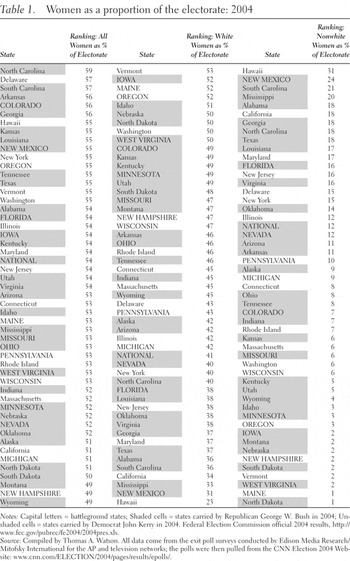
In 2004, after intense Get-Out-The-Vote (GOTV) efforts, ranging from calls and transportation assistance to heavily targeted television, radio, Internet, and direct mail ads, the turnout rate went up, especially among women (MacManus 2006). As a result, women increased their share of the electorate from 52 percent in 1996 and 2000 to an estimated 54% in 2004. Women made up a majority of the electorate in all but three states. (See Table 1.)
Women as a proportion of the electorate: 2004

Lasting Lessons from 2004
In the 2004 campaign, both major political parties and their respective allies learned four important lessons. Each of these lessons is sure to be heeded in the 2008 presidential election cycle because the proportion of women in the electorate will undoubtedly continue to rise.
Lesson No. 1: Identifying and effectively targeting “persuadable and winnable” infrequently voting slices of the female electorate is essential to winning the White House. The Kerry-Edwards campaign and its Democratic-leaning advocacy groups heavily targeted young, single, and blue-collar working women, and suburban women seen as “swing” voters. (Pollsters tended to describe the typical swing female voter as one who is “older than 50, lives in the suburbs, and works outside the home. Half are married; a majority never attended college.”3
Joseph Curl, “Despite Campaign Tactics, Female Vote Remains Elusive,” Washington Times, 〈http://www.washingtontimes.com/functions/print.php?StoryID=20041021-120937-4652r21〉 October 21, 2004.
Many analysts honed in on the “marriage” gap among women voters: “Want to know which candidate a woman is likely to support for president? Look at her ring finger. It may sound like the start of a bad joke, but the fact is most married women say they'll vote for President Bush. By nearly 2-to-1, unmarried women say they support John Kerry,” wrote reporter Susan Page in a lead article in USA TODAY.4
“Married? Single? Status Affects How Women Vote,” 26 August 2004, sec.1A.
Married people are more optimistic about the future and more suspicious about government's ability to help them. This favors incumbents and Republicans, the definition of Bush. Unmarried people tend to view government as more able to provide solutions to problems and are more pessimistic about the future of the country. This tends to favor challengers and Democrats, the definition of Kerry.5
Cited by Chuck Raasch, Gannett News Service, “Candidates Face Challenges in Courting Female Voters,” Florida Today, 〈http://floridatoday.gannettonline.com/election2004/gns/20040924-51819.html〉 September 27, 2004.
Democrats aimed their sights at unmarried women who are more liberal-leaning, while Republicans targeted more conservative married women, especially those with children, and those who work outside the home. The latter group was perceived as a high turnout group, but one that tended to switch its vote between Republicans and Democrats.
While the nonmonolithic nature of the women's vote was well established prior to 2004, many of the “microtargeting” techniques used to reach key slices were new and improved. Postelection analyses generally concluded that the Republicans had the superior microtargeting operation, as this account from the Washington Post affirms:
The Bush operation sniffed out potential voters with precision-guided accuracy, particularly in fast-growing counties beyond the first ring of suburbs of major cities. The campaign used computer models and demographic files to locate probable GOP voters. “They looked at what they read, what they watch, what they spend money on,” a party official said. Once those people were identified, the RNC [Republican National Committee] sought to register them, and the campaign used phone calls, mail and front-porch visits—all with a message emphasizing the issues about which they cared most—to encourage them to turn out for Bush.6
Dan Balz and Mike Allen, “Four More Years Attributed to Rove's Strategy,” Washington Post, 7 November 2004, sec. A.
By 2008, the technology and the retrievable individual-level data will undoubtedly permit even sharper targeting, or “narrow-casting,” of messages and media. It is likely that Democrats will put a higher priority on refining their voter data bases before the 2008 presidential election.
Lesson No. 2: Mobilizing single, non-college-educated, and infrequent women voters is considerably more difficult than it looks on a paper. Gains tend to be incremental rather than sharp. Without question, Democrats had the right group targeted to help Kerry win the election. Polls showed that the overwhelming majority of never-married, divorced, and widowed women favored Kerry, and statistics from the 2000 election showed that 22 million unmarried women who were eligible to vote did not do so.7
Susan Page, “Married? Single? Status Affects How Women Vote,” USA TODAY, 26 August 2004, sec.1A.
Early on, supporters of this targeting strategy had presumed that pocketbook issues would overwhelmingly trump security issues among these women. The campaign literature distributed by groups like America Coming Together, AFL-CIO, NOW, and Media Fund generally emphasized economics and jobs over security issues. But as the campaign progressed, it became evident that the pocketbook premise was not a “universal truth,” particularly among middle-class women. The director of the Pew Research Center for the People and the Press, in discussing the results of its September poll, said: “There's a tension among middle-class women who are attracted by Bush's perceived strength on terrorism and concerns about his poor performance on the domestic agenda. ‘They will be the story of this election: the way women make this choice,’ he predicted.”8
Katherine Q. Seelye, “Kerry in a Struggle for a Democratic Base: Women,” New York Times, 〈http://www.nytimes.com/2004/09/22/politics/campaign/22women.html?pagewatned=print〉 September 25, 2004.
As it turned out, Democrats had a tougher time reaching their female targets than did Republicans. A postelection survey by Lake Snell Perry & Associates (2004, 2) found that “support for the Democratic candidate … eroded among white women, working women, married women, and older women.” Kerry did best among minority women, especially first-time voters, and young women. Exit polls showed that the Democratic women who did vote placed the most importance on the economy and jobs, while the Republican women were more concerned about homeland security and terrorism, followed by moral values. The all-important independent women, who split their votes between Bush and Kerry, put the greatest emphasis on homeland security and terrorism, followed by jobs and the economy (Lake Snell Perry & Associates 2004, 3).
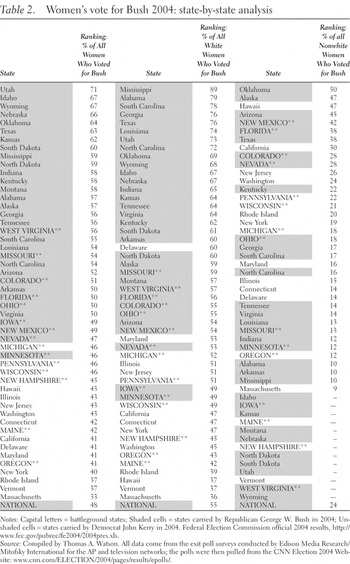
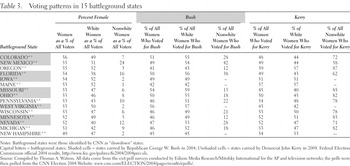
The bottom line is that Republicans were better at mobilizing the infrequent female voters they targeted (conservative moms in rural and suburban areas) than were the Democrats (targeting more liberal-leaning, single, working women in urban areas). From a broader perspective, the results seem to reinforce what social scientists have long known: Fear is a more powerful motivator than money. As one NOW member put it, “The theme of security in a time of war appears to be the major winner—the ‘fear gap’ clearly played to Bush's advantage” (Bennett 2004). Bush increased his overall share of the women's vote by 5% more than he received in 2000 (48% to 43%). He received a majority of the women's vote in 28 states—all of which he carried. (See Table 2.) He also received a narrow majority of female votes in the two most fiercely fought and critical battleground states—Ohio and Florida. (See Table 3.)
Women's vote for Bush 2004: state-by-state analysis

Voting patterns in 15 battleground states

Looking ahead to 2008, the key question is whether having a woman on one or both major parties' presidential tickets may be more effective in mobilizing generally “apolitical” women than are either heavily targeted campaign ads or female surrogate appearances. The political science literature tells us that a “glass-ceiling-breaker” candidate often spikes turnout among the constituency that that person represents. Both Democrat Hillary Clinton and Republican Condoleezza Rice might well have this effect if they are on presidential tickets in 2008.
Lesson No. 3: The “woman-to-woman” approach to getting-out-the-female-vote (GOTFV) has become a vital part of each party's campaign strategy. The 2004 election cycle saw the emergence of many women's groups, each reaching a narrow slice of the female electorate and each with its own clever “marketing” strategies, ranging from house parties to meet-ups at girls-nights-out-oriented festivities and chic “chick” shoes and shirts (MacManus 2006).
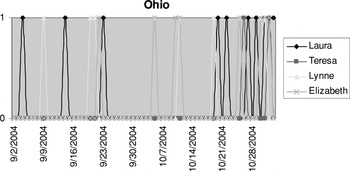
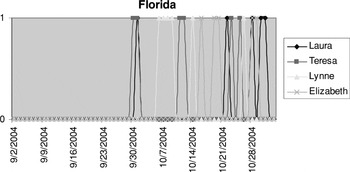
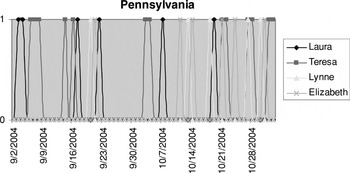
In 2004, the “surrogate campaign” featuring the wives of the Democratic and Republican presidential and vice presidential candidates was quite evident, particularly in key battleground states down the final stretch when Laura Bush, Teresa Heinz Kerry, Lynne Cheney, and Elizabeth Edwards were almost omnipresent in key states like Ohio, Florida, and Pennsylvania. (See Figures 1, 2, and 3.) Each campaign had professionals charged with managing and coordinating the appearances of these “running mates.” As an example, the Democrats' Florida Victory 2004 handbook had an entire section devoted to “surrogate strategy.” It identified female voters as one of the key constituency groups to be targeted by the surrogate program and even identified the specific media markets (Orlando, Tampa, Daytona) where surrogates that would appeal to women should be taken.9
Victory 2004 Florida Coordinated Campaign, Florida Victory 2004, September 3, 2004, p. 12. The other key constituency groups to be targeted by the surrogate campaign were seniors, African Americans, Hispanics, Jews, veterans, and youth.
Ibid., p. 7.

Presidential and vice presidential candidate wives' visits: Ohio. (Sources: Compiled by Andrew Quecan from “The Note” by ABCNEWS Political Unit, candidate Websites, George Washington University's Democracy in Action Website, http://www.gwu.edu/~action/2004/.)

Presidential and vice presidential candidate wives' visits: Florida. (Sources: Compiled by Andrew Quecan from “The Note” by ABCNEWS Political Unit, candidate Websites, George Washington University's Democracy in Action Website, http://www.gwu.edu/~action/2004/.)

Presidential and vice presidential candidate wives' visits: Pennsylvania. (Sources: Compiled by Andrew Quecan from “The Note” by ABCNEWS Political Unit, candidate Websites, George Washington University's Democracy in Action Website, http://www.gwu.edu/~action/2004/.)
In general, turnout in the presidential battleground states increased by 6.3%. In hotly contested Florida and Ohio, it rose by more than 8% (Ritchie 2004), mostly “in regions of Republican strength.”11
Larry Eichel, “Lessons Learned From the Bush Win,” Philadelphia Inquirer, 〈http://www.miami.com/mld/miamiherald/news/special_packages/election2004/10122793.htm?tem〉 November 7, 2004; Paul Farhi and James V. Grimaldi, “How Ohio Was Won,” Washington Post National Weekly Edition, 8–14 November 2004, p. 13.
The “high profile female surrogate” campaign is likely to become even more finely tuned in 2008. Some analysts have already predicted that “all attention [will] again [be] paid on the two big truly swing states, Florida and Ohio” (Ritchie 2004).
Lesson No. 4: The outreach to women voters escalates in key states the closer it gets to Election Day—when polls are showing the election “too close to call.” Why? Because historically, women are more likely to be late deciders than men. In August of 2004, political scientist Sue Carroll predicted the emergence of that same pattern: “This election may well be won by the presidential candidate who does the better job of mobilizing and speaking to the concerns of women voters, especially those still undecided women voters who will make their decisions between now and Election Day” (Junk 2004). Sure enough, with less than two weeks left in the campaign, “both candidates [were] making emotional appeals to undecided women, who, if the polls [were] accurate, could [have] total[ed] as many as 11 million voters.”12
Joseph Curl, “Despite Campaign Tactics, Female Vote Remains Elusive,” Washington Times, 〈http://www.washingtontimes.com/functions/print.php?StoryID=20041021-120937-4652r21〉 October 21, 2004.
Republican pollster Sergio Breglio, quoted in Musgrave, “Candidates Chase Votes of Undecided Women.”
The emergence of “two campaigns” within one presidential election cycle—one for early voters, the other for election day voters—began to gel in 2004. It will intensify in 2008 as more states adopt early voting and move to make absentee voting easier. This obviously intensifies the need for more focus-group work and greater attentiveness to age. Typically, older voters cast their ballots earlier than younger voters. We can expect more intense generation-based targeting in 2008.
Key Research Questions
From the four lessons learned come a number of research questions for women-in-politics scholars to examine more closely in future election cycles:
1. Timing of decision making. We need to probe more deeply into the demographics of late-deciding female voters. (It is easier to tell which way they are leaning than to gauge whether they will actually vote.) Understanding more precisely who these women are and how they eventually make up their minds about issues or candidates could help campaigns plan strategies for converting them to firm votes.
Are late deciders caught in the tension between poor performance on domestic issues and strength on international terrorism? Would a female candidate provide just enough motivation to push them to one side? When persuaded to vote for one side, how can late deciders be encouraged to vote early or absentee or to hold to that side on election day?
One may surmise that a portion of women voters will always make their decisions late and that campaigns need to plan their strategies accordingly. In that case, what are the most effective tactics for identifying and persuading eleventh-hour deciders?
2. Generational dimensions of campaigning. What works best to reach young, middle-age, and older women voters? Are their issues and priorities different? The evidence to date is mixed (Lake Snell Perry & Associates 2004; MacManus 1996).
In 2004, Kerry was successful in turning out young, especially first-time, women voters but lost support among older women. Does appealing to one generation necessarily alienate another generation, or are there issues and candidates that can unify women across the age spectrum?
Perhaps age is best considered in combination with factors like education level, race and ethnicity, employment outside the home, or blue-collar versus white-collar job. What are the key combinations that a campaign can use to its benefit?
3. Marital status and children. Is there more to the “marriage gap” than meets the eye? It is well documented that married people—men as well as women—are more optimistic and live longer than those who are unmarried. A corollary is that unmarried women feel more pessimistic and vulnerable. This feeling of insecurity could translate into favoring the political party that promises more social programs. The truth is that unmarried women today have more resources than their grandmothers did. The circumstances of a woman's marital status—a choice of career over marriage and family, a nasty versus amicable divorce, widowhood, cohabitation without marriage—can affect a woman's perspective. Is it worth sorting out these nuances? Is the assumption about a woman's political leaning based on marital status dangerously close to a stereotype?
Having children changes the equation for both married and unmarried women. Children give women first-hand experience with such issues as affordable health care, quality of schools, neighborhood safety, illegal drugs, choice of military service, higher education costs, and future employment opportunities. Controlling for marital status, what are the key differences in issues and priorities between women with children and those without?
Fear has proven to be an effective campaign tactic. Is it possible for a campaign to effectively diffuse fear engendered by an opponent? Is it harder to quell fear related to international issues than that related to domestic issues?
4. The effectiveness of the female surrogate campaign. What type of female surrogate is selected to target specific audiences? How effective are local surrogates? The presumption is that national surrogates are better, yet in the aftermath of the 2004 election, many have concluded that neighbors are more effective than outsiders in drawing voters to the polls.
What kind of forum is best for which kind of surrogate? Does a national surrogate attract more targeted women in a rally on state capitol grounds or at a garden club luncheon, for example? Is a local surrogate most effective in a child health clinic or on a city-to-city bus tour? What is the best purpose for each event: signing up volunteers, raising money, garnering votes?
How can meet-ups, clothing gimmicks, and similar activities be made more effective? How can campaigns further exploit technology—Websites on the Internet, cellphone messaging, and podcasting, for example?
5. Different mobilization approaches to non-college-educated women. Historically, this demographic has been hard to engage. Why? Is it an attitude of powerlessness or perhaps an indifference to public affairs? Is it a lack of education about citizen responsibility or about the candidates and issues? Is the reason more pragmatic—a lack of time, child care, or transportation to the polls?
Could campaigns more readily identify and motivate these women through microtargeting and other techniques? How and when should state and local party organizations gear up voter registration drives aimed specifically at noncollege graduates? Which messages are most effective for this slice of the female voting demographic? To what degree do television ads, direct mail ads, front-porch meetings, neighbor-to-neighbor interactions, and other outreach strategies work among this group?
As the campaigns become more strategic in their efforts to reach out to women, scholars have wonderful opportunities to investigate new theories and offer fresh explanations of female voting behavior. Will the dynamics of the women's vote be different this year?