In the modern scientific literature, psychopathy is conceptualized as a superordinate construct that includes three subdimensions: impulsivity, narcissism, and callousness (Fite, Greening, Stoppelbein, & Fabiano, Reference Fite, Greening, Stoppelbein and Fabiano2009; Kotler & McMahon, Reference Kotler and McMahon2005). In this study, we focus on callous–unemotional (CU) behaviors because of their direct relevance to the early childhood period. CU behaviors include diminished guilt following negative actions, low empathy and fear, poor recognition of fear or distress in others, reduced reactivity to challenging events, and an overfocus on reward and an insensitivity to punishment (Blair, Peschardt, Budhani, Mitchell, & Pine, Reference Blair, Peschardt, Budhani, Mitchell and Pine2006; Frick & White, Reference Frick and White2008). Approximately one-third of all youths who exhibit elevated levels of conduct problems (CP) also exhibit elevated levels of CU traits (e.g., Christian, Frick, Hill, Tyler, & Frazer, Reference Christian, Frick, Hill, Tyler and Frazer1997; Frick, Bodin, & Barry, Reference Frick, Bodin and Barry2000; Murrie & Cornell, Reference Murrie and Cornell2002; Woodworth & Waschbusch, Reference Woodworth and Waschbusch2008). Among children with elevated levels of CP, those with elevated levels of CU exhibit more diverse, severe, and persistent forms of antisocial behavior. There is growing evidence to suggest that the antisocial behavior of CP-only and CP + CU youth arises from distinct developmental pathways (Frick & Morris, Reference Frick and Morris2004; Frick & Viding, Reference Frick and Viding2009; Patrick, Fowles, & Krueger, Reference Patrick, Fowles and Krueger2009).
The consistent pattern of group differences observed between CP-only and CP + CU youth in middle childhood and adolescence provides a strong rationale for incorporating measures of CU into studies of disruptive behavior. Doing so has the potential to provide new insights into the causes and course of disruptive behavior, as well as for generating novel approaches for treatment (Dadds & Salmon, Reference Dadds and Salmon2003; Hawes & Dadds, Reference Hawes and Dadds2005; Viding, Blair, Moffitt, & Plomin, Reference Viding, Blair, Moffitt and Plomin2005; Waschbusch, Carrey, Willoughby, King, & Andrade, Reference Waschbusch, Carrey, Willoughby, King and Andrade2007). This potential promise is a major reason why CU is being considered as a modifier to conduct disorder diagnoses in DSM-5 (Frick & Moffitt, Reference Frick and Moffitt2010; McMahon, Witkiewitz, Kotler, & Conduct Problems Research Group, Reference McMahon, Witkiewitz and Kotler2010).
Although the validity and utility of extending the measurement of CU into middle childhood and especially adolescence is well established (Frick, Reference Frick2009), there is a paucity of research on CU in early childhood. We are only aware of one study that explicitly examined CU in a preschool age sample (Kimonis et al., Reference Kimonis, Frick, Boris, Smyke, Cornell and Farrell2006). However, Dadds and colleagues have included children as young as 3 years old in studies investigating the measurement of CU, as well as the association between empathy and psychopathy (Dadds, Fraser, Frost, & Hawes, Reference Dadds, Fraser, Frost and Hawes2005; Dadds et al., Reference Dadds, Hawes, Frost, Vassallo, Bunn and Hunter2009). Moreover, Gao and colleagues established that poor fear conditioning, fearlessness, and stimulation seeking (temperamental characteristics related to CU) measured at age 3 years were predictive of childhood aggression, adult criminality, and adult psychopathy (Gao, Raine, Venables, Dawson, & Mednick, Reference Gao, Raine, Venables, Dawson and Mednick2008, Reference Gao, Raine, Venables, Dawson and Mednick2010a; Glenn, Raine, Venables, & Mednick, Reference Glenn, Raine, Venables and Mednick2007; Raine, Reynolds, Venables, Mednick, & Farrington, Reference Raine, Reynolds, Venables, Mednick and Farrington1998). Others have also established the validity of measuring guilt and empathy in children as young as 3 years old (Cornell & Frick, Reference Cornell and Frick2007; Kochanska, Barry, Jimenez, Hollatz, & Woodard, Reference Kochanska, Barry, Jimenez, Hollatz and Woodard2009; Luby et al., Reference Luby, Belden, Sullivan, Hayen, McCadney and Spitznagel2009). Hence, although few studies have explicitly focused on CU in early childhood, individual differences in fearlessness, guilt, and empathy (key features of CU) are evident as young as age 3, which implies that the measurement of CU may be useful.
In contrast to CU, the validity and utility of measuring CP in early childhood is well accepted (Alink et al., Reference Alink, Mesman, van Zeijl, Stolk, Juffer and Koot2006; Wakschlag et al., Reference Wakschlag, Briggs-Gowan, Carter, Hill, Danis and Keenan2007). Given that many of the typical indicators of CP are not developmentally appropriate for young children, researchers have frequently relied on modified symptoms of conduct and especially oppositional defiant disorder (ODD) to represent individual differences in CP in early childhood (Egger & Angold, Reference Egger and Angold2006; Keenan & Wakschlag, Reference Keenan and Wakschlag2000, Reference Keenan and Wakschlag2004; Speltz, McClellan, DeKleyn, & Jones, Reference Speltz, McClellan, DeKleyn and Jones1999). The predictive validity of preschool ODD to CP in middle childhood and adolescence is well established (Burke, Waldman, & Lahey, Reference Burke, Waldman and Lahey2010; Keenan et al., Reference Keenan, Boeldt, Chen, Coyne, Donald and Duax2011; Lavigne et al., Reference Lavigne, Cicchetti, Gibbons, Binns, Larsen and DeVito2001; Loeber, Burke, Lahey, Winters, & Zera, Reference Loeber, Burke, Lahey, Winters and Zera2000). Our use of ODD is intended as a developmentally appropriate indicator of early CP. Our primary interest is whether individual differences in CU behaviors help to reduce heterogeneity among children with elevated CP.
To the extent that CU (and CP) behaviors can be reliably measured in early childhood, there exists an opportunity to test whether specific early life experiences contribute to the emergence and co-occurrence of these behaviors. Gene × Environment (G × E) interaction studies may be particularly appropriate for this work, because they acknowledge the interdependence between endogenous characteristics of children and their early experiences. We followed the four-step approach for framing G × E studies that was advocated by Caspi and Moffit (Reference Caspi and Moffitt2006; Moffitt, Caspi, & Rutter, Reference Moffitt, Caspi and Rutter2005, Reference Caspi and Moffitt2006).
The first step involved consultation of quantitative behavior genetic studies of CU. Viding and colleagues conducted the first twin study of CU behaviors in a large (N = 612 probands, 459 twin pairs) sample of 7-year-olds who resembled the populations of children born in the United Kingdom. Teacher-rated CU behaviors were highly heritable (h 2 = .67); moreover, the heritability of CP behavior was appreciably larger in children with (h 2 = .81) versus without (h 2 = .30) elevated levels of CU behaviors (Viding et al., Reference Viding, Blair, Moffitt and Plomin2005). This latter finding was replicated when children were 9 years old and held up even after controlling for attention-deficit/hyperactivity disorder (ADHD) behaviors (Viding, Jones, Frick, Moffitt, & Plomin, Reference Viding, Jones, Frick, Moffitt and Plomin2008). In a third report involving the same sample, Viding and colleagues also established that the co-occurrence of CP and CU behaviors was also highly heritable, with h 2 = .71 and .77 for boys and girls, respectively (Viding, Frick, & Plomin, Reference Viding, Frick and Plomin2007). Similarly, high heritability estimates have also been reported in other, adolescent-aged samples (Larsson et al., Reference Larsson, Tuvblad, Rijsdijk, Andershed, Grann and Lichtenstein2007; Taylor, Loney, Bobadilla, Iacono, & McGue, Reference Taylor, Loney, Bobadilla, Iacono and McGue2003). However, given that heritability estimates result from both genetic and Gene × Environment variation, the high heritability estimates of CU (and CP in the presence of high CU) in no way indicates that these behaviors are under exclusively genetic control.
The second step involved the identification of environmental experiences that may be causally related to the early emergence of CU behaviors. Two ideas influenced our thinking. First, Dadds and Salmon (Reference Dadds and Salmon2003) provided a provocative argument suggesting that individual differences in fearlessness and punishment insensitivity, characteristics that are attributed to children with elevated CP and CU, may represent early developmental outcomes, stemming from the early experience of dysfunctional or nonoptimal caregiving environments, and may not represent a stable component of temperament that is evident from birth. Their suggestions were based primarily on animal literature, given the paucity of studies that have considered the early (i.e., infancy or toddlerhood) familial experiences of children who are subsequently characterized as high on CU. Second, Gao and colleagues demonstrated that individual differences in fear conditioning, measured when children were 3 years old, were predictive of aggression in middle childhood, as well as adult criminality (Gao, Raine, et al., Reference Gao, Raine, Venables, Dawson and Mednick2010a; Gao, Raine, Venables, Dawson, & Mednick, Reference Gao, Raine, Venables, Dawson and Mednick2010b; Gao, Raine, Venables, & Mednick, Reference Gao, Raine, Venables and Mednick2004). Fear conditioning, which has been studied across species, involves the ability to learn to predict aversive events and change behavior accordingly. Taken together, these ideas raise the possibility that children who are exposed to early caregiving environments that are characterized by low levels of sensitivity and low levels of contingent responsiveness and/or high levels of harsh and intrusive behaviors, two correlated but distinct dimensions of parenting, may present as fearless and insensitive to punishment in early childhood. This temperamental profile may represent a short-term adaptation to the experience of a nonoptimal caregiving milieu that results in long-term risks for the subsequent development of CU and/or CP behaviors. This is consistent with the recent suggestions that serious disruptions in infant–caregiver relationships, including the experience of early maltreatment, may alter the neurobiological systems that contribute to the emergence of CU behaviors in particular (Daversa, Reference Daversa2010; Gao, Raine, Chan, Venables, & Mednick, Reference Gao, Raine, Chan, Venables and Mednick2010; Kochanska, Woodard, et al., Reference Kochanska, Woodard, Kim, Koenig, Yoon and Barry2010; Larsson, Viding, & Plomin, Reference Larsson, Viding and Plomin2008; Saltaris, Reference Saltaris2002; Weiler & Widom, Reference Weiler and Widom1996). For example, retrospective reports of experiences of harsh and unsupportive parenting in early childhood have been associated with lower levels of amygdala activation in response to presentations of negative and fearful faces in adults (Taylor, Eisenberger, Saxbe, Lehman, & Lieberman, Reference Taylor, Eisenberger, Saxbe, Lehman and Lieberman2006) and smaller hippocampal volumes for women (but not for men; Buss et al., Reference Buss, Lord, Wadiwalla, Hellhammer, Lupien and Meaney2007). Furthermore, self-reports of experiences of harsh maternal care moderate associations between both hippocampal (Whittle et al., Reference Whittle, Yap, Sheeber, Dudgeon, Yücel and Pantelis2011) and amygdala (Yap et al., Reference Yap, Whittle, Yücel, Sheeber, Pantelis and Simmons2008) activity and psychopathology in adolescence, suggesting that experiences of sensitive and harsh parenting likely have early and ongoing effects on relevant biobehavioral correlates of CU across development.
The third step of Caspi and Moffit's (Reference Caspi and Moffitt2006; Moffitt et al., Reference Moffitt, Caspi and Rutter2005, Reference Moffitt, Caspi and Rutter2006) recommended approach for G × E studies involves optimizing the measurement of the environmental risk factor. Numerous studies have reported that the experience of punitive (coercive) parenting is more strongly associated with CP when CU is low, not high (e.g., Edens, Skopp, & Cahill, Reference Edens, Skopp and Cahill2008; Hipwell et al., Reference Hipwell, Pardini, Loeber, Sembower, Keenan and Stouthamer-Loeber2007; Oxford, Cavell, & Hughes, Reference Oxford, Cavell and Hughes2003; Wootton, Frick, Shelton, & Silverthorn, Reference Wootton, Frick, Shelton and Silverthorn1997). Although these studies may appear to contradict our focus on caregiver behaviors as relevant to the emergence of CU and/or CP (ODD) behaviors (i.e., these studies indicate that CP behaviors are associated with poorer parenting among children low, but not high, on CU), it is noteworthy that all of these studies measured CP, not CU, as an outcome. More important, all of these studies measured CP, CU, and parenting behaviors in cross-sectional designs during middle childhood and adolescence. Hence, they do not inform questions about the role of early caregiving behaviors as precursors to the emergence of either CU or CP (ODD) behaviors. Developmentally, we are particularly interested in children's experience of nonoptimal (insensitive or harsh–intrusive) caregiving behaviors during the first 18 month of life, because this is a period of profound developmental change in the fear system, including the ability to anticipate and learn from punishments (Crittenden, Reference Crittenden2008; Marks, Reference Marks1987; Pauli-Pott, Friedl, Hinney, & Hebebrand, Reference Pauli-Pott, Friedl, Hinney and Hebebrand2009).
Here, we capitalize on the availability of an ongoing prospective longitudinal study, which included two distinct but correlated dimensions of parenting behaviors that were observed during infancy (at 6 and 12 months) and during the toddler/preschool (at 24 and 36 months) periods to test questions about the role of the developmental timing of nonoptimal caregiving behaviors. We hypothesized that whereas the early experience (in infancy) of nonoptimal parenting behaviors would be uniquely related to subsequent CU behaviors, the later experience (in toddlerhood and the preschool period) of nonoptimal parenting behaviors would be uniquely related to subsequent CP (ODD) behaviors. These hypotheses are consistent with the idea that attachment-related disturbances that are first evident in infancy may represent a unique risk for CU (Daversa, Reference Daversa2010; Kochanska, Barry, Stellern, & O'Bleness, Reference Kochanska, Barry, Stellern and O'Bleness2009; Kochanska, Woodard, et al., Reference Kochanska, Woodard, Kim, Koenig, Yoon and Barry2010), whereas coercive processes that are first evident in the toddler/preschool period may represent a unique risk for CP (ODD; Granic & Patterson, Reference Granic and Patterson2006; Patterson, Reference Patterson1982).
By considering two dimensions of nonoptimal parenting behavior (insensitivity and harsh–intrusive parenting), we are able to test hypotheses regarding specific caregiving processes in the early years of life that may lead to heightened risk for later CP (ODD) and CU. For example, sensitive and contingent responsiveness to an infant's physical and emotional needs is associated with a myriad of developmental outcomes, such as attachment security (De Wolff & van IJzendoorn, Reference De Wolff and van IJzendoorn1997) and effective stress reactivity and regulation (Blair et al., Reference Blair, Granger, Kivlighan, Mills-Koonce, Willoughby and Greenberg2008; Moore et al., Reference Moore, Hill-Soderlund, Propper, Calkins, Mills-Koonce and Cox2009), which are likely milestones in a broader developmental cascade, characterized by parental sensitive and contingent responsiveness. Such a parent–child dynamic should foster optimal functioning of both basic (fear) and complex (guilt and empathy) emotions (Swain, Lorberbaum, Kose, & Strathearn, Reference Swain, Lorberbaum, Kose and Strathearn2007), deficits that are implicated in both CP and CU (Blair et al., Reference Blair, Peschardt, Budhani, Mitchell and Pine2006; Frick & White, Reference Frick and White2008). Whereas an insensitive and emotionally detached parent may fail to provide the necessary scaffolding necessary for children to co-regulate and eventually self-regulate their distress and arousal over time, harsh and intrusive parenting may actually serve as elicitors of child distress and dysregulation. Furthermore, this harsh and controlling style of parenting may be indicative of broader patterns and coercive caregiving predictive of later CP and CU (Madigan, Moran, Schuengel, Pederson, & Otten, Reference Madigan, Moran, Schuengel, Pederson and Otten2007), as well as more atypical parenting behaviors that have been related to antisocial personality disorder symptoms and diagnoses in later adulthood (Shi, Bureau, Easterbrooks, Zhao, & Lyons-Ruth, Reference Shi, Bureau, Easterbrooks, Zhao and Lyons-Ruth2012).
The fourth step involved identifying a susceptibility gene that may act in concert with the receipt of nonoptimal caregiving behaviors to increase the probability of subsequent CU and CP (ODD) behaviors. We relied on the cognitive neuroscience literature to guide the selection of a susceptibility gene (Caspi & Moffitt, Reference Caspi and Moffitt2006). Blair has implicated the amygdala and ventromedial prefrontal cortex as the neural substrates most relevant to psychopathy (Blair, Reference Blair2007, Reference Blair2008; Finger, Mitchell, Jones, & Blair, Reference Finger, Mitchell, Jones and Blair2008). Kiehl implicated a broader array of neural substrates (i.e., the orbital frontal cortex, insula, anterior and posterior cingulate, amygdala, parahippocampal gyrus, and anterior superior temporal gyrus), which he collectively referred to as the paralimbic system (Kiehl, Reference Kiehl2006; Kiehl & Liddle, Reference Kiehl and Liddle2004). Although there are important differences between these perspectives, for our purposes it is only important to establish that these substrates are understood to contribute to individual differences in emotion processing, including the ability to learn from rewards and punishments (Blair, Reference Blair, Salelin and Lynam2010). In line with this work and consistent with our interest in adopting a developmental perspective on the emergence of CU behaviors, a recent study established that investigator-induced lesions to the amygdala and the hippocampus in rhesus macaques at 2 weeks of age resulted in a fearless phenotype at 18 months of age and appear to contribute to long-term impairments in emotion processing (Bliss-Moreau, Toscano, Bauman, Mason, & Amaral, Reference Bliss-Moreau, Toscano, Bauman, Mason and Amaral2010). An open question is whether the early experience of insensitive and/or harsh–intrusive caregiving behaviors similarly serves to compromise the normative development of these substrates, resulting in a fearless presentation and a compromised ability to learn from punishments and rewards.
Our interest in individual differences in both the expression of fear and the ability to learn from punishment (fear conditioning) led us to consider a single nucleotide polymorphism (SNP) of the brain-derived neurotrophic factor (BDNF) gene as a susceptibility gene for CU and possibly CP. The BDNF gene is a member of the neurotrophin family of growth factors that support the survival of existing neurons, as well as the growth and differentiation of new neurons and synapses (neural plasticity; Savitz, Solms, & Ramesar, Reference Savitz, Solms and Ramesar2006). An SNP of the BDNF gene (i.e., the presence of a methionine allele) results in decreased activity-dependent release of BDNF and is implicated in learning that is dependent on both the hippocampus and the amygdala (Casey et al., Reference Casey, Glatt, Tottenham, Soliman, Bath and Amso2009), the principle substrates implicated in CU. In addition to a large animal literature implicating the methionine allele in fear conditioning, two recent human studies that involved adults reported that individuals with a methionine allele of the valine 66 to methionine (Val66Met) BDNF genotype were characterized by deficient fear conditioning and/or fear extinction (Hajcak et al., Reference Hajcak, Castille, Olvet, Dunning, Roohi and Hatchwell2009; Soliman et al., Reference Soliman, Glatt, Bath, Levita, Jones and Pattwell2010). Another recent study demonstrated that the BNDF SNP is associated with differences in functional connectivity of neural networks that are involved in emotional processing in typically developing children and adolescents (Thomason, Yoo, Glover, & Gotlib, Reference Thomason, Yoo, Glover and Gotlib2009). In addition to indexing individual differences in psychological processes (fear conditioning) and neural substrates (the amygdala) that are implicated in CU, the BDNF SNP may be particularly important for studies of early relationship quality on subsequent behavior development. Casey et al. (Reference Casey, Glatt, Tottenham, Soliman, Bath and Amso2009) proposed that the BDNF SNP may be particularly important in early development and that children with a methionine allele may have increased vulnerability to early life stress due to the effects of BDNF on amygdala structure and function. This is consistent with the results of a recent study involving preschool-aged children, which reported that exposure to early indicators of stress (separate analyses focused on parental divorce and relationship discord) was only associated with higher levels of negative emotionality for children with the methionine allele of the BDNF gene (Hayden et al., Reference Hayden, Klein, Dougherty, Olino, Dyson and Durbin2010). Similarly, retrospective adult reports of decreased maternal caregiving behaviors were only predictive of personality traits (harm avoidance, reward dependence, and self-directedness) among adults with a methionine allele of the BDNF gene (Suzuki et al., Reference Suzuki, Matsumoto, Shibuya, Sadahiro, Kamata and Goto2011). Collectively, these results formed the basis of our hypotheses that children with a methionine allele of the BDNF gene whose parents rely heavily on punitive caregiving strategies should exhibit the highest levels of CU behaviors. Moreover, consistent with Casey et al. (Reference Casey, Glatt, Tottenham, Soliman, Bath and Amso2009), it may be that the earlier experience of harsh or punitive caregiving behaviors will be most strongly predictive of subsequent CU and/or CP.
In sum, this study tested whether two dimensions of observed parenting behaviors (sensitivity and harsh intrusiveness), measured at two different periods in time (infancy and toddler/preschool) were predictive of the early emergence of CU and ODD behaviors at age 3 years, as well as whether the strength of this association was moderated by a SNP of the BDNF gene. We hypothesized G × E interactions, such that children who carried the methionine allele (either Met/Val or Met/Met) and who experienced lower levels of sensitive parenting or higher levels of harsh and intrusive parenting in infancy would exhibit the highest mean levels of CU behaviors at age 36 months. The methionine allele was conceptualized as a risk factor given evidence that it is associated with poorer fear conditioning (hence, children who receive the harshest parenting but are least able to learn from it should exhibit the highest rates of CU and CP [ODD]). We also hypothesized that whereas harsh and intrusive parenting behaviors in infancy would be uniquely related to CU (conditional on the BDNF methionine allele), harsh and intrusive parenting behaviors in toddlerhood/preschool would be uniquely related to ODD, consistent with long-standing notions of coercive family processes as they relate to CP (ODD). We ran a parallel set of models predicting CU and ODD behaviors, in order to understand whether any of the obtained G × E interactions were specific to either behavior.
Methods
Participants
Participants were drawn from the Durham Child Health and Development Study (DCHD), a prospective longitudinal study consisting of 206 healthy, full-term infants who were recruited at 3 months of age. The sampling design of the DCHD study was intended to recruit approximately equal numbers of African American and Caucasian families from lower and higher income groups. Families who had an infant less than 3 months of age were targeted for inclusion in the DCHD study. Families were recruited from a largely urban community via fliers and postings at birthing and parenting classes, as well as through telephone contact information from birth records. Infants included in the study were healthy, full-term, and born without significant birth complications. Family's race was determined from mother self-report; income status was determined by whether the family was above or below 200% of the federally established poverty threshold.
Of the 206 children who were recruited into the DCHD study, 171 (83%) had data for the BDNF rs6265 (Val66Met) gene (reasons for not having data included refusal to participate, data collection error, and study attrition; the call rate for BDNF genotype was 92.4%). The current study was restricted to these 171 cases. There was no evidence that children with (N = 171) and without (N = 35) data for the BDNF gene differed as a function of the racial (57% vs. 57% African American, p = .96) or poverty (50% vs. 60% poor, p = .27) indicators that were used to guide sample selection. Moreover, based on more limited data from the 36-month outcome assessment (i.e., N = 167 vs. 16 with and without BDNF data, respectively), there was no evidence that the availability of genetic data was related to mean level differences in opposition defiant (M = 0.5 vs. 0.3, for children with and without genetic data, p = .12) or CU behaviors (M = 0.2 vs. 0.2, for children with and without genetic data, p = .24).
Procedure
Families were part of an ongoing prospective longitudinal study that began when children were 3 months old. The current analyses involved observed parenting behaviors during free play interactions when children were 6 and 12 months of age (defined as early parenting), observed parenting behaviors during challenge tasks when children were 24 and 36 months of age (defined as later parenting), and genetic (buccal swab) data collected from children at the 12-month visit, parent-rated temperament at 3, 6, and 12 months of age, and parent-rated ODD and CU behaviors when children were 36 months of age. With the exception of the 6-month visit, which occurred in the family home, all ratings and observations were made in the context of lab visits. Taxi service was provided to families who required transportation in order to come to the lab. Families were compensated $50 for their participation at each visit, which lasted an average of 2 hr.
Measures
Infant Behavior Questionnaire
Primary caregivers completed the Infant Behavior Questionnaire—Revised (Gartstein & Rothbart, Reference Gartstein and Rothbart2003) at the 3-, 6-, and 12-month visits. The items on the questionnaire ask caregivers to rate the frequency of specific temperament-related behaviors that may have occurred in a variety of everyday situations and that were observed over the past 1–2 weeks. Items were rated on a 7-point Likert scale (1 = never, 4 = half of the time, 7 = always). Two scales were used in the current study: fear (16 items; e.g., startles to a sudden or loud noise or never warms up to unfamiliar adults) and distress to limitations (16 items; e.g., baby seems angry when you left her/him in the crib, fussy or cry when washed, or protests when placed in confining place like car seat), each of which had good internal consistency (fear αs = 0.90, 0.89, and 0.87; distress to limitations αs = 0.81, 0.83, and 0.82, at the 3, 6, and 12-month visits, respectively). Scores were averaged across the 3-, 6-, and 12-month assessments in order to minimize data loss (the across-time correlations for fear were r 3 with 6 months = .56, r 3 with 12 months = .29, and r 6 with 12 months = .44, all ps < .001; the across-time correlations for distress were r 3 with 6 months = .60, r 3 with 12 months = .36, and r 6 with 12 months = .60, all ps < .0001). Fear and distress to limitations were intended to control for potential early child effects, with fear and distress being conceptualized as negatively and positively correlated with CU and ODD, respectively.
Observed parent–infant interactions
Mothers and children were observed in a free play session as part of a home visit at 6 months of child age and a laboratory visit at 12 months of age. During this interaction, mothers were asked to interact with their children as they normally would in a typical day. A standard set of toys was provided for the mother and child to use, and the pair was asked to sit on a blanket that was laid out across the floor. In addition, mothers and children were observed in a puzzle completion task as part of laboratory visits at 24 and 36 months of age. During this task, the child was sequentially presented with three puzzles of increasing difficulty, and the mother was instructed to assist as she saw fit. Because they were part of a larger assessment battery, free play and challenge tasks were structured to last approximately 10 min. All parent–child interactions were videotaped for later coding, with researchers monitoring the camera discreetly to minimize interference with the ongoing interaction.
Independent coders rated the interactions using 5-point subscales to measure parental sensitivity, intrusiveness, detachment, stimulation of development, positive regard, negative regard, and animation (measures adapted from the NICHD Early Child Care Research Network, 1999). No effort was made to ensure that the same coders were available to code all interactions, though standards for reliability of observations were constant throughout. Previous factor analyses supported the creation of two composite measures of maternal behaviors. The first was harsh and intrusive parenting behavior, which included intrusiveness and negative regard; the second composite was sensitive parenting behavior, which included sensitivity, detachment (reversed scored), stimulation of development, positive regard, and animation. Each subscale was double-coded and conferenced by trained and reliable coders. Reliabilities across each pair of coders were determined by maintaining intraclass correlation coefficients of 0.80 or greater on all subscales and composite measures (intraclass correlation range = 0.80–0.96). Sensitive and harsh–intrusive composites were negatively correlated at the 6-, 12-, 24-, and 36-month assessments (rs = −.37, −.47, −.62, and −.50, respectively, all ps < .0001). Measures of sensitive and harsh–intrusive parenting behaviors were averaged across the 6- and 12-month (sensitive r = .69, harsh–intrusive r = .36, ps < .0001) assessments to index early parenting behaviors and across 24- and 36-month (sensitive r = .51, harsh–intrusive r = .60, ps < .0001) assessments to index later parenting behaviors.
Achenbach System of Empirically Based Assessment (ASEBA)
Primary caregivers completed the ASEBA preschool forms (Achenbach & Rescorla, Reference Achenbach and Rescorla2000) at the 36-month visit. The ASEBA is a standardized assessment that indexes children's behavioral/emotional problems by having caregivers rate their children on items describing the children currently or within the last 2 months. This version of the ASEBA consists of 99 items describing behavioral/emotional problems and an open-ended item for additional problems. We recently demonstrated how 17 items drawn from the ASEBA could be used to measure individual differences in disruptive, including CU, behaviors in 3-year-olds. Specifically, we demonstrated (a) that items indicating CU (e.g., “punishment doesn't change behavior” or “shows too little fear of getting hurt”), ODD (e.g., “defiant” or “uncooperative”), and ADHD (e.g., “can't sit still” or “quickly shifts from one activity to another”), although highly correlated in this sample, were best conceptualized as distinct latent factors; (b) that the measurement properties of CU items were equivalent to those of ODD and ADHD behaviors; (c) that individual differences in CU, ODD, and ADHD behaviors are highly stable over time (from 3 to 5 years); and (d) that distinguishing children with elevated ODD behaviors as a function of co-occurring CU behaviors revealed distinct temperamental profiles in infancy (Willoughby, Waschbusch, Moore, & Propper, Reference Willoughby, Waschbusch, Moore and Propper2011). Mean scores for the 5-item CU (α = 0.65) and ODD (α = 0.83) scales were the dependent variables used in the current study.
BDNF genotyping
Genomic DNA was extracted from each salivary sample using the Puregene DNA extraction kit by following the manufacturer's protocol for DNA isolation from 1 ml of body fluid. Saliva samples yielded DNA in adequate quantities for genotyping (~200 µg/ml). Genotyping of the BDNF rs6265 (Val66Met) gene was performed by polymerase chain reaction amplification using the primers ACTCTGGAGAGCGTGAATGG and AGAAGAGGAGGCTCCAAAGG, followed by digestion with the Nla III restriction enzyme (Egan et al., Reference Egan, Kojima, Callicott, Goldberg, Kolachana and Bertolino2003). Genotyping resulted in three groups: Val/Val (GG), Val/Met (GA), and Met/Met (AA). The Val66Met genotype distribution (Val/Val: n = 138, 80.70%; Val/Met: n = 30, 17.55%; and Met/Met: n = 3, 1.75%) was in Hardy–Weinberg equilibrium (p > .05; χ2 test). Because the methionine allele served as a risk factor, children with either Val/Met or Met/Met genotypes were combined for purposes of analysis.
Analytic strategy
The primary analytic approach involved estimating a series of ordinary least squares multiple regression models in which CU and ODD behaviors were separately regressed on indices of observed parenting behaviors, a dichotomous indicator of BDNF genotype (indicating the presence of the methionine allele), and their interactions. For each set of predictors, a preliminary model was estimated in order to evaluate distributional assumptions and to identify potentially highly influential cases. We relied primarily on graphical methods to evaluate distributional assumptions and to identify cases with high influence, as indicated by large Cook d values (Fox, Reference Fox1991). Distributional assumptions were met. Moreover, in nearly every model, there were one to four cases that inflated the strength of the associations between predictors and outcomes. We adopted a conservative approach and excluded highly influential cases from focal models (these are the only results that are reported here). When G × E interactions were not significant, the model was reestimated (continuing to exclude influential cases) dropping the nonsignificant interaction term(s). When G × E interaction terms were statistically significant, we followed standard procedures and provided tests of simple slopes of the effect of a given parental belief or behavior on outcomes as a function of BDNF genotype (Aiken & West, Reference Aiken and West1991). A standard set of covariates, consisting of child gender (male), race (black), and poverty status at the time of recruitment, as well as parent ratings of infant temperament (fear and distress to limitations), which were aggregated across the 3-, 6-, and 12-month assessments, were included in all models. Race and poverty were included because of their use in the sampling design. Gender was included given the possibility of elevated levels of disruptive behavior at age 3 among males (Keenan & Shaw, Reference Keenan and Shaw1997). Temperamental indicators of fear and distress to limitations were added to control for potential child-level effects that preceded CU and ODD and that may have contributed to the nature of the parent–child interaction quality. All predictor variables (covariates inclusive) were mean centered in order to reduce nonessential multicollinearity (Aiken & West, Reference Aiken and West1991). All models used listwise deletion, because the rates of missing data for predictors and outcomes were very low (<3% cases).
Three sets of regression models were estimated for each outcome. The first model exclusively considered early sensitive and harsh–intrusive behaviors, in conjunction with child genotype, as predictors. The second model exclusively considered later sensitive and harsh–intrusive behaviors, in conjunction with child genotype, as predictors. The third model considered the combination of early and late caregiver behaviors, in conjunction with child genotype, as predictors. The first and second set of models inform questions about which dimensions of observed parenting (sensitivity versus harsh–intrusion) are uniquely predictive, either alone or conditional on BDNF genotype, of ODD and CU outcomes. The third model informs the question about whether the developmental timing of observed parenting behaviors matters. Standardized regression coefficients are reported in the text, and unstandardized coefficients (and 95% confidence intervals) and indices of model fit are provided in the tables.
Results
Threats to inference
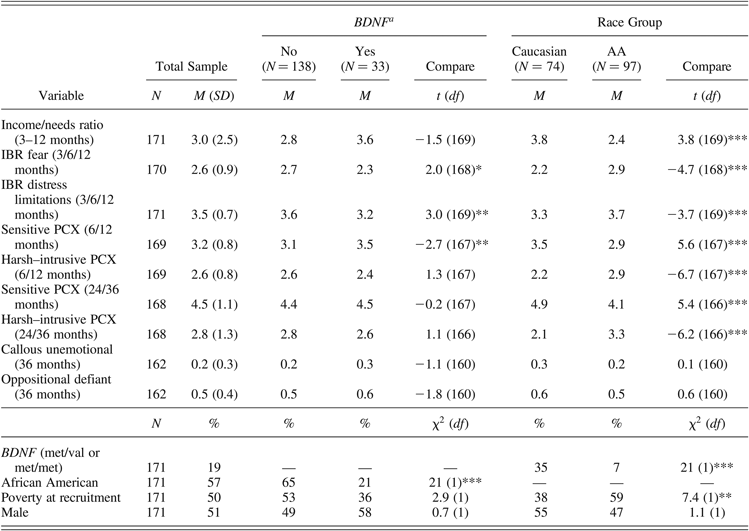
Gene–environment correlations (rGE) refer to genetic differences that result in differential exposure to certain environments (Jaffee & Price, Reference Jaffee and Price2007). Whereas passive rGE refers to the association between a child's inherited genotype and the rearing environment provided by his/her biological parents, evocative rGE refers to the association between a child's genetically influenced behavior (in our case temperament) and the environment's reaction to that behavior (in our case, caregivers’ parenting behaviors). In addition, rGEs can impact the discovery of G × E interactions. In order to explore for the possibility of rGEs, we tested for differences between children with (N = 33) and without (N = 138) the methionine allele of the BDNF gene (see Table 1). Children with risk alleles (Val/Met or Met/Met) were rated as having lower levels of fear (p = .047) and distress to limitations (p = .004) in infancy. These differences notwithstanding, there was no evidence that children with risk alleles were the recipients of less sensitive or more harsh–intrusive caregiving behaviors during either the infancy/toddler or the preschool periods (children with the risk allele were the recipients of more sensitive caregiving behaviors during the infancy/toddler period, p = .009).
Descriptive statistics for predictor and outcome variables

Note: Satterthwaite degrees of freedom were used because the groups had different variances. BDNF, brain-derived neurotrophic factor gene; AA, African American; IBR, Infant Behavior Record; PCX, parent–child interaction observations; Poverty, family income ≤200% poverty threshold for given household size at study entry.
aEither a valine/methionine or methionine/methionine allele.
*p < .05. **p < .01. ***p < .001.
Population stratification refers to the situation in which racial/ethnic differences in both an allelic frequency and a behavioral outcome yield a spurious association between the genotype and behavior (Hutchison, Stallings, McGeary, & Bryan, Reference Hutchison, Stallings, McGeary and Bryan2004). Hutchison et al. implied that concerns about population stratification were typically overstated and when present were typically of small magnitude. Nonetheless, given that the participants in the study were racially heterogeneous, we considered race differences in the frequency of the BDNF polymorphism, observed parenting behavior, and in children's ODD and CU behaviors. The results are summarized in Table 1. African American children were significantly less likely to exhibit the risk allele (p < .0001) and more likely to experience nonoptimal parenting (i.e., less sensitive or more harsh–intrusive) behaviors. However, there were no racial/ethnic differences in CU (p = .90) or ODD (p = .52) behaviors. Such group equivalence on behavioral outcomes helped to rule out population stratification as a threat to our interest in testing G × E interactions, although child race was nevertheless included in all regression analyses.
Descriptive statistics
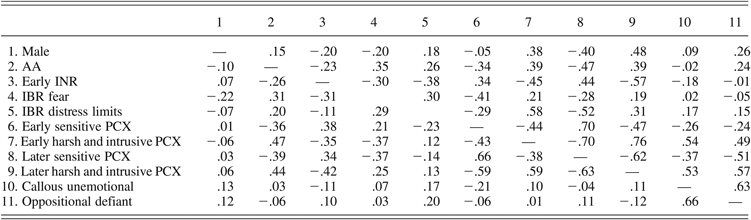
Bivariate correlations between all predictor and outcome variables, separately for BDNF-defined groups are summarized in Table 2. Given the large discrepancies in sample sizes across groups, correlations are presented descriptively with no consideration of statistical significance. Inspection of correlation coefficients highlighted two points. First, CU and ODD were moderately highly correlated in both groups (rs = .63 and .66). Second, for many predictors, the strength of the association between a given predictor and behavioral outcomes was appreciably different for BDNF-defined groups. For example, whereas early harsh–intrusive parenting behaviors were largely unrelated to CU (r = .10) and ODD (r = .01) in children without the risk (methionine) allele, they were moderately to strongly related to CU (r = .54) and ODD (r = .49) in children with the risk (methionine) allele. Similar discrepancies were evident for other indices of parenting behaviors and are indicative of G × E interactions.
Bivariate correlations for predictor and outcome variables
Note: Correlations above and below the diagonal are for children with and without the methionine (Met) allele brain-derived neurotrophic factor, respectively, that is, valine (Val)/Met or Met/Met are above (Ns = 28–33) and Val/Val is below (Ns = 114–138). AA, African American; INR, income to needs ratio; IBR, Infant Behavior Record; PCX, Parent–child interaction observations.
Early parenting behaviors
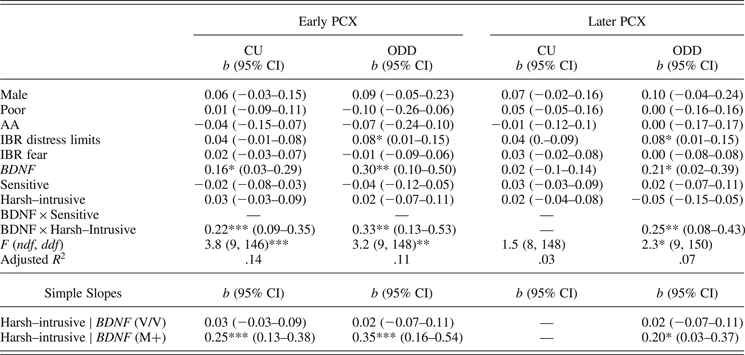
A preliminary ordinary least squares (OLS) model that regressed CU on early parenting behaviors identified three highly influential cases that were excluded from subsequent analyses. The model that included both the BDNF × Sensitivity and the BDNF × Harsh–Intrusion interaction terms was statistically significant, F (10, 145) = 3.6, p = .0002. The two interaction terms uniquely explained 7% more variation in CU behaviors than did the covariates and main effects, F (2, 145) = 6.7, p = .002; R 2 = .20 versus .13. Although the BDNF × Harsh–Intrusion term was statistically significant (β = 0.36, p = .0004), the BDNF × Sensitivity term was not (β = 0.13, p = .19). The model was reestimated, removing the BDNF × Sensitivity term. The trimmed model continued to be statistically significant, F (9, 146) = 3.8, p = .0002, as did the BDNF × Harsh–Intrusion term (β = 0.31, p = .0008). Early harsh–intrusive parenting was associated with increased CU behaviors for children with a methionine allele (β = 0.86, p < .0001) but not for children without a methionine allele (β = 0.11, p = .30). Parameter estimates from the trimmed model are summarized in Table 3, and the interaction is depicted in the top panel of Figure 1.
(Color online) The observed Harsh–Intrusive Parenting × Brain-Derived Neurotrophic Factor prediction of oppositional defiant disorder and callous–unemotional.
Prediction of callous unemotional (CU) and oppositional defiant disorder (ODD) behaviors from early and later observed parenting behaviors considered separately
Note: PCX, parent–child interaction observations; AA, African American; IBR, Infant Behavior Record; BDNF, brain-derived neurotrophic factor gene; V/V, valine/valine; M+, Val/methionine (Met) or Met/Met.
*p < .05. **p < .01. ***p < .001.
A preliminary OLS model that regressed ODD on early parenting behaviors identified one highly influential case that was excluded from subsequent analyses. The model that included both the BDNF × Sensitivity and the BDNF × Harsh–Intrusion interaction terms was statistically significant, F (10, 147) = 2.9, p = .0024. The two interaction terms uniquely explained 7% more variation in ODD behaviors than did the covariates and main effects, F (2, 147) = 5.6, p = .005; R 2 = .17 versus .10. Although the BDNF × Harsh–Intrusion term was statistically significant (β = 0.31, p = .002), the BDNF × Sensitivity term was not (β = 0.04, p = .69). The model was reestimated, removing the BDNF × Sensitivity term. The trimmed model continued to be statistically significant, F (9, 148) = 3.2, p = .0013, as did the BDNF × Harsh–Intrusion term (β = 0.30, p = .0011). Early harsh–intrusive parenting was associated with increased ODD behaviors for children with a methionine allele (β = 0.78, p = .0003) but not for children without a methionine allele (β = 0.05, p = .65). Parameter estimates from the trimmed model are summarized in Table 3, and the interaction is depicted in the middle panel of Figure 1.
Later parenting behaviors
A preliminary OLS model that regressed CU on later parenting behaviors identified four highly influential cases that were excluded from subsequent analyses. The model that included both the BDNF × Sensitivity and the BDNF × Harsh–Intrusion interaction terms was not statistically significant, F (10, 146) = 1.2, p = .28. The two interaction terms did not explain any additional variation in CU behaviors relative to the covariates and the main effects, F (2, 146) = 0.2, p = .83; R 2 = .08 versus .08. Neither BDNF × Sensitivity nor BDNF × Harsh–Intrusion was statistically significant (ps = .79 and .77, respectively). Moreover, in a model in which BDNF × Parenting interactions were trimmed, neither the main effect for sensitivity (β = 0.10, p = .34) nor for harsh–intrusive (β = 0.08, p = .49) parenting behaviors was statistically significant. Parameter estimates from the main effects model are summarized in Table 3.
A preliminary OLS model that regressed ODD on later parenting behaviors identified one highly influential case that was excluded from subsequent analyses. The model, which included both the BDNF × Sensitivity and the BDNF × Harsh–Intrusion interaction terms was statistically significant, F (10, 149) = 2.1, p = .027. The two interaction terms uniquely explained 5% more variation in ODD behaviors than did the covariates and main effects, F (2, 149) = 4.2, p = .017; R 2 = .12 versus .07. Although the BDNF × Harsh–Intrusion term was statistically significant (β = 0.24, p = .03), the BDNF × Sensitivity term was not (β = −0.03, p = .77). The model was reestimated, removing the BDNF × Sensitivity term. The trimmed model continued to be statistically significant, F (9, 150) = 2.3, p = .017, as did the BDNF × Harsh–Intrusion term (β = 0.26, p = .004). Early harsh–intrusive parenting was associated with increased ODD behaviors for children with a methionine allele (β = 0.46, p = .02) but not for children without a methionine allele (β = −.12, p = .29). Parameter estimates from the trimmed model are summarized in Table 3, and the interaction is depicted in the bottom panel of Figure 1.
Developmental timing of observed harsh and intrusive parenting behaviors
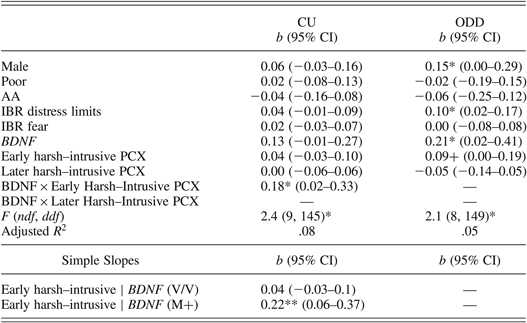
The preceding results suggest that whereas early observed harsh and intrusive parenting interacted with BDNF to predict CU and ODD, later observed harsh and intrusive parenting interacted with BDNF to predict ODD but not CU. A final set of models was estimated in which CU and ODD were regressed on early and later harsh and intrusive parenting simultaneously, in order to more definitively test questions regarding the importance of the timing of exposure to harsh–intrusive parenting behaviors. A preliminary model that regressed CU on early and later harsh and intrusive parenting, BDNF, their interaction (i.e., Early Harsh × BDNF and Later Harsh × BDNF), and covariates identified four highly influential cases that were excluded from subsequent analyses. The model that included both the BDNF × Early Harsh–Intrusion and the BDNF × Later Harsh–Intrusion interaction terms was statistically significant, F (10, 144) = 2.2, p = .02. The two interaction terms uniquely explained 3% more variation in CU behaviors than did the covariates and main effects, F (2, 144) = 2.9, p = .058; R 2 = .13 versus .10. Although the BDNF × Early Harsh–Intrusion term was statistically significant (β = 0.29, p = .026), the BDNF × Later Harsh–Intrusion term was not (β = 0.10, p = .42). The model was reestimated, removing the BDNF × Later Harsh–Intrusion term. The trimmed model continued to be statistically significant, F (9, 145) = 2.4, p = .014, as did the BDNF × Early Harsh–Intrusion term (β = 0.22, p = .025). Early harsh–intrusive parenting was associated with increased CU behaviors for children with a methionine allele (β = 0.74, p = .005) but not for children without a methionine allele (β = 0.13, p = .24). Parameter estimates from the trimmed model are summarized in Table 4. We note that the parameter estimate for the interaction term (and the simple slopes, which are not reported) from this model is very similar to that observed in the early model in which the BDNF × Early Harsh–Intrusion term was included without consideration of the BDNF × Later Harsh–Intrusion term (compare coefficients from Tables 3 and 4).
Prediction of callous unemotional (CU) and oppositional defiant disorder (ODD) behaviors from early and later observed harsh–intrusive parenting behaviors considered simultaneously
Note: V, valine; M+, Val/methionine (Met) or Met/Met; AA, African American; IBR, Infant Behavior Record; BDNF, brain-derived neurotrophic factor gene; PCX, parent–child interaction observations.
*p < .05. **p < .01. ***p < .001.
A preliminary model that regressed ODD on early and later harsh and intrusive parenting, BDNF, their interaction (i.e., Early Harsh × BDNF or Later Harsh × BDNF), and covariates identified one highly influential case that was excluded from subsequent analyses. The model that included both the BDNF × Early Harsh–Intrusion and the BDNF × Later Harsh–Intrusion interaction terms were statistically significant, F (10, 147) = 3.3 p = .0008. The two interaction terms uniquely explained 8% more variation in ODD behaviors than did the covariates and main effects, F (2, 147) = 7.0, p = .001; R 2 = .18 versus .10. However, neither the BDNF × Early Harsh–Intrusion term (β = 0.16, p = .25) nor the BDNF × Later Harsh–Intrusion (β = 0.19, p = .16) term was statistically significant. These results indicated that BDNF × Early and BDNF × Later Harsh–Intrusive behaviors explained overlapping variation in ODD. Each interaction term was statistically significant when the other was omitted from the model. Parameter estimates from the main effects model, in which both nonsignificant interactions were trimmed, are summarized in Table 4.
Influential cases
A ubiquitous finding was the presence of a small number of highly influential cases. We adopted a conservative approach and only reported results in which these highly influential cases were excluded, despite the fact that this tended to reduce the magnitude of reported effects. Four cases were frequently identified as exerting excessive influence on model results. All four of these cases were recruited in the poor stratum, three of the four were male, and three of the four had a methionine allele on the BDNF gene. Three of the four had parent-rated CU and ODD scores that exceeded the 95th percentile of scores in this sample. This suggests that their large influence on model results may have been warranted, given extreme scores on predictors and outcomes (i.e., these cases are likely not “outliers” in the typical use of the term). These cases may well be among a handful of children in this relatively small sample who are at greatest risk for the development of serious behavior problems. Nonetheless, the fact that the same pattern of results emerged given their exclusion gives us more confidence in the generalizability of our conclusions.
Discussion
It has been known for a long time that children with elevated CPs are heterogeneous with respect to their etiologies, risk factors, developmental outcomes, and possibly treatment response. There is growing interest in relying on individual differences in CU traits (behaviors) to reduce this heterogeneity. It is for this reason that CU is being considered as a modifier for diagnoses of conduct disorder in DSM-5 (Frick & Moffit, Reference Frick and Moffitt2010). Despite a burgeoning research literature on CU in middle childhood and adolescent samples, relatively little is known about CU traits in early childhood, even though this is the developmental period in which individual differences in empathy and guilt (key indicators of the construct of CU) are first evident (Kochanska, Barry, Jimenez, et al., Reference Kochanska, Barry, Jimenez, Hollatz and Woodard2009; Kochanska, Koenig, Barry, Kim, & Yoon, Reference Kochanska, Koenig, Barry, Kim and Yoon2010). The primary goal of this study was to test whether children who were exposed to nonoptimal caregiving behaviors (low sensitivity or high harsh intrusiveness) and who have a methionine allele of the BDNF gene that is associated with individual differences in the ability to learn from punishment were at increased risk for the emergence of CU and ODD behaviors at age 3 years. A secondary question was whether the timing at which a child experienced nonoptimal caregiving behaviors was differentially related to the subsequent emergence of CU and ODD. In partial support of our hypotheses, observed harsh and intrusive (but not insensitive) caregiving behaviors were more strongly associated with elevated levels of CU and ODD behaviors for children with a methionine allele of the BDNF gene. Specifically, higher levels of harsh–intrusive parenting behaviors were significantly and positively associated with higher levels of CU and ODD behaviors for the subset of children with a methionine allele of the BDNF gene. Moreover, in partial support of our hypotheses regarding developmental timing, whereas the early experience of harsh–intrusive behaviors was uniquely related to CU, both early and later harsh–intrusive behaviors were related to ODD.
The prospective design of the DCHD study, combined with its repeated assessment of parent–child interaction quality using developmentally appropriate protocols and observational methods, provided a unique opportunity to test whether early versus later experience of harsh and intrusive parenting behaviors was uniquely associated with the subsequent emergence of CU behaviors. The early (but not later) experience of harsh and intrusive parenting behaviors interacted with child BDNF genotype to predict CU behaviors at age 3. In contrast, both the early and the later experience of harsh and intrusive parenting behaviors interacted with child BDNF genotype to predict ODD behaviors at age 3; however, early and later harsh–intrusive parenting behaviors explained overlapping variation in ODD, because neither was uniquely related to ODD when considered together. These results suggest that the first year of life may serve as a “sensitive period” for the development of the fear system, including the presentation of a fearless style as well as foundations for fear conditioning, and that the normative development of this system may be partially dependent on the nature of the parent–child relationship during this time period. The finding that early and later harsh and intrusive parenting interacted with the BDNF genotype to predict ODD behaviors is more closely aligned with traditional developmental models that implicate coercive family processes in the initiation and maintenance of early onset antisocial behaviors (Patterson, Reference Patterson1982; Patterson, DeGarmo, & Knutson, Reference Patterson, DeGarmo and Knutson2000).
Given the relatively strong correlation between harsh and intrusive parenting that we observe across the first 3 years of life (see Table 2), it is tempting to speculate that the sustained exposure to nonnormative caregiving behaviors across the entire early childhood period, in combination with genetic risks (of which BDNF is just one), may initiate children's membership in a life course persistent pattern of antisocial behavior (Aguilar, Sroufe, Egeland, & Carlson, Reference Aguilar, Sroufe, Egeland and Carlson2000; Loeber et al., Reference Loeber, Wung, Keenan, Giroux, Stouthamer-Loeber and Van Kammen1993; Moffitt & Caspi, Reference Moffitt and Caspi2001), which may be best characterized by the joint co-occurrence of CP and CU behaviors. Children carrying the methionine allele of the BDNF gene may be at increased risk for poor fear conditioning due to low levels of expressed BDNF protein, which undermine hippocampal- and/or amygdala-related learning (Hajcak et al., Reference Hajcak, Castille, Olvet, Dunning, Roohi and Hatchwell2009; Liu, Lyons, Mamounas, & Thompson, Reference Liu, Lyons, Mamounas and Thompson2004). This risk may be particularly accentuated for children whose caregivers exhibit overly harsh and/or inconsistent caregiving behaviors that may further compromise the ability to learn from punishments. Children's short-term adaptations to the experience of nonoptimal early caregiving environments during infancy and toddlerhood (i.e., the manifestation of a fearless temperamental style and punishment insensitivity) may contribute to further disruptions of the parent–child relationship across the early childhood period, including the onset of coercive family processes, which serve to entrench serious disruptive behaviors that persist into middle childhood.
The results of this study are in line with the work of Kochanska and colleagues, who demonstrated the early contingent and responsive caregiving behaviors as contributing to what they call a mutually responsive orientation between parents and children, which becomes a foundation for the children's early consciousness development and which in turn protects against the emergence of disruptive behaviors by age 6 years (Kochanska, Barry, Aksan, & Boldt, Reference Kochanska, Barry, Aksan and Boldt2008; Kochanska, Koenig, et al., Reference Kochanska, Koenig, Barry, Kim and Yoon2010). The results of our study describe an alternative developmental pathway. Parents who adopt a harsh and intrusive parenting style with their infants and young children likely undermine the emergence of mutually responsive orientation with consequent impairments in the development of consciousness and an increased risk for disruptive behaviors. In contrast to an insensitive and unresponsive parent who fails to support the emotional needs of her child, a harsh and intrusive parent may display erratic and inappropriate levels of control and harsh and punitive behaviors, which inhibits the child from developing a sense of contingency between child behavior and a harsh and controlling response from the parent. Such findings are also consistent with the etiology of early attachment disorganization in that more actively dysregulating parenting styles (e.g., frightening/frightened parenting or highly atypical parenting; Lyons-Ruth, Bronfman, & Parsons, Reference Lyons-Ruth, Bronfman and Parsons1999; or in the current analyses, harsh–intrusive parenting) is more predictive of the most severe child maladjustment as compared to measures of low parental sensitivity and support. During infancy and the toddler years, measures of parental sensitive support and harsh intrusiveness are negatively correlated, but low levels of sensitivity do not necessarily indicate high levels of harsh intrusiveness. Some insensitive mothers may be characterized simply by being extremely emotionally detached and unresponsive, whereas others may be both detached and harsh and intrusive. The current analyses indicate that it is children who experience the latter who are the most at risk for later CP and CU, perhaps indicating that the frightening and actively dysregulating parenting behaviors are more problematic for the development of fear processing and punishment sensitivity in young children than more generalized warmth and emotional support. Furthermore, consistent with a growing evidence base indicating that early parenting variables interact with child genotype (Barry, Kochanska, & Philibert, Reference Barry, Kochanska and Philibert2008; Kochanska, Kim, Barry, & Philibert, Reference Kochanska, Kim, Barry and Philibert2011; Kochanska, Philibert, & Barry, Reference Kochanska, Philibert and Barry2009), our results suggest that this negative behavioral sequelae related to early exposure to harsh–intrusive parenting may be specific to those children who are least likely to effectively learn from punishment (as indicated by a methionine allele of the BDNF gene).
In the time since we initially planned our study, the first G × E study involving psychopathy was published. Sadeh et al. (Reference Sadeh, Javdani, Jackson, Reynolds, Potenza and Gelernter2010) reported that the serotonin transporter linked polymorphic region (5-HTTLPR) genotype interacted with socioeconomic status to predict CU and narcissistic features of psychopathy. Specifically, in a pair of linked studies, both of approximately equal size to the current study, that involved adolescent (Study 1) and preadolescent (Study 2) samples, children with both the long/long genotype and who resided in lower income households exhibited elevated CU and narcissistic scores. It is noteworthy that BDNF and 5-HTT act in a synergistic fashion and have been implicated in the development of affective disorders (Henningsson et al., Reference Henningsson, Borg, Lundberg, Bah, Lindstrom and Ryding2009; Martinowich & Lu, Reference Martinowich and Lu2008). Regrettably, there were errors made in the genotyping of the 5-HTT genotype in our sample, which prohibited our testing G × G × E interactions in the prediction of CU and ODD behaviors, although this would appear to be an important direction for future research (see, e.g., Dougherty, Klein, Congdon, Canli, & Hayden, Reference Dougherty, Klein, Congdon, Canli and Hayden2010). Another future direction might involve consideration of G × E interactions in which genotypes other than BDNF were used to test the specificity of this effect. Finally, our results emphasize the importance of considering the timing of environmental exposures, with the suggestion that the first 12 months of life may be a period of special importance for subsequent CU behaviors. Future work that makes use of large prospective longitudinal studies that ideally start at birth (and possibly prenatally) will be in a better position to more definitively test questions of developmental timing.
This study suffered from at least five limitations. First, although we are primarily interested in making inferences about the role of early experience and genetic risk factors in the emergence of serious disruptive behavior disorders, we have relied on the DCHD study, which involves a moderate risk (owing to oversampling by poverty). The majority of children in this sample did not exhibit clinically significant levels of behavior problems. Our confidence in these results would be substantially strengthened if they were replicated in a sample that included a sufficiently large number of children with elevated CP and/or CU. Small samples are prone to false positives. Moreover, although we have predicted individual differences in ODD and CU, the prediction of membership in extreme groups (CP-only, CP + CU) is more closely aligned with our long-term interests. Second, we relied on two screening measures of CU and ODD behaviors. The use of more extensive measures of CU and ODD behaviors, combined with multiple-informant ratings, would provide increased confidence in these results. Third, despite the application of a consistent coding scheme, different tasks were used to measure parent–child interaction variables during infancy that during the toddler/preschool periods. We cannot rule out that it is the use of differential tasks, not the developmental timing of parenting behavior, that contributed to differential prediction of CU from early versus later parenting behaviors. Fourth, although we included two dimensions of child temperament to control for “child effects” on outcomes, we did not include covariates related to potential parental effects (e.g., parental antisocial or psychopathic behaviors). It is unclear to us whether measures of parental psychopathology should be included as covariates in the prediction of child outcomes versus conceptualized more broadly as predictors of observed parenting behaviors. Fifth, the DCHD is designed to be racially heterogeneous, which may lead to concerns about population stratification as a threat to its internal validity. However, it is important to note that our sample does not meet the two basic conditions necessary for population stratification to be a threat to internal validity (Hutchison et al., Reference Hutchison, Stallings, McGeary and Bryan2004). Although it meets the first criteria (the frequency of the allele of interest varies across population subgroups within the sample), it does not meet the second necessary criteria (the population subgroups that differ in allele frequency also differ in respect to the outcome variable).
Over the last decade, there has been a growing interest in testing whether the measurement of CU behaviors may help reduce heterogeneity within the category of children who exhibit elevated CP. It is hoped that doing so will provide new insights into the causes and course of disruptive behavior, as well as for generating novel approaches for treatment (Dadds & Salmon, Reference Dadds and Salmon2003; Hawes & Dadds, Reference Hawes and Dadds2005; Viding et al., Reference Viding, Blair, Moffitt and Plomin2005; Waschbusch et al., Reference Waschbusch, Carrey, Willoughby, King and Andrade2007). This study contributes to a nascent literature that considers the ways in which genetic factors interact with the early environment to predict the emergence of CU and ODD. The primary contribution is initial evidence linking the combination of a specific genetic risk with the experience of harsh and intrusive caregiving behaviors during the first year of life as precursors to individual differences in CU and ODD behaviors 2 years later. If replicated, these results and others like them would provide an empirical basis for the development of early intervention activities directed at the early emergence of CU.