INTRODUCTION
Community-level governance systems, often referred to as ‘custom’ or ‘customary law’, have regulated natural resource use and management in the Pacific islands for centuries (Veitayaki Reference Veitayaki1997; Scaglion Reference Scaglion and Rapaport1999). While the effectiveness of these systems was variable and context dependent, they nonetheless played an important role in maintaining resource availability in many communities throughout the region (Johannes Reference Johannes2002; Aswani Reference Aswani2005). These traditional systems were modified and eroded during the colonial era (Johannes Reference Johannes1978; Care & Zorn Reference Care and Zorn2001), and the contemporary legal systems of Pacific island states and territories vary in the extent to which they recognize customary law and traditional resource tenure. Most national constitutions in the region have provisions recognizing custom, but the extent of this recognition, and the place of custom in the legal hierarchy, vary across countries (NZLC [New Zealand Law Commission] 2006).
National legislation in most Pacific island countries recognizes and protects indigenous land tenure, and the large majority of land in the region is held under customary communal title (Lane Reference Lane2008). Recognition of customary marine tenure has been more uneven, reflecting a historical conflict between Pacific marine tenure systems and the ‘open access’ traditions of colonizing European states (Govan et al. Reference Govan, Tawake, Tabunakawai, Jenkins, Lasgorceix, Schwarz, Aalbersberg, Manele, Vieux, Notere, Afzal, Techera, Rasalato, Sykes, Walton, Tafea, Korovulavula, Comley, Kinch, Feehely, Petit, Heaps, Anderson, Cohen, Ifopo, Vave, Hills, Tawakelevu, Alefaio, Meo, Troniak, Malimali, Kukuian, George, Tauaefa and Obed2009). Influenced by developments in international law and policy, Pacific island countries have developed national environmental policies and enacted environmental legislation (Mauro & Hardison Reference Mauro and Hardison2000). However, the capacity of Pacific island governments to develop, implement and enforce environmental legislation has been constrained by a lack of financial, technical and human resources, professional training (Lane Reference Lane2008) and public awareness of environmental laws.
In practice, customary governance systems remain the primary mechanism for regulating the use of terrestrial and marine resources in many contemporary Pacific societies (Cinner & McClanahan Reference Cinner and McClanahan2006; Aswani et al. Reference Aswani, Albert, Sabetian and Furusawa2007). Respect for customary law and institutions is an integral feature of most rural communities, where the overwhelming majority of disputes are resolved by customary means (NZLC 2006). In remote areas, daily life is almost entirely governed by custom and customary processes, and even where state institutions exist at the local level, they co-exist with customary institutions, resulting in ‘legal pluralism’, or the existence of multiple legal systems within one geographic area (Care & Zorn Reference Care and Zorn2001; Scaglion Reference Scaglion and Lockwood2003; NZLC 2006).
In recent years, recognition of the central role of customary governance systems in natural resource and ecosystem management has resulted in a strong shift towards community-based natural resource management (CBNRM) in the region. There has been rapid growth in the number of community conserved areas, especially in the coastal marine environment. In Fiji, for example, the national network of locally-managed marine areas (LMMAs) has grown from one site in 1997 to 217 sites in 2009 (Govan et al. Reference Govan, Tawake, Tabunakawai, Jenkins, Lasgorceix, Schwarz, Aalbersberg, Manele, Vieux, Notere, Afzal, Techera, Rasalato, Sykes, Walton, Tafea, Korovulavula, Comley, Kinch, Feehely, Petit, Heaps, Anderson, Cohen, Ifopo, Vave, Hills, Tawakelevu, Alefaio, Meo, Troniak, Malimali, Kukuian, George, Tauaefa and Obed2009). This rapid expansion of CBNRM initiatives presents important questions regarding interaction, and potential conflict, between national laws and local governance systems in the Pacific.
Site-based conservation provides insights into practical compliance and enforcement barriers and opportunities for engaging with relevant government institutions to resolve these issues. Here we present case studies from the district of Kubulau in Bua Province (Fiji) to illustrate the challenges and successes of integrating CBNRM of marine and terrestrial resources within the Fijian legislative context. To stem perceived declines in natural resources, the communities of Kubulau collectively established a protected area network in 2005 comprising three large district-wide no-take marine protected areas (MPAs), 17 small traditionally-managed periodic marine closures (tabu), one legally recognized nature reserve and a proposed forest reserve. We draw on specific examples of management successes and challenges in the maintenance of the largest district-wide MPA (Namena Marine Reserve) and establishment of forest reserves in Kubulau to identify: (1) Under which circumstances do custom and law complement one another for governing and managing natural resources? (2) Under which situations does conflict arise between custom and law and what are the management implications of the discord? (3) What type of legal and institutional reform would help improve sustainable resource management while minimizing internal and external conflict?
METHODS
Site description
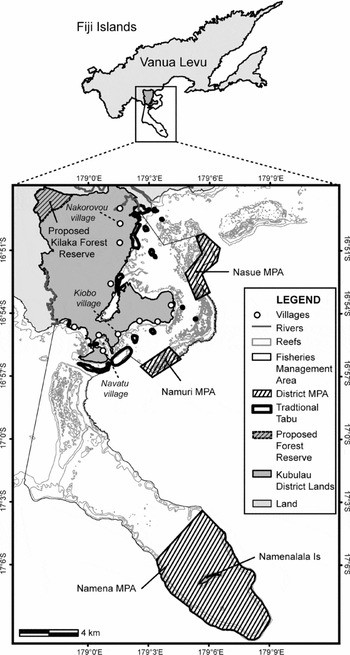
Kubulau District is an administrative unit of Bua Province, centred at 16°51′ S and 179°0′ E in south-west Vanua Levu (Fig. 1). The landward boundaries of the district (tikina; 98.5 km2) are contiguous with the traditional boundaries of local land-owning clans (mataqali), as recorded by the Native Lands and Fisheries Commission. The boundaries of Kubulau's traditional fisheries management area (qoliqoli; 261.6 km2) extend to the outer edge of the coral reefs and include a number of small islands. The human population of Kubulau district is approximately 1000 and predominantly indigenous Fijian in origin. There are ten villages in the district (three inland, seven coastal), and villages contain c. 50–200 people. Households in Kubulau are highly dependent on fishing and farming for subsistence, and rely heavily on fishing, farming and copra harvesting for cash income (WCS [Wildlife Conservation Society], unpublished data 2005). Clan members also derive income from payments for commercial land use activities, including native forest logging and plantation forestry.
Kubulau District and traditional fisheries management area, including district no-take marine protected areas and proposed forest reserve (black diagonal striped) and traditional village-managed closures (thick black outlines).

CBNRM initiatives in Kubulau
In response to local concerns about over-exploitation of marine resources during the early 1990s, the Kubulau district council of chiefs (Bose Vanua) established a district fisheries committee. The Bose Vanua, chaired by the paramount chief (Tui Kubulau), does not have any formal status under national law and does not have legal powers to adopt or enforce natural resource management measures. Nonetheless, its traditional authority is widely respected in the district, and it has played an increasingly prominent role in promoting sustainable resource management in Kubulau. For instance, in 1997, the district fisheries committee established by the Bose Vanua banned commercial fishing by non-resource owners in the Kubulau qoliqoli (Appendix 1, see Supplementary material at Journals.cambridge.org/ENC for definition of resource owners under the Fisheries Act). The committee also established the Namena Marine Reserve, a no-take area of 65.6 km2, covering the reefs around Namenalala Island. The c. 40 ha Namenalala Island Nature Reserve, created through a conservation lease in 1983, is the district's only legally recognized protected forest area.
Despite the early success of the Namena Marine Reserve, by 2003–2004, the communities of Kubulau perceived strong declines in marine resource availability in their qoliqoli and requested external assistance with management. Recognizing the additional impacts of unsustainable land use on water quality and the health of downstream ecosystems, the Bose Vanua established the Kubulau Resource Management Committee (KRMC) to promote integrated management of marine, freshwater and terrestrial resources throughout the district. The committee consists of one nominated representative from each village appointed by the Bose Vanua. Since its establishment, KRMC has taken a central role in the management planning process.
In 2005, the communities of Kubulau established a network of protected areas, including 17 village-managed traditional tabu areas, three no-take district marine reserves (Namena, Nasue and Namuri) and proposed the establishment of a forest reserve on the mainland (Kilaka Forest Reserve; Fig. 1). The initial design of the protected areas network, and its subsequent reconfiguration, were informed by socioeconomic and biological research undertaken by the KRMC and its conservation partners, namely the WCS, World Wildlife Fund (WWF), Wetlands International (Oceania) and the Coral Reef Alliance.
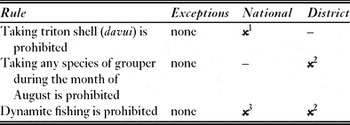
In 2008, building on their earlier conservation successes, the KRMC and its conservation partners resolved to develop an integrated ‘ridge-to-reef’ management plan for Kubulau that places community management rules alongside national legislation and policy (WCS 2009; Table 1). The management plan was completed in July 2009 and has been endorsed by the Bose Vanua. The planning process was informed by extensive scientific and socioeconomic research, as well as local and traditional ecological knowledge.
Extract from the management rule table for marine ecosystems contained in the 2009 Ecosystem-Based Management Plan for Kubulau District (WCS 2009). Sources: 1Fisheries Regulations r.22, 2Kubulau Management Plan Review Workshop, January 2007, 3Fisheries Act (Cap 158) s 10(4) (Appendix 1, see Supplementary material at Journals.cambridge.org/ENC).

Legislative review
In preparation of the Kubulau plan (WCS 2009), national legislation and management institutions were reviewed by a legal consultant to identify legal rules and institutional frameworks relevant to natural resource management in Kubulau (Appendix 1, see Supplementary material at Journals.cambridge.org/ENC). Options for lawful sanctions that may be imposed in response to breaches of community rules were identified, along with protocols for enforcement of national laws and policies. Comparisons between customary and national legal treatments of land and sea tenure were made to draw attention to synergies and potential sources of conflict between national laws and community decision-making processes.
Socioeconomic assessment
In order to determine whether there are specific socioeconomic factors which influence the level of non-compliance with management rules in Kubulau, surveys were conducted at 35 out of 48 total households in the three villages (Navatu, Kiobo and Nakorovou) that have given up portions of their traditional fishing grounds (kanakana) to support the establishment of the three district-wide no-take MPAs (Namena, Namuri and Nasue). Heads of households were surveyed in August 2009 by WCS and trained community volunteers. To gauge differences in levels of compliance with management rules, we directly asked heads of households to what extent they comply with the management rules. We also indirectly assessed compliance by asking about preferred fishing gear types before and after the establishment of Kubulau's MPAs to assess behavioural change in response to customary management. Responses were classified as either (1) illegal/destructive (fish poison, fine gill nets or spearguns with SCUBA), (2) requires management (larger mesh gillnets, spearguns or Hawaiian sling [triggerless] spears) and (3) minimally destructive (hand nets, hand spear or hook and line). To determine the extent to which disapproval with customary management rules may be influencing non-compliance, we asked whether heads of households agreed with decisions by the Bose Vanua and the KRMC. Lastly, to evaluate differences in market access and relative dependency on fishing for income, the proportions of catch consumed, given away and sold were compared across villages for approximately weekly catch landing records collected between May 2008 and June 2009 using methods described in Cakacaka et al. (Reference Cakacaka, Jupiter, Egli and Moy2010).
RESULTS
Namena Marine Reserve
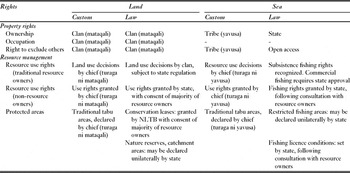
Namena Marine Reserve's success has largely relied on respect for traditional chiefly authority and, to a lesser extent, a misconception that the Reserve is protected under national legislation. Compliance with the community prohibition on fishing in the Reserve has been greatly assisted by the vigilance of the owners of Namena Island Resort, located within the Reserve. There has been only one documented sanctioned opening of the area following the Tui Kubulau's death in August 2008, when nearly 700 kg of fish were harvested for the funeral (WCS, unpublished data 2008). However, the frequency of non-compliance with the no-take status of Namena has recently increased, mostly due to the discord between legal and customary recognition of sea tenure, whereby the Fiji Fisheries Act [Cap 158] (Appendix 1, see Supplementary material at Journals.cambridge.org/ENC) recognizes subsistence fishing rights of traditional resources owners, but not customary tenure over marine areas (Table 2).
Comparison of property and resource management rights for land and sea under custom and national legislation.

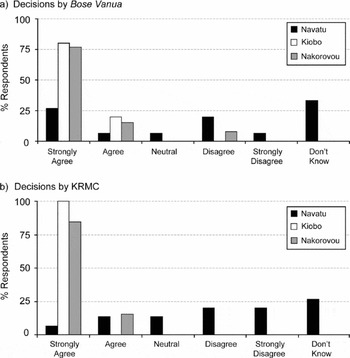
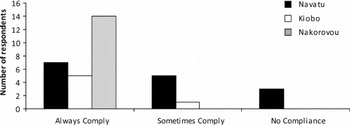
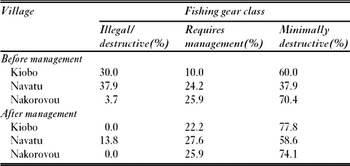
One of the two clans in Navatu village has traditional fishing rights in the Namena Marine Reserve, and there has long been some dissent about the closure of the fishing grounds without adequate compensation. In 2009, only 33% and 20% of Navatu heads of households reported that they usually agreed with decisions by the Bose Vanua and KRMC, respectively (Fig. 2). By contrast, 94% and 100% of heads of households from from Kiobo and Nakorovou villages, who have traditional fishing rights in Namuri and Nasue marine reserves, respectively, agreed with decisions by the Bose Vanua and KRMC. Members of Navatu were open about their non-compliance: 8 of 15 heads of households reported that they personally never or only sometimes complied with protected area rules (Fig. 3), including respecting boundaries. Furthermore, only Navatu residents admitted to continued use of illegal gear following the establishment of the protected area network (Table 3).
(a) Proportion of responses by village in 2009 household surveys of Kubulau to the statement: ‘I usually agree with the decisions by the council of chiefs (Bose Vanua)’. (b) Proportion of responses by village to the statement: ‘I usually agree with decisions by the Kubulau Resource Management Committee (KRMC)’. Number of households surveyed per village: Navatu: n = 15 of 18; Kiobo: n = 5 of 8; Nakorovou: n = 13 of 18.

Responses of heads of households in Navatu (n = 15), Kiobo (n = 6) and Nakorovou (n = 14) to the question: ‘To what extent do you comply with the protected area rules, including respecting boundaries?’

Fishing gear types preferred by fishers before and after the marine protected area network was established, based on responses from household surveys in Kubulau in 2009. Illegal/destructive gear includes fish poison, fine gill nets and use of SCUBA. Gear requiring management includes larger gill nets, speargun and Hawaiian sling. Minimally destructive gear includes hand nets, hand spear and hook and line.

Following discussion about the lack of effective protection for the Namena Marine Reserve during a February 2009 workshop, fishers from Navatu village were found fishing in the Reserve. The fishers may have deliberately set out to be caught to challenge traditional authority upon learning that the Reserve was not legally protected. The new Tui Kubulau then called on clan chiefs and church ministers to conduct a traditional blessing of the district's marine reserves to enhance their recognition throughout Kubulau and neighbouring districts. Navatu fishers were again found fishing in Namena Marine Reserve the following week.
The Tui Kubulau moved to legally protect the three district marine reserves by issuing conditional letters of consent for restricted commercial fishing inside the qoliqoli by traditional resource owners, prohibiting fishing within the reserves. Any traditional resource owner wishing to fish for ‘trade or business’ had then to apply to the Department of Fisheries for a licence under the Fisheries Act (Appendix 1, see Supplementary material at Journals.cambridge.org/ENC). The Department of Fisheries since then included this prohibition in all fishing licences issued for the Kubulau qoliqoli, together with a map of the district marine reserves.
The steps taken by the Tui Kubulau represent a pragmatic response to localized decline in respect for traditional authority and are consistent with the existing legislative framework (Table 2). Using the licensing process to protect the district reserves has four advantages. The letter of consent process allows the Tui Kubulau to directly impose conditions that reflect community management decisions. Community fish wardens appointed and recognized under the Fisheries Act are now legally empowered to search and apprehend vessels found fishing for trade or business inside a district reserve. People found fishing for trade or business inside the district reserves may be prosecuted by police. As fishing licences expire at the end of each year, management measures can be introduced, amended or removed relatively quickly.
There are also a number of limitations to this approach. For example, vessels fishing for subsistence purposes are not required to obtain a fishing licence and are therefore not legally prohibited from fishing in the marine reserves. Moreover, it may be difficult to prove that a vessel was fishing for commercial purposes, rather than subsistence. Many local fishers in Navatu operate on an artisanal scale even though the majority are not licence holders. The high proportion of catch sold in Navatu (73%) is unique in Kubulau (Fig. 4) and is owing to the presence of a middleman based in the village who regularly buys catch to sell to the nearest urban centre. In addition, the effectiveness of legal mechanisms relies on effective monitoring, surveillance and evidence gathering by fish wardens, the willingness of police to investigate and prosecute fisheries offences and the imposition of adequate penalties by the courts.
Percentage of fish from catch per unit effort surveys consumed (black), sold (white), and given away (striped) for catches by fishers from Navatu, Kiobo and Nakorovou.

The only legal mechanism currently available for prohibiting subsistence and commercial fishing in a marine reserve is the gazetting of a ‘restricted area’ by the Minister for Fisheries. This option is currently being considered by resource owners in Kubulau, but legitimate concerns have been raised about the relatively inflexible nature of the gazetting process, and consequent loss of management control by resource owners. There is also a perception that gazetting a marine reserve effectively extinguishes customary marine resource rights.
Establishment of forest reserves in Kubulau
Fijian law protects and maintains customary communal land tenure and empowers the Native Land Trust Board (NLTB) to enter into leases on behalf of landowning clans (Table 2), with the prior consent of the majority of landowners. The Namenalala Island Nature Reserve was created under the Native Lands Trust Act [Cap 134] through a conservation lease brokered by the Native Lands Trust Board (NLTB) on behalf of the landowning clan (Table 2) to allow the construction of a luxury tourist resort, on the condition that 90% of the island was managed as a strict nature reserve. (Appendix 1, see Supplementary material at Journals.cambridge.org/ENC). At the time of establishment, there were no permanent residents on the island. The successful conservation of biodiversity within the Namenalala Island Nature Reserve, in particular large populations of nesting red-footed booby birds (Sula sula), has relied on four factors that are not easily replicated in mainland Kubulau. The island is a suitable location for a successful tourist resort.The lessees were willing and able to pay for exclusive occupation of the island.The tourist resort has provided income and employment for members of the landowning clan. The lessees are committed to long-term preservation of the island's natural values, including management of the Reserve.
Establishment of forest reserves under the Forestry Decree 1992 (Appendix 1, see Supplementary material at Journals.cambridge.org/ENC) on mainland Kubulau has been less successful. In 2005, the community was consulted on creation of a forest reserve in the upper catchment of the Kilaka River. Initially, two landowning clans (Nadicake-Kilaka and Nadicake-Nadi) expressed an interest in reserving their land for conservation purposes, but the latter clan subsequently abandoned their conservation plans and allowed commercial logging of their forests. The revised boundaries of the proposed Kilaka Forest Reserve cover an area of c. 500 ha. Draft management guidelines were prepared in 2006, providing for the establishment of a community-based management committee and prohibition of destructive activities such as logging, clearing, grazing and hunting. To date, however, the landowning clan has not reached a final decision about whether to reserve the area.
Kubulau is a poor rural district, with relatively limited options for economic development. In this context, resource owners were conscious of the opportunity costs of forest conservation and were reluctant to protect forests purely on the basis of their conservation value. In the case of the proposed Kilaka Reserve, the benefits of logging the forest are tangible (lease payments), concentrated (within-clan) and short-term, while the benefits of conserving the forest are largely intangible, diffuse and long term. The forests of Kubulau, despite their high conservation value, are unlikely to attract significant international tourism in their own right. There is little incentive to pursue formal legal protection for the forest, as the landowning clan can readily control most types of development by refusing to consent to the issuing of a lease by the NLTB. The landowners have expressed concerns that formal reservation will constrain future development options, and that they will lose their management rights. The Forest Decree 1992 (Appendix 1, see Supplementary material at Journals.cambridge.org/ENC) strictly limits the use of nature reserves and does not provide for landowner involvement in reserve management, effectively transferring control of the reserved land to the Forest Department.
Despite these limitations, the Kubulau communities suggested several community-based protection measures during a February 2009 management planning workshop. Participants resolved to prohibit clearing, burning, farming and logging in drinking water catchments and riparian zones (30 m buffer). These prohibitions have been endorsed by the Bose Vanua, and the KRMC has committed to undertake a range of related management actions, including mapping drinking water catchments, raising awareness of the impacts of unsustainable farming, logging and burning, monitoring and reporting breaches of the national forestry code of practice, and restoring native vegetation in catchment areas and stream buffers.
DISCUSSION
Implications for conservation practice
The legal status of customary resource tenure is a key factor in CBNRM in the Pacific islands (Johannes Reference Johannes2002; Techera Reference Techera2010). In many cases, effective conservation practice requires an understanding of legal and customary resource rights, institutions and decision-making processes. In Fiji, the treatment of customary marine tenure in the national legal system differs markedly from that applied to customary land tenure, reflecting the historical collision of traditional approaches to the ownership and management of marine resources with ‘open access’ traditions imported from Britain during the colonial era (Lam Reference Lam1998). Ethical conservation practice requires open discussion about the legal rights and responsibilities of resource owners and other stakeholders, noting that this may have unintended consequences, as shown by the response of Navatu villagers fishing in the Namena Marine Reserve learning that the Reserve was not legally protected.
Customary resource tenure often determines the boundaries of resource management units and defines the level at which resource management decisions are made. Mapping tenure boundaries, including overlapping and competing claims, may help to avoid management conflicts. For example, in Kubulau, clearer understanding of the relationship between village kanakana and the district qoliqoli fishing areas when designing protected area boundaries might have helped to avoid conflict with Navatu village, enhancing the effectiveness of the Namena Marine Reserve while minimizing the opportunity costs to Navatu fishers given their stronger dependence on marine resources for income than other villages in the district (Klein et al. Reference Klein, Steinback, Scholz and Possingham2008).
Management measures are more likely to be supported by local communities if they reflect local knowledge, traditions and priorities (Drew Reference Drew2005). Emphasizing the links between community management targets, threats and management measures helps to create ownership of management rules, and promotes community monitoring and reporting. In Kubulau, participants in the planning workshop appeared to favour management measures that were linked to perceived threats to community wellbeing and livelihoods from ecosystem services (such as water quality and coastal fisheries). Management planning processes also provide opportunities for discussing interaction of community management targets with national laws and institutions (Lindsay Reference Lindsay1998). Integration of national laws and community rules in management plans, and development of compliance and enforcement protocols, may enhance management effectiveness and reduce conflict risk.
Clearly articulating the relationship between local decision-making processes and government regulation can help to integrate local adaptive management and effective enforcement (Kellert et al. Reference Kellert, Mehta, Ebbin and Lichtenfeld2000). In Kubulau, the use of fisheries licence conditions to control fishing in district marine reserves provides a direct mechanism for linking community management decisions with government regulation and legally empowers community fish wardens to control fishing in those areas. However, it is important that conservation practitioners are transparent about the costs and benefits of legal protection measures and understand that certain measures may be perceived as a threat to customary resource management rights.
In the Pacific, compliance with local resource management rules relies to a significant extent on respect for traditional authority and decision-making processes (Aswani Reference Aswani2005; Hoffman Reference Hoffman2002; Tiraa Reference Tiraa2006). Management planning processes that respect and reinforce the roles of traditional leaders, while providing opportunities for broad community engagement, strengthen long-term prospects for community-based resource governance (Hoffmann 2002). Perceptions of inequity, exclusion from decision-making processes or failure to respect customary resource rights may result in challenges to traditional authority. Customary institutions, already undermined by a range of historical factors, may be further eroded by access to new markets for natural resources (Cinner et al. Reference Cinner, Sutton and Bond2007). For example, the high dependency of Navatu residents on income from fishing has been facilitated by the presence the middleman living in their village. Such opportunities for financial gain can create loss of respect for traditional authority that may cause people to commit acts in open violation of community rules.
In Fiji, enforcement of community management rules is constrained by the national legal system: local communities have no formal authority to enforce management rules, and certain community-imposed sanctions may breach national criminal laws (Veitayaki Reference Veitayaki and Hooper2000). In past centuries, traditional penalties in Fiji and elsewhere in the Pacific included beatings, execution, banishment or seizure and destruction of property (Munro Reference Munro1996; Tiraa Reference Tiraa2006), all of which are now prohibited under law. Lawful sanctions for breaching community rules, which include verbal warnings, public shaming and withholding letters of consent for fishing licence renewal, are largely ineffectual given that the financial benefits of breaching community fishing restrictions are substantial. Resource owners who take the law into their own hands may face criminal prosecution: in 2008, the paramount chief of Macuata Province (Vanua Levu) was arrested and charged with larceny after seizing a fishing boat found catching fish in a tabu area. The charges against him were subsequently dropped, but the case highlighted the need to ensure that community sanctions do not breach criminal laws and appears to have had a chilling effect on community-based enforcement.
Legal and institutional reform implications
Legal recognition of customary resource tenure and decision-making processes can enhance the effectiveness of CBNRM (Reti Reference Reti and Boer1993; Lynch & Alcorn Reference Lynch, Alcorn, Western and Wright1994). Conversely, failure to recognize customary resource tenure and decision-making processes may lead to resource conflict and, when combined with limited government capacity, can result in poor resource management outcomes (Lindsay Reference Lindsay1998). To effectively manage natural resources, community-based managers need secure and certain rights, as well as the flexibility and power (‘legal space’) to make decisions that reflect their unique circumstances and priorities (Lindsay Reference Lindsay1998).
Long-term effectiveness of CBNRM initiatives in Fiji requires significant legal and institutional reform (Evans Reference Evans2006; Lane Reference Lane2008). In particular, the current arrangements present major compliance and enforcement challenges for traditional resource owners, who are constrained by national criminal law, yet not adequately supported by natural resource laws and institutions (Minter Reference Minter2008). The Fiji national government is, however, currently developing new legislation for fisheries, forestry and protected areas, which may resolve some of the issues outlined in the Kubulau case studies.
Community conservation initiatives provide insights into practical barriers to effective resource management and opportunities for engaging with government institutions to resolve these issues. In Fiji, where prosecution for fisheries offences in coastal waters is extremely rare, the experiences of LMMAs have allowed the identification of priorities for legal and institutional reform in the fisheries sector, including improved training and resources for community fish wardens, fisheries enforcement training for police and magistrates, powers for the Department of Fisheries to revoke fishing licences for breaches of the Fisheries Act, a clear and efficient process for gazetting restricted areas and formalized management powers for community resource management committees (Minter Reference Minter2008). In addition, current penalties under the Act are inadequate to deter future breaches: the maximum penalty for most offences under is FJ$ 500 (equivalent to € 187, March 2010), and anecdotal evidence suggests that courts award penalties well below this maximum amount (Minter Reference Minter2008).
In the existing legal context, communities can improve marine management outcomes by protecting tabu areas using licence conditions, not renewing licences for vessels that wilfully breach community rules or national laws, increasing fish warden patrols, and reporting breaches to police, fisheries officers and the national LMMA network (Minter Reference Minter2008). The national LMMA network has recently established a ‘blacklist’ of vessels which have breached community rules or national laws. This list will be made available to all LMMA sites, and resource owners will be encouraged to refuse licence applications from blacklisted vessels.
Landowning clans exercise significant control over the use and development of their land, but environmental outcomes are undermined by a number of factors, including limited awareness of the negative impacts of unsustainable land use, strong economic incentives for short-term resource development, poor implementation of natural resource management and environmental protection laws, and limited integration between national legislation and community land management practices (Lane Reference Lane2008). The environmental impact assessment (EIA) procedures required under the Environment Management Act 2005 (Appendix 1, see Supplementary material at Journals.cambridge.org/ENC) present opportunities for ensuring that landowners are informed of the environmental impacts of proposed developments before consenting to issue a native land lease. The public participation procedures set out in the Act also provide an opportunity for other stakeholders, including downstream landowners, to raise concerns about potential environmental impacts. It is essential that the national government allocate adequate resources to promote awareness of the Act and to ensure its lawful and efficient administration.
The environmental impacts of logging operations could be significantly reduced by rigorous enforcement of the national logging code of practice, monitoring logging operations by community forest wardens, increased penalties for forestry offences, a legal obligation to ensure reforestation of logged areas, and use of environmental bonds. The current practice of issuing short-term forest leases is a barrier to long-term sustainable forest management (Prasad & Tisdell Reference Prasad and Tisdell2006), and should be abandoned. Community-based management rules would benefit from being integrated into logging licence conditions and enforced.
The absence of a coherent legal framework for protected areas presents challenges for effective site-based conservation. In particular, existing laws do not provide for the active involvement of resource owners in the identification, establishment and management of protected areas. Existing legal mechanisms, such as nature reserves and restricted areas, tend to be inflexible, with no opportunity for resource owners to develop management rules, or to modify those rules over time (Lindsay Reference Lindsay1998; Clarke & Gillespie Reference Clarke and Gillespie2008). There is a pressing need to develop protected areas legislation that provides for management by local communities in collaboration with government agencies and civil society organizations. Mechanisms for fair and equitable distribution of economic benefits from conservation areas must be trialled and replicated to reduce local conflict and increase long-term management effectiveness (Kellert et al. Reference Kellert, Mehta, Ebbin and Lichtenfeld2000; Warner Reference Warner2000).
Ultimately, effective resource management is likely to rely on the emergence of hybrid models of governance, which respect local traditions, practices and resource rights, and share responsibility for planning, implementation and enforcement of management measures between communities and government institutions, taking into account their respective strengths and limitations (Reti Reference Reti and Boer1993; Cinner et al. Reference Cinner, Marnane and McClanahan2005; McClanahan et al. Reference McClanahan, Marnane, Cinner and Kiene2006; Aswani et al. Reference Aswani, Albert, Sabetian and Furusawa2007). National laws and institutions must recognize the legitimate and enduring role of local communities in natural resource management (Lindsay Reference Lindsay1998; Lynch Reference Lynch1998). To do otherwise ignores the realities of resource management in the Pacific islands, and overlooks the opportunity to build on the region's rich and ancient heritage of community-based resource management.
ACKNOWLEDGEMENTS
Funding was provided by the David and Lucile Packard Foundation (2007–31847), the Gordon and Betty Moore Foundation (540.01), and the NOAA Coral Reef Conservation program (NA07NOS4630035). We are grateful to T. Tui, S. Prasad, A. Caginitoba and A. Cakacaka (WCS South Pacific Program) and H. Williams (Coral Reef Alliance) for assistance gathering cultural information. We acknowledge the strong support and conservation commitment of the Tui Kubulau (A.Vuki), the chairman of the Kubulau Resource Management Committee (P. Kolikata) and all of the Kubulau communities.