Implications
This research will improve the understanding of the metabolic pathway of mammalian lignans in dairy cows, in order to enable targeted manipulation of their quantities in milk.
Introduction
Flaxseed (Linum usitatissimum) contains about 200 g/kg of crude protein (CP), 300 g/kg of neutral detergent fiber (NDF) and 400 g/kg of fat (Petit, Reference Petit2002). In general, untreated whole flaxseed is readily accepted by dairy cows and feeding up to 150 g/kg of the total dry matter (DM) as flaxseed has no detrimental effect on DM intake and milk yield of dairy cows (Petit, Reference Petit2002; Secchiari et al., Reference Secchiari, Antongiovanni, Mele, Serra, Buccioni, Ferruzzi, Paoletti and Petacchi2003). Moreover, flaxseed enhances fertility of dairy cows as shown by decreased embryo mortality (Petit and Twagiramungu, Reference Petit and Twagiramungu2006) and increased gestation rate (Ambrose et al., Reference Ambrose, Kastelic, Corbett, Pitney, Petit, Small and Zalkovic2006). Overall, flaxseed is an attractive feed ingredient for inclusion in lactating dairy cow rations as a source of both energy and protein.
Flaxseed is one of the richest sources of the plant lignan precursor secoisolariciresinol diglucoside (SDG; Axelson et al., Reference Axelson, Sjovall, Gustafsson and Setchell1982) with concentrations ranging from 6.1 to 25.9 mg/g (Johnsson et al., Reference Johnsson, Kamal-Eldin, Lundgren and Aman2000; Eliasson et al., Reference Eliasson, Kamal-Eldin, Andersson and Åman2003). Studies suggest that plant lignans have a potential role in the prevention of menopausal symptoms, hormone-dependent cancers (e.g. breast and prostate cancer), cardiovascular diseases and possibly osteoporosis (Murkies et al., Reference Murkies, Wilcox and Davis1998). Following ingestion, microbial enzymes convert SDG to mammalian lignans, mainly enterodiol (ED) and enterolactone (EL; Setchell et al., Reference Setchell, Lawson, Mitchell, Adlercreutz, Kirk and Axelson1980). Recent in vitro results have shown that the main mammalian lignan metabolite produced from flax hulls by ruminal microbiota of dairy cows was EL while fecal microbiota led mainly to the net production of ED (Côrtes et al., Reference Côrtes, Gagnon, Benchaar, da Silva, Santos and Petit2008). Previous studies have confirmed the presence of EL in cow milk (Antignac et al., Reference Antignac, Cariou, Le Bizec and André2004; Steinshamn et al., Reference Steinshamn, Purup, Thuen and Hansen-Møller2008) and SDG in offspring through milk when rat dams were fed with 3H-SDG (Tou et al., Reference Tou, Chen and Thompson1998). However, there is no information on the potential of increasing concentration of mammalian lignans in milk by feeding whole flaxseed to dairy cows. Therefore, the objective of the experiment was to determine the effects of feeding different concentrations of whole flaxseed in the diet on milk concentrations of EL and ED. Because information about the effect of proportion of whole flaxseed in the diet of dairy cows was limited, feed intake, digestion, milk production and milk composition for each dietary concentration of flaxseed were also determined.
Material and methods
Animals and diets
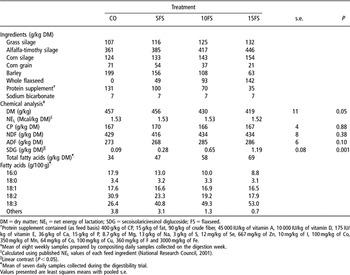
The experiment was conducted at the Atlantic Dairy and Forage Institute (ADFI) of Fredericton Junction, NB, Canada from July 2003 to March 2004 using 32 multiparous Holstein cows with mean body weight of 622 kg (s.e. = 24). Animals were cared for according to the guidelines of the Canadian Council on Animal Care (1993). The four dietary treatments (Table 1) were formulated to meet requirements for cows that produced 30 kg/day of milk with 40 g/kg of fat (National Research Council, 2001). Cows were blocked for similar days in milk and the experiment was carried out from week 25 (week 0 of the experiment) to week 29 of lactation. Cows were housed in tie stalls, fed individually and milked twice daily at 0615 and 1530 h. Milk production was recorded at every milking. Cows within blocks were assigned randomly to one of four total mixed diets (Table 1) containing 0 (control; CO), 50 (5FS), 100 (10FS) or 150 g/kg of whole flaxseed (15FS; Table 2). Diets were designed at the beginning of the experiment to yield similar concentrations of CP and net energy of lactation.
Composition of total mixed diets of Holstein cows fed a control diet with no flaxseed (CO) or 50 (5FS), 100 (10FS) and 150 (15FS) g/kg of whole flaxseed in the dry matter

DM = dry matter; NEL = net energy of lactation; SDG = secoisolariciresinol diglucoside; FS = flaxseed.
†Protein supplement contained (as feed basis) 400 g/kg of CP, 15 g/kg of fat, 90 g/kg of crude fiber, 45 000 IU/kg of vitamin A, 10 000 IU/kg of vitamin D, 175 IU/kg of vitamin E, 36 g/kg of Ca, 15 g/kg of P, 8.7 g/kg of Mg, 13 g/kg of Na, 3 g/kg of S, 12 mg/kg of Se, 667 mg/kg of Zn, 10 mg/kg of I, 100 mg/kg of Co, 350 mg/kg of Mn, 64 mg/kg of Co, 100 mg/kg of Cu, 360 mg/kg of F and 3000 mg/kg of Fe.
‡Mean of eight weekly samples prepared by compositing daily samples collected on the digestion week.
§Calculated using published NEL values of each feed ingredient (National Research Council, 2001).
||Linear contrast (P < 0.05).
¶Mean of seven daily samples collected during the digestibility trial.
Values presented are least squares means with pooled s.e.
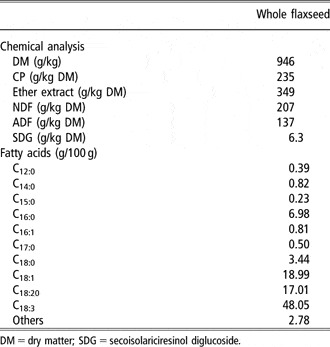
Chemical composition of whole flaxseed (mean of five weekly samples)

DM = dry matter; SDG = secoisolariciresinol diglucoside.
Experimental procedures
Diets were fed twice daily at ad libitum rates at 0600 and 1400 h to allow 10% refusals. Feed consumption was recorded daily. Total mixed diets were sampled daily on the last week of the experiment, frozen and composited on a 7-day basis. Composited samples were mixed thoroughly and subsampled for chemical analyses. Milk samples were obtained weekly from each cow for two consecutive milkings and were analyzed separately to determine milk composition. Milk samples were kept at room temperature with a preservative (bronopol-B2) for determination of protein, fat and lactose concentrations. One sample without preservative was kept frozen to determine milk fatty acid profile on week 5 of the experiment. Body weight of cows was determined at the beginning and the end of the experiment. Total feces and urine were collected from all cows during week 5 of the experiment for 7 days. Feces were collected from a rubber mat placed behind the animals and stored in plastic containers. Daily fecal output was weighed and feces were mixed thoroughly. A 10% subsample was taken daily and stored at −15°C for subsequent drying at 55°C. Urine was collected in stainless steel containers via Gooch tube (BF Goodrich Co., Kitchener, ON, Canada) attached to the cow with a nylon netting covered with neoprene (Spall Bowan Ltd, Guelph, ON, Canada) affixed to the vulva.
Chemical analysis
Analytical DM of diets was determined by drying at 100°C for 48 h. Total mixed diets and feces were dried at 55°C for 48 h and ground to pass a 1-mm screen in a Wiley mill before analyses of N, ether extract, NDF and acid detergent fiber (ADF). Total N concentration in diets, whole flaxseed and feces was determined by combustion (LECO model FP-428 Nitrogen Determinator; LECO, St. Joseph, MI, USA) and CP was calculated as N × 6.25. Neutral and acid detergent fiber components were measured according to the non-sequential procedures of Van Soest et al. (Reference Van Soest, Robertson and Lewis1991). Protein, fat and lactose in milk were determined by infrared spectroscopy (Bentley, 2000; Bentley Instrument, Inc., Chaska, MN, USA) except for fat in milk samples collected during the digestion trial, which were analyzed by the method of Roese-Goettlib (Association of Official Analytical Chemists, 1990). Somatic cells were counted using an optical somatic cell counter (Fossomatic 90; Foss Electric, Hillerød, Denmark). Ether extraction in diets was conducted with a Soxtec system HT6 apparatus (Tecator; Fisher Scientific, Montreal, QC, Canada) according to the method No. 7.060 (Association of Official Analytical Chemists, 1990). Fat was extracted from milk samples, extracted lipid samples were methylated and fatty acid methyl esters were separated on a HP 5890 GLC fitted with a HP autosampler (model 18596C, HP 7673 injector; Hewlett-Packard, Ltd., Mississauga, ON, Canada) as described by Petit and Benchaar (Reference Petit and Benchaar2007).
Extraction and analysis of plant SDG in whole flaxseed and diets was performed according to the procedures described by Muir and Westcott (Reference Muir and Westcott2000). Lignans were hydrolyzed and extracted from milk according to the method of Frank and Custer (Reference Frank and Custer1996) originally developed for daidzein and genistein determination in human milk with some modifications. Briefly, frozen milk was thawed and warmed at 40°C for 30 min. Each sample was analyzed in triplicate. For hydrolysis, 500 μl of milk were mixed with 5 μl of β-glucuronidase/arylsulfatase from Helix pomatia (Roche-Diagnostics, Laval, QC, Canada) and then shaken in a water bath at 37°C for 1.5 h. Hydrolyzed samples were washed with 3 ml of hexane. The upper phase was discarded and extraction was done twice with 2 ml of diethyl ether. Extracts were combined and evaporated by vacuum (Speed-Vac; Thermo Savant, Holbrook, NY, USA) at room temperature. The dry extract was warmed at 37°C and redissolved in 150 μl of methanol and 50 μl of 0.2 M sodium acetate buffer (pH 4) by vortexing. After centrifugation at 1800 × g for 1.5 min, 150 μl of clear supernatant were transferred into a HPLC vial and a 50-μl aliquot was injected into the HPLC system. Standards of ED and EL were obtained from Sigma-Aldrich (Oakville, ON, Canada).
Enterodiol and EL in milk samples were quantified by a HPLC (model 210; Varian, Mississauga, ON, Canada) solvent delivery system equipped with a 100-μl injection loop autosampler (model 410; Varian) and an electrochemical detector (Coulochem II; ESA, Concord, ON, Canada) set as follows: guard cell (model 5020; E = +1400 mV) and analytical cell (model 5010; E1 = 0 mV, E2 = +1000 mV). Sensitivity of the detector was set to 1 μA. Analyses were carried out on a C18 reversed-phase column (4.6 × 250 mm Microsorb-mv, R0086200C5; Varian). The mobile phase consisted of a mixture of two eluents (50/50): A, 50 mM sodium acetate buffer, pH 4.8/methanol, 80/20; and B, 50 mM sodium acetate buffer, pH 4.8/methanol/acetonitrile, 40/40/20. The mobile phase was filtered on a 0.22-μm nylon membrane filter (Gelman-Sciences, Ann Arbor, MI, USA) and then pumped through the column at a flow rate of 1 ml/min. All the solvents were HPLC-grade from Fisher Scientific (Nepean, ON, Canada). The standard used for quantification was a mixture of ED and EL. Average recoveries of ED and EL, which were calculated by addition of different doses of standards to a pooled sample, were 98% and 110%, respectively. The intra- and inter-assay coefficients of variation were 4% and 8%, respectively.
Statistical analysis
All results were analyzed using the MIXED procedure of SAS (Release 8.02; SAS Institute Inc., Cary, NC, USA). Digestibility measurements recorded during the experiment were analyzed as a randomized block design, and block and treatment were the main sources of variation. Data on milk production parameters were analyzed as repeated measurements using PROC MIXED of SAS and as mean values for the 5-week experiment when there was no interaction between week and treatment (P > 0.10). Data on EL concentrations were transformed (log) as previously performed by Côrtes et al. (Reference Côrtes, Gagnon, Benchaar, da Silva, Santos and Petit2008), but results are reported as the adjusted mean value (with confidence interval) on the original scale of measurements. Treatment sum of squares were partitioned to provide linear, cubic and quadratic contrasts after a significant F-test. Significance was declared at P < 0.05 and a trend at P < 0.10.
Results
Whole flaxseed was fed at 49, 93 and 142 g/kg of the DM (Table 1), respectively, for 5FS, 10FS and 15FS diets, which was close to percentages planned at initiation of the experiment. Concentration of SDG in the DM of the total mixed diets increased linearly (P < 0.001) from CO (0.09 g/kg), 5FS (0.28 g/kg), 10FS (0.65 g/kg) to 15FS (1.19 g/kg). Proportions (g/100 g of fatty acids) of C12:0, C14:0, C15:0, C16:0, C16:1, C17:0, C18:0, C18:1, C18:2 and C18:3 in flaxseed were 0.39, 0.82, 0.23, 6.98, 0.81, 0.50, 3.44, 18.99, 17.01 and 48.05, respectively.
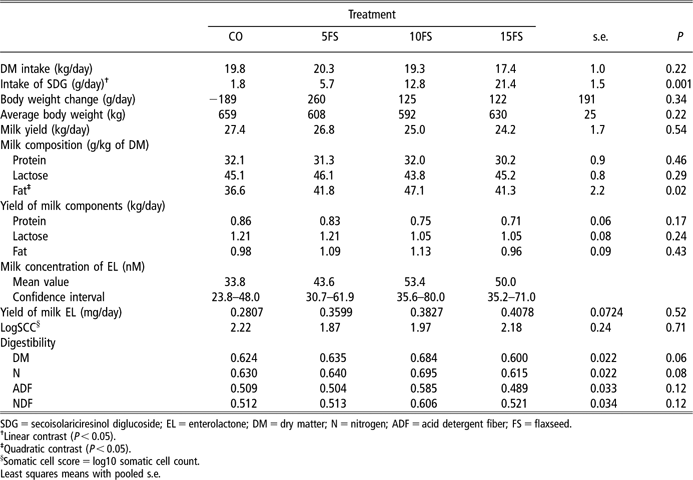
Intake of DM averaged 19.2 kg/day and was not significantly affected by treatment (Table 3). Daily intake of SDG increased linearly (P < 0.001) with increased concentration of whole flaxseed in the diet. Diet had no effect (P > 0.10) on initial and final body weight, body weight change, average body weight, milk yield, milk concentrations of protein and lactose and yield of milk components (Table 3). Milk concentration of fat differed significantly among diets with the highest concentration obtained for cows fed 10FS. The mammalian lignan ED was not detected in the milk of cows. Therefore, no data are reported on ED concentration. On the other hand, concentration of EL in milk was above detection level and tended to increase linearly (P = 0.08) with increased concentration of SDG in the diet, although output of EL in milk was similar among diets (Table 3). Flaxseed was the main contributor of SDG in the 5FS and 10FS diets. For the 15FS diet, silage contributed approximately to 25% of the measured SDG. Digestibility of DM and N tended (P = 0.06 and 0.08, respectively) to differ among diets with a quadratic effect being observed at P = 0.04 (Table 3). Digestibilities of ADF and NDF were similar among diets.
Feed intake, body weight, milk production, milk composition and digestibility of Holstein cows fed a control diet with no flaxseed (CO) or 50 (5FS), 100 (10FS) and 150 (15FS) g/kg of whole flaxseed in the dry matter
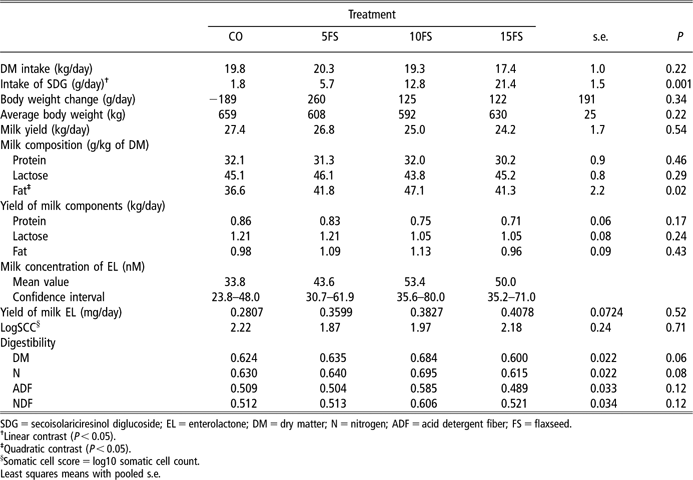
SDG = secoisolariciresinol diglucoside; EL = enterolactone; DM = dry matter; N = nitrogen; ADF = acid detergent fiber; FS = flaxseed.
†Linear contrast (P < 0.05).
‡Quadratic contrast (P < 0.05).
§Somatic cell score = log10 somatic cell count.
Least squares means with pooled s.e.
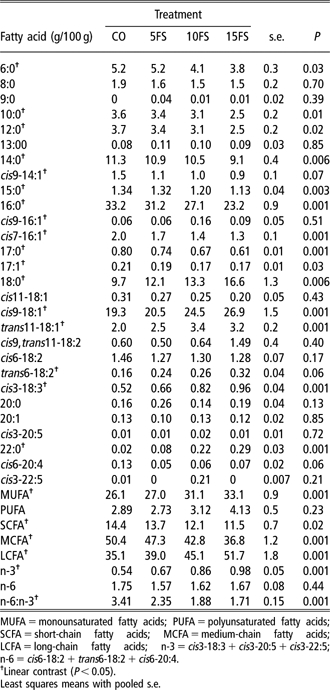
Concentrations of C6:0, C10:0, C12:0, C14:0, cis9-C14:1, C15:0, C16:0, cis7-C16:1, C17:0 and C17:1 in milk fat decreased linearly (P < 0.05) with increased concentrations of whole flaxseed in the diet (Table 4) while the inverse was observed for concentrations of C18:0, cis9-18:1, trans11-18:1 trans6-18:2, cis3-18:3 and C22:0. Concentrations of short-chain and medium-chain fatty acids in milk fat decreased with greater concentrations of whole flaxseed in the diet. On the other hand, milk fat concentrations of monounsaturated and long-chain fatty acids increased with increased proportions of flaxseed in the diet. Feeding higher concentrations of whole flaxseed increased concentrations of n-3 fatty acids and decreased the n-6 to n-3 fatty acids ratio in milk fat.
Average milk fatty acid profile of Holstein cows fed a control diet with no flaxseed (CO) or 5% (5FS), 10% (10FS) and 15% (15FS) whole flaxseed in the dry matter
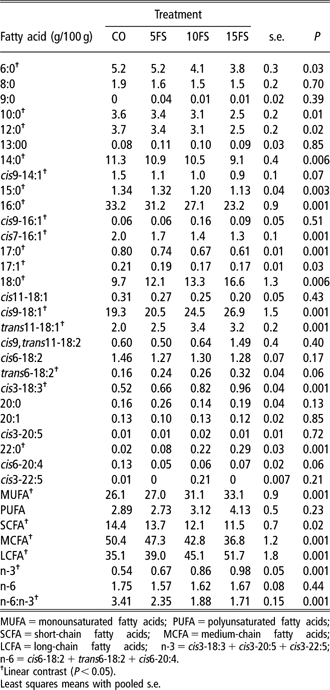
MUFA = monounsaturated fatty acids; PUFA = polyunsaturated fatty acids; SCFA = short-chain fatty acids; MCFA = medium-chain fatty acids; LCFA = long-chain fatty acids; n-3 = cis3-18:3 + cis3-20:5 + cis3-22:5; n-6 = cis6-18:2 + trans6-18:2 + cis6-20:4.
†Linear contrast (P < 0.05).
Least squares means with pooled s.e.
Discussion
Dry matter intake was not affected by flaxseed supplementation, which agrees with the ready consumption of untreated whole flaxseed up to 150 g/kg of the total DM by mid-lactating dairy cows (Secchiari et al., Reference Secchiari, Antongiovanni, Mele, Serra, Buccioni, Ferruzzi, Paoletti and Petacchi2003). Moreover, mid-lactating dairy cows fed 0, 50, 100 and 150 g/kg of whole flaxseed in the diet averaged 26.9 kg of milk per day and flaxseed concentration in the diet had no effect on milk production as previously reported (Kennelly, Reference Kennelly1996). According to Martin et al. (Reference Martin, Rouel, Jouany, Doreau and Chilliard2008), feeding flaxseed has no negative effect on DM intake and milk yield due to a slow release of fatty acids in the rumen fluid as compared to when flaxseed is fed extruded or as oil. In the present experiment, cows fed the highest level of flaxseed tended to have lower digestibility of DM and N. Decreases (Martin et al., Reference Martin, Rouel, Jouany, Doreau and Chilliard2008), increases (Gonthier et al., Reference Gonthier, Mustafa, Berthiaume, Petit, Martineau and Ouellet2004) or no effect (Doreau et al., Reference Doreau, Aurousseau and Martin2009a) of flaxseed supplementation on digestibility of nutrients by dairy cows have been reported. Martin et al. (Reference Martin, Rouel, Jouany, Doreau and Chilliard2008) concluded that the amount of added lipids and their form of presentation (oil v. seed) are major determining factors for the negative effect of flaxseed fatty acids on digestibility.
Feeding whole flaxseed increased milk fat concentration compared to feeding no flaxseed. Inclusion of whole flaxseed in the diet of dairy cows has increased milk fat concentration but the increase has not been significant (Petit et al., Reference Petit, Germiquet and LeBel2004; Petit and Benchaar, Reference Petit and Benchaar2007). Feeding fat through seeds maintains or increases milk fat content (Dhiman et al., Reference Dhiman, Satter, Pariza, Galli, Albridht and Tolosa2000). Oils effectively protected against ruminal biohydrogenation increase milk fat yield (Ashes et al., Reference Ashes, St Vincent Welch, Gulati, Scott, Brown and Blakelyel1992) whereas supplemental fat decreases fat percentages in milk likely due to the highly unsaturated fat sources affecting rumen fermentation. Therefore, feeding whole flaxseed in the present experiment may contribute to a more gradual release of oil in the rumen, thus resulting in little effect on ruminal fermentation as shown for cows fed lipids in the form of oil, rolled or extruded linseeds (Doreau et al., Reference Doreau, Aurousseau and Martin2009a) and no significant effect on milk fat percentage.
Milk fatty acid profile was slightly improved by feeding flaxseed as shown by higher concentrations of fatty acids (e.g. n-3) recognized as being beneficial for human health (Wright et al., Reference Wright, McBride and Holub1998). Similarly, a meta-analysis of the response of cow milk fatty acid composition to oilseed lipid supplements has shown that the inclusion of flaxseed in the diet has caused a reduction in the concentration of short-chain (C4 to C12) fatty acids as well as C16:0 while the concentration of monounsaturated and long-chain fatty acids has increased (Glasser et al., Reference Glasser, Ferlay and Chilliard2008). The extent of change in the concentration of fatty acids in milk is proportional to the level of inclusion of flaxseed in the diet (Kennelly, Reference Kennelly1996) although differences would be of little biological significance. Moreover, greater trans-18:1 relative percentage in milk fat has been reported previously when flaxseed was fed to dairy cows compared to when raw cracked soybeans were fed (Dhiman et al., Reference Dhiman, Satter, Pariza, Galli, Albridht and Tolosa2000) and higher n-3 fatty acid concentrations in milk fat of cows fed flaxseed (Glasser et al., Reference Glasser, Ferlay and Chilliard2008). Enhanced milk fat concentration of n-3 fatty acids with increased proportions of whole flaxseed in the diet may result in the parallel increase in C18:3 concentrations of the diets. However, flaxseed supplementation produces relatively small changes in the concentration of cis3-C18:3 in milk, thus indicating that extensive biohydrogenation of cis3-C18:3 may occur in the rumen as previously reported by Doreau et al. (Reference Doreau, Laverroux, Normand, Chesneau and Glasser2009b) for cows fed extruded or rolled linseed. The lack of any effect of flaxseed supplementation on conjugated linoleic acid might be a result of flax that was fed as whole seed in the present experiment. Indeed, physical breakdown of flaxseed may contribute to increase partial ruminal biohydrogenation of C18:3 as shown by enhanced cis9, trans11-18:2 concentration in milk fat of cows fed linseed lipids given as extruded, micronized or ground seeds (Glasser et al., Reference Glasser, Ferlay and Chilliard2008).
Concentration of ED in milk was below detection level and only EL was present in significant amount. Studies with ruminant animals have shown that lignans are metabolized by both ruminal and fecal microbiota (Côrtes et al., Reference Côrtes, Gagnon, Benchaar, da Silva, Santos and Petit2008; Zhou et al., Reference Zhou, Wang, Han, Yao and Zhu2009) and lignan metabolites are present in biological fluids such as plasma and semen (Dehennin et al., Reference Dehennin, Reiffsteck, Jondet and Thibier1982; Hansen-Møller and Kristensen, Reference Hansen-Møller and Kristensen2004; Kilkkinen et al., Reference Kilkkinen, Stumpf, Pietinen, Valsta, Tapanainen and Adlercreutz2001) and milk (Antignac et al., Reference Antignac, Cariou, Le Bizec and André2004; Steinshamn et al., Reference Steinshamn, Purup, Thuen and Hansen-Møller2008). Feed ingredients such as forages and cereals (Peñalvo et al., Reference Peñalvo, Haajanen, Botting and Adlercreutz2005; Steinshamn et al., Reference Steinshamn, Purup, Thuen and Hansen-Møller2008) and the bran of corn and barley (Smeds et al., Reference Smeds, Eklund, Sjoholm, Willfor, Nishibe, Deyama and Holmbom2007) contain lignans, which contributes to the formation of mammalian lignans and explains the presence of EL in the milk of cows on all diets in the present experiment. Higher milk EL concentrations were observed for cows fed white clover-grass silage compared to those fed red clover-grass silage, which was related to the higher dietary content and intake of their precursors (Steinshamn et al., Reference Steinshamn, Purup, Thuen and Hansen-Møller2008). On the other hand, lower intake of SDG by cows fed grass/clover silage compared to those fed alfalfa silage resulted in similar concentrations of mammalian lignans in milk (Andersen et al., Reference Andersen, Weisbjerg, Hansen-Møller and Sejrsen2009). In the present experiment, supplementation with whole flaxseed from 0 to 150 g/kg DM was accompanied by changes in ration composition in order to maintain similar concentrations of protein and energy among the experimental diets. For example, grass silage proportion was increased from 107 to 132 g/kg of DM and alfalfa-timothy silage was increased from 361 to 446 g/kg of DM and those of corn and barley were decreased from 71 and 199 to 21 and 63 g/kg of DM, respectively. Alfalfa silage contains more SDG than grass/clover silage, corn silage and barley (Andersen et al., Reference Andersen, Weisbjerg, Hansen-Møller and Sejrsen2009). Based on the listed composition, flaxseed contributed to 0.31, 0.59 and 0.89 g of SDG per kg of DM in diets 5FS, 10FS and 15FS, respectively. As the respective concentrations of SDG were 0.28, 0.65 and 1.19 g/kg of DM, flaxseed then accounted for all of the SDG in the 5FS diet while it was 90% and 75% for the 10FS and 15FS diets, respectively. Therefore, the amount of SDG supplied by the forage component from the 15FS diet will be greater than the one from the other diets, thus contributing to increase significantly total SDG intake with higher alfalfa/timothy silage proportion in the diet. However, because the richest source of plant lignans is flaxseed (Axelson et al., Reference Axelson, Sjovall, Gustafsson and Setchell1982), higher proportions of flaxseed in the diet may likely be the highest supply of precursor leading to increased EL concentration in milk as observed in the present experiment.
Greater proportions of flaxseed in the diet increased dietary concentrations of fatty acids. However, it is unlikely that differences in fatty acids concentrations influenced the yield of EL in milk. Indeed, Gagnon et al. (Reference Gagnon, Côrtes, da Silva, Kazama, dos Santos, Zeoula, Benchaar and Petit2009) have shown that SDG metabolism in the rumen is not affected by flax oil as indicated by similar EL concentrations in ruminal fluid and milk when cows are supplemented with flax oil in the rumen or the abomasum.
Although SDG intake of cows fed 15FS was 9.3 times higher (P < 0.001) than that of cows fed CO, output of EL in milk was similar for both diets. Steinshamn et al. (Reference Steinshamn, Purup, Thuen and Hansen-Møller2008) suggested that the metabolism of the phytoestrogens in the gastrointestinal tract and the hepatic reconjugation before blood transport and secretion into the udder could be rate-limited. Moreover, Andersen et al. (Reference Andersen, Weisbjerg, Hansen-Møller and Sejrsen2009) reported that higher recoveries of phytoestrogens such as biochanin A, genistein, lignans and coumestrol in milk were associated with a lower content of the precursor in the feed. This supports that the transfer of phytoestrogens from feed to milk could be limited by something in the metabolism, diminishing the amount of phytoestrogens transferred to the milk with increasing content of phytoestrogens in the feed.
Flaxseed was fed unprocessed in the present experiment and increased availability of flaxseed lignans in the human digestive system following crushing and milling has resulted in enhanced concentrations of EL and ED in blood (Kuijsten et al., Reference Kuijsten, Arts, van’t Veer and Hollman2005). Previous results (Petit and Gagnon, Reference Petit and Gagnon2009) have shown that feeding 150 g/kg of flaxseed meal in the DM resulted in higher concentration of EL in milk (83 μM) than those observed in the present experiment. Therefore, the lack of flaxseed processing likely contributed to restrict the production of mammalian lignans from SDG by ruminal microbiota, thus limiting concentration of EL in the milk of cows.
In conclusion, feeding whole flaxseed improves the milk fatty acid profile for better human health and EL was the mammalian lignan, of the two metabolites studied, detected in the milk of cows. Bioactive components in bovine milk or colostrum such as growth factors have been identified with concentrations lower than 20 × 10−6 mg/ml (see review of Rowan et al., (Reference Rowan, Haggarty and Ram2005)), which is within the range of milk EL concentrations observed in the present experiment (10.1 × 10⁻⁶ to 15.9 × 10⁻⁶ mg/ml). Although the concentration of mammalian lignan in bovine milk is low compared to dietary SDG concentration, milk EL concentration tended (P = 0.08) to increase linearly with higher intake of the plant lignan precursor SDG in the diet. Low daily intakes of flaxseed (38 to 50 g) have been shown to reduce serum cholesterol in human (Cunnane et al., Reference Cunnane, Hamadeh, Liede, Thompson, Wolever and Jenkins1995). Some results suggest that absorption of mammalian lignans is higher than that of plant lignans as shown by a five-fold increase in urine excretion of EL in rats fed pure EL compared with those fed plant lignans (Saarinen et al., Reference Saarinen, Smeds, Mäkelä, Ämmälä, Hakala, Pihlava, Ryhänen, Sjöholm and Santti2002). This suggests that improved absorption of EL from enriched milk may contribute to increase blood EL concentration in human. Moreover, SDG and mammalian lignan metabolites ED and EL have greater antioxidant activity than vitamin E (Prasad, Reference Prasad2000), which may also contribute to better human health. Dietary manipulation of dairy rations could be used to modify the content of EL in milk, and potentially provide a vehicle for delivering the health benefits of lignans to consumers.
Acknowledgements
The authors thank N. Clark, L. Veilleux, and S. Dallaire for technical assistance, Steve Méthot for his help in the statistical analyses, and the Atlantic Dairy and Forage Institute, Fredericton Junction, NB E5L 1R1 for their financial help. This project was sponsored in part by the Matching Investment Initiative of Agriculture and Agri-Food Canada.