The ability to repeat novel phonological forms has been shown to be strongly related to children's vocabulary knowledge and word learning (e.g., Gathercole & Baddeley, Reference Gathercole and Baddeley1989; Gathercole, Hitch, Service, & Martin, Reference Gathercole, Hitch, Service and Martin1997) and to second language vocabulary acquisition (e.g., Masoura & Gathercole, Reference Masoura and Gathercole1999, Reference Masoura and Gathercole2005). Further delineating the association between nonword repetition and vocabulary acquisition has the potential to increase our understanding of language development in typically developing children and in children with specific language impairments. Gathercole (Reference Gathercole2006) recently reviewed the literature on this association and proposed a model outlining the serial processes involved in nonword repetition and the potential variables at each step that could explain individual differences in children's performances. Particularly relevant to the current paper are two alternative accounts of the association between nonword repetition and word learning summarized by Gathercole (see also Bowey, Reference Bowey1996, Reference Bowey2006). According to the phonological storage capacity account, individual differences in the storage capacity of the phonological loop in working memory impact the ability to repeat a nonword and to hold a new phonological form in memory in the process of acquiring new vocabulary items. Within this account, phonological memory capacity accounts for the association between nonword repetition and vocabulary knowledge. Gathercole (Reference Gathercole2006) referred to the second explanation as the phonological processing account, and we refer to in this paper as the lexical reorganization account.Footnote 1 According to this position, increases in vocabulary knowledge impacts the detail, structure, connection strengths, or autonomy of representations in long-term lexical memory, which in turn, facilitates nonword repetition and vocabulary acquisition (e.g., Bowey, Reference Bowey1996, Reference Bowey2001; Edwards, Beckman, & Munson, Reference Edwards, Beckman and Munson2004; Metsala, Reference Metsala1999; see also Snowling, Chiat, & Hulme, Reference Snowling, Chiat and Hulme1991). Within this position, the size and resulting organization of the mental lexicon accounts for the shared variance between nonword repetition and vocabulary knowledge.
According to Gathercole's (Reference Gathercole2006) review, within the lexical reorganization account, long-term knowledge would have its primary impact at the phonological analysis stage, preceding storage. In more complex or interactive models, however, the instantiated pattern within the phonological loop might itself be supported by connections to long-term memory (LTM; e.g., Jones, Gobet, & Pine, Reference Jones, Gobet and Pine2007; see also Gupta, Reference Gupta2006). Consistent with the lexical reorganization account, one computational model of nonword repetition has demonstrated that age related changes can be explained “. . . purely in terms of differences in the amount of phonological knowledge that has built up in LTM. The implication is that developmental changes in working memory capacity are not necessary in order to explain developmental changes in nonword repetition performance” (Jones et al., Reference Jones, Gobet and Pine2007, p. 860).
Gathercole (Reference Gathercole2006) emphasized that variation on nonword repetition and word learning tasks is multiply determined, and could arise from factors associated with sensory, cognitive, and motor processing, as well as phonological storage (see also van der Lily & Gallon, Reference van der Lely and Gallon2006). Munson (Reference Munson2006) suggested that one point researchers do agree upon is that nonword repetition and word learning are related because of their reliance on phonological representations. In the phonological storage account, the endurance of phonological representations in short-term memory (STM) is a key contributor to performance on nonword repetition and word learning tasks. Within a lexical reorganization framework, phonological representations are supported by long-term phonological and lexical knowledge, and are instrumental in accurate repetition of a nonword.
Phonological representations are fuzzy constructs and, as Munson (Reference Munson2006) noted, we refine our understanding of these latent structures by examining which aspects of the speech signal people are sensitive to. The current paper took this approach toward the goal of further delineating the contribution of long-term lexical knowledge to children's nonword repetition and how this contribution might vary with nonword length. At one point, it was proposed that nonword repetition was a relatively pure measure of phonological storage capacity because lexical knowledge could not be drawn upon as for serial recall tasks that used digit names or monosyllabic words (e.g., Gathercole & Baddeley, Reference Gathercole and Baddeley1989; Gathercole, Willis, Emslie, & Baddeley, Reference Gathercole, Willis, Emslie and Baddeley1991, Reference Gathercole, Willis, Emslie and Baddeley1992). A number of findings have since refuted this claim and support the view that nonword repetition is influenced by long-term knowledge. First, nonwords higher on adult ratings of wordlikeness are repeated more accurately than those rated low in wordlikeness (e.g., Gathercole, Reference Gathercole1995; Gathercole et al., Reference Gathercole, Willis, Emslie and Baddeley1991). Second, nonwords containing a stressed lexical syllable are repeated better than matched nonwords not containing a lexical unit (Dollaghan, Biber, & Campbell, Reference Dollaghan, Biber and Campbell1993, Reference Dollaghan, Biber and Campbell1995). Third, children's repetition accuracy is positively influenced for nonwords containing sequences high versus low in phonotactic probability (e.g., Edwards et al., Reference Edwards, Beckman and Munson2004; Munson, Edwards, & Beckman, Reference Munson, Kurtz and Windsor2005).
Phonotactic probability refers to the frequency of occurrence across a language that a segment (phoneme) or sequence of segments occurs in a given position within a word. Adults perform better on a number of spoken recognition tasks for nonwords that are higher in phonotactic probability (e.g., Vitevitch & Luce, Reference Vitevitch and Luce2005; Vitevitch, Luce, Pisoni, & Auer, Reference Vitevitch, Luce, Pisoni and Auer1999). On a serial recall task children recalled nonword sequences more accurately for high versus low probability nonwords (Gathercole, Frankish, Pickering, & Peaker, Reference Gathercole, Frankish, Pickering and Peaker1999). Most relevant to the current paper, Edwards et al. (Reference Edwards, Beckman and Munson2004) found that 3- to 8-year-olds were more accurate and fluent at repeating high-frequency versus low-frequency two-phoneme sequences embedded within multisyllabic nonwords. Further, the size of the high probability advantage diminished with increasing vocabulary knowledge. Findings were interpreted within the context of a model in which representations of phonemic units develop gradually with vocabulary growth (see also Metsala & Walley, Reference Metsala, Walley, Metsala and Ehri1998; Walley, Reference Walley1993). Munson, Edwards, et al. (Reference Munson, Edwards and Beckman2005) examined typically developing children and children with phonological disorders and similarly found a high probability advantage for two-phoneme sequences embedded within nonwords, the magnitude of which was negatively correlated with vocabulary knowledge and not due to speech perception or articulatory skills (see also Munson, Kurtz, & Windsor, Reference Munson, Kurtz and Windsor2005). Munson, Edwards, et al. (Reference Munson, Edwards and Beckman2005) suggested that “. . . successful repetition of a low-probability nonword relies on a rich representational system associated with having a large vocabulary,” and noted that their findings were “. . . consistent with models of cognitive processing that posit continuity between long-term knowledge and real-time processing” (p. 77). The current study afforded an examination of possible interactions between long-term knowledge variables and nonword length, a limitation of previous research.
In the literature on adults’ spoken word processing, influences of phonotactic probability are attributed to phonological-level knowledge that has been differentiated from lexical-level knowledge (Vitevitch & Luce, Reference Vitevitch and Luce2005). One approach to examining lexical knowledge and lexical organization and the influence on children's performance across an array of tasks has been with neighborhood density. Neighborhood density refers to the number of similarly sounding words in a listener's lexicon; it has been most frequently operationalized as the number of words differing from the target word by a one phoneme substitution, addition, or deletion (e.g., Goldinger, Luce, & Pisoni, Reference Goldinger, Luce and Pisoni1989; Luce & Pisoni, Reference Luce and Pisoni1998). Findings have shown that young children are more sensitive in similarity classification and phonological awareness tasks to the phoneme structure of words from dense versus sparse neighborhoods (e.g., Metsala, Reference Metsala1999; Storkel, Reference Storkel2002; Swan & Goswami, Reference Swan and Goswami1997). These findings lend support for the notion that phonological development is related to vocabulary growth and, in particular, to increasing phonological similarity among lexical items (e.g., Fowler, Reference Fowler, Brady and Shankweiler1991; Metsala & Walley, Reference Metsala, Walley, Metsala and Ehri1998).
Neighborhood density has not been examined in children's repetition of multisyllabic nonwords. Investigators have suggested that the neighborhood structure of the nonwords to be repeated should have an impact on performance for typically developing children (e.g., Dollaghan et al., Reference Dollaghan, Biber and Campbell1995; Jones et al., Reference Jones, Gobet and Pine2007) and for children with specific language impairments (Weismer & Edwards, Reference Weismer and Edwards2006). Related findings are consistent with the proposal that neighborhood density will impact children's nonword repetition. First, wordlikeness effects children's nonword repetition (e.g., Gathercole, Reference Gathercole1995; Gathercole et al., Reference Gathercole, Willis, Emslie and Baddeley1991) and wordlikeness been shown to be related to the number of real words that share similar sound patterns in the listener's lexicon (e.g., Bailey & Hahn, Reference Bailey and Hahn2001; Masterson, Laxon, Carnegie, Wright, & Horslen, Reference Masterson, Laxon, Carnegie, Wright and Horslen2005). Second, on a related phonological memory task, Masterson et al. (Reference Masterson, Laxon, Carnegie, Wright and Horslen2005) showed that 4- to 6-year-olds’ probed recall was better for consonant–vowel–consonant nonwords from dense versus sparse neighborhoods. Third, reported effects of phonotactic probability on Gathercole et al.'s (Reference Gathercole, Frankish, Pickering and Peaker1999) serial recall tasks with children have been questioned in light of evidence showing the absence of these effects when neighborhood density was controlled; neighborhood density did impact recall when phonotactic probability was controlled (Roodenrys & Hinton, Reference Roodenrys and Hinton2002, but see Majerus, Van der Linden, Mulder, Meulemans, & Peters, Reference Majerus, Van Der Linden, Mulder, Meulemans and Peters2004). Roodenrys and Hinton (Reference Roodenrys and Hinton2002) argued that the effects on serial recall are more appropriately attributed to lexical-level rather than phonological-level knowledge. Similarly, previous findings concerning phonotactic probability on children's nonword repetition (Edwards et al., Reference Edwards, Beckman and Munson2004; Munson, Edwards, et al., Reference Munson, Edwards and Beckman2005; Munson, Kurtz, et al., Reference Munson, Kurtz and Windsor2005) may be highly related to neighborhood density and thus to lexical-level knowledge. Hypotheses concerning the effects of neighborhood density on nonword repetition arise out of the same models that led Munson and colleagues to examine phonotactic probability in nonword repetition: first, models that posit vocabulary growth as the driving force behind the development of detailed lexical representations and abstract phonological knowledge (e.g., Ferguson & Farwell, Reference Ferguson and Farewell1975; Jusczyk, Reference Jusczyk1997; Metsala & Walley, Reference Metsala, Walley, Metsala and Ehri1998); second, models that highlight the interactive connections between long-term knowledge and on-line processing such that the instantiated pattern representing the nonword is a function of the strengths of connections in LTM (e.g., Gupta, Reference Gupta2006; Jones et al., Reference Jones, Gobet and Pine2007). However, consistent with the adult literature on spoken word processing (e.g., Vitevitch et al., Reference Vitevitch, Luce, Pisoni and Auer1999; Vitevitch & Luce, Reference Vitevitch and Luce2005), it might be argued that the observed effects of phonotactic probability on children's nonword repetition are attributable to children's rule-based knowledge of phonotactic structure and sensitivities from the ambient language, rather than due to the knowledge and organization of lexical items per se. An examination of neighborhood density appears warranted to further support models of nonword repetition that posit effects because of long-term lexical knowledge/organization.
To better understand the impact of long-term lexical knowledge on children's nonword repetition accuracy, performance was examined as a function of the lexical status and neighborhood density of the constituent syllables of two-, three-, and four-syllable nonwords. Previous studies examining a lexical effect have found that nonwords with a stressed word syllable were repeated more accurately than matched nonwords with a stressed nonword syllable (Dollaghan et al., Reference Dollaghan, Biber and Campbell1993, Reference Dollaghan, Biber and Campbell1995). It was concluded that the nonword input had made contact with listeners’ lexicons and freed storage capacity in the word-syllable condition, enabling the remainder of the nonword to be more accurately remembered. Gathercole et al. (Reference Gathercole, Willis, Emslie and Baddeley1991) demonstrated that nonword length effects were still obtained when the number of linguistic morphemes in the nonwords was controlled; however, accuracy as a function of the constituent syllables’ lexical status was not examined. Unlike Dollaghan et al. (Reference Dollaghan, Biber and Campbell1993, Reference Dollaghan, Biber and Campbell1995) and Gathercole et al. (Reference Gathercole, Willis, Emslie and Baddeley1991), in the present study we hypothesized that word syllables within multisyllabic nonwords would be pronounced better than nonword syllables. In line with Dollaghan et al.'s (Reference Dollaghan, Biber and Campbell1993, Reference Dollaghan, Biber and Campbell1995) findings and the expectation that lexical knowledge impacts performance, we further expected that children would make more errors in which nonword units were turned into word units than the converse. Our children were younger and spanned a larger age range than in Dollaghan et al. (Reference Dollaghan, Biber and Campbell1993, Reference Dollaghan, Biber and Campbell1995), and we predicted that the magnitude of the lexical influence on accuracy and error types might decrease with increasing age. This is in line with those who have found that performance on phonological tasks is tied less to lexical characteristics with increasing vocabulary knowledge (e.g., Edwards et al., Reference Edwards, Beckman and Munson2004; Metsala, Reference Metsala1999).
The impact of neighborhood density has been previously examined for serial recall tasks with children, but not for children's nonword repetition. The current study set out to examine the influence of neighborhood density on accurate repetition of the constituent syllables in multisyllabic nonwords. Research on young children's similarity classification and phonological awareness tasks has argued for more detailed or segmental representations with increasing density (e.g., Metsala, Reference Metsala1999; Storkel, Reference Storkel2002). We expected that repetition for syllables from dense neighborhoods would have more supporting connections from lexical memory and would, therefore, be repeated more accurately than for syllables without many lexical neighbors. We were able to examine whether neighborhood density interacted with nonword length, a limitation in previous studies examining the influences of phonotactic probability on children's nonword repetition (e.g., Edwards et al., Reference Edwards, Beckman and Munson2004). We also predicted that when children made errors, the error responses would be from denser neighborhoods than the target syllables. This prediction is similar to observations that children's substitution errors for low-frequency phoneme sequences tended to be of higher probability phoneme sequences (Edwards et al., Reference Edwards, Beckman and Munson2004). We were curious to examine whether the effects of neighborhood density would decrease with age, as vocabulary becomes more complex and representations more robust and autonomous (e.g., Edwards et al., Reference Edwards, Beckman and Munson2004; Munson, Edwards, et al., Reference Munson, Edwards and Beckman2005).
In summary, the current study provides one of the first examinations of neighborhood density on children's nonword repetition, and examines the impact of lexical status for each constituent syllable in the nonword. The demonstration of neighborhood density effects for the constituent syllables throughout the nonwords will provide stronger support, we propose, for effects of lexical-level knowledge as outlined in the lexical reorganization account, than previous examinations of phonotactic probability (frequently attributed to phonological-level knowledge). Further, we extend previous research by examining possible interactions between the long-term knowledge variables (lexical status and neighborhood density) and nonword length, as well as with participants’ age.
METHOD
Participants
The participants were 194 children ranging in age from 3.0 to 7.0 years. The children participated in a larger study described in Metsala (Reference Metsala1999). Children were recruited from preschool and elementary school settings serving primarily lower to upper middle-class families. English was the first language of most of the children. There were 22 children who did not have English as their first language but had learned English very early in their development and were fluent before entering preschool. According to parental reports, none of the children had any speech or hearing difficulties.
Children were divided into three age groups of approximately equal sizes to examine age-related changes in nonword repetition performance. This resulted in a young group (n = 65, 34 females; M age = 51.75 months, range = 36–59 months), a middle group (n = 65, 34 females; M age = 70.22 months, range = 60–74 months), and an older group (n = 64, 32 females; M age = 78.05 months, range = 75–84 months).Footnote 2, Footnote 3
Procedure
Children were part of a larger study for which they completed various standardized and experimental tasks assessing vocabulary, phonological awareness, phonological memory, reading, and nonword repetition (see Metsala, Reference Metsala1999). For the present paper, children's vocabulary scores (Peabody Picture Vocabulary Test—Revised [PPVT-R]; Dunn & Dunn, Reference Dunn and Dunn1981) and children's accuracy and error data for the nonword repetition task are presented. For the nonword repetition task, children repeated 32 nonwords (Gathercole et al., Reference Gathercole, Willis, Emslie and Baddeley1991); eight nonwords each of one, two, three, and four syllables (see Appendix A). Data is presented in the current analyses for the two-, three-, and four-syllable nonwords.Footnote 4 Children were told that they would hear a made-up word on the tape recorder and were asked to repeat the made-up word exactly as it was said on the tape recorder. There were several practice items with feedback. Repetitions were transcribed by a graduate student with training in phonology, using broad phonetic transcription; changes in stress or syllabification were not recorded. Accuracy was scored for each phoneme and any productions with a substituted, added, or deleted phoneme were scored as incorrect. Following Dollaghan et al. (Reference Dollaghan, Biber and Campbell1995), vowel modifications typical of everyday speech (e.g., reducing an unstressed, lax vowel to schwa) were scored correct.
RESULTS
Effects of lexical status on nonword repetition
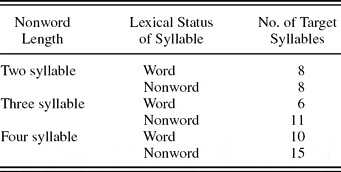
Across the 24 nonwords, the lexical status of each syllable comprising at least two phonemes was determined. This was done by submitting each syllable to the Washington University Speech and Hearing Lab Neighborhood Database (2007). This resulted in a total of 24 word syllables and 34 nonword syllables. For each subject, a proportion correct score was calculated for each lexical status (word, nonword) by nonword length cell (two, three, four syllables; Table 1 shows the number of stimuli in each cell). Subjects’ accuracy scores were analyzed in a 3 (Group) × 2 (Lexical Status) × 3 (Nonword Length) mixed-design analysis of variance (ANOVA). Unless otherwise noted, effects are reported as significant at or beyond α < .05. The analysis revealed main effects of group, F (2, 191) = 3.42, lexical status, F (1, 191) = 10.87, and nonword length, F (1, 191) = 65.82, and a Lexical Status × Nonword Length interaction, F (1, 191) = 22.15. The Group × Lexical Status × Nonword Length interaction approached conventional levels of statistical significance, F (2, 191) = 2.69, p = .07.
Number of stimuli in each Lexical Status × Nonword Length cell

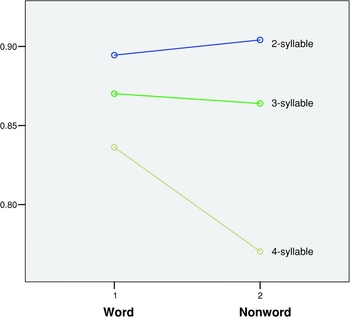
The main effects of lexical status and nonword length were qualified by the interaction between these two factors (see Figure 1). Simple F tests were used to examine all interaction effects. The Nonword Length × Lexical Status interaction revealed that children were more accurate for word versus nonword syllables for the four-syllable nonwords (M = 0.84, SE = 0.011 vs. M = 0.77, SE = 0.012, respectively). There was no effect of lexical status for the two- and three-syllable nonwords (M = 0.89, SE = 0.009 and M = 0.90, SE = 0.009 for two-syllable words and nonwords, respectively; M = 0.87, SE = 0.012 and M = 0.86, SE = 0.010 for three-syllable words and nonwords, respectively). This interaction was consistent across all three age groups. Children's repetition accuracy for constituent syllables deteriorated from two-, to three-, to four-syllable nonwords, with the exception that word syllables for each of the two- and three-syllable nonwords were repeated with equal accuracy.
The mean percent correct scores for each Lexical Status × Nonword Length cell. [A color version of this figure can be viewed online at journals.cambridge.org/aps]

Younger children were less accurate overall than the middle and older age groups (M = 0.83, SE = 0.011 for the younger group and M = 0.87, SE = 0.011 for both of the two older groups). The Age × Lexical Status × Nonword Length interaction approached significance as the younger group performed as well as both older groups on the three- and four-syllable nonwords for word syllables, but more poorly than both older groups on the nonword syllables in three- and four-syllable nonwords.
To further investigate the effects of lexical knowledge on nonword repetition, we examined the occurrence of two types of errors for which subjects changed the lexical status of the target syllable (following Dollaghan et al., Reference Dollaghan, Biber and Campbell1993, Reference Dollaghan, Biber and Campbell1995). First, the total number of instances for which a word error was substituted for a nonword target syllable was calculated for each participant and then divided by the total number of possible occurrences for this error type (i.e., divided by the number of nonword targets = 34, word substitution errors). Second, the total number of times that a nonword error was substituted for a word target syllable was calculated for each participant and divided by the total number of possible occurrences for this error type (i.e., divided by the number of word targets = 24, nonword substitution errors).
These proportions were submitted to a two-way, mixed-design ANOVA with age as the between-subject variable and substitution type as the repeated measure. Results showed a main effect of substitution type, F (1, 191) = 3.978, p < .05. Overall, children made a higher proportion of word substitution errors for nonword targets (M = 0.051, SE = 0.003) than nonword substitution errors for word targets (M = 0.042, SE = 0.004).
Effects of neighborhood density on nonword repetition
We calculated neighborhood statistics in the same way as for our previous research (e.g., Metsala, Reference Metsala1997; Garlock, Walley, & Metsala, Reference Garlock, Walley and Metsala2001). Briefly, each constituent syllable was submitted to a database of 918 monosyllabic words from Webster's dictionary, previously used in perceptual experiments with adults (Luce, Reference Luce1986). The advantage of this database for research with children is that each word, as rated by adults, had received a familiarity rating of 6 or above on a 7-point familiarly rating scale (Luce, Reference Luce1986). The numbers of neighbor words in this database resulting from a one-phoneme substitution, addition, or deletion from the target syllable were calculated. A median split technique was used to generate categories of syllables from dense and sparse neighborhoods. Twenty-eight syllables were categorized as sparse (M neighbors = 2, range = 1–5, SE = 0.32) and 30 syllables categorized as dense (M = 11.17, range = 6–19, SE = 0.70). To check the validity of this categorization, we calculated neighborhood density for each syllable using a larger database of 4,086 monosyllabic words (De Cara & Goswami, Reference De Cara and Goswami2002). An independent t test showed that the number of neighbors calculated from this second data base differed significantly between the sparse and dense neighborhood cells, t (56) = 5.392, p < .001 (M = 15.07, SE = 1.76 vs. M = 30.83, SE = 2.29, for the sparse and dense stimulus cells, respectively).
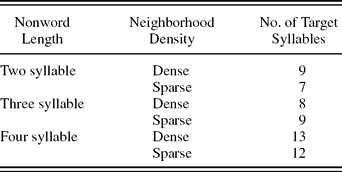
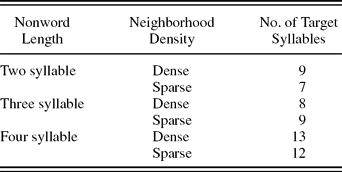
For each participant, a proportion correct score was calculated for each density (dense, sparse) by nonword length cell (two, three, and four syllables; Table 2 shows the number of stimuli in each cell). Subjects’ accuracy scores were analyzed in a 3 (Group) × 2 (Density) × 3 (Nonword Length) mixed-design ANOVA. The analysis revealed main effects of group, F (2, 191) = 3.97, density, F (1, 191) = 32.86, and nonword length, F (1, 191) = 70.60, and a Density × Nonword Length interaction, F (1, 191) = 21.57. As for the earlier analysis, children in the younger group performed poorer than the two older groups.
Number of words in each Neighborhood Density × Nonword Length cell
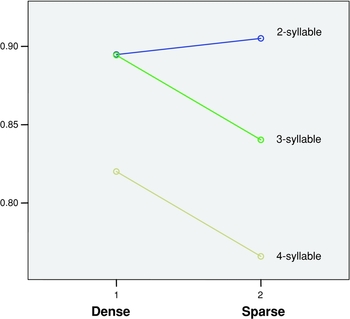
The main effect of better repetition for syllables from dense neighborhoods was qualified by the interaction with nonword length (see Figure 2). Syllables from dense neighborhoods were repeated more accurately for three- and four-syllable nonwords, but density did not impact repetition for target syllables from two-syllable nonwords. In addition, accuracy for target syllables from sparse neighborhoods decreased incrementally across each nonword length (M = 0.90, 0.84, and 0.76 and SE = 0.01, 0.01, and 0.01 for two-, three-, and four-syllable nonwords, respectively). Target syllables from dense neighborhoods were repeated equally well for two- and three-syllable nonwords, which, in turn, were more accurate than for four-syllable nonwords (M = 0.89, 0.89, and 0.82 and SE = 0.01, 0.01, and 0.01 for two-, three-, and four-syllable nonwords, respectively).
The mean percent correct scores for each Neighborhood Density × Nonword Length cell. [A color version of this figure can be viewed online at journals.cambridge.org/aps]

Previous research found that the size of the advantage for high versus low phonotactic probability sequences decreased with increasing vocabulary knowledge. In our analysis, age group did not interact with any other factor, although we had predicted an interaction with neighborhood density. To more closely replicate analyses from previous research on phonotactic probabilities (e.g., Munson, Edwards, et al., Reference Munson, Edwards and Beckman2005), we reran the above ANOVA with vocabulary group (high vs. low) as the between subject variable.Footnote 5 As well as the main effects of density and nonword length, and the Density × Nonword Length interaction, there was a main effect of vocabulary group, F (1, 192) = 19.73, and a Vocabulary Group × Density interaction, F (1, 192) = 4.07. The interaction was obtained because the advantage for syllables from dense neighborhoods was greater for the low versus higher vocabulary group (partial eta squared = 0.234 and 0.108 for the lower and high vocabulary groups, respectively).
To further examine the role of neighborhood density in children's nonword repetition, we calculated the mean neighborhood density for children's error responses and compared these to the neighborhood density of the target syllables. Each error response was submitted to the same neighborhood calculation procedure as described above for the target syllables (i.e., calculated based on a lexicon of 918 monosyllabic words). Next, for each of the 57 syllables for which errors were made, the mean error density was calculated across all participants. The mean densities of errors for each syllable were then compared to the densities for the target syllables in a paired samples t test. The mean densities for error responses was higher than the density of the target syllables, t (56) = 2.17; M = 8.17, SE = 0.50 and M = 6.89, SE = 0.72, respectively.
DISCUSSION
Nonword repetition is no longer thought to be a knowledge-free test of phonological storage capacity. The present study examined the influence of lexical status and neighborhood density toward providing evidence for the contribution of long-term lexical knowledge to children's nonword repetition. We found that word syllables were pronounced more accurately than nonword syllables for the four-syllable nonwords; however, lexical status did not impact the repetition of constituent syllables in two- and three-syllable nonwords. In a similar manner, syllables from dense versus sparse neighborhoods were repeated more accurately for three- and four-syllable nonwords, but not for the shortest two-syllable nonwords. Thus, both factors related to long-term lexical knowledge interacted with nonword length.
Although it may not be surprising that long-term lexical knowledge had the most impact on the nonwords for which more errors were made overall, these interactions were not because of ceiling effects per se. Previous research on lexical status and on phonotactic probability in children's nonword repetition used only two nonword lengths, and this factor was not examined in the comparisons (e.g., Dollaghan et al., Reference Dollaghan, Biber and Campbell1993, Reference Dollaghan, Biber and Campbell1995; Edwards et al., 2005; Munson, Edwards, et al., Reference Munson, Edwards and Beckman2005). Past research has proposed that longer nonwords are repeated less accurately because of the greater demands on STM capacity (e.g., Gathercole et al., Reference Gathercole, Frankish, Pickering and Peaker1999). Consistent with this proposal, it may be that the overall nonword length effect and the interaction effects between nonword length and the LTM variables in the current study result from the role of STM capacity in nonword repetition. Such an interpretation might be most congruent with Gathercole's (2006) model. Although these interactions were not predicted in the current study, the computational model presented in Jones et al. (Reference Jones, Gobet and Pine2007) behaved in a similar manner, showing an interaction of wordlikeness and nonword length, and thus offers an alternative explanation to an STM account. Specifically, the simulation (at a learning level proposed to be comparable to 4- to 5-year-olds) performed better for wordlike versus nonwordlike nonwords only for the lengthiest, three-syllable nonwords; there was no effect of wordlikeness for the one- and two-syllable nonwords. Jones et al. (Reference Jones, Gobet and Pine2007) do not appear to offer an explanation for the interaction; however, understanding how their computational model accounts for the main effects of wordlikeness and nonword length without invoking individual or developmental differences in STM capacity may help to explain the interactions observed in the current study.
In their model, EPAM-VOC, Jones et al. (Reference Jones, Gobet and Pine2007) simulated commonly observed effects in children's nonword repetition without invoking individual or developmental differences in phonological memory capacity. Rather, differences in phonological knowledge associated with vocabulary learning accounted for variability in performance across age, wordlikeness, and nonword length. Jones et al. (Reference Jones, Gobet and Pine2007) stated the following:
The model gradually builds up a hierarchy of phoneme sequences in order to increase the amount of information that can be held in phonological working memory. As input is received into the model, any existing long-term representation of any part of the input can be accessed such that if the model knows a three-phoneme sequence, for example, those three phonemes do not need to be stored individually within phonological working memory, but rather a pointer can be stored to the equivalent node containing the sequence. As a result, the more phonological knowledge the model has in its LTM, the more items can be stored in phonological working memory. (p. 867)
With memory capacity acting as a bottleneck in EPAM-VOC, this chunking becomes most crucial for the longer nonwords, as decay processes lead to greater errors as more separate phonemes or phoneme sequences need to be held in memory. The model takes much longer (i.e., more vocabulary learning) to master repetition of lengthier nonwords, even though memory capacity is held constant across time (development). Applying this framework to the present results, the lengthier nonwords were forgotten unless frames (chunks) from LTM could be applied, which was more readily the case for word syllables and for syllables from dense neighborhoods. Jones et al. (Reference Jones, Gobet and Pine2007) note that EPAM-VOC will learn more detail about words from dense versus sparse neighborhoods because of experience with similar phoneme sequences in many word neighbors. This knowledge appears particularly relevant when working memory capacity is most challenged. Consistent with the lexical reorganization account (see also Munson, Edwards, et al., Reference Munson, Edwards and Beckman2005) and with EPAM-VOC, vocabulary knowledge may be the primary force in the association between nonword repetition and word learning. In a similar manner, French and O'Brien (Reference French and O'Brien2008) examined nonword repetition for English and Arabic nonwords in native French-speaking children (mean age = 11 years) over the course of a 5-month intensive English program. They concluded that performance on phonological memory tasks (e.g., English nonword repetition) increases with increasing language knowledge, but that phonological memory capacity (measured in this instance by repetition of Arabic nonwords) is invariant over time.Footnote 6 Ottem, Lian, and Karlson (Reference Ottem, Lian and Karlson2007) similarly argued that developmental increases in memory span tasks were because of growth in language abilities, particularly in increased chunking capacity as a functioning of language development. They suggested that phonological memory capacity is invariant from about 4 years of age onward.
Additional findings from the current study are congruent with this developmental account of nonword repetition. For the three- and four-syllable nonwords, young children repeated word syllables as accurately as the two older groups but were poorer at nonword syllables. Although lexical status did not interact with age group, nonetheless, developmental differences were least pronounced for target syllables that could make direct contact with lexical entries. It appears that the young children were able to use frames from LTM to support repetition of the word syllables and could perform as well as the older children. Similarly, for syllables from sparse neighborhoods, there were incremental decreases in accuracy from two- to three- to four-syllable nonwords. For syllables from dense neighborhoods, repetition was equally accurate for two- and three-syllable nonwords and less accurate for four-syllable nonwords. Thus, word length had less impact for syllables that could be more readily supported by lexical knowledge, such as those from dense neighborhoods.
Previous research reported an inverse relationship between vocabulary knowledge and the size of the advantage for high versus low probability sequences (Edwards et al., Reference Edwards, Beckman and Munson2004; Munson, Edwards, et al., Reference Munson, Edwards and Beckman2005; Munson, Kurtz, et al., Reference Munson, Kurtz and Windsor2005). Similarly, we found that the magnitude of the density effect was larger for the group with lower versus higher vocabulary knowledge. One possible explanation for this finding is that children with poorer phonological memory capacities rely more on long-term representations in the nonword repetition task than children with better developed phonological memories. This interpretation would provide support for the phonological storage capacity account of the relation between nonword repetition and word learning.Footnote 7 It may be, however, that children with larger vocabularies are able to represent syllables from sparse neighborhoods more accurately because they know relatively more of the words’ neighbors. Alternatively, as a result of vocabulary development, there may be a shift toward analyzing all input phonemically, regardless of lexical constraints (e.g., Munson, Edwards, et al., Reference Munson, Edwards and Beckman2005). On phonological awareness tasks that did not have heavy phonological memory demands, Metsala (Reference Metsala1999) found that 4-year-olds were more constrained by lexical characteristics and task demands than were the 5-year-olds. Masterson et al. (Reference Masterson, Laxon, Carnegie, Wright and Horslen2005) found that a group of children lower on a nonword repetition task showed better recall for monosyllabic nonwords from dense versus sparse neighborhoods, but this effect was absent for the higher scoring group. Dividing groups by nonword repetition performance was conceptualized as forming a group high versus low in phonological processing ability. Reaching a state of phonological processing “freer” from lexical constraints may be hampered in some children who show poorer nonword repetition ability and who may have difficulty learning an alphabetic code. Further examinations appear warranted to better understand the negative correlation between vocabulary knowledge and neighborhood density (or phonotactic probability) effects in children's nonword repetition, and whether a phonological storage capacity account or a lexical reorganization account can better explain this interaction.
In the current study, we found that children were more likely to substitute a word syllable for a nonword syllable target than the converse (nonword syllable substituted for a word syllable). Past research interpreted this finding to be evidence of the intrusion of lexical knowledge on children's nonword repetition (Dollaghan et al., Reference Dollaghan, Biber and Campbell1993, Reference Dollaghan, Biber and Campbell1995). A related finding in the current study was that the mean densities of children's errors were higher than the densities of the target syllables. This finding was congruent with the work of Munson and his colleagues, who found that errors for low phonotactic probability sequences tended to be of higher phonotactic probability (Edwards et al., Reference Edwards, Beckman and Munson2004; Munson, Edwards, et al., Reference Munson, Edwards and Beckman2005; Munson, Kurtz, et al., Reference Munson, Kurtz and Windsor2005). These types of errors seem congruent with models for which instantiated patterns in phonological memory reflect the weighted connections activated in long-term lexical memory.
Lexical characteristics of the stimuli in the present study were examined on an ad hoc basis; the stimuli were not contrived for the purposes of examining our specific hypotheses. A limitation of this approach was that linguistic aspects of the stimuli were not tightly controlled between differing levels of lexical status or neighborhood density. Despite this limitation, findings were congruent with predictions derived from previous research that has used contrived stimuli (e.g., Dollaghan et al., Reference Dollaghan, Biber and Campbell1993, Reference Dollaghan, Biber and Campbell1995; Edwards et al., Reference Edwards, Beckman and Munson2004) and from our theoretical orientation (e.g., Metsala, Reference Metsala1999; Metsala & Walley, Reference Metsala, Walley, Metsala and Ehri1998). A second limitation of this approach was that the influence of neighborhood density and phonotactic probabilities could not be disentangled, as in some controlled experiments of adult word learning and word recognition (e.g., Storkel, Armbrüster, & Hogan, Reference Storkel, Armbrüster and Hogan2006; Vitevitch et al., Reference Vitevitch, Luce, Pisoni and Auer1999) and children's serial recall (Roodenrys & Hinton, Reference Roodenrys and Hinton2002). Within the theoretical orientation adopted by Munson and colleagues (e.g., Edwards et al., Reference Edwards, Beckman and Munson2004; Munson et al., Reference Munson, Edwards and Beckman2005) and the current paper, effects of phonotactic probability and neighborhood density might both be seen as arising from one primary source, an individual's lexical knowledge. Thus, theoretically and empirically, there might be little advantage to examining these factors separately. However, if phonological knowledge is viewed as a rule-based system developing somewhat independently of an individual's lexical knowledge, then it might be proposed that the effects of phonotactic probabilities and neighborhood density should be separable. A related limitation was that potential interactions between lexical status and neighborhood density in nonword repetition could not be examined as this resulted in too limited a number of items at each nonword length. In the adult literature, spoken word recognition is impeded for words from dense neighborhood but facilitated for nonwords from dense neighborhoods (e.g., Vitevitch et al., Reference Vitevitch, Luce, Pisoni and Auer1999). Two levels of representation in adults’ spoken word recognition have been invoked to explain these findings. Words from dense neighborhoods are inhibited because of lexical-level competition; nonwords from dense neighborhoods are facilitated because of the phonological-level advantages associated with higher phonotactic frequencies and the lack of strong lexical-level competition (e.g., Vitevitch et al., Reference Vitevitch, Luce, Pisoni and Auer1999; Vitevitch & Luce, Reference Vitevitch and Luce2005). The findings of the effects of competition are less clear for children and may change with development (e.g., Garlock et al., Reference Garlock, Walley and Metsala2001; Pitrat, Logan, Cockell, & Gutteridge, Reference Pitrat, Logan, Cockell and Gutteridge1995). Future research might begin to tease apart the effects of phonotactic probabilities and neighborhood density on nonword repetition and investigate any interactions with the lexical status of constituent syllables.Footnote 8
The results of the present study fit well with a growing body of research that supports the notion that language growth accounts for changes in performance on memory tasks (e.g., French & O'Brien, Reference French and O'Brien2008; Ottem et al., Reference Ottem, Lian and Karlson2007) and, more specifically, with the lexical reorganization account of the association between nonword repetition and word learning (e.g., Jones et al., Reference Jones, Gobet and Pine2007; Munson, Edwards, et al., Reference Munson, Edwards and Beckman2005; Munson, Kurtz, et al., Reference Munson, Kurtz and Windsor2005). According to this account, changes in vocabulary knowledge and lexical organization are the pace setter for the observed association. We would argue that our findings concerning accuracy for repetition related to lexical status, neighborhood density, and interactions with nonword length, as well as children's errors all support an important role for lexical knowledge in children's nonword repetition performance. Phonological memory capacity may be best conceptualized as a bottleneck, rather than the driving force in developmental changes for typically developing children's nonword repetition (Jones et al., Reference Jones, Gobet and Pine2007). Repeating multisyllabic nonwords is a complex process with multiple determinants (e.g., Gathercole, Reference Gathercole2006). Future investigations and computational models of nonword repetition may benefit from examining effects of lexical status and neighborhood density of the constituent syllables.
APPENDIX A
The 24 nonwords analyzed in this study

ACKNOWLEDGMENTS
Support for this research was provided by Natural Sciences and Engineering Research Council of Canada Discovery Grant 341588-2008 (to J.L.M.). We are grateful to two anonymous reviewers for helpful comments on an earlier version of this paper.