Introduction
Tympanoplasty is the procedure of tympanic membrane closure to protect the middle ear from chemotoxins, water and other foreign objects. Although this is usually a successful procedure, in cases with Eustachian tube dysfunction, infection or defective healing mechanisms, the prognosis is not favourable.Reference Fukuchi, Cerchiari, Garcia, Rezende and Rapoport1
Many different types of graft are used in tympanoplasty, such as fascia, perichondrium, vein, dura mater, cartilage and xenografts. The pros and cons of these grafts have been outlined in many studies. The temporalis fascia graft has been most commonly used in primary tympanoplasty over the last few decades; however, it may become atrophic or form a retraction pocket over time.Reference Storrs2–Reference Jansen5 JansenReference Jansen5 and Heerman-Johnson and colleaguesReference Heermann, Heermann and Kopstein6 proposed the use of cartilage graft.
The major advantage of cartilage graft is the stiffness and long-term endurance associated with its bradytrophic metabolism.Reference Neumann, Kevenhoerster and Gostian7 Other advantages of cartilage include its resistance to resorption and retraction due to the negative pressure of the middle ear and elasticity. These features mean the graft can be used for reconstruction in subtotal perforation, adhesive otitis and revision tympanoplasty.Reference Kouhi, Khorsandi Ashthiani and Jalali8–Reference Abdelhameed, Rezk and Awad12 In cartilage tympanoplasty, the stiffness and bulk of the cartilage may affect the transmission of the sound through the ear; hence, it may have some effect on hearing.Reference Jalali, Motasaddi, Kouhi, Dabiri and Soleimani13–Reference Schöttke, Hartwein and Pan15
Crushed human auricular and costal cartilage grafts have been used in other procedures such as rhinoplasty to facilitate resorption and the reduction of chondrocytes.Reference Buyuklu, Hizal, Yilmaz, Sahin and Cakmak16 We performed this clinical study to compare the results of cartilage tympanoplasty using crushed and non-crushed cartilage.
Materials and methods
This study was approved by the local ethics committee (trial registration code: IR.TUMS.VCR.REC.1395.1550). All patients signed informed consent forms after adequate explanation of possible complications and clinical outcomes.
This randomised clinical trial comprised 46 patients who were referred to our tertiary clinic with chronic otitis media from August 2017 to January 2019. Patients were enrolled after obtaining present illness details, past medical history, physical examination findings and microscopic ear examination results. Patients were excluded if they had a history of: former otological operations, relapsing polychondritis, tympanosclerosis, cholesteatoma, adhesive otitis with or without perforation, otic polyp, ossicular chain discontinuity, contralateral Eustachian tube dysfunction, middle-ear malformations, or intracranial complications.
Patients were allocated to the intervention and control groups according to a randomised block design. The patients, the audiologists, the statistician who analysed the results, and the doctors (SD and AK) who counselled and examined the patients on the procedure and followed them up, were all blinded. The surgeons (AT and NH) were not blinded to the concept of the codes and were acquainted with the type of surgery the day before the operation. The operation notes were coded separately by the surgeons. The physicians who followed up the patients were not informed of the type of surgery (i.e. crushed vs intact cartilage tympanoplasty).
The cartilage graft material was obtained from the cavum conchae during surgery. The cartilage was sliced to 0.4 mm thickness (using a Kurz® Precise Cartilage Knife); it was then crushed under a cottle cartilage crusher on one side, leaving the opposite side intact. Crushed cartilage was fixed under the freshened edges of the perforation (underlying) based on perforation types in the intervention group. All patients underwent cartilage rim augmented fascia tympanoplasty with the temporalis fascia. All cartilage grafts were placed in the posterior superior position and were fixed under the perforation in both groups. The middle ear and external auditory canal were packed with haemostatic gelatine sponge (Cutanplast, Mascia Brunelli, Milan, Italy). We did not perform ossicular reconstruction in either group at this stage of the surgery. Surgical procedures were performed using a Carl Zeiss surgical microscope.
The technique was identical for the control and intervention groups, other than crushing of the cartilage. If the patient was a candidate for second-stage surgery, ossicular chain reconstruction was performed by the same surgeon a year later.
Success rate and hearing results were determined based on a one-year follow up post-operatively. Patients were assessed every four months to one year following the surgery; audiometric parameters and ear examination findings were obtained at each follow up. We evaluated auditory results before the operation at four frequencies of 0.5, 1, 2 and 4 kHz based on pure tone audiometry and speech reception thresholds, and repeated these parameters every four months to one year following the surgery.
In two patients – one from the intervention group and one from the control group – who underwent a second procedure for hearing reconstruction, a biopsy was taken during surgery to evaluate the viability of chondrocytes and the cellularity of the cartilage graft. A blinded pathologist evaluated the histological sections obtained from the two patients during the second-stage surgery using haematoxylin and eosin staining.
SPSS for Windows statistical software, version 24.0 (IBM, Armonk, New York, USA) was used for statistical analysis. P-values of 0.05 or less were considered statistically significant. A chi-square test, a repeated-measures analysis of variance, an independent t-test and a paired t-test were utilised to assess the statistical significance of graft condition and to compare the hearing outcomes for both groups.
Results and analysis
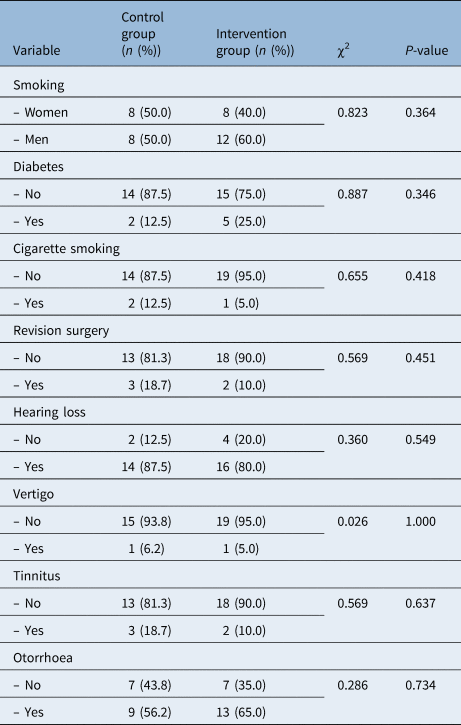
Forty-six subjects were enrolled and randomised to the present study from August 2017 to January 2019; 36 patients (20 in the intervention and 16 in the control group) had at least one year of follow up. The mean age (standard deviation) was 42.60 (13.72) years in the intervention group and 43.47 (14.47) years in the control group; there was no significant difference between the two groups (p > 0.05). Table 1 shows the demographic and clinical presentation of patients; the results showed that there were no significant differences between the intervention and control groups in the distribution of these parameters (p > 0.05).
Distribution of sex, diabetes, smoking, revision surgery, hearing loss, vertigo, tinnitus and otorrhoea in both groups

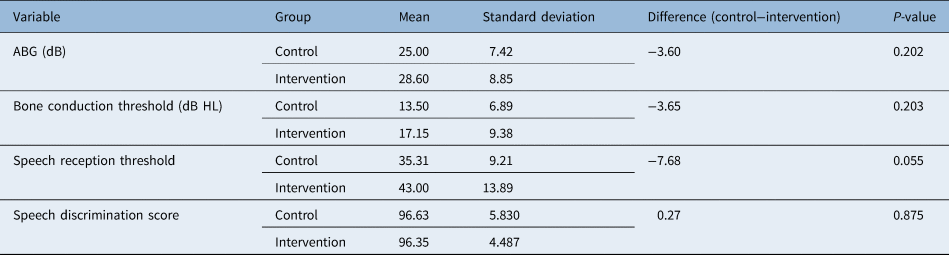
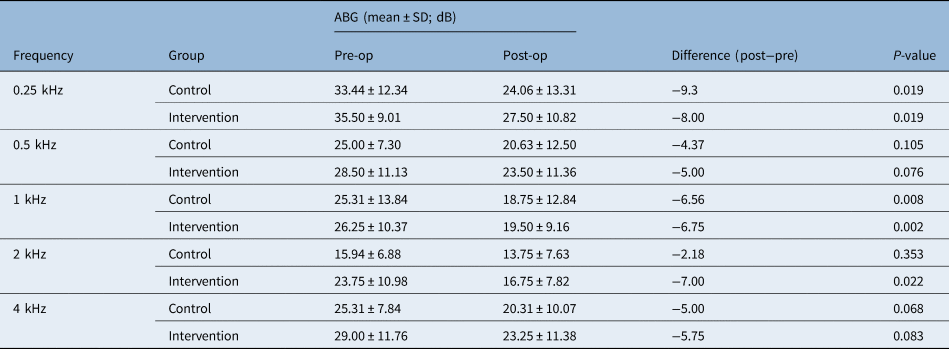
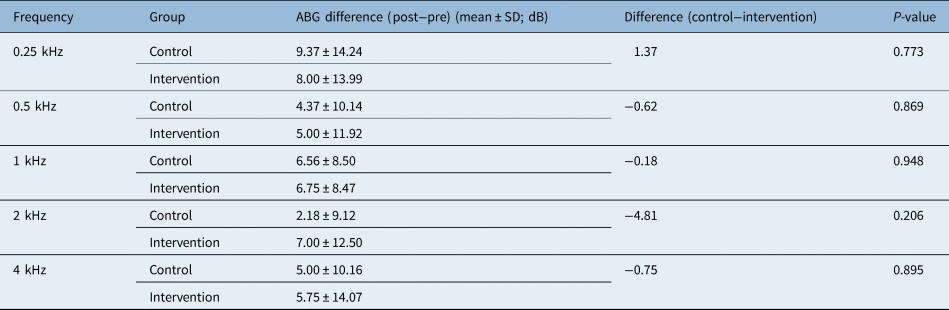
There was no statistically significant difference regarding hearing before surgery between the two groups (p > 0.05) (Table 2). Table 3 shows the hearing thresholds before and a year after the operation in both groups. The mean air–bone gap was significantly decreased at 0.25 kHz, 1 kHz and 2 kHz (p < 0.05) a year following surgery; however, there was no significant difference at 0.5 kHz and 4 kHz (p > 0.05). The mean air–bone gap difference at 0.25–4 kHz before and a year following the operation was compared between the groups using an independent t-test; there were no statistically significant differences between the two groups (p > 0.05) (Table 4).
ABG, bone conduction threshold, speech reception threshold and speech discrimination score before surgery for both groups

ABG = air–bone gap
ABG pre- and post-operation for both groups

ABG = air–bone gap; SD = standard deviation; pre-op = pre-operation; post-op = post-operation
ABG difference for control versus intervention group

ABG = air–bone gap; post−pre = post-operation minus pre-operation; SD = standard deviation
Table 5 shows the speech reception thresholds and speech discrimination scores before and a year following the surgery; there were no significant differences between them (p > 0.05). The tympanic membrane healing rate was evaluated in both groups a year following the operation; it was not significantly different (p > 0.05) (Table 6).
Speech reception threshold and speech discrimination score pre- and post-operation for both groups

Pre-op = pre-operation; SD = standard deviation; post-op = post-operation
Tympanic membrane evaluation in both groups

* Improvement classified by complete perforation closure
A histological study of the cartilage samples from the two patients who underwent second-stage surgery a year after the initial surgery revealed a significant reduction in live cells within the crushed cartilage.
Discussion
Chronic otitis media can be defined as an inflammatory process in the middle ear, and may be associated with a permanent defect in the eardrum.Reference Ballenger and Snow17 The goals of tympanoplasty are to seal the tympanic membrane perforation, improve hearing and aid recovery of a functional middle-ear cavity.
Temporalis fascia is the most frequently used graft for primary tympanoplasty, with a success rate of 93–97 per cent.Reference Mohamad, Khan and Hussain3,Reference Lee, Lee, Nam, Lee and Kwon4 In recent years, surgeons have utilised cartilage in tympanoplasty when they need more support and reliability to improve their post-operative outcomes, especially in patients with an atelectatic ear, large perforation or bilateral perforations, in revision surgery cases, and in reconstruction following cholesteatoma.Reference Andersen, Caye-Thomasen and Tos18 The sound transmission properties following cartilage tympanoplasty depend on cartilage thickness and mass (thickness of 500 μm or less). Other challenging issues associated with the use of a thick cartilage graft include post-operative monitoring for effusion and cholesteatoma, and tympanometry.Reference Gerber, Mason and Lambert14,Reference Zahnert, Hüttenbrink, Mürbe and Bornitz19
The results of experimental studies on human cadavers by Zahnert et al.Reference Zahnert, Hüttenbrink, Mürbe and Bornitz19 showed that reducing the thickness of the cartilage graft may decrease acoustic transfer loss. A study by Aslıer et al.Reference Aslıer, Özay, Gürkan, Kırkım and Güneri20 on 34 cases of type 1 tympanoplasty using cartilage grafts showed no differences in hearing thresholds, but graft material, graft thickness, cartilage surface area ratio and time passed after surgery may affect the course of sound energy absorbance. In the present study, a significant reduction was observed in air–bone gap at frequencies of 0.25, 1 and 2 kHz (5–7 dB) a year following surgery; hence, crushed cartilage may affect the course of acoustic transfer and may reduce air–bone gap.
Buyuklu et al.Reference Buyuklu, Hizal, Yilmaz, Sahin and Cakmak16 evaluated the viability and proliferation rates of chondrocytes in 20 patients during secondary rhinoplasty. They prepared their samples as slightly crushed, moderately crushed, significantly crushed and severely crushed, for auricular and costal cartilage. The mean chondrocyte viability rates decreased when the level of crushing was increased. They found that mild or moderate crushing of human auricular or costal cartilage may conceal irregularities and defects; thus, it may create a smoother surface in rhinoplasty. In our study, two patients (one from the intervention group and one from the control group) underwent second-stage surgery for ossicular reconstruction, and a biopsy of their cartilage graft was performed a year following their initial surgery. Samples were stained with haematoxylin and eosin and analysed. Chondrocytes were observed in 5 per cent of the intervention group and in 70 per cent of the control group. All the cartilage grafts utilised for cartilage tympanoplasty in the intervention group were mildly crushed.
The air–bone gap closure results after surgery (Table 4) were better in the intervention group than in the control group at 0.25 kHz, by 1.37 dB (p = 0.773). Regarding the remaining frequencies, the air–bone gap closure (intervention group minus control group difference) was −0.62 dB at 0.5 kHz (p = 0.869), −0.18 dB at 1 kHz (p = 0.948), −4.81 dB at 2 kHz (p = 0.206) and −0.75 dB at 4 kHz (p = 0.895). There were no statistically significant differences between groups. For the crushed cartilage technique, a decrease in chondrocytes, displacement by fibrosis tissue, and reduction of volume and rigidity of the cartilage graft may lead to the closure of air–bone gap.
Mürbe et al.Reference Mürbe, Zahnert, Bornitz and Huttenbrink21 utilised cartilage grafts with different thicknesses (1.0, 0.7, 0.5 and 0.3 mm), cartilage palisades, and cartilage island transplants. Sound-induced vibrational amplitudes were measured by laser Doppler vibrometry. They concluded that the sound transmission was strongly influenced by the reconstruction technique. When thick cartilages are sliced into thin plates, the frequency of the first resonance is reduced and its amplitude increased. Hence, thin cartilage, cartilage palisades and island transplants are more favourable to enhance sound transmission. In a study by Mokbel and Thabet,Reference Mokbel and Thabet22 85 patients with unilateral chronic otitis media with subtotal perforation were classified into 3 groups according to graft type: 0.2 mm thickness cartilage graft, full-thickness cartilage graft and temporalis fascia graft. Good hearing results were obtained using 0.2 mm partial-thickness cartilage grafts for the reconstruction of subtotal tympanic membrane perforation.
• Tympanoplasty refers to tympanic membrane closure to protect the middle ear; many types of grafts are used
• The stiffness and bulk of cartilage graft may affect sound transmission through the ear and affect hearing
• In this study, crushed cartilage was used in tympanoplasty as a novel technique
• Success rates and hearing results were determined at one year; patients were assessed every four months to one year post-operatively
• There were no significant differences between crushed and non-crushed cartilage groups in mean air–bone gap, bone conduction, speech discrimination score or speech reception threshold
• The reduction in living cells after crushing may decrease graft rigidity and volume; however, crushing did not improve hearing
In our study, we ascertained that speech reception thresholds and speech discrimination scores were no different between the two groups at one year following cartilage tympanoplasty (Table 5). The success rate of tympanic membrane reconstruction in the intervention and control groups was 70 and 63.4 per cent, respectively (Table 6); the difference was not significant. A patient from the control group developed a visible retraction pocket. There was no cholesteatoma formation in either group. In a systematic review by Jalali et al.,Reference Jalali, Motasaddi, Kouhi, Dabiri and Soleimani13 the success rate of tympanic membrane reconstructions was 92 per cent for cartilage tympanoplasty and 82 per cent for temporal fascia tympanoplasty. Any study will have limitations associated with a restricted sampling area or study population, and the lower graft take rate in our patients may be due to selection bias; however, our centre is a tertiary referral centre, and most patients have very large perforations with co-morbidities that may affect the healing process. If we could evaluate more cartilage samples histologically, we would have more confidence about the cartilage graft take rate in the middle ear. Statistical tests normally require a larger sample size to ensure a representative distribution; because of our long-term follow up, 10 patients, mostly from other provinces, declined their follow-up appointments.
Cakmak and BuyukluReference Cakmak and Buyuklu23 used crushed cartilage grafts to decrease nasal irregularities during rhinoplasty performed in 462 cases between 1999 and 2006. The grafts were categorised according to the level of crushing, into severe, distinct, moderate and mild. There was no resorption in the mild group; hence, mild crushing may not be a reason for cartilage graft resorption. In the present study, all cartilage grafts in the intervention group were slightly crushed and were used for tympanic membrane reconstruction. In 2012, Kayabasoglu et al.Reference Kayabasoglu, Ozbek, Yanar, Sahin, Keles and Yilmaz24 compared the cellular viability of diced, crushed and morselised cartilage in rhinological surgery. After three months, diced cartilage had the highest number of live cells, whereas they observed a significant reduction of live cells in crushed cartilage. It can be assumed that the volume and thickness of cartilage may diminish over time because of the gradual disappearance of chondrocytes and replacement by fibrosis; this may improve hearing following cartilage tympanoplasty.
Based on our study findings, crushed cartilage tympanoplasty may help surgeons to improve patients’ post-operative hearing outcomes at some frequencies. This procedure eliminates the risk of graft failure. However, overall hearing results were not significantly different using this method. This study should be followed by additional investigations in a sample large enough to prove our results.
Conclusion
There are various methods for cartilage tympanoplasty. A thick cartilage graft may decrease air conductivity through the ear. The reduction in living cells following crushing may decrease the rigidity and volume of the graft. Nevertheless, crushing the cartilage graft in tympanoplasty did not result in improved hearing results following tympanic membrane reconstruction. Graft take rates were similar in the crushed and non-crushed cartilage groups.
Acknowledgements
The authors would like to thank Professor Masoud Motasaddi Zarandy for his assistance throughout all aspects of our study, and for his help in visiting the patients regularly, reviewing our manuscript and providing supportive comments. This study was financially supported by the Otorhinolaryngology Research Center, Tehran University of Medical Sciences, Iran.
Competing interests
None declared