Implications
Close linear relationships between in vivo standardised ileal digestibilities (SID) and in vitro predicted SID values for crude protein (CP) and amino acids (AA) in faba beans, field peas and lupins were obtained. However, probably due to the presence of anti-nutritional factors, differences between in vitro predicted SID and in vivo SID values varied between and within these grain legume species. Thus, further validation of the in vitro assay based on the results of in vivo SID studies is required before being used for the prediction of SID of CP and AA in feed ingredients and diets for pigs.
Introduction
Grain legumes are frequently used as feed ingredients in pig diets due to their high contents of crude protein (CP), amino acids (AA) and energy (Mekbungwan, Reference Mekbungwan2007). Progress in plant breeding may improve both quality and protein contents in grain legumes (Monti and Grillo, Reference Monti and Grillo1983; Clarke and Wiseman, Reference Clarke and Wiseman2000): therefore, there may be a need to re-evaluate the nutritional value of currently available grain legume cultivars such as faba beans, field peas and lupins. At present, feed protein evaluation systems for pigs are based on standardised ileal digestibilities (SID) of CP and AA, and data for SID of CP and AA have been published for different feed ingredients in various feed tables (e.g. NRC, 1998; AmiPig, 2000; Degussa, 2006; GfE, 2008). Data in these feed tables originate from measurements of in vivo apparent ileal digestibilities (AID) of CP and AA in growing pigs, which are subsequently corrected for estimates of basal ileal endogenous CP and AA losses to calculate SID values (e.g. Jansman et al., Reference Jansman, Smink, van Leeuwen and Rademacher2002; GfE, 2008). However, there is a scarcity of information on SID of CP and AA in grain legumes grown in Central Europe. Moreover, published feed tables (e.g. NRC, 1998; AmiPig, 2000; Degussa, 2006; GfE, 2008) do not take into account any variations that may result from progress in breeding of new cultivars of grain legumes (Jezierny, Reference Jezierny2009). For example, the level of anti-nutritional factors (ANF) has been notably decreased through the breeding of zero-tannin faba bean cultivars (Duc et al., Reference Duc, Marget, Esnault, Le Guen and Bastianelli1999; Jezierny, Reference Jezierny2009) or low alkaloid lupin cultivars (Petterson, Reference Petterson1998; Jezierny, Reference Jezierny2009). Furthermore, the chemical composition of grain legumes may also be affected by variable growing and harvesting conditions in Central Europe compared to other regions in the world (Mossé and Baudet, Reference Mossé and Baudet1983; Simon and Köhn, Reference Simon and Köhn2004). In vivo ileal digestibility experiments are time consuming, labour intensive, expensive, and require the use of surgically modified pigs for collection of ileal digesta (e.g. Zimmermann and Mosenthin, Reference Zimmermann and Mosenthin2002). Thus, the feed industry would most likely benefit from an evaluation system that could provide a rapid and accurate measure of SID of CP and AA in individual batches of grain legumes used for feed manufacturing.
As an alternative to in vivo digestibility assays, several in vitro methods that simulate the digestive processes along the digestive tract, have been developed to predict energy and nutrient digestibilities in feed ingredients for monogastrics (Boisen and Eggum, Reference Boisen and Eggum1991). Multi-enzyme systems, such as one-step or two-step systems, aim at reflecting digestive processes in the stomach and the small intestine and appear to be effective in predicting ileal CP and AA digestibilities in pigs (Boisen and Eggum, Reference Boisen and Eggum1991). Boisen and Fernández (Reference Boisen and Fernández1991) introduced a two-step method for prediction of ileal CP and AA digestibilities based on pepsin and pancreatin digestion with further modifications as described by Boisen and Fernández (Reference Boisen and Fernández1995). However, there is still a lack of validation studies that confirm the suitability of this method for in vitro prediction of SID of CP and AA in feed ingredients for growing pigs.
The aim of this study was to predict SID of CP and AA in different legume seeds according to the in vitro procedures as proposed by Boisen and Fernández (Reference Boisen and Fernández1995) and Boisen (Reference Boisen2007), and to compare these SID values with those obtained previously under in vivo conditions with growing pigs (Jezierny, Reference Jezierny2009). The SID values of CP and AA were predicted from in vitro degradation of dry matter (DM) and nitrogen in different grain legumes including six cultivars of faba beans (Vicia faba), six cultivars of field peas (Pisum sativum) and five cultivars of lupins (Lupinus luteus, Lupinus angustifolius).
Material and methods
Grain legume samples
In total, six seed-grade cultivars of faba beans (Vicia faba), six seed-grade cultivars of field peas (Pisum sativum) and five seed-grade cultivars of lupins (Lupinus spp.) were assayed. All grain legume cultivars used in this study were spring cultivars. The faba bean cultivars included the two white-flowered cultivars Aurelia and Gloria (Saatzucht Gleisdorf, Gleisdorf, Austria), and the four coloured-flowered cultivars Divine (Agri Obtentions, Guyancourt, France), Limbo (Lochow-Petkus GmbH, Bergen, Germany), Fuego and Espresso (Norddeutsche Pflanzenzucht, Lembke KG, Holtsee, Germany). The faba bean cultivars Aurelia and Gloria were grown in Austria, cultivar Divine was grown in France, and cultivars Limbo, Fuego and Espresso were grown in Germany. All faba bean cultivars were harvested in 2004, except for cultivar Divine, which was harvested in 2005. The field pea cultivars Santana (Lochow-Petkus GmbH, Bergen, Germany), Jutta, Harnas, Hardy (Norddeutsche Pflanzenzucht, Lembke KG, Holtsee, Germany), Phönix and Rocket (Südwestsaat GbR, Rastatt, Germany) were white-flowered. All field pea cultivars were grown in Germany. The cultivars Santana, Jutta, Harnas and Hardy were harvested in 2004, cultivar Phönix was harvested in 2001 and cultivar Rocket was harvested in 2005. All lupins used in this study were grown in Germany and were harvested in 2005. The lupin cultivars were low-alkaloid cultivars, also referred to as sweet lupins. The cultivars Probor, Boregine, Boruta (Saatzucht Steinach GmbH, Bocksee, Germany) and Idefix (Südwestsaat GbR, Rastatt, Germany) were L. angustifolius cultivars, also referred to as blue lupins, whereas the cultivar Bornal (Saatzucht Steinach GmbH, Bocksee, Germany) was a L. luteus cultivar, also referred to as yellow lupin.
All subsamples of grain legumes were drawn from reference samples of material, which had been previously used for in vivo digestibility studies with growing pigs (Jezierny, Reference Jezierny2009). These grain legume subsamples were ground to pass a 0.5 mm mesh sieve before chemical analyses for proximate nutrients (Naumann and Bassler, Reference Naumann and Bassler1997) and fibre contents (van Soest et al., Reference van Soest, Robertson and Lewis1991). Measurements of condensed tannins in grain legumes were performed as described by Makkar et al. (Reference Makkar, Blümmel, Borowy and Becker1993). Trypsin inhibitor activities (TIA) in grain legumes were determined according to the American Oil Chemists’ Society official method Ba 12-75 (AOCS, 1997). AA analyses in grain legumes were performed by using ion-exchange chromatography with post column derivatisation with ninhydrin. AA were oxidised with performic acid, which was neutralised with sodium metabisulfite (Llames and Fontaine, Reference Llames and Fontaine1994; Commission Directive, 1998). AA were hydrolised by means of six N HCl for 24 h at 110°C. AA were quantified with the internal standard method by measuring the absorption of reaction products with ninhydrin at 570 nm. Tryptophan was determined by HPLC with fluorescence detection (extinction 280 nm, emission 256 nm), after alkaline hydrolysis with barium hydroxide octahydrate for 20 h at 110°C (Commission Directive, 2000). Tyrosine was not determined.
In vitro digestion method
The in vitro digestion method proposed by Boisen and Fernández (Reference Boisen and Fernández1995) and Boisen (Reference Boisen2007) was applied to predict SID of CP and AA in faba beans (n = 6), field peas (n = 6) and lupins (n = 5). This in vitro approach included consecutive incubations of the assay feed samples with solutions of pepsin and pancreatin according to the slightly modified two-step procedure by Boisen and Fernández (Reference Boisen and Fernández1995).
Step 1
A series of two samples of approximately 0.5 g of finely ground material (<1 mm) were weighed to an accuracy of ± 0.02 mg in 100 ml conical flasks. In each of the series, a blank was included. To each sample, 25 ml of a 0.1 M phosphate buffer (pH 6.0) was added and mixed thereafter through magnetic stirring. To this mixture, 10 ml of a 0.2 M HCl solution was added, and pH was adjusted to 2.0 with a 1 M HCl or a 1 M NaOH solution. Subsequently, 1 ml of a freshly prepared pepsin solution was added containing 0.1 g porcine pepsin (2000 FIP U/g, Merck no. 7190, Merck KGaA, Darmstadt, Germany) per 10 ml of a 0.2 M HCl solution. Bacterial contamination was prevented by adding 0.1 ml of a chloramphenicol solution, containing 0.1 g chloramphenicol (Sigma no. C-0378, Sigma-Aldrich, St. Louis, USA) per 100 ml ethanol to each sample. Thereafter, the flasks were closed with rubber plugs and placed on multipoint magnetic stirrers (H+P Labortechnik AG, Oberschleissheim, Germany). These stirrers were located in a drying oven (WTC Binder, Tuttlingen, Germany) at 40 ± 1°C, and the samples were stirred continuously for 6 h.
Step 2
To each sample, 5 ml of 0.6 M NaOH solution and 10 ml of a 0.2 M phosphate buffer (pH 6.8) were added. The pH was then adjusted to pH 6.8 with a 1 M HCl or a 1 M NaOH solution. To this mixture, 1 ml of a freshly prepared pancreatin solution was added, containing 0.5 mg pancreatin from porcine pancreas (Sigma no. p-1750, Sigma-Aldrich) per 10 ml of a 0.2 M phosphate buffer (pH 6.8). After closure with rubber plugs, the flasks were incubated under continuous magnetic stirring at 40°C ± 1°C for 18 h. Thereafter, 5 ml of 20% sulphosalicylic acid was added to every sample. Solubilised but not digested proteins were precipitated under continuous magnetic stirring during 30-min incubation at room temperature. The undigested residues were then collected in a filtration unit (Fibertec™ system, Tecator FOSS GmbH, Rellingen, Germany) by using dried and pre-weighed glass filter crucibles (diameter, 3 cm; pore size, P2, 40 to 90 μm) containing about 0.4 g Celite® 545 (Roth no. 11.2, Carl Roth GmbH+Co. KG, Karlsruhe, Germany) as filter aid. All material was then transferred with 1% sulphosalicylic acid to the crucibles. After consecutive washings with approximately 10 ml of ethanol and acetone, respectively, the undigested residues were dried at 103°C for 4 h. The in vitro digestibility of DM in the sample was calculated by the difference between the DM content in the sample and the undigested residue after correction for DM in the blank. The undigested material together with the Celite was wrapped to a piece of nitrogen-free paper, and undigested nitrogen was measured by the Kjeldahl method (Naumann and Bassler, Reference Naumann and Bassler1997). The in vitro digestibility of nitrogen was calculated as the difference between the nitrogen content in the sample and the undigested nitrogen residue after correction for nitrogen in the blank.
Calculations
Since in vitro nitrogen digestibility is not influenced by basal and specific ileal endogenous nitrogen losses during digestion, this value reflects true ileal digestibility (TID) of dietary nitrogen (Boisen and Moughan, Reference Boisen and Moughan1996a and Reference Boisen and Moughan1996b). In vivo, ileal endogenous nitrogen and AA losses can be separated into basal losses, which are not influenced by feed ingredient composition, and specific losses, which are induced by feed ingredient characteristics, such as levels and types of fibre and ANF. Correcting AID values for both basal and specific endogenous CP and AA losses, yields TID values, whereas correction of AID values for basal endogenous losses yields SID values for CP and AA (Stein et al., Reference Stein, Fuller, Moughan, Sève, Mosenthin, Jansman, Fernández and de Lange2007). Thus, SID of CP (nitrogen × 6.25) and AA can be predicted from in vitro enzyme digestibility of CP (nitrogen × 6.25) after correction for the specific endogenous CP losses (nitrogen × 6.25) of the assay feed ingredient (Equations (1) to (4)), which have been shown to correspond linearly to indigestible DM content (Boisen and Fernández, Reference Boisen and Fernández1995; Boisen, Reference Boisen1998). For practical feed evaluation, the AA composition of the endogenous protein can be considered as a constant (Boisen and Moughan, Reference Boisen and Moughan1996b). Therefore, according to Boisen (Reference Boisen1998), specific endogenous losses of individual AA can be calculated by using conversion factors from nitrogen to individual AA, based on a standardised composition of endogenous protein (equation
(6)). Thus, the SID of CP (nitrogen × 6.25) and AA can be predicted from in vitro enzyme digestibility of CP (nitrogen × 6.25) according to the following equations by Boisen (Reference Boisen2007):

where TDCP = true digestible CP (g/kg DM); CPA = CP content of the assay feed ingredient (g/kg DM), DN = in vitro digested nitrogen (g/kg DM).

where SELCP = specific endogenous losses of CP (g/kg DMI), UDM = in vitro undigested DM (g/kg).

where CPSID = standardised ileal digestible CP (g/kg DM).

where SIDCP = standardised ileal digestibility of CP (%).

where TDAA = true digestible AA (g/kg DM), AAA = AA content in the assay feed ingredient (g/kg DM).

where SELAA = specific endogenous AA loss (g/kg DMI); CF = conversion factor from nitrogen to the individual AA is for Lys (0.188), Thr (0.281), Met (0.063), Cys (0.100), Trp (0.075), Ile (0.156), Leu (0.250), Val (0.219), His (0.094) and Phe (0.188) (Boisen, Reference Boisen1998).

where AASID = standardised digestible AA (g/kg DM).

where SIDAA = standardised digestibility of AA (%).
Statistical analysis
The experimental data were subjected to analysis of variance using the GLM procedure of SAS (2003). The factor grain legume species was included as a fixed effect in the model. Significant differences between grain legume species were determined using the paired differences of means option on the least square means. The significance level was set at P < 0.05. Simple linear relationships between in vivo and in vitro predicted SID values were established, using the GLM procedure. The model was Y = aX + b, where Y = in vivo SID of CP and AA, a = slope, X = in vitro predicted SID of CP and AA, b = intercept. Homogeneity of the slopes and the intercepts of the linear regression were tested for the grain legume species. The corresponding model for multiple linear regression analysis included grain legume species as a covariate. The effect of condensed tannins in faba beans on the in vitro predicted SID values was modelled by linear regressions on the condensed tannin level.
Results and discussion
Nutrient composition and ANF contents in the assay feed ingredients
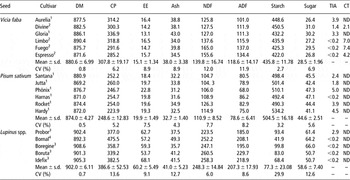
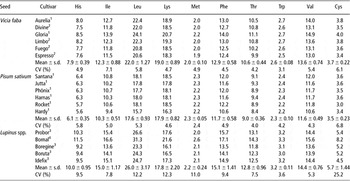
The nutrient composition and ANF contents in faba bean (Vicia faba), field pea (Pisum sativum) and lupin (Lupinus spp.) cultivars as shown in Table 1a and b, were in good agreement with values published in current feed tables (NRC, 1998; AmiPig, 2000; Degussa, 2006). The average CP level was highest in lupin (387 g/kg DM), intermediate in faba bean (308 g/kg DM) and lowest in field pea (249 g/kg DM) cultivars. Among different faba bean cultivars, CP contents ranged from 285 g/kg DM in the coloured-flowered cultivar Espresso to 337 g/kg DM in the white-flowered cultivar Gloria. Average contents of Met, Trp, Cys and Lys in faba bean cultivars amounted to 2.0, 2.6, 3.7 and 19.0 g/kg DM, respectively. The highest AA contents were observed in the white-flowered faba bean cultivar Gloria and lowest in the coloured-flowered faba bean cultivar Espresso. The lowest CP content among field peas was determined in cultivar Hardy (223 g/kg DM), whereas the CP content of the remaining field pea cultivars ranged from 246 to 260 g/kg DM. The average contents of Met, Trp, Cys and Lys in all field pea cultivars amounted to 2.3, 2.3, 3.5 and 17.9 g/kg DM, respectively, with the lowest contents of most AA in cultivar Hardy. Among lupin cultivars, the L. luteus cultivar Bornal had the highest CP (476 g/kg DM) and AA contents. The CP contents of the L. angustifolius cultivars (Probor, Boregine, Boruta and Idefix) ranged from 339 to 383 g/kg DM and the contents of Met, Trp, Cys and Lys ranged from 2.0 to 2.1, 3.0 to 3.2, 4.5 to 5.4, and 16.1 to 17.3 g/kg DM, respectively.
The analysed nutrient composition and contents of anti-nutritional factors in assay feed ingredients (g/kg of DM)

DM = dry matter; EE = ether extract; TIA = trypsin inhibitor activity (mg TI/g CP); CT = condensed tannins; ND = not detectable.
1White-flowered cultivar.
2Coloured-flowered cultivar.
3L. angustifolius.
4L. luteus.
The analysed contents of amino acids in the assay feed ingredients (g/kg of DM)

DM = dry matter.
1White-flowered cultivar.
2Coloured-flowered cultivar.
3L. angustifolius.
4L. luteus
In agreement with reports by Salgado et al. (Reference Salgado, Freire, Mourato, Cabral, Toullec and Lallès2002), the lupin cultivars assayed herein had higher average NDF and ADF contents (248 and 207 g/kg DM, respectively) compared with faba bean and field pea cultivars. In this study, coloured-flowered faba bean cultivars (Divine, Limbo, Fuego, Espresso) had higher NDF and ADF contents compared with white-flowered cultivars (Aurelia, Gloria), which may be associated with a thicker seed coat in coloured-flowered faba beans (Duc et al., Reference Duc, Marget, Esnault, Le Guen and Bastianelli1999). Similarly, Bach Knudsen (Reference Bach Knudsen1997) and Bastianelli et al. (Reference Bastianelli, Grosjean, Peyronnet, Duparque and Régnier1998) reported higher NDF and ADF levels in coloured- than in white-flowered field pea cultivars. Faba bean and field pea cultivars were rich in starch (on average 436 and 505 g/kg DM, respectively), whereas lupin cultivars contained comparatively low levels of starch (on average 77 g/kg DM).
The level of TIA in faba bean, field pea and lupin cultivars used in this study (Table 1a) was distinctly lower than that reported in soybean meal (AmiPig, 2000; Jezierny, Reference Jezierny2009). In agreement with previous reports, the white-flowered faba bean and field pea cultivars used in this study were devoid of condensed tannins, because condensed tannins are only present in coloured-flowered faba beans and field peas (Griffiths, Reference Griffiths1981; Makkar et al., Reference Makkar, Becker, Abel and Pawelzik1997). In this study, the contents of condensed tannins in the coloured-flowered faba bean cultivars Divine, Limbo, Fuego and Espresso ranged from 2.1 to 7.4 g/kg DM.
In vivo and in vitro predicted SID of CP and AA
For comparison of in vivo and in vitro predicted SID of CP and AA in grain legumes, the corresponding in vivo data were extracted from a previous study with growing pigs (Jezierny, Reference Jezierny2009). For the determination of in vivo SID values in this study, three consecutive experiments were conducted with six barrows each, fitted with simple ileal T-cannulas. The assay diets, including six different cultivars of faba beans (Vicia faba), six different cultivars of field peas (Pisum sativum), and five different cultivars of lupins (L. luteus, L. angustifolius), were fed according to a row-column design. The assay feed ingredients were added to a corn starch casein-based basal diet at the expense of corn starch. Each diet was formulated to supply approximately 50% of CP and AA from the assay feed ingredient and casein, respectively. Furthermore, the basal ileal endogenous losses and SID of CP and AA in casein were estimated by regression analysis from apparent ileal digestible and total dietary contents of CP and AA. The SID of CP and AA in the grain legumes were determined by the difference in SID of CP and AA originating from casein, after correcting the AID of CP and AA in the assay diets for basal ileal endogenous CP and AA losses. For further details see Jezierny (Reference Jezierny2009).
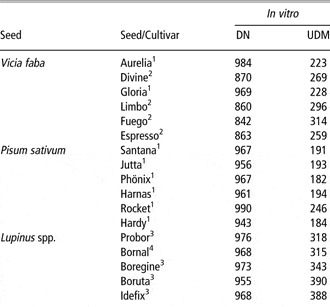
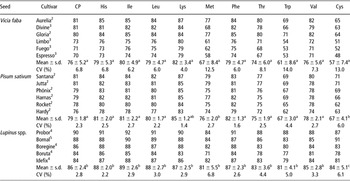
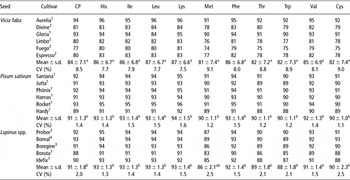
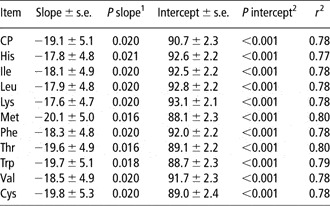
The analysed values for in vitro digestibilities of nitrogen and in vitro undigested DM are shown in Table 2. The in vivo SID of CP and AA in the grain legumes, as determined in a previous study with growing pigs, are summarised in Table 3 (Jezierny, Reference Jezierny2009), whereas the corresponding in vitro predicted SID values for CP and AA are shown in Table 4. In vitro predicted SID of CP in faba bean, field pea and lupin cultivars averaged 84%, 91% and 91%, respectively. The corresponding mean values for in vitro predicted SID of AA ranged from 81% (Met) to 87% (Lys, Leu), and from 90% (Met, Cys, Thr, Trp) to 94% (Lys), and from 86% (Met) to 93% (Lys, Ile, Leu, His) in faba bean, field pea and lupin cultivars, respectively. The largest variations in the in vitro predicted SID values were observed in faba bean cultivars (CV = 7.5% for Lys to CV = 9.1% for Met), followed by lupins (CV = 1.3% for His to CV = 2.5% for Met and Cys), whereas the smallest variations were obtained in field peas (CV = 1.1% for Cys to CV = 1.6% for Lys). The in vivo SID values for CP and AA were in general agreement with the tabulated values published by Degussa (2006) or AmiPig (2000). Similar to the in vitro predicted SID, the largest variations in the in vivo SID values for CP and AA were observed in faba bean cultivars (CV = 4.0% for Lys to CV = 14.0% for Trp), whereas the variations were rather low in field pea (CV = 1.4% for Lys to CV = 6.0% for Cys) and lupin cultivars (CV = 2.2% for His to CV = 6.8% for Met). In agreement with the in vivo SID values (Jezierny, Reference Jezierny2009), the in vitro predicted SID values in the white-flowered faba bean cultivars, Aurelia and Gloria, were higher compared with the coloured-flowered cultivars Divine, Fuego, Limbo and Espresso. The large variations in the in vivo SID values in faba beans resulted from a linear decrease in the in vivo SID as the contents of condensed tannins increased (Jezierny, Reference Jezierny2009). Similarly, the in vitro predicted SID values decreased linearly (P < 0.05) as the contents of condensed tannins in the faba bean cultivars increased (r 2 = 0.77 for His to r 2 = 0.80 for Met and Thr) (Table 5). In agreement with this observation, Smulikowska et al. (Reference Smulikowska, Pastuszewska, Święch, Ochtabińska, Mieczkowska, Nguyen and Buraczewska2001) reported a detrimental effect of increasing levels of condensed tannins on CP digestibility in field peas under in vitro conditions. Condensed tannins are known to exert negative effects on protein digestibility, such as they may form complexes with both dietary proteins and digestive enzymes (Jansman, Reference Jansman1993), which in turn may inhibit the activity of proteolytic enzymes and/or increase the secretion of endogenous proteins (Marquardt, Reference Marquardt1989).
In vitro enzyme DN (g/kg of DM) and in vitro enzyme undigested dry matter (UDM, g/kg of DM) in grain legumes

DN = digested nitrogen; DM = dry matter; UDM = undigested dry matter.
1White-flowered cultivar.
2Coloured-flowered cultivar.
3L. angustifolius.
4L. luteus.
In vivo standardised ileal digestibilities of CP and amino acids in grain legumes (%)Footnote 1

1 Jezierny (Reference Jezierny2009).
2 White-flowered cultivar.
3 Coloured-flowered cultivar.
4 L. angustifolius.
5 L. luteus.
a,b,c Within a same column means with a common superscript are not significantly different (α = 0.05).
In vitro predicted standardised ileal digestibilities of CP and amino acids in grain legumes (%)

1White-flowered cultivar.
2Coloured-flowered cultivar.
3L. angustifolius.
4L. luteus.
a,bWithin a same column means with a common superscript are not significantly different (α = 0.05).
The estimates of the linear regression analysis between in vitro predicted standardised ileal digestibilities of CP and amino acids and contents of condensed tannins in faba beans

1The P-values of the estimates for the slopes of the regression equations.
2The P-values of the estimates of the intercepts of the regression equations.
In vitro predicted SID values, however, do not provide direct estimates of in vivo SID of CP and AA in the assayed grain legumes. In fact, in vitro predicted SID values were higher than the measured in vivo SID values, which was also reported by Cone and van der Poel (Reference Cone and van der Poel1993) for AID values. In vitro methods not only lack interactions with the digestive tract of the animal such as absorption of nutrients, secretion of endogenous compounds into the gut lumen but also digesta transit and microbial activity (Cone and van der Poel, Reference Cone and van der Poel1993; Moughan, Reference Moughan1999). Thus, several methodological factors may interfere with the prediction of digestibility values based on in vitro measurements as was reviewed by Moughan (Reference Moughan1999). For example, most of the differences between in vivo SID and in vitro predicted SID values may result from the presence of ANF. Trypsin inhibitors, for example, may increase endogenous CP and AA losses and depress nutrient digestibility in vivo, but have much smaller effects on in vitro digestibility (Boisen and Eggum, Reference Boisen and Eggum1991; Cone and van der Poel, Reference Cone and van der Poel1993). Trypsin inhibitors act by inhibiting the proteolytic pancreatic enzymes, trypsin and chymotrypsin, by forming stable inactive complexes in vivo (Lallès and Jansman, Reference Lallès and Jansman1998) whereas in vitro predicted SID values in raw soybean were not affected by the presence of trypsin inhibitors (Święch et al., Reference Święch, Buraczewska and Taciak2004). Under in vitro conditions, a surplus of digestive enzymes may alleviate the negative effects of trypsin inhibitors (Boisen and Eggum, Reference Boisen and Eggum1991; Cone and van der Poel, Reference Cone and van der Poel1993). However, in this study, the differences between in vivo SID and in vitro predicted SID values in faba bean, as well as in field pea or lupin cultivars cannot be exclusively attributed to differences in the level of ANF. Furthermore, some of the differences between in vivo SID and in vitro predicted SID values may result from the presence of microbial enzymes in the small intestine, thereby affecting ileal digestibility of organic matter, but these are not present in the in vitro assays (Moughan, Reference Moughan1999). Moreover, part of the feed proteins may be digested in the small intestine without being absorbed due to various physical conditions, such as viscosity and osmolarity of digesta (Moughan, Reference Moughan1999). In vivo, this digested, but not absorbed, nitrogen fraction is recognised as undigested protein, whereas in vitro all solubilised nitrogen appears as being digested (Cone and van der Poel, Reference Cone and van der Poel1993).
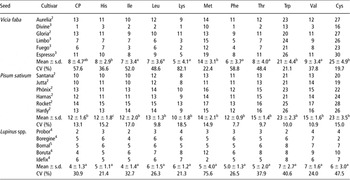
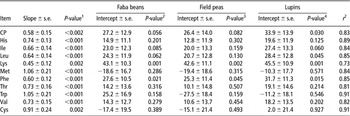
In this study, simple linear regression analyses showed poor linear relationships between in vivo SID and in vitro predicted SID values for the 17 feed ingredients assayed (r 2 = 0.39 for Thr to r 2 = 0.60 for His, data not shown). Therefore, the homogeneity of the slopes and the intercepts between faba bean, field pea and lupin cultivars in the linear regression model between in vivo SID and in vitro predicted SID values was tested. The slopes of the linear relationship between in vivo SID and in vitro predicted SID did not differ between faba beans, field peas and lupins (P > 0.05), whereas the corresponding intercepts differed (P < 0.05). Different intercepts for each grain legume species can be attributed to dissimilar differences (P < 0.05) between in vitro predicted SID and in vivo SID of CP and AA and, in addition, to different coefficients of variation between grain legume species (Table 6). For example, the differences between in vitro predicted SID and in vivo SID of CP averaged 12, 8 and 4 percentage units for field pea, faba bean and lupin cultivars, respectively. The differences between in vitro predicted SID and in vivo SID of CP in field peas ranged from 10 to 14 percentage units, corresponding to a CV of 13%. In faba bean cultivars, in contrast to field pea cultivars, the differences between in vitro predicted SID and in vivo SID of CP varied greatly and ranged from 1 to 13 percentage units, corresponding to a CV of 58%. In lupin cultivars the differences between in vitro predicted SID and in vivo SID of CP ranged only from 2 to 6 percentage units. However, as differences between in vitro predicted SID and in vivo SID of CP and AA were rather small, a CV of 31% was calculated. Thus, even small variations in absolute differences between in vitro predicted SID and in vivo SID of CP and AA resulted in high CV values. To account for the different intercepts and CV values between grain legume species, multiple linear regression analysis between in vivo SID and in vitro predicted SID values, which included grain legume species as a covariate, was conducted. As a result, there were strong linear relationships (P < 0.05) between in vivo SID and in vitro predicted SID values (Table 7). The coefficient of linear determination for CP was 0.83 and coefficients of linear determination for AA ranged from 0.73 for Lys to 0.91 for Cys and Trp. The relationships between in vivo SID and in vitro predicted SID values were closer for Cys (r 2 = 0.91), Trp (r 2 = 0.91) and His (r 2 = 0.89), than for Phe (r 2 = 0.85), Leu (r 2 = 0.85), Met (r 2 = 0.84), Trp (r 2 = 0.84), Val (r 2 = 0.82), Thr (r 2 = 0.81) and Lys (r 2 = 0.73). The inclusion of grain legume species as a covariate accounts for the significant effect of legume species on the differences between in vitro predicted SID and in vivo SID values and the different CV values between legume species.
DifferencesFootnote 1 between in vitro predicted and in vivo SID of CP and amino acids in grain legumes (percentage units)

SID = standardised ileal digestibilities.
1 in vitro predicted SID values – in vivo SID values.
2 White-flowered cultivar.
3 Coloured-flowered cultivar.
4 L. angustifolius.
5 L. luteus.
a,b,c Within a same column means with a common superscript are not significantly different (α = 0.05).
Multiple linear regression analyses between in vivo SID of CP and amino acids and in vitro predicted SID of CP and amino acids in grain legumes

SID = standardised ileal digestibilities.
1The P-values of the estimates for the slopes of the regression equations.
2The P-values of the estimates for the intercepts of the regression equations for faba beans.
3The P-values of the estimates for the intercepts of the regression equations for field peas.
4The P-values of the estimates for the intercepts of the regression equations for lupins.
In conclusion, this study reveals close linear relationships between in vivo SID and in vitro predicted SID values for CP and AA in different cultivars of faba beans, field peas and lupins. However, differences between in vitro predicted SID and in vivo SID values varied between and within grain legume species, probably due to the ANF contents in grain legumes, which are known to depress nutrient digestibility in vivo but have much smaller effects on in vitro digestibility. There exist, however, up to now, only few studies directed to in vitro prediction of SID values in feed ingredients used in the diet formulation for pigs. As a consequence, further application of the in vitro procedure, as originally proposed by Boisen and Fernández (Reference Boisen and Fernández1995) and Boisen (Reference Boisen2007), warrants combined in vitro and in vivo studies to further validate this method for in vitro prediction of SID of CP and AA in feed ingredients and diets used in pig nutrition.
Acknowledgements
This project was financially supported by UFOP (Union zur Förderung von Oel- und Proteinpflanzen e.V., Berlin, Germany). The provision of a scholarship for D. Jezierny, provided by the H. W. Schaumann Stiftung (Hamburg, Germany), is gratefully acknowledged. The authors are grateful to Agri Obtentions (Guyancourt, France), Lochow-Petkus GmbH (Bergen, Germany), Norddeutsche Pflanzenzucht Lembke KG (Holtsee, Germany), Saatzucht Gleisdorf (Gleisdorf, Austria), Saatzucht Steinach GmbH (Bocksee, Germany) and Südwestsaat GbR (Rastatt, Germany) for providing the legume seeds. Evonik-Degussa GmbH (Hanau-Wolfgang, Germany) is gratefully acknowledged for conducting amino acids analyses. A special thank goes to S. Boisen, for introduction in the in vitro procedures established at the Agricultural Science Research Centre Foulum (Tjele, Denmark).