1. The counterfactual imagination
In 1958 Martin Luther King, Jr. was stabbed and almost died. A decade later he remarked:
The tip of the blade was on the edge of my aorta … It came out in the New York Times the next morning that if I had sneezed I would have died … And I want to say tonight, I want to say that I'm happy I didn't sneeze. Because if I had sneezed, I wouldn't have been around here in 1960 when students from all over the South started sitting-in at lunch counters … If I had sneezed I wouldn't have had the chance later that year in August to try to tell America about a dream that I had had … I'm so happy that I didn't sneeze. (King Reference King1968)
In The Rational Imagination: How People Create Alternatives to Reality (Byrne Reference Byrne2005), I offer an explanation for how the mind creates such “if only …” thoughts. Thoughts about what might have been can seem irresistible in daily life. They emerge at a very young age and they seem to exist in most cultures. I suggest that their explanation relies on the idea that imaginative thought and rational thought share a lot in common.
There are surprising similarities in what everyone imagines. Some aspects of reality that people mentally represent seem to be “mutable,” that is, they are readily “undone” in a mental simulation (Kahneman & Miller Reference Kahneman and Miller1986). The remarkable regularities in what most people change suggest that there are “fault-lines” in reality (Kahneman & Tversky Reference Kahneman, Tversky, Kahneman, Slovic and Tversky1982). Consider a scenario in which an individual, Paul, dies in a car accident on his way home from work. He left work at his regular time, although sometimes he would leave early to take care of chores. He did not drive home by his regular route, but instead drove along the shore to enjoy the view. The accident occurred when a truck charged through an intersection. Paul's family often said “if only …” during the days that followed the accident. How do you think they continued this sentence? Most participants who were told that Paul did not drive home by his regular route tended to think his family would say “if only Paul had driven home by his regular route” (Kahneman & Tversky Reference Kahneman, Tversky, Kahneman, Slovic and Tversky1982). Other participants who were told that Paul had driven home by his regular route but had left the office earlier than usual tended to complete the sentence by saying “if only Paul had left at his regular time.” Thoughts about what might have been also seem to amplify certain emotions, such as regret, guilt, shame, relief, hope, and anticipation. The emotion seems to depend on a comparison between how the event actually turned out and how it could have or should have turned out differently. The same is true for social attributions of culpability such as blame, responsibility, and fault (Mandel Reference Mandel2003a; Roese & Olson Reference Roese and Olson1995).
Why do people imagine alternatives to some aspects of reality more readily than to other ones? This question is the key to understanding how the counterfactual imagination works. My aim in The Rational Imagination is to answer it. I focus on the perceived fault-lines in reality, which may correspond to core categories of mental life, such as space, time, cause, and intention (Byrne Reference Byrne and Medin1997; Miller & Johnson-Laird Reference Miller and Johnson-Laird1976). For example, people tend to imagine alternatives to actions more than they do to inactions (Kahneman & Tversky Reference Kahneman, Tversky, Kahneman, Slovic and Tversky1982). They tend to imagine alternatives to events that are within their control more than to those outside their control (Girotto et al. Reference Girotto, Legrenzi and Rizzo1991). Their thoughts about how an event might have turned out differently lead them to judge that a strong causal relation exists between an antecedent and the outcome (Wells & Gavanski Reference Wells and Gavanski1989). And their thoughts about how an event might have turned out the same lead them to judge that a weak causal relation exists between the antecedent and the outcome (Boninger et al. Reference Boninger, Gleicher and Strathman1994). In a simple, non-causal temporal sequence, their thoughts about how events could have turned out differently focus on the most recent event rather than on earlier ones (Miller & Gunasegaram Reference Miller and Gunasegaram1990).
We gain an important glimpse of the counterfactual imagination when we look at the things that people focus on when they create alternatives to reality. Most people focus on the perceived fault-lines of reality and in Chapter 1 of the book I sketch these fault-lines. We gain an equally important glimpse when we look at the things that people do not focus on and I also sketch these characteristics in Chapter 1. People do not tend to create “miracle-world” counterfactuals, such as, for example, “if the Romans had had machine guns …” (McMullen & Markman Reference McMullen and Markman2002). They do not mentally alter natural laws; for example, “she would not have fallen if there had not been gravity” (Seeleu et al. Reference Seeleu, Seeleu, Wells, Windschitl, Roese and Olson Erlbaum1995). They do not tend to focus on impossibilities; for example, “if Kangaroos had no tails they would topple over” (Lewis Reference Lewis1973). They do not tend to imagine “remote” counterfactual alternatives; instead, they focus on counterfactuals that are close to the current facts, such as a runner who just misses first place in a race. They judge “close counterfactuals” to be plausible (Tetlock & Parker Reference Tetlock, Parker, Tetlock, Lebow and Parker2005). People also tend to judge a counterfactual to be plausible when it is consistent with their beliefs. Consider the assertion: ‘“If Kennedy had listened to his Hawk advisers, he would have engaged in a nuclear strike during the Cuban missile crisis.” Experts who believe that nuclear weapons could be deployed judge the assertion to be more plausible than experts who believe they would never be used (Tetlock & Lebow Reference Tetlock and Lebow2001). Most people tend to imagine plausible counterfactual alternatives.
Most people do not imagine how the world might be different after every event: they tend to think “if only” after something bad happens (Roese Reference Roese1997). People can think about how things might have been better or worse. For example, after an argument with a friend they can think about a better outcome – “if I had not said such harsh things, we would still be friends” – which might help them to learn from their mistakes and prepare for the future (Roese Reference Roese1994). But such thoughts can make them feel bad, so, instead, they may think about a worse outcome – “if I had told her how I felt, she would never have forgiven me” or “at least I did not say anything cruel” – which may help them to feel good (McMullen & Markman Reference McMullen and Markman2000). However, these kinds of thoughts can encourage complacency. People can also think about how things might have turned out exactly the same: for example, “even if I had apologised to her, she would not have forgiven me.” In other words, they can exert some control over whether they imagine alternatives that are better, worse, or the same. Their choice may depend on their motivation – for example, to console a victim (Seeleu et al. Reference Seeleu, Seeleu, Wells, Windschitl, Roese and Olson Erlbaum1995) – or on their goals (Roese et al. Reference Roese, Sanna, Galinsky, Hassin, Uleman and Bargh2005).
Counterfactual thoughts are central to everyday mental life. But some people can become plagued by thoughts about what might have been. Individuals who have experienced the grief of the death of a spouse or child are sometimes haunted by thoughts of how they could have prevented the death, for example, “if only I had checked on him more often during the night.” Of course, everyone thinks about what might have been after a traumatic life event. But those people who continue to think about what might have been experience greater distress (Davis et al. Reference Davis, Lehman, Wortman, Silver and Thompson1995). Counterfactual thoughts may be implicated in clinical disorders such as depression and anxiety (Roese & Olson Reference Roese and Olson1995). An understanding of how people imagine alternatives to reality may advance ways to help people for whom the counterfactual imagination has become dysfunctional.
The book is organised around the fault-lines of reality; each chapter examines one of them. I start by sketching the characteristics of the counterfactual imagination in Chapter 1 and then I examine its relation to rational thought in Chapter 2. In Chapter 3, I offer an explanation of the tendency to think “if only” about actions more than inactions, and in Chapter 4 I discuss the way the counterfactual imagination deals with forbidden actions. Chapter 5 addresses the relation of “if only” thoughts to causal thoughts and Chapter 6 examines the other side of the causal coin, “even if” thoughts. Chapter 7 deals with the tendency to imagine alternatives to the most recent event in a temporal sequence. In Chapter 8, I sketch two implications of this view of the counterfactual imagination: one implication for the nature of individual differences, and the other for understanding creative thought in general. The final chapter, Chapter 9, considers the consequences of the idea of a rational imagination.
2. Imagination and rational thought
In the past, rationality and imagination have been viewed as opposites, sharing little in common. Logical thought and creativity have even been considered to be mutually exclusive. Contrary to this viewpoint, the argument I make throughout The Rational Imagination is that rationality and imagination share a lot in common. In Chapter 2, I focus on one view of the nature of human rationality – that people envisage certain kinds of possibilities – and I sketch some of the principles that guide the possibilities that people think about when they make inferences. Later in the book I show how the same principles, and corollaries to them, explain how people create counterfactual alternatives to reality.
People try to think rationally in many situations. For example, you try to reach a rational conclusion when you estimate the likelihood that the next flight you take will be hijacked, or when you work out the risk that you may have contracted new variant Creutzfeldt-Jakob disease (CJD) from your exposures to meat infected by bovine spongiform encephalopathy (BSE). The idea that people are capable of rational thought has been debated (Gigerenzer & Selten Reference Gigerenzer and Selten2001; Stanovich Reference Stanovich1999).
Clearly, people can engage in hypothetical thought and it is an impressive achievement of human cognition. But most people make mistakes. Their mistakes have led some theorists to suggest that people do not have a general capacity for rational thought. Human reasoning may be based on an assortment of biases, rules of thumb, or “heuristics” (Evans Reference Evans1989). Or it may depend on a fixed set of rules that govern a specific domain (Fiddick et al. Reference Fiddick, Cosmides and Tooby2000; Holyoak & Cheng Reference Holyoak and Cheng1995). Some theorists have suggested that people do have a general capacity for rational thought. Reasoning may depend on a “mental logic” of inference rules (Braine & O'Brien Reference Braine and O'Brien1998; Rips Reference Rips1994). Or it may depend on a simple semantic principle: An inference is valid if there are no counterexamples to it (Johnson-Laird & Byrne Reference Johnson-Laird and Byrne1991). The formulation of a theory based on this last view has shed light on the imagination, and I outline it further in the next section.
2.1. Rational thought
Hypothetical thought has been studied in many guises and one good illustration is conditional reasoning. Conditionals such as “if Alicia went to the stables then she rode Starlight” have been considered to be the key to how people make suppositions and conjecture relationships between events (Johnson-Laird & Byrne Reference Johnson-Laird and Byrne1991). One view is that the human ability to think rationally about hypothetical situations and conditional relations rests on the capacity to imagine possibilities (Johnson-Laird Reference Johnson-Laird1983). There are several principles that guide the possibilities that people consider when they understand a conditional (Johnson-Laird & Byrne Reference Johnson-Laird and Byrne2002). The first principle is that people tend to think about true possibilities, such as “Alicia went to the stables and she rode Starlight,” but they do not think about false possibilities, such as “Alicia went to the stables and she did not ride Starlight.” The second principle is that initially people think about just a few of the possibilities. There are several possibilities that are consistent with the conditional, such as “Alicia did not go to the stables and she did not ride Starlight” and “Alicia did not go to the stables and she rode Starlight” (perhaps because the pony was in a nearby field). But usually people mentally represent the conditional by thinking about just a single true possibility. Multiple possibilities tend to exceed working memory capacity. Of course, knowledge can help people to think about more possibilities, it can help them to enrich those possibilities, and it can also eliminate possibilities (Johnson-Laird & Byrne Reference Johnson-Laird and Byrne2002).
People can readily make some inferences based on the possibilities they have kept in mind, but they find other inferences more difficult to make. Suppose you know “if Mark left at 9 a.m. then he caught the airplane” and you are told, “Mark left at 9 a.m.” What, if anything, do you think follows from these premises? Most people find it easy to make the modus ponens inference, “he caught the airplane.” They have understood the conditional by envisaging the single true possibility, “Mark left at 9 a.m. and he caught the airplane.” Now suppose you are told “Mark did not catch the airplane.” What, if anything, follows from this premise and the conditional? Many people say nothing follows. They have difficulty making the inference to the conclusion, “he did not leave at 9 a.m.” To make this modus tollens inference, they need to remember that there are alternative possibilities and they must think through what they are. As a result, most people find the modus ponens inference easier than the modus tollens one. On this account, people make mistakes, and can appear irrational because of the limits to the possibilities they can consider (Johnson-Laird & Byrne Reference Johnson-Laird and Byrne1991). But they are rational, at least in principle, because they possess an underlying competence to think of all the relevant possibilities so that they can search for counterexamples.
2.2. Rational thought and imaginative thought
My claim in the book is that the principles for rational thought also guide imaginative thought. I suggest that a bridge from rationality to imagination can be built on counterfactual conditionals. Conditionals yield a good example of deductive rationality; counterfactual thoughts are a good example of everyday imagination. Counterfactual conditionals combine both rational and imaginative elements. Counterfactuals are special. Consider a counterfactual conditional in the subjunctive mood, “if Oswald had not killed Kennedy then someone else would have.” It seems to mean something very different from a factual conditional in the indicative mood, “if Oswald did not kill Kennedy then someone else did” (Lewis Reference Lewis1973). Attempts to understand counterfactuals have led to important developments in linguistics (Athanasiadou & Dirven Reference Athanasiadou and Dirven1997), artificial intelligence (Ginsberg Reference Ginsberg1986), and philosophy (Lewis Reference Lewis1973). A counterfactual such as “if only he had been handsome, I would have married him” evokes two possibilities: an imagined possibility in which the man is handsome and the speaker marries him, and a reality in which the man was not and she did not. The way that people interpret such assertions goes beyond the simple truth of their components (Quine Reference Quine1972). A counterfactual seems to presuppose that its antecedent is false, and so, according to a simple truth functional account, every counterfactual must be true. But people judge some counterfactuals to be plausible and others to be implausible. Philosophers have suggested instead that the truth of a counterfactual may depend on its truth in a “possible world” (Stalnaker Reference Stalnaker and Rescher1968).
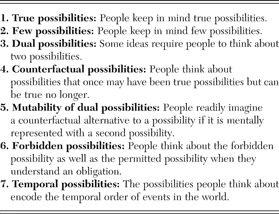
The critical psychological difference between factual and counterfactual conditionals may lie in the possibilities that people think about. Consider the conditional, “if Iraq had weapons of mass destruction then the war was justified.” It is consistent with several possibilities: Iraq had weapons of mass destruction and the war was justified; Iraq did not have weapons of mass destruction and the war was not justified; and Iraq did not have weapons of mass destruction and the war was justified (for other reasons). Most people mentally represent the factual conditional initially by thinking about just the single possibility that Iraq had weapons of mass destruction and the war was justified. Now consider the counterfactual conditional, “if Iraq had had weapons of mass destruction then the war would have been justified.” It is consistent with essentially the same possibilities as the factual conditional. You might have understood the counterfactual by thinking about the conjecture, Iraq had weapons of mass destruction and the war was justified. But, you might also have thought about the facts that the speaker uttering the counterfactual is likely to have presupposed, that Iraq did not have weapons of mass destruction and the war was not justified. In other words, you might have thought about more than one possibility when you understood the counterfactual. The factual and counterfactual conditionals are consistent with essentially the same possibilities but a key difference between them is that people think about different possibilities when they understand them. The difference between factual and counterfactual conditionals illustrates a third principle underlying the possibilities that people think about: some ideas require people to think about dual possibilities, as Table 1 shows.
Summary of principles that guide the possibilities that people envisage

Of course another critical difference between factual and counterfactual conditionals is that the possibilities correspond to the putative facts for the factual conditional, whereas they correspond not only to putative facts but also to counterfactual possibilities for the counterfactual conditional. People keep track of the status of different possibilities. They think about two possibilities when they understand a counterfactual conditional, and they note one as the “facts” and the other as “imagined” possibilities (Johnson-Laird & Byrne Reference Johnson-Laird and Byrne2002). A fourth principle is that even though people tend to keep in mind just true possibilities, they can think about what might have been because they can envisage possibilities that once were true but are so no longer. Often in everyday thoughts, people temporarily suppose something to be true even when they know it is false. They keep track of what is actually true and what is imagined. They can think about entirely imaginary situations, for example, to understand and create fantasy and fiction, in daydreams as well as in theatre, film, and literature. They can think about what is true in these imagined situations and what is false in them.
People tend to think about two possibilities for some ideas and this factor has significant consequences for how they imagine what might have been. It helps to explain why people mentally change only some aspects of their mental representation of reality. A basic principle of mutability is that an event can be readily changed if it brings to mind an alternative. For example, suppose you go to a concert and you sit in seat 426. You change seats after a while to seat 739 to get a better view. At the interval, an announcement is made that there is a prize of a trip around the world for the person seated in seat 426 (Johnson Reference Johnson1986). You may wish you had not changed seats. The prize seems to have been almost in your grasp. But suppose instead you had gone to the concert and you sat in seat 739 from the outset. At the interval, an announcement is made that there is a prize of a trip around the world for the person seated in seat 426. You may wish you had won, but you are unlikely to believe that the prize was almost in your grasp. In the first scenario, there is a ready-made alternative and people are influenced by the availability of alternatives. They may base their judgments on the ease with which instances can be brought to mind (Kahneman & Tversky Reference Kahneman, Tversky, Kahneman, Slovic and Tversky1982). The fifth principle is that people readily imagine a counterfactual alternative to a possibility if it is mentally represented from the outset with a second possibility. The possibility can be mutated easily; for example, it can be deleted from the mental representation and replaced with the second possibility as its counterfactual alternative.
The principles that guide the possibilities that people envisage when they reason help to explain how people imagine alternatives to reality. In Chapters 3 to 7 of The Rational Imagination I show how the application of these principles explains the regularities people exhibit in their imagination of counterfactual alternatives. I begin in Chapter 3 by showing how these principles explain why most people imagine counterfactual alternatives to an action more than to a failure to act in many situations.
3. Imagining how actions might have been different
Suppose you hear about a new disease, such as Severe Acute Respiratory Syndrome (SARS). It can be fatal and you suspect you could be exposed to it. But the vaccine can also have serious consequences. What will you decide to do? The decision is a difficult one. Many people choose to do nothing, even when the chances of death from a vaccine are less than death from a disease (Ritov & Baron Reference Ritov and Baron1990). Take a moment to imagine the families of the victims. Which families do you think are more likely to say, “if only …” – the families of individuals who died from the disease, or of individuals who died from the vaccine? Most people think the families who will feel worse are the families of the individuals who died from the vaccine. The example illustrates that thoughts about what might have been often fall towards one side of the perceived fault-line between action and inaction. In Chapter 3, I first sketch some characteristics of the tendency shown by most people to focus on actions rather than failures to act when they imagine counterfactual alternatives to reality. Next, I outline some clues from reasoning that help identify why this perceived fault-line is observed. The clues come from studies of how people reason about counterfactual conditionals. Then, I show how these clues help to explain the tendency people have to focus on actions. I also explain an important exception to this tendency: situations in which people sometimes focus on failures to act.
People tend to regret actions that lead to a bad outcome more than inactions that lead to a bad outcome (Kahneman & Tversky Reference Kahneman, Tversky, Kahneman, Slovic and Tversky1982). Most people also judge that individuals feel better about their actions than their inactions when the outcome is good (Landman Reference Landman1987). The tendency to focus on actions occurs in many everyday situations (Catellani & Milesi Reference Catellani and Milesi2001; Zeelenberg et al. Reference Zeelenberg, Van der Pligt and Manstead1998a). To delete an action from a mental representation may require less mental effort than to add one (Dunning & Parpal Reference Dunning and Parpal1989). Actions seem to be mentally “re-wound” in reminiscences and re-played differently (Hofstadter Reference Hofstadter1985). Of course, failures to act can be real causes of outcomes (Hart & Honore Reference Hart and Honore1959). For example, the Herald of Free Enterprise passenger car ferry capsized off the Belgian port of Zeebrugge en route to the English port of Dover in 1987, ending on her side half submerged in shallow water. One hundred and eighty-eight people were killed; the worst death toll for a British ship in peacetime since the sinking of the Titanic in 1912. The cause of the tragedy was the failure of staff to close the bow doors (through which cars drove on to the ferry). However, in many circumstances people may tend not to view omission as a real cause (Ritov & Baron Reference Ritov and Baron1990). Actions seem to call to mind the alternatives of not acting, or acting differently, whereas inactions do not readily call to mind actions. Why do people focus on actions in their “if only …” thoughts? A clue to the answer comes from the study of counterfactual conditionals.
3.1. Clues from reasoning: Counterfactual conditionals
A key principle is that people think about some ideas by keeping in mind two possibilities. The two possibilities they envisage affect the way people think in many situations; for example, the two possibilities affect the way they reason about counterfactual conditionals. Suppose you are told: “if Mark had left at 9 a.m. then he would have caught the airplane.” You may interpret the subjunctive conditional as a counterfactual and think initially about two possibilities: the conjecture, Mark left at 9 a.m. and he caught the airplane, and the presupposed facts, Mark did not leave at 9 a.m. and he did not catch the airplane. Suppose you then discover that Mark did not catch the airplane. What would you conclude? People are able to infer readily that Mark did not leave at 9 a.m. (Byrne & Tasso Reference Byrne and Tasso1999). The modus tollens inference is difficult to make from a factual conditional “if Mark left at 9 a.m. then he caught the airplane,” because people think about just a single possibility initially: Mark left at 9 a.m. and he caught the airplane. But as the theory predicts, the inference is easier to make from the counterfactual because of the enriched representation.
Suppose you discover that, in fact, Mark left at 9 a.m. What would you conclude from this premise and the counterfactual conditional? People are able to infer readily that Mark caught the airplane. These data for modus tollens and modus ponens support the suggestion that people think about both possibilities: the conjecture, Mark left at 9 a.m. and he caught the airplane, and also the presupposed facts, Mark did not leave at 9 a.m. and he did not catch the airplane. The evidence that people understand counterfactual conditionals by keeping in mind two possibilities provides an important clue to solve the puzzle of why people imagine counterfactual alternatives to their actions more than their inactions.
3.2. The rational imagination: Why people imagine alternatives to actions
People think about two possibilities when they understand an action. When you understand the decision to act you think about the situation before the action and the situation after the action. Consider the scenario in which two individuals, Mary and Laura, consider their stock options. Mary owns shares in company A. During the past year she considered switching to stock in company B, but she decided against it. She now finds out that she would have been better off by $1,000 if she had switched to the stock of company B. Laura owned shares in company B. During the past year she switched to stock in company A. She now finds out that she would have been better off by $1,000 if she had kept her stock in company B (Kahneman & Tversky Reference Kahneman, Tversky, Kahneman, Slovic and Tversky1982). When people think about Laura's action they think about both the pre-action situation, Laura owned shares in company B, and the post-action situation, Laura owns shares in company A:
Laura owned shares in company B (pre-action) Laura owns shares in company A (post-action)
However, when they think about Mary's inaction, they think only about one situation – the shares that she owns in company A:
Mary owns shares in company A (pre-decision and post-decision)
They do not need to think about two possibilities for an inaction – the situation before the decision and the situation after the decision – because these two situations are the same. An important corollary to the principles that guide the possibilities that people think about is that people keep in mind two possibilities when they understand an action. Inactions are mentally represented more economically than actions (Byrne & McEleney Reference Byrne and McEleney2000). This difference may underlie the perception that actions are a departure from the status quo (Kahneman & Miller Reference Kahneman and Miller1986). Because people envisage more information for actions than for inactions, they can mentally change actions more easily than inactions.
Intriguingly, in certain circumstances people imagine a counterfactual alternative to an inaction. People usually think about a single state of affairs when they understand an inaction. But, of course, they can switch from thinking about one possibility to thinking about two possibilities. In The Rational Imagination I consider several ways in which this switch to thinking about two possibilities for an inaction occurs. For example, people think about two possibilities to mentally represent a failure to act when they know that there were good reasons to act (Zeelenberg et al. Reference Zeelenberg, van der Bos, van Dijk and Pieters2002; Zhang et al. Reference Zhang, Bonnefon and Deng2004). They also think about two possibilities when they consider the consequences of a failure to act from a long-term perspective (Gilovich & Medvec Reference Gilovich and Medvec1995). When most people look back over their lives, it is their inactions that they tend to regret, the things they failed to do, such as failing to spend time with family and friends, failing to avail of educational opportunities, or failing to pursue hobbies. I outline in the book how people switch to thinking “if only” about a failure to act from a long-term perspective when they can imagine a better outcome (e.g., if he had switched to a different college, he would have been happy), compared to the outcome they imagine when they think “if only” about an action (e.g., if he had stayed in his original college, he would have remained unhappy) (Byrne & McEleney Reference Byrne and McEleney2000). People can think of the good that may have resulted had more time been spent with family and friends, had educational opportunities been availed of, or had hobbies been pursued. In these situations, if only the person had acted, a better outcome might have occurred than the outcome that did in fact occur. A second corollary to the principles that guide the possibilities that people think about is that people can switch from thinking about one possibility to thinking about two possibilities in some circumstances. The impact of an imagined better outcome is illustrated in the example of Jane who went to a travel agency to look for holidays in the Caribbean. There was a wonderful package deal at a very affordable price. She wondered whether to book it immediately but she decided to think about it overnight. The next day when she returned to the travel agency the holiday had been sold and there were no other deals that looked as attractive. Jane is likely to regret her inaction. If she had acted, she would have been able to go on a fabulous holiday.
People tend to focus on actions when they think about what could have happened. Even more strikingly, they tend to focus on forbidden actions. In Chapter 4 of The Rational Imagination, I offer an account of how people think about what should have happened and what should not have happened.
4. Thinking about what should have happened
When people think about what they could have done differently, they sometimes think about what they should have done differently. Everyday judgments are often based on beliefs about obligations, and about what is permitted and what is forbidden. Should scientists be allowed to clone humans? Are you morally obliged to recycle your office waste-paper? Ought manufacturers to identify products containing genetically modified ingredients? In Chapter 4, I first sketch some characteristics of the tendency shown by most people to focus on forbidden actions. Next, I outline some clues from reasoning that help identify why this perceived fault-line is observed. The clues come from studies of how people reason about obligations. Then, I show how these clues help to explain the tendency people have to focus on forbidden actions, and for obligations to be immutable.
Consider Steven, who was delayed on his way home by a series of events, and arrived too late to save his wife from dying of a heart attack (Girotto et al. Reference Girotto, Legrenzi and Rizzo1991). The events that delayed Steven included a road blocked by a fallen tree, visiting a bar for a drink, and having an asthma attack. What do you think Steven's thoughts about “what might have been” focused on after the death of his wife? When people were asked to complete his “if only …” thoughts, they focused on his decision to stop at a bar for a drink, saying “if only I hadn't stopped for that drink” (Girotto et al. Reference Girotto, Legrenzi and Rizzo1991). Of course, stopping for a drink is the only event in the series that was completely within Steven's control. It is also an event that may be perceived to be socially unacceptable. Drinking in a bar may fit with social norms about how to celebrate with friends, but it seems inappropriate in the context of drinking alone while your spouse is ill at home. Most people focus their thoughts about what-might-have-been on those controllable events that are socially unacceptable, more than on controllable events that are socially acceptable (McCloy & Byrne Reference McCloy and Byrne2000). The contents of thoughts are constrained not only by natural laws, but also by social laws such as social conventions and cultural regulations. Why do people imagine alternatives most readily to socially unacceptable events? An important clue comes from the inferences people make about obligations.
4.1. Clues from reasoning: Inferences about obligations
Knowledge of a regulation – for example, “hard-hats must be worn on the building site” – ensures that most people think about not only what is obligatory, such as wearing a hard hat, but also what is not permissible, such as not wearing a hard hat. A sixth principle about the possibilities that people envisage is that they think about the forbidden possibility as well as the permitted possibility when they understand an obligation. For the obligation, “if Jack's parents are elderly, he should look after them,” people keep in mind two possibilities: (1) Jack's parents are elderly and he looks after them, and (2) Jack's parents are elderly and he does not look after them. They note that the status of this second possibility is that it is forbidden. People usually think about true possibilities. Even when they understand a counterfactual conjecture that contradicts known facts, they may temporarily suppose the conjecture to be true. But obligations are different. Their understanding requires people to think about a forbidden possibility. Obligations are unique in that they require people to consider the possibility that is explicitly ruled out by the conditional. The forbidden possibility influences the inferences they make and the counterfactual alternatives they imagine.
Most people reason well about obligations (Bucciarelli & Johnson-Laird Reference Bucciarelli and Johnson-Laird2005; Cheng & Holyoak Reference Cheng and Holyoak1985; Cosmides Reference Cosmides1989; Sperber et al. Reference Sperber, Cara and Girotto1995). Because people think about the permitted possibility and the forbidden possibility, they can make certain inferences readily. When reasoners are told “if Paul rides a motorbike, he must wear a helmet,” and are also told that “Paul is not wearing a helmet,” they can infer that Paul is not permitted to ride a motorbike. In other words, they readily make the otherwise difficult modus tollens inference from a conditional with obligation content. The ease with which they make the inference highlights an important feature of reasoning. There is more than one way to make an inference. A common route to making the modus tollens inference is by thinking about the true possibilities, as we have seen earlier. But reasoning about obligations illustrates a second route for the inference, by thinking about what is forbidden. For the conditional, “if Paul rides his motorbike, he must wear a helmet,” people think about two possibilities: (1) Paul rides his motorbike and he wears a helmet, and (2) Paul rides his motorbike and he does not wear a helmet (forbidden). When they are told that Paul did not wear a helmet, they can match this information to the forbidden possibility, and infer that it is forbidden for him to ride his motorbike. The theory accurately predicts that people can make more modus tollens inferences from obligation conditionals compared to conditionals with other sorts of content (Quelhas & Byrne Reference Quelhas and Byrne2003).
Counterfactual obligations communicate, through shared knowledge or context, information about what was once obligatory and what was once forbidden; and they also communicate that what was once unacceptable is no longer so. Suppose, for example, that it used to be obligatory to pay a property tax on houses which increased with increasing house size, but that the tax was abolished some years ago. Suppose your friend buys a large house. You might say, “if you had bought that house 10 years ago, you would have had to pay a very large tax bill.” For a counterfactual obligation, people may think about one of the permitted possibilities conjectured by the counterfactual: your friend bought the house 10 years ago and paid a large tax bill. They may also think about the forbidden possibility: your friend bought the house 10 years ago and did not pay a large tax bill. And they may also think about the presupposed facts: your friend did not buy the house 10 years ago and did not pay a large tax bill. These insights from how people reason about obligations and forbidden events help to explain why people are drawn to forbidden events when they imagine counterfactual alternatives.
4.2. The rational imagination: Why people focus on forbidden fruit
When you learn that manufacturers in Europe must identify genetically modified constituents in food, you understand what is forbidden: they are not allowed to conceal genetically modified constituents. When you know that scientists are obliged to restrict cloning attempts to nonhuman species, you understand what is forbidden: they are not allowed to clone humans. A conditional obligation is understood by thinking about one of the permitted possibilities, and also what is forbidden. This ready access to the forbidden possibility has a large impact on how people imagine events turning out differently.
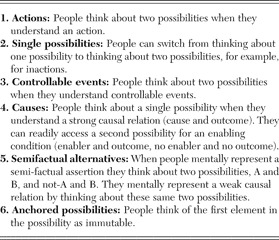
People keep in mind both the permitted possibility and the forbidden possibility, and so they can readily imagine a counterfactual alternative to the forbidden possibility. Steven, who did not return home in time to save his wife, is judged to say “if only …” most often about his decision to visit a bar for a drink. A third corollary to the principles that guide the possibilities that people think about is that they envisage two possibilities when they understand controllable events, as Table 2 shows. People imagine alternatives to socially unacceptable actions, such as stopping at a bar for a beer in the context of an ill spouse waiting at home, because they think about two possibilities – stopping for a beer and not stopping for a beer – and they note that one of the possibilities is unacceptable (stopping for a beer), and the other is acceptable (not stopping for a beer). They imagine an alternative by mentally changing the unacceptable possibility and they say, “if only Steven had not stopped for a beer …” The unacceptable possibility brings to mind its acceptable counterpart, just as an event that is exceptional for an individual brings to mind its normal counterpart (Kahneman & Miller Reference Kahneman and Miller1986).
Summary of some corollaries to the principles that guide the possibilities that people think about when they imagine counterfactual alternatives

If you do what you should do socially, people do not tend to wish you had not done it. Consider a situation in which a friend of yours, Bernard, is disappointed: he had an important performance at a concert in front of thousands of people and it was not well received. You know he stayed out late at a pre-concert party the night before, something he rarely does. He tells you he went to the party because he wanted to meet one of his orchestral heroes. You may believe that his poor performance was his own fault and he should not have gone to the party (Klauer et al. Reference Klauer, Jacobsen and Migulla1995). But suppose, instead, your friend tells you he went to the party because it was a fund-raiser for his orchestra. You understand his obligation by keeping in mind two possibilities: “he went to the party” is acceptable in this case, and “he did not go to the party” is unacceptable. Would you think he should not have gone to the party? Would you think his poor performance was his own fault? When participants described Bernard's thoughts, they generated reliably fewer “if only …” sentence completions that focused on the party when they were told he was obliged to go to it, compared to when they were not given a reason (Walsh & Byrne 2007).
Some theorists believe that the ease with which people reason about certain permissions or obligations shows that the mind evolved to store knowledge about social regulations in specialised modules (Cosmides Reference Cosmides1989). The modules contain rules that are specific to reasoning about certain content, such as the domains of obligation and permission (Cheng & Holyoak Reference Cheng and Holyoak1985), and they are operated on by specialised procedures (Gigerenzer & Hug Reference Gigerenzer and Hug1992). An alternative view is that people reason about permissions and obligations rather than give fixed responses to them (Sperber & Girotto Reference Sperber, Girotto, Fitness and Sterelny2003). Their reasoning depends on their ability to think about permitted possibilities and especially about possibilities that are forbidden. Human beings evolved but it is not known yet which aspects of the brain resulted from selective pressures. In Chapter 4, I suggest that what evolved is the ability to understand obligations by thinking about not only the permitted possibility but also the forbidden possibility.
People tend to focus on controllable actions, especially controllable actions that are socially unacceptable. But intriguingly, people often imagine a counterfactual alternative to a controllable event even when the controllable event was not the cause of the outcome. In Chapter 5 of The Rational Imagination I explore the vagaries in the relationship between causal and counterfactual thoughts.
5. Causal relations and counterfactuals
In the days that followed the September 11th, 2001 attacks on the World Trade Center in New York, many media reports focused on the failure of the airport security personnel to detect passengers who carried weapons on board the aircraft. The implication of the reports was that the baggage handlers' failure allowed the attack to occur. But why was media focus drawn to this factor? Presumably no one believed that the baggage handlers caused the attack. And media attention could have focused on other plausible causes, such as, “if only the Al-Qaeda network did not exist…” and many other antecedent events, for example, “if only the hijackers had been over-powered on board… .” The focus on the baggage handlers illustrates a curious feature of counterfactual thoughts: Their relation to causal thoughts is not straightforward. In Chapter 5 of The Rational Imagination I propose that counterfactual and causal thoughts sometimes focus on different events because people can distinguish strong causes from enabling conditions. Their causal thoughts tend to focus on strong causes; their counterfactual thoughts tend to focus on enabling conditions. If the enabling condition had not occurred the outcome would not have occurred.
Consider, as an example, that you were seriously injured in a car crash that happened on a route you do not usually take home, and that occurred when a careless driver crashed into you. What would you tend to say “if only …” about most often: “if only I'd gone home by my usual route” or “if only the other driver had been more careful?” Most people say “if only I had gone home by my usual route,” even though they identify the other driver as the cause of the accident (Mandel & Lehman Reference Mandel and Lehman1996). This tendency has been verified in naturalistic studies of individuals who have sustained severe injuries, such as paralysis, as a result of a traumatic accident. They tend spontaneously to imagine counterfactual alternatives that depend on how they could have prevented their accident, without believing that they caused it (Davis et al. Reference Davis, Lehman, Silver, Wortman and Ellard1996). In considering causal and counterfactual thoughts, Chapter 5 follows the by-now familiar structure: First, I sketch some characteristics of the relation between counterfactual and causal thoughts. Next, I garner some clues from reasoning that help to clarify the relationship. The clues come from studies of how people reason about different causes in particular strong causes and enablers. Then, I show how these clues help to explain the tendency people have to focus on enabling conditions when they imagine a counterfactual alternative to reality.
5.1. The causal chicken and the counterfactual egg
Causal thoughts can influence the counterfactual alternatives that people imagine. Causal knowledge affects judgments about the plausibility of a counterfactual speculation. Experts committed to a causal law perceive less “wiggle room for re-writing history” (Tetlock & Lebow Reference Tetlock and Lebow2001, p. 838). And the relation is reciprocal: People sometimes imagine counterfactual alternatives to help them to work out causal relations. Consider for example, what caused the rise of the West? If Islamic armies had conquered France and Italy in the 8th century, would later European development have been side-tracked? Such counterfactual thoughts are an essential ingredient in historical reasoning, even if they are considered controversial (Tetlock & Lebow Reference Tetlock and Lebow2001).
The counterfactual thought that if an antecedent had not happened, then the outcome would not have happened, increases the judgment that the antecedent has a causal relation to the outcome. Consider a taxi driver who refused to give a couple a lift and the couple were subsequently killed in an accident in their own car as they drove across a bridge that collapsed (Wells & Gavanski Reference Wells and Gavanski1989). Most people judge the driver's decision not to give the couple a lift to have had some causal role in the couple's death when they are told that the taxi driver crossed the bridge safely. But they tend to judge the driver's decision to have had little causal role when they are told that he was also killed as he drove across the collapsing bridge. When the driver was also killed, they cannot say “if only he had given them a lift, they would still be alive” (Wells & Gavanski Reference Wells and Gavanski1989). Causal thoughts can influence counterfactual thoughts, and vice versa. But causal thoughts and counterfactual thoughts can diverge. An important clue to explain why people imagine counterfactual alternatives to events within their control, even though they know these events were not the cause of the outcome, comes from the study of different sorts of causal relations.
5.2. Clues from reasoning: Strong causal and enabling relations
The observation that people sometimes focus on different events in their counterfactual and causal thoughts can be explained by the possibilities that people think about. The explanation has two main components. The first part of the explanation as to why the focus of counterfactual and causal thoughts differs is that people mentally represent a causal claim and a counterfactual one by thinking about different possibilities. A causal claim can be readily paraphrased as a counterfactual; for example, “Heating the water to 100 degrees centigrade caused it to boil” can be paraphrased by “if the water had not been heated to 100 degrees centigrade it would not have boiled.” Many philosophers have supposed that to think counterfactually is to think causally (Hume Reference Hume, Norton and Norton1739/2000; Mill Reference Mill1872/1956). The strong causal relation is consistent with the possibility, “water was heated to 100 degrees and it boiled,” as well as the possibility, “water was not heated to 100 degrees and it did not boil.” The counterfactual is consistent with the same two possibilities. However, people mentally represent a causal relation and a counterfactual in different ways. For example, they keep in mind just a single possibility initially when they understand the strong causal relation. But they keep in mind both possibilities when they understand the counterfactual, one corresponding to the conjecture and the other to the presupposed facts. As a result, the counterfactual makes more information readily available to them from the outset than does the causal assertion.
The second part of the explanation for why the focus of counterfactual and causal thoughts differs is that there are different sorts of causes and people think about different possibilities when they understand them. A strong causal relation, such as the one about water boiling, is consistent with two possibilities – although people initially think about just one of them (Goldvarg & Johnson-Laird Reference Goldvarg and Johnson-Laird2001). An enabling relation, such as “dry leaves made it possible for the forest fire to spread” is consistent with three possibilities: “dry leaves and the forest fire,” “no dry leaves and no forest fire,” and “dry leaves and no forest fire” (Goldvarg & Johnson-Laird Reference Goldvarg and Johnson-Laird2001). People can distinguish between strong causal relations and enabling relations (Cheng Reference Cheng1997; Goldvarg & Johnson-Laird Reference Goldvarg and Johnson-Laird2001). Moreover, they make different inferences from strong causal relations and enabling relations (Byrne et al. Reference Byrne, Espino and Santamaria1999).
People mentally represent the enabling relation by initially thinking about the possibility, “dry leaves and the forest fire,” and they can readily access a second possibility, “no dry leaves and no forest fire.” An important corollary to the principles that guide the possibilities people consider is that they think about a single possibility when they understand a strong causal relation; they are able to think readily about a second possibility when they understand an enabling relation. This second possibility provides a ready-made counterfactual alternative. They can imagine the situation turning out differently if the enabling condition had not occurred. Consequently, people tend to focus more often on enabling relations than on strong causal relations in their counterfactual thoughts.
5.3. The rational imagination: Why counterfactual and causal thoughts differ
The clue from reasoning about causes that helps solve the puzzle is the crucial distinction between a strong causal relation and an enabling relation. Counterfactual thoughts often focus on enabling conditions, for example, “if only I had taken a different route home, I would not have had the crash,” whereas causal thoughts often focus on strong causes, for example, “the drunk driver caused the crash.” Causes can seem immutable because people keep in mind just a single possibility. Enabling conditions seem mutable because they require people to think about two possibilities. Enablers can be mentally deleted from an imagined alternative – dry leaves removed, alternative routes home taken, airport security improved. Wishing that whatever could have been done had been done to prevent the outcome or promote a better one may be a plausible alternative.
It is easier to think about one possibility than about several possibilities. The theory predicts that people should produce more causal thoughts than counterfactual thoughts, because they mentally represent a strong causal relation by thinking about a single possibility, and they mentally represent a counterfactual by thinking about two possibilities. The data support the hypothesis: Most people tend to think spontaneously more often about why a situation turned out the way it did, than about how it might have turned out differently (McEleney & Byrne Reference McEleney and Byrne2006). Further support comes from the observation that causal assertions are made earlier by children than counterfactual assertions (Harris Reference Harris2000). An important development of childhood cognition is the ability to keep more information in working memory (Oakhill & Johnson-Laird Reference Oakhill and Johnson-Laird1985). As a result, children should be able to think about a strong causal relation, for which they need think about only a single possibility, before they can imagine a counterfactual alternative, for which they must think about two possibilities. Two-year-olds can engage in pretend play, for example, they can climb into a large brown box and pretend it is a boat at sea (Riggs & Peterson Reference Riggs, Peterson, Mitchell and Riggs2000). Counterfactual thinking is similar to pretence but it requires a comparison of the facts with the imagined alternative (Harris Reference Harris2000). By age 2 or 3 years, children can use “nearly” and “almost” (Harris et al. Reference Harris, German and Mills1996). By age 3 or 4 years, they can answer questions about what should have been done so that a bad outcome would not have happened (Laura should have used the pencil so her fingers would not have got ink on them). Children are able to make hypothetical inferences, for example, “If I draw on this piece of paper, which box will it go in?” (in a situation in which blank sheets go in a different box from used sheets), before they can make counterfactual inferences such as “If I had not drawn on the paper, which box would it go in?” (Riggs et al. Reference Riggs, Peterson, Robinson and Mitchell1998).
When people imagine how an outcome could have turned out differently, their “if only …” thoughts about an antecedent increase their judgment that it is causally related to the outcome. Intriguingly, when they imagine how the outcome might have turned out the same, their “even if …” thoughts about the antecedent decrease their judgment that it is causally related to the outcome. I address this other side of the causal coin in Chapter 6 of The Rational Imagination.
6. “Even if …”
Suppose a survivor from an airplane crash with severe injuries struggles for days through the jungle but dies just before reaching a village. You might think “if only he had managed to walk to the village, he would have been rescued” (Miller & Turnbull Reference Miller and Turnbull1990). But suppose you wish to defend the rescue team who got as far as the village but no further. Your motivation to defend may influence the alternative you imagine (Roese et al. Reference Roese, Sanna, Galinsky, Hassin, Uleman and Bargh2005). You may focus on the severity of the victim's injuries and suggest “even if he had managed to walk to the village, he still would have died.” “Even if …” conditionals have been called “semi-factual” by philosophers because they combine a counterfactual antecedent and a factual consequent (Chisholm Reference Chisholm1946). Uniquely among thoughts about what might have been, imagined semi-factual alternatives suggest that the outcome is inevitable.
When people can imagine an alternative in which an antecedent does not occur and yet the outcome still occurs, their judgment that the antecedent caused the outcome decreases. Their judgments of fault, responsibility, and blame are also affected dramatically. Suppose your task is to change an account of a bank-robbery, but you are to alter only the actions of the bank-robber, and you are to ensure that the outcome is different, for example, the teller does not get shot (Branscombe et al. Reference Branscombe, Owen, Garstka and Coleman1996). You might imagine that the bank-robber did not grab the teller and the teller did not get shot. Suppose instead that your task is to change the story, again altering only the actions of the bank-robber, but this time you are to ensure that the outcome remains the same. You might imagine that the bank-robber did not grab the teller but she still got shot. People blame the bank-robber when they imagine his actions were different and the outcome was different, more so than when they imagine his actions were different but the outcome remained the same (Branscombe et al. Reference Branscombe, Owen, Garstka and Coleman1996). The effects of a counterfactual or semi-factual alternative on judgments of cause and blame are implicated in everyday decisions, including decisions made by juries. Why do “even if” thoughts decrease judgments of causality? The explanation relies on the identification of a third sort of causal relation, distinct from a strong causal relation or an enabling condition – namely, a weak causal relation. In Chapter 6, I first sketch some characteristics of “even if …” thoughts. Next I outline some clues from reasoning. The clues come from studies of how people reason about semi-factual conditionals. Then, I show how these clues help to explain how people imagine “even if …” alternatives to reality.
6.1. Clues from reasoning: “Even if …” conditionals and inferences
People think about a semi-factual conditional such as, “even if the airplane crash victim had made it to the village, he still would have died” by thinking initially about two possibilities. They envisage the conjecture, “he made it to the village and he died” and the presupposed facts, “he did not make it to the village and he died.” A corollary to the principles that guide the possibilities that people think about is that they mentally represent an “even if …” conditional by thinking about two possibilities, one in which the antecedent and the outcome both occur, and one in which the antecedent does not occur but the outcome occurs.
There is clear evidence that people think about two possibilities when they understand a semi-factual “even if …” conditional. A semi-factual conditional such as “even if there had been lilies there would still have been roses” primes you to read the conjunction “there were no lilies and there were roses” very rapidly. You understand the semi-factual by mentally representing two possibilities from the outset: “there were lilies and there were roses” and “there were no lilies and there were roses” When you are subsequently told that in fact “there were no lilies and there were roses” you can process this information rapidly. It matches one of the possibilities you have thought about from the outset. The theory accurately predicts that people are able to read the conjunction “there were no lilies and there were roses” more quickly after they have understood an “even if” conditional compared to after they have understood a factual “if” conditional (Santamaria et al. Reference Santamaria, Espino and Byrne2005; See also Moreno-Rios et al., in press). The evidence shows that people understand semi-factual conditionals by keeping in mind two possibilities, one in which the antecedent and outcome both occur and one in which the antecedent does not occur but the outcome occurs. It provides an important clue to solve the puzzle of why people do not tend to think an antecedent caused the outcome when they can imagine a semi-factual alternative.
6.2. The rational imagination: Imagined semi-factuals and causality
Consider a scenario about a runner competing in the Olympics (based on Boninger et al. Reference Boninger, Gleicher and Strathman1994):
On the day before the 400 metre race, in a freak accident during training, you sprain your left ankle … Your trainer recommends that you choose between two drugs, both legal according to Olympic guidelines. One is a well-known pain-killer that has been proved effective but also has some serious side effects including temporary nausea and drowsiness. The other pain killer is a newer and less well-known drug … the newer drug might be a more effective pain killer [but] its side effects are not yet known … After considerable thought, you elect to go with the more well-known drug. On the day of the race, although there is no pain in your ankle, you already begin to feel the nausea and find yourself fighting off fatigue. You finish in fourth place.
In the days after the race the runner thought “even if …” How do you think she completed this thought? People completed the “even if …” sentence by saying, for example, “even if I had taken the newer drug, I still would have lost the race.” They think about two possibilities: the conjecture, “she took the newer drug and she lost the race,” and the presupposed facts, “she did not take the newer drug and she lost the race.” To what extent do you think the runner's decision to take the older well-known drug led to her failure to obtain an Olympic medal in the 400 metre race? In The Rational Imagination I propose that the two possibilities imagined for the semi-factual alternative emphasize that the antecedent, taking the well-known drug, was not necessary for the outcome. They correspond to the possibilities that people consider initially for a weak causal relation. The theory accurately predicts that judgments of the strength of the causal relation between the antecedent and the outcome are weaker when people imagine a semi-factual alternative (McCloy & Byrne Reference McCloy and Byrne2002).
When people imagine an alternative to reality in which the outcome turns out the same even though they acted differently, the outcome can seem inevitable (Sanna et al. Reference Sanna, Schwarz and Stocker2002b). The idea that an outcome was inevitable can be comforting and can even appear to absolve people of blame and responsibility. Some religions and cultures value the related ideas of fate and destiny. Given that the ideas of individual progress and perfection gained currency just a few hundred years ago, we can speculate that our ancestors may not have been so inclined to perceive fault-lines in reality and to imagine alternatives that are better than reality. In Chapter 7 of The Rational Imagination I consider one last perceived fault-line of reality. I examine the tendency people show to imagine alternatives in which they change the last event in a simple sequence of events.
7. The “last chance”
During the World Cup soccer tournament in Japan in 2002, the match between Ireland and Germany went into several minutes of extra “injury” time. The score was 1–0 to Germany. Then, at the eleventh hour, Robbie Keane scored a goal. For every Irish fan who watched the match there could be no doubt: the striker had saved Ireland's World Cup hopes. Did Keane really save the day? The question illustrates a curious feature of human thought. In a temporal sequence of events, people zoom in on the most recent one. This “last chance” focus in counterfactual thought extends beyond the sporting domain. For example, counterfactual thoughts about how major events in history could have turned out differently also tend to focus on the “last chance” juncture, such as in conjectures about why the West rose to dominance (Tetlock & Parker Reference Tetlock, Parker, Tetlock, Lebow and Parker2005). In Chapter 7, I first sketch some characteristics of the tendency shown by most people to focus on the most recent event rather than on earlier events. Next I outline some clues from reasoning that help identify why this perceived fault-line exists. The clues come from studies of how people reason about “only if” conditionals. Then, I show how these clues help to explain the tendency people have to focus on recent events.
Consider a game in which two individuals, Lisa and Jenny, each toss a coin. If both tosses come up the same, heads or tails, they will each win $1,000. But if they come up different, neither wins. Lisa goes first and tosses a head, Jenny goes next and tosses a tail, and so neither wins. How do you think things could have turned out differently, if only …? When people are asked to think about how things could have turned out differently, almost all of them think, “if only Jenny had tossed a head …” (Miller & Gunasegaram Reference Miller and Gunasegaram1990). What is more, they judge that Lisa will blame Jenny more, and that Jenny will feel more guilt than Lisa. The next section examines clues from reasoning to explain why people focus on the most recent event in their counterfactual thoughts.
7.1. Clues from reasoning: The case of “only if” conditionals
People think about possibilities in a way that preserves a record of the temporal order of the events in the world. Consider an “only if” conditional “Alicia went swimming only if she slept well.” You may be surprised to find that an “if” conditional, such as “if Alicia went swimming, she slept well,” and an “only if” conditional, such as “Alicia went swimming only if she slept well,” are usually logically equivalent. The equivalence can be illustrated by thinking about what possibility is ruled out by “Alicia went swimming only if she slept well.” Most people judge accurately that it rules out the possibility that Alicia went swimming and she did not sleep well, which is the same possibility ruled out by the “if” conditional (Jeffrey Reference Jeffrey1981). But the two conditionals are not psychologically equivalent (Evans Reference Evans1977). When you know that “Alicia went swimming only if she slept well,” which event do you believe occurs first, Alicia went swimming, or, she slept well? The “only if” conditional seems to work best when its second clause, “Alicia slept well,” refers to a state of affairs that holds prior to the state referred to in its first clause, “Alicia went swimming” (Marcus & Rips Reference Marcus and Rips1979).
People make different inferences from “only if” and “if” conditionals. Suppose you know that “Alicia went swimming only if she slept well” and then you find out that “Alicia did not sleep well.” What would you conclude? Many people conclude readily that, “Alicia did not go swimming.” The modus tollens inference, which is difficult to make from an “if” conditional, is made readily from the “only if” conditional. Why is the inference so easy from the “only if” conditional? The answer is that “only if” requires people to think about more possibilities from the outset than “if” (Johnson-Laird & Byrne Reference Johnson-Laird and Byrne1989). People understand “Alicia went swimming only if she slept well” by thinking about the possibility in which both events occurred and they also think about the possibility in which neither event occurred. As a result, they can readily make the inference. But there is more to the mental representation of “only if” than keeping in mind two possibilities.
Temporal information is conveyed implicitly by many “only if” conditionals, such as “Alicia went swimming only if she slept well.” People understand the order in which the events occurred in the world and so they think about the possibility “Alicia sleeps well and she goes swimming” rather than the opposite order, “Alicia goes swimming and she sleeps well.” Likewise, they think about the second possibility “Alicia does not sleep well and she does not go swimming.” When they read an “only if” conditional, “A only if B,” they are primed to read quickly the conjunction, “B and A” (with the clauses in the reversed order of mention to their order in the “only if” conditional). They are also primed to read quickly the conjunction “not-B and not-A.” They read “not-B and not-A” reliably faster after they read “A only if B” compared to “if A, then B.” The result supports the view that people think about two possibilities when they understand “only if.” Equally tellingly, they do not read “A and B” more quickly after they read “A only if B” compared to “if A then B” (Santamaría & Espino Reference Santamaria and Espino2002). A seventh principle about the possibilities people consider is that the possibilities encode the temporal order of events in the world. The evidence shows that people understand “only if” conditionals by keeping in mind two possibilities which preserve the temporal order of the events in the world. It provides an important clue to solve the puzzle of why people imagine a counterfactual alternative that changes the most recent event in a sequence of events.
7.2. The rational imagination: Why people change recent events
In the coin toss game in which Lisa tossed heads and Jenny tossed tails, most people believe the players could have won if only Jenny had tossed heads. There are three counterfactual possibilities for this game but people tend to think about just one of them, the possibility that “Lisa tossed heads and Jenny tossed heads and they win.” They do not think about the possibility that “Lisa tossed tails and Jenny tossed heads and they lose” because it is not an effective counterfactual alternative; that is, it does not change the outcome (Byrne Reference Byrne and Medin1997). But why do they not think about the possibility, “Lisa tossed tails and Jenny tossed tails and they win?” The answer lies in the final corollary to the principles of possibilities: people encode the first part of a possibility as immutable. When they imagine a counterfactual alternative to the coin toss, they hold constant the first player's selection, “Lisa tossed heads,” and they change the second player's selection, “Jenny tossed tails.” The first player's selection is presupposed (Miller & Gunasegaram Reference Miller and Gunasegaram1990). It provides the background against which later events are perceived (Sherman & McConnell Reference Sherman and McConnell1996).
Suppose you wanted a computer program to behave like a person who participated in the coin toss game. The program must generate the same sorts of counterfactual alternatives as people do and so it must focus on the most recent event. To carry out the task in the way that the theory proposes people do, the program needs to keep a record of possibilities and make changes to them. A computer program written in the programming language LISP to simulate the theory takes as input a description of the coin toss game, “if the two coins are of the same face (both heads or both tails), each player wins $1,000” (Walsh & Byrne Reference Walsh and Byrne2004). It produces as output a counterfactual about how the events could have turned out differently: “if Jenny had tossed heads, they would have won.” The program makes a record of the facts described in the story, “Lisa tossed heads and Jenny tossed tails and they both lost.” It also makes a record of the set of counterfactual possibilities suggested by the story, that is, the possibilities in which the players would have won. The program compares its record of the facts to the two possibilities in which the players would have won. It generates a counterfactual alternative by changing parts of its record of the facts to be like parts of its record of the possibilities in which the players would have won. The program relies on a simple algorithm based on the key principle: Because Lisa is the first player mentioned in the facts, her selection is the anchor and it is held constant.
People do not readily think of an alternative to an anchored idea. But just as people can sometimes switch to thinking about two possibilities in situations in which they usually think about a single possibility, so too an anchored idea can be transformed into a more mutable one. The theory predicts that people should be able to imagine a counterfactual alternative even to an anchor such as the first player's selection, when they have thought about two possibilities rather than a single possibility. Imagine a television game show based on the coin toss game in which a technical hitch occurs:
Lisa goes first and tosses a head. At this point, the game-show host has to stop the game because of a technical difficulty. After a few minutes, the technical problem is solved and the game can be restarted. Lisa goes first again, and this time she tosses a tail. Jenny goes next and she tosses a head.
The first event, Lisa tosses heads, is the anchor but the technical hitch provides an alternative to it: Lisa tosses tails. People think about two possibilities, the pre-hitch and post-hitch plays. They can imagine a counterfactual alternative in which they mentally change the first event. The theory accurately predicts that people say, “if only Lisa had tossed heads” as often as “if only Jenny had tossed tails” (Byrne et al. Reference Byrne, Segura, Culhane, Tasso and Berrocal2000).
The idea of a “last chance” is a powerful one. When people try to understand why someone carried out a shocking act, such as a school massacre, they often focus on the events that occurred immediately before it. Their focus reflects the belief that the bad outcome was precipitated by the event that immediately preceded it.
In Chapters 3 to 7 of The Rational Imagination I explain the perceived fault-lines of reality that people focus on in their imagination of counterfactual alternatives, such as actions, forbidden actions, strong and weak causes and enabling conditions, and recent events. The explanation depends on the idea that people think about possibilities, and the possibilities they think about are guided by a set of principles. In the penultimate chapter, Chapter 8, I consider some implications of this view of the imagination.
8. Individuals and creative thoughts
The idea that the imagination depends on thinking about possibilities has implications for understanding other aspects of cognition. In Chapter 8 of The Rational Imagination I consider two important implications. One implication is for understanding the nature of individual differences in imaginative thoughts. Most people exhibit the sorts of regularities described in the book, such as the tendency to imagine alternatives to actions or controllable events or forbidden events. However, a minority of people do the opposite. Chapter 8 offers an explanation for these individual differences. A second implication is for understanding the relation of counterfactual thoughts to other sorts of creative thoughts. The counterfactual imagination is one sort of imaginative thought. An explanation of it may contribute towards understanding other sorts of creative thoughts.
8.1. Individual differences in imaginative thoughts
Cognitive differences underlie many differences between individuals in thinking and reasoning (Sternberg Reference Sternberg1997). People may create different counterfactual alternatives because of differences in their ability to think about possibilities of various sorts (Barrouillet & Lecas Reference Barrouillet and Lecas1999; Torrens et al. Reference Torrens, Thompson and Cramer1999). Some individuals may tend to focus more on the facts and others on the imagined possibility. For example, what two shapes do you think would best fit the counterfactual, “if there had been a circle on the blackboard then there would have been a triangle?” People consider two possibilities when they understand the counterfactual, the imagined possibility of a circle and a triangle, and the presupposed facts of no circle and no triangle. The theory accurately predicts that people are torn between these two possibilities (Byrne & Tasso Reference Byrne and Tasso1999). Some people say that the two shapes that would best fit the counterfactual are the circle and the triangle, whereas others say that the best two shapes would be shapes that are not the circle or the triangle. People were similarly torn when their task was to say what two shapes would definitely go against the description.
There may be even more fundamental differences in the way different individuals interpret counterfactuals (Thompson & Byrne Reference Thompson and Byrne2002). A minority of individuals seem to think about just a single possibility. About three-quarters of participants envisaged two possibilities when they understood a counterfactual such as “if Mark had gone to Moose Jaw then Karl would have gone to Medicine Hat.” They thought about the conjecture, “Mark went to Moose Jaw and Karl went to Medicine Hat,” and they also thought about the presupposed facts, “Mark did not go to Moose Jaw and Karl did not go to Medicine Hat.” We established that they thought about these two possibilities by their answers to two tasks. First, when these individuals judged what someone who uttered the counterfactual meant to imply, they interpreted the intended implication as: “Mark did not go to Moose Jaw” or “Karl did not go to Medicine Hat,” or both. Second, when they judged whether different situations were consistent or inconsistent with the counterfactual, they judged the situation, “Mark went to Moose Jaw and Karl went to Medicine Hat” to be consistent with it.
In contrast, about one-quarter of participants focused on a single possibility: the facts, “Mark did not go to Moose Jaw and Karl did not go to Medicine Hat.” First, when these individuals were asked what someone who uttered the counterfactual meant to imply, they judged the person meant to imply that “Mark did not go to Moose Jaw” or “Karl did not go to Medicine Hat,” or both – like the first group. But, unlike the first group, when they were asked to judge whether different situations were consistent or inconsistent with the counterfactual, this second group judged the situation “Mark went to Moose Jaw and Karl went to Medicine Hat” to be inconsistent with the counterfactual. Importantly, the two groups reasoned differently. For example, the single-possibility group who understood the counterfactual by thinking about just the single possibility, “Mark did not go to Moose Jaw and Karl did not go to Medicine Hat,” tended not to make the modus ponens inference from “Mark went to Moose Jaw” to “therefore, Karl went to Medicine Hat.” These differences in the imagination of possibilities may have consequences for the impact of counterfactual thoughts. Someone who understands a counterfactual “if Bert had driven fast, he would have been injured,” by thinking only about the facts “Bert was not driving fast and he was not injured” may not benefit from the preparatory effects of the counterfactual alternative (Bert should not drive fast in the future). They also may not gain any solace from its emotional amplification (Bert feels relieved at his lucky escape this time).
8.2. Creative thoughts
My interest in The Rational Imagination is in the creation of counterfactual alternatives to reality. But an understanding of the counterfactual imagination may have implications for understanding other sorts of creative thoughts. Creative thoughts are relied upon to write a poem, paint a picture, compose a piece of music, design an experiment, or invent a new product. These sorts of activities can seem very different from the imagination of a counterfactual alternative to reality. But counterfactual imaginative thoughts may share some similarities with other sorts of creative thoughts, such as category expansion, concept combination, and insight.
One sort of creative thought is inventing new instances of a category, such as designing a new coffee mug, a better car, or a fashionable “new look.” Take a moment to imagine a new alien life form. The results are typically diverse, from the giant plants in “The day of the triffids,” to the fluid metal of the robots in “Terminator 2.” When people draw a creature from a planet somewhere else in the universe, their drawings differ very widely (Ward et al. Reference Ward, Patterson and Sifonis2004). But they also show some very informative regularities. For example, people tended to make sure that their alien creature had sensory organs, most commonly eyes, and functional appendages, most commonly legs. People may think of possibilities corresponding to true instances of the category, and they may not think about possibilities that are not instances of the category. They may imagine an alternative creature by making a minimal change to their representation of the exemplar they have in mind. They can readily think of alternative possibilities for the size, shape, and color of creatures; for example, known birds come in many different sizes. They may be able mentally to alter these aspects of the category more readily than other aspects. They may think of just a single possibility to mentally represent other aspects, such as the presence of the sensory organ of eyes. These aspects of reality seem immutable because people do not mentally represent them from the outset by thinking about alternative possibilities.
A second sort of creative thought is concept combination. One way that people come up with new ideas is by combining several existing concepts to form a new one. Suppose you hear for the first time the combination “corn oil.” What do you think it means? You may decide it is oil made from corn. Now imagine you hear for the first time, “baby oil.” What does it mean? You are unlikely to decide it is oil made from babies. It is more likely you will conclude it is oil to rub on babies' skin. Now, what is “lamp oil?” It is unlikely you will say it is oil made from lamps, or oil to rub on lamps. Instead you might say it is oil to fuel lamps (Wisniewski Reference Wisniewski1996). When people combine two concepts they often transfer aspects of the first concept to change something about the second concept. What do you think a “robin snake” is? You might think it is a snake with a red breast. Alternatively, you might decide that it is a snake that eats robins. What is a “cactus fish?” You might consider that it is a fish that has prickly spines. Prickly spines are diagnostic of cactii, there are few other plants that have them (Costello & Keane Reference Costello and Keane2001). People may combine concepts by identifying the most immutable aspect of the first concept and the most mutable aspect of the second concept. They may think about what snakes eat, or the shapes and colors of fish, by thinking about several possibilities from the outset. The perceived fault-lines of the concept correspond to the aspects for which people can readily think of several possibilities. Because they mentally represent some aspects of a concept, for example, what snakes eat, by more than a single possibility, they can alter those aspects readily.
A third sort of creative thought is insight. In the sciences and arts, individuals sometimes report experiencing a moment of “insight” in which a new idea “pops” into mind. Suppose you are asked to describe how to throw a ping-pong ball so that it will go a short distance, come to a dead stop, and then reverse itself. You are not allowed to bounce the ball against any object or attach anything to it (Ansburg & Dominowski Reference Ansburg and Dominowski2000). What solution would you suggest? Most people suggest throwing the ball so that it curves back to them (but this solution violates the constraint that the ball comes to a dead stop). Others suggest throwing the ball against a wall or to another person (but this solution violates the constraint not to bounce the ball against any object). Few people reach the correct solution, to throw the ball up into the air. People may think about problems such as the ping-pong one by thinking about possibilities that are limited by their previous experience with similar situations (Galinsky & Moscowitz Reference Galinsky and Moskowitz2000; Keane Reference Keane1997). They may add the usual horizontal trajectory of a ping-pong ball in play to their mental representation of the problem. But they may not add the horizontal trajectory assumption to their mental representation of other sorts of ball in play. In a basketball version of the problem, the trajectory of the ball should become a fault-line in the mental representation of reality, that is, an aspect of the facts for which people can think of alternative possibilities. This account accurately predicts that people can solve a basketball version more readily than a ping-pong version of the same problem (Murray & Byrne Reference Murray and Byrne2007). Moments of insight may be moments of mutability, when a previously immutable aspect of the mental representation of reality is transformed into a fault-line. In Chapter 8 of The Rational Imagination I suggest that the idea that the imagination depends on thinking about possibilities has implications for understanding individual differences and for understanding other sorts of creative thoughts. In Chapter 9, I consider what it means for the counterfactual imagination to be rational.
9. The idea of a rational imagination
Human mental life would be very different from the way it is if people could not imagine counterfactual alternatives to reality. To appreciate how commonplace thoughts about what might have been are, consider what life would be like without them. There would be no conjectures about how things might have turned out differently, or the same, and so people would not experience a sense of inevitability or a sense that something else “almost” happened (Roese & Olson Reference Roese and Olson1995). They would find it hard to learn from their mistakes and to plan how to avoid similar ones in future. Their experiences of hope or relief and regret or guilt or remorse would be impoverished. Their ability to ascribe blame, fault, and responsibility would be limited.
Some unfortunate individuals do appear to lose the capacity to create counterfactual alternatives as a result of brain injury to the frontal cortex (Knight & Grabowecky Reference Knight, Grabowecky and Gazzaniga1995). Provided people are able to imagine counterfactual alternatives, does it matter whether the counterfactual imagination is rational or irrational? One reason that people create alternatives to reality may be to learn from mistakes and to prepare for the future (Roese Reference Roese1994). Another reason may be to work out causal relations (Roese & Olson Reference Roese and Olson1995). Thoughts about what might have happened “if only …” or “even if …” may help people to make sense of their personal histories and they may help people in their attempts to make sure that events in the future turn out better. If the counterfactual imagination is an irrational process, then its usefulness and reliability is in doubt.
In The Rational Imagination, the claim that the counterfactual imagination is rational depends on three steps. The first step is that humans are capable of rational thought. People can make rational inferences, as shown by evidence about their deductions. But people also make mistakes. I argue that the existence of error does not undermine the idea of rational thought. People may be rational in principle, that is, they have the mental machinery to make rational inferences. But they may err in practice, that is, their performance is constrained by various factors such as working memory limitations, as well as their knowledge, beliefs, and interest in different topics (Johnson-Laird & Byrne Reference Johnson-Laird and Byrne1991). Their competence to be rational rests on their ability to imagine alternatives, including counterexamples to conclusions. The second step towards the conclusion that the counterfactual imagination is rational depends on the idea that people make inferences by thinking about possibilities. This view places imagination at the heart of reasoning (Johnson-Laird & Byrne Reference Johnson-Laird and Byrne2002). There is extensive experimental support for it (for a review, see Johnson-Laird Reference Johnson-Laird2001). I argue that the idea that human reasoning depends on the imagination of possibilities is crucial to the idea that the counterfactual imagination is rational. The third step towards the conclusion that the imagination is rational is that counterfactual thoughts rely on thinking about possibilities, just as rational thoughts do. In The Rational Imagination I outline the set of principles that guide the possibilities that people think about when they create counterfactual alternatives to reality and I sketch how these principles apply to key phenomena of the counterfactual imagination.
Of course, you may accept these three steps and still reject the conclusion that the counterfactual imagination is rational. I suggest that the conclusion depends on what it means for the counterfactual imagination to be rational. A strong version is that the cognitive processes that underpin the counterfactual imagination are capable of producing the best counterfactual thoughts. Of course, there are many examples of the counterfactual imagination producing irrational outputs (Miller et al. Reference Miller, Turnbull, McFarland and Zanna1990; Ritov & Baron Reference Ritov and Baron1992). For example, when people can readily imagine a woman who was attacked doing something differently, say, walking home by a different route, or not accepting a lift, they tend to blame the victim for her fate (Branscombe et al. Reference Branscombe, N'gbala, Kobrynowicz and Wann1997). Their judgments of fault, responsibility, and causality are swayed by how readily they can imagine an alternative. And how readily they can imagine an alternative sometimes depends merely on the way in which the information about the facts was presented to them (Walsh & Byrne Reference Walsh and Byrne2004). But just as the existence of invalid deductions does not indict human competence in reasoning, so too the existence of irrational judgments does not indict human competence in counterfactual imaginative thought.
How can you tell whether a counterfactual thought is the best one? There is no normative standard. A counterfactual thought could be judged to be good by whether or not it serves its purpose, for example, to help people to learn from mistakes (Roese et al. Reference Roese, Sanna, Galinsky, Hassin, Uleman and Bargh2005). But of course, people may imagine what might have been different even when such thoughts are not useful for preparing for the future. Alternatively, a counterfactual thought could be judged to be good if it helps people to feel better. But if people only generated counterfactual thoughts about how things could have been worse, their thoughts may act as a false panacea. Another option is that a counterfactual thought could be judged to be good by how plausible it is. For example, historical counterfactual conjectures can be illuminating or merely whimsical (Tetlock & Parker Reference Tetlock, Parker, Tetlock, Lebow and Parker2005). The difference may depend on whether or not people made minimal changes to their mental representation of reality to create the counterfactual alternative (Pollock Reference Pollock1986). In the book I suggest that the regularities that people exhibit, the perceived fault-lines of reality, are not limitations of the imagination; they are, in fact, the very hallmark of its rationality. The regularities that people exhibit reflect a rational exploitation of fault-lines in their representation of reality. People think about two possibilities from the outset when they understand certain ideas, such as choices, actions, controllable events, forbidden actions, and so on. Minimal changes may ground imaginative thoughts in the bedrock of rationality and ensure that the facts are recoverable from the imagined possibility (Byrne Reference Byrne and Medin1997).
Is the creation of counterfactual alternatives a uniquely human capacity? There is little evidence as yet to indicate whether animals reflect upon their past mistakes and create counterfactual alternatives about what might have been. There is evidence that people do so. Reality can seem to shimmer with glimpses of counterfactual alternatives. Human mental life is made undeniably richer by their existence.
ACKNOWLEDGMENTS
I wish to thank Paul Bloom, Phil Johnson-Laird, and Mark Keane for their helpful and insightful comments on an earlier draft of this précis. I am also grateful to each of my collaborators for allowing me to discuss our joint work in this context.