INTRODUCTION
The knowledge of marine biodiversity, of the behaviour, abundance and distribution of species, are basic subjects in the conservation, resources management and for detecting global and local changes because they are strongly linked. In this context the Alborán Sea is a very important geographical area, due to its situation at the boundary with the Atlantic Ocean, and consequently to the mixture of waters with different physical and chemical characteristics. It is therefore a natural and well defined laboratory to detect changes associated to natural or anthropogenic events, such as the expansion or disappearance of species with different origin.
Within the Crustacea the Stomatopoda or ‘mantis shrimp’ is a small group with approximately 450 species described (Ahyong, Reference Ahyong1997; Ahyong & Harling, Reference Ahyong and Harling2000; Ahyong, & Lowry, Reference Ahyong and Lowry2001). They are predators on fish and invertebrates, most of them living in shallow water within burrows or crevices on all types of substrate (hard bottoms, coral and soft bottoms). In the Mediterranean Sea most species are rare or rarely recorded showing a patchy distribution with low densities; this is perhaps because some of them live in specific biotopes or because they mainly originate from tropical or subtropical waters, and the Mediterranean is close to their northern limit distribution.
Conversely, the Decapoda shows a high specific richness estimated at over 15,000 species; they are frequent and abundant in all areas and live in many habitats and depths, with a high diversity of life strategies.
RESULTS
In this note two rare species belonging to to the orders Stomatopoda and Decapoda are reported from the south and south-east Spanish coast of Andalusia.
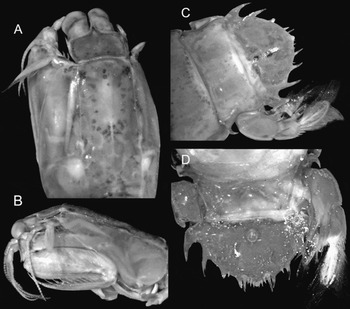
Platysquilla eusebia (Risso, 1816). Male specimen from Fuengirola, Málaga, Spain. (A) Dorsal view of carapace; (B) lateral view of carapace; (C) telson in dorsal view; (D) telson in ventral view.

Material: 1 male specimen (41.1 mm total length, from distal part of eyes to terminal part of telson; carapace length without rostral plate: 6.8 mm). Off Fuengirola, Málaga, Spain, 5 May 1986, 5 m depth. Fine sandy bottoms. Sampling gear: semicircular dredge, with a mouth length of 1 m, a height of 60 cm and a mesh size 1 cm knot to knot.
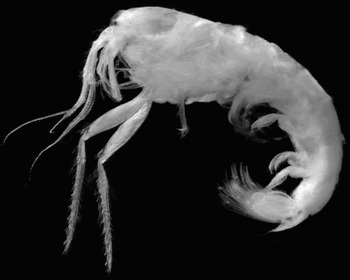
Automate branchialis Holthuis & Gottlieb, Reference Holthuis and Gottlieb1958. Small specimen in lateral view, from Almería, Spain.

Material: 1 small specimen 16.5 mm total length (carapace length: 5.5 mm). Almería, 37°19′10″N–1°40′56″W, off Cala Panizo, 25 January 2009, 20 m depth. Sandy bottoms next to a Posidonia bed. Sampling gear: small heavy rock dredge, with a rectangular frame of 42 × 22 cm and a mesh size of 4.0 mm knot to knot.
DISCUSSION
The occurrence of Platysquilla eusebia (Risso, 1816) on the south Mediterranean coasts of the Iberian Peninsula fills in the distribution gap existing between the Atlantic and the Mediterranean records of this species. Its known general distribution includes localities in the Mediterranean Sea (Turkey, Greece, Adriatic Sea, Italy and France) and the north-west Atlantic (Portugal, Madeira, France, west coast of Ireland and North Sea (larvae)) (van der Baan & Holthuis, Reference Baan and Holthuis1969; O'Céidigh, Reference O'Céidigh1970; Manning, Reference Manning1977; Manning & Camp, Reference Manning and Camp1981; Froglia & Manning, Reference Froglia, Manning and Ferrero1989; Biscoito, Reference Biscoito1985; Ozel, Reference Ozel1985; d'Udekem d'Acoz, Reference Udekem d'Acoz1995). However there is an old reference given by Miranda y Rivera (Reference Miranda y Rivera1921) from Málaga as Lysiosquilla sp. which could correspond to P. eusebia. Unfortunately the collection of this author is lost. In any case, it is a very uncommon species in the Alborán Sea (a relatively well sampled area), probably because, at least in part, it lives in deep burrows like thalassinids (d'Udekem d'Acoz, Reference Udekem d'Acoz1995). Other references for the Iberian Peninsula are from Atlantic waters: Portugal (Manning, Reference Manning1977) and Bay of Biscay (Martínez & Adarraga, Reference Martínez and Adarraga2003).
In the Mediterranean only twelve species of Stomatopods have been cited (Manning, Reference Manning1977; Froglia & Manning, Reference Froglia, Manning and Ferrero1989; http://www.sibm.it (by Froglia); Galil et al., Reference Galil, Froglia, Noël and Briand2002; Colmenero et al., in press). For Spanish waters Abelló (in http://www.fauna-iberica.mncn.csic.es/faunaib/) gave a list of ten species, but this is merely the general Mediterranean list less one of the two actual lessepsian species and less a larva caught in Italy. However, at present, in Spanish peninsular waters only the following seven species are positively documented:
Family Squillidae Latreille, 1803: Squilla mantis (Linnaeus, 1758): the most common species of stomatopod living in the Spanish littoral; the only one commercially fished and cited by de Buen (Reference Buen1887, Reference Buen1916, Reference Buen1930), Ferrer y Galdiano (Reference Ferrer y Galdiano1918), Miranda y Rivera (Reference Miranda y Rivera1921), among others. Rissoides desmaresti (Risso, 1816) is the second relatively frequent species; mentioned by de Buen (Reference Buen1887, Reference Buen1916), Bolivar (Reference Bolivar1893, Reference Bolivar1916), Ferrer i Aledo (Reference Ferrer i Aledo1906), Manning (Reference Manning1977), Valladares (Reference Valladares1987). Rissoides pallidus (Giesberch, 1910), close to R. desmaresti, was cited by Valladares (Reference Valladares1987) and Abelló et al. (Reference Abelló, Pretus and Corbera1994, Reference Abelló, Carbonell and Torres2002); recently (April 2009) we have caught two specimens from Djibouti seamount (Alboran Sea) at 492 m using a beam trawl.
Family Pseudosquillidae Manning, Reference Manning1977: Parasquilla ferussaci (Roux, 1830): Colmenero et al. (in press) provide a review of this species in Spain. Pseudosquillopsis cerisii (Roux, 1828) was mentioned in Spain by de Buen (Reference Buen1887, Reference Buen1916), Parisi (Reference Parisi1914) and, recently, we have identified a specimen of this species from the island of Mallorca, Balearics Islands (collected February 1989).
Family Nannosquillidae Manning, 1980: Platysquilloides lillyae (Manning, Reference Manning1977): another uncommon species found off Catalan coasts (Valladares, Reference Valladares and Ferrero1989; Abelló et al., Reference Abelló, Pretus and Corbera1994). Platysquilla eusebia (Risso, 1816): see previous remarks.
On the other hand, the capture of one specimen of the decapod Automate branchialis Holthuis & Gottlieb, Reference Holthuis and Gottlieb1958, off the shores of Almería represents its known western limit of distribution. In the Mediterranean, this Alpheidae is mainly found in the eastern basin: Israel (Holthuis & Gottlieb, Reference Holthuis and Gottlieb1958), Malta (Števčić, Reference Števčić1979), Adriatic (Froglia, Reference Froglia1975; Vaso & Gjiknuri, Reference Vaso and Gjiknuri1993; Števčić, Reference Števčić2002), Aegean Sea (Koukouras et al., Reference Koukouras, Dounas, Türkay and Voultsiadou-Koukoura1992, Reference Koukouras, Dounas and Eleftheriou1993; Katağan & Kocataş, Reference Katağan and Kocataş2001; Ateş et al., Reference Ateş, Katağan and Kocataş2004) and Cyprus (Katağan & Kocataş, Reference Katağan and Kocataş2001). In the western basin, there are only two references: the later authors mention an unpublished record by Noël from Port-Cros (France) and in the Mediterranean Spanish waters it was found in the Balearic Islands (Box et al., Reference Box, Guerao, Abelló and Deudero2007); however we know a previous unpublished record off Alicante (Guillen Nieto, Reference Guillen Nieto1996; unpublished thesis). These western records do not agree with the previously considered status as a possible lessepsian colonizer and support the second supposition given by Holthuis & Gottlieb (Reference Holthuis and Gottlieb1958): it ‘is a true Mediterranean form’ (Katağan & Kocataş, Reference Katağan and Kocataş2001; Galil et al., Reference Galil, Froglia, Noël and Briand2002).
This new capture of one specimen in the Alborán Sea (off Almería) extends its distribution area to the entire Mediterranean and shows a possible continuous process of expansion from the eastern basin or simply the capture of a rare Mediterranean species in its western geographical distribution limit.