1. Introduction
While advanced industrialized countries have been the main contributors to accumulated greenhouse gases (GHGs) in the atmosphere, emissions growth from these economies has been stabilized in recent years, partly due to substitution of domestic emission-intensive goods by imports from developing countries (Raupach et al., Reference Raupach, Marland, Ciais, Le Quéré, Canadell, Klepper and Field2007; Weber and Matthews, Reference Weber and Matthews2007; Peters and Hertwich, Reference Peters and Hertwich2008a, Reference Peters and Hertwichb; Le Quéré et al., Reference Le Quéré, Raupach, Canadell and Marland2009; Weber and Peters, Reference Weber and Peters2009; Peters et al., Reference Peters, Minx, Weber and Edenhofer2011a), and due to energy efficiency energy efficiency improvements.Footnote 1 The growth of emissions from large developing economies, on the other hand, has accelerated due to rapid economic growth partly fuelled by the shifting of production from high-cost developed to low-cost developing economies. These developments during the last couple of decades have put the developing economies such as China and India under increasing pressure to reduce their emissions. The central issue is that, while emissions in major developing economies have grown rapidly in recent years, their exports to developed economies have also increased to supply the increased demand and so have the emissions exports. The question is who should be responsible for the underlying emissions growth – the suppliers (producers or exporters) or the final consumers of the goods and services; therefore, how should the emissions reduction targets be allocated? A number of studies including a recent one from the Brookings Institution (Grasso and Roberts, Reference Grasso and Roberts2013) have argued that the allocation of the emissions reduction target should be based on the carbon footprint of own consumption, not territorial emissions – essentially switching the responsibility away from where the implied good originated to where it is destined for.
Under the current UNFCCC framework, reduction targets are set on production-based emissions (PBEs), which account for emissions generated within the domestic boundaries of a country. Given that in the current context not all countries are bound by reduction targets or are not undertaking comparable abatement, actions by only a nation or a subset of nations could result in significant emission leakage as emission-intensive domestic production is replaced by imports from similar or more emission intensive source countries. The result is that, although some countries with emissions reduction targets were able to reduce their own territorial emissions, their trans-boundary emissions increased through consumption of imports. In the current framework some large exporters of energy-intensive commodities also argue that they are unfairly targeted as they cannot net out any emissions generated in producing goods destined for export. They suggest that emissions embodied in trade should receive special attention in the distribution of post-Kyoto abatement burdens (Narayanan and Walmsley, Reference Narayanan and Walmsley2008). It is important to note that consumption-based emissions (CBEs) targets might involve measures to reduce consumption of not only domestic but also imported carbon-intensive goods and therefore the application of border carbon adjustments (BCAs) to reduce imported emissions and address the competitiveness and leakage effect of unilateral abatement policies. Some argue that properly crafted BCAs could help reduce trade distortions, limit the competiveness effects and help build a broader coalition of interests for more global actions (Helm et al., Reference Helm, Hepburn and Ruta2012).
The CBEs approach accounts for all GHG emissions that occur to satisfy total final demand for goods and services of a country irrespective of their sourcing. The main difference between this and the production-based approach is the treatment of emissions embodied in trade flows. In the CBEs framework, emissions from the production of exports are excluded, but it includes emissions embodied in imports. While plenty of research has been undertaken on the usefulness of this approach and the estimation of CBEs inventories, to our knowledge there has not been much research that examines how its application to target setting would affect different nations.Footnote 2 A preliminary study by the Committee for Economic Development of Australia (2009) finds that the projected decline in welfare, as measured by GNP, per tonne of CO2-e abated within Australia, is smaller for the consumption-based approach than for a production-based Carbon Pollution Reduction Scheme approach. This study, however, focuses on the perspectives of Australia which is a net exporter of emissions. Economic intuition suggests that the implications of moving away from production- to consumption-based targets would be quite different for net exporters and net importers of emissions under unilateral actions. This paper examines the implications of CBEs targets not only for the net exporters of emissions but also for net importers of emissions.
In the CBEs approach, net emission-exporting nations can benefit in two ways: first by having a lower emission base on which targets are set; second, by a possible terms-of-trade gain from levying a carbon tariff on their imports. For the importing nations the benefits come through possible terms of trade gains and changes in the carbon tax base. To clarify further, it is also worth noting that under the CBEs approach, while production of exportables faces no emissions regulation in the domestic economy, these can be subject to a carbon tariff in the importing countries.Footnote 3 This could lead to a contraction of the energy-intensive export sector. The net effect of the emission target base switching would therefore depend on the cost savings from having to meet a lower or less stringent target, the loss from reduced exports and, more importantly, on the marginal abatement costs of CBEs vis-à-vis PBEs. It should, however, be noted that while PBEs measures may encourage the ‘importing of “dirty” goods and services’, CBEs accounting may ‘reduce incentives to “clean up” domestic technology’ where manufacturing primarily serves export demands (Energy and Climate Change Committee, 2012). These suggest that the overall merit of one approach versus the other is an empirical issue and would also depend upon the country in question. It is premature to empirically evaluate these issues as there has been no application of these policies in parallel. The computable general equilibrium (CGE) modelling approach undertaken in this paper provides some deep insights about the possible implications of these approaches by conducting a model simulation of key policy scenarios.
The main findings of the paper are that, while CBEs targets seem attractive for the net exporters of emissions in terms of securing a lower target, the inframarginal cost of reducing CBEs could exceed that of the same percentage reduction in PBEs. This is likely to be true, even for countries like China whose CBEs are estimated to be 80 per cent of PBEs. For the net importers of emissions, particularly Europe and the United States, for which simulation exercises are undertaken, the net effects will depend on whether imported final consumptions are covered under policies or not. If BCAs are allowed under a CBEs target, Europe and the United States are better off relative to a PBEs target although the absolute reduction target under the CBEs is higher. This is due to the much lower cost of emissions abatement and the possible terms-of-trade gain under the BCAs.
If imported final consumptions are not covered under the BCAs, the CBEs allocation would be much costlier than their production-based targets. Simulation results also suggest that CBEs targets could lead to larger reductions at the global level with negative distributional consequences.
In the following, we first set the context of the paper through a selective review of the literature in section 2. In section 3 the methodological details including a non-technical description of the multisector, multiregional CGE model used in this paper and the sources of data and the parameters of the model are discussed. Simulation scenarios and results are analyzed in section 4. Finally, section 5 discusses the main policy implications and concludes.
2. The context: selective literature review
It is argued that the production-based territorial emissions inventory system currently followed in UNFCCC has many limitations. For example, it does not target the main drivers of emissions growth, namely the demanders or consumers of the products, particularly for internationally traded goods and services (Peters et al., Reference Peters, Minx, Weber and Edenhofer2011a). The production-based system accounts for emissions generated only within the domestic boundaries of a country. It does not account for emissions generated elsewhere in the production of imported goods used as intermediates or final consumption.Footnote 4 Similarly, it does not deduct emissions resulting from the production of goods consumed by foreigners (i.e., exports). Peters et al. (Reference Peters, Minx, Weber and Edenhofer2011a) find that between 1990 and 2008, Annex B territorial emissions have decreased by about 2 per cent from 14.2 Gt to 13.9 Gt; however, their CBEs have increased rapidly during the same period. The net emission transfers from developing to developed countries have increased from 0.4 Gt in 1990 to 1.6 Gt in 2008, which more than offsets the reductions experienced within developed country boundaries. Using a multiregional input–output (MRIO) framework as used in Böhringer et al. (Reference Böhringer, Carbone and Rutherford2011), Ghosh and Siddiqui (Reference Ghosh and Siddiqui2011) find that in 2004 net imported emissions in major European nations constituted 20–50 per cent of total PBEs. They also find that Russia, China, Brazil, Ukraine and South Africa were the topmost net exporters of emissions in 2004. Among the developed nations, Canada as well as Australia were net exporters of emissions, while the United States, Japan, Germany and the United Kingdom were the topmost net importers of emissions.
There is a wide body of literature on the methodological aspects of estimating CBEs and also on its estimates at the single country and multiregional level. As mentioned before, to our knowledge there is not much available in the literature that looks into the issues raised in this paper. However, there is a large body of literature in the unilateral climate policy context. In this literature BCAs are proposed to minimize the competitiveness and emission leakage effects of unilateral GHG reduction policies. These include Goh (Reference Goh2004), Babiker and Rutherford (Reference Babiker and Rutherford2005), Biermann and Brohm (Reference Biermann and Brohm2005), McCorriston and Sleldon (Reference McCorriston and Sleldon2005), de Cendra (Reference de Cendra2006), Ismer and Neuhoff (Reference Ismer and Neuhoff2007), Brewer (Reference Brewer2008), Lockwood and Whalley (Reference Lockwood and Whalley2008), Stavins (Reference Stavins2008), Mattoo et al. (Reference Mattoo, Subramanian, van der Mensbrugghe and He2009), Kuik and Hofkes (Reference Kuik and Hofkes2010) and Peters et al. (Reference Peters, Andrew and Lennox2011b). Asselt and Biermann (Reference Asselt and Biermann2007) evaluate proposed measures on a set of political and legal criteria, including environmental effectiveness in the European context. This literature is indirectly relevant to this paper as the CBEs targets might involve BCAs. In December 2012 a series of articles from a symposium on BCAs were published in Energy Economics (Volume 34, Supplement 2). Some of the findings of these studies are similar to ours. For example, BTAs help to reduce emission leakage and they can have significant distributional consequences on the countries not undertaking comparable climate actions.
Differential environmental standards could cause a ‘pollution haven effect’ as discussed in Copeland and Taylor (Reference Copeland and Taylor2004). Although there is very little empirical support including that in Copeland and Taylor (Reference Copeland and Taylor2004) and Temurshoev (Reference Temurshoev2006), countries with lax environmental standards may attract emission-intensive industries to relocate from regulated countries. Therefore, exploring a different emissions targeting rule in the unilateral carbon policy context is important.
3. Methodology and the model
3.1. Consumption-based emissions
The CBEs approach accounts for all emissions generated directly in the production of the final product and indirectly in making the required intermediates irrespective of sourcing. In a highly integrated production system, the production chain includes domestic goods and those from multiple foreign jurisdictions. Accounting for embodied emissions therefore involves tracking input–output relations over multiple regions. In this paper an MRIO framework is used to account for the embodied emissions in the final product.Footnote 5 Depending upon data availability, by using this approach it is possible to estimate the direct and indirect emissions embodied in goods and services. We apply a similar approach to that used in Böhringer et al. (Reference Böhringer, Carbone and Rutherford2011) to estimate the embodied emissions as described below.
Total embodied emissions in final product j produced in region s(TE js ) can be written as direct combustion and process emissions (E d js ) and indirect emissions to produce domestic (I D ijs ) and imported (I M ijrs ) intermediates from region r. Using the MRIO identity, the above can be written as:
 $$y^{js}a_y^{js} =E_{dr}^{js} +\sum_{i} I_d^{ijs} a_y^{is} +\sum_r \sum_i I_m^{ijrs} a_y^{ir}$$
where a y js refers to the emission intensity of sector j in country s to be determined endogenously by solving equation (1). y js refers to the gross output of sector j. Given the values of y js , (E d js ), (I D ijs ) and (I M ijrs ), the emission intensity factor of sector j in country s can be determined as a solution to the system of j×s equations.Footnote 6
CBEs can be calculated as the embodied emissions in products plus direct emissions from the consumption of goods by households, governments and investment. Direct consumption-related emissions include, for example, those generated from the combustion of gasoline used in motor vehicles, home heating and cooking. Total CBEs of country r(CBE r ) can be written as
 $$CBE_r =\sum_{i,s} (a^{is}+ comb^{is})(c_r^{is} +g_r^{is}+{Inv}_r^{is})$$
where a is is the production-related emission intensity of good i produced in country s, comb is is the combustion-related emission from direct consumption of commodity i produced in country s, and c rr is , g rr is , Inv rr is are the household, government final consumption and investment demand, respectively, of commodity i in country r from source s. There are uncertainties regarding different estimates due to base-data, model structure and underlying assumptions in the studies.Footnote 7 However, it seems that the differences are not large.
To address the uncertainties, a number of papers have applied Monte Carlo analysis to their MRIO model results (e.g., Wiedmann et al., Reference Wiedmann, Lenzen and Wood2008a,Reference Wiedmann, Wood, Minx, Lenzen and Harrisb; Lenzen et al., Reference Lenzen, Wood and Wiedmann2010). A Monte Carlo analysis introduces random perturbations to various values (e.g., technical coefficients, import prices, GHG intensities, etc.) to see how they will affect the MRIO model results. Using the Monte Carlo approach, Wiedmann et al. (Wiedmann et al., Reference Wiedmann, Lenzen and Wood2008a: 28) found that estimates of demand-based GHGs in the UK had ‘relative standard errors’ of between 3.3 and 5.5 per cent, suggesting that the estimates were ‘robust and reliable’.
3.2. The CGE model
In order to assess the implications of alternative emission targeting rules for economic and welfare consequences in developing and developed economies (particularly for net importers and exporters of emissions), this paper uses a version of Environment Canada's static multisector, multiregional (EC-MS-MR) CGE model, similar to that used by Böhringer and Rutherford (Reference Böhringer and Rutherford2010). The CGE approach is used due to its solid microeconomic foundation based on a market mechanism that is well suited to capture all the direct and indirect interactions and feedbacks between sectors and agents of the economic system within the model framework. Algebraically, the model is formulated as a mixed complementarity problem and numerically implemented in MPSGE (Rutherford, Reference Rutherford1999) as a subsystem of GAMS (Brooke et al., Reference Brooke, Kendrick and Meeraus1996) using PATH (Dirkse and Ferris, Reference Dirkse and Ferris1995).
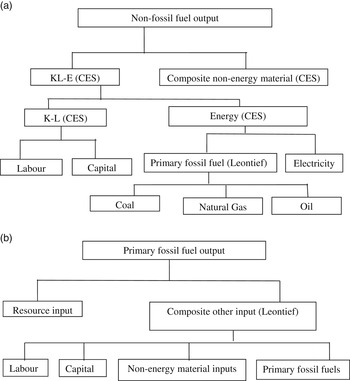
This section provides a non-technical description of the model.Footnote 8 The model is aggregated into 12 regions. These include net exporters of emissions such as China and India and net importers of emissions such as Europe (EU27 + EFTA), the United States and Japan, other energy-exporting regions and Russia, and other developing countries such as Brazil. In each region there are 15 output-producing sectors including three primary fossil fuel sectors (coal, crude oil and natural gas). Other sectors include energy-intensive trade exposed sectors such as chemicals, rubber and plastic products, metals and mineral products and other manufacturing, transport and services.Footnote 9 The model distinguishes two primary factors: capital and labour, that are mobile across sectors but immobile across regions; in addition, each of the three primary fossil fuel sectors uses a resource factor specific to the sector. The supply of each factor is assumed to be fixed for each region or country. Production technology in each sector can be described by multi-level nests consisting of constant elasticity of substitution (CES) or Leontief (Reference Leontief1986) functions of material and factor inputs (figures 1a and 1b). These describe the price-dependent use of capital, labour, energy and material inputs in production. Given the prices of factors and inputs, firms in each sector choose factors and other inputs to maximize profits.
(a) Non-fossil fuel output. (b) Primary fossil fuel output

In non-fossil fuel sectors at the top level nest CES non-energy material composite input is combined with a CES aggregate of energy, capital and labour (KL-E) to produce final output (figure 1a). At the second level, a CES function describes the trade-offs between composites of value added (KL) and energy aggregate. At the third level the substitution possibilities within value added (K-L) is implemented as a CES function of labour and capital. The composite energy is a CES function of composite primary fossil fuel and electricity. The composite primary fossil fuel is described as a Leontief function of coal, oil and gas.
The primary fossil fuel production function is further simplified (in figure 1b). At the top nest of the production function, a sector-specific fossil fuel resource is combined with a composite other input bundle. The composite other input bundle is a Leontief function of capital, labour and all other materials including electricity, oil, natural gas and coal inputs. Attention is paid to calibrating the production function consistent with empirical estimates for the price elasticity of fossil fuel supply.
There is one representative household in each region that owns all the primary factors including resources, receives factor incomes, rents from fossil fuel resources and tax revenue, and pays taxes on goods and services. The representative household chooses bundles of goods and services to maximize its utility subject to a budget constraint with investment and exogenous government provision. Preferences across commodities are represented again by nested CES functions similar to that represented in figure 1a.
Regions are linked through international trade. Domestic production therefore meets the domestic demand which enters in the Armington (Reference Armington1969) good and/or is exported to satisfy import demand from other countries. Total supply of a good to the domestic economy is formed by a CES aggregator of the domestically produced good and the composite imported good of the same kind. The composite imported good in turn is a CES aggregate of the goods imported from different origins. It is also assumed that each region maintains a constant current account balance.
3.3. GHG emissions
Globally, CO2 constitutes roughly three-quarters of total anthropogenic emissions (GTAP 7.1). This version of the model captures CO2 emissions only. These are essentially related to the combustion of fossil fuels (coal, oil and gas). CO2 emissions are therefore linked in fixed proportions of its use by sectors. This implies that CO2 abatement can take place by inter-fuel substitution or energy savings (substituting energy inputs by non-energy inputs and/or by a scale reduction of production). Similarly, emissions can be reduced by substituting emission-intensive commodities by less emission-intensive ones in final consumption.
Restrictions on CO2 emissions in production and consumption are typically implemented through exogenous emission constraints to keep emissions to a specified limit that determines the emission taxes or price required endogenously. Revenues from emission regulations accrue from CO2 taxes (or, equivalently, from the auctioning of emission allowances) and are recycled lump-sum to the representative agent in the respective region.
3.4. Equilibrium conditions
Equilibrium in the model is characterized by market clearing in goods and factor markets in all regions of the model. Goods and factor prices are endogenous, which ensures that there is full employment and goods market clear. Given the constant returns to scale technology and perfectly competitive market structure, a zero profit condition in each market is ensured. For external closure a constant trade balance condition is imposed.
3.5. Data and parameterization of the model
The model builds on the GTAP 7.1 (Global Trade Analysis Project) data set with detailed accounts of regional production and consumption, bilateral trade flows, and energy flows and CO2 emissions, all for the base year 2004 (Narayanan and Walmsley, Reference Narayanan and Walmsley2008). This database provides a micro-consistent data set for 112 regions and 57 economic sectors. These data are aggregated into 12 regions and 15 sectors using the GTAPinGAMS aggregating program developed by Böhringer and Rutherford (Reference Böhringer and Rutherford2011). As is customary in applied general equilibrium analysis, base year data together with exogenous values of elasticity determine the free parameters of the functional forms (Böhringer et al., Reference Böhringer, Löschel and Rutherford2006).
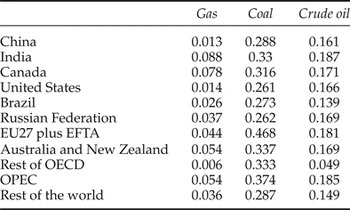
Values of elasticity that determine the price responsiveness in demand and supply to changes in prices induced by policy shifts play a central role in the quantitative impact assessment of policy reforms. Substitution elasticity indicates the ease or difficulty in substitution between the inputs in production or between imports and domestic goods in consumption, for example. The values of elasticity of substitution in the energy nest are assumed to be 0.5, reflecting the existing literature. The values of elasticity of substitution in the resource sector used in model calibration are reported in table 1. Values for trade elasticity and those for capital and labour are taken from GTAP 7.1.
Values of elasticity between resource factor and other inputs in primary fossil fuel production

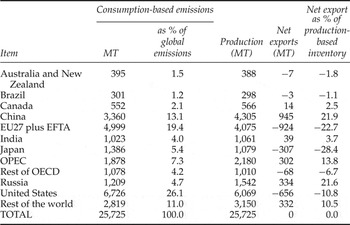
Emissions data came from the GTAP 7.1 database. The PBEs inventory and the estimated CBEs using the MRIO model described earlier for the 12 regions of the CGE model are reported in table 2.Footnote 10 Only CO2 emissions are accounted for in these estimates.Footnote 11
Production and consumption-based CO2 emissions inventory of the regions of the model

Notes: These estimates include CO2 emissions only. The PBEs are from GTAP 7.1, while other estimates are based on a 12-region 15-product MRIO model.
4. Simulation scenarios and results
4.1. Designing simulation scenarios
In order to understand the implications of alternative emissions targeting rules for net exporters and importers of emissions, four country/regions are selected, each of which unilaterally undertakes emissions reduction policies. These include: the EU (EU27 plus EFTA) and the United States as the major importers of emissions; China as the major exporter of emissions; and finally India whose emissions have been increasing rapidly in recent years and which is also a net exporter of emissions. These regions had significant differences between their estimated PBEs and CBEs in 2004 (table 2). Net exported emissions from China accounted for 22 per cent of its total production-based CO2 emissions. On the other hand, net imported emissions from the EU and the US constituted 23 and 11 per cent of their respective production-based CO2 inventories.
In order to assess the implications of PBEs and CBEs in the context of setting the reduction targets, the following three unilateral policy scenarios are considered for each of the four countries. In each scenario a single region undertakes a 20 per cent reduction of the benchmark (2004) PBEs or CBEs; altogether a total of 12 scenarios are run using the model.
-
• Scenario 1: a PBEs target scenario. Each region, one at a time, reduces its benchmark PBEs by 20 per cent. This is achieved by a domestic carbon price (tax) on all economic activities including final consumption endogenously determined to meet the target.
-
• Scenario 2: a CBEs target scenario with BCAs on imports. Each region, one at a time, reduces its benchmark CBEs by 20 per cent. In line with the definition of CBEs, the emissions from the production of goods for export are excluded and those from the production imports for final consumption are included under the policy. Policy measures include a carbon price (tax) applied to all domestic production activities including final consumption, but rebates are given in the form of subsidies to exports for carbon price (tax) initially paid. Finally, tariffs are imposed on imported goods based on the CO2 embodied in the product.
-
• Scenario 3: a CBEs target scenario with no BCAs on imports. Each region, one at a time, reduces its benchmark CBEs by 20 per cent. The policy adopted to reduce the CBEs in this scenario is the same as in scenario 2 with the exception of tariffs on imported goods. To understand the implications of the CBEs target, in case the application of a border carbon tariff is not politically feasible, this scenario exempts the emissions from the production of goods for export through tax rebates as in scenario 2, but does not introduce a border carbon tariff on imports.
In the US, as well as in Europe, emission policies have proposed BCAs in the energy-intensive trade exposed sectors with respect to partner countries not having comparable abatement efforts in these sectors due to the competiveness concerns and emission leakage effects. Some European parliaments have called for BEAs in energy-intensive industries which are determined to be exposed to significant risk of carbon leakage in the form of a higher amount of freely allocated emission permits. Of the many market-based climate change bills introduced in the US Congress, including H.R. 2454 (Waxman–Markey Bill), almost half called for some border tax adjustments in the form of a tax applied to fossil fuel imports or requiring emission permits for energy-intensive imports. In this paper, however, wherever applicable, BCAs are imposed on all imported commodities in order to have a clearer picture and also because these are based on embodied carbon content in the spirit of the CBEs approach.
4.2. Simulation results
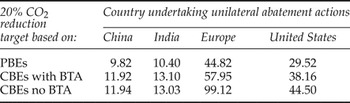
The simulation results of scenarios 1–3 for CO2 price or tax per tonne required for achieving the reduction target, inframarginal or welfare impacts in terms of Hicksian equivalent variation as a percentage of base case consumption and global and regional emissions reductions achieved are reported in tables 3–6. Sensitivity results with respect to elasticity parameter values fall in line with the intuition and are not reported due to space constraints.
CO2 emission price ($ per tonne) under alternative policies

Welfare economic effect of alternative carbon reduction policies (Hicksian equivalent variation as % of benchmark consumption)

Emissions reduction as percentage of own benchmark PBEs

Global net emissions reduction as percentage of benchmark emissions

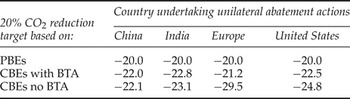
The marginal cost of abatement or the carbon price required to meet the respective targets vary widely across the regions and between scenarios, particularly for Europe and the United States (table 3). Results suggest that China has the lowest ($9.8/tonne of CO2e) and the Europe has the highest ($44.8/tonne of CO2e) marginal cost of abatements among the four regions for a 20 per cent cut in respective PBEs.Footnote 12 The marginal abatement cost in the United States is relatively low ($29.5/tonne CO2e) compared to that in Europe. The lower price in the United States can be explained by the low-cost abatement options available in the US, such as in electricity generation. Electricity constitutes more than 40 per cent of GHG emissions and the costs are relatively lower as it is dominated by coal-fired electricity generation in the US. Lu et al. (Reference Lu, Salovaara and McElroy2012) find that, while CO2 emissions from the US power sector decreased by 8.76 per cent in 2009 relative to 2008, more than half of the reduction is attributed to a shift from generation of power using coal to gas, driven by a recent decrease in gas prices in response to the increase in production from shale. Their econometric modelling results also suggest that, when the cost differential for generation using gas rather than coal falls below 2–3 cents/kWh, less efficient coal fired plants are displaced by more efficient natural gas combined cycle generation alternatives. This indicates that a modest price on carbon could contribute to additional switching from coal to gas with further savings in CO2 emissions. The cost advantages, however, diminish as low-cost options are exhausted or input substitution possibilities decrease with increased targets.
If the targets are rather based on the CBEs, as in scenario 2, the marginal cost of abatement increases in all regions – for China and India it increases by $2 to $3 per tonne CO2e, although effective reduction requirements are lower; for Europe it increases from $44.8 to $58 and for the United States it increases from $29.5 to $38.1 per tonne under BCAs. If BCAs are not implemented as part of the CBEs target, the required carbon prices are even higher compared to scenario 2 BCAs for Europe and the United States; the changes for China are marginal. The introduction of BCAs, i.e., a carbon tax on imported goods, widens the coverage of the goods and facilitates abatements resulting in lower costs compared to no BCAs. The lower abatement price in scenario 2 compared to that in scenario 3 is pronounced in the case of Europe and the US, both because of the larger share of imports in final consumption and because it is relatively cheaper to abate by reducing the consumption of imported goods which have higher carbon content. For China and India the costs difference is marginal between scenarios 2 and 3.
Interestingly, the marginal costs of abatement of CBEs are higher compared to those of PBEs for all regions. Intuitively, the marginal costs of abatement of CBEs are higher compared to those of PBEs due to relatively limited substitution possibilities under CBEs. Effectively, there are three options available in the model. These include inter-fuel substitution (for example between coal and gas), energy efficiency improvements (implemented in the model as capital energy substitution), and scale reduction in consumption or production. While under the PBEs target all these options are effective directly, under the CBEs target not all channels work directly for the full basket of final consumption. For example, a carbon price induces the electricity producers to switch from coal to gas generation under the PBEs target. A target based on CBEs will directly affect the consumers of electricity and the move towards gas from coal in electricity generation is only impacted via consumer demand. Consumer demand, on the other hand, will depend upon the availability of alternatives and the expenditure shares, etc.
However, to a certain extent policies may be formulated along these channels as much as possible to achieve the target efficiently. An attempt has been made in this paper to utilize the available options. As described before for meeting the CBEs target efficiently, an emissions price (tax) is introduced on all domestic activities but rebates in the form of subsidies are given to those that go towards exports. However, when it comes to consumption of imports, it is not possible to target all activities in the foreign countries associated with the production of imports. The option available was a tariff on the embodied carbon in the second scenario.
The higher marginal abatement costs for a CBEs target for Europe and the United States is also expected, as both of them face higher targets under CBEs. However, for China and India, although the absolute reduction targets are lower, the marginal abatement costs are higher under CBEs. As China and India move from a PBEs to a CBEs target, they move from low- to high-cost abatement base emissions, which is reflected in the marginal abatements cost of domestic emissions. China and India are the economies where abatements from domestic production activities are cheaper compared to reduction of consumption of imported goods due to relatively higher carbon content in the domestic products compared to the imports.
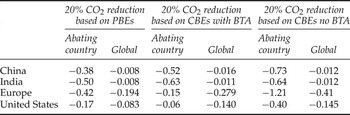
The marginal abatement costs provide a partial representation of the policy costs. Therefore, inframarginal costs or welfare costs in terms of consumption loss compared to the benchmark for different emissions targets and scenarios are also reported in table 4. The results show significant differences across scenarios and regions. By moving from a PBEs to a CBEs target, the net importing nations (i.e., from scenario 1 to 2) Europe and the United States improve the welfare loss although the absolute reduction targets under the CBEs are higher. If emissions reduction targets are based on CBEs instead of PBEs, welfare costs in Europe drop from −0.42 to −0.15 per cent and in the United States they drop from −0.17 to −0.06 per cent of benchmark consumption. The net exporters of emissions, China and India, incur higher welfare costs under the CBEs than under the PBEs target. Welfare costs in China increase from −0.38 to −0.52 per cent and in India from −0.50 to −0.63 per cent of benchmark consumption.
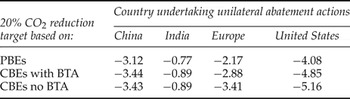
The United States and Europe account for 26 and 19 per cent of global emissions, respectively. The reduction of US CBEs leads to a larger global reduction (5 per cent) compared to that of the EU (3 per cent) (table 5). Unilateral action by China to reduce its CBEs by 20 per cent could contribute to a global emissions reduction of 3.4 per cent, albeit at a much lower or negligible global economic cost (−0.01 per cent) although the loss to China would be significant (−0.54 per cent). Noticeably, net global reductions under CBEs targets are higher compared to the respective PBEs targets. Similarly, net reductions by the country/region undertaking unilateral reductions are also higher under CBEs targets (table 6). Given that Europe and the United States are net importers of emissions, it is quite obvious that reductions will be higher, but for China and India it is not obvious. The main reason for this is the available targeting tools. The model does not separate production technology for domestic and foreign sales; rather, it defines a composite commodity, parts of which are sold domestically and the remaining for foreign sales. To the extent that production technologies are distinguished for domestic and foreign sales, the results may differ. By our understanding, in most cases the model formulation reflects reality.
If border carbon taxes are not allowed (scenario 3) due to political or other considerations, CBEs targets yield worse welfare impacts for all regions undertaking unilateral carbon reductions. This is understandable as in this scenario policies are applied only on a part of CBEs while the target remains the same. The impacts on global welfare are also highest in this scenario. It is difficult to make a clear ranking of these three policy scenarios as the net reductions associated with these scenarios differ. However, studies that are designed to control global emissions at the same level across scenarios found scenario 2 to be the least costly option at the global level (Ghosh et al., Reference Ghosh, Luo, Siddiqui and Zhu2012).Footnote 13
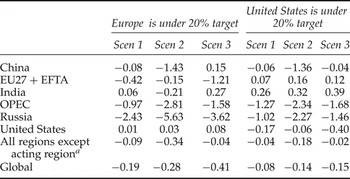
It should be noted that the CBEs targets with BCAs have strong distributional consequences, particularly when these are implemented by large economies such as the Europe and the United States in line with scenario 2 in this paper (table 7). For example, when Europe makes unilateral reductions as in scenario 2, welfare costs in China increase significantly from −0.08 per cent under PBEs (scenario 1) to −1.43 per cent of its benchmark consumption. Similarly, when the United States undertakes the unilateral actions as in scenario 2, the welfare costs in Russia increase from −1.02 per cent under PBEs (scenario 1) to −2.27 per cent of its benchmark consumption. The aggregate net impacts on countries other than the country acting unilaterally are also reported in table 7 to confirm the distributional effects. The distributional effect when China or India unilaterally undertakes the CBEs target is relatively small (not reported here).
Distributional effect of PBEs and CBEs targets in selected regions: unilateral action by Europe and United States (central case) (Hicksian equivalent variation as % of benchmark consumption)

Notes: a This includes all regions of the model not undertaking any policy action. For example, when Europe is undertaking unilateral policy action it is not included.
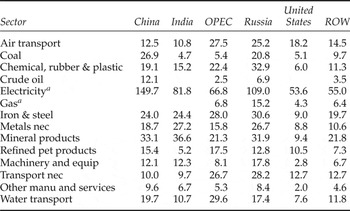
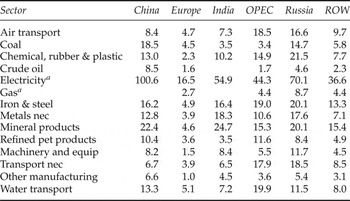
Interestingly, results also suggest relatively higher welfare impacts on the oil-exporting economies of Russia and the OPEC under the CBEs (table 7). The higher impacts on Russia and OPEC are intuitive from analyzing the BTAs tariffs imposed by the EU and the US in Appendices A and B.Footnote 14 The tariff rates on imports from Russia and OPEC by the EU and the United States are quite high due to its embodied carbon contents and also because of their reliance on petroleum exports. Given its low share, a reduction of Indian consumption-based CO2 emissions would have a relatively small effect on global emissions although it has significant impacts on India.
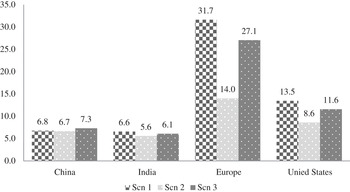
A CBEs target implemented in line with scenario 2 can be effective in minimizing emissions leakage (figure 2). As can be seen, emissions leakage is the lowest in scenario 2 and the net reductions at the global level are the highest. Consumption-based targets implemented by Europe and the United States result in significant large drops in the emission leakage, while those by China and India have marginal impacts on leakage compared to respective production-based policies.
Emission leakage as percentage of domestic reduction under unilateral carbon policies

5. Summary and conclusions
While the developed economies have been able to stabilize the growth of PBEs, their CBEs continued to grow between 1990 and 2008. On the other hand, PBEs from developing countries such as China and South Africa have undergone rapid increases and hence they are under increasing pressure in multilateral fora to reduce emissions. A wide body of literature suggests that the cause of emissions growth in the developing economies is the increased demand for their products from the developed economies. Therefore, emissions reduction targets should be based on the sources of emissions growth (i.e., the demanders or consumers of emissions-intensive products). It is argued that country emissions targets should be based on CBEs instead of the PBEs currently followed under the UNFCCC framework, although these are difficult to implement.Footnote 15
While plenty of research has been undertaken in the development of a methodology for accounting for CBEs, to our knowledge there is very little that examines how its application to target setting would affect different nations, net exporters and net importers of emissions in particular. Using a global CGE model, this paper analyzes the implications of using this approach on economic welfare and emissions for a variety of countries as well as at the global level.
Simulation results suggest that the marginal abatement costs of CBEs are higher in general. However, the welfare costs of CBEs relative to those of PBEs would depend on the associated policies used to reduce CBEs. Policies that target all CBEs (i.e., domestic as well as foreign sources) in line with full BCAs make the net importers of emissions (i.e., Europe and the United States, in this study) better off compared to PBEs targets although the absolute reduction targets are higher under the CBEs. For the net exporter, namely the economies of China and India, CBEs targets would have relatively worse welfare impacts compared to targets based on PBEs. This result is essentially driven by the strong terms-of-trade effects, the relatively lower costs of abatements by reducing imports for the developed economies. For the net exporting nations it works the other way round. The economies of Europe and the United States could reduce the welfare effects significantly by applying BCAs as a policy option to reduce CBEs but this would cause significant distributional consequences in the global economy. Results show that net reductions achieved under CBEs are higher than those under PBEs, essentially due to a drop in emissions leakage, but policy ranking in terms of its effectiveness is difficult in this study as the associated reductions in scenarios are different across the scenarios.
Supplementary materials and methods
The supplementary material referred to in this paper can be found online at journals.cambridge.org/EDE/.
Tariff rates imposed by Europe under BCAs

Tariff rates imposed by the United States under BCAs