Implications
The diet self-regulation ability of goats during late lactation was studied with regard to the production level. Five feeds were individually offered to the goats in a free-choice feeding system. The nutrient input was much higher than needed. The study highlighted the ability of goats to self-regulate, during the day, their diet for quality, more than quantity, to reach a ‘curative’ effect of the selected diet against metabolic discomfort. Indeed, shifting goats from a feeding system, based on a mixture of the five feeds, to the free-choice feeding system caused an increase of milk yield, despite the late-lactation stage. In the light of the positive response of goats to the free-choice system, the research could stimulate further studies aimed to optimize the free-choice feeding system, searching for the best combination between less protein-rich feeds and more sources of roughages.
Introduction
Studies on feeding choice in goats have been mostly focused on grazing or browsing animals, whereas few studies are available on selection activity in lactating goats fed indoors with grains and protein-rich feeds. It has been found that goats are able to self-regulate their nutrients input with regard to their needs (Fedele et al., Reference Fedele, Claps, Calandrelli and Pilla2002; Mellado et al., Reference Mellado, Rodriguez, Villareal and Olvera2005). Yurtseven and Görgülü (Reference Yurtseven and Görgülü2004) concluded that lactating goats can select their diet according to nutrient requirements when they are free to choose among feeds. Lindberg and Gonda (Reference Lindberg and Gonda1997) reported that the selective feeding behaviour of goats improves dry matter (DM) intake, diet nutrient balance and thereby also the potential production. Some studies on the daily pattern of feeding of goats highlighted the ability of goats to behave in a manner to avoid digestive disorders, according to a complete diet (Abijaoudé et al., Reference Abijaoudé, Morand-Fehr, Tessier, Schmidely and Sauvant2000) or a time-restricted feeding single feeding system (Görgülü et al., Reference Görgülü, Boga, Sahin, Serbester, Kutlu and Sahinler2008). However, to our knowledge, no research has been conducted to study the effects of milk production level on a 24-h free-choice feeding pattern among Mediterranean goats.
With the aim to investigate the diet self-regulation ability of lactating goats with regard to their production level, we conducted a free-choice study, allowing the animals to select their diet according to their needs, by making available feeds with differing chemical–nutritive characteristics.
Material and methods
Animals and feeding management
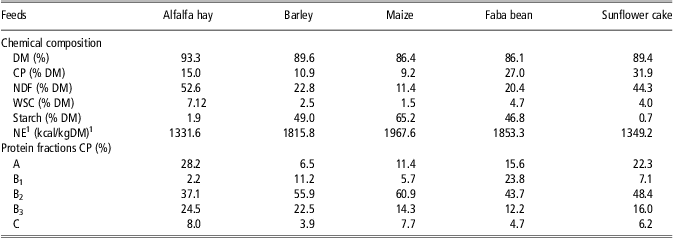
The trial was conducted in an experimental farm located in Sicily (temperature, minimum 14.7°C, maximum 24.2°C; humidity, 70%; day length, 13.49 h). Two groups (H and L) of seven Girgentana goats at second lactation were formed on the basis of milk production level (H group: milk production, 1100 ± 157 g/day; days of lactation, 144 ± 5.3; BW, 36.1 ± 2.9 kg and L group: milk production, 613 ± 138 g/day; days of lactation, 142 ± 5.4; BW, 35 ± 1.7). Goats were housed in individual pens with mangers subdivided into five separate containers. Goats were offered alfalfa pelleted hay, two sources of starch (whole barley and whole maize) and two sources of protein (whole faba bean and pelleted sunflower cake; Table 1). In each pen, water and salt were always available. During the pre-experimental period of 1 week, animals received a mixed ration of 1.5 kg of hay and 0.4 kg of each concentrate: a 7-day period during which goats received separately 1.5 kg of hay and a quantity of each feed gradually increasing from 0.2 to 0.5 kg. The adaptation period lasted for 7 days during which the animals received the experimental feeds (1.5 kg of hay and 0.5 kg of each concentrate). The free-choice experimental period lasted for 2 weeks. All the animals were managed according to the guidelines of the Animal Ethics Committee of the University of Catania.
Chemical composition and protein fractions of the feeds
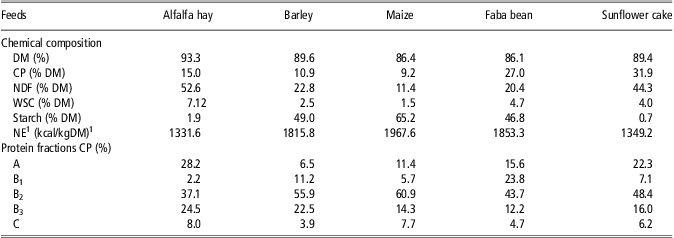
DM = dry matter; WSC = water-soluble carbohydrates.
1Net energy for lactation (Conrad et al., Reference Conrad, Weiss, Odwongo and Shockey1984).
A, non-protein N; B1, true soluble protein; B2, neutral detergent soluble protein; B3, neutral detergent insoluble protein, but soluble in acid detergent; C, insoluble in acid detergent (Licitra et al., Reference Licitra, Hernandez and Van Soest1996).
Data collection and analysis
During the pre-experimental period, DM intake was measured daily, milk production was recorded twice daily and individual samples of diet refusals and milk samples were collected twice. During the experimental period, individual intake of each feed was measured daily on the basis of residuals. Individual feed choice was continuously recorded for 7 days using a 24-h IR video surveillance system equipped with four video cameras, each pointed at the trough of three or four contiguous pens. The recorded video was then observed, and eating time dedicated by each goat to the single feed during the 24-h trial period was noted.
Twice a week, individual milk production was recorded and milk samples were individually collected from the morning and evening milking. Twenty-eight pre-experimental samples of diet residuals and three samples for each feed were analysed for DM), CP (Association of Official Analytical Chemists, 1990) and structural carbohydrates (Van Soest et al., Reference Van Soest, Robertson and Lewis1991). Water-soluble carbohydrates were analysed by a modified anthrone method (Deriaz, Reference Deriaz1961), starch by an enzymic procedure (Megazyme International Ireland Ltd, Bray, County Wicklow, Ireland). Protein fractions (A, non-protein nitrogen (NPN); B1, true soluble protein; B2, neutral detergent-soluble protein; B3, neutral detergent-insoluble protein, but soluble in acid detergent; and C, insoluble in acid detergent) were determined according to Licitra et al. (Reference Licitra, Hernandez and Van Soest1996), only for the three samples of each feed. Milk samples, consisting of proportional volumes of morning and evening milk, were analysed for lactose, fat, protein and somatic cells count by an IR method (Combi-foss 6000, Foss Electric, Hillerød, Denmark). Total nitrogen (TN), NPN and non-casein nitrogen (NCN) were determined by FIL-IDF standard procedures (International Dairy Federation, 1964). From these nitrogen fractions, total protein (TN × 6.38) and casein [(TN – (NCN × 0.994)) × 6.38] were calculated. Milk urea content was determined using a differential pH meter (CL10, Eurochem, Savona, Italy).
Individual pre-experimental and experimental data for intake, diet selection, diet composition, milk production and composition were analysed using the GLM procedure for repeated measures of SPSS (SPSS for Windows, SPSS Inc., Chicago, IL, USA). The animal was the experimental unit.
Results
The health status of goats, checked during the trial, was good. No clinical signs of disease were detected.
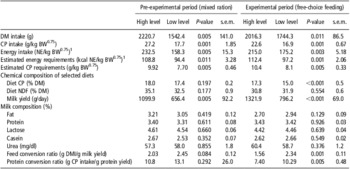
DM, CP and net energy intake were significantly higher in the H group, both with mixed (pre-experimental) and free-choice feeding system (Table 2). When fed with mixed diet, diet CP levels of both groups were similar, whereas it was significantly higher in the H group with free-choice feeding. No differences between the groups were found in NDF content of the selected diet.
Effects of milk production level on daily intake, CP, NDF and energy content of the selected diets, milk yield and composition, feed conversion efficiency and energy and CP balance during pre-experimental and experimental periods (n = 7)

DM = dry matter; NE = net energy; DMI = dry matter intake.
1Net energy for lactation (Conrad et al., Reference Conrad, Weiss, Odwongo and Shockey1984).
The difference in milk production between H and L groups tended to further increase with free-choice feeding. No differences have been found between the groups in milk composition. DM and CP conversion index were significantly improved in the H group only during the free-choice feeding.
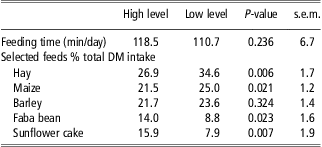
No difference was evident in terms of feeding time (Table 3). Diet components in the selected diet have been significantly affected by milk production level. Hay and maize were less selected, whereas faba bean and sunflower cake were more selected by the H group compared with the L group. No difference was found between the groups in barley selection.
Effects of milk production level on feeding time and feed selection (n = 7)
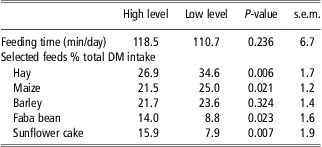
DM = dry matter.
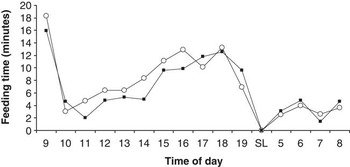
Feeding time trend during the day was not significantly influenced by milk production level (Figure 1).
Hourly feeding time (minutes dedicated to feeding during each hour of the day) in high production level group, H (-○-) and low production level group, L (-▪-) (n = 7; s.e.m. = 0.40; SL = sleeping).

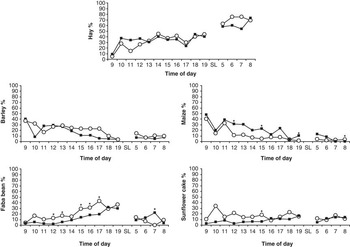
Hourly feed-selection daily trend, expressed as the feeding time dedicated to each feed in percent of the total feeding time (Figure 2), was partially affected by milk production level. Significant differences were detectable in the choice of maize, sunflower cakes and faba bean. According to the mean results for each feed (Table 3), maize was more selected in the L group at 1200, 1500 and 1900 h and was less selected at 0800 h (it should be specified that no more maize was available from 0700 h); sunflower cakes were more selected in the H group at 1500 h; and faba bean was more selected in the H group at, 1200, 1300, 1500, 1600 and 1700 h, and was less selected at 0700 h. No significant difference was evident between the groups in hay and barley selection, despite the higher level of hay found in the L group (Table 3).
Hourly feed selection (feeding time for each feed, expressed in percentage of the total feeding time during each hour of the day) in high production level group, H (-○-) and low production level group, L (-▪-). The s.e.m. for hay, barley, maize, faba bean and sunflower cakes were 1.87, 1.35, 1.38, 1.17 and 1.02, respectively (n = 7; *P < 0.05; SL = sleeping).

Discussion
The feeds were the same as those utilized in a previous free-choice study conducted on other goats, to evaluate whether the different genotype at αs1-casein locus (goats homozygous for weak, FF or strong alleles, AA) could affect diet selection (Avondo et al., Reference Avondo, Pagano, Guastella, Criscione, Di Gloria, Bernardo, Piccione and Pennisi2009). In such conditions, significant effects of genotype were reported. For this reason, in the present trial, we selected goats heterozygous at this locus (AF) to avoid any interference of genotype in the results.
Intake and diet composition
DM intake was higher than the data reported in literature for goats fed high-concentrate diets (Tovar-Luna et al., Reference Tovar-Luna, Puchala, Sahlu, Freetly and Goetsch2010; Serment et al., Reference Serment, Schmidely, Giger-Reverdin, Chapoutot and Sauvant2011), but lower than what we previously found in similar experimental conditions (Avondo et al., Reference Avondo, Pagano, Guastella, Criscione, Di Gloria, Bernardo, Piccione and Pennisi2009).
Taking into account the milk production levels and BWs in the L and H groups, the nutrients input was much higher than needed (Cannas et al., Reference Cannas, Atzori, Boe and Teixeira2008), both with mixed (pre-experimental period) and free-choice feeds. As a result, there was a significant increase in BWs (162.8 and 88.6 g/day, respectively, in the H and L groups) throughout the trial. In addition, Bava et al. (Reference Bava, Rapetti, Crovetto, Tamburini, Sandrucci, Galassi and Succi2001) found that lactating goats fed with a non-forage diet reached higher levels of intake than needed. What is rather surprising is that, despite the high-nutrient input, we found greater intake in the H group, which should be explained only with the different requirements associated with different milk productions. We could hypothesize that goats consumed more, simply as a consequence of the high palatability of feeds and the low fill effect of the concentrates and the pelleted hay. Increased feed consumption has been found directly proportional to ruminal escape (Huntington, Reference Huntington1997) and inversely proportional to total digestive tract retention time (Lindberg, Reference Lindberg1988). Indeed, taking into account that goats received whole grains, we could suppose that digestibility of feeds in the small intestine was reduced further. In such conditions, these assumptions could have, as a consequence, a lower-nutrient availability for lactation that, in turn, could also justify the different intake found in the two groups.
The H group selected less hay and maize and more faba bean and sunflower cake, reaching higher CP input and similar NDF input because of high fibre content in sunflower cake.
CP intakes were much greater than required (Cannas et al., Reference Cannas, Atzori, Boe and Teixeira2008); however, even in this case, differences between the groups seem to be coherently associable with different needs for lactation.
Selective behaviour
Video recording allowed the observing of the eating activity very clearly, even during the night, thanks to the IR system. When the goat heads were in each container on the trough, it was supposed that they were eating that feed, in accordance with Abijaoudé et al. (Reference Abijaoudé, Morand-Fehr, Béchet, Brun, Tessier and Sauvant1999). The jaw movements showed by the animals as soon as they moved their head from the containers confirmed the eating activity. In both the groups, the eating pattern was similar, showing a peak after the administration of feeds in the morning, followed by a period of lower feeding activity. Then the animals showed an increased eating activity until afternoon milking (1800 h). During the night, there was a negligible eating activity. Another period of intake occurred in correspondence with the morning milking. Fedele et al. (Reference Fedele, Claps, Calandrelli and Pilla2002) and Görgülü et al. (Reference Görgülü, Boga, Sahin, Serbester, Kutlu and Sahinler2008) found a similar concentration in feeding activity during the day and just a small activity overnight in free-choice fed goats.
Soon after feed administration, the diet choice in both groups was mainly addressed to maize and barley, and then the goats increased their selection for hay, the most selected feed, and to a lesser extent, for faba bean and sunflower cake, with the H group showing higher selectivity throughout the daylight for the protein-rich feeds. As mentioned earlier (Avondo et al., Reference Avondo, Pagano, Guastella, Criscione, Di Gloria, Bernardo, Piccione and Pennisi2009), the feeding behaviour observed during the 24 h could explain the good tolerance showed by goats to the high-nutrient input. In fact, apart from the 1st hour, it is possible to note that hay was more constantly present in the diet, on average, never <20% of hourly total feeding time, compared with concentrate feeds. As a consequence, the NDF content of the diet, associated with hay selection, has probably exercised a ‘curative’ effect that enabled the goats to continue the intake of very high levels of starch, without manifesting any signs of disease. Moreover, it must be taken into account that maize, barley and faba bean were given as whole grains. This certainly contributed to a more intense chewing activity for these feeds, allowing the animals to produce more saliva, whose buffering effect in ruminal environment is well known. Previous studies, conducted in similar high-concentrate feeding systems, report no metabolic disorders derived from feeding: Yurtseven and Görgülü (Reference Yurtseven and Görgülü2004) concluded that goats could consume high-level concentrate (75% to 77%) without having any metabolic problem. Abijaoudé et al. (Reference Abijaoudé, Morand-Fehr, Tessier, Schmidely and Sauvant2000) reported that goats avoided acidosis with their feeding behaviour, organizing the distribution of the diet throughout the day. In turn, Görgülü et al. (Reference Görgülü, Boga, Sahin, Serbester, Kutlu and Sahinler2008) affirm that the success in diet selection in free-choice fed lactating goats can be explained by hourly arrangements of feeding behaviour. All these findings seem to support the hypothesis that animals can learn the metabolic consequence of feed intake and modify their feeding behaviour to avoid negative perceptions (Provenza, Reference Provenza1995).
Total time spent in eating was lower in comparison with the data in literature (Morand-Fehr et al., Reference Morand-Fehr, Bas, Blanchart, Daccord, Giger-Reverdis, Gihad, Hadjpanayiotou, Mwlem, Remeuf and Sauvant1991; Rapetti et al., Reference Rapetti, Bava, Tamburini and Crovetto2005). This result could be justified by the type of feeds on offer, represented by concentrates and pelleted hay. In fact, our results were in line with the data reported by Abijaoudé et al. (Reference Abijaoudé, Morand-Fehr, Tessier, Schmidely and Sauvant2000) in goats fed with high concentrate levels. The time dedicated to feeding was not significantly affected by the level of milk production.
Milk production and quality
Shifting goats from the pre-experimental diet, based on a mixture of the same feeds used during the experimental period, to the free-choice feeding caused more than 20% increase of milk production in both the groups. This result could be because of the increased levels of concentrate consumed by goats. Such an increase occurred, despite the late-lactation stage of goats, at the end of the trial on average at 178 days from parturition, and it is known that the effects of nutritional treatments in mid-late lactation are often more evident on BW gains than on milk yield (often unchanged or reduced; Bocquier and Caja, Reference Bocquier and Caja1993). However, Görgülü et al. (Reference Görgülü, Kutlu, Demir, Torun, Ozuyamik and Kutulu2003 and Reference Görgülü, Boga, Sahin, Serbester, Kutlu and Sahinler2008) hypothesized that choice feeding has a potential to increase lactating performance. Lindberg and Gonda (Reference Lindberg and Gonda1997) emphasized that the selective feeding behaviour of goats can have a marked influence on the dynamics of digestion and, as a consequence, on the nutrient utilization of a diet.
Milk composition was similar in both groups. No dilution effect was evident in the H group for milk components. As expected, milk fat was low and concentration was further depressed by high starch levels in the diet selected by the goats. An inverse fat-to-protein ratio has been found in both the groups. As reported earlier, the frequency of this phenomenon is not rare in goats and it tends to increase from a low roughage to concentrate ratio (Morand-Fehr et al., Reference Morand-Fehr, Tessier, Meschy and Sauvant2000; Avondo et al., Reference Avondo, Pagano, Guastella, Criscione, Di Gloria, Bernardo, Piccione and Pennisi2009), but is also evident in grazing goats (Di Grigoli et al., Reference Di Grigoli, Todaro, Di Miceli, Alicata, Cascone and Bonanno2009). As mentioned earlier (Avondo et al., Reference Avondo, Pagano, Guastella, Criscione, Di Gloria, Bernardo, Piccione and Pennisi2009) urea content was high, coherently with the high protein input reached by goats, both with mixed and free-choice diets and independently from milk productions. It could be assumed that more CP consumed by the H goats was more efficiently utilized to support the higher milk output. Milk urea content was high because of the protein inputs reached by the goats and the results were over the range values for Girgentana goats as reported by Bonanno et al., Reference Bonanno, Todaro, Di Grigoli, Scatassa, Tornambè and Alicata2008). However, Rapetti et al. (Reference Rapetti, Bruni, Zanatta and Colombini2009) reported that about 75% of the bulk milk urea content in dairy goat farms of Lombardy was higher than these standard levels, which also report 68.8 mg/l of range variability.
Conclusions
From these results, we are unable to conclude that the goats can select their diet to meet their requirements. In fact, goats ate much more than what was needed. However, when free to choose their diet, the animals improved their milk performance, despite the late-lactation stage. Indeed, the group at higher production level showed higher intake and selected more protein-rich feeds, coherently with higher milk yield. During the 24-h trial period, hay was the feed more constantly selected. This behaviour has probably exercised a ‘curative’ effect that enabled the goats to continue the intake of very high levels of nutrients, increasing their milk production with no clinical signs of disease. In the light of positive response of goats to the free-choice system, further studies are needed to optimize the system, testing less protein-rich feeds and more sources of roughages.