Stuart Hall, one of Britain’s great thinkers in cultural studies, addressed the responses of white people in Britain to discussions of racism and empire through a series of talks he gave in 1978 and within his developing written work. In his 1979 essay on ‘Race and “Moral Panics” in Post-war Britain’, Hall contemplated ‘the tendency to abstract race from the internal dynamic of the society’ in Britain among both the ‘Liberal left’ and the ‘Right’.Footnote 1 He captured the view common among white people on both sides of the political spectrum, which argued: ‘Racism is not endemic to the structures of British social life, it has nothing intrinsically to do with the dynamic of British politics, or with the economic crisis: it is not part of English culture – it does not belong to the English ideology. It is an external virus injected into the body politic.’Footnote 2
Through this lens, racism was something that could be solved through addressing the size or shape of the population of Black people in Britain, by applying policy measures such as controls on immigration. Hall’s response to this conceptualisation of racism as external to British life was a long-form essay on Britain’s imperial past and a present shaped by concerns about race, in which he ultimately argued of this conceit, ‘I hope to persuade you this cannot be true.’ For Hall, racism was foundational to British culture, society and state. It was part of the fabric of modern Britain and not easily separated, or faced, as a result.
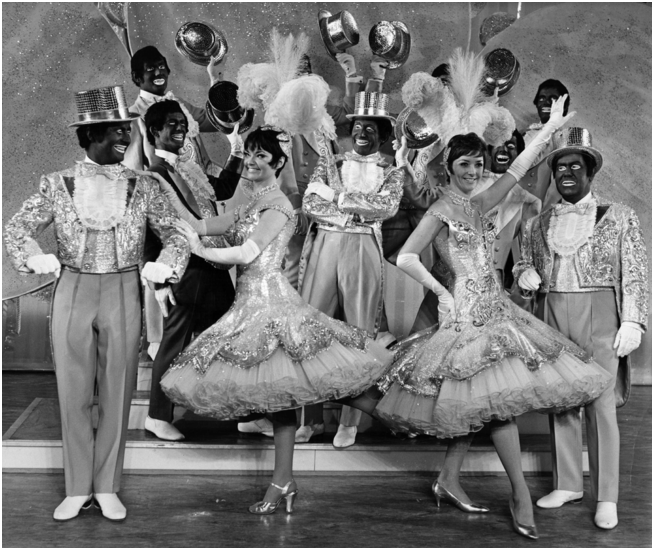
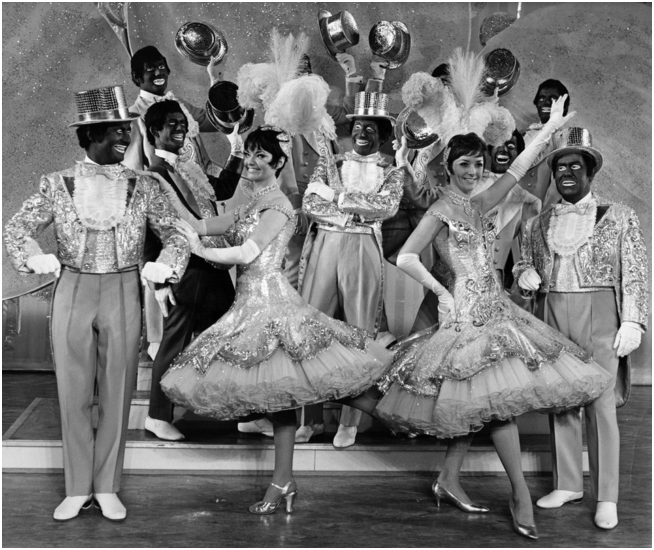
As a Black viewer of television in Britain, Hall would have been familiar with the BBC’s long-standing television hit, The Black and White Minstrel Show, which had only ceased to be broadcast in 1978. For 20 years between 1958 to 1978, the tremendously popular song and dance variety show had appeared on the BBC, the nation’s central television broadcaster. Every prime-time Saturday evening, viewers watched the ‘Mitchell Minstrels’, white men who performed in blackface makeup with white circles painted round their mouths and eyes. They wore matching outfits usually consisting of white trousers, waistcoats, colourful ties and white top hats pulled over woolly black wigs and performed alongside a white female dance troupe, ‘The Television Toppers’. The prodigious run of The Black and White Minstrel Show throughout these decades made for a remarkable hit for the BBC but it also exists like a steady and unacknowledged tick of a metronome accompanying every major race relations event that occurred from 1958 to 1978. The Black and White Minstrel Show came to the screen two weeks before the Notting Hill and Nottingham race riots in the summer of 1958 and had been broadcasting for not quite a year when a young Black man from Antigua, Kelso Cochrane, was stabbed to death by white youths in the same neighbourhood.Footnote 3 The show continued every week while the first Commonwealth Immigrants Act was enacted in 1962; the first Race Relations Acts were passed in 1965 and 1968; and when the 1976 Act was also passed. It was on television while the Race Relations Board struggled to appoint members to an organisation that was meant to enforce the first Race Relations Act in 1965.Footnote 4 The Black and White Minstrel Show was on screen when the 1968 Olympics were broadcast in October, showing Tommie Smith and John Carlos raising their fists in the Black power salute; when Black leaders in Britain were beginning to ‘think Black’ as Rob Waters has documented; and as Martin Luther King Jr, Malcolm X and Stokely Carmichael visited the country.Footnote 5 The show was also on – by then in glaring colour – in British homes when Enoch Powell made his ‘Rivers of Blood’ speech in April 1968; when the National Front made its first minor gains in politics and throughout the 1970s; and as race relations seemingly worsened in the face of rising white nationalism in the country. As Stuart Hall cemented his own critical work on class, race, politics and media at the University of Birmingham, The Black and White Minstrel Show went on and on.
The Black and White Minstrel Show was remarkable at the time for its success and longevity; to the historian, it is remarkable because it was so deeply enmeshed in racist imagery and yet was tremendously popular. Very few people in the third decade of the twenty-first century can see glimpses of the programme and deny that its premise was disturbing. It remains a rather shocking example of what was acceptable when it came to everyday attitudes towards racial imagery on screen. However, protests against the show did occur at the time, and in 1961 the show was criticised by Flamingo, a small magazine written by Black authors for predominantly Black readers, who recounted the offence that the show caused to these viewers. Black audiences described their experiences as viewers who chose to turn the telly off while having physical reactions of shame and disgust at the programme’s overt racism.Footnote 6 However it was not until 1967, when a petition to remove the programme was presented to the BBC, that a discussion would occur in the national press about the show’s practice of blacking up. The petition, put forth by Trinidadian Clive West and supported by the Campaign Against Racial Discrimination (CARD), identified the show as a ‘hideous impersonation’ that was ‘quite offensive and causes much distress to most coloured people’.Footnote 7 The white executives behind the show’s success, the white performers starring in it, and the white audiences enthusiastically consuming the show, did not share this reaction and instead viewed it as a pleasurable, inoffensive programme featuring cheerful singers and dancers. The Black and White Minstrel Show was repeatedly labelled by BBC representatives, the show’s stage-producer himself and audiences as a harmless ‘tradition’ that could not, and certainly should not, be interpreted as offensive. Black viewers, according to white viewers and supporters, were viewing this show incorrectly and seeing racism where it did not exist. Television and theatre critics such as Milton Shulman writing for the Evening Standard in 1967 argued that the show was actually doing a service to Black people:
In addition to the undemanding pleasure it gives me, I have always thought The Black and White Minstrel Show was one of the few programmes on the air that effectively preached and practised racial tolerance. It is the only programme that regularly shows coloured men – even if only in black make-up – cuddling, cooing, loving, and courting white girls.Footnote 8
By Shulman’s estimate, the programme’s use of minstrelsy offered a type of vehicle for racial integration while also providing an ‘undemanding pleasure’ for the white television viewer.
Performers from The Black and White Minstrel Show in 1969. The programme ran on the BBC from 1958 to 1978.
Stuart Hall was already living in the country when the minstrels made their debut. Hall is seldom claimed as a Black audience member: his interest in the cultural formation of the imaginary vaulted academics such as Hall out of the realm of the audience and into an emerging field of ‘mass communication’, or in Hall’s case ‘cultural studies’. Yet it was his role as a Black man in the audience watching film and television in both Jamaica where he grew up and in Britain where he moved as a young man that likely prompted his close, consistent examination of what a white media taught British people about Blackness on screen and his eventual supervision of a doctoral student with the British Film Institute on the very subject.Footnote 9 As Hall recounted of his youth, he ‘went to cinema religiously on Saturdays’ with a group of friends or his Aunt Mavis on Saturday afternoons.Footnote 10 Hall’s astute sense as a viewer and imbiber of popular culture contributed to his sharp arguments about race and representation in both his written work and then on screen in 1979, in a 25-minute television episode put together by the Campaign Against Racism in Media (CARM) of which Hall was a member.Footnote 11 The programme, ‘It Ain’t Half Racist Mum’, a play on the title of the popular BBC series, It Ain’t Half Hot Mum, then being broadcast on BBC, was broadcast on the BBC’s Open Door series, which was ostensibly open to public broadcasting but which also saw CARM argue that organisations such as the BBC persistently equated immigrants and Black people with ‘problems’ in the British news cycle.Footnote 12 The master-class of media analysis that Hall and his co-presenter took the audience through showed how the language and presentation of a ‘neutral’ broadcaster became a powerful means of upholding Black inferiority.
A few years later, in a defence of CARM’s approach and the programme, Hall wrote about the audience the organisation and the programme was attempting to reach. He discussed the decision to avoid speaking to the political left and to instead concentrate on those viewers ‘struggling over the muddy and confused middle ground: the ground where Powellism, Thatcherism and the National Front have, in recent years, made such remarkable headway’.Footnote 13 For Hall, trying to change the minds of this audience was the primary purpose of the programme, even if he seemed ambivalent about the end result, noting that ‘CARM’s intervention could not be anything but a tiny movement in a long war of position, on the stony ground which television, regularly, delivers to the wrong side’.Footnote 14 That stony ground remained so, and the British population’s deep amnesia about and avoidance of race remained a central component of the audience. Hall wrote of the act of forgetting of imperial conquest and imperial ties that were central to modern attitudes towards race and immigration in post-war Britain. He argued that the ‘racism of the post-war period begins with this profound forgetfulness – the loss of historical memory, the collective amnesia, the ideological repression – which has overtaken the British people since the “end of Empire” in the 1950s’.Footnote 15 This ideological repression, and that collective amnesia, is something that this book will extend to the end of the twentieth century, to investigate just how stony that ground was, and just how tiny but important a moment CARM’s intervention was in 1979, the year after The Black and White Minstrel Show went off the air.
This is a book that is about a history of not knowing racism in twentieth-century Britain and the relationship of this not knowing to film and television content, their audiences, and how audience wants were envisioned in the period. It is about a concerted effort in the twentieth century by the vast majority of white Britons, both ordinary and extraordinary, to turn away from knowledge about racism’s existence in the country and its impact upon racialised people, in an effort to maintain a racial comfort for white viewers that, in turn, allowed everyday racist imagery to flourish within television and film. This research centres on the ordinary, everyday racism that was denied by the white British public and the British media and yet was evident in both as ‘what the audience wanted’ was considered and provided by television and film producers, script-writers, and the nascent field of audience research. It examines racial formation in twentieth-century Britain, not through attention to the political and social spheres that have preoccupied Marc Matera and others, but through the often-overlooked constitution of British screen culture for white British audiences.Footnote 16 It posits that a look at the central television and film organs of the nation can tell us something vital about what ordinary people knew, and also wanted to know, about ‘race’ in the period. The remarkable 20-year run of The Black and White Minstrel Show on British screens, an enduring example of giving the audience what it wanted, offers an entrance to examine this overlooked story of twentieth-century British history and the considerable effort to not see racism in the country. The defences of The Black and White Minstrel Show by BBC and ITV executives, white British audiences, the press and television critics, censors and screen regulators, as ‘not about race’ but also obviously all about race marked both a consensus of effort and a pattern of evading knowledge of racism that became an enduring feature of British national identity in this period. This selective and sought ignorance about racism was sheltered in the spheres of pleasure offered to audiences by the big and small screen and informed the content and production of both in profound ways.
To not know racism’s broad contours and impact in the great age of immigration and at the end of the British empire did in fact take some work by white audiences and producers of screen culture. While historians such as Michel-Rolph Trouillot and Ibram X. Kendi have convincingly shown the inability of white enlightenment thinkers to conceive of or see Black achievement or Black emancipation in the eighteenth century, twentieth-century Britain was not such a place.Footnote 17 Knowledge about a broader spectrum of racism that went beyond the racial violence in the US was increasingly available in a century that was ever mediatising, even if that knowledge was highly contested. Erik Linstrum’s work on colonial violence at the end of empire has argued effectively that that knowledge in Britain of this violence was ‘never altogether absent’ and existed in diverse sources such as newspaper reporting, radio broadcasts and regimental magazines.Footnote 18 Racist ideologies and actions were broadcast on the news as existing in the establishment of apartheid in South Africa; it was spoken of by Black American leaders quoted in the press and on television; it was dramatised in televised BBC plays and American films starring Sidney Poitier and a handful of other Black actors; and it was evident in the discussions of Black and Asian leaders with other white thinkers, as Priyamvada Gopal has shown.Footnote 19 Racialised immigrants themselves, as they arrived and settled across the UK, repeatedly prompted a discussion of racism’s range – its contours, its sharp edges, its mild faces and blunt words, its hardening eyes through the passage of three race relations acts from 1965 to 1976. Whether it was a thing to be acknowledged, denied or rationalised, the information was uneasily out there in the world that Black men and women experienced different treatment than white people. To maintain racial ignorance in the twentieth century took some effort.
This book grapples with firstly, the imagining of audience preferences by producers and regulators of screen culture when it came to presentations of ‘race’ on the big and small screens and secondly, the work that film, television and the developing field of ‘audience research’ did in sheltering, nurturing, measuring and even creating that inability to see or know racism. The contours of that consensus around racial ignorance would significantly structure British media’s inability to acknowledge and address racism and in turn deeply inform the experiences of Black and south Asian women, men and children in the country. This book positions British media and its screen culture as a vital site of racial formation and a producer of a wilful racial ignorance in the twentieth century.
I.1 Not Seeing Racism: Critical Race Theory and Histories of Not Knowing
A historical examination of ‘not knowing’ is not an ideal subject for historians. The topic resists methodologies in the discipline that remain wedded to the empirical and to archival spaces that are presented as sites of provision rather than obfuscation. As Trouillot wrote, the edges of not knowing are so slippery that it is almost impossible to know where the beginning and endings of this chasm of the unthinkable lie. There are also, as Trouillot has charted, myriad ways of not knowing in the past—there is that which cannot be conceived of, things to innocently ignore and realities to avoid. Trouillot’s work is probably one of the best examples of a concerted history of not knowing or seeing, tracing that which was ‘unthinkable’ to European elites when it came to the abilities of Black men and women in the empire.Footnote 20 The history of empire remains the most notable field where some form of ‘not knowing’ lurks at the edges and margins of most works, occasionally coming to the centre. It is in the classic debates between Bernard Porter and John MacKenzie about Porter’s ‘absent-minded imperialists’ who, according to him, hardly seemed to know what they were doing or reflect upon this in the massive project that was empire. MacKenzie’s responses across multiple books and taken up by others point to the sheer presence of empire in the everyday as a means of questioning how much ordinary Britons did not know about empire.Footnote 21 These works argue that ordinary Britons were surrounded by an everydayness of empire and imperial products. Yet few of these works touch on what ordinary Britons could afford to ignore when it came to empire’s presence in the everyday. Linstrum, on the other hand, does just that when he takes us into the post-war period and argues that ordinary Britons were also surrounded by stories of the violent end of empire and the colonial conflicts that accompanied this. By his account numerous bodies including the press, the BBC and even ex-soldiers made this evidence visible and ordinary to the public if not appetising. Together this work paints a picture of ordinary Britons steeped in the material goods and evidence of empire in advertising, medicine, museums, gardening, steam travel and the bloody images of atrocities in the colonies, but still maintaining only a vague knowledge of the specific workings of empire.Footnote 22
Priya Satia’s work on ‘agnatology’, the study of wilful ignorance, preceded by her history of ‘a state that could not see’ in interwar Britain and Arabia takes the debate about how much people saw and knew of empire in different directions, uncovering what political structures embrace in the absence of knowledge about racialized people.Footnote 23 Her earliest work looked at what state actors turn to when official knowledge or intelligence of a place or people is absent, arguing that concepts of the mysterious and secretive Arab rooted in popular culture filled this space in the minds of intelligence officers. Satia’s later work examines the turning away from empire among ordinary Britons that was apparent between the wars and which was, she argues, further developed by the newly democratic liberal state in order to conduct foreign policy away from the prying eyes of the masses.Footnote 24 Bill Schwarz, Wendy Webster and Jordanna Bailkin have taken this wilful absence of knowledge into the post-war period as a means of discussing popular responses to immigration rooted in the collective amnesia that Hall, as well as Paul Gilroy, had previously raised.Footnote 25 Webster starts her classic Englishness and Empire with a discussion of the public’s widespread ignorance about empire’s practicalities, and particularly the 1948 ‘Social Survey of Public Opinion in Britain on Colonial Affairs’, to establish the lack of basic knowledge that ordinary Britons had of Britain’s colonial territories and peoples in the immediate aftermath of the war.Footnote 26 Confusion reigned about which countries were colonies and more than half of the respondents did not name India or Pakistan as ‘colonies, which in the past year, have been given more responsibility for governing themselves’.Footnote 27 Ordinary Britons showed a stunning lack of education about both the empire and people from the colonies, even as subsequent historians have demonstrated that elements of the colonial and commonwealth governance structured a variety of post-war public initiatives, including controls around advertising, early forms of the NHS, social care and the formation of the charity sector.Footnote 28
However, not knowing about the specifics of empire and its workings should not be confused with not caring about empire. Ordinary Britons and even some politicians might have been confused about the differences between dominion, protectorate and colony but that did not mean that they did not care deeply and passionately about empire and attach considerable emotion to it. Book knowledge of the empire was and still is not the best way to measure whether the public cared and were invested in the British empire. Film and television producers, directors and regulators in Britain understood this when it came to imperial and racialised imagery on the screen. The empire sells. It was what film-producers and film-makers such as Stephen Tallents and John Grierson believed when they spearheaded the Empire Film Unit; it was what the film-director Korda brothers understood when they set numerous fantastical stories in the empire; and it was what advertisers imagined when they drew on often misleading and factually incorrect imagery of empire to sell their wares.Footnote 29 The details mattered little in the face of audience want when it came to empire. In particular, the triumphant story of white supremacy within empire is what brought audiences to the screen. One of the contentions of this book is that the specific elements of this emotional attachment to the empire by white Britons in the twentieth century requires new attention by historians as part of the emotional framework of racism, including scrutiny of the pleasures associated with white superiority and racial inferiority.
The history of emotions, as it currently stands, is not particularly well equipped to address the historic intersection of emotions with racism and racialised thinking, with that field’s overwhelming attention to the feelings and thoughts of white communities.Footnote 30 The ways in which select emotions, such as fear or anger, have been racialised as dominant within one minoritised group or how several emotions have been prized as particularly absent from the dominant white group have been left unexplored in the history of emotions but are touched upon in this book. Media history has also been curiously divorced from the history of emotions, perhaps an implicit acknowledgment that media as it functioned in the twentieth century traded primarily in its enormous ability to emotionally connect with or steer audiences. It was why governments invested so heavily in ‘media relations’, however poorly conceived, in the interwar period and during World War II, only to cede the ground to the field of advertising and audience experts in the post-war period. It is ultimately at the intersection of the history of emotions and the history of media that we encounter just how much white audiences cared about empire, all while knowing, often willingly, little of its workings.
My attention here to the history of white audiences who evaded, avoided, and actively worked to not know race and racism contributes to an existing field of scholars in critical race theory studying claims and practices of colour blindness or racial ‘ignorance’ and ‘innocence’ among predominantly white populations in a range of settings; colonial, settler, and post-colonial.Footnote 31 Most often associated with the field of legal studies in the United States, critical race theory emerged in the 1970s and 1980s to examine the seemingly ‘colour-blind’ systems of law in the country, an approach which was then quickly taken up by scholars of pedagogy to grapple with university environments which also claimed colour-blind meritocracy.Footnote 32 Both strands involve a careful and meticulous unpicking of systemic racism in the courts and in educational settings through a concerted examination of not just text but repetitive meaning, implications and behaviour which highlight how deeply racialised these supposedly colour-blind sites really are. Such deep unpicking of the myriad structures of seemingly invisible race-making was not limited to the United States. In the same period, Stuart Hall, Dick Hebdige, Paul Gilroy and others working within and adjacent to Birmingham’s Centre for Contemporary Cultural Studies were engaged in an similar excavation of British culture’s meaning, practices and associated repetitive behaviour when it came to racialisation and empire’s legacy.Footnote 33 This deep archival investigation of the manifestations and ripples of racial formation in Britain echoed what was happening in the United States.Footnote 34 Collectively this scholarship, which has since extended into philosophy and other fields, represented a burgeoning trans-Atlantic understanding of racialisation’s operations in the 1970s and 1980s and goes beyond the common argument at the time that racist behaviour and ideology stems from a lack of understanding, or knowledge, among white people of Black, south Asian or minority ethnic experiences. Taken together as a body of work on, and adjacent to, critical race theory, this trans-Atlantic research examines strategic ignorance or lack of knowledge as central to a range of practices, concepts and beliefs that underpin the very function of law, education, culture and media in majority white societies.
Within the framework of critical race theory that this book turns to repeatedly, racial ignorance and innocence is not just ‘a lack of’ knowledge about race to be corrected but instead can be viewed as an active, invested and strategic means of relating to and maintaining subordinated populations. What can seem to be inadvertent oversights or lack of education are instead linked to a deliberate, albeit often unacknowledged, avoidance of new information that would unsettle or disturb. As the philosopher Charles W. Mills argues, the end result is an: ‘[i]nverted epistemology, an epistemology of ignorance, a particular pattern of localised and global cognitive dysfunctions (which are psychologically and socially functional), producing the ironic outcome that whites will in general be unable to understand the world they themselves have made’.Footnote 35 Shannon Sullivan and Nancy Tuana further sum up this irony: ‘Even though – or more accurately, precisely because – they tend not to understand the racist world in which they live, white people are able to fully benefit from its racial hierarchies, ontologies, and economies.’Footnote 36 This lack of racial perception or knowledge of racism experienced by Black people becomes a means of preserving the social, economic and political privileges derived from it. The act of not knowing is thus wilful and ultimately serves that person who has that luxury of an absence of knowledge. Together these works formed a subset of ‘whiteness studies’ that can be dated back to the works of Frederick Douglas but also include David Roediger and Richard Dyer.Footnote 37 Research in anti-racism education, a field with its own blind spots, has also worked to identify what Robin DiAngelo refers to as a type of shared script among white people; the repetitive expressions of white people’s discomfort when presented with evidence, or claims, of experienced racism.Footnote 38 The field of anti-racist education and training has done much to draw attention to what white people in a supposedly post-racial world do when faced with evidence of their own participation in upholding racist systems of thought, behaviour and institution-making.
What has stood out to me as a historian, as I considered the shared scripts of whiteness identified by people such as Bonilla-Silva and Reni Eddo-Lodge were the patterns of behaviour I also saw within archival sources on twentieth-century Britain.Footnote 39 The defensiveness, the tone-policing, and the convoluted rationales or false equivalencies offered by white people in areas of law and education in late twentieth- and early twenty-first-century America when asked to consider racism and their role within it are evident in archives of history that are wide-ranging in terms of time frames and geographic coverage. In the case of Britain we have a country that has never claimed, such as the US briefly did in the twenty-first century, to be ‘post-racial’ but rather has asserted it was, and is, racially tolerant or racially blind instead. This claim has functioned, however, in much the same way. As Kennetta Hammond Perry has noted, these were ‘the imagined antiracist ideals tethered to notions of what it meant to be British’ in the post-war period and as the riots in Notting Hill broke out.Footnote 40 The resonance of these arguments in post-war Britain, which demonstrably had a ‘race problem’ of a dominant white population that was both hostile to visible minorities and yet claimed on public stages and at various legislative moments that it was not racist, offers a vital framework for examining this interplay of deniability and racialising practices. Indeed, some historians of post-war immigration and Black history have engaged with critical race theory’s more trenchant observations. Hammond Perry, in particular, discusses the ‘mystique of British anti-racism’ which she sees as being in dialogue with Eduardo Bonilla-Silva’s work on colour-blind racism.Footnote 41 Rob Waters’ Thinking Black, and his talk at the Institute of Historical Research, also hints at the alternative epistemological frameworks discussed in this book and which are vital to the ‘counter-storytelling’ that critical race theory identifies as a key element in working against colour-blind racism (discussed in Chapters 2 and 5).Footnote 42 The flexibility that historic Black communities exhibited in collapsing the distinctions between the past and present is a vital attempt to bring past and present trauma into the same framework in order to convey the emotional weight of not only thinking Black, but also feeling Black in environments claimed as racially tolerant.
If historians are already engaging with elements of critical race theory, is it particularly important to label this as such? I began drawing on critical race theory in earnest in 2016, a tremendous year in retrospect but one that did not include much, if any, public discussion of critical race theory outside of academia. Nowadays, one could be easily excused for running the other way at the very mention of it with all the negative attention it has garnered first in the US and then in the UK.Footnote 43 In part that attention indicates just how salient and sensible the work of critical race theory is to most who encounter it, and it is one of those theories of knowledge and behaviour that quickly transcends the academic in many ways.Footnote 44 My hope is that the current furore and misunderstandings of critical race theory will ultimately not turn academics away from what is a fruitful and useful field of academic study. Historians have, after all, worked across disciplinary boundaries before and have increasingly engaged with the so-called post-colonial turn ushered in by the work of Edward Said. Critical race theory offers the field something unique particularly due to the origins of its framework, where picking through the ‘colour-blind’ spheres of the courtroom, legal records and cultural texts invokes the historian’s methodologies, scouring the archive for the spoken, the inferred, the webs of presence and absence in the historical record.
Perhaps the most practical contribution of critical race theory is firstly, its ability to identify and parse out the behaviours and patterns of white superiority and imagined racial inferiority across a range of geographical and temporal settings and secondly, to show the durability and fluidity of racist thinking in multiple settings. Critical race theory manages to cut across and work within both the post-colonial turn and the relatively new attention to settler colonialism in the field, while also accounting for the persistent patterns of behaviour among white people when faced with the presence of Black people and other people of colour. It offers a map of behaviour rooted in racial superiority that can be tested in all the settings that historians explore and within the frameworks of knowledge that govern these. Marc Matera, Radhika Natarajan, Kennetta Hammond Perry, Camilla Schofield and Rob Waters have called for historians of twentieth-century Britain to place racial formation at the centre of their work as a category of analysis itself, and although they largely turn to works from sociology for frameworks to do so, critical race theory does a similar, and I would say an even more convincing, job of noting the work of whiteness across time, space, place and peoples.Footnote 45 It is less bound by national frameworks and instead oriented towards the frameworks of whiteness that sit within people, regardless of place or space. Waters’ recent effort to uncover the racial framework underpinning ‘racial liberalism’ in post-war Britain is one such example that draws upon, perhaps unwittingly, the approach of critical race theory.Footnote 46 A direct engagement with the field and its builders could make similar explorations an accessible and vital new direction within our discipline. This focus upon how whiteness works in various settings allows us to see moments when it works against or around empire and decolonisation in the cultural imaginary, which itself is an overlooked site of political persuasion in the period I examine.
Historians have been willing to examine shifting epistemological frameworks since the so-called discursive turn, yet historical accounts that intersect with epistemologies of racial perception and its absence, in other words how social actors ‘know’ or ‘see’ codes and experiences of Blackness, are in short supply compared with works on historic epistemologies of gender and sexuality.Footnote 47 Both the relative scarcity of works doing this, and the usefulness of explicitly incorporating critical race theory into our work as historians is, I think, due in part to the whiteness of the field and university environments more broadly, as Nicola Rollock has shown.Footnote 48 In the UK, the Royal Historical Society’s Race, Ethnicity & Equality in UK History: A Report and Resource for Change published in October 2018 highlighted the discipline of history as an overlooked site of whiteness studies, with a disproportionate number of white academics teaching a disproportionate number of white students, in a curriculum that has been disproportionally preoccupied with the histories and experiences of white groups.Footnote 49 The report resonated throughout the profession as History departments grappled with the lack of representation of Black and minority ethnic staff and content in the discipline.Footnote 50 If one looks to the field of twentieth-century British history in the last 20 years or so this particular problem looks even more pronounced considering the role of immigration and empire in that century. What we have then are potentially colour-blind historians in Britain writing equally colour-blind histories of the twentieth century, unable to see their topic as related to race or racialised thinking in the period or cramming the experience of multiple minorities into a few pages or a slim chapter. Alongside this is the excellent work of historians working on twentieth-century Black British history.Footnote 51 But perhaps this too reflects a certain history of the country as well. Regardless, critical race theory would seem to offer historians a two-fold benefit: a framework for examining the repetitive scripts of whiteness that mark out parts of British history as ‘not about race’; and language and conceptual frameworks to interrogate the racialised practices, habits, and preoccupations of history-making as well.
I.2 Film, Television and the Racially Innocent Audience
Critical race theory has a further vital place in a history of British screen culture where sites such as television have been historically tied to concerns about ‘neutrality’ that situate it, impossibly, as colour-blind. Neutrality became a powerful term in British media history early on, built on concepts of ‘public service’ attached to the birth of broadcasting in Britain and a commitment to offering both sides of every story. Lord Reith argued, on the eve of the BBC’s shift from company to corporation in December 1926, that ‘the BBC has tried to found a tradition of public service, and to dedicate broadcasting to the service of humanity in the broadest sense’.Footnote 52 Prime Minister Stanley Baldwin described the BBC in that same month as ‘keeping itself, as it always had done, free from personal bias, from personal feeling, and was disseminated what it always does, the bare, uncoloured truth, and nothing else’.Footnote 53 This definition of public service was strengthened by the activities of the Ullswater Committee (1935) and others after it, including the Beveridge Committee (1949–1951) and the Television Act of 1954, even as a range of dailies continued to debate evidence of bias within the BBC. From 1968, The Times digital archive records ‘neutrality’ as a term openly used in letters to the editor regarding the BBC as members of the public argued for, or against, the integrity of the BBC’s screen content and its independence from the state.Footnote 54 Official and public concerns about public service and neutrality, and a not unrelated vigilance against bias, while seeming to apply more to journalism than the production of film or television sitcoms, nevertheless still informed the institutional production and regulation of fictional storytelling on screen. Concerns about neutrality acted as a type of boundary-making around most programmes, marking the limits of acceptability even as the BBC marched into the 1960s. While the methodologies of cultural history and the post-structuralist or cultural turn in our discipline from the 1980s highlight the impossibility of neutral storytelling in media sources, this framework of knowledge was central to what audiences knew, or expected, particularly from the BBC. Consequently, this book concentrates on the highly racialised framework underpinning seemingly neutral spaces such as television production.
At the heart of this book are the audiences, both Black and white, who watched film and television in the twentieth century, and how these groups were imagined, served, shaped and measured by a relatively new field of ‘audience research’. As I have written previously, the ‘audience’ has for far too long been only peripheral to the preoccupations of those working in the field of cultural history.Footnote 55 It is often only briefly inferred or sketched out, partly because of the lack of primary sources produced by audiences about the culture they encounter, however widely conceived. What we have been left with instead are countless histories of the culture itself, the representations or texts that audiences or consumers purchase, with little sense of their experiences engaging with these. This book, in many ways, is a long-form effort to think through the audience and excavate it. It offers a multifaceted and wide-ranging approach to the audience by examining the ways film and television audiences were conceived of by the government, regulators, producers, directors and also the field of audience research, which was uniquely tasked with knowing and measuring the audience. This project certainly speaks to Adrian Bingham’s invitation to historians of the twentieth century to recognise Britain as a ‘mediated democracy’ full of various forms of media consumed by ordinary people as a matter of course.Footnote 56 Trying to locate the audience has at times, I will admit, felt like nailing jelly to the wall. The answer that this book provides to the question of the ‘absent audience’ in cultural history is one that ultimately points to the audience as largely a construct of these people and organisations, and very seldom a reality. The audience was both a figment of imagination among various groups, imagined in certain ways as behaving rationally and consistently, but was also at times an awkward reality such as when Black and south Asian audiences responded negatively to what was on the screen, or when white audiences spoke bluntly of their beliefs in racial inferiority. This book chases both the image and the reality of the audience and in the process offers a view of media production and consumption in twentieth-century Britain as something quite rigid and slow to change and built on rather shaky foundations as white, middle-class executives and researchers imagined audiences that looked like them.
Producers and regulators of British screen culture at its inception had, I will demonstrate, a fairly narrow audience in mind. Not surprisingly, the imagining of this audience was directly related to the worldview of the predominantly white and middle and upper-class men producing and regulating screen culture in a country that choose to adhere to a firm two-channel model for the bulk of the twentieth century. This was the formation of the outlook of ‘the white man’s world’ that Bill Schwarz has written about.Footnote 57 This media elite, from Stephen Tallents to Johnny Speight, claimed to know what British audiences wanted and needed in period when they had immense power and from within institutions that straddled a murky line between public service and free-market competition far before explicit tensions between these positions would structure what would come to be known as neoliberalism in late twentieth-century Britain. The creation of audience research departments within organisations such as the BBC and ITV would cement the expertise of men such as Tallents who knew the audience but also prove audience research’s malleability. Other organisations with less raw production power outside the BBC and ITV would also put forward claims to knowing what British audiences wanted and needed with some rather more preoccupied with the latter. This book examines that imagining of the audience across a complex and tumultuous period in Britain, one which had a profound impact on notions of national identity. Above all the early envisioning of audiences of screen culture was actively tied to efforts to shield audiences who were imagined as white and vulnerable from the social, economic and political ills of the day. From its very inception as the first regulator of Britain’s screen culture, the British Board of Film Censors, as Jeffrey Richards has argued, strove to break the connection between filmed reality and the social, economic and political reality of audiences, and this maxim was extended with the advent of television broadcasting.Footnote 58
Central to this early desire to separate screen reality from the lived reality of British audiences was an important assumption about the impact of moving images on ordinary people that would go on to shape both film and post-war television content. I argue that audiences of Britain’s screen culture in the twentieth century, with one important exception, were imagined early on by regulators and producers as fragile, impressionable and in constant need of protection by Britain’s emerging media elite. The conception of the screen audience as a tabula rasa on which a range of images were thought to impress, prompting the need for protection, mimicked conceptions of the child in twentieth-century Britain and the state’s responsibility to it.Footnote 59 This was the wayward but well-meaning child-like audience that the BBC, ‘Dear Aunty’, had to be attentive to. The official thinking was that if the audience saw something they would then imitate it. This attitude, as I will demonstrate, was slow to change throughout the century. This assumption about the fragility of ordinary audiences buttressed both the decision to avoid the comparatively laissez-faire American model for producing, regulating and broadcasting screen culture and underpins the relatively late deregulation of screen culture in the UK with the passage of the Broadcasting Act in 1990. This vision of the impressionable audience accounts for the content of early cinema and the slow shifts in representation that were seen in post-war television. It is why crime could not easily be shown on screen, lest audiences learned how to engage in crime themselves. Male and female sexual acts outside of marriage or the definitions of chaste normality were treated carefully by both producers and regulators, often only finding their way onto screens through pathways of ‘high culture’. British institutions from the police to the medical profession also continued to be actively depicted in largely positive ways.Footnote 60 Politicians were not criticised on film or television until the political satire That Was the Week That Was made its debut on the BBC in 1962. On-screen criticisms of these figures or bodies inevitably produced a flurry of memos at the BBC, the ITA, the British Board of Film Censors (BBFC) and certainly by and within organisations such as the National Viewers’ and Listeners’ Association (NVLA) and London Public Morality Council (LPMC). Above all, the potential reactions of British audiences had to be carefully considered both within media institutions and without.
There was an important exception when it came to conceptualising the fragility of British audiences in this period that pointed to a vital, although often unacknowledged, aspect of the imagined British audience. British audiences were envisioned as sensitive to portrayals of crime, sexuality, class conflict and critiques of British institutions; yet producers and regulators of Britain’s screen culture imagined audiences as largely unaffected by negative images of Black and minority ethnic populations or spoken and physical expressions of racism by British subjects on screen. Indeed, British audiences were imagined as uniquely unimpressionable on this subject and this subject almost exclusively. A relatively sophisticated audience, savvy in their understanding of messages on the screen, was invoked by producers and regulators of screen culture in defence of controversial discussions or representations of race. As O. J. Whitley, chief assistant to the BBC’s Director General Hugh Greene, argued in response to criticism of The Black and White Minstrel Show in 1967: ‘It seems to be absurd to imagine that people who are not already racially prejudiced could possibly be in some way contaminated by the Minstrels.’Footnote 61 Images of racism on the screen, in other words, could not possibly impact British audiences. Such a rationale was in place well before 1967 and allowed empire films of the 1930s featuring devious and sometimes grotesque Black and south Asian villains, usually played by white actors in blackface, to be passed without comment by the BBFC even as other films deemed too political or controversial were censored. This rationale allowed these same empire films to be rebroadcast on the BBC and ITV in the post-war period when immigration of Black and south Asian people was at its peak. This belief also supported the production of the BBC’s and ITV’s ‘racial sitcoms’ such as Till Death Us Do Part (BBC, 1965–1975) and Love Thy Neighbour (LWT, 1972 to 1976) each featuring a bigoted main character, Alf Garnett and Eddie Booth respectively. Audiences, it was argued, understood the joke and had a shrewd comprehension of racism on screen and, more crucially, were not really racist themselves anyways.
This exceptional aspect of the British audience, tied to both its imagined ‘racial innocence’ and ‘racial ignorance’, is at the heart of this project. By exploring how audience responses to racist imagery were persistently disregarded, denied, undermeasured or simply not seen as important by regulators and producers of Britain’s screen culture, we further see how central the audience’s presumed ‘whiteness’ was in this period. The blind spot of audiences, or their imagined innocent lack of racial perception when it came to race on screen, points to the epistemological flexibility inherent in the practice of imagining a British audience in the age of democracy and at the end of empire and during a period of growth in the immigration of racialised peoples. The white audience in this framework was painted as both innocent and knowing, but above all it was not an object of concern as potentially racist in this regard and only in this regard. The term ‘racial innocence’ is useful when discussing the way in which British audiences were imagined by producers and regulators of screen culture in Britain in the twentieth century as largely devoid of serious racism, which they defined as the type of violence-based racism that was shown in the press and on television in the US.Footnote 62 Yet, innocence cannot be the only term in play. While Gloria Wekker makes a compelling case for the centrality of racial innocence to Dutch national identity, British national identity, bound up in the world’s largest empire, has a more difficult claim to this term. Indeed, among the political and economic elite of Britain, there have historically been claims to a different type of understanding of Blackness based on first-hand experience of empire and tied up in the capable privileges of middle and upper-class ‘absent-mindedness’.Footnote 63 Mills’ foundational conceptualisation of ‘white ignorance’ allows for the deliberate obfuscation that white people make in order to appear innocent, while benefitting from the privileges accorded to those working to ‘not know’.Footnote 64 I use, racial innocence, racial ignorance, or the less elegant ‘wilful not knowing’, alongside others, depending on what is at work, be it liberal wide-eyed shock at racism’s existence, or a more grim irritated turning away from its reality, or something else altogether that this language can hint at. I have tried to avoid repeating variations of ‘epistemology’ throughout the book, although it has inevitably come in at points. All these terms have a place in discussions of racism in twentieth-century Britain and in the media produced in the period.
I.3 Archives of Not Knowing
Finally, this book grapples with the archival silences that many a historian has grappled with, yet with some distinctive twists that speak to the twentieth-century setting and the topic of not knowing racism. The archival mix that informs this book is one rooted in the peculiar placement of screen culture in the period, as something to be fretted over and concerned about, but ultimately something with relatively little official government involvement. Concerns about the screen and its impact can be traced through the usual means in government archives such as the National Archives and through government inquiries and committees, but also in the countless non-governmental organisations that mounted their own studies of the impact of film and television such as some of the film and television inquiries discussed in Chapter 1. Non-governmental bodies that functioned adjacent to the Home Office, such as the BBFC, are also present. By far the most substantial archive consulted for this work, however, is that of the BBC. Its archive, and the much more diffuse scattering of documents related to ITV and its affiliates (primarily housed at the University of Bournemouth in the Independent Television Authority and Independent Television Broadcaster collections there) represent media broadcasters that functioned at the intersection of the private and public sectors before other parts of the public sector (such as the NHS, education and universities) began that awkward straddling in the late twentieth and early twenty-first centuries. The archives of a company such as the BBC are simply that, the archives of a company with little official duty to make their material public that is largely engaged in archiving as a branding opportunity (regardless of the excellent staff who work there) to cement their legacy and contribute to their business model, which in the case of the BBC have been under constant scrutiny in the post-war period.Footnote 65 Indeed, the BBC’s written archive, started in 1936, charges academics per word for quotations from archival material. The complexities of navigating business archives are not a new challenge to the historian of the twentieth century but do raise pertinent issues when it comes to investigating a topic such as racism in the company archive. How much does a company or corporation want to know about its history? And how much does it want the historian to know what it knows?
There are moments in this research where I have come up against clear censorship in the company archive at both the BBC and ITV, such as the thin 12-page folder on The Black and White Minstrel Show which includes a note by an archivist from 2007 that they recognise material is missing: ‘These references (to Registry Classification N0387 N0441) have been followed up, and these files were found to be destroyed as part of the BBC’s Records Management programme and have never been deposited into the BBC Written Archives Centre.’ This early records management programme remains a rather murky thing, dateless and unexplained.Footnote 66 These types of archival absences speak to what I think historians of the twentieth century need to discuss in greater detail – how new understandings of race, gender, sexuality and class in the late twentieth or early twenty-first centuries have shaped the archival records available to us. We know of spectacular moments of archival censorship, such as what David M. Anderson and Caroline Elkins located in their work on the Mau Mau and the subsequent discovery of the ‘migrated’ Foreign and Commonwealth Office files, but what of the smaller moments such as these in the BBC archives or in the archives of the Girl Guides that Kristine Alexander has written of, when an organisation’s understanding of what is questionable or problematic in the archive causes a type of records management by company employees, however formal or informal?Footnote 67 How does knowing about racism lead to further silencing of this knowledge, as organisations and even archivists themselves work to protect their brand, reputation, or jobs? In my case, I have been relatively lucky. The written material discussing racism would be sparse anyways considering the framework of racial innocence and ignorance that I have outlined. The BBC archivists, keeping the online catalogue they consult to themselves, are pleased to provide the historian working on race with the established files on the topic. Historians of ‘race’ and the BBC have commiserated about being put on the same path at the BBC with the well-consulted ‘Programmes for Racial Minorities’ files and a few choice others. Yet without an online catalogue the proportionality of that material in respect to say, how many files exist about swearing or sexual indecency is difficult to gauge.Footnote 68
This book ultimately builds a bridge between sometimes scarce archives of written material from media producers and consumers that largely denied racialised thinking in their production of media content and the evidence of a visual screen archive of highly racist material that spoke to the proliferation of this thinking. Although the written archives of organisations such as the BBC and ITV or those of film directors such as the Korda brothers do not easily provide evidence of racist thinking in their memos and programming decisions as that thinking was so ingrained as to be literally unremarkable, the content that was ultimately put up on the screen, large or small, speaks to a series of decisions about what audiences wanted when it came to images of Black and south Asian people. The visual legacy of these films and television material is enduring and largely intact and clearly indicates why historic film and television material is not particularly popular with contemporary audiences – this content ages badly and quickly. In the aftermath of George Floyd’s murder in the summer of 2022, while most of the country was stuck at home in Covid lockdowns, a debate briefly raged in the UK about the content of shows such as Fawlty Towers and others, with their racist and xenophobic content being newly aired, and this issue continues to simmer.Footnote 69
Film and television archives of twentieth-century Britain thus present a ‘difficult heritage’ to grapple with that speaks of the everyday racism of ordinary white Britons. This book uses critical race theory and its attention to scripts of whiteness as a way of interrogating three archival currents: the scarce moments where race is discussed in an organisation such as the BBC or ITV and the monumental silences that can follow this (such as in Chapter 6); the often shocking content on the screen itself, which says volumes about what has been unspoken but collectively endorsed behind the screen as ‘what the audience wants’; and finally the pseudo social-science world of audience research as an exceptional place within the written archives of the BBC and ITV where the silent attitudes of audiences and producers were sometimes said out loud but which was as disregarded at the time as it has been more recently by historians. These three archival currents form the shape of not knowing ‘race’ in twentieth-century Britain and offer a fascinating insight into the complexities of racialised avoidance, ignorance and silencing through archives of the modern.
This book also makes intermittent use of another type of audience response overlooked by historians of media: the home movie. The home movie or amateur film was in evidence from the 1920s onwards and there are currently thousands in media archives across the UK. Beyond acting as an importance source for the examination of ordinary lives in Briton, the home movie also documents how ordinary Britons engaged with existing screen culture in the period. The ability of ordinary Britons to do so increased after 1965 when Kodak’s relatively affordable Super 8mm camera came onto the market.Footnote 70 British audiences made home movies and, I will demonstrate, claimed a type of racial innocence while mobilising stereotypes of Black and minority ethnic populations in domestic settings. Blackface practices were evident in a range of home movies produced by Britons from the 1920s to as late as the 1980s and perhaps beyond. Often for the sake of a pageant or parade, both children and adults blacked up as minstrels, Zulu warriors after 1964, golliwogs and as Black hobos. After 1958, when The Black and White Minstrel Show was airing regularly on the BBC, it was not uncommon for the home movie to capture floats in community parades devoted to a minstrel show enacted by adults in blackface in imitation of the television show. In this regard, home movies both demonstrate the engagement of a range of Britons with existing screen culture and seemingly affirm the premise of censorship from 1913 onwards – that if it is shown on screen, the people will imitate it. Such sources raise vital questions about the audience’s own role in perpetuating the limited racial perception of the screen in Britain. Was this what the audience wanted?
Organisation
The following chapters examine the multiple ways in which that central question ‘what does the audience want?’ was considered in film and television production. It moves in and out through screen content as the ultimate authored answer to this, discussions within institutions, and decisions in response to this question and finally the creation of audience research as a means of addressing it. The book begins at the start of the twentieth century with a more prolonged focus on the interwar period when anxieties about films preoccupied various organisations and people, then moves into the post-war period with the addition of television and ends in the 1990s. This chronological movement mimics how audiences, producers and regulators of British screen culture encountered each new form of screen culture as it was presented and how this new medium influenced thinking on the central question of audience preferences. Within the book, feature films are joined by documentary films which are then joined by television. Home movies, in many ways the most stable of the screen mediums examined here, are addressed intermittently in the book. I have largely concentrated on fictional film and television, or ‘narrative’ content, instead of news reporting. This is partly because the excellent studies on news reporting on television by Stuart Hall, Sarita Malik, Gavin Schaffer and others make such a study redundant; however, it is also a nod to the moments when film and television producers and directors were most explicitly engaged with producing the fictions they imagined audiences wanted on screen when it came to racialised people and places.Footnote 71 Early documentary films are included in this, as an acknowledgement of the considerable shaping of content that occurred at the Empire Marketing Film Board and GPO film units.
Chapter 1 examines the discovery of the audience in twentieth-century Britain and sketches out both the anxieties about audience impressionability which were voiced in various government and non-governmental committees on films and television, and the solutions that came to be offered through the developing field of ‘public relations’ and later ‘audience research’. Chapter 2 surveys what ultimately made it to the screen when presenting racialised people, places and themes to British audiences. It concentrates on the thinking behind the production of the popular empire feature films, documentaries about empire and home movies of blacked-up Britons produced in the early twentieth century and ending in 1945, while also noting the responses of audiences of colour to some of this content. Chapter 3 moves into the post-war period and into the Audience Research Department in the BBC archive for the first time, examining two special audience research reports on a 1952 documentary series about Africa and a 1968 Audience Research Report about the BBC’s first fictional television series focusing on a Black man’s family in Birmingham, Rainbow City (1967). Chapter 4 considers how race and racism were presented in post-war television. Much of this chapter focuses on blacking-up practices on television, the related success of The Black and White Minstrel Show with white audiences, and its defence by white producers, audiences and the press when Black audiences in Britain protested against it.
Chapter 5 delves deeper into the perspectives of Black audiences by looking at the content of Black ‘glossy’ magazines produced in post-war Britain. This signals the book’s primary focus on representations of Blackness and Black audiences. South Asian audiences and their voices come into this account at numerous points, and the alliance between Black and south Asian groups in the 1960s and 1970s under ‘political blackness’ attempted to highlight how white people and institutions conflated these groups and identities, even while also often giving disproportionate attention to differences between them. By and large, I have kept the book’s attention on Blackness as the primary signifier of racial difference in the book, following the preoccupations of British media with its support of practices such as blacking up and provocations centring on Black neighbours in shows such as Love Thy Neighbour as well as the Black sitcoms of the 1980s and 1990s.Footnote 72 Chapter 5 takes us beyond representations constructed by white people to examine how the Black press ‘glossies’ imagined Black audiences and their preferences, even as white readers writing into the magazines attempted to shape the relationship of Black audiences to white media culture and their own racial discomfort.
Chapter 6 moves back into the audience research archives of the BBC but also brings in ITV by examining audience research reports conducted at the BBC on Till Death Us Do Part in 1973 and the BBC’s response to this, as well as an exceptional study of West Indian audiences and their response to Love Thy Neighbour conducted for ITV in 1975. It further interrogates the relationship of both institutions with Black and south Asian audiences in that decade. Chapter 7 ends the book with an examination of a seemingly golden age of television in Britain for Black sitcoms looking at three shows that were popular with British audiences: The Cosby Show (Channel 4, 1985–1992), Desmond’s (Channel 4, 1989–1994) and The Fresh Prince of Bel-Air (BBC2, 1991–2004). It examines the response of white critics and Black viewers to the programmes both who were looking for two rather different types of racially comfortable viewing at the end of the twentieth century.
Together these chapters offer only glimpses of film and television culture in twentieth-century Britain, and as we shall see the pursuit of the audience, how they were imagined, measured and contested, is sometimes quite fragmentary in the period. The audience was sought but often remained elusive, troubling or contradictory no matter how often film and television producers chased and cajoled them. Nevertheless, across these chapters a sense of this imagining and the racially circumscribed understanding of audience wants, needs and pleasures comes to the fore in twentieth-century Britain. Knowing what the audience wanted, this book argues, was the privileged knowledge of a very few and at the expense of Black and south Asian voices.