Allons enfants de la patrie,
Le jour de gloire est arrivé!
…
Tremblez, tyrans…
Whether through its association with 1789 or 1830, with the German labor movement of the nineteenth century, or the fight against fascism in the twentieth, the stirring sound of the national anthem of France is familiar to us all.Footnote 1 (And film buffs everywhere have a powerful image of this last association thanks to the unforgettable depiction of the song in Casablanca.) Less well known is that this famous song, though feared during the 1790s as the terrorist “chant” of the guillotine,Footnote 2 also provided René-Charles Guilbert de Pixérécourt with the ingredients, and a ready-made dramaturgical recipe, for inventing a new theatrical genre.Footnote 3 With its simple division of the world into vulnerable, imperiled enfants on the one hand, and powerful, plotting tyrans on the other, and its demand that the latter be killed, “La Marseillaise” may well have helped to stoke the fire of the Terror and certainly helped legitimize its violence. But in terms of its plot, characters, and politicomoral thought, even in terms of its diction and spectacle,Footnote 4 “La Marseillaise” also laid down the dramaturgical rules for playwriting in revolutionary Paris, showing the father of melodrama how to make for the happiness of the enfants de la patrie—those in the audience and those on the stage.
Pixérécourt, who was active in Paris from 1793 to 1833, is universally acknowledged as “the father of melodrama,” the man who, “[m]ore than any other single playwright,” was “responsible for establishing” both “the conventions of melodrama” and “its popularity among spectators.”Footnote 5 Because the genre was substantially invented in Paris in the 1790s, its revolutionary roots have always been fairly clear, and scholars have taken a variety of approaches to illuminating them. Peter Brooks, for example, sees melodrama as an essentially “moral” response to the Revolution's “liquidation of the … sacred.”Footnote 6 Matthew Buckley analyzes the genre as an expression of the extreme emotions of the revolutionary period.Footnote 7 Gabrielle Hyslop sees it as a conservative, post-Revolution backlash,Footnote 8 as to some degree does Lynn Hunt, who views early melodrama as part of a postregicidal “rehabilitation” of the patriarchal family.Footnote 9 Both Hyslop and Hunt, however, despite their assumptions about the genre's reactionary nature, ultimately concede that the politics of early Parisian melodrama require further study.Footnote 10 I have risen to that challenge here, for in “La Marseillaise” we have a powerful tool for unearthing the political ideology of the genre at the time and place of its birth. Read through the text of “La Marseillaise,” Pixérécourt's first two melodramas give up their politics easily. After a François Furet–inspired reading of the song as a “chemically pure” statement of revolutionary ideology,Footnote 11 I show how the anthem affected theatrical conditions in revolutionary Paris, establishing the dramaturgical rules for playwriting in 1798 and 1800, the years of Pixérécourt's first two theatrical hits. I end with an analysis of these plays, Victor, ou L'Enfant de la forêt and Cœ lina, ou L'Enfant du mystère, both of which obey the poetics of “La Marseillaise” to the letter.
“La Marseillaise” was written by Rouget de Lisle on 25 April 1792 in Strasbourg, where he was garrisoned as an army engineer along the hostile German border.Footnote 12 France had just declared war on Austria, and the mayor of Strasbourg, whose son commanded a youth battalion called the Enfants de la Patrie, urged de Lisle to compose a patriotic march. The resulting “War Song of the Rhine Army” was written to be sung by the French forces who were marching against the counterrevolutionary army of Austrians, Prussians, and émigré French nobles assembled across the river in Koblenz. With its emphatic marching meter and promise of a glorious victory, the song encourages revolutionary patriots to defend their homeland by soaking the fields of France with the “impure blood” of foreign despots. It was intended to inspire a military fight against an external foe, and it worked. Lazare Carnot, head of the French army and its celebrated “Organizer of Victory,” credited “La Marseillaise” with having increased his fighting force by a hundred thousand men.Footnote 13 But what was intended as a revolutionary army song took on a different function in the capital.
As Michel Vovelle, Laura Mason, and Jesse Goldhammer recount, “La Marseillaise” became the anthem of revolutionary terrorism when it was brought to Paris that summer by about five hundred volunteer soldiers from Marseille.Footnote 14 On the morning of 10 August, these singing fédérés, leading another twenty thousand armed Parisians, surrounded the Tuileries Palace with canons and pikes, forced their way in, and massacred about six hundred guards and assorted courtiers and servants of the royal family.Footnote 15 Influential journalists such as Antoine-Joseph Gorsas immediately picked up the terms of the song, calling all Parisians to arms against traitors in the capital. Using language drawn directly from de Lisle, Gorsas predicted that not merely drops but “rivers” of “impure blood” would have to be shed to protect “innocent” families from the counterrevolutionaries who were plotting to murder them.Footnote 16 Two weeks later, in response to such rumors, armed citizen battalions singing “La Marseillaise” went on a series of killing sprees in which they decapitated at least 1,368 people being held in city jails.Footnote 17 “La Marseillaise” was no longer just a military march directed at an army across the Rhine; it had become a summons to extirpate the Revolution's enemies within the fatherland itself.
The massacres of August and September that followed close on the heels of the song's introduction into Paris are believed by some historians to have “ushered in a new phase of the Revolution.”Footnote 18 But as François Furet persuasively argues, there was nothing ideologically new in the journées of August and September or in the Terror that followed. In Furet's view, a Manichaean and potentially terrorist division of the verbal–ideological world into good patriots and wicked traitors—along with “the assumption that the [latter] must be put to death”—was present in revolutionary discourse from the start.Footnote 19 If Furet is correct, then de Lisle's song, with one exception, merely gave memorable expression to existing ideas. The lyrics bear citing at length because most of this diction reappears, verbatim, in Pixérécourt's playsFootnote 20:
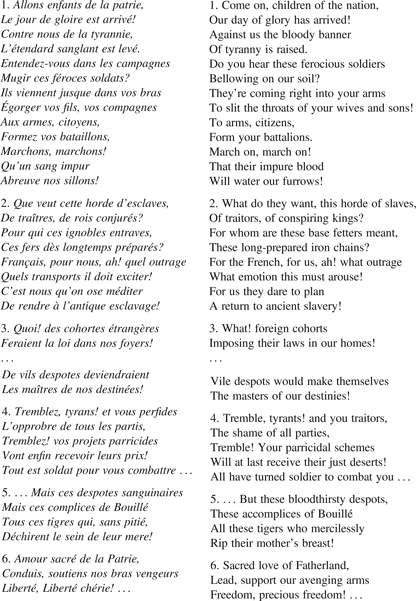
As Julien Tiersot has shown, de Lisle lifted a few of these phrases directly from a text read out to the citizens of Strasbourg by his political club earlier that day. His plagiarisms include the refrain “To arms, citizens!,” the demand for “tyrants” to “tremble,” and the imperative to “March on!”Footnote 21 The song's final stanza, with its repeated calls for “Liberté,” also echoes that of a revolutionary hymn by François-Joseph Gossec.Footnote 22
Right from his opening lines, however, which announce to the enfants de la patrie the arrival of “our day of glory,” de Lisle has also added something new. He has conceived of “us,” the Revolution's protagonists, heroes, and beneficiaries, as children—not “people,” not “brothers,”Footnote 23 not members of the “human race.” Whereas the text of the Société des Amis de la Constitution from which de Lisle took so many other phrases looks forward to the day when “the light of liberty will shine for all men” and ends with its hopes “for the happiness of the human race,”Footnote 24 de Lisle concerns himself instead with the happiness of the nation's children. He appears to have taken the phrase from the name of the local youth battalion, the Enfants de la Patrie, which had marched through the streets of Strasbourg during the ceremonies and speeches that day.Footnote 25 This characterization of revolutionaries as children was not completely without precedent; as Hunt points out, colonists during the American Revolution were sometimes described as the “children” of their British “parent,” and kings had long been described as the “father” of their people.Footnote 26 But de Lisle's equation of revolutionary patriots with children was more than a colonial or monarchical metaphor. Given the workings of the French language and the way he characterizes his enfants in “La Marseillaise,” de Lisle had effectively invented a new political protagonist.
As Ariès has shown, up to this point in French history, childhood barely existed as a specific stage of life: before the nineteenth century, childhood did not refer in French to a particular period of biological years.Footnote 27 Because French did not yet have a word for infancy or adolescence and because “youth” was still used to refer to the bulk of adult life before old age, childhood in eighteenth-century France referred not to a specific age group but to “the idea of dependence” in general. Accordingly, enfants and related words in de Lisle's time were bound up not only with ideas of biological dependency, but with those of “feudal subordination” as well.Footnote 28 As Ariès puts it, “one could leave childhood only by leaving the state of dependence.” Thus “men of humble rank,” who remained subordinate throughout life—lackeys, servants, foot-soldiers, and so on—were typically addressed as enfants regardless of their age.Footnote 29 For this reason, the enfants of “La Marseillaise” referred not just to a vague biological category, the nonage of the minors in the mayor's son's youth brigade, but to a specific political one: the enfants de la patrie were all of France's subordinates and dependents, regardless of their ages. And indeed, the political meaning of enfants within “La Marseillaise” is confirmed by the end of the first stanza: the patriotic enfants addressed in the first line turn out, by line eight, to be married with children. The final lines of the stanza warn these enfants that tyrants are “coming right into your arms / To slit the throats of your wives and sons.”
To appreciate the full significance of de Lisle's choice of children as the heroes of the Revolution, it helps to remember that in his famous definition of 1784, Kant suggested that Enlightenment is nothing other than mankind's emergence from a state of immaturity, a liberation from the dependent condition of childhood.Footnote 30 Rather than behaving as a child, thinking and acting only as one's guardians and masters tell one to think and act, truly free people in Kant's characterization were those who dared to throw off their subordinate state of intellectual nonage and start thinking for themselves. Kant presented casting off the “yoke of immaturity” and emerging into adulthood as a positive thing, an act of self-liberation. Thus it was not only in French usage but also in the language of the Enlightenment in general that childhood had a negative valuation: it connoted physical dependence, feudal subordination, and intellectual servitude.
In opposition to Kant, however, and reversing centuries of verbal–ideological thinking on the subject,Footnote 31 de Lisle depicts childhood as a wholly positive state. In “La Marseillaise,” he associates the enfants de la patrie with “glory,” “victory,” “magnanim[ity],” “sacred love,” patriotism, transports of righteous emotion, close family ties, skill with weapons, and racial purity (in contrast to their more powerful, more adult enemies, who have “impure blood”). De Lisle's departure from the language of his political club, which glorified “humanity” in general, is thus a significant one, with a strong anti-Enlightenment flavor. For rather than giving his enfants any reason to wish ever to leave the dependent state of childhood and become autonomous adults, as Kant does, de Lisle provides them with a compelling list of reasons to remain armed and vengeful enfants forever, in purity, patriotic pride, and glory.
It is clear, moreover, that this nationalistic glorification of an armed childhood was understood at the time as central to the song's meaning. When, for example, “La Marseillaise” was performed in Paris as a grand operatic spectacle in September of 1792, the stage filled up with a chorus of children dressed in white; they sang lines from stanza fourFootnote 32 about the permanently armed condition of the nation's eternally immature patriots, who do not develop or grow up but are merely replenished ad infinitum by fresh crops of similarly militarized children: “s'ils tombent nos jeunes héros/La terre en produit de nouveaux.” A seventh stanza was then added to the anthem (not by de Lisle) that was known as the Couplet des enfants and intended to be sung by children.Footnote 33
The ubiquity of “La Marseillaise” in Paris and throughout the country from August of 1792 through to July of 1815Footnote 34 all but guaranteed that everyone in France was familiar with de Lisle's new category of a completely good, patriotic, and righteously armed enfant. In positively revaluing childhood in this way, de Lisle had few, if any, antecedents. According to Hunt, children simply do not appear “as protagonists in their own right” in French literature until 1788, when a handful of novels begin to exhibit a sudden and unprecedented interest in child protagonists.Footnote 35 But since between 30 and 70 percent of the French population at this time was illiterate,Footnote 36 most revolutionaries did not encounter the new child-hero in novels. It was rather through de Lisle and the revolutionary propagandists who imitated him that the character type was disseminated: Pixérécourt based the child-heroes of his first two melodramas on characters of Ducray-Duminil, a writer whose explicit fictionalizations of “La Marseillaise” include such titles as “Josette de la colline des Allinges, ou l'enfant de la patrie.”Footnote 37 Pixérécourt's protagonists in Victor, ou l'enfant de la forêt and Coelina, ou l'enfant du mystère are infantilized revolutionary heroes of the same type. Like their models in “La Marseillaise,” they are old enough to be married but are treated, addressed, and described as children throughout the play, from the first to the final scene: in Victor, they are called enfants thirteen times; in Coelina, the number rises to twenty-six.Footnote 38 Like de Lisle's enfants de la patrie, Pixérécourt's child-heroes are portrayed as eternally subordinate, as ideally good and glorious, and as threatened by traitors to their families who must be killed.
Apart from his choice of enfants as protagonists, de Lisle depicts the standard revolutionary narrative: we the freedom-loving people, imperiled by counterrevolutionary traitors, must take up arms against these tyrants and, in a righteous act of vengeance, kill them, thereby saving our families, our fatherland, and freedom itself. Because it promises our salvation and liberty—but only if a certain category of wicked person is first singled out for exclusion and death—this revolutionary narrative has rightly been diagnosed by James Billington, as well as by Furet and Goldhammer, as essentially religious in nature.Footnote 39 With its demand for exclusion and punishment, it is also a pointedly anti-Enlightenment story. Throughout the eighteenth century, progressive, freedom-loving lyricists such as Voltaire and Schiller had visualized a similar salvation in liberty, but one expressly intended for enjoyment by “all men,” by the whole “human race,” by every living being without exception. Gossec's previously mentioned ode to liberty, for example, was taken from an aria written by Voltaire for Rameau's (lost) opera Samson (1733–4). Addressing an all-inclusive population of adults, Samson sings “People, wake up! Break your chains! Liberty is calling you!”Footnote 40 Schiller's An die Freude (1785) similarly looks forward to the day when “all men,” “the entire world,” when “all creatures” alike are united in freedom and joy; once delivered from the “tyrant's chains,” all of mankind will rejoice. For Schiller, everybody deserves liberation and happiness, including “sinners,” “the villain,” “all the good and all the wicked.” In stanza after stanza, Schiller promises everyone without exception joy, compassion, and liberation, even “our mortal enemy”: even for “the villain,” he writes, there will be “no pain.”Footnote 41
The contrast between this Enlightenment narrative and the plot of “La Marseillaise” could not be greater. In de Lisle's vision, to “us” enfants alone go the joys of liberty—and enfants by definition are not synonymous with the whole human race. Unlike Schiller's narrative, which grants freedom and happiness to all living creatures including our enemies, de Lisle's song denies our enemies the right even to life. According to the song our enemies include “tyrants,” “kings,” “traitors,” “accomplices,” “cohorts,” “despots,” “masters,” and “tigers.” Some are French (“traitors”) and some are “foreign.” And as their accompanying adjectives make clear, these tyrans are as thoroughly wicked as the enfants are wholly good: they are “ferocious,” “bellowing,” “conspiring,” “shame[ful], “mercenary,” “vile” “parricidal,” “impure,” “merciless[ ]” and “bloodthirsty.” They are “tigers” who come “right into your arms,” “slit the throats” of your loved ones, and “rip their mother's breast.” Their “just deserts” is an immediate bloody death—a far cry from the life, liberty, and happiness promised them by Schiller.
But what allows the song to crystallize, so effectively, the “chemically pure form” of revolutionary ideology as Furet describes itFootnote 42 is that de Lisle's opposition between the enfants and their enemies is a politicomoral one: its politics are moralized, and its morality is politicized. For de Lisle's enfants are not just absolutely good. Their subordinate status, qua children, is used to constitute their goodness: they are (morally) good because they are (politically) weak. Their vulnerable condition is emphasized throughout the song, especially in contrast with the powerful status of the “kings,” “masters,” and “despots” ranged against them. The enfants not only are children, as “our young heroes,” but are also associated with children, with the babes that the song invites its singers to imagine cradled at home in “your arms,” suckling at their mother's breast, the naked, defenseless breast that the tyrant-tigers are intent on ripping apart. Above all, the enfants were once literally slaves. It is precisely to their former condition of ultimate subordination, to “ancient slavery,” that the tyrans plan to return them. The tyrans, by contrast, are associated throughout with signs of power, mastery, and brute authoritarian might: “banner[s],” “fetters,” “iron chains,” “tigers.” The imagery here—of “ferocious” “kings” raising “the bloody banner” of “tyranny” against members of one's own family, forcibly subduing “our homes” under “their laws,” bringing their “fetters” and “irons” right into the loving “arms” and bosom of our most intimate relationships, jusque dans vos bras—divides the world into two opposing power groups with opposite moral qualities. The strong “masters,” who plan to reenslave children after slitting the throats of their loved ones, are thoroughly wicked, and the weak enfants, the nation's freedom-loving subordinates and former slaves, are altogether good.
De Lisle's two human categories are vague enough to be applied to virtually everyone.Footnote 43 The very simplicity of his polarity—“we” are weak and good; “they” are strong and wicked—makes it almost infinitely adaptable. His plot, however, specifies a single outcome only: the enfants gloriously defeat the tyrans by killing them at once. According to the song's opening lines, we enfants will achieve this victory not within weeks or months, let alone after Judgment Day, but immediately, within “the day.” Stanza 4 says that “all” of us patriotic children have been turned into “soldiers”; on the glorious day when we take up “our avenging arms”—a day that has arrived—the tyrans “will at last receive their just deserts.” Deservedly they will be killed, and their “impure blood” will water the soil. The narrative of “La Marseillaise” is thus one in which weak good children triumph over strong wicked tyrants by physically and bloodily defeating them. As we will see, this is an accurate synopsis of the plot of Pixérécourt's first two melodramas.
As for the “thought” of the anthem, the ideology that justifies the characters’ actions,Footnote 44 Furet articulates it best in his analysis of the “Robespierrist metaphysics” of conspiracy.Footnote 45 For Furet, the positing of a conspiratorial plot against the freedom-loving people was “central” to, even constitutive of, “the revolutionary phenomenon itself” (63). Within this metaphysics, “our” adversaries are not only strong and wicked but are also inevitably plotting in secret—for who would openly admit to being opposed to us good people and our freedom? Who would publicly say so if his goal were to enslave the nation's children and kill their families? With perfectly circular logic, our adversaries’ alleged secretiveness is then taken as proof of their wickedness: their aims must be nefarious indeed to be hidden away like that (53–4). Once we, the nation's patriots, have identified ourselves with freedom, those plotting against us will naturally appear to be traitorous and antidemocratic, the enemies of freedom itself. The swift extirpation of such tyrants thus appears to be democratically necessary, “a laudable and purifying act” (53). This “dialectic between people and plot” (69) was, according to Furet, “fully operative from 1789” (62) and neither in 1789 nor after that depended for its successful functioning on the existence of an actual military threat (62–3). Likewise, although energized by France's imperiled military situation in 1792, the call of “La Marseillaise” for the immediate slaughter of tyrans actually depends for its logic less on the existence of real external dangers than on the verbal–ideological positing of a secret plot. According to the song, the plotters are “conspiring kings” and their “cohorts” of “accomplices.” Their “plan” is to return the enfants to “ancient slavery” and establish themselves as “masters” over them. With their “mercenary” helpers, their “vile” “accomplices,” these conspirators have united in wicked “schemes” against the freedom-loving people.
The conspiratorial nature of the enfants’ enemies is a defining feature of this revolutionary narrative—and of Pixérécourt's early melodramas. Counterrevolutionary tyrans of this type, we notice, are not criminals by mistake or in ignorance, as are the kings of Greek tragedy, nor even through open arrogance, as is an Enlightenment tyrant such as Count Almaviva in The Marriage of Figaro. Instead, the tyrans of “La Marseillaise” plot their evil deliberately and covertly. They have been “conspiring” and “plan[ning]” for some time, maybe years, to enslave the good enfants, for the “iron chains” they bring into the enfants’ homes are “long-prepared.” In fact the servitude to which they plan to return the people is “ancient,” so they may have been scheming for a very long time indeed. (Pixérécourt's tyrans, as we shall see, have been plotting against the enfants and their families for years.) In this ideological universe, as Furet describes it, where politics has become “the realm of truth and falsehood, good and evil,” human action “no longer encounters obstacles or limits, only adversaries, preferably traitors” (26).Footnote 46 De Lisle likewise offers the deliberate conspiracies of antidemocratic traitors as the sole source of all perils facing the people of France.Footnote 47 This conspiratorial and adversarial political ideology was absorbed directly into early melodrama. Like their prototypes in de Lisle, the enfants of Victor and Cœlina are never “unhappy,” “poor,” “mute,” or “wretched” for any reason other than the deliberate persecutions by a traitor to the family. Innocently victimized by the traitorous plots of wicked adversaries, acting only in defense of their liberty, revolutionary enfants of this type are morally indemnified and licensed to kill.
With this addition of the wicked conspiracy—what the title character in Cœlina calls le complot infernal—we have the chief dramaturgical ingredients out of which Pixérécourt made his first two melodramas: the good, imperiled enfants; the powerful, scheming tyrans, traitors to their families; and the violent physical contests that secure the triumph of the enfants over the “parricidal,” maternal-breast-ripping “tigers” within “the day.” As de Lisle prescribes, Pixérécourt excludes the tyrans from life and reserves happiness and liberty for the enfants only. The “just deserts” meted out to Pixérécourt's tyrans, as in “La Marseillaise,” is simply death, whether by a gunshot onstage, as in Victor, or by guillotine later, as in Cœlina. Pixérécourt's use of these elements is remarkably explicit, on every level, down to and including the characters’ diction. Quoting now from the plays, not the anthem, Victor and Cœlina depict “good” and “innocent” “child” “soldiers” having to “defend” their “families” against “wicked” and “powerful” “tiger[s]” who, with their “vile” “accomplices,” have “come right into [their] home[s],” right into “[their] arms,” with a “diabolical plot” to enslave them after killing their loved ones. Like de Lisle, Pixérécourt characterizes the enfants’ enemies as killers of fathers and mothers, as traitors who “rip” their mother's “breast” (Victor) and “slit” their father's “throat” (Cœlina). Far from hiding any debt to de Lisle, Pixérécourt seems to be pointing as clearly as possible toward it.
Victor and Cœlina, which premiered in 1798 and 1800, respectively, are products of a time and place ruled by the ideology of “La Marseillaise.” As Pierre, Mason, and Vovelle have shown, within days of its Paris debut on 10 August, the song had swept the city. By September it was being sung daily in the theatres, and by November it was heard in the streets and cafés and squares of Paris and across the country.Footnote 48 It was printed in multiple editions and adopted by the government for propaganda purposes. As Mason demonstrates in detail, it remained the most “critically important” song of the Revolution throughout the Terror, during which it was known as the “chant” of the guillotine.Footnote 49 Above all, according to Furet and Richet, it continued to enjoy an almost uncontested supremacy as “the official music of the Directory” as well, retaining its popularity and cultural dominance right through the Terror of Fructidor and well into the Napoleonic period.Footnote 50
As Vovelle notes, de Lisle himself disavowed “La Marseillaise” immediately.Footnote 51 He'd written his revolutionary anthem as a military march in defense of (what he'd hoped would be) a constitutional monarchy. The singers of his song in Paris, however, the revolutionaries who would soon be making up the audience for Pixérécourt's plays, took his lyrics literally. As Michèle Root-Bernstein argues and as the playwright's own writings on melodrama confirm, popular theatre audiences in Paris were comprised at this time of some of the city's least privileged citizens.Footnote 52 In addressing its call to arms specifically to the enfants de la patrie, to the country's dependents and subordinates, “La Marseillaise” was effectively calling these theatre audiences by name.Footnote 53 The song blamed all their perils and unhappiness on the wicked plots of the powerful; but in Paris, cut loose of its original context and intention, it appeared to indict powerful people in general, regardless of whether their strength relative to enfants was military, political, economic, educational, or even vocational.Footnote 54 Accordingly, as we learn from the testimonies collected by Albert Soboul, the rank and file of Paris revolutionaries believed that their traitorous adversaries included such people as “the rich,” “merchants,” “grocers,” “farmers,” and even people who “sympathize with farmers.”Footnote 55 The seeming incoherence of this list of perceived traitors makes sense in light of the characterization in “La Marseillaise” of tyrans as “masters” and “us” patriots as their once and future slaves. Asked later to describe his participation in the Terror, Ferrier, a hatter, explained that “we had to destroy the big communes which were full of merchants and wealthy people whom it was necessary to exterminate.”Footnote 56 When asked to explain their actions, the enfants of Paris “repeated continuously that those who were richer, better dressed, or better educated than themselves were counterrevolutionaries, and their enemies.”Footnote 57 “La Marseillaise” had, in Paris, cast everyone more powerful than “us” in the role of tyran.
The anthem was of course not alone in promoting violence against such tyrans; most revolutionary propaganda of the period was making similar claims about the urgent need to save the people by exterminating their adversaries.Footnote 58 “The tenth of August,” said Danton, “divided France into two parties” only, and Saint-Just reinforced the anthem's Manichaean view when he insisted that between good patriots and their antidemocratic enemies, “there is nothing in common.”Footnote 59 Robespierre echoed de Lisle's sentiments closely when he said that “the family” of France is la patrie, which is “the entire human race, except for the tyrants and their accomplices.”Footnote 60 As Furet and Richet, Mignet, Soboul, and Scurr recount, this revolutionary rationale for killing tyrans was soon enshrined in legislation: the first head rolled off the guillotine four days after 10 August, followed by a series of “public safety” and surveillance laws that required citizens to denounce suspected traitors and legally authorized them to arrest and condemn such suspicious persons to death.Footnote 61 Though some of these laws were suspended after the fall of Robespierre, most were reactivated during the Terror of Fructidor (1797) and remained in force for the rest of the decade.Footnote 62 Long gone were Voltaire's and Schiller's enlightened hopes of securing freedom and joy for all mankind. According to France's leading politicians and propagandists—including, inadvertently, Rouget de Lisle—the most urgent task of the Revolution was to secure the “safety and happiness”Footnote 63 of the nation's enfants by extirpating tyrans.
But in order to save the child and kill the traitor, you first have to figure out which is which. Indeed, how do you know who is a good child of the revolutionary nation and who is a traitorous tyrant—especially when the latter, by definition, schemes in secret? As Albert Soboul, Jennifer Harris, and Nicola Shilliam discovered, clothing was the single most common method ordinary Parisians used to determine who was an enfant and who a tyran. Revolutionary clothing included the red Phrygian cap, the blue stocking hat of the police, tricoloured fabrics, striped skirts and trousers, and clogs or bare feet. Tyrans were identified by their knee breeches, the fleur-de-lys, and buckled shoes. Actors had to wear a piece of revolutionary tricolor ribbon on their costumes, regardless of the role.Footnote 64 Both onstage and in the streets, you had to signify your enfant status in your clothing or risk being denounced as a counterrevolutionary tyran. Throughout the revolutionary decade and beyond, clothing was used as if it were a reliable sign of a person's political beliefs and character.Footnote 65 Wearing a big black hat, or even a black cockade on one's hat, was considered to be a definite sign of tyranny and a deliberate provocation to enfants. On their famous march to Versailles, the women of Paris assaulted people they passed on the road who were wearing black cockades on their hats, announcing as they pulled them to the ground from their horses that “as punishment for … insulting the national cockade,” the tricolor, “they must die.”Footnote 66 The Commune banned sartorially unpatriotic women from all “public buildings, gardens, and monuments.”Footnote 67 The Convention decreed ten years in jail for some hat-related crimes.Footnote 68 And as Soboul recounts, a man named Jean-Baptist Gentil was denounced and arrested as a counterrevolutionary by his neighbors because of his attitude toward hats.Footnote 69 As the newspaper Chronique de Paris explained on 27 May 1793, “It is by the headdress that tyrants can be recognized.”Footnote 70
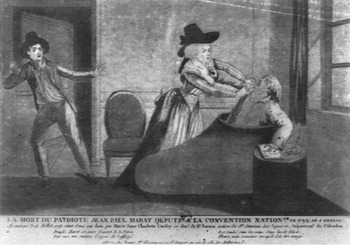
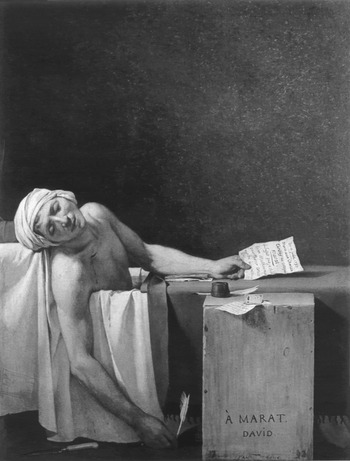
That a big black hat could serve as a sign of a tyrannical heart can be seen in the well-circulated image of Charlotte Corday assassinating the “patriot” Marat in his bath (see Fig. 1).Footnote 71 The semiotics of clothing in this image say clearly that Corday (and by extension the Girondin party to which she belonged) is an enemy of the people. The patriotism of Marat is spelled out in the legend, but for the many French citizens who could not read or even sign their names, it is also communicated visually by the softly draping light-colored cloth on his head, a strong contrast with Corday's big black tyrant's hat.Footnote 72 Jacques-Louis David's painting of the event makes the imagery of the good enfant even more explicit by transforming Marat's headdress into an actual swaddling-cloth, soft and warm and cozy, and by showing his vulnerable exposed skin and naked, punctured breast (the kind of breast the tigers of “La Marseillaise” are portrayed as ripping). He lies peacefully against creamy white linens, his newborn puffy eyes serenely closed, sleeping like a baby in the cradle of his bath (see Fig. 2).
“La Mort[e] du Patriote Jean Paul Marat.” Revolutions de Paris no. 209, 6–20 juillet 1793. Courtesy of the Bibliothèque nationale de France.

“Marat assassiné.” Jacques-Louis David, 1793. © Royal Museums of Fine Arts of Belgium, Brussels.

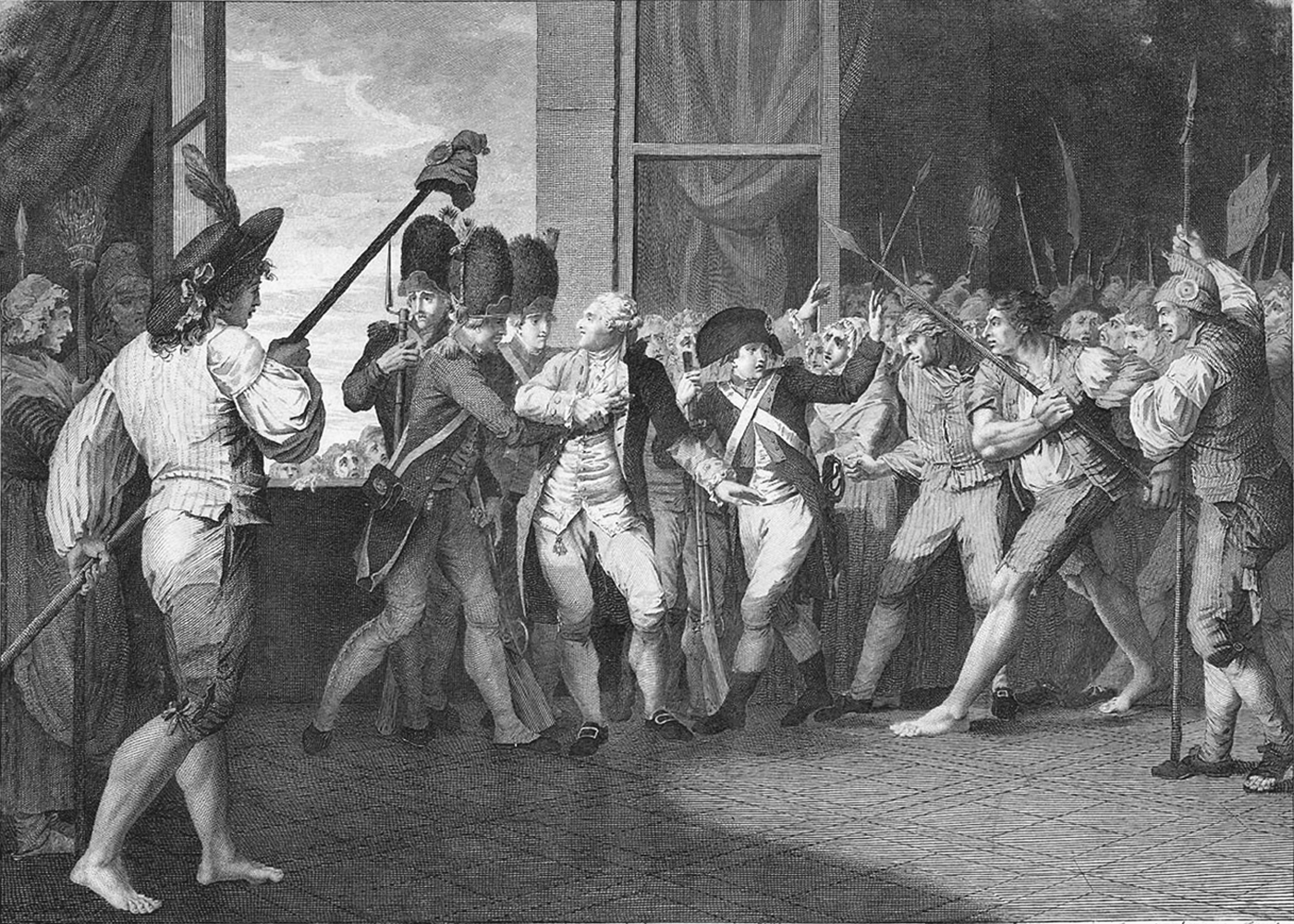
This iconography of clothing, which Parisians used to make life-and-death judgments about their fellow citizens, accurately illustrates the polarized ideology of “La Marseillaise.” It equates weak, naked vulnerability with patriotic goodness, and that which is better equipped and stronger with evil tyranny. Explaining how he knew who his enemies were during the Terror, a gunner named Fontaine explained that they were the people “who appeared to be better dressed” than himself.Footnote 73 Patriots were believed to be those who were “not powdered and perfumed, not elegantly dressed.”Footnote 74 The ideology is clearly on display in an engraving commemorating the first attack on the Tuileries in June: the enfants are depicted as poorly dressed, with uncombed hair, frayed trousers, and bare feet, whereas the tyrant is richly attired in a curled and powdered wig, silk knee breeches, stockings, and buckled shoes. The guards surrounding and protecting the king, at the center of the image, wear suitably tyrannical hats (see Fig. 3).
“Journée mémorable du 20 juin 1792.” C. P. L., Pauquet, and Jourdan. 1792. Courtesy of the Bibliothèque nationale de France.
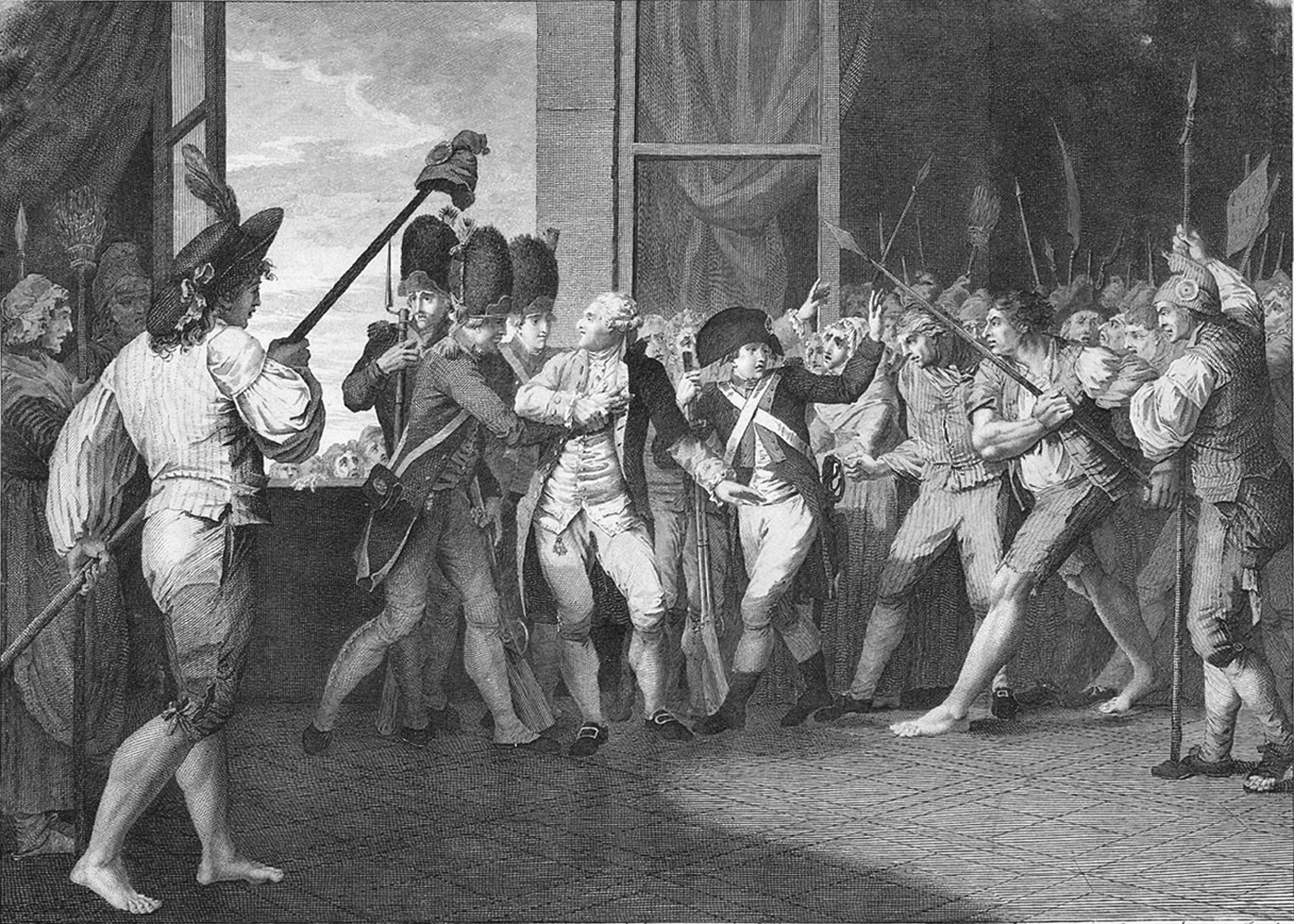
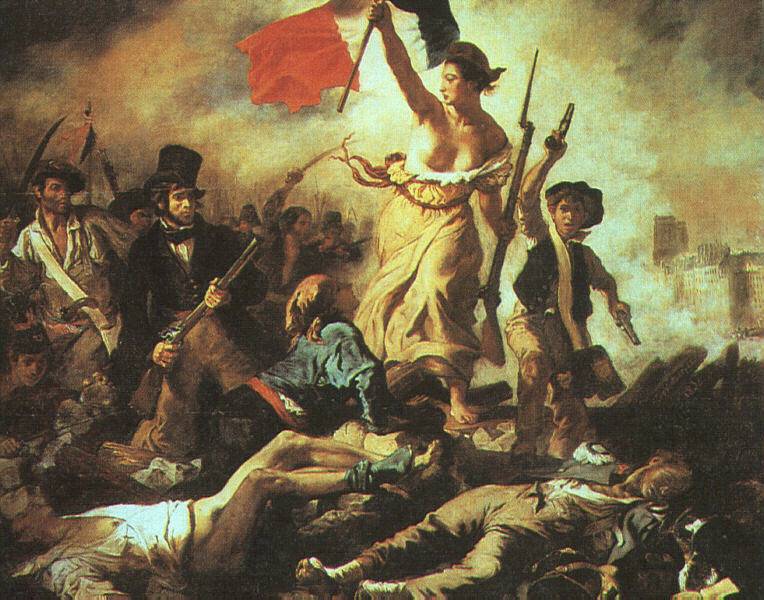
The pike-wielding patriots who stormed the palace on this occasion were pacified, apparently by the king's decision to signify his loyalty to the people by donning the red cap of liberty for all to see.Footnote 75 But the association of the good enfant with torn clothing, naked legs, and bare feet would remain, from this 20 June engraving to Eugène Delacroix's famous 1830 painting of the Revolution, Liberty Singing La Marseillaise on the Barricades and Leading the People in the Battle of July, which depicts the ultimate patriot Marianne as barefoot, naked-breasted, and leading an armed child.Footnote 76 That the king was able to pacify an armed mob by clapping a red toque on his head shows that it was possible (and necessary) for suspected tyrants to signify their support of the people's happiness in clearly visible signs that could be understood at a glance by all.
Pixérécourt had to do likewise. When he arrived in Paris about four months after the September Massacres, the playwright was not just a suspected tyran but a proven one.Footnote 77 An aristocrat whose family was ruined by the Revolution, he fled the country at eighteen in “horror” of the hatred and violence shown by peasant neighbors toward his parents, who he says were benevolent and charitable people.Footnote 78 In September of 1791, he crossed the border and joined up with the émigré army of the French nobility in Koblenz—the army against which “La Marseillaise” was originally directed—and remained in the area, with the rest of France's gilded youth, until the following September.Footnote 79 Thus, at the very moment when Rouget de Lisle, garrisoned on France's eastern border, was writing his anthem to rally the troops against “conspiring kings” and their “accomplices,” Pixérécourt was encamped on the other side, with the king's brothers and all the “elite of the French nobility,” fitting the description exactly.Footnote 80 When this counterrevolutionary army was defeated in the autumn and he snuck back into France with the help of the Duc de Bourbon, he did so disguised as a beggar in rags—literally as a tyran in enfant's clothing.Footnote 81 Barely escaping capture on two hair-raising occasions, he made it to Paris. He hid in a friend's attic, preparing for death. He describes watching the tumbrels go by every night from his garret window, loaded with victims bound for the guillotine.Footnote 82
Though his enfant costume might have sufficed to save his skin in the streets, it would not have gotten his plays onto the stage. As Michèle Root-Bernstein, Susan Maslan, Phyllis Robinove, and Emmet Kennedy have shown, the enfants who made up the bulk of the theatre audience in revolutionary Paris were doctrinaire in their adherence to revolutionary ideology and demanded the same from playwrights. Plays they judged to be inconsistent with this ideology were immediately suppressed or denounced. For example, on 24 February 1792, the audience rioted at the Théâtre de Vaudeville in protest against a comedy that, according to the audience's spokesman, contained elements that “outrage the Revolution and patriots.”Footnote 83 The management agreed to shelve the play, but this did not satisfy the crowd, which got a copy of the work from a musician in the pit and proceeded to burn it in the theatre as they sang “Ça ira.”Footnote 84 On 28 January 1793, a few days after the king was executed, the fédérés who stormed his palace in August rioted in response to La Chaste Suzanne, a biblical play with no apparent reference to contemporary politics. Maslan thinks its plot offended the audience because it represents “surveillance”—something all good patriots were required to exercise over their neighbors at this time—as a criminal perversion.Footnote 85 The outraged fédérés vandalized the theatre, terrified the actors, and mounted the stage in search of the guilty. Then they left, vowing to come back and “turn the theater into a hospital.”Footnote 86 The actors appealed to the city for protection, but the Commune sided with the fédérés and demanded that the play be removed for “corrupt[ing] republican morals.”Footnote 87 The newspapers agreed; if the audience didn't like a play's politics, its politics must be bad.Footnote 88 The Chronique de Paris editorialized that “it is to be hoped” that theatre managers had learned their lesson and would “no longer engage themselves in fighting against public opinion.”Footnote 89
Jean François Boursault, founding entrepreneur of the Théâtre Molière, to which Pixérécourt sold his first play in 1793,Footnote 90 told the Committee of Public Instruction that managers had a “duty to present only those plays” that “make for the Happiness of France.”Footnote 91 Dozens of classics of the French stage were found to be counterrevolutionary and unstageable.Footnote 92 As Robinove shows, even overtly republican plays such as the Roman tragedies of Voltaire, which at one point were performed three times a week by command of the Committee of Public Instruction, were censored and then banned outright for their failure to “make for the happiness” of the nation's enfants. Mérope, for example, was judged unpatriotic because any expression of sympathy for a queen was seen as “not suitable for revolutionary audiences.”Footnote 93 According to Denise Baxter, Justice Minister Louis-Jérôme Gohier personally rewrote La Morte de César so that Brutus is only praised as “holy” and is never criticized, as he is in Voltaire's original, as a “monster.”Footnote 94 And while lines from Brutus had once been the revolutionary motto of the Cordelier Club, plastered on posters all over Paris in 1791, the play came to be banned altogether because the characters’ politicomoral identities were insufficiently clear: is Brutus the good republican enfant or the wicked tyran?Footnote 95 Pixérécourt's enfants and tyrans would have to be free of all such ambiguity, as clearly and completely polarized as de Lisle's.
If his plays were to “make for the happiness” of revolutionary audiences, he would also have to follow de Lisle's plot. Unlike Enlightenment and Greek tragic plots—which generally achieve audience happiness by rewarding the people's fictional counterparts onstage while forgiving or integrating their adversariesFootnote 96—the plot of “La Marseillaise” stipulates that the enfants’ adversaries must be killed before they themselves can be happy: the enfants’ “day of glory” arrives only with the death of their enemies. Accordingly, plays performed during the anthem's reign were expected to destroy the tyrans by the end. Just how unambiguously they had to be purged can be seen in Maréchal's successful Le Dernier Jugement des rois, which rewarded the enfants of Paris with the sight, sound, flying debris, and even the gunpowder smell of the destruction, by volcanic eruption, of all the tyrans and kings of Europe—with the aid of real explosives commandeered by the Committee of Public Safety from the munitions-strapped army.Footnote 97
Paris theatre audiences gauged the political content of plays according to the same politicomoral iconography they used when judging their neighbors’ patriotism. For example, in September 1793, police informer Latour-Lamontagne denounced an outbreak of politically incorrect plays partly on the basis of the characters’ clothes:
The privileged orders appear once again on the stage, hateful clothing wounds our eyes, the language of tyranny resounds in our republican ears and the counterrevolution takes place every day in our theatres.Footnote 98
Counterrevolutionary plays are here identified by the “hateful clothing” of tyrans, which “wounds” the audience's eyes. When such tyrans appeared, they had to be demonized as such and explicitly punished. Playwrights, actors, and managers who failed to fulfill audience expectations in this regard were denounced, arrested, jailed, and guillotined.Footnote 99 As Emmet Kennedy recounts, the Théâtre de la Nation presented a version of Pamela in August 1793 that failed in this way precisely; it rewarded a nobleman with marriage rather than punishing him with death. The actors were arrested and imprisoned, and the theatre was closed by the Committee of Public Safety.Footnote 100
These were the theatrical conditions under which Pixérécourt invented melodrama. They prevailed during the Terror of 1793–4, when he wrote his first plays; during the Terror of Fructidor, when he struck pay dirt with Victor (10 June 1798); and on 15 Fructidor, year VIII of the Revolution, when he triumphed with Cœlina. Under such conditions, absolute clarity in the display of revolutionary ideology and its iconography was a necessity. In Victor and Cœlina, his first plays to run for over a year, Pixérécourt is explicit indeed, rewarding the enfants with freedom, family embraces, and marriage, and punishing the tyrans with pistols, sabers, daggers, explosions, collapsing caves, a raging river, a storm, denunciation, and arrest and battery by armed peasants.
Before creating these melodramas, however, Pixérécourt had an opportunity to observe the dramaturgical rules for revolutionary playwriting up close and in relative safety: he became a police informer himself. After being reprieved from execution by two members of the Committee of Public Safety, he consented to work for the government as a theatrical spy.Footnote 101 A March 1794 decree against nobles in the capital effectively sentenced him to death,Footnote 102 but he says that he was saved by Bertrand Barère, at whose feet he threw himself and begged to be allowed to live and be of some use. Barère responded by getting him a job under Lazare Carnot. What Pixérécourt doesn't say in his description of the incident is that the twelve-man Committee of Public Safety, to which Barère and Carnot both belonged, was just at that moment establishing its first central spy agency, the Bureau for Administrative Surveillance and General Police.Footnote 103 It was this police bureau, many of whose warrants bear Carnot's handwriting and signature, that ordered the arrest of the actors of the Comédie-Française that spring.Footnote 104
Within a year of being taken under the wing of one of the most powerful men in France,Footnote 105 Pixérécourt submitted to the bureau a report about the Paris theatres. In this “Rapport” and in an appended note entitled “Spectacles, 7 Floréal,”Footnote 106 he evaluates the theatres’ politicomoral effect on the people, both before and since the Revolution, and makes recommendations about both old and new plays. The 23-year-old author explains that the primary function of the theatre is political indoctrination: the stage, he writes, has a duty to inculcate the “political” and individual virtues “that every citizen must profess.”Footnote 107 As these new citizens have lately been growing colder to “political ideas,” he suggests that theatre managers should more often present works from their existing repertory that will “reawaken a love for la patrie and for the Republic.”Footnote 108
As for new plays, he recommends a complete takeover of the theatrical repertoire by the revolutionary government on behalf of “the people.”Footnote 109 This measure is necessary, he argues, because while the evil prerevolutionary theatre has thankfully been swept away, along with its corrupting effects, the stage still remains in the hands of tyrans: actors and managers have simply replaced the tyrants of old. In fact the whole theatrical profession, according to Pixérécourt, is “a colossus of evil” that the government must “hasten to extirpate”; its members are depraved, greedy, drunken whores who are more servile than any aristocrat and morally unlike the rest of mankind.Footnote 110 Answering the question “How, then, might these theatres [be made to] serve us in benefitting public instruction?”Footnote 111 he concludes that control of the theatres must be wrested out of the maws of the “tapeworm” (i.e., actors and managers) that is currently infesting the bowels of la patrie and placed in the hands of “the people,” by which he appears to mean the government: “It is therefore necessary that the government … remove from the hands of theatre managers the power to choose new works.”Footnote 112
The scurrilous nature of Pixérécourt's denunciation of actors is quite shocking, as is his insistence on the need for a dictatorship of the new theatrical repertory by the ideological needs of the audience (to be determined by the government).Footnote 113 But since the government he was talking about was the government of Carnot, his employer and protector, the “Rapport” needs to be considered as an artifact of the playwright's relationship with Carnot. According to Patrice Gueniffey, Carnot was a narrowly nationalistic “champion of the state” who “supported any policy that aimed to strengthen it.”Footnote 114 At the time he took Pixérécourt into his War Office, in March or April of 1794, Carnot was advocating, as supreme commander of the army, that soldiers profess “hatred and contempt” for their enemies and “exterminate” them “down to the last soldier.”Footnote 115 For Carnot, these enemies included Frenchmen.Footnote 116 Carnot's mastery of revolutionary ideology is especially well documented in his two-hundred-page Reply pamphlet of 1799, in which he defends himself as an “innocent” patriot and vilifies his political enemies as wicked tyrans, using virtually all of de Lisle's terms.Footnote 117 The subject of tyrans in fact inspires Carnot to the same kind of earthy vituperation as we see in the report of his protégé: he denounces them in terms of “corrupted organs” and “filthy excrements” and the like, sounding a lot like Pixérécourt with his description of actors as intestinal parasites.
If the “Rapport” shows signs, in its language and politics, of having been calculated to please Carnot, Pixérécourt had the best motive for doing so: Carnot saved the playwright's life not once but twice, the second time when some hometown actors from Nancy recognized him on the street and denounced him to Robespierre.Footnote 118 (Pixérécourt's slander of actors the following year might have had something to do with this betrayal.) However, the contents of the “Rapport” might be more reliably explained by his sincere and well-documented affection for the man who saved him: Pixérécourt says that Carnot treated him with the loving-kindness of a father, and he conspicuously brings his entire revolutionary memoir to a close by emotionally averring, in its final line, that he owes his life to Carnot.Footnote 119
Carnot's protection of the playwright contrasts starkly with his apparent persecution of Rouget de Lisle.Footnote 120 Carnot admired De Lisle's anthem, we recall, as a recruiting tool for his revolutionary army. But as Vovelle recounts, de Lisle himself was stripped of his commission and imprisoned after 10 August, when he disavowed the anthem's terrorist implications. He was made to suffer for his lack of murderous hatred for tyrans, kept alive only, Vovelle suspects, because of his authorship of “La Marseillaise.” After his release from jail he was kept under surveillance and banned from the theatres.Footnote 121 From his politically and artistically marginalized position, de Lisle was able to look disinterestedly on the outbursts of violence that his song seemed always to unleash in the capital. “Things are going badly,” he wrote home, dryly, from Paris, “they're singing La Marseillaise!”Footnote 122
The father of melodrama, by contrast, had much to gain from exploiting the anthem's effect on the public. Indeed, his safety as a tyran seems to have depended on it. He may, of course, have sincerely subscribed to the revolutionary ideology he expounds in his police report and dramatizes in his plays. But as a twice-condemned former noble, as a protégé of Carnot who was willing to spy for his government, echo his politics, and perhaps even parrot his language, he was probably also acting out of some degree of self-interest. He would certainly have known that there was big money to be made from the happiness of revolutionary audiences.Footnote 123 What this happiness consisted of and what types of plays delivered that happiness were things that, at the very least, Pixérécourt's theatre surveillance work would have given him an ideal opportunity to discover. In both his police report of 1795 and in later writings he expresses a highly patronizing attitude toward these audiences; he describes “the largest part” of them as lowly born, poor, uneducated, unenlightened, and incapable of understanding (let alone enjoying) the “masterpieces” of the adult theatre.Footnote 124 He saw them as subordinate enfants in every sense of the word and made no attempt to hide the fact that he wrote his plays with their tastes, needs, and abilities in mind.Footnote 125
Accordingly, for the material for his first two melodramas, he turned to works written for and about children by François Guillaume Ducray-Duminil. By 1793, Ducray was writing what Michael Tilby describes as explicit “Revolutionary propaganda.”Footnote 126 Pixérécourt's version of Victor, ou L'Enfant de la forêt, although it differs in many ways from Ducray's novel, is a similarly propagandistic story of two ideally good militarized children, Victor and his beloved Clémence. Their home and loved ones are threatened by Roger, a wicked villain who tore Victor's mother from the arms of her parents, impregnated her, and then killed her when Victor still was a babe in her arms. Though the murder happened years ago, we are told how it happened: the “tiger ran toward her and pierced her breast.”Footnote 127 Using the terms of “La Marseillaise,” Pixérécourt identifies Roger as a tyran by depicting him as a “tiger” who rips a mother's breast and moreover one who came right into “the arms” of the enfant’s loved one to do so (2.8). Having killed the enfant's mother, the tyran now comes, with his “heavily armed” “accomplices,” right into the enfants’ “cradle,” to enslave by “force” the enfant's foster mother, whom Victor proceeds to “defend” with arms (1.1–4). A hundred and fifty men and “vassals” volunteer or are conscripted to help the enfant “to save” his “innocent” foster mother, his “good” fiancée, and his “virtuous,” weak and elderly adoptive father (1.6). The soldiers in the enfants’ “little army” are all “ready to spill their blood” to repel the “powerful” and “insolent” tyran (1.7). Victor is told that in defending a “poor woman” such as Mme Germain, he must know above all “how to handle the blood of [his] soldiers” (1.10). Act 1 ends as the enfant leads his battalion of fédérés with the first-person-plural imperative of the chorus of “La Marseillaise”: “Marchons” (1.8).
The munitions in act 2 include cannons, barrels of explosives, artillery, trenches, ramparts, and an ordnance-stuffed tower (2.1). While the enfants’ army awaits the assault, the wounded old war veteran Valentin is asked to “sing one of those military songs that they sang in your time … la … you understand what I mean?” (2.1).Footnote 128 The soldiers agree to join in for the chorus, and Valentin introduces the song by saying (or singing?) “Allons.” Later, when the tocsin rings, Victor cries out, “Aux armes” (2.5). In a battle involving swordfights, shootouts, fire, smoke, and explosions, the enfant and his army kill many of the tyran's “officers.” With his saber, Victor physically subdues Roger, crying “Monster, you will die!” But during the “tableau” of “general stupefaction” that follows on the revelation of his identity, the “terrible,” “cruel,” and “abominable” tyran escapes (2.7).
Act 3 takes us to the military encampment of the tyran and his criminal cohorts. These “accomplices” have already “slit the throats” of countless good people, spilling “the blood of the innocent” (3.6). The enfants seek out Victor's wicked traitor of a father and beg him to change sides and “make [them] happy,” but as a tyran he cannot change his tiger's stripes and he categorically refuses: he has always been more attracted to “vice” than to “virtue,” and “nothing can ever make [him] change” (3.6). The enfants beg the tyran a second, third, and fourth time to “make [them] happy,” but in vain (3.6–7).Footnote 129 The tyran's camp is then attacked by soldiers of the German emperor. Another battle ensues that includes guns, artillery, swords, giant boulders, explosions, and collapsing caves. The enfants gloriously fight off the enemy, Clémence participating while dressed in male clothing (3.11). At the moment of Victor's greatest peril, she stabs and kills an attacking soldier with a dagger, saving her beloved (3.12). Roger is mortally shot, and his criminal cohorts are captured and bound “in chains” (3.15). The enfants throw themselves into the arms of the good weak man who alone deserves to be called their father (3.13, 15), and the loving family is reunited in freedom, happiness, and marriage. The tyran dies to the accompaniment of thunder and music.
An almost identical story is dramatized in Cœlina, ou L'Enfant du mystère. Two betrothed enfants, Cœlina and Stéphany, are imperiled by the unwanted entry into their home of an armed tyran whose conspiracy is abetted by criminal accomplices. In this case it is Cœlina's traitorous uncle, Truguelin, who brings, right into the bosom of their family “cradle,” a long-prepared plot of enslavement, a plan to shackle Cœlina to an unwanted husband (2.1). He also wants to finish the job of slitting the throat of Cœlina's poor helpless father, Francisque, whose tongue he sliced off eight years before. As do Victor and “La Marseillaise,” Cœlina promises that the enfants will be gloriously rewarded: the tyran and his accomplices will be punished within “the day.” The enfant Michaud, the once and future slave of de Lisle's anthem who rejoices in his freedom and remembers the ancient times when he was a “lackey” (3.4), explains the play's plot and ideology directly to the enfants in the audience:
It's impossible for the master to escape…. Although I'm not wicked, the friendship that I have for the unhappy Francisque makes me desire swift and exemplary punishment for this monster. Come, you'll soon see that I have spoken truly. Here's a brigade. (3.2)
As in Victor, armed forces are necessary for saving the enfants and defeating “the master,” who is a “monster.” Further augmenting such verbal assurances to the audience that their “day of glory has arrived,” Michaud sings to them de Lisle's promise to physically punish the masters today: “Honest, happy, charitable,/I am not afraid of death,/This day is fearful/For villains only” (3.2). Pixérécourt was in fact very proud of observing the “unity of time” in his melodramas by confining the action to a single day.Footnote 130
Act 3 obeys the command in “La Marseillaise” that tyrants “tremble” because their wicked deeds “will at last receive their just deserts.” Truguelin realizes that his days are numbered and that there is “no rest for the assassin.” Twice he cries, “I tremble!” (3.1, 3). He is vanquished in a battle involving pistols, daggers, swords, a storm, a raging river, and a windmill. Archers arrive with more weapons, followed by “armed peasants” (3.10). These assault and subdue the tyran, who is arrested and taken off to prison for what we assume will be a short trialFootnote 131 and “the swift and exemplary justice” of “the guillotine” (3.1, 2). The morality of arresting and guillotining people after a short trial is addressed and found to be good. Pixérécourt has the former lackey Michaud equate such behavior with virtue: “the virtuous man punishes,” he says, then lets “the law” enact his “vengeance” (3.11).
After the tyran has trembled and been punished, instantly delivering safety and happiness to all the virtuous enfants—with “one evil man less” and many good enfants “happy again” (3.11)—the final scene of Cœlina, like that of Victor, visually depicts the anthem's image of the loving family in “your arms.” The “honest Dufour” gathers his “children” into “his arms” and presses them all “to his breast”—the parental breast now safe from savage ripping by tyrannous tigers. These embraces gather in not only the play's biological children, Stéphany and Cœlina, but also the politically subordinate enfants Tiennette and Faribole (3.11). The audience of both plays is clearly shown that freedom and happiness are reserved exclusively for enfants and will never be enjoyed by their adversaries.
Both melodramas present the killing of tyrans as gloriously justified and urgently necessary. They achieve this, as does de Lisle, through the circular device of making the tyrans unambiguously wicked and strong individuals who consciously conspire to destroy weak and innocent children. Victor, for example, is introduced in the first scene of act 1 as weak in every way: he is all alone in the world, with “no possessions,” “only an orphan, without a friend, without relatives.” According to the stage directions, we first meet him in “a cradle made of greenery,” and Valentin further emphasizes Victor's powerless, babyish innocence by saying that he still visualizes Victor, an “unhappy child,” looking as he did on the day he was found, “still … in [his] little cradle” (1.1). Similarly in Cœlina, the enfant Stéphany is introduced as a defenseless infant by Tiennette, who says that she “witnessed his birth, this dear Stéphany,” and that “he's the best child I know” (1.1). The infantile setting in Cœlina, “a pretty cradle made of greenery” (2.1), functions similarly. Not all of the enfants in these plays are as dependent as Victor, a destitute and orphaned child, or Francisque, a destitute, mute, and mutilated beggar. Cœlina, for example, is actually an heiress, but she is given full enfant status by Pixérécourt nevertheless: she is treated and addressed as a child, from the first scene of the play to the last; she shows her politicomoral goodness by associating herself with and desiring the happiness of the weakest and poorest character in the play, the beggar; and she rejects the very idea of inherited money as ill-gotten gains. She speaks of such money as “wealth to which I have no right” (3.5). Offered a purse full of gold coins, she contemptuously refuses it (2.6).
Like those of de Lisle, Pixérécourt's good enfants are old enough to be married, and some are fathers with children themselves. Francisque, Cœlina's father, is identified as a good enfant by his clothing (rags), and by his inarticulate, preverbal “whimper[ing],” his babyish need for the nanny, Tiennette, to speak for him and interpret his wishes. Like Cœlina, he signals his politically correct hatred of the rich by twice refusing a purse of money (1.16). Because he is a “poor,” “helpless,” “homeless,” “unfortunate,” “mutilated” “wretch” “who was Truguelin's victim” (1.9; 3.2), he is also “gentle” “honest,” “innocent,” and “incapable of lying” (1.1). As in de Lisle, the enfants in these plays are identified not by age but by subordination: by dependency as minors (Victor, Clémence, Cœlina, Stéphany), by physical impotence or disability (Fritzierne, Valentin, Francisque, Dufour), by feudal subordination as servants or former servants (Tiennette, Michaud, Faribole), and by the way they hate wealth and power. Cœlina's and Francisque's contempt for money has been noted; in Victor, the goodness of the enfants’ true father, Fritzierne, “the most generous of men” (3.4), is proved not only by the fact that he is too old and weak to arm himself (1.10) but also by the fact that “birth and gifts of fortune mean nothing to him” (1.1). And as in “La Marseillaise,” weakness in both plays is moralized as goodness: the “poor” and “unfortunate” enfants are repeatedly said by themselves and everyone else to be “innocent,” “worthy,” “virtuous,” “pure,” “good,” and “honest.”Footnote 132
Pixérécourt's tyrans are as strong and wicked as the enfants are weak and good. In Victor, Roger is “a powerful man, a man for whom death is the only threat,” “a villainous” “tiger” who is “capable of anything!” (1.6). He is the “enemy who is ten times stronger than us” (2.2), a “guilty” “barbarian,” “the monster who has made me so unhappy” (1.12). Similarly in Cœlina: against an army of wholly good “children,” their servants, and a “poor” “mute” beggar “covered in rags” stands Truguelin, a “rich” “assassin” who is “envious, false, and mean”; “ambitious”; “cruel”; and “greedy” (1.1). But no matter how slight the difference in actual status or wealth between these tyrans and enfants,Footnote 133 the tyrans are said to be separated from their victims by a vast moral abyss: “What a difference there is between Truguelin and the good Monsieur Dufour,” marvels the enfant Tiennette (1.1). The “honest” Dufour agrees: his “dear enfants” do not have anything “in common” with the “cruel,” “disgusting,” “evil,” “savage” “monster” who is threatening them (2.3; 1.13, 12; 2.3, 4; 3.4). In Victor it is likewise said to be impossible for “the innocent” to be “confused with the guilty” (3.13) for between “crime and virtue,” there can be no real “connection” (1.11). While the enfant Clémence has “the blood of virtue” in her veins, the tyran Roger, like de Lisle's bloodily “impure” tyrants, is naturally and irremediably corrupted by the “blood” of “vice” (3.6, 16).
As does “La Marseillaise,” both plays indemnify the armed children against any moral criticism. The battle against Roger is described as “a just cause” (1.13). When Victor expresses qualms about the plan to ignite the tower when the tyrans enter it, thereby trapping and incinerating them, his companion in arms waves this scruple away: the “method,” he says, “is excusable,” since “we have to fight an enemy that is ten times stronger than us” (2.2). When we first meet the enfant Stéphany in his garden “cradle” in Cœlina, he is already carrying a gun, seeming to have been born with a rifle under his arm (1.1). The “helpless” Francisque also turns out to be surprisingly well armed (1.1–3, 6; 3.9, 10). Somehow this destitute beggar happens to carry two loaded pistols, both of which prove necessary, on two separate occasions, for the defeat of the one “rich” villain who is “persecuting” “so many good” and “poor” people (1.16; 3.8). But while the pistol-packing enfant Francisque has such a “good heart that he could not be wicked,” Truguelin, the dagger-wielding tyran, is “a monster unworthy of life” (3.1). As Cœlina explains, neatly summing up the anthem's terrorist ideology, “everything,” no matter how extreme, is necessary “to save an innocent” (1.7).
In keeping with the ideology of the antidemocratic plot, the tyrans of both melodramas are shown as deliberately scheming to deprive the enfants of their liberty and as bringing their long-prepared plots of enslavement right into the enfants’ homes. In Victor, Roger has been busy for over twenty years with his “disguise[d]” and “infamous projects,” in league with his “criminal” “accomplices” (3.14, 6, 8). Years after abducting and then murdering his child's mother, he now schemes to force the child into a life of crime; to this end he plans to kidnap Mme Germain and “force her” to reveal the enfant's whereabouts (3.3). When foiled in this plot by the enfant's army—“Roger, whom no peril has ever frightened, whom no one has ever vanquished…. Roger, foiled by a child!”—he schemes to “revenge” himself “cruelly” by reducing the enfants’ family home to “ashes” (3.1). Truguelin in Cœlina is similarly “capable of anything” in his “diabolical plot” to enslave his niece for his own enrichment. While enfants such as Cœlina love and deserve “complete freedom,” the freedom-hating tyran Truguelin thinks that their elders should use “force” and “violence” to assert their “rights over” them (1.8). Like Roger, this tyran is a deliberate traitor to the family who brings his conspiracy right into the bosom of the enfants’ home: pretending to desire “the happiness of these two children” (1.8), he is in reality busy advancing his complot infernal, his diabolical plot to enslave his niece after killing her beloved father (1.17). Having been wickedly scheming for years—in fact, for most of Victor's and Cœlina's lives—Pixérécourt's tyrans, like de Lisle's, are solely, directly, and intentionally responsible for all of the enfants’ unhappiness.
Like “La Marseillaise,” which presents the enfants’ triumph as certain and imminent, Victor assures the spectators from the start that the enfants “will be well rewarded” by the end (1.9). Cœlina does the same with its frequent promises that the tyran will be punished for his “wickedness” (3.1), that “it won't be long” until “the monster receives his punishment” (3.4). Because “crime never goes unpunished” (3.2),, the tyran Truguelin “can never escape” the enfants’ righteous vengeance (3.1, 11). And lest we should be tempted to attribute this inevitable punishment to the workings of a transcendent Providence of some kind, Pixérécourt goes out of his way to show, on the contrary, that tyrans are punished only when enfants take up weapons against them. In Victor, the enfants go into battle as a literal army, and Roger, the sole obstacle to their happiness, is shot with a gun and killed (3.12–15). Before being physically vanquished, the tyran and his accomplice in Cœlina are first “recognized” by Citizen Andrevon (1.11), who, unable to control his outrage, “ran to denounce them to the magistrates” (2.9; 3.2). (Dufour assures him that he “did well” in surrendering to such vengeful impulses [2.9].) The enfant Francisque then whips out his pistols, archers and “armed peasants” arrive and commit assault and battery (3.10), and the tyran is taken away to be executed (3.11). (So too, perhaps, are Roger's accomplices whom we last see “in chains” [Victor, 3.15]).
Finally, as specified by de Lisle, the enfants’ happiness arrives with the extirpation of their adversaries from the face of “the earth” (Cœlina, 2.9). In Victor, Roger is given a chance to live if he agrees to relinquish his power and live in quiet obscurity “like someone formed by nature without … strength” (3.8)—i.e., become an enfant. According to the plot of “La Marseillaise,” however, this is impossible: because he is a wicked tyran, his just deserts can only be death, which comes as he admits to “all the crimes that he tried vainly to disguise under the most false and dangerous systems” (3.14). Sounding like a doomed aristocrat on a tumbrel, he bids the innocents adieu as he dies, acknowledging himself as the sole source of all their unhappiness: “Farewell … forgive me your unhappy life” (3.14). Truguelin similarly acknowledges in Cœlina that, as a tyran, he deserves to be killed and that only enfants deserve life, liberty, and happiness: “Consolation … is reserved only for the innocent…. Tears, the guillotine; that is what awaits [me]” (3.1). Although the audience is not treated to the sight of Truguelin's death onstage, his punishment follows recognizable revolutionary protocol: denunciation, “arrest,” “prison,” a short unnecessary trial, and “the swift and exemplary justice” of “the guillotine” (3.2, 3). Observance of legal rules or presumption of innocence would only delay the enfants’ happiness; as in de Lisle, the need to extirpate the enfants’ enemies is said in Cœlina to be urgent: “we cannot too soon purge the earth of the wicked” (2.9).
Victor and Cœlina were both enormous hits, each running for over a year. They put their author on the theatrical map and launched one of the most commercially successful careers in Paris theatre history.Footnote 134 So successful were Pixérécourt's plays, both in France and internationally (in translated and bootlegged versions), that they popularized de Lisle's armed child-heroes and the ideology of the Revolution from London to Moscow to New York.Footnote 135 By dramatically delivering happiness to the armed enfants—those on the stage and those in the audience—Pixérécourt also secured safety for himself.
In light of the evidence presented here, it would appear that early Parisian melodrama as exemplified by Victor and Cœlina was neither a conservative reaction to the Revolution nor in any sense a moral response to it. On the contrary, when read through the text of de Lisle's anthem, both plays reveal themselves to be as pure an expression of revolutionary ideology as anything the decade produced. Circular in their morality and therefore self-indemnifying in their violence, both melodramas are essentially terrorist narratives. Whether later examples of the genre by Pixérécourt or his countless descendants are similarly marked by a terrorist poetics is a question that scholars of melodrama might wish to pursue.Footnote 136 But if the genre's birth in Paris offers any insight that is transferable to melodrama in general, it is that the appeal of this kind of narrative for those living under revolutionary ideologies is as great for the producers it protects as for the consumers it makes happy. Like a bonnet rouge during the French Revolution, the dramaturgy that Pixérécourt borrowed from de Lisle seems to have real apotropaic powers. With its help, even the most privileged author can profit from even the most subordinate audiences, enriching himself while sending them out of the theatre happy and singing every time.