Introduction
Why do people support coethnic political elites? Research on ethnicallyFootnote 1 diverse polities emphasizes the role of material exchanges in shaping the patterns of political support, particularly electoral support. Ethnic parties and communal elites are shown to play a key role in providing access to social services and other economic benefits (Posner Reference Posner2005; Cammett Reference Cammett2014; Corstange Reference Corstange2016; Kramon Reference Kramon2018). Because ethnic groups are often densely networked (Habyarimana et al. Reference Habyarimana, Humphreys, Posner and Weinstein2009; Larson and Lewis Reference Larson and Lewis2017), characterized by high levels of intra-communal trust (Robinson Reference Robinson2016), and associated with perceptions of linked fate (Sanchez and Vargas Reference Sanchez and Vargas2016; Donnelly Reference Donnelly2020), they are said to be more efficient purveyors of material benefits, especially clientelism. On the other hand, a large literature also shows that ethnic group membership can provide less clearly material benefits related to one's sense of security and belonging (Tajfel and Turner Reference Tajfel, Turner, Austin and Worchel1979; Shayo Reference Shayo2009). Do these social psychological benefits of group membership independently shape voter preferences in contexts where ethnicity is salient? In other words, does coethnicity appeal to voters net of instrumental considerations?
In this paper, we explore whether and why the non-instrumental appeal of coethnicity drives voter preferences in Lebanon, an ethnically diverse “patronage democracy.”Footnote 2 We investigate whether non-material incentives also drive coethnic support through a conjoint experiment embedded in a nationally representative survey of 2,455 Lebanese citizens, conducted in 2017 in anticipation of national elections the following year. The experiment is supplemented with a variety of questions related to political behavior, socioeconomic status, perceived communal belonging, and trust in state and non-state institutions.
We find that coethnicity is the single most important driver of voter behavior in Lebanon—more so than other candidate attributes such as party affiliation, programmatic platform, experience, education, and provision of clientelism. We also find that coethnicity drives voter behavior regardless of the specific type or value of clientelism the candidate promises. In other words, support for coethnic candidates does not appear to be solely motivated by perceptions that coethnic elites are more reliable providers of particularistic goods. We further show that coethnicity is significantly more important for respondents with higher reported ties to their ethnic community and lower trust in state institutions. Collectively, these findings suggest that non-instrumental considerations are also key drivers of coethnic support in Lebanon, and specifically that desire for a sense of community and security is important even outside the realm of transactional clientelist exchanges.
These findings contribute to literature detailing the social psychological benefits of group membership in diverse polities, particularly unconsolidated democracies where clientelist exchanges are commonplace (Huddy, Mason, and Aarøe Reference Huddy, Mason and Aarøe2015; Oskooii Reference Oskooii2020). They also speak to a more nascent comparative politics literature which uses causal identification techniques to isolate and measure the effect of coethnicity independent of material exchanges (Malik Reference Malik2020; Shockley and Gengler Reference Shockley and Gengler2020). More broadly, our results provide new insights for scholars seeking to understand how ethnic parties and politicians maintain electoral dominance even after governing in a suboptimal manner (Chandra Reference Chandra2004; LeBas Reference LeBas2013; Thachil and Teitelbaum Reference Thachil and Teitelbaum2015).
The paper proceeds as follows. We begin with an overview of the literature emphasizing how clientelism undergirds the importance of identity in ethnically diverse societies. We then discuss other explanations for the salience of coethnicity in electoral politics, including those emphasizing the psychological benefits of group membership. We also describe our core hypotheses regarding the role of coethnicity in Lebanese voter behavior. Next, we discuss the survey methods and conjoint design. We then detail our results, which demonstrate the overarching importance of coethnicity in Lebanese voter behavior, irrespective of clientelism. We conclude by discussing the implications of these findings for future scholarship on ethnic parties and voter behavior in patronage democracies.
The Appeal of Coethnicity
Parties and elites that affiliate themselves with specific identity-based groups are commonplace throughout the Global South. Scholars of comparative politics have devoted much attention to understanding the consequences of “ethnic politics,” broadly defined, and the conditions under which it persists. In keeping with the constructivist turn in comparative politics—which emphasizes the contingent and socially constructed nature of ethnic identity (Fearon and Laitin Reference Fearon and Laitin2000; Brubaker Reference Brubaker2002; Chandra Reference Chandra2006)—many scholars maintain that material considerations concomitant with ethnicity underpin its salience, rather than some intrinsic feature of identity per se. We overview these arguments before turning to other explanations for the salience of ethnicity in the political science and social psychology literatures.
Instrumental Foundations of Coethnicity
A large literature shows that ethnic parties and elites gain and sustain support by mediating access to clientelism. This can happen directly, with ethnic groups directly supplying material benefits such as healthcare, education, employment, and cash, or ethnic groups may mediate the provision of such goods via the state or affiliated non-state institutions (Mares and Young Reference Mares and Young2019; Yıldırım and Kitschelt Reference Yıldırım and Kitschelt2020). These patron–client interactions may be one-shot, i.e., driven by purely electoral concerns, or they may be part of deeper, more enduring relationships between communal elites and their clients (Scott Reference Scott1972; Auyero Reference Auyero2000). In all the aforementioned exchanges, ethnicity is said to render clientelism more readily accessible (from the perspective of the client) and better poised to guarantee political support from the patron's end (Lemarchand Reference Lemarchand1972; Chandra Reference Chandra, Kitschelt and Wilkinson2007).
Why do ethnic politics and clientelism so frequently coincide? One common explanation holds that coethnicity acts as an “information shortcut,” which cues access to benefits, particularly in contexts with new or weakly institutionalized parties (Ferree Reference Ferree2002; Birnir Reference Birnir2006). Recent experimental research finds, conversely, that reliance on ethnic cues decreases when respondents are exposed to information about the relative competence of in-group and out-group candidates (Conroy-Krutz Reference Conroy-Krutz2013). Others find that coethnicity only serves as an effective cue when coethnic candidates have a prior track record of constituent service (Carlson Reference Carlson2015). When it is difficult to evaluate candidate performance, therefore, coethnicity may serve as the best available signal of candidates' ability to provide clientelist benefits (Ferree et al. Reference Ferree, Jung, Dowd and Gibson2020) or support a programmatic platform that favors one's ethnic group (Lieberman and McClendon Reference Lieberman and McClendon2013).
Another core explanation for coethnic voting centers on the role of social networks that develop within ethnic groups. Dense social ties to coethnics may make it easier to reward compliance and sanction defection (Habyarimana et al. Reference Habyarimana, Humphreys, Posner and Weinstein2009). Relatedly, coethnic social networks facilitate the ability of clientelist brokers to monitor their clients' electoral behavior (Bachus Reference Bachus2020), though others counter that brokers often serve multiple ethnic networks and may not exhibit particularly strong coethnic preferences (Auerbach and Thachil Reference Auerbach and Thachil2018). Coethnic social networks may also facilitate the spread of information regarding the group's programmatic preferences (Christakis and Fowler Reference Christakis and Fowler2013). Citizens may choose to vote for coethnics not because they expect one-to-one clientelist benefits, but because they believe their coethnics will enact programmatic distributive strategies that favor their ethnic group (e.g., directing public spending to a particular region or decreasing tax burden) (Kasara Reference Kasara2007; Gibson and Hoffman Reference Gibson and Hoffman2013).
Finally, the presence of ethnic parties—those chiefly deriving support from and claiming to serve a particular ethnic group—may help explain why coethnic voting and clientelism often coincide. Reliance on ethnicity to exclude and include members within a winning coalition can be an efficient strategy in settings where identity is fixed, or at least very difficult to alter (Fearon Reference Fearon1999). Accordingly, contexts where ethnic parties and coethnic voting predominate see higher levels of pork-barrel spending (Burgess et al. Reference Burgess, Miguel, Jedwab and Morjaria2015), corruption (Banerjee and Pande Reference Banerjee and Pande2007), and clientelism (Padro i Miquel Reference Padro i Miquel2007). Once ethnic parties begin to rely on clientelism to retain power, this provides subsequent disincentives to engage in distribution along non-ethnic lines (Keefer and Vlaicu Reference Keefer and Vlaicu2008; Cruz and Keefer Reference Cruz and Keefer2015).
That said, clientelism likely does not explain the sum total of political behavior in ethnically diverse societies. Other scholarship from social psychology and comparative politics shows that citizens identify strongly and vote with their ethnic group for reasons that have little to do with material exchanges. Instead, expressive aspects of identity may play a distinct, if still related role in determining voting patterns. We turn to these arguments in the following section.
Expressive Dimensions of Coethnicity
In contrast to instrumental accounts, voters may support coethnics as an independently meaningful expression of group identification or affirmation of commitment to the group. Expressive accounts of coethnic political support allow for clientelism but contend that it occurs concomitantly with the flow of other, less immediately material “goods” from coethnic elites to their voters. Much of this scholarship is grounded in the framework of social identity theory, which holds that one's identity is connected to both individual features and those of the group to which they belong (Tajfel and Turner Reference Tajfel, Turner, Austin and Worchel1979; Huddy Reference Huddy, Huddy, Sears and Levy2013).
Within the study of social identity, many scholars have shown that the desire to belong within—and be perceived as belonging to—a cohesive, dependable community drives favoritism toward in-group members, or what Brewer (Reference Brewer1999) refers to as “in-group love.” Such self-reinforcing attachment to one's community may be particularly potent in contexts where other structures of social protection are weak or uneven. Promises of protection can heighten in-group favoritism when paired with a credible external threat, which may come from an ethnic out-group (Cho et al. Reference Cho, Wu, Gimpel and T2006; Huddy, Feldman, and Weber Reference Huddy, Feldman and Weber2007; Hatemi et al. Reference Hatemi2013). Relatedly, coethnicity becomes more salient when people perceive themselves to be discriminated against within the context of an inefficient and predatory state (Oskooii Reference Oskooii2020). Biased treatment may activate coethnic support not because people believe they will receive material redress, but because it generates a desire for dignity that coethnics can fulfill (Malik Reference Malik2020).
Conversely, expressive dimensions of identity may also drive biases against out-group members, including against non-coethnic candidates in an electoral context. Politicians who “play the sect” card using the specter of the ethnic other are often rewarded at the ballot box (Mendelberg Reference Mendelberg2001; Valentino, Hutchings, and White Reference Valentino, Hutchings and White2002; Lupia and Menning Reference Lupia and Menning2009), though this strategy can be ineffective or backfire when used too overtly (Huber and Lapinski Reference Huber and Lapinski2006; Rosenzweig Reference Rosenzweig2019; Horowitz and Klaus Reference Horowitz and Klaus2020). Again, biases against non-coethnics are particularly likely to be sustained in places where emotions of fear and anger have consistently been provoked (Canetti-Nisim et al. Reference Canetti-Nisim, Halperin, Sharvit and Hobfoll2009; Höglund and Piyarathne Reference Höglund and Piyarathne2009). One does not have to subscribe to (thoroughly debunked) primordialist theories of ethnicity to acknowledge that immaterial dimensions of group identity, once constructed and reified, may exert independent influence on political behavior.
Testable Implications
Here, we briefly outline the testable implications of our theoretical framework. We have discussed how the clientelism literature posits that material exchanges explain the bulk of coethnic voting. Conversely, we have also described work that centers on the expressive dimensions of coethnic support, including emotional desires for belonging and security in the face of weak social protection mechanisms. This discussion gives rise to one key hypothesis:
H1 Citizens should be more likely to support coethnic candidates net of other material benefits, including clientelism and programmatic policy platform.
Note that we do not expect clientelism to have a null effect on voting behavior. Rather, we hypothesize that coethnicity also has a positive effect on voting behavior, and that the effect cannot be explained solely by perceptions of how coethnicity mediates clientelism. We also test two related hypotheses regarding mechanisms underlying why coethnicity matters, apart from clientelism.Footnote 3 These hypotheses are in keeping with previous scholarship detailing the role of communal attachment and insecurity in generating coethnic support, particularly in insecure contexts:
H2 Coethnic voting should be significantly more prevalent among voters who feel a strong attachment to their ethnic community.
H3 Coethnic voting should be significantly more prevalent among voters who display lower levels of trust in state institutions.
In the next section, we present background on the Lebanese case, then describe the data and methods used to examine the patterns of coethnic support among Lebanese citizens.
Research Design
Lebanon is an ethnically diverse state in which ethnic parties and patron-clientelism dominate political life, making it an appropriate context for our analysis (Cammett Reference Cammett2014; Corstange Reference Corstange2016). Ethnic identity has been formally institutionalized via consociational power-sharing in all branches of government since the founding of the modern state. In elections prior to 2018, electoral rules (1) fixed the number of seats allotted to each ethnic group within every electoral district, and (2) incentivized out-group voting via multi-member voting.Footnote 4 Successful candidates received the plurality or majority of the votes allotted to their ethnic group; all voters vote for as many candidates as there are seats available in their districts (IFES 2009).
Lebanon is also characterized by a history of weak state institutions and political insecurity, making it an appropriate context in which to examine how such factors affect coethnic political support. Lebanon's civil war, which lasted from 1975 to 1990, was prompted in part by inter-ethnic tension, and the country has subsequently seen less severe episodes of inter-group conflict in 2008 and following the start of the Syrian civil war in 2011. Lebanese political elites frequently utilize rhetoric calling for the protection of their in-group and highlighting alleged threats posed by their ethnic out-group (Siegel and Badaan Reference Siegel and Badaan2020). Political entrepreneurs operate in an environment where programmatic policymaking is scarce and has deteriorated over time. Basic infrastructural and other public goods are provided in an exceptionally poor manner (Parreira Reference Parreira2020), and public perceptions of state institutions generally concur with this characterization (Mahdi and Sanchez Reference Mahdi and Sanchez2019).
Nonetheless, Lebanon maintains a formally democratic political system in which elections are contested in a free and fair manner. Research in the Lebanese case, therefore, does allow for an effective examination of how coethnicity impacts voter behavior in other analogous, unconsolidated patronage democracies where ethnic identity is also salient. The political dynamics of the Lebanese case at the time our research was conducted were widely generalizable to a considerable number of ethnically diverse democracies and hybrid regimes with lackluster governance track records.
Survey Sampling and Logistics
Our evidence comes from an original, nationally representative survey of 2,455 Lebanese citizens fielded between September 29 and November 18, 2017. Interviews were conducted face-to-face in respondents' households by trained enumerators using a computer-assisted personal interviewing (CAPI) method. Prior to the experimental portion of the survey, respondents were asked a battery of demographic, political engagement, and attitudinal questions.Footnote 5 Enumerators read the questions and recorded respondents' answers for most of the survey. However, due to the cognitive burden of comparing candidate profiles in the conjoint experiment (discussed in the following two sub-sections), enumerators handed over the tablet to the respondents for this portion of the study, allowing them to proceed at their own pace and record their answers privately.Footnote 6 On average, the survey lasted about 26 minutes.
The survey used probability proportional to size sampling, done in four stages: (1) selecting 240 clusters, each of which contains between 100 and 150 households; (2) randomly selecting 10 households from each cluster; (3) listing all adults of voting age who were available at the time of the interview using a Kish table matrix; and (4) selecting an adult at random using the Kish table. Because a census has not been conducted since 1932, stage one of the sampling strategy was done using data collected by the firm with which we partnered, Statistics Lebanon, which maintains records of about 800,000 households out of a total of approximately 877,000 households in the country. Table A.1 of our Appendix provides summary statistics for the respondent pool.
Conjoint Experiment
All respondents completed four rounds of a conjoint experiment, with two candidate profiles per pairing. Respondents were presented with short biographies of two hypothetical candidates running for national legislative seats.Footnote 7 Within each candidate's biography, we randomly varied several characteristics, including the candidate's ethnic identity and promises of clientelism, to identify the causal effect of each attribute on our outcomes of interest. Some attribute combinations presented might be rare, but since they are all plausible, we did not place any restrictions on randomization. The order in which attributes were presented was randomly assigned to avoid ordering effects but remained consistent throughout all rounds to ease the cognitive burden on respondents.Footnote 8
Each respondent saw four pairs of profiles, presented side-by-side, with each pair of profiles on a separate screen. Figure A.1 in the Appendix shows an example of the conjoint presentation. On the same screen as each candidate pairing, respondents were asked (1) to choose which candidate they would be more likely to vote for and (2) to indicate how likely they would be to attend a rally or demonstration organized by each candidate.Footnote 9 The ordering of these questions was randomized.Footnote 10
An important advantage of a conjoint experimental design is that it allows the researcher to vary many candidate attributes simultaneously, rather than limiting the analysis to one or two factors. This makes it possible to evaluate which aspects of a candidate's biography make them more likely to be elected and by extension, to compare the relative explanatory power of distinct hypotheses, from those that focus on clientelist relationships to those highlighting the importance of coethnicity. Moreover, such a set-up more accurately reflects the multidimensional choice faced by citizens when they consider their vote choices or involvement in other forms of political behavior (Meyer and Rosenzweig Reference Meyer and Rosenzweig2016).
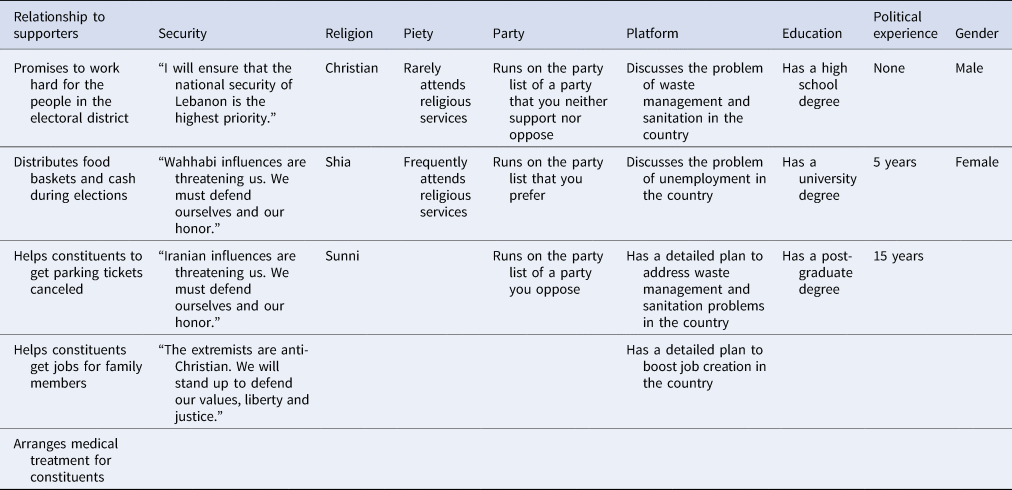
We include a set of attributes in the conjoint experiment that typically compel voters to support candidates, in Lebanon and other contexts. Table 1 provides a list of all attributes and their corresponding levels, with baseline levels in italics.
Conjoint experiment attributes and levels

Several attributes relate to our core hypotheses. First, we include the ethnic group of the candidate (Christian, Shia Muslim, or Sunni Muslim) and code whether the respondent is from the same ethnic group as the candidate. Next, we include whether the candidate has made promises of clientelism to their constituents. Promises of clientelism range from the baseline value—a candidate who pledges to “work hard for their district”—to lower-value cash or food and higher-value goods, such as medical treatment or patronage employment. Another attribute of interest is programmatic policy platform. Candidates are associated with appeals related to the topics of immediate relevance in Lebanese politics: employment and waste management.
Other relevant attributes in the conjoint experiment include the candidate's religious piety (independent of ethnic identity), party affiliation, educational level, political experience, and gender. We include piety because the perceived religiosity of candidates has been shown to compel voters via signaling credentials and moral values (Pepinsky, Liddle, and Mujani Reference Pepinsky, Liddle and Mujani2012; Cammett and Luong Reference Cammett and Luong2014). We also include partisan identification as a well-known predictor of voting behavior in its own right because it represents membership in a group, apart from parties' commitment to a particular set of ideas or policy positions (Green and Palmquist Reference Green and Palmquist2004). Furthermore, even in Lebanon, where parties are structured by ethnic affiliation, partisanship is distinct from ethnic identification and coethnic support.Footnote 11
Candidates' level of education and political experience are also likely to affect citizen political preferences. All things being equal, respondents are likely to favor individuals with higher levels of education (Hainmueller and Hopkins Reference Hainmueller and Hopkins2015; Horiuchi, Smith, and Yamamoto Reference Horiuchi, Smith and Yamamoto2018). The effect of candidate political experience, however, is not clear. In some contexts, voters report more positive assessments of more politically experienced candidates (Horiuchi, Smith, and Yamamoto Reference Horiuchi, Smith and Yamamoto2018; Kirkland and Coppock Reference Kirkland and Coppock2018). On the other hand, given poor historical government performance in Lebanon, political experience may backfire, compelling citizens to look at longstanding politicians with distrust and cynicism. Finally, we include an attribute for the candidate's gender, since citizens in a variety of contexts express skepticism about women in public leadership positions (Masoud, Jamal, and Nugent Reference Masoud, Jamal and Nugent2016; Kao and Benstead Reference Kao and Benstead2021). Although we do not focus on these demographic attributes, we include them to increase the realism of candidate profiles, and we report their effects as a useful metric of comparison to other attributes of interest.
Conjoint Analysis
The key quantity of interest is the average marginal component effect (AMCE), or the treatment effect of any one of the profile attributes relative to that attribute's baseline. The AMCE represents the average difference in the probability of being the elected candidate when comparing two different attribute values—for example, a candidate who distributes food and cash to supporters to a candidate who promises to work hard for the district—where the average is taken over all possible combinations of the other candidate attributes. Due to random assignment of attributes, on average, profiles with a candidate who distributes food and cash, for example, have the same distribution for all other attributes as profiles with a candidate who pledges to work hard, allowing for a comparison of means.
Hainmueller, Hopkins, and Yamamoto (Reference Hainmueller, Hopkins and Yamamoto2014) show that the AMCE is non-parametrically identified given the conditionally independent randomization of the attributes and can be estimated by regressing the binary outcome variable (candidate selected) on sets of indicator variables measuring the levels of each attribute. Because observed choice outcomes are not independent across the profiles rated by a single respondent, standard errors are clustered by respondent to obtain accurate variance estimates.
Results
We present four key findings in this section. First, we find that coethnicity is the single most important predictor of vote choice, based on the AMCE associated with different candidate attribute levels. Coethnicity is more important, all else considered, than programmatic or clientelist platforms, in addition to other salient features, such as education and partisanship. Second, we find that the overwhelming importance of coethnicity is not mediated by the type of clientelism that coethnic candidates promise. Promises of clientelism (relative to a generic, non-clientelist baseline) do not make coethnic candidates significantly more attractive than non-coethnics.
Next, we look at other mechanisms that might help explain the salience of coethnicity. We find that coethnicity is more important to individuals with a strong expressed attachment to their ethnoreligious community, and to individuals who display lower levels of trust in state institutions. Collectively, these findings support the assertion that expressive components of identity tied to desires for security and belonging also independently exert influence on vote choice.
Importance of Coethnicity for Vote Choice
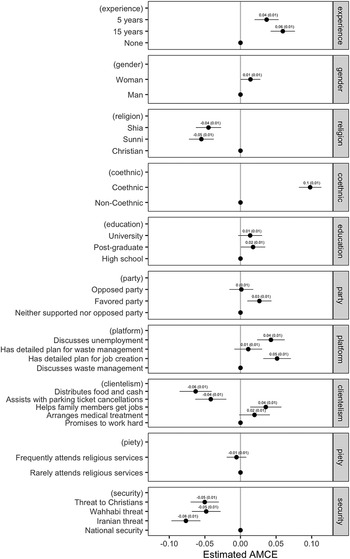
Figure 1 depicts the AMCE for all candidate attribute levels on respondent vote choice. We find that candidate coethnicity has the single largest effect on vote choice of any attribute level, an approximately 10 percentage point effect compared to the non-coethnic baseline. By contrast, promises of patronage-based employment cause a four percentage point increase in the likelihood of choosing a candidate, and detailed plans for programmatic policies related to employment are associated with a five-point increase. As reference, other characteristics positively associated with vote choice include candidates with at least 15 years of experience (six percentage points), candidates from the favored party of the respondent (three percentage points), and candidates with a post-graduate education (two percentage points).
Effect of candidate attributes on vote choice (AMCE)
Note: Average effect of candidate attributes on respondents' preferences for hypothetical MP candidates. Points represent the estimated average marginal component effect (AMCE) of a candidate attribute on respondents' probability of choosing a candidate with that attribute, compared to a candidate with the baseline attribute quality. Horizontal bars represent 95% confidence intervals. All standard errors are heteroskedasticity robust and clustered at the individual level.

Certain candidate characteristics are also negatively associated with vote choice. Interestingly, these include references to out-group threats, relative to a baseline reference to national security provision (ranging from a five to eight percentage point effect on the likelihood of vote choice, depending on the specific treatment). Promises of low-value clientelism such as food or forbearance (in this case, cancelling of parking tickets) are also negatively associated with vote choice (six and four percentage point decrease, respectively). Interestingly, religious piety is not rewarded, and membership in a political party opposed to the respondent is not punished.
The Appendix contains several robustness checks that bolster our confidence in these core findings. Figure A.2 presents the AMCE results for a model in which the dependent variable is defined as an alternate form of political support, rally attendance. Coethnicity remains by far the most important candidate characteristic, and most forms of clientelism are comparatively uncompelling to respondents in this analysis. Figure A.3 presents unadjusted marginal means results, a commonly used alternative to the AMCE that does not rely on comparisons to any baseline attribute (but also cannot be used to make causal inferences about the effect of any attribute level on vote choice).
Another possible concern is that coethnicity may be an important characteristic only to some sub-set of voters. If coethnicity were found to only be of critical importance to lower-income voters, this would support assertions that coethnicity acts as a credible signal of clientelism, to which lower-income voters are often said to be particularly susceptible (Magaloni Reference Magaloni2006; Stokes et al. Reference Stokes, Dunning, Nazareno and Brusco2013). Similarly, if coethnicity were only important to core partisans, or when interacted with candidates' partisan identity, this would signal that some property of ethnic parties (e.g., their propensity to engage in clientelist transactions) is chiefly mediating coethnicity's effect on vote choice rather than other expressive dimensions of identity in which this paper is interested.
These concerns are not born out in the empirical analysis. Figure A.4 in the Appendix shows that socioeconomic status does not have a significant effect on the overwhelming importance of coethnicity (nine percentage point increase for higher income voters and 10 percentage point increase for lower income voters, no statistically significant difference). The mediating effects of respondent education (Figure A.8) and age cohort (Figure A.9) are also insignificant. In contrast with common expectations that ethnic identity is less salient to younger citizens, respondents from the post-war (younger) generation were more likely to support coethnic candidates than their older war-era and pre-war peers (13 percentage point AMCE versus nine), though this difference is not significant at conventional levels. Additionally, party supporters are not more likely to support coethnic candidates (Figure A.5). Interestingly, however, respondents are slightly more likely to support coethnics when they come from a party to which they feel opposed or neutral (11 percentage point AMCE versus eight percentage points, Figure A.7). We interpret this to indicate that respondents favor coethnic candidates even when ties to the candidate's party are weak and, thus, a clientelist transaction is less likely to occur.
A final concern is that coethnicity is salient to respondents because it acts as a sect-specific signal of programmatic policy preferences. In other words, it might be the case that Christian, Sunni Muslim, and Shia Muslim identities each signal a coherent and distinct set of policies, and that voters support coethnics as proxies therein. This instrumentalist account, though not associated with clientelism, would conflict with expressive understandings of coethnic support centered on the desire to belong within and be represented by a community. Figure A.10 investigates whether respondents from these three main sub-groups have different programmatic policy or clientelism preferences. Our findings are mostly null, with a few minor exceptions: Sunni Muslims slightly favor job creation platforms, relative to other groups, and Shia Muslims slightly disfavor medical treatment as a clientelist good. We take this to indicate that inter-group policy preferences are not sufficiently distinguished to the extent that ethnic identity acts as a proxy for policymaking.
In summary, we find that coethnicity is the single most impactful candidate feature on respondent vote choice, and that this holds across different estimation strategies and for a variety of relevant sub-groups. We also find evidence that ethnicity is not acting purely as a proxy for party or policy platform. Next, we investigate whether the effect of coethnicity is mediated by promises of clientelism.
Clientelism and Coethnicity
Does coethnicity make promises of clientelism more credible? As we previously discussed, this is the most prevalent and compelling rebuttal to expressive theories of ethnic identity in the comparative politics literature. Here, we do not argue that Lebanese voters are not compelled by clientelism; indeed, some of the evidence we present demonstrates they are. Instead, we show that the effect of clientelist promises on vote choice is not mediated in any significant way by coethnicity, even when clientelism is disaggregated in various politically relevant ways.
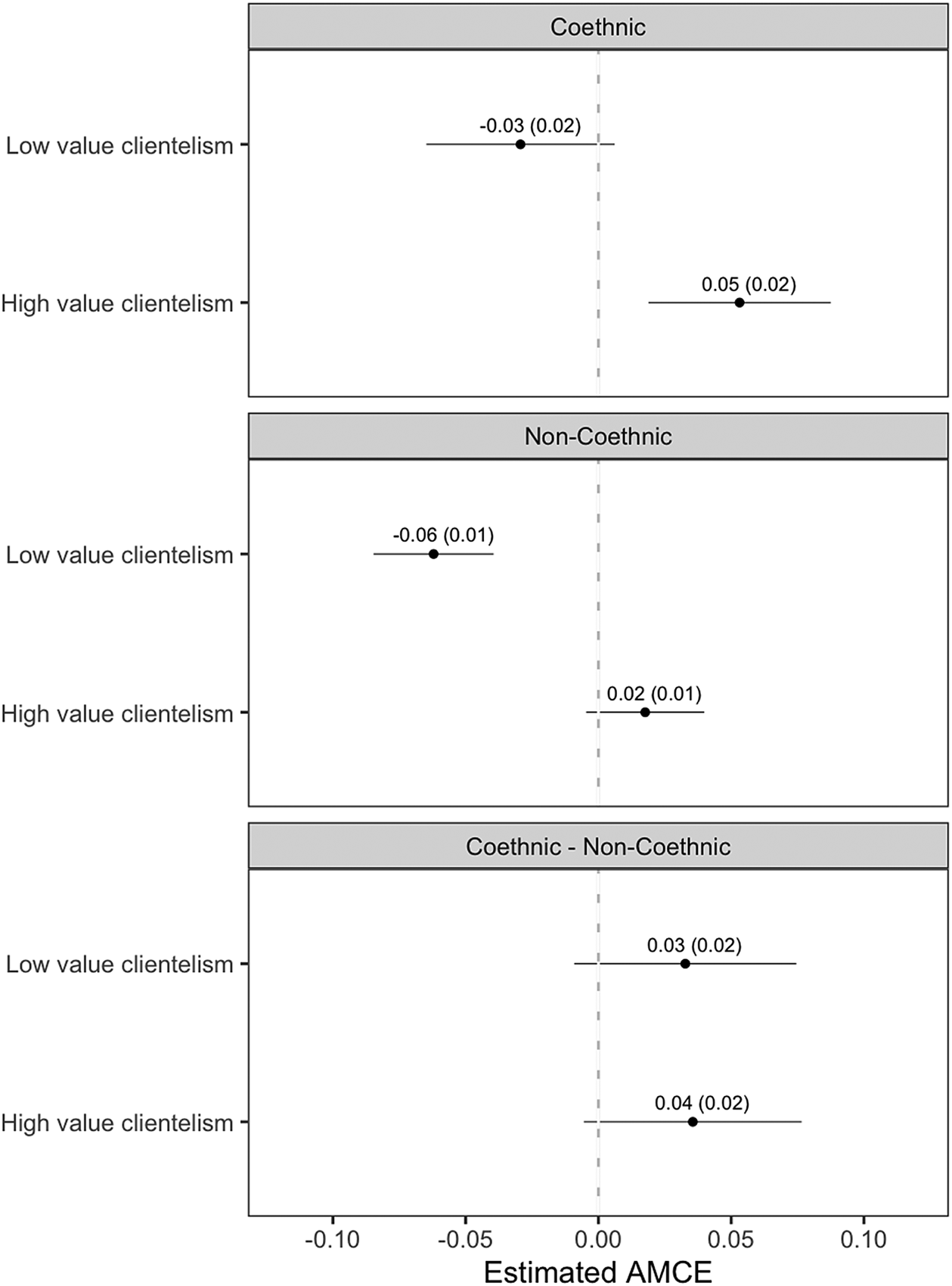
Figure 2 depicts the AMCE associated with low-value and high-value clientelism depending on whether the candidate was a coethnic of the respondent. In keeping with the full AMCE results presented in Figure 1, respondents generally disfavor low-value clientelism (food and cash or forbearance) and favor high-value clientelism (medical care and patronage employment). There are small differences in the magnitude of the AMCE for each, with coethnic candidates favored. People disfavor low-value clientelism provided by coethnics by three percentage points, and by non-coethnics by six percentage points; they also favor high-value clientelism from coethnics by five points, as opposed to four for non-coethnics. But these differences are not statistically significant at conventional levels, thus supporting our assertion that clientelism is not the sole driver of coethnic support.
Coethnicity and vote choice by provision of clientelism
Note: Average effect of candidate attributes on respondents' preferences for hypothetical MP candidates. Points represent the estimated average marginal component effect (AMCE) of a candidate attribute on respondents' probability of choosing a candidate with that attribute, compared to a candidate with the baseline attribute quality. Horizontal bars represent 95% confidence intervals. All standard errors are heteroskedasticity robust and clustered at the individual level. Baseline attribute for clientelism attribute is “promises to work hard for members of their district.” Low value clientelism is defined as offers of parking ticket cancellations or food and cash. High value clientelism is defined as offers of medical treatment or jobs for family members.

These results also hold when we further disaggregate clientelism into the four types that were originally presented to respondents in each task (Figure A.6 in the Appendix). Food and cash are particularly disfavored, regardless of whether a coethnic is providing them or not; similarly, employment provision is widely favored. Across all four types of clientelism, the difference between coethnic and non-coethnic provision is quite small and statistically insignificant. Next, we provide corroborating evidence for two alternative mechanisms driving coethnic support: expressive attachment to community and desire for protection in the context of systemic insecurity.
Coethnicity by Attachment to Community and Trust in State Institutions
Here, we investigate whether expressive components of ethnic identity—communal attachment and desire for protection—affect support for coethnic politicians in the Lebanese context. In the non-experimental portion of our survey, which preceded the conjoint tasks, respondents were asked to report the extent to which they felt a part of their ethnoreligious community. We divided respondents based on whether they responded affirmatively to this question (84% of the sample) and investigated whether there were salient differences between sub-groups.
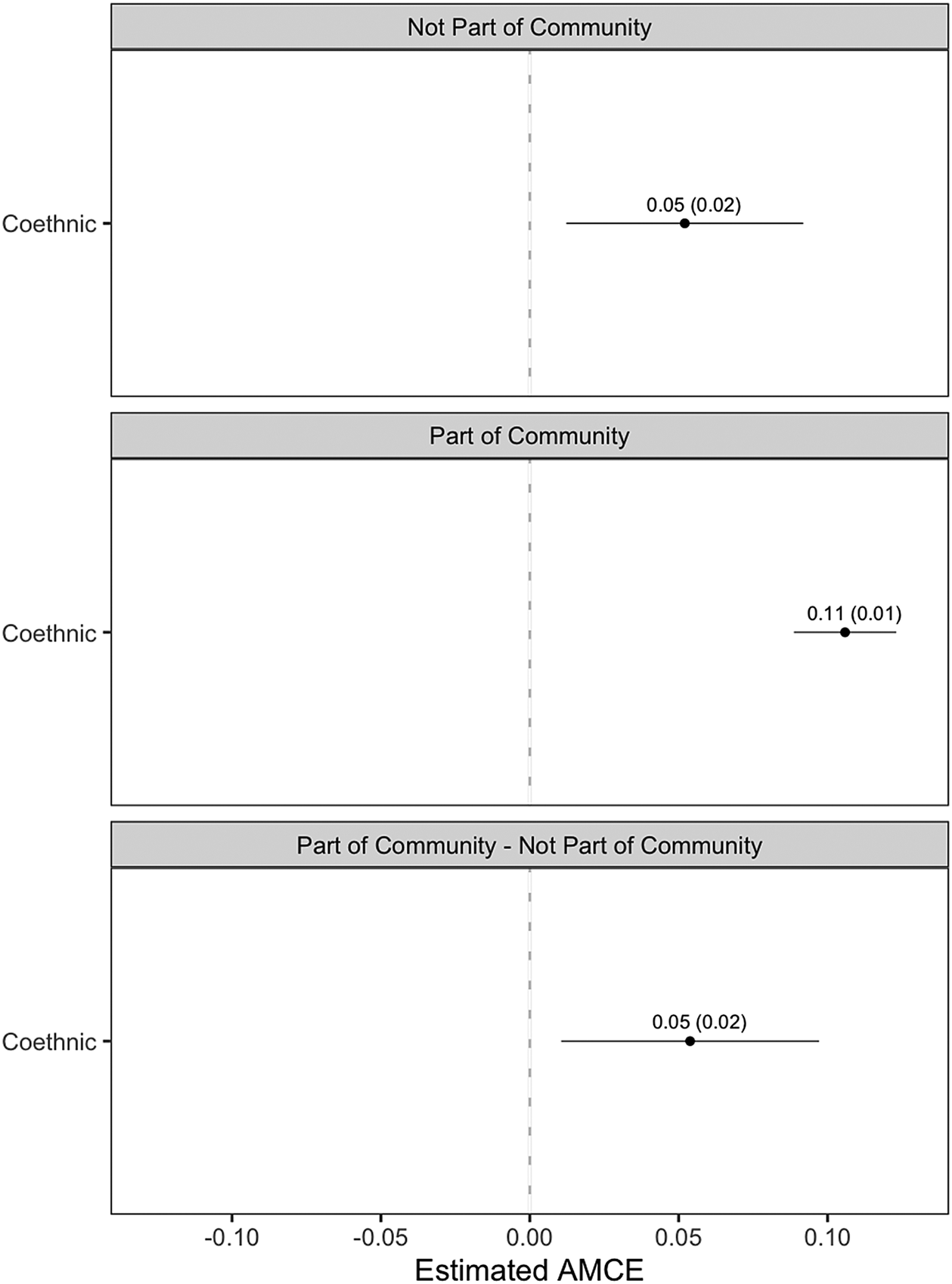
Figure 3 depicts levels of coethnic support for those who reported higher or lower levels of attachment to their ethnic community. For the majority of respondents, who responded affirmatively, coethnicity was associated with an AMCE of 11 percentage points, but only five percentage points among those who did not consider themselves part of their community (statistically significant, p = 0.05). We interpret these findings with some caution: it is impossible to know from our data whether higher levels of support for coethnics drive attachment to community among these respondents, or whether communal attachment leads people to support coethnics at higher rates. Indeed, expressive components of communal attachment are generally thought of as an equilibrium outcome, rather than part of a unidimensional causal pattern (Huddy Reference Huddy, Huddy, Sears and Levy2013). Therefore, these findings lend purely descriptive evidence to claims linking the expressive benefits of group belonging—and potentially, those of out-group punishment—to the political salience of coethnicity.
Attachment to community and support for coethnic candidates
Note: Average effect of candidate attributes on respondents' preferences for hypothetical MP candidates. Points represent the estimated average marginal component effect (AMCE) of a candidate attribute on respondents' probability of choosing a candidate with that attribute, compared to a candidate with the baseline attribute quality. Horizontal bars represent 95% confidence intervals. All standard errors are heteroskedasticity robust and clustered at the individual level. Baseline attribute for coethnicity attribute is non-coethnic. Attachment to community is based on respondents' self-reporting of whether they consider themselves part of their ethnoreligious community (84% respond affirmatively).

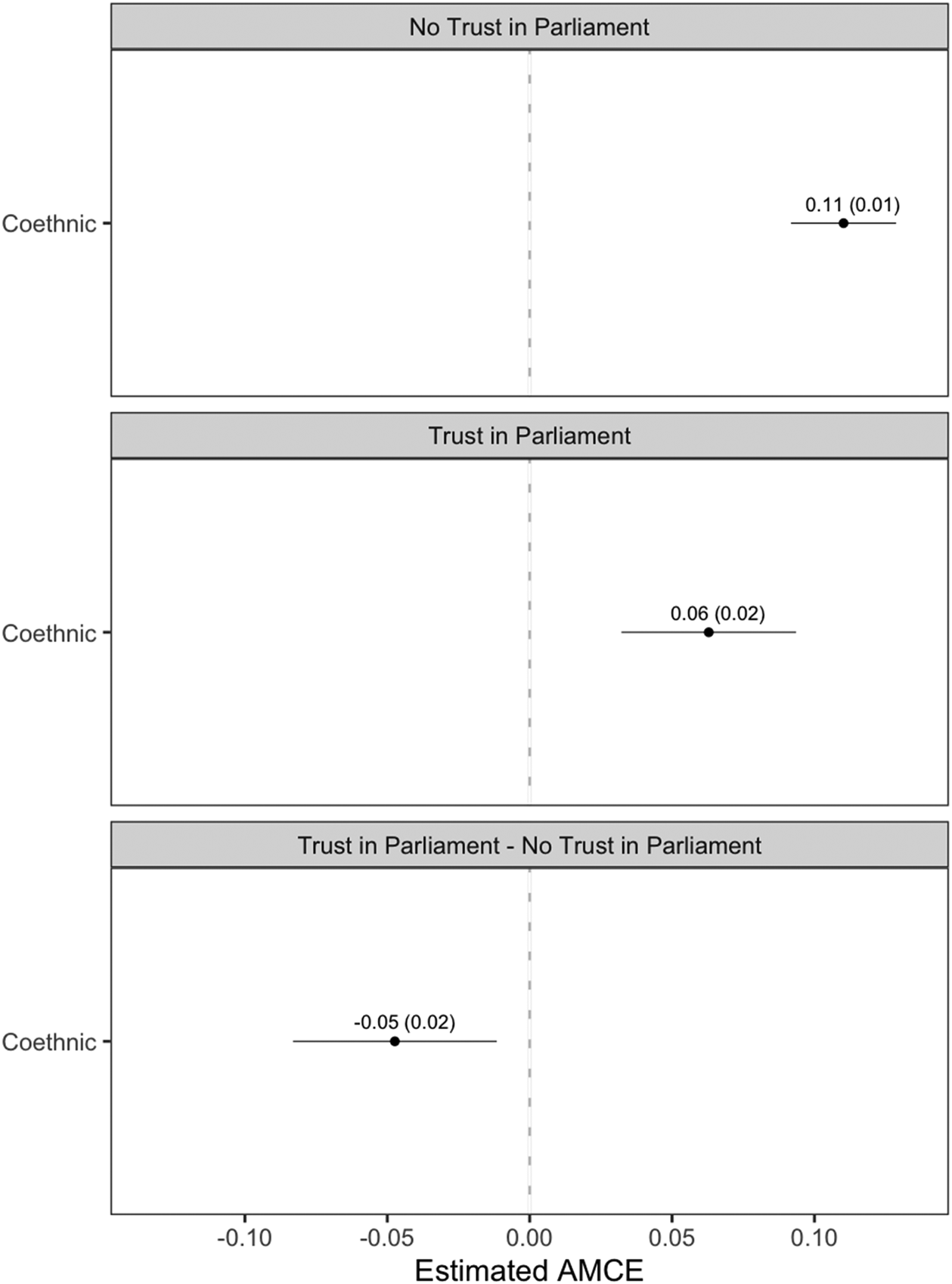
Figure 4 presents findings related to the effect of coethnicity by respondents' level of trust in state institutions. In the non-experimental part of our survey, respondents were asked about their level of trust in the Lebanese Parliament, with 27% of respondents expressing high levels of trust. Among these respondents, the AMCE for the support of coethnic candidates was six percentage points, compared to 11 percentage points for those with lower levels of trust in the Parliament (statistically significant, p = 0.05). Here again, we do not have the evidence to determine the direction of the causal arrow. People who more heavily favor coethnic candidates may subsequently trust the (multi-ethnic) Parliament less; or, alternatively, lower levels of trust in the Parliament may lead people to subsequently favor their ethnic group more. Indeed, the data also allow for some intervening variable to concomitantly affect both indicators at once.
Trust in parliament and support for coethnic candidates
Note: Average effect of candidate attributes on respondents' preferences for hypothetical MP candidates. Points represent the estimated average marginal component effect (AMCE) of a candidate attribute on respondents' probability of choosing a candidate with that attribute, compared to a candidate with the baseline attribute quality. Horizontal bars represent 95% confidence intervals. All standard errors are heteroskedasticity robust and clustered at the individual level. Baseline attribute for coethnicity attribute is non-coethnic. 27% of respondents report high levels of trust in Parliament.

That said, we interpret this as descriptive evidence that stronger coethnic support is associated with the sentiments of mistrust in the state, a finding that has some extant support in the comparative politics literature (Huebert and Liu Reference Huebert and Liu2017; Sahin and Akboga Reference Sahin and Akboga2019). This finding could plausibly be interpreted as instrumentalist, e.g., people looking to their ethnic group for physical protection from threats when they perceive the state to be negligent in providing this good. Indeed, security services in the form of checkpoints, guarding, and even dispute resolution are provided on a clientelist basis in Lebanon and analogous contexts (Belhadj et al. Reference Belhadj2015; Stedem Reference Stedem2020). On the other hand, social identity theory posits a less immediately material understanding of protection, in which ethnic groups ease the psychological burdens of insecurity or alienation in insecure contexts. Our findings point to the possibility, at a minimum, that these expressive dimensions of coethnicity are also at work in the Lebanese context.
Discussion
In this paper, we have provided experimental evidence of coethnicity's overwhelming salience in the Lebanese political context. All else equal, coethnicity exerts the single greatest effect on vote choice for our survey respondents—far greater than promises of clientelism, policy platform, education, experience, or partisanship. These findings hold across respondents of different socioeconomic status, education, age cohort, and party membership. We also find that coethnicity does not significantly alter respondent perceptions of clientelism. Regardless of whether candidates are coethnics or not, respondents generally disfavor low-value clientelism and favor higher-value goods. Finally, we find that respondents with higher levels of attachment to their ethnic community and lower levels of trust in state institutions value coethnicity at significantly higher rates than other respondents. Collectively, these findings suggest that less immediately material factors associated with ethnic identity—and not merely its role in promoting clientelist transfers—also critically affect vote choice in patronage democracies like Lebanon.
These findings have important implications for micro-level studies of political identity, as well as broader macro-level studies of governance and party development in ethnically diverse polities. As we have previously detailed, clientelism remains the dominant explanation for the persistence of ethnicity as a salient identity in much of the Global South. Were parties and elites to discontinue patronage politics, much of the literature implicitly assumes that coethnic favoritism would fade, at least in the political realm. Presumably, this would then strengthen national identity and lessen the threat of future violence or state breakdown in contexts where ethnic identification previously contributed to division and discontent.
Our findings de-center clientelism from accounts of ethnic politics and suggest a more complex pathway toward programmatic, nation-oriented politics. Our evidence indicates that weak state performance and pre-existing ethnic group attachments can reinforce coethnic voting, net of the clientelist politics that often go hand in hand with those conditions. Our evidence also implies that ethnic parties do not only succeed because they are better at providing clientelism and, conversely, that coethnicity does not remain salient solely because of patronage supplied by ethnic parties. These findings contribute to a growing literature that situates identity as constructed and contingent on elite interventions, yet also relevant to peoples' vote choices for a variety of social psychological reasons (Charness and Chen Reference Charness and Chen2020; Egan Reference Egan2020; Klar Reference Klar2020). They also cohere with recent work on Lebanon that extends the study of ethnic identity beyond its ties to ethnic party clientelism (Paler, Marshall, and Atallah Reference Paler, Marshall and Atallah2018; Marshall and Paler Reference Marshall and Paler2020).
Future scholarship should continue to explore the various reasons why coethnicity is salient to voters in diverse polities. Our work cannot fully arbitrate between various non-instrumental accounts of coethnicity, nor can it draw a clean causal arrow from any of them to voter behavior. Future research, including survey experimental work, should attempt to further untangle some of the mechanisms we have proposed. Does a need to belong and be perceived as belonging within one's ethnic group motivate vote choice, even absent of state weakness and general structural insecurity? Do desires for protection ultimately link to clientelist provision of security, or are there less material conceptions of protection that also affect political preferences? It would also be worth disaggregating such preferences not only by demographic factors, as we have done, but also by sub-national geographies and their attendant historical legacies. Finally, observational and experimental evidence should shed light on the conditions under which the salience of expressive components of coethnicity increases or fades. When regional or domestic events activate voters' perceptions of threats, does the salience of coethnicity increase? What policy interventions, if any, decrease the expressive benefits of coethnicity in diverse polities? Further research is necessary to understand how coethnicity matters beyond its relationship to clientelism, and to what end.
Supplementary material
The supplementary material for this article can be found at https://doi.org/10.1017/S1755048321000201.
Acknowledgements
For valuable feedback and suggestions, we thank Carol Abi-Ghanem, Karen Ferree, Anselm Hager, Adam Harris, Evan Lieberman, Ellen Lust, Mashail Malik, Gwyneth McClendon, Ahmed Mohamed, Jana Mourad, Lama Mourad, Laura Paler, David Romney, Leah Rosenzweig, Bassel Salloukh, Aytug Sasmaz, Daniel Smith, Anton Strezhnev, Lily Tsai, Guadalupe Tunon, Sami Zbheib, and participants in seminars at the American Political Science Association, Boston University, Gothenburg University, Harvard University, MIT, Notre Dame University, the University of Pittsburgh, and Texas A&M, as well as researchers at the Lebanese Center for Policy Studies. All errors are our own.
Melani Cammett is Clarence Dillon Professor of International Affairs, Department of Government, Harvard University.
Dominika Kruszewska-Eduardo is an Independent Scholar.
Christiana Parreira is a Postdoctoral Research Associate in the Department of Near Eastern Studies at Princeton University.
Sami Atallah is Founding Director, The Policy Initiative, Beirut, Lebanon.