


Introduction
Mindfulness has been described as “the awareness that emerges through paying attention on purpose, in the present moment, and non-judgmentally to the unfolding of experience moment by moment” (Kabat-Zinn, Reference Kabat-Zinn2003, p. 145). Mindfulness skills are often taught in the context of improving emotional well-being and constitute the basis for therapeutic change within clinical interventions such as Mindfulness-based Cognitive Therapy (MBCT; Segal, Williams and Teasdale, Reference Segal, Williams and Teasdale2002).
MBCT programmes aim to help people to become aware of and relate differently to their thoughts, feelings and bodily sensations in relation to depression and “to do so through changes in understanding at a deep level” (Segal et al., Reference Segal, Williams and Teasdale2002, p. 65). The core skill that MBCT aims to teach involves stepping out of old habits of thinking, recognized as perpetuating the cognitive aspect of depression, being aware of these and letting them go (Segal et al., Reference Segal, Williams and Teasdale2002). This approach encourages people to allow their difficult thoughts and feelings to simply be there, adopting a more “welcome” than a “need to solve” stance to problems (Segal et al., Reference Segal, Williams and Teasdale2002, p. 55). Segal et al. (Reference Segal, Williams and Teasdale2002) describe this as “best to capture the decentering” (p. 62), which they believe to be the critical cognitive element within their therapy.
MBCT has been found to contribute positively to relapse prevention for people with a past history of more than two episodes of depression (Coelho, Canter and Ernst, Reference Coelho, Canter and Ernst2007; Hick and Chan, Reference Hick and Chan2010; Teasdale et al., Reference Teasdale, Segal, Williams, Ridgeway, Soulsby and Lau2000) and is recommended within the NICE Guidelines for Depression (NICE, 2009). There is also increasing evidence to support the usefulness of MBCT (and other mindfulness-based interventions) with various clinical populations (Baer, Reference Baer2003). The current review focuses upon the use of MBCT across a range of clinical settings.
In addition to the expanding body of quantitative research relating to MBCT, qualitative research in this area offers insight into how participants make sense of and experience MBCT programmes, as well as having good fidelity with the core principles of mindfulness (Allen, Bromley, Kuyken and Sonnenberg, Reference *Allen, Bromley, Kuyken and Sonnenberg2009). Although individual qualitative studies are of value, research that attempts to synthesize the findings of multiple qualitative studies is recognized as being essential to enhancing the generalizability of findings and reaching “higher analytic goals” (Sandelowski, Docherty and Emden, Reference Sandelowski, Docherty and Emden1997, p. 367), producing robust findings that can be used to develop evidence-based care and inform guidelines.
With a number of qualitative studies available on participants’ experiences of MBCT, this review utilizes Noblit and Hare's (Reference Noblit and Hare1988) meta-ethnography process to synthesize the study findings to identify how the features of Mindfulness-based Cognitive Therapy contribute to positive therapeutic change.
Method
Data sources
A systematic search was conducted using the electronic databases PsychINFO, AMED, CINAHL, Web of Science, PubMed and MEDLINE. The search terms Mindfulness or Mindfulness Therapy and Qualitative or Qualitative study or Qualitative research were used. The limits of English language and peer reviewed journal article were also imposed upon the searches where the databases allowed.
Inclusion/exclusion criteria
Articles were excluded if they: i) were of quantitative design only; ii) were not an empirical study e.g. case studies, reviews, discussion of theory; iii) focused upon the application of mindfulness in either an alternative form i.e. Mindfulness-based Stress Reduction or Mindfulness Meditation, not at all, or upon the views of clinicians rather than service users; and iv) employed a form of qualitative analysis that did not produce themes within the results.
Articles were included if they: i) were published within a peer-reviewed journal; ii) were written in the English language; iii) included the qualitative analysis of interview data that produced themes within the research findings; and iv) included a sample of participants who had undertaken Mindfulness-based Cognitive Therapy and where the focus of the study concerned their experiences of this.
Search outcome
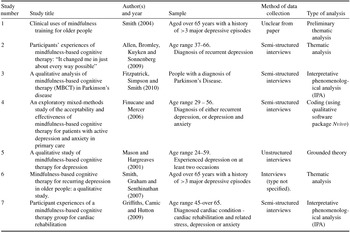
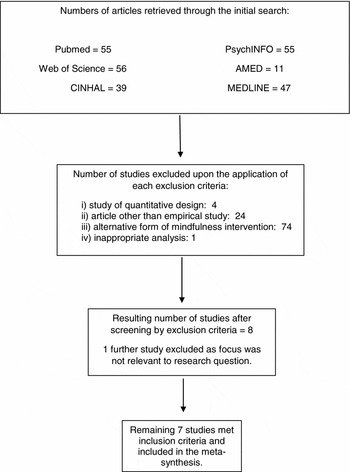
The final search and application of the exclusion criteria was conducted on 6 May 2011 and identified eight studies for inclusion in the review. A study by Bailie, Kuyken and Sonnenberg (Reference Bailie, Kuyken and Sonnenberg2011) was excluded at this point as, although it explored the experiences of participants who had completed a Mindfulness-based Cognitive Therapy programme, the focus of this study was upon the impact of the therapy upon participants’ parenting skills rather than the experiences of the programme itself, and so it was felt that this would not be relevant to the research question of this meta-synthesis. The remaining seven studies met the inclusion criteria outlined above and were included within the meta-synthesis. The reference section of each of these papers was examined for any additional relevant references but none were identified. Figure 1 outlines the progression of the search process and Table 1 summarizes the demographic characteristics of the included studies.
The demographic and methodological characteristics of the seven included studies

The progression of the search process from initial search to final studies included for review

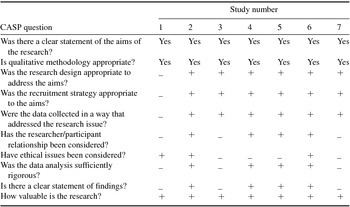
Studies were not excluded on the basis of quality, but were subjected to a quality appraisal using the Critical Appraisal Skills Programme (CASP; Public Health Resource Unit, 2006). This tool is used to consider the rigour, credibility and relevance of the research design, methodology and findings of each study. The CASP tool begins by asking two screening questions that require a yes/no answer and then eight questions using a positive (+) or negative (−) rating by the researcher for each study. Table 2 summarizes the outcome of this quality appraisal process, the findings of which are discussed in relation to the findings of the meta-synthesis later within this paper. This process was carried out by the first author and validated by the second author.
Quality appraisal process applied to the seven included studies

Key: (+) signifies a positive rating made by the researcher in relation to this aspect of quality
(−) signifies that the paper has been felt by the researcher to be lacking in relation to this aspect of quality
Data analysis
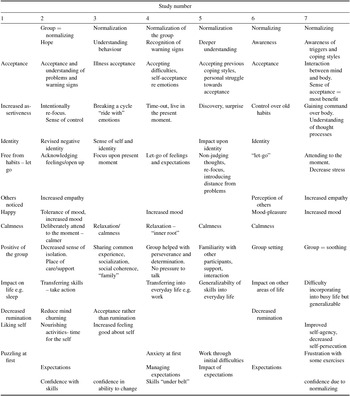
Noblit and Hare's (Reference Noblit and Hare1988) process of meta-ethnography was used to synthesize study data. This aims to explore the contribution of the collection of studies as a whole and produce higher order themes, whilst preserving the interpretations of participants’ original accounts. The meta-ethnography process achieves this through comparing and contrasting the findings of individual studies in order to seek variance and similarities and explore these in a “new interpretive context” (Noblit and Hare, Reference Noblit and Hare1988, p. 64). During analysis the researcher considered the entire “findings” section of each of the seven papers (made up of theme descriptions that included quotes from original participants) as the data to be subjected to analysis. Each study was read several times, throughout which key themes, metaphors and concepts within the findings sections of each study were noted. The relationship between the findings of the studies was then determined by juxtaposing the noted key themes/concepts from each study within a table and examining their relationships, presented within Table 3.
Initial key concepts within each study juxtaposed for examination of relationship

Next, the process of reciprocal translation was carried out. This involved a comparison of the key concepts of each study in turn. As this process ensued, key concepts from each study were compared to emerging themes across studies whilst remaining open to the potential emergence of new themes. Through this iterative process the findings were gradually integrated in order to be considered as an entire set. Throughout this process the “sense” of the findings from each study was retained, whilst their interaction across studies compared in order to identify groups of subthemes that were then further grouped into major themes. These final themes were then validated by the second author by comparison of themes and subthemes against the table of initial key concepts.
A synthesis of translation was then carried out in order to create a higher order concept that describes the interaction between the four major themes. This is described by Noblit and Hare (Reference Noblit and Hare1988) as “making a whole into something more than the parts alone” (p. 28). This synthesis was also validated by the second author and is communicated in written and diagrammatic form below.
Results
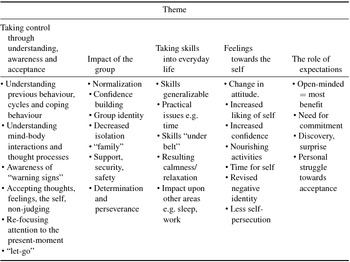
The process of reciprocal translation identified 29 sub-themes, which were further refined into the following five major themes: (i) Taking control through understanding, awareness and acceptance; (ii) The impact of the group; (iii) Taking skills into everyday life; (iv) Feelings towards the self; (v) The role of expectations. Table 4 describes in detail these five major themes and their incorporated subthemes.
Concepts refined into major themes following reciprocal translation

Taking control through understanding, awareness and acceptance
Within all seven studies participants appeared to experience a positive shift in their appraisal of personal agency and control. This was facilitated by the development of an understanding of personal difficulties, increased awareness on a number of levels and acceptance of the self, previous coping behaviours, and present moment arising thoughts and feelings.
Participants described an empowerment associated with gaining understanding and becoming aware of their experience of difficulties. One aspect of this, the process of understanding psychological and bodily signals, was interpreted by Allen et al. (Reference *Allen, Bromley, Kuyken and Sonnenberg2009) as creating a “thermostatic” (p. 418) feature within participants that signalled a need for action and provided opportunities to gain control. This awareness of early warning signs increased feelings of control:
It's so easy to trip up, so unbelievably easy to get yourself back into the rut. . .I think perhaps it makes you recognize that you are on the edge of the rut quicker rather than falling into it and saying how the hell did I get here. And it gives you some methods of holding a better balance. (Finucane and Mercer, Reference *Finucane and Mercer2006, p. 10)
Whilst gaining understanding many participants described moments of realization:
During the 8 weeks I realized that it was possibly my attitude and the way I was running myself that led finally to the way I am. (Mason and Hargreaves, Reference *Mason and Hargreaves2001, p. 206)
These appeared to result in positive change:
Instead through the mindfulness and acknowledging what is going on in the moment . . .you can start to enjoy life as it is happening rather than looking to the past or the future. (Mason and Hargreaves, Reference *Mason and Hargreaves2001, p. 206)
The development of an awareness of the mind-body interaction also seemed to be an important feature of MBCT recognized as giving participants “more command over their bodies” (Griffiths, Camic and Hutton, Reference *Griffiths, Camic and Hutton2009, p. 678). Interestingly, this aspect of awareness was less explicitly discussed in the other six studies, possibly a reflection upon the nature of the sample of participants studied by Griffiths et al. (Reference *Griffiths, Camic and Hutton2009) who were completing the MBCT within a cardiac rehabilitation setting.
Developing an awareness of the present moment was found to positively impact upon mood and depressive thinking. One participant described the direct link between awareness of the present moment and taking control:
When I used to get very depressed, troublesome thoughts became troublesome obsessions, you couldn't clear them from your mind. But now I find it easier to sit down and relax and do this thinking about my breathing and realizing that no matter what you think, today's today and this moment's alright, so. . .it's given me more control. (Smith, Graham and Senthinathan, Reference *Smith, Graham and Senthinathan2007, p. 351)
Acceptance of the present moment experience included acceptance of thoughts, feelings and emotions and was also associated with increased feelings of control. Participants experienced a process of becoming aware of and then choosing to accept and tolerate experiences that previously may have resulted in decreased mood and activation of maladaptive coping strategies:
A lot of what happens to a Parkinson's patient is exacerbated or can be exacerbated by stress and emotions. . .So if you can control. . .control is the wrong word, if you can ride with them, then it's . . . it can be better for you. (Fitzpatrick, Simpson and Smith, Reference *Fitzpatrick, Simpson and Smith2010, p. 185)
Fitzpatrick et al. (Reference *Fitzpatrick, Simpson and Smith2010) provides an interpretation of the use of the words “ride with” (p. 185) within this account as being a metaphor for having gained mastery over an object to be ridden i.e. stress. Another participant explained bluntly “it's helped me look at things in a different way. . .just accept it” (Finucane and Mercer, Reference *Finucane and Mercer2006, p. 9). Despite the apparent “mastery” of acceptance that appears within such accounts, acceptance is discussed by several participants as provoking a personal struggle and as being difficult to achieve:
The acceptance area is the hardest thing to accept, I struggle very strongly with that – I thought, well I can't accept this; I don't want to accept what my life could be, you know, its um [pause] to me it was too terrifying, I struggle hard with that bit. (Mason and Hargreaves, Reference *Mason and Hargreaves2001, p. 206)
The impact of the group
Across all studies, the impact of engaging with a group-based programme resonated within the accounts of participants. The impact of being with others with a shared sense of distress provided a validating and normalizing experience, whilst learning alongside others also appeared to increase levels of motivation and determination. Additionally, the group setting played a role in developing participants’ interpersonal relationships, both during the course of MBCT and in other areas of their lives.
Participants described others within the group as being like a “mirror” or “echo” (Allen et al., Reference *Allen, Bromley, Kuyken and Sonnenberg2009, p. 420). The normalizing effect of meeting and learning about others with similar difficulties ameliorated previous feelings of stigma and played a large part in facilitating therapeutic change:
They were ordinary everyday run of the mill people which reinforces the fact that that Is what I am as well. I am not a nut. . .I’m just an ordinary, everyday run of the mill person who ended up in the crap for whatever reason, and so are they. So that was another thing that was a great plus. (Finucane and Mercer, Reference *Finucane and Mercer2006, p. 6)
Closeness and social coherence developed between the groups over time, creating and maintaining a supportive therapeutic environment that helped to build individual confidence:
It became like a family outing, everybody was so friendly; my friend is very sort of self-conscious who's got Parkinson's and she actually joined in. (Fitzpatrick et al., Reference *Fitzpatrick, Simpson and Smith2010, p. 187)
The group feature of MBCT also appeared to contribute to maintaining perseverance and determination:
I think if you are on your own you would quite easily walk away and give up whereas you’ve got the support there and you know that everybody's sort of helping you out. . . (Finucane and Mercer, Reference *Finucane and Mercer2006, p. 7)
Finally, the group nature of this intervention also appeared to provoke changes in attitudes towards others. Two of the seven studies (Allen et al., Reference *Allen, Bromley, Kuyken and Sonnenberg2009; Griffiths et al., Reference *Griffiths, Camic and Hutton2009) discussed an increase in empathy for others and participants were found to attribute their greater emotional closeness with friends and family, better communication and increased empathy to the accepting culture of the group, enabling them to open up to emotions they may have previously buried.
Taking skills into everyday life
The skills and tools learnt during the MBCT groups were highly valued by participants, including several who described the process of bringing skills into everyday living as “essential to therapeutic gain” (Mason and Hargreaves, Reference *Mason and Hargreaves2001, p. 207). Participants learnt to apply mindfulness skills in their everyday life in various ways, with lasting impact as well as practical and personal challenges. Mindfulness skills were used in a proactive manner:
I used to walk for hours and not see things, and now I’ll sort of consciously say, I’ll stop in half an hour and look around. . . and see what is there, which makes it much more pleasurable as well. (Mason and Hargreaves, Reference *Mason and Hargreaves2001, p. 207)
and in a reactive approach:
. . .when I felt very depressed. . .when I breathe I feel all right, don't think of the past or forward, it's the moment (Smith et al., Reference *Smith, Graham and Senthinathan2007, p. 351)
and also as a way of responding to precursor warning signs of depression and “nip them in the bud” (Smith et al., Reference *Smith, Graham and Senthinathan2007, p. 351).
Throughout the studies participants described a number of examples of successfully using mindfulness skills to manage emotions of everyday situations such as at work:
I do the 3-minute thing when I’m at work. . .and to be honest with you I feel that if I didn't do it I would have to go home you know, I would have to leave my work (Finucane and Mercer, Reference *Finucane and Mercer2006, p. 9)
as well as in preparation for facing specific anxiety provoking situations such as having a medical procedure:
I got a lot out of the body-scan. There was an incidence where I had went to the hospital for an endoscopy . . . normally with things like that I would be physically shaken, you know I would be so uptight but because I had this, under my belt if you like, I thought no I’ve got to use it. . .so I did use it and I wasn't shaken and I was so proud of myself. (Finucane and Mercer, Reference *Finucane and Mercer2006, p. 9)
The resulting impact of taking mindfulness skills into everyday life has been described by many to be calmness and relaxation, both as a positive outcome of a specific exercise: “it calmed me down a lot and created a space of calmness” (Mason and Hargreaves, Reference *Mason and Hargreaves2001, p. 204) and also as a positive overall physiological change (Smith, Reference *Smith2004).
Although often creating positive results, participants also acknowledged the challenges of generalizing new skills into everyday life (Finucane and Mercer, Reference *Finucane and Mercer2006; Griffiths et al., Reference *Griffiths, Camic and Hutton2009; Mason and Hargreaves, Reference *Mason and Hargreaves2001). Reasons reported included practicalities of finding the time to practise meditation in a busy life (Griffiths et al., Reference *Griffiths, Camic and Hutton2009) and a personal struggle towards acceptance (Mason and Hargreaves, Reference *Mason and Hargreaves2001).
Feelings towards the self
There appeared to be a change in attitude and feelings expressed by participants towards themselves throughout their experience of MBCT. This had implications in areas including identity, self-care and confidence.
Smith (Reference *Smith2004) described how “Many participants came generally to like themselves better” (p. 427). Similarly, one participant described: “I just feel good about myself, that it's probably maybe giving me some kind of inner peace” (Fitzpatrick et al., Reference *Fitzpatrick, Simpson and Smith2010, p. 187). Participants noticed changes in the way they interacted with others, interpreted by Griffiths et al. (Reference *Griffiths, Camic and Hutton2009) as indicative of improved self-agency and a lessened self-persecutory attitude in some cases.
Participants also experienced an increased sense of personal identity as a result of revision of negative self-perceptions. One participant's experience likening meditation to prayer was found to impact positively upon her feelings towards herself and was interpreted by Fitzpatrick et al. (Reference *Fitzpatrick, Simpson and Smith2010) as the mindfulness technique having allowed her
to retain a sense of self, as an individual committed to religious practice and as a person who could find an experience of peace through this process. (p. 187)
There was also a shift in participants’ willingness to give time to themselves without feeling guilty, and in appreciating the importance of taking part in nourishing activities for themselves. Over half of the participants interviewed by Allen et al. (Reference *Allen, Bromley, Kuyken and Sonnenberg2009) described deliberately engaging in a nourishing activity in response to recognizing early warning signs:
If I feel myself beginning to slip . . . I drag myself off to a nice garden centre for half a day. . . I just wander around and um, on my own, have a cup of tea or coffee and I find that that . . . nourishes me. (Allen et al., Reference *Allen, Bromley, Kuyken and Sonnenberg2009, p. 419)
Finally, participants reported feeling increased confidence in their ability to confront previously avoided situations: “one day it was a very dull dark day and I [went shopping]. A thing I have never done before . . . .” This same participant then later commented “My whole outlook is different. . .I feel a different person” (Smith et al., Reference *Smith, Graham and Senthinathan2007, p. 353).
The role of expectations
Expectations of MBCT appeared to play a mediating role in the experience of change and some participants appeared to experience a struggle in finding the most helpful balance in their expectations. Participants’ expectations were described as being along a continuum from having few expectations to expecting a “cure” (Mason and Hargreaves, Reference *Mason and Hargreaves2001). Finucane and Mercer (2009) described how those that were able to “let go of expectations of results and focus simply on the meditation methods” (p. 8) were more likely to gain benefit.
Participants described the struggle they had with being able to accept the limitations of MBCT and coming to terms with the fact that this was not going to be the “cure” they had hoped for. In addition, these participants attributed the failure of the course to meet their expectations to themselves, leading to self-blame and reasons given such as “low will power”, “poor time-management” and “trying so hard to do it that I didn't do it” (Smith et al., Reference *Smith, Graham and Senthinathan2007, p. 422).
Managing expectations appears to involve a fine balance, playing a role in motivating participants to engage and to continue to use skills following the end of the course. Smith et al. (Reference *Smith, Graham and Senthinathan2007) observed a positive relationship between many pre-course expectations of the course providing lasting results and actual continued practice of skills when interviewed at a one-year follow-up. It would seem that the most helpful expectations to hold at the start of MBCT are to remain open-minded and realistic, similar to those described by one participant who gained benefit from the course:
I suppose I thought, well, I’ve got this problem, and I want to find a solution . . . so I’ll give it a go, and I went along with an open mind and just thought it is worth a try basically, but I had no preconceptions about what it was. (Mason and Hargreaves, Reference *Mason and Hargreaves2001, p. 203)
The synthesis of translation
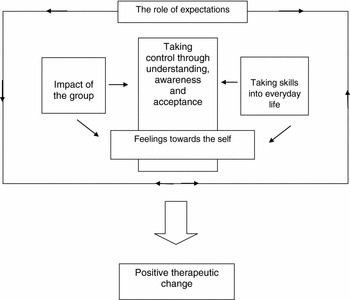
The above five themes were identified and defined during the process of reciprocal translation and further integrated in order to examine the interaction between them. This synthesis of translation generated the higher order concept of “The Mindfulness-based Cognitive Therapy Journey to Change” which encompasses all five themes. This higher order concept is represented in Figure 2.
The higher-order concept “The mindfulness-based cognitive therapy journey to change”

Through embracing the features of MBCT participants developed understanding, awareness and acceptance, processes that appear entwined within the journey to change but ultimately contribute to the empowering experience of “taking control”. Other features of MBCT encaptured within the “impact of the group” and “taking skills into everyday life” served to facilitate the process of therapeutic change, resulting in a positive impact upon “feelings towards the self”. Finally the “role of expectations” acted as a mediating factor, impacting upon any aspect of the participants’ experience of their personal Mindfulness-based Cognitive Therapy Journey to Change.
The process of synthesizing this translation highlights the complex interaction between the five themes identified through reciprocal translation and encourages readers to view the higher order concept as an overall interpretation of an individual's journey to change through MBCT, rather than considering any of the themes solely in isolation.
Discussion
This meta-synthesis aimed to explore how the features of Mindfulness-based Cognitive Therapy (MBCT) contribute to positive therapeutic change, furthering the understanding gained by any individual study. The process of reciprocal translation (Noblit and Hare, Reference Noblit and Hare1988) identified five major themes involved in this journey to change: taking control through understanding; awareness and acceptance; the impact of the group; taking skills into everyday life; feelings towards the self and the role of expectations. These have been integrated in the synthesis of translation to create the higher order concept of The Mindfulness-based Cognitive Therapy Journey to Change, capturing the complex interaction between the five major themes and how this interplay contributes to positive therapeutic change.
An initial finding of interest relates to the strength of similarities observed between the accounts of participants from varying populations e.g. adults, older adults, those with cardiac difficulties. Analysis focused upon participants’ experience of MBCT irrespective of the contributing factors behind their psychological difficulties, and interestingly, with respect to only one aspect relating to control over bodily sensations did the participants’ individual backgrounds appear to resonate within their experiences of the programme. This suggests that the background to an individual's difficulties for which they are seeking therapy may not necessarily impact upon how they experience MBCT.
A second valuable finding relates to the mediating role of expectations upon an individual's journey to change. This was discussed in part within broader themes by four of the individual studies. Examples include Mason and Hargreaves (Reference *Mason and Hargreaves2001), who identified this mediating role and noted how expectations were revised in some cases after initial negative experiences, and Allen et al. (Reference *Allen, Bromley, Kuyken and Sonnenberg2009), who discussed expectations within the context of their theme entitled “struggle” (p. 422). The current meta-synthesis has further elucidated the role of expectations as an important feature of MBCT to be considered in its own right. This suggests potential implications for participants’ subsequent experience of MBCT, based upon their place along a proposed continuum of expectation, from having few expectations to expecting a “cure” (Mason and Hargreaves, Reference *Mason and Hargreaves2001).
Finally, the findings relating to “feelings towards the self” resonate with previous research regarding the positive impact of MBCT upon levels of self-compassion (Kuyken et al., Reference Kuyken, Watkins, Holden, White, Taylor and Byford2010). The current findings provide additional insight into the way in which feelings toward the self, including those of self-compassion, are developed during MBCT.
Implications of the findings
Implications are considered in relation to previous research and clinical practice. The amalgam of empowerment and struggle described within “taking control through understanding, awareness and acceptance” accords with previous literature describing a sense of striving that participants often bring to therapy (Segal et al., Reference Segal, Williams and Teasdale2002) and the struggle to resolve tensions in shifting from trying to “solve sadness” (Allen et al., Reference *Allen, Bromley, Kuyken and Sonnenberg2009, p. 425) to accepting feelings and being with experiences. In order to support participants through this challenging aspect of MBCT, skill is required from the teacher in nurturing the sensitive interaction of all features of this approach.
The findings regarding the nurturing and normalizing environment of the group also concur with previous research that has identified the important effects of a group setting in mindfulness-based therapy e.g. Imel, Baldwin, Bonus and MacCoon (Reference Imel, Baldwin, Bonus and MacCoon2008). Furthermore, in relation to long-term change, findings regarding the way in which participants take skills into their everyday lives add a qualitative perspective to previous quantitative research such as Teasdale et al. (Reference Teasdale, Segal, Williams, Ridgeway, Soulsby and Lau2000). The current findings suggest that the support given within MBCT to generalize skills to other areas of life may contribute to long-term change.
The complex interaction between the process of taking control, the impact of the group environment, the practice of mindfulness skills in everyday life and the resulting impact of this upon an individual's feelings towards the self is highlighted by the synthesis of translation. It is important for teachers of MBCT to be aware of this delicate interaction during first considerations and throughout delivery of an MBCT programme.
The mediating impact of the role of expectations, as discussed above, suggests that MBCT may not be suitable for those with unrealistic expectations of a “cure” to their problems. This is supported by Kabat-Zinn (Reference Kabat-Zinn1990) who suggests that expectations that suspend judgement are the most useful to have. Clinicians are encouraged to consider potential participants’ attitudes and expectations and draw upon psychological theory such as the Stages of Change (Norcross, Krebs and Prochaska, Reference Norcross, Krebs and Prochaska2011) in assessing for suitability for this form of therapy.
Finally, the similarities between initial concepts found in the accounts of participants from varying populations suggest that adapting the MBCT programme in order to accommodate the needs of different populations does not necessarily impact upon the MBCT experience.
Limitations of the meta-synthesis
Some may consider the synthesis of studies that employed qualitative methodologies from varying epistemological stances a limitation. However, a number of researchers suggest that these concerns appear unwarranted (Sandelowski et al., Reference Sandelowski, Docherty and Emden1997), supported by emerging evidence that the value of findings is enhanced by the combination of multiple epistemological stances (Finfgeld, Reference Finfgeld2003).
Although the researcher is supported in the decision not to exclude studies on the basis of quality (Sandelowski et al., Reference Sandelowski, Docherty and Emden1997; Walsh and Downe, Reference Walsh and Downe2005), the quality appraisal conducted using the CASP tool (Public Health Resource Unit, 2006) provides an insight into the varying quality of the seven included studies. All seven studies were clear about the aims of their research, and the use of qualitative research methods was appropriate to meet these aims. Further appraisal found two studies (Allen et al., Reference *Allen, Bromley, Kuyken and Sonnenberg2009; Smith et al., Reference *Smith, Graham and Senthinathan2007) to be rated positively on all remaining eight questions, suggesting these to be of very good quality. Of the remaining five studies however, all but Smith (Reference *Smith2004) received a negative rating regarding considering and discussing the ethical issues in any detail. Other criticisms that were negatively rated included a lack of consideration of the researcher/participant relationship, insufficient detail provided regarding the analysis, and limited discussion of the findings (Fitzpatrick et al., Reference *Fitzpatrick, Simpson and Smith2010; Griffiths et al., Reference *Griffiths, Camic and Hutton2009; Smith, Reference *Smith2004). Despite such limitations however, all seven studies were positively rated in relation to their value to the area of interest, supporting the decision not to exclude on the basis of quality.
The authors acknowledge the possible implications of the varying quality of studies upon the findings of this metasynthesis and the limitation of this quality appraisal process having been conducted by a single researcher. It is noted that the findings of the studies of greater quality and those that provided more detail and insight into the original accounts of their participants (Allen et al., Reference *Allen, Bromley, Kuyken and Sonnenberg2009; Finucane and Mercer, Reference *Finucane and Mercer2006; Fitzpatrick et al., Reference *Fitzpatrick, Simpson and Smith2010; Mason and Hargreaves, Reference *Mason and Hargreaves2001; Smith et al., Reference *Smith, Graham and Senthinathan2007) have been reflected within this metasynthesis more than those of the remaining articles (Griffiths et al., Reference *Griffiths, Camic and Hutton2009; Smith, Reference *Smith2004).
Recommendations for future research
Future research may wish to build upon the findings of this review, for example engaging in further exploration of the potential mediating factor of expectations. Building upon the clinical implications identified above, additional avenues of research may also include the exploration of the experience of the delivery of, and engagement with, mindfulness intervention from a clinician perspective.
Conclusions
In exploring the participant experience of MBCT through a process of meta-ethnography (Noblitt and Hare, Reference Noblit and Hare1988), the current meta-synthesis has revealed the higher order concept of The Mindfulness-based Cognitive Therapy Journey to Change. This construct involves a complex interaction between five major themes that capture the way in which participants experiencing an empowering sense of “taking control” through the development of understanding, awareness and acceptance offered by MBCT. These findings have highlighted implications for clinicians delivering MBCT, particularly in relation to the mediating role of expectations, and make suggestions for future research including the qualitative exploration of this therapy with varying populations.
*Indicates study included within the meta-synthesis



Comments
No Comments have been published for this article.