Coeliac disease is a proximal small intestine disease that develops with autoimmune mechanisms as permanent intolerance to gluten and other grain proteins in genetically susceptible individuals. This disease, which is the most common cause of malabsorption in childhood, can occur at any age. Coeliac disease is diagnosed by serological tests and small intestine biopsy. Serological tests are used to search for antibodies against proteins in foods (gluten) and structural proteins in the intestinal mucosa (endomysium, reticulin, and transglutaminase). The gold standard method in the diagnosis of coeliac disease is small intestine biopsy. Histological findings in the intestinal mucosa in coeliac disease are crypt hyperplasia, duodenal villous atrophy, and an increase in intraepithelial lymphocytes. Modified Marsh (Marsh-Oberhuber) classification is currently used for histopathological diagnosis.
Gastrointestinal system and non-gastrointestinal system symptoms are seen due to malabsorption in the proximal small intestine. Cardiovascular complications in coeliac disease are known to be one of the leading causes of morbidity and mortality. It can cause complications such as autoimmune myocarditis and cardiomyopathy. Some studies have shown that coeliac disease patients have ischaemic heart disease and impaired aortic function. Reference Ludvigsson, James and Askling1
Left ventricular dysfunction plays an important role in the development of arrhythmias. Prolonged cardiac repolarisation time increases the sensitivity of the heart to ventricular arrhythmias. In recent clinical studies, the importance of QT, heart rate corrected QT, QT dispersion, P wave dispersion, Tp-e / QT, and Tp-e / QTc in demonstrating the sensitivity of myocardium to arrhythmias have been emphasised. Reference Castro-Torres, Carmona-Puerta and Katholi2,Reference Gupta, Patel and Patel3
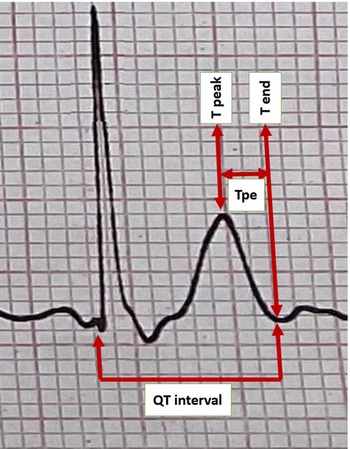
The time between the point where the T wave reaches its maximum amplitude and the end of the T wave is called the Tp-e interval. Three different cell types have been identified in the ventricular myocardium: endocardial, epicardial, and mid-myocardial M cells. The time differences during the repolarization of these cells significantly contribute to the T wave formation on the electrocardiogram. Reference Yan and Antzelevitch4 It is the measurement of the transmural dispersion of the interval repolarisation between the point where the T wave reaches its maximum amplitude and the end of the T wave.
The distance between the beginning of the QRS complex and the end of the T wave is defined as the QT interval. The difference between the longest QT distance and the shortest QT distance in a standard 12-lead electrocardiogram is called QT dispersion.
In our study, it was aimed to investigate the effect of coeliac disease on cardiac electrical activity by comparing the Tp-e interval and QT distribution values of coeliac patients and healthy children.
Materıals and methods
Our study consists of patient and control groups. Fifty-seven coeliac patients and 57 healthy patients were included in the study. Coeliac patients without additional chronic diseases who applied to the Paediatric Gastroenterology Unit were included as patient group. The cases who applied to the Paediatric Cardiology Unit for sports report without coeliac disease and additional chronic diseases were included as the control group. Cases similar to the patient group in terms of age and gender distribution were included in the study.
Physical examination and anthropometric measurements of coeliac patients and control group were performed. Routine blood tests (complete blood count, alanine aminotransferase, aspartate aminotransferase, urea, creatinine, ferritin, vitamin B12, calcium, magnesium, folic acid, C-reactive protein, TSH, ft4, IgA, glucose, and coeliac autoantibodies), age of diagnosis, complaints, dietary compliance, endoscopy and pathology findings, electrocardiogram, and echocardiography findings were recorded with a prospectively standardised form. The families were informed about the study, and written consent was obtained from each individual.
Electrocardiogram evaluation was done by the same physician. After all patients were rested for 10 minutes, 12-lead electrocardiogram records of 25 mm / sec velocity and 10 mm/mV amplitude were obtained. The data on the standard 12-lead electrocardiogram derivations were examined. The ventricular rate of three consecutive beats in the DII derivation was calculated and averaged, and the average heart rate of each patient was determined. In addition, P wave, PR interval, QRS complex, QT interval, QTc, Tp-e, Tp-e / QT, Tp-e / QTc, QT dispersion, and QTc dispersion calculations were made. Echocardiographic examinations were performed with two-dimensional and colour Doppler echocardiography device. Echocardiographic evaluation was performed by the same paediatric cardiologist. As classical echocardiographic measurements in all cases, left ventricular end-diastolic diameter, left ventricular end systolic diameter, end-diastolic interventricular septum thickness, end-diastolic left ventricular posterior wall thickness, ejection fraction, and fractional shortening measurements were made.
Proportions in independent groups were compared using Chi-square analysis. When numerical variables in more than two independent groups met the normal distribution condition in the groups, the one-way ANOVA test was performed with the Kruskal Wallis test when the normal distribution condition was not met. Student’s t test was used to compare groups. Statistical significance level was accepted as p < 0.05. SPSS 15.0 for Windows program was used for statistical analysis.
Results
There was no statistically significant difference between the patient group and the control group in terms of gender distribution. The mean age of the patient group was 10.5 ± 4.2 years, and the mean age of the control group was 10.4 ± 3.9 years. No statistically significant difference was found between the two groups in terms of mean age. There was no significant difference between the groups in terms of height, height percentiles, weight, and weight percentiles. The mean age at diagnosis of the patients was 8.4 ± 4.4 years. Twenty-five of the patients had inability to gain weight, 22 of them had abdominal pain, 12 of them had short stature, 10 of them had constipation, 9 of them had diarrhoea, 5 of them had abdominal distension, 4 of them had vomiting, and 4 of them had weakness. When the laboratory findings of the patients were evaluated, iron deficiency anaemia was found in 22 (38.6%) and vitamin B12 deficiency in 1 (1.8%). While 63.2% of the patients (n = 36) reported that they followed the gluten-free diet, and 36.8% (n = 21) reported that they did not comply with the diet. During the examination, tissue transglutaminase IgA and endomysium antibody IgA were measured from coeliac serological tests in the patient group. The cut-off value for tissue transglutaminase IgA was accepted as 18 IU / ml. Tissue transglutaminase IgA level was above 18 IU/ml in 64.9% of the patients (n = 37), and it was accepted as positive. In 35.1% of the patients (n = 20), tissue transglutaminase IgA level was below 18 IU/ml and was considered negative. The cut-off value for endomysium antibody IgA was accepted as a 1:10 titer. Endomysium antibody IgA value was above 1:10 titer in 57.9% of the patients (n = 33) and was accepted as positive. In 42.1% (n = 24) patients, the endomysium antibody IgA value was below 1:10 titer and was considered negative.
According to the endoscopy performed in the patient group, endoscopic findings suggestive of coeliac disease (disappearance of the folds of the duodenal mucosa, scalloped folds, and mosaic pattern) were detected in 47 (82.5%) patients. Non-specific findings were detected in the remaining 10 (17.5%) patients. Pathology results of small intestine biopsies taken as a result of endoscopy were reported according to Marsh classification. Totally, 45.6% of the patients (n = 26) Marsh 3b, 33.3% (n = 19) Marsh 3c, 10.5% (n = 6) Marsh 3a, 8.8% (n 5) Marsh 2, and 1.8% (n = 1) were compatible with Marsh 1.0
Heart rate was found to be 91.9 ± 21.7 (/min) in the patient group. In the control group, the mean heart rate was 92.6 ± 16.6 (/min). There was no statistically significant difference in heart rate between the two groups. No significant difference was found between the patient and control groups in terms of P wave, PR interval, QRS complex, QT interval, and QTc values. There were no patients with a QTc value >440 ms in both the patient and control groups.
In the patient group, the mean Tp-e interval was found to be 77.2 ± 6.9 ms. In the control group, the mean Tp-e interval was found to be 59.1 ± 7.2 ms. Tp-e interval was statistically significantly higher in the patient group compared to the control group (p < 0.001) (Table 1).
Comparison of Tp-e interval, Tp-e/QT ratio, and Tp-e/QTc ratio in the patient and control groups

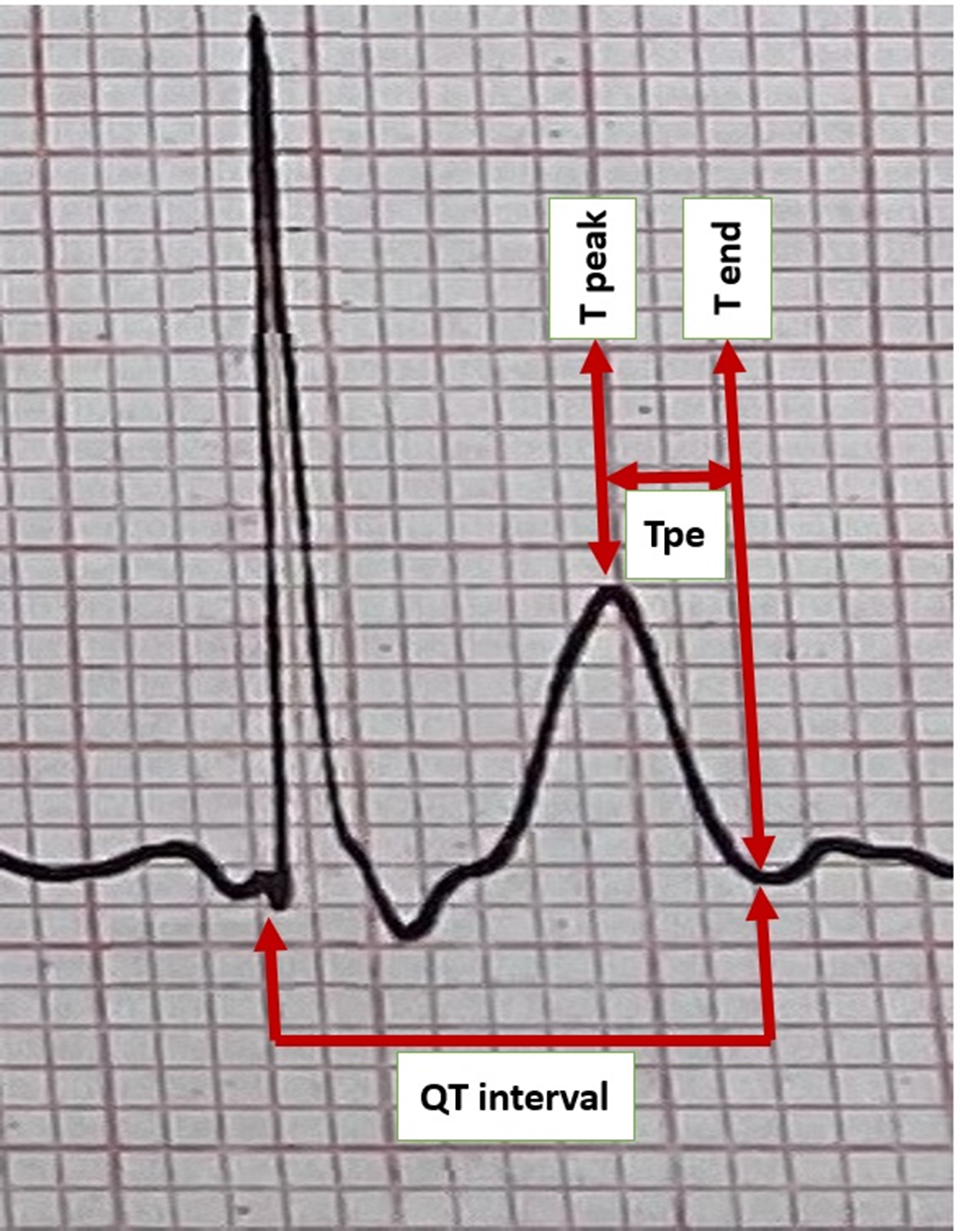
An example of a patient’s electrocardiogram with a prolonged Tp-e interval (Fig 1).
An example of a patient’s electrocardiogram with a prolonged Tp-e interval.
In the patient group, the Tp-e / QT ratio and the Tp-e / QTc ratio were found to be statistically significantly higher than the control group (p < 0.001 and p < 0.001) (Table 1).
No statistically significant difference was found between the patient and control groups in terms of QT minimum, QT maximum, QT dispersion, QTc minimum, QTc maximum, and QTc dispersion values.
No statistically significant correlation was found between disease duration and Tp-e interval, Tp-e / QT ratio, Tp-e / QTc ratio (respectively p = 0.635; p = 0.113; p = 0.886).
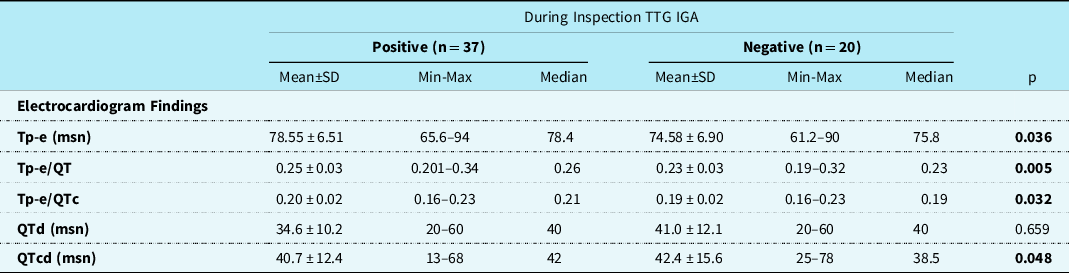
In the patient group, the correlations between tissue transglutaminase IgA positive or negative and Tp-e interval, Tp-e / QT ratio, Tp-e / QTc ratio, QT dispersion were evaluated. In 37 (64.9%) patients with tissue transglutaminase IgA positive, Tp-e interval, Tp-e / QT ratio, Tp-e / QTc ratio were statistically significantly higher compared to 20 (35.1%) patients with tissue transglutaminase IgA negative was detected (respectively p = 0.036; p = 0.005; p = 0.032) (Table 2).
Evaluation of electrocardiogram findings according to TTG IgA values

Abbrevations: QTd: QT dispersion; QTcd: Corrected QT dispersion.
In the patient group, the correlation between endomysium antibody IgA positive or negative and Tp-e interval, Tp-e / QT ratio, Tp-e / QTc ratio, QT dispersion, and QTc dispersion were evaluated. Tp-e / QT ratio was statistically significantly higher in 33 (57.9%) patients with endomysium antibody IgA positive compared to 24 (42.1%) patients with negative endomysium antibody IgA (p = 0.012). There was no significant difference in Tp-e interval, Tp-e / QTc ratio, QT dispersion, and QTc dispersion.
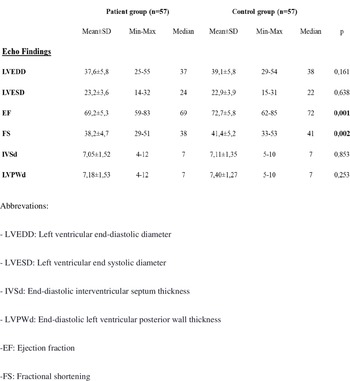
As classical echocardiography measurements in patient and control groups, left ventricular end-diastolic diameter, left ventricular end systolic diameter, end-diastolic interventricular septum thickness, end-diastolic left ventricular posterior wall thickness, ejection fraction, and fractional shortening measurements done. Ejection fraction and fractional shortening values were significantly lower in the patient group compared to the control group (p = 0.001 and p = 0.002, respectively). There was no significant difference between the two groups in terms of left ventricular end-diastolic diameter, left ventricular end systolic diameter, end-diastolic interventricular septum thickness, and end-diastolic left ventricular posterior wall thickness values (Fig 2).
Echocardiographic findings of the patient and control groups.

Dıscussıon
Although coeliac disease is known as small bowel disease, it has become a disease of every system with its extra-gastrointestinal system findings that have been revealed and evident in recent years. Reference Maki, Lohi, Walker, Goulet, Kleinman and tal5 Most patients have an atypical or silent clinical course. Reference Maki, Lohi, Walker, Goulet, Kleinman and tal5,Reference Fasano and Catassi6 The disease is more common in women. Reference Ivarsson, Persson and Nystrom7,Reference Fasano, Berti and Gerarduzzi8 Cardiovascular complications in coeliac disease are known to be one of the leading causes of morbidity and mortality. Reference Ludvigsson, Montgomery and Ekbom9 Autoimmune myocarditis, idiopathic dilated cardiomyopathy, ischaemic heart disease, and aortic dysfunction can be seen. Reference Ludvigsson, James and Askling1,Reference Sari, Ertem and Sari10 Left ventricular dysfunction leads to arrhythmia development. Reference Bigger11 In a study of 52 patients, the incidence of coeliac disease was reported to be 5.7% in patients with dilated cardiomyopathy. Reference Curione, Barbato and De Biase12 In a large population-based cohort study conducted in Sweden, a positive relationship was found between coeliac disease and dilated cardiomyopathy and ischaemic heart disease. Reference Ludvigsson, James and Askling1
There are many mechanisms explaining cardiovascular involvement in coeliac disease. Chronic malabsorption seen in coeliac disease leads to cardiomyopathy due to nutritional deficiencies. Plasma homocysteine levels increase due to malabsorption of folic acid and vitamin B12. Increasing plasma homocysteine level causes structural and functional abnormalities of cardiomyocytes, causing cardiomyopathy. Reference Lim, Tzemos and Farquharson13 Intestinal permeability abnormalities seen in coeliac disease cause increased absorption of antigens and infectious agents from the intestine. This causes the activation of immune mechanisms and eventually myocardial damage. Reference van Elburg, Uil and Mulder14 Villous atrophy seen in coeliac disease causes impaired absorption of thiamine, riboflavin, magnesium, calcium, selenium, and carnitine, which play a role in myocardial metabolism. Reference Curione, Barbato and Viola15 Autoimmune mechanism triggered by gliadin in coeliac disease causes cardiac damage. Deamidated gliadin binds to HLA-DQ2 or HLA-DQ8 with high affinity and causes activation of T lymphocytes. Activated T lymphocytes secrete high amounts of pro-inflammatory cytokines such as Tumor Necrosis Factor. These secreted cytokines are thought to trigger atherosclerosis by causing endothelial damage and cause ischaemic heart diseases and heart failure. There are studies showing that the absorption of oligoelements is better with a gluten-free diet, which has an advantage on myocardial contractility and electrical stability. Reference Peracchi, Trovato and Longhi16
Many of the electrocardiogram parameters provide preliminary information in terms of current or possible clinical situations. QT interval and T wave are important for showing cardiac repolarisation. In our study, we compared the Tp-e interval and QT dispersion values of coeliac patients with healthy children. QT interval reflects the sum of the depolarisation and repolarisation times of the ventricular myocardium. It has been shown that the increase in QT dispersion, which is considered to indicate regional heterogeneity in myocardial repolarisation, causes serious ventricular arrhythmias and sudden cardiac death through the reentry mechanism. Reference Pye and Cobbe17 Tp-e interval corresponds to ventricular repolarisation dispersion. Increased ventricular repolarisation dispersion is seen as an important risk factor for ventricular arrhythmias. The prolonged Tp-e interval reflects the abnormal distribution of ventricular repolarisation and is associated with an increased risk of ventricular arrhythmia. Reference Castro-Torres, Carmona-Puerta and Katholi2 Therefore, the Tp-e interval can be used as a non-invasive screening method for arrhythmogenesis.
Cardiovascular diseases characterised by left ventricular dysfunction such as idiopathic congestive heart failure and myocarditis are seen in coeliac disease. Reference Frustaci, Cuoco and Chimenti18 In a study conducted with 187 patients with autoimmune myocarditis, 9 patients had coeliac disease. Heart failure was detected in 5 of 9 patients, and ventricular arrhythmia was detected in 4 of them. When these patients were given a gluten-free diet, it was observed that cardiac functions improved and arrhythmias decreased. Reference Frustaci, Cuoco and Chimenti18 Polat et al. detected subclinical left ventricular dysfunction in paediatric coeliac patients with positive endomysium antibody IgA levels. Reference Polat, Urganci and Yalcin19 Sarı et al demonstrated the subclinical effect of coeliac disease on left ventricular systolic function using strain echocardiography. Reference Sari, A.D. and Akin20 In our study, ejection fraction and fractional shortening values were found to be significantly lower in coeliac patients compared to the control group (p = 0.001 and p = 0.002, respectively). Ventricular arrhythmia is more common in patients with left ventricular dysfunction than normal left ventricular function. Increased ventricular repolarisation dispersion is associated with malignant arrhythmias. Prolonged QT interval is one of the markers of delayed cardiac repolarisation in electrocardiography. Corozza et al. found prolongation of the QT interval in 33% of coeliac patients in their adult age study. Reference Corazza, Frisoni and Filipponi21
In recent studies, Tp-e interval, Tp-e / QT ratio, and Tp-e / QTc ratio are parameters showing the increase in ventricular repolarisation dispersion. Reference Gupta, Patel and Patel3 The prolonged Tp-e interval is associated with increased mortality in patients with long QT syndrome, Brugada syndrome, and acute myocardial infarction. Since the Tp-e / QT ratio is not affected by heart rate and body weight, it is a more sensitive marker than others. Reference Gupta, Patel and Patel3
In our study, Tp-e interval, Tp-e / QT ratio, and Tp-e / QTc ratio were found to be significantly higher in coeliac patients compared to the control group. Left ventricular dysfunction seen in coeliac disease is thought to play a role in the development of arrhythmia. Reference Bigger11 Therefore, these markers may be helpful in predicting ventricular arrhythmia and mortality in coeliac patients. Demirtaş et al. in their study conducted with 38 adult age group of coeliac patients found that the Tp-e interval, Tp-e / QT ratio, and Tp-e / QTc ratio of coeliac patients were significantly higher than the control group consisting of 38 patients. Reference Demirtas, Yayla and Yuksel22
In our study, no statistically significant correlation was found between disease duration and Tp-e interval, Tp-e / QT ratio, Tp-e / QTc ratio. The reason for this is that 63.2% of the patients who participated in our study were able to adapt to a gluten-free diet.
Chronic inflammation seen in Coeliac disease is thought to cause atherosclerosis and vascular damage. In a study conducted with coeliac patients, the relationship of endothelial dysfunction with the increase in carotid intima-media thickness, which is an indicator of macrovascular diseases, was demonstrated. Reference Libby, Ridker and Hansson23 Studies have shown that there is a relationship between carotid intima-media thickness and cardiac repolarisation disorders. Reference Ede, Ibrahim Serin and Ede24 In a study conducted in paediatric patients with ulcerative colitis and crohn’s disease with chronic inflammation, QT dispersion and QTc dispersion were found to be prolonged compared to the normal population. This study predicts that inflammatory bowel diseases are at risk for ventricular arrhythmias. Reference Bornaun, Yilmaz and Kutluk25 In another study, it was found that QT dispersion, QTc dispersion, and Tp-e interval were prolonged in paediatric Kawasaki patients compared to the normal population (26). In our study, no statistically significant difference was found between the patient and control groups in terms of QT dispersion and QTc dispersion values.
In our study, the correlation of tissue transglutaminase IgA positive or negativity with the ventricular repolarisation markers Tp-e interval, Tp-e / QT ratio, Tp-e / QTc ratio, QT dispersion, and QTc dispersion were evaluated. Tp-e interval, Tp-e / QT ratio, and Tp-e / QTc ratio were found to be statistically significantly higher in patients with positive tissue transglutaminase IgA compared to patients with negative tissue transglutaminase IgA. QT dispersion did not differ significantly. In a study involving 288 patients with end-stage heart failure without clinical signs of coeliac disease awaiting heart transplantation, almost half of the patients were found to be positive for tissue transglutaminase IgA and tissue transglutaminase IgG (73). In another study, there is evidence that tissue transglutaminase antibodies have an antiangiogenic effect that can disrupt the functioning of the vascular system, impair myocardial electrical activity and contraction, and trigger atherosclerosis. Reference Sane, Kontos and Greenberg27 We found tissue transglutaminase antibody positivity in our study compatible with the literature in order to predict cardiac involvement.
In our study, the correlation between endomysium antibody IgA positive or negativity and Tp-e interval, Tp-e / QT ratio, Tp-e / QTc ratio, QT dispersion, and QTc dispersion were evaluated in coeliac patients. Only the Tp-e / QT ratio of patients with endomysium antibody IgA positive was found to be statistically significantly higher compared to patients with endomysium antibody IgA negative. The reason for differentiation with tissue transglutaminase can be shown as tissue transglutaminase positive while endomysium antibody IgA negative in 4 patients. In the literature, there are studies showing that left ventricular function and myocardial performance decrease in patients with endomysium antibody IgA positive compared to negative ones. Reference Saylan, Cevik and Kirsaclioglu28 In our study, more patients are needed to use endomysium antibody IgA positivity as a marker for predicting cardiac arrhythmias.
In our study, Marsh stages of coeliac patients Tp-e interval, Tp-e / QT ratio, Tp-e / QTc ratio, QT dispersion, and QTc dispersion were compared. There was no significant relationship between Marsh stages and ventricular repolarisation markers. The marsh stage of the patients shows the stages at the time of diagnosis. We could not find a significant relationship between marsh staging and repolarisation markers due to the patients' compliance with gluten-free diet and histological improvement beginning within 6–24 months.
In conclusion, our study gives important findings in terms of detecting the early signs of future cardiovascular events in paediatric coeliac patients. Repolarisation differences compared to the normal population may reflect early subclinical findings associated with coeliac disease. Prospective wider studies are needed to capture these early changes and their future significance. Since coeliac patients included in our study did not have electrocardiogram in the healthy period, that could be an important data for detecting electrocardiogram changes before and after coeliac disease, limits our study for the inability to evaluate electrocardiogram retrospectively.
Acknowledgements
None.
Fınancıal support
This research received no specific grant from any funding agency, commercial, or not-for-profit sectors.
Conflıct of interest
None.
Ethıcal standards
The study was approved by the Health Sciences University Istanbul Training and Research Hospital Clinical Research Ethics Committee.