Introduction
Previous research has consistently shown that self-rated personal importance of religion or spirituality and attendance at religious or spiritual services are inversely associated with a DSM diagnosis of major depressive disorder (MDD), with some studies showing a prospective protective effect of religiosity/spirituality on MDD (Levin et al., Reference Levin, Markides and Ray1996; Miller et al., Reference Miller, Warner, Wickramaratne and Weissman1997, Reference Miller, Wickramaratne, Gameroff, Sage, Tenke and Weissman2012; Strawbridge et al., Reference Strawbridge, Shema, Cohen and Kaplan2001; Barton et al., Reference Barton, Miller, Wickramaratne, Gameroff and Weissman2013). Biological mechanisms that potentially mediate this relationship include thickening of parietal and occipital cortices (Miller et al., Reference Miller, Bansal, Wickramaratne, Hao, Tenke, Weissman and Peterson2014), decreased default mode network connectivity (Svob et al., Reference Svob, Wang, Weissman, Wickramaratne and Posner2016), dopamine and oxytocin receptor genetic correlates (Anderson et al., Reference Anderson, Miller, Wickramaratne, Svob, Odgerel, Zhao and Weissman2017), and greater posterior EEG alpha (Tenke et al., Reference Tenke, Kayser, Miller, Warner, Wickramaratne, Weissman and Bruder2013, Reference Tenke, Kayser, Svob, Miller, Alvarenga, Abraham, Warner, Wickramaratne, Weissman and Bruder2017). The association between depression and religiosity/spirituality is more pronounced among those with high risk (Kasen et al., Reference Kasen, Wickramaratne, Gameroff and Weissman2012; Miller, Reference Miller2012; Svob et al., Reference Svob, Wang, Weissman, Wickramaratne and Posner2016). Despite the large body of evidence demonstrating a relationship between depression and global single-item assessments of religiosity and spirituality and religious or spiritual service attendance, the meaning of these findings within a broader and more comprehensive understanding of religious and spiritual life remains unclear.
Scholars generally agree that religion and spirituality represent highly overlapping, complex, and multidimensional constructs that refer to a transcendent, sacred, and the ultimate realm of existence (Maslow, Reference Maslow1970; Emmons, Reference Emmons2000; Hill and Pargament, Reference Hill and Pargament2003). Yet, with some notable exceptions (Kendler et al., Reference Kendler, Gardner and Prescott1997, Reference Kendler, Liu, Gardner, McCullough, Larson and Prescott2003; Maselko et al., Reference Maselko, Gilman and Buka2009), research on the relationship between religiosity/spirituality and mental health diagnoses, as generated by DSM-based structured clinical interviews, has relied on unidimensional and often single-item, global assessments. While this standard methodological practice permits an understanding of relationships between global assessment and mental health outcomes, it can obscure the complexity of relationships between religiosity/spirituality and mental health (Little et al., Reference Little, Lindenberger and Nesselroade1999; Cacioppo and Brandon, Reference Cacioppo and Brandon2002). Specifically, relying on global measurements does not yield information about how distinct domains of religious or spiritual views, experiences, and behaviors might relate to one other nor how they might be differentially related to psychological and biological pathways and psychiatric outcomes. For these reasons, it is important for the advancement of this field of research to account for more specific and distinct domains of religious and spiritual life.
We had the opportunity to gain a clearer understanding by using a factor analytic model we previously derived from a multinational survey (McClintock et al., Reference McClintock, Lau and Miller2016). To date, this investigation is the only one to the best of our knowledge that inductively derived factors of religiosity/spirituality among adults in a cross-culturally valid fashion. Results revealed five distinct domains of religiosity/spirituality that were common across different countries: religious/spiritual commitment, as a prioritization of a higher power or sacred reality in daily life; contemplative practice, or engagement in meditative and prayerful practices; sense of interconnectedness, as an awareness of unity with all living things; experience of love, as a feeling of inner harmony and a benevolent intention towards others; and altruistic engagement, or serving and caring for others. For the current study, we used a separate multi-generational sample of families at high and low familial risk (HLR) for MDD, in which high-risk is defined as 2nd and 3rd generation biological descendants (G2 and G3) of a proband (1st generation; G1) having a diagnosis of MDD while low-risk group comprised descendants of probands with no psychiatric diagnosis (Weissman et al., Reference Weissman, Berry, Warner, Gameroff, Skipper, Talati, Pilowsky and Wickramaratne2016a, Reference Weissman, Wickramaratne, Gameroff, Warner, Pilowsky, Kohad, Verdeli, Skipper and Talati2016b).
A common critique of findings on religiosity/spirituality and depression is that the apparent protective benefits of religiosity/spirituality may merely represent pre-existing sub-clinical or clinical differences (Sloan, Reference Sloan2006; Yeager et al., Reference Yeager, Glei, Au, Lin, Sloan and Weinstein2006). More specifically, according to this claim, spirituality could be epiphenomenal or an artifact of being not depressed; that is, individuals who already have symptoms of depression may be more likely to exhibit an existential ennui and, therefore, may identify as not spiritual. This argument assumes that religiosity/spirituality is not an entity unto its own, with an internal integrity or structural nature, stable across the episode. However, disconfirming of this argument is previous research showing the heritable contribution and biological correlates of religiosity/spirituality distinct from depression, suggesting that religiosity/spirituality is independent of depression (Kendler et al., Reference Kendler, Gardner and Prescott1997, 1999; Miller et al., Reference Miller, Bansal, Wickramaratne, Hao, Tenke, Weissman and Peterson2014; Anderson et al., Reference Anderson, Miller, Wickramaratne, Svob, Odgerel, Zhao and Weissman2017), and potentially suggesting there is a phenotypic expression of a heritable endowment for dimensions of religiosity/spirituality. In this study, we examine the structural integrity of religiosity/spirituality across the history of depression and familial risk for depression.
Previous research also has found that depression can degrade the level of psychological resilience factors over time (MacQueen and Frodl, Reference MacQueen and Frodl2011; Kessler, Reference Kessler2012). While most research in the field of religiosity/spirituality examines either its cross-sectional correlation or longitudinal relationship with mental health outcomes, some evidence does exist that MDD likewise longitudinally leads to lower levels of religiosity/spirituality (Gur et al., Reference Gur, Miller, Warner, Wickramaratne and Weissman2005; Maselko et al., Reference Maselko, Hayward, Hanlon, Buka and Meador2012). The outcome measures used, however, were limited to global measures of the importance of religion or spirituality and attendance at religious or spiritual services, raising the question of how MDD affects other domains of religiosity/spirituality.
Our primary objective was to determine if these domains of religiosity/spirituality replicated in this independent sample and, furthermore, remained invariant across familial risk for MDD and MDD diagnosis status within the sample. In addition, we aimed to clarify the relationship between distinct domains of religiosity/spirituality and the commonly used global single-item assessments of the importance of religion or spirituality and religious or spiritual service attendance, as well as to explore the relationship between these religiosity/spirituality measures and potential attenuation due to MDD 5 years previously.
Method
Participants
HLR sample
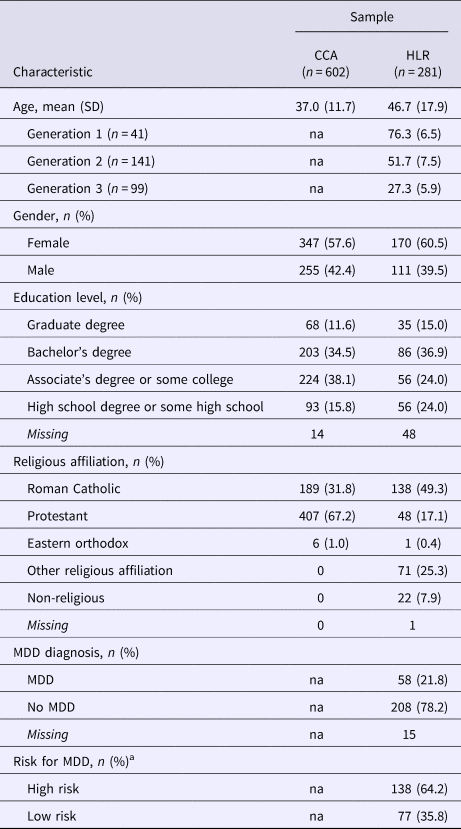
For the HLR sample, participants (n = 281) were drawn from three generations of families at high and low risk for MDD (Weissman et al., Reference Weissman, Wickramaratne, Gameroff, Warner, Pilowsky, Kohad, Verdeli, Skipper and Talati2016b). In the original study, probands (G1) with moderate to severely impairing MDD were outpatients receiving treatment for depression. Non-depressed probands were selected from an epidemiologic sample in the same community and had no lifetime history of psychiatric illness, as determined by several interviews. The procedures and training of interviewers were kept similar across the waves to avoid methods variance. High-risk is defined as the proband (1st generation; G1) having a diagnosis of MDD and includes 2nd generation (G2) and 3rd generation (G3) offspring. The low-risk group comprised probands with no psychiatric diagnosis and their biological descendants in G2 and G3. G1 were all European Caucasians to reduce heterogeneity for future genetic studies, as was standard practice when the study began. Further, half of the original sample was Roman Catholic (see Table 1). The study protocol was approved by the Institutional Review Board at New York State Psychiatric Institute/Columbia University.
Sociodemographic characteristics of Caucasian Christian American (CCA) and the high and low risk (HLR) samples

a Generation 1 and ‘married-ins’ in Generations 2 and 3 are not included in risk groups.
Data were collected across seven waves and up to 35 years (Baseline, 2 years, 10 years, 20 years, 25 years, 30 years, and 35 years). Data collection of the single-item measures of the personal importance of religion or spirituality and attending religious or spiritual services began at Year 10 and was collected successively over the following four waves. In addition to these measures, at Year 35, we also collected a much more extensive array of religiosity/spirituality measures through a questionnaire that comprised open-ended and Likert-scale responses that were administered either over the phone or via the Internet through a HIPAA compliant web application (Qualtrics.com). These measures are described in greater detail in the Religiosity/Spirituality Variables section.
Caucasian Christian American (CCA) sample
The CCA sample (n = 602) was drawn from a previous cross-cultural investigation from which the original factor analytic model of religiosity/spirituality tested in the current study was derived (McClintock et al., Reference McClintock, Lau and Miller2016). In order to reduce heterogeneity, only participants from the cross-cultural investigation that met inclusion criteria for the Caucasian race, Christian affiliation, and American nationality were selected for the CCA sample.
Data collection for the religiosity/spirituality measures was administered via an online survey, and participants were recruited using the crowd-sourcing website Mturk.com. The study protocol was approved by the Institutional Review Board at Teachers College/Columbia University. See Table 1 for a summary of sociodemographic characteristics for both CCA and HLR samples.
Religiosity/spirituality variables
The previous cross-cultural factor analytic study yielded a five-factor solution across three countries: China, India, and the USA. The resulting domains of religiosity/spirituality included religious/spiritual commitment, contemplative practice, sense of interconnectedness, the experience of love, and altruistic engagement.
Of the original 34 instruments comprising these domains, we selected a subset for Year 35 of the HLR study in order to enhance feasibility. We chose the three highest loading measures from each of the domains with the exceptions for conceptual clarity of contemplative practice, in which lifetime sitting and moving contemplation items were selected, and altruistic engagement, in which humanistic engagement and compassion were selected. The following instruments were used: (a) intrinsic religiosity and spirituality measured by the Intrinsic Religiosity subscale of the Duke University Religion Index (Koenig and Büssing, Reference Koenig and Büssing2010); (b) salience of spiritual beliefs measured by the Belief Salience Scale (Blaine and Crocker, Reference Blaine and Crocker1995); (c) compassion measured by the Compassion Scale as modified by Krause and Hayward (Reference Krause and Hayward2015); (d) sitting and moving contemplation items assessed whether or not participants had regularly engaged in such practices; (e) nature spirituality measured by the Spirituality in Nature scale (Drapkin et al., Reference Drapkin, McClintock, Lau and Miller2016); (f) experiences of ontological, psychological, and social love measured by respective subscales within the Sorokin Multidimensional Index of Love Experience (Levin, Reference Levin2000); (g) eco-awareness measured by the Eco-awareness subscale of the Spirituality Scale (Delaney, Reference Delaney2005); (h) a sense of unity in life measured by the Universality subscale of the Spiritual Transcendence Scale (Piedmont, Reference Piedmont1999); and (i) helping behaviors were assessed by the Humanistic Engagement subscale of the SpREUK-P Questionnaire (Büssing et al., Reference Büssing, Ostermann and Matthiessen2005).
Clinical assessments
The diagnostic interview for the HLR study was the Schedule for Affective Disorders and Schizophrenia–Lifetime Version (SADS-L; Endicott and Spitzer, Reference Endicott and Spitzer1978) for adults; the child version (K-SADS-E; Kaufman et al., Reference Kaufman, Birmaher, Brent, Rao, Flynn, Moreci, Williamson and Ryan1997), modified for DSM-IV for participants when they were between ages 6 and 17, was used for children. These interviews provided clinical measures of MDD for the present study, measured at Year 30, collected 5 years prior to the extensive religiosity/spirituality data collection.
The diagnostic assessments were administered by trained doctoral and master's level mental health professionals blind to the clinical status of the parents and other generations. Based on a best-estimate procedure using all available information, final diagnoses were made by experienced clinicians, either a psychiatrist or Ph.D. psychologist, who was not involved in the interviewing and was blind to the clinical status of previous generations.
Statistical analyses
The data were analyzed with SPSS 22.0 (ibm.com) and Mplus 7.0 (Muthén and Muthén, Reference Muthén and Muthén2015). Sitting and moving contemplation items were treated as categorical variables; all other religiosity/spirituality variables were treated as continuous variables. We elected to use exploratory structural equation modeling (ESEM) to confirm the previously observed factor structure in light of considerable evidence showing advantages of ESEM over the traditional confirmatory factor analysis approach, which include more differentiated latent factors and a better fit to the data (Marsh et al., Reference Marsh, Hau, Grayson, Maydeu-Olivares and McArdle2005, Reference Marsh, Lüdtke, Muthén, Asparouhov, Morin, Trautwein and Nagengast2010; Marsh, Reference Marsh2007; Schmitt and Sass, Reference Schmitt and Sass2011). The CCA and HLR samples were both used to perform ESEM on the religiosity/spirituality variables. Following McClintock et al. (Reference McClintock, Lau and Miller2016) for five factors, using oblique quartimin rotation and a weighted least square means and variance adjusted (WLSRV) estimator were employed. Factor scores were determined based on the regression method of factor score estimation (Skrondal and Laake, Reference Skrondal and Laake2001). The HLR sample was also stratified dichotomously by both familial risk status and lifetime diagnosis for MDD, and ESEM was applied to each of these four subsamples.
Pearson correlations were then conducted between each of the religiosity/spirituality factors and the importance of religion or spirituality and religious or spiritual service attendance items. In order to explore the temporal relationship between religiosity and spirituality with MDD 5 years previously, each of the religiosity/spirituality factors and the importance and attendance items at Year 35 were regressed onto MDD status at Year 30, adjusting for sociodemographic factors of age, sex, and education. With the sample stratified by risk level, univariate linear regressions were also conducted for religiosity/spirituality onto MDD, adjusting for age, sex, education. Furthermore, in order to test for interaction effects, a risk by MDD interaction term was added to the regression models for each of the religiosity/spirituality factors applied to the entire sample. Cases with missing values were excluded listwise.
Results
Background characteristics
Table 1 summarizes the sociodemographic characteristics of the CCA and HLR samples. While the two samples did not differ in terms of gender or race, the HLR sample was older, t(882) = 9.50, p < 0.001. The two samples also differed in level of education, χ2 (3, n = 821) = 23.13, p < 0.001, and affiliated religious denominations, χ2 (4, n = 876) = 309.28, p < 0.001. In the high familial risk group, 27% met criteria for MDD, while 14% met MDD criteria in the low familial risk group.
Domains of religiosity/spirituality
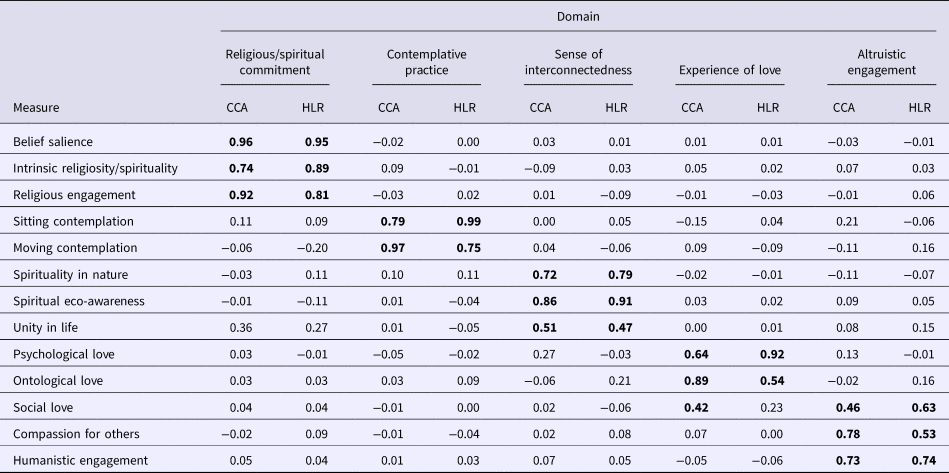
When ESEM was applied to the CCA sample, the solution provided a good fit to the data, RMSEA = 0.038, CFI = 0.987, TLI = 0.955 (Table 2). All items demonstrated substantial loadings, as defined by ⩾|0.40|, onto their expected factors based on the previously determined factor structure (McClintock et al., Reference McClintock, Lau and Miller2016). Additionally, nearly all items loaded onto a single factor, with the exception of social love which also cross-loaded onto altruistic engagement. The solution similarly provided a good fit to the data when ESEM was applied to the HLR sample, RMSEA = 0.038, CFI = 0.987, TLI = 0.955 (Table 2). Items loaded onto the same factors as those from the CCA sample with the minor difference that social love loaded solely onto altruistic engagement.
Factor structure of religiosity/spirituality: five ESEM factors based on 13 religiosity/spirituality measures from Christian Caucasian American (CCA) and high and low risk (HLR) samples

ESEM were conducted with weighted least square means and variance adjusted (WLSRV) estimation and quartimin rotation. Factor loadings ⩾|0.40| are in boldface. CCA sample: n = 602; RMSEA = 0.038, CFI = 0.987, TLI = 0.955. HLR sample: n = 281; RMSEA = 0.038, CFI = 0.987, TLI = 0.955.
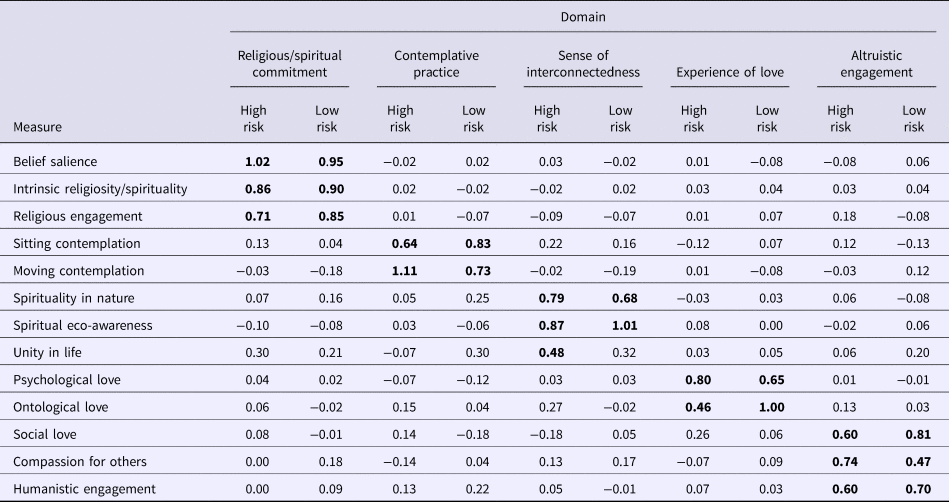
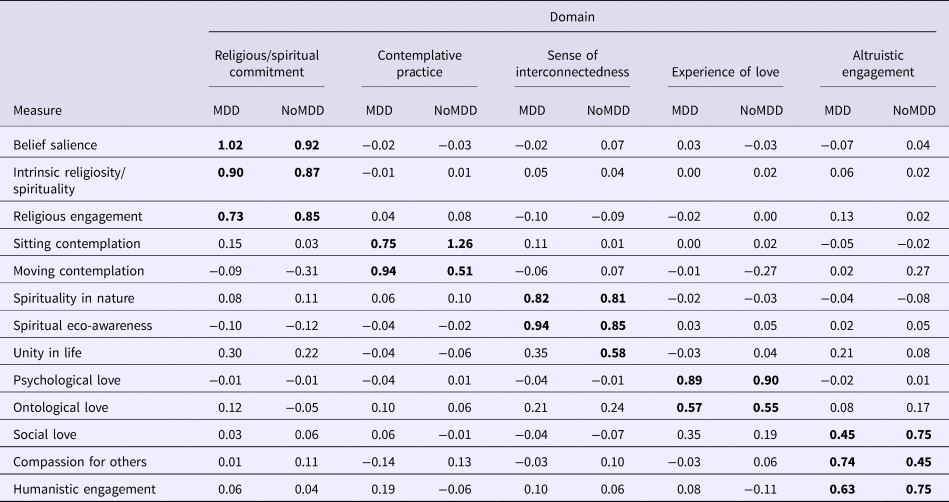
When the HLR sample was stratified by familial risk for depression, the factor structure from the HLR solution was replicated in each of the subgroups (Table 3). The factor structure was also nearly identical when the HLR sample was stratified by previous MDD status (Table 4). One minor difference was found with the Unity in Life measure, which was just below the |0.40| threshold for low risk and MDD subgroups but, nevertheless, primarily loaded onto the Sense of Interconnectedness factor. While minor differences of cross-loadings and item thresholds exist, overall this model provides a good description of the data. The same factors underlie the various religiosity/spirituality measures in each sample and subgroup, indicating configural invariance.
Factor structure of religiosity/spirituality across risk status: five ESEM factors based on 13 religiosity/spirituality measures among individuals at high and low familial risk for depression

ESEM were conducted with weighted least square means and variance adjusted (WLSRV) estimation and quartimin rotation. Factor loadings ⩾|0.40| are in boldface. High Risk group: n = 138; RMSEA = 0.038, CFI = 0.987, TLI = 0.957. Low risk group: n = 77; RMSEA = 0.000, CFI = 1.000, TLI = 1.156.
Factor structure of religiosity/spirituality across lifetime major depressive disorder (MDD) status: five ESEM factors based on 13 religiosity/spirituality measures among individuals with and without MDD diagnosis

ESEM were conducted with weighted least square means and variance adjusted (WLSRV) estimation and quartimin rotation. Factor loadings ⩾|0.40| are in boldface. MDD group: n = 117; RMSEA = 0.060, CFI = 0.965, TLI = 0.880. No MDD group: n = 162; RMSEA = 0.000, CFI = 1.000, TLI = 1.022.
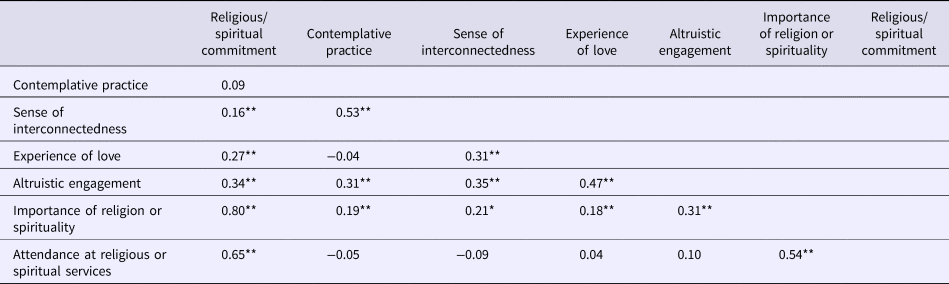
The religious or spiritual commitment domain was highly correlated with the global single-items of the importance of religion or spirituality, r = 0.80, and religious or spiritual service attendance, r = 0.65. These items showed moderate to weak correlations with the other domains of spirituality, r = 0.18–0.31 (Table 5).
Inter-correlations between religiosity/spirituality domains and single-item measures

*p < 0.05, **p < 0.01.
Associations with major depression
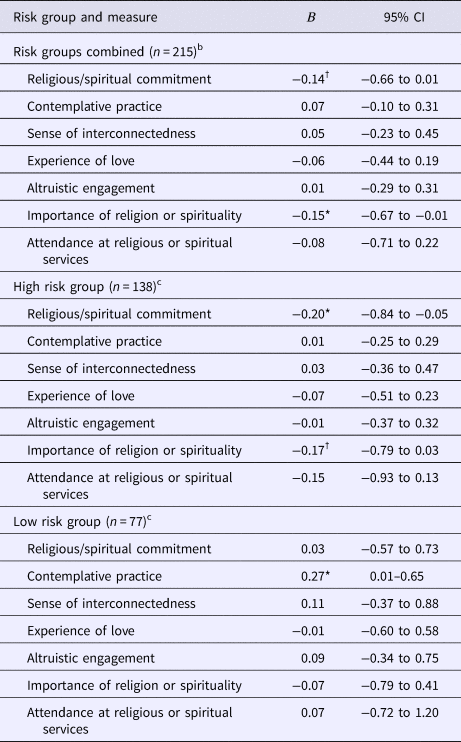
Table 6 lists the results of the exploratory univariate linear regressions of the five religiosity/spirituality domains and two single-item religiosity/spirituality measures at Year 35 onto a previous episode of MDD status at Year 30. Previous MDD diagnosis was associated with lower levels of importance of religion or spirituality (β = −0.15, p < 0.05). When stratified by risk group, among those at high risk for depression, a previous diagnosis of MDD was associated with lower levels of religious/spiritual commitment (β = −0.20, p < 0.05). Among the low-risk group, a previous MDD diagnosis was associated with higher frequency of contemplative practice (β = 0.27, p < 0.05). The interaction of previous MDD and risk did not have a statistically significant relationship with any of the religiosity/spirituality domains or measures (data not shown).
Regressions of religiosity/spirituality domains and single-item measures onto major depressive disorder (MDD) diagnosisa 5 years prior
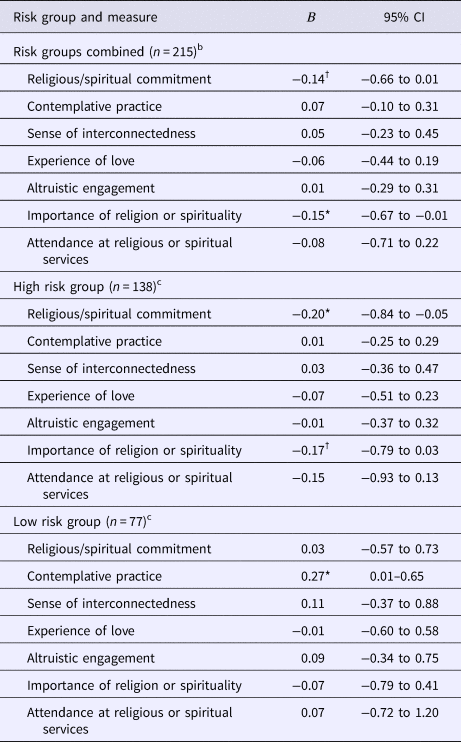
*p < 0.05, †p < 0.10.
a MDD assessed with schedule for affective disorders and schizophrenia–lifetime version.
b Controlling for age, sex, education, and risk status.
c Controlling for age, sex, and education.
Furthermore, when examining trends beyond strict levels of statistical significance, these exploratory analyses show that overall MDD predicts a decrease in religious/spiritual commitment mostly due to a decrease in importance of religion or spirituality rather than attendance at religious or spiritual services. When stratified by risk status, MDD predicts a decrease in both importance or religion or spirituality and attendance at religious or spiritual services in the high-risk group but has no effect in the low-risk group, presumably because MDD in the high-risk group is more severe. While these regression analyses are exploratory, results are consistent with previous literature and give us greater insight into the mechanisms by which MDD and religiosity/spirituality are related.
Discussion
This study found that structural dimensions of religiosity/spirituality previously derived in a large multinational sample (India, China, and the USA) replicated across familial risk for depression and MDD diagnostic history. Additionally, correlations between these religiosity/spirituality domains and commonly used assessments of religious and spiritual life were examined, and the differential relations between these measures and major depression 5 years previously were explored. Factor analyses demonstrated that the previously observed domains of religiosity/spirituality replicated in the current sample, namely: religious/spiritual commitment, contemplative practice, sense of interconnectedness, the experience of love, and altruistic engagement. These domains, furthermore, remained invariant across depression history and familial risk groups. Both religious and spiritual importance and religious or spiritual service attendance were highly correlated with religious/spiritual commitment but had low correlations with others, indicating that these global items may capture the domain of religious and spiritual commitment but not others. In exploratory analyses, we also observed that a diagnosis of major depression 5 years previously was associated with a lower religious/spiritual commitment among those with high risk, with higher contemplative practice among those with low risk, and with the lower importance of religion or spirituality irrespective of risk group.
Factor structure of religiosity/spirituality
The stability of the factor structure across samples underscores the notion that religiosity/spirituality is a complex and multidimensional construct with discrete and relatively independent domains, each of which may contribute to observed relationships to mental health. Furthermore, the configural invariance of these factors across familial risk and diagnosis for depression also indicates that discrete domains are also structurally consistent across familial risk for depression and clinical groups.
Previous research has shown that familial risk for depression has predicted differences in the ways in which religiosity/spirituality confers risk for or benefit against major depression and resilience (Miller et al., Reference Miller, Warner, Wickramaratne and Weissman1997, Reference Miller, Wickramaratne, Gameroff, Sage, Tenke and Weissman2012; Kasen et al., Reference Kasen, Wickramaratne, Gameroff and Weissman2012; Barton et al., Reference Barton, Miller, Wickramaratne, Gameroff and Weissman2013), suggesting that the outcomes of being religious/spiritual can be potentiated or disrupted by an ecology of familial risk. In spite of these documented differences between risk groups, the current findings suggest that the underlying structure of religiosity/spirituality remains intact despite differences in risk status.
Moreover, these current findings offer counter-evidence to a common critique that pre-existing clinical differences (including diagnostically sub-threshold) between those who identify as spiritual and those who do not contribute to spurious correlations between spirituality and mental health outcomes (Sloan, Reference Sloan2006; Yeager et al., Reference Yeager, Glei, Au, Lin, Sloan and Weinstein2006). More specifically, according to this claim, spirituality could be an artifact of being not depressed; that is, individuals who already have symptoms of depression may be more likely to exhibit an existential ennui and, therefore, may identify as not spiritual. Similarly, an extension of the claim holds that, in studies where positive emotions comprise a part of the operationalization of spirituality, findings are more tautological than indicative of an actual relationship to depression (Koenig, Reference Koenig2008). Nevertheless, these current findings show that the structure of spirituality remains constant across MDD diagnostic groups and familial risk for depression. In other words, spirituality is not merely an epiphenomenon of a low level of depression or absence of depressive tendency; rather, it is a human faculty independent of depression.
Importance of religion or spirituality and religious or spiritual service attendance
Despite multiple studies indicating that the global single-item, self-rated measures of importance of religion or spirituality and religious or spiritual service attendance were protective against MDD, critiques of the link between religion/spirituality and clinical diagnosis have been aimed at the validity and precision of measures of religiosity or spirituality (Sloan and Bagiella, Reference Sloan and Bagiella2002; Sloan, Reference Sloan2007; Hall et al., Reference Hall, Meador and Koenig2008). An understanding of the relation between these measures and the larger multidimensional construct of religiosity/spirituality would help clarify which aspects of religious and spiritual life confer protection against MDD. That personal importance of religion or spirituality and religious or spiritual service attendance were highly associated with only the domain of religious and spiritual commitment in this sample indicates that these items may be proximal measures of religious or spiritual commitment but not of other aspects of religiosity/spirituality.
This set of findings also brings added clarity to previous studies on religiosity/spirituality and depression that rely on the global assessment of religious or spiritual importance or attendance. Specifically, they provide evidence for the connection between depression and religious or spiritual commitment but not with other vital aspects of religiosity/spirituality, such as meditative practices, altruistic acts of service, or a subjective sense of interconnectedness. With the elucidation of some relatively unexamined domains, future investigations could provide a much more nuanced and precise understanding of the relationship between religiosity/spirituality and mental health.
Impact of previous major depression on levels of religiosity/spirituality
In exploratory analyses, a previous MDD diagnosis was associated with the lower importance of religion or spirituality 5 years later regardless of risk group, and, within the high-risk group, MDD was similarly associated with lower levels of religious/spiritual commitment. It is well known that one of the cardinal symptoms of depression is disengagement with regular social activities. Less documented is the association between depression and withdrawal from the types of both public and private religious activity that define religious or spiritual commitment. In one large, multi-sample study, women with early onset (<18 years) of a major depressive episode (MDE) were 1.4 times as likely to stop attending religious services as those with no history of MDE or those with adult-onset MDE (Maselko et al., Reference Maselko, Hayward, Hanlon, Buka and Meador2012), suggesting that depression with developmental origins may interfere with later religious life. As a result of the impairment and negative outcomes of depression, it is also possible that religious individuals who are depressed can subsequently develop feelings of discontent towards and abandonment by God (Braam et al., Reference Braam, Schaap-Jonker, Mooi, Ritter, Beekman and Deeg2008, Reference Braam, Schaap-Jonker, van der Horst, Steunenberg, Beekman, van Tilburg and Deeg2014), which could conceivably lead to disavowal of religious/spiritual engagement and a reduced emphasis on religion or spirituality in one's life. That the factor structure for all five domains of religiosity/spirituality remains consistent irrespective of this history of MDD, however, suggests that the capacity of religiosity/spirituality is not mitigated, only the level of current religiosity/spirituality.
In the low-risk group, MDD was associated with greater contemplative practice 5 years later, which may reflect a tendency among these individuals to engage in prayer and contemplative practice for psychiatric benefits. In recent years, there has been a proliferation and increase in popularity of mind-body and meta-cognitive approaches in both popular culture and the research literature as alternatives to psychotropic or psychotherapeutic treatment of depression (Brown et al., Reference Brown, Ryan and Creswell2007; Salmon et al., Reference Salmon, Lush, Jablonski and Sephton2009; Duerr, Reference Duerr2011; Morone et al., Reference Morone, Moore and Greco2017). It is plausible that low risk individuals tend more often to seek out activities such as mindfulness, yoga, and prayer because formal psychiatric treatment (e.g. medication, psychotherapy) among high-risk individuals and families are more prevalent and, therefore, less stigmatized and more normalized within this group (Milne et al., Reference Milne, Caspi, Harrington, Poulton, Rutter and Moffitt2009; Weissman et al., Reference Weissman, Berry, Warner, Gameroff, Skipper, Talati, Pilowsky and Wickramaratne2016a).
Clinical implications and future directions
That importance of religiosity or spirituality and religious or spirituality service attendance highly correlated exclusively with the religious/spiritual commitment domain helps to inform and focus evidence-based clinical approaches, particularly for religiously and spiritually oriented people. As these items have clinically significant associations with major depression longitudinally, utilizing them in psychiatric assessments may provide a useful predictor of depression.
The differential associations between the previous episode of MDD and distinct domains of religiosity/spirituality suggest a dynamic and interactive relationship between religiosity/spirituality and depression, which is further moderated by familial risk. The field of clinical science would benefit from taking into account a more precise, multidimensional conceptualization of religiosity/spirituality and a corresponding set of measures like those proposed in the current study. Although mechanisms for the associations between depression and religiosity/spirituality domains were not examined in this study, we infer from previous studies that distinct causal processes interact with one another to mediate these relationships (Emmons, Reference Emmons1999; Seybold, Reference Seybold2007; Tenke et al., Reference Tenke, Kayser, Miller, Warner, Wickramaratne, Weissman and Bruder2013; Miller et al., Reference Miller, Bansal, Wickramaratne, Hao, Tenke, Weissman and Peterson2014). Future research into phenomenological, biological, and/or ecological mechanisms is imperative to further narrow the empirical gap between MDD and various components of religious and spiritual life.
Limitations
The religiosity/spirituality variables included in this investigation were a subset of measures from the original study, thereby precluding the possibility of exact replication. However, the selected measures loaded highly and were the most representative of the factors, and the replication of the factor structure combined with strong goodness-of-fit indices from the current analysis lends further support to the robustness of the factor structure. While the HLR sample was limited to Caucasians and mostly Catholic and Protestant denominations, this factor structure was nearly identical in the multinational study with religiously diverse samples, suggesting that the structure is robust regardless of race or religious affiliation. The current study examines the potentially attenuating impact of MDD on the level of spirituality, building on research showing dynamics such as ‘reverse causality’ or bi-directional effects between religiosity/spirituality and MDD (Maselko et al., Reference Maselko, Hayward, Hanlon, Buka and Meador2012; VanderWeele, Reference VanderWeele2013). Future research might examine these prospective effects of MDD together with the protective effect of religiosity/spirituality on prospective episodes of MDD, as later in the current study was limited by the timing of assessments for MDD in the larger study. The associations between religiosity/spirituality and MDD have been known to change with age and developmental period (Koenig et al., Reference Koenig, McCullough and Larson2001; Smith et al., Reference Smith, McCullough and Poll2003; Pössel et al., Reference Pössel, Martin, Garber, Banister, Pickering and Hautzinger2011), which we were unable to address due to lack of statistical power (i.e. from dividing the sample by age and risk). Future research might look at differential relationships between the multiple domains of religiosity/spirituality and MDD at specific developmental periods across the life-course. The ability to draw on this particular HLR sample permitted a valuable contribution to the research insofar as we can refute existing claims that increased importance of religiosity/spirituality is only epiphenomenal of a history of MDD.
Conclusion
In sum, this investigation provides further evidence of an underlying structure of religiosity/spirituality that does not differ by diagnostic, family risk, cultural, or geographical differences. Findings may be interpreted in light of previous research on the biological correlates and heritable contribution of religiosity/spirituality, as representing a phenotypic expression that works interactively or systematically in tandem with depression but is structurally distinct at the level of the component. The expression of religiosity/spirituality remained stable across various groups, suggesting that it is not simply an artifact of a previous or ongoing sub-clinical depression nor an attempt to seek external comfort. Rather, this complex, multidimensional, and vital aspect of human experience appears to be constitutionally independent of but related in level to clinical depression. Further research that takes advantage of a more nuanced and multidimensional conceptualization and set of measurements of religious and spiritual life is necessary to elucidate a more precise understanding of its relationships with depression and mental health more generally, as well as the mechanisms underlying these relationships.
Acknowledgements
This work was supported by the John Templeton Foundation Grant for Understanding the Role of Belief in the Resilience of Families at Risk for Depression: Religion, Brain Structure and Function #54679 (PI: Myrna Weissman) and NIMH grant R01 MH-036197 (PI: Myrna Weissman).
Conflicts of interest
In the past 3 years, Dr Weissman received funding from the National Institute of Mental Health (NIMH), the National Alliance for Research on Schizophrenia and Depression, the Sackler Foundation and the Templeton Foundation. She receives royalties from the Oxford University Press, Perseus Press, the American Psychiatric Association Press, and MultiHealth Systems. None of these present a conflict of interest.