I. INTRODUCTION
Fuel cells are among the most promising power supply systems for meeting ecofriendly energy demands in a practical manner.Reference Arico, Bruce, Scrosati, Tarascon and Van Schalkwijk1 Direct methanol fuel cells (DMFCs) have been intensively studied for use in portable appliances with the expectation of achieving high-efficiency energy conversion with a lower weight that is achievable using other fuel cell systems.Reference Liu, Song, Zhang, Zhang, Wang and Wilkinson2 However, poor methanol oxidation catalysis at the anodes and the need for expensive platinum catalysts have hampered the widespread use of DMFCs.Reference Arico, Bruce, Scrosati, Tarascon and Van Schalkwijk1–Reference Kua and Goddard4
Methanol oxidation catalysis is sensitive to a variety of factors, such as the average size, loading amount, and dispersion status of the catalyst particles. To control these factors and enhance the catalytic activity, Pt nanoparticles (NPs) are immobilized on supports, including porous substrates, such as activated carbon,Reference Kua and Goddard4–Reference Rodríguez-Reinoso, Rodríguez-Ramos, Moreno-Castilla, Guerrero-Ruiz and López-González8 or nanocarbon, such as carbon black,Reference Zhou, Zhou, Wang, Wang, Jiang, Li, Sun and Xin9, Reference Wang, Yin, Shao, Zhang, Wang and Gao10 carbon nanofibers,Reference Steigerwalt, Deluga, Cliffel and Lukehart11, Reference Hsin, Hwang and Yeh12 or carbon nanotubes.Reference Ermete13–Reference Matsumoto, Komatsu, Nakano, Arai, Nagashima, Yoo, Yamazaki, Kijima, Shimizu, Takasawa and Nakamura18
Multiwalled carbon nanotubes (denoted MWCNTs) have been widely studied as one of the most effective supporting materials for anchoring Pt NPs due to their excellent electronic conductivity, high accessible surface area, and chemical stability.Reference Ermete13 To effectively load Pt NPs onto MWCNTs, the MWCNTs must be covalently or noncovalently modified to create anchoring sites and to enhance the dispersibility of them in a solution.Reference Ermete13–Reference Georgakilas, Kordatos, Prato, Guldi, Holzinger and Hirsch24 Covalent surface modification may be achieved by introducing hydroxyl, carboxylic, or thiol groups onto the surfaces of the MWCNTs.Reference Ermete13–Reference Yang, Cho, Nahm and Park23 This approach typically concurrently sacrifices the intrinsic properties of the MWCNTs, including the electronic conductivity and the chemical stability, leading to decrease in the catalytic activity of the Pt/MWCNTs and, therefore, the overall DMFC performance. To retain the optimal intrinsic properties, noncovalent surface modifications have been adopted using a variety of mediating molecules, such as sodium dodecyl sulfate,Reference Wang, Xu, Tian, Zong, Cheng and Lin25 poly(sodium 4-styrenesulfonate),Reference Yang, Wang, Yang, Yang and Yang26 poly(diallyldimethylammonium chloride),Reference Wang, Jiang and Wang27 or 4,4-dipyridine, which are promoted by van der Waals interactions, hydrogen bonds, electrostatic interactions, and π–π interactions with the MWCNTs.Reference Yang, Hennequin and Sacher28 However, the catalytic activity of Pt NPs supported on noncovalently functionalized MWCNTs was not as high as expected. A low loading density and poor dispersion of the Pt NPs were suggested as possible factors that limited the catalytic activity of the Pt NPs on the surfaces of noncovalently modified MWCNTs.Reference Yang, Wang, Yang, Yang and Yang26–Reference Yang, Hennequin and Sacher28
Little information is available regarding how the physical properties of Pt NPs, such as their size, size distribution, loading density, or extent of dispersion, depend on the preparation conditions and the physicochemical characteristics of the mediating molecules. Furthermore, it is unclear how the physical properties of the Pt NPs affect the catalytic activity toward methanol oxidation in DMFCs. Herein, we report a systematic experimental exploration of the factors that influence the physical and electrochemical properties of Pt NPs supported on polyacrylic acid (PAA)-wrapped MWCNTs (PAA-w-MWCNTs). The morphological properties of the Pt NPs, such as the average size, size distribution, loading density, and dispersion of the Pt NPs on the specific surface area (SSA), electrochemically active surface area (EASA), and catalytic activity toward methanol oxidation, were systematically studied and are discussed. The physical properties of the Pt NPs were found to depend strongly on the preparation conditions, and the enhanced catalytic activity toward methanol oxidation is attributed to a high degree of dispersion, SSA, and EASA of the Pt NPs. The optimized Pt/PAA-w-MWCNTs catalyst exhibits a ∼165% higher catalytic activity toward methanol oxidation than the commercial E-TEK. In general, binary Pt–Ru catalyst is well known as the best electrocatalysts for the electrooxidation of methanol. In this paper, however, single Pt catalyst was used to discuss the effect of morphological characteristics of the catalysts on electrochemical properties in the academic point of view. To obtain electrocatalysts on the support material, different methods such as colloidal method,Reference Lee, Chiou, Chang and Huang29, Reference Zhao, Yang, Tian, Wang and Zhan30 impregnation method,Reference Noto and Negro31–Reference Neyerlin, Srivastava, Yu and Strasser33 and microemulsion methodReference Zhang and Chan34 have been widely studied. However, these methods involve considerable difficulties to remove the surfactant and control the particle size and distribution. With consideration for this situation, we devised the polyol method using poly(acrylic acid) instead of commonly used ethylene glycol.
II. EXPERIMENTAL
A. Materials
MWCNTs (10–50 nm in diameter, 10–15 μm in length; JEIO Tech., Incheon, Korea), synthesized via chemical vapor deposition, were purchased and used after purification by subjecting them to oxidative heat treatment in air at 430 °C for 1 h to obtain MWCNTs with the purity of 95.5 wt%. Hexachloroplatinic (IV) acid (Aldrich, Yongin, Korea), PAA (Aldrich), sodium borohydride (Aldrich), 5 wt% Nafion solution (Aldrich), and 40 wt% E-TEK Pt/C catalysts (PEMEAS Fuel Cell Technologies, Somerset, NJ) were purchased and used without further purification or treatment.
B. Preparation of Pt/PAA-w-MWCNTs
To create Pt NP anchoring sites on the MWCNT support, PAA was first dissolved in deionized (DI) water (80 mL) at pH of 2, 5, 7, and 10, adjusted by adding NaOH or HCl to the solution. The purified MWCNTs were then dispersed in the pH-controlled PAA solutions with ultrasonication for 30 min to yield PAA-w-MWCNTs. After ultrasonication, the solution was rinsed with DI water to remove PAA, which was not wrapped to MWCNTs. Then, the solution was centrifuged at 3500 rpm for 5 min to separate the unmodified MWCNTs. Hexachloroplatinic (IV) acid (H2PtCl6·6H2O) was dissolved in 20 mL DI water with magnetic stirring, then the as-prepared PAA-w-MWCNTs were added. The solution was dispersed in round bottom flask and incubated for time periods of 0, 1, 2, and 3 h with magnetic stirring. After incubation, an aqueous NaBH4 solution (10 mL) was added to the solution to induce the nucleation and growth of Pt NPs. Sodium borohydride was used as reducing coagent to reduce Pt ions on the PAA-w-MWCNTs effectively. The flask was submerged into a preheated oil bath at a specific temperature. To reduce the Pt ions, the temperature was increased up to 200 °C. During the growth time between 10 and 60 min, the solution was refluxed N2 bubbling. After filtration, washing with DI water and drying in vacuum at 80 °C, Pt NPs supported on PAA-w-MWCNTs were obtained.
C. Characterization of Pt/PAA-w-MWCNTs
The extent of dissociation of carboxylic acids to carboxylate groups on PAA-w-MWCNTs was estimated as a function pH by dissolving different amounts (0, 0.003, 0.015, and 0.03 meq) of PAA in 10 mL of a 0.01 M NaOH solution, followed by titration with 0.01 M HCl titrant using a potentiometer 888 Titrando (Metrohm, Herisau, Switzerland). The concentration ratio of carboxylic (COOH) to carboxylate (COO−) groups was calculated from the pKa distribution of PAA obtained by fitting the titration curves to a modified Henderson–Hasselbalch equation.Reference Katchalsky and Spitnik35
The morphology of Pt/PAA-w-MWCNTs was examined using high-resolution transmission electron microscopy (TEM; JEM-3000F; JEOL, Tokyo, Japan) equipped with a ZrO/W(100) filament operated at 300 kV and using an energy-filtered TEM (LIBRA 120; Carl Zeiss, Oberkochen, Germany) operated at 120 kV. The average size and standard deviation, which were indicative of the size distribution, as well as the degree of dispersion of Pt NPs, were determined by image analysis of the TEM micrographs (Scion image). The degree of dispersion was calculated according to the following equation.

The loading amount of Pt NPs was determined using inductively coupled plasma emission spectrometer (ICPS-1000IV; Shimadzu, Kyoto, Japan).
D. Electrochemical tests
To characterize the electrochemical performance of the as-prepared catalyst, cyclic voltammetry (CV) measurement was carried out on an Autolab general purpose electrochemical system (VMP3; Bio Logic, Claix, France) in a three-electrode cell at room temperature. A homogeneous ink slurry was prepared by mixing Pt/PAA-w-MWCNTs, 30 mL DI water, 600 μL of a 5 wt% Nafion® solution as a binder, and 1 mL 2-propanol per 0.01 g catalyst. A constant amount of ink slurry was then drop cast using a micropipette onto a glassy carbon (GC, 6 mm diameter) electrode that had been precleaned using a polishing process with alumina oxide powders (Buehler Ltd., Lake Bluff, IL) of decreasing particle size, 1, 0.3, or 0.05 μm, sequentially, until the GC electrode surface became mirror like. The ink-coated GC electrode was then dried in a vacuum oven at 80 °C for 10 min to remove the solvent before scanning the potential. Ag/AgCl/3M KCl and a Pt wire were used as reference and counter electrodes, respectively. All electrolytes were purged with pure nitrogen gas for 30 min to remove oxygen followed by performing 10 consecutive scans to obtain stable curves. Methanol electrooxidation was measured in a nitrogen-saturated solution containing 0.5 M H2SO4/1 M CH3OH, and CV was subsequently conducted over the potential range 0–1.2 V versus normal hydrogen electrode (NHE) at a scan rate of 50 mV/s. The EASA of all samples was measured in a nitrogen-saturated 0.5 M H2SO4 solution at a scan rate of 50 mV/s.
III. RESULTS AND DISCUSSION
A. Variables that influence the physical nature of Pt NPs supported on PAA-w-MWCNTs
1. Variations in the number of Pt NP anchoring sites as a function of pH
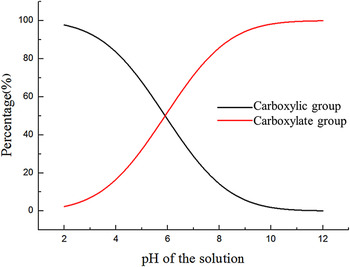
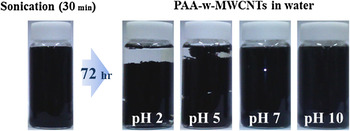
MWCNT catalyst supports have insufficient binding sites for anchoring catalysts without surface activation. This leads to low catalyst loading and dispersion.Reference Ermete13 To effectively load Pt NPs onto MWCNTs, PAA is used as a mediating material to introduce variable numbers of anchoring sites, viz carboxylate groups, onto the MWCNTs. Because PAA is a polyelectrolytic polymer, the extent of dissociation of the carboxylic acid groups to form carboxylate groups on PAA-w-MWCNTs can be controlled by varying the pH. Figure 1 shows the concentration ratio of carboxylic and carboxylate groups on the PAA-w-MWCNTs, obtained from the pKa distribution of PAA, as a function of pH. It is clear that as the pH of the solution increases, the relative concentration of carboxylate anions increases. This result suggests that high concentrations of negatively charged carboxylate groups may provide numerous anchoring sites for Pt NPs and provide a good dispersion of Pt NPs on the PAA-w-MWCNTs, mediated by repulsion among the carboxylate anions. If such a dispersion is prepared in practice, it is possible to fabricate unagglomerated or isolated Pt NPs with controlled sizes and size distributions. Indeed, Fig. 2 shows that the dispersion of PAA-w-MWCNTs in the solution becomes more stable with increasing pH. This may be related to the PAA conformational changes with increasing pH from a coiled state stabilized by intramolecular hydrogen bonds between carboxylic groups to an extended state stabilized by repulsion among the negatively charged carboxylate anions. Higher numbers of carboxylate anions are expected to enhance the degree of dispersion and can influence the size and size distribution of Pt NPs on a PAA-w-MWCNT support.
Graphs for the relative concentration ratio of carboxylic and carboxylate groups on the PAA-w-MWCNTs.

Photographs of PAA-w-MWCNTs dispersed in water with varied pH.

2. Degree of dispersion of Pt NPs on PAA-w-MWCNTs
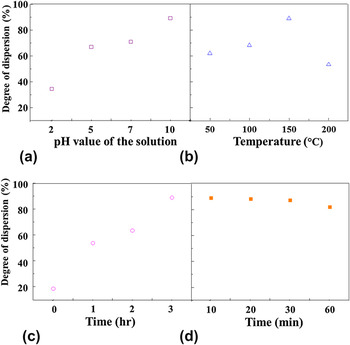
The catalyst should be well-dispersed on the supporting material because agglomerated catalysts have an inner dead volume into which the methanol fuel cannot diffuse. For this reason, the degree of dispersion of the catalyst must be considered in the synthesis and characterization of the electrochemical catalyst. The degree of dispersion is measured from the TEM micrographs, which show the number of separated Pt NPs on the surface of the MWCNTs. The degrees of dispersion as a function of the number of carboxylate anions, determined by pH, are shown in Fig. 3(a) for Pt NPs on PAA-w-MWCNTs. The Pt NPs prepared in a low pH solution show a very low dispersion for two reasons: at low pH, as shown above, the degree of ionization of carboxylic groups is very low. This leads to low electrostatic repulsion among the uncharged carboxylic groups, and PAA assumes a highly coiled morphology with extensive intramolecular hydrogen bonding. Consequently, the PAA-w-MWCNTs are agglomerated and the Pt ions are difficult to disperse in the media. In contrast, at high pH, the PAA chains assumes straightened rather than coiled chain conformations stabilized by negatively charged side chains. These extended chains improve the dispersibility of the MWCNTs and reduce the strength of interatomic van der Waals forces to promote unagglomerated and isolated Pt NPs with a homogeneous dispersion on the PAA-w-MWCNTs surface. In addition, the reaction temperature and time are expected to influence the degree of dispersion. Figure 3(b) shows the degree of dispersion as a function of the reaction temperature. As the sample prepared at 200 °C underwent fast growth, the degree of dispersion in this sample is low, 53.5%, due to extensive aggregation. The samples prepared below 100 °C produce few Pt nuclei because the temperature is insufficient to overcome the barrier to nucleation. The number of Pt ions that proceed to the nucleation step is low, and Pt nuclei growth is dominant. In this situation, Pt NPs tend to form agglomerated morphologies. Figures 3(c) and 3(d) show the degree of dispersion as a function of the incubation and growth time. Short incubation periods give the Pt ions insufficient time for dispersal on the PAA-w-MWCNTs, resulting in a low degree of dispersion. The degree of dispersion increases as the incubation period increased. These results showed that the degree of dispersion is not sensitive to the growth period. A long incubation period improves the dispersion of the Pt NPs, but the growth period is not found to affect the degree of dispersion.
Degree of dispersion of Pt NPs/PAA-w-MWCNTs prepared under various conditions. [(a) temperature: 150 °C, incubation: 3 h, growth: 10 min; (b) pH: 10, incubation: 3 h, growth: 10 min; (c) pH: 10, temperature: 150 °C, growth: 10 min; and (d) pH: 10, temperature: 150 °C, incubation: 3 h].

3. Average size and size distribution
The catalytic activity of Pt NPs depends strongly on the average size and particle size distribution. Small average sizes and a narrow size distribution of Pt NPs are ideal for electrochemical performance because a high surface-to-volume ratio promotes a large surface area for contacting with methanol during the electrochemical reaction. For this reason, as described above, the sample preparation conditions, including the number of carboxylate anions, the reaction temperature, and the reaction time, are investigated for their influence on the average size and catalyst particle size distribution. Figure 4 shows TEM micrographs and a diagram of the average size and catalyst NP size distribution as a function of the number of carboxylate anions, varied according to the solution pH. The Pt NPs prepared in a solution with pH values of 2 or 5 display an agglomerated morphology, a broad size distribution, and a poor dispersion on the PAA-w-MWCNTs. As the pH of the solution increases, smaller Pt NPs with a narrower size distribution and better dispersion on the PAA-w-MWCNTs are observed. The Pt NPs prepared at a pH of 10 form isolated islands on the PAA-w-MWCNTs. This trend indicates that the extent of dissociation of carboxylic to carboxylate groups on the PAA-w-MWCNT surfaces increases in proportion to the solution pH. As a result, the number of anchoring site on the PAA-w-MWCNTs surface increases and the average size and size distribution of the Pt NPs decrease.
TEM micrographs of Pt NPs/PAA-w-MWCNTs catalysts prepared at pH of (a) 2, (b) 5, (c) 7, and (d) 10 (reaction temperature: 150 °C, incubation time: 3 h, growth time: 10 min), and (e) diagram for average size (solid square) and size distribution (solid line).

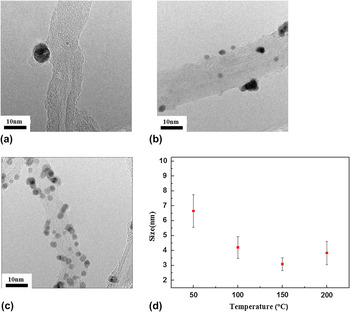
Figure 5 shows that the average size and particle size distribution of Pt NPs depend strongly on the reaction temperature, which influenced crystallization of the Pt NPs on the PAA-w-MWCNT surfaces. In principle, Pt NPs form through two steps, nucleation and growth.Reference Cushing, Kolesnichenko and O’Connor36, Reference Narayanan and El-Sayed37 As the temperature increases, the number of Pt nuclei that proceed to the nucleation step increases. However, at excessively high temperatures, Pt NPs accelerate aggregation or Ostwald ripening during the growth step, resulting in formation of larger particles.Reference Cushing, Kolesnichenko and O’Connor36 It is, therefore, important to control the temperature for fabricating size-controlled well-dispersed Pt NPs. Figures 5(a) and 5(b) show that Pt NPs prepared at 50 or 100 °C yield a large average size and particle size distribution. Moreover, the average Pt NP size decreases around 200 °C due to Ostwald ripening [Fig. 5(c)]. Figure 5(d) shows that the average size of the Pt NPs decreases as the reaction temperature is increased up to 150 °C because the reaction rate increases. Pt NPs prepared at 150 °C have the smallest average size and a narrow size distribution.
TEM micrographs of Pt NPs/PAA-w-MWCNTs catalysts prepared at reaction temperature of (a) 50 °C, (b) 100 °C, (c) 200 °C (pH of the solution: 10, incubation time: 3 h, growth time: 10 min), and (d) diagram for average size (solid square) and size distribution (solid line).

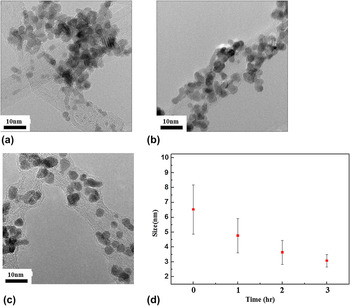
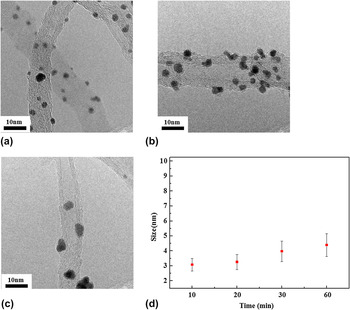
Figures 6 and 7 show TEM micrographs and a diagram of the samples prepared at different incubation and growth periods, respectively. The mechanism by which Pt NPs are synthesized can be divided into two periods: incubation and growth. The incubation period is critical for dispersion and attachment to the Pt nuclei on the PAA-w-MWCNT surfaces. The growth period determines the size of the NPs. PAA can play a role as a reducing agent for Pt ions. However, the Pt nuclei are not expected to nucleate and grow on PAA-w-MWCNTs during the incubation period because incubation step proceeds at room temperature and reducing rate of the Pt ions is low. Figure 6 shows that at longer incubation periods, the distribution of Pt NP sizes is more homogeneous and the NPs are uniformly dispersed. During the incubation period, Pt ions are initially dispersed and attached to the PAA-w-MWCNTs through electrostatic interactions. The binding mode slowly shifts toward charge-transfer or covalent interactions between Pt ions and the carboxylate anions on the PAA-w-MWCNTs. The Pt NPs prepared at an incubation period of 0 h display an agglomerated morphology with a relatively large average size and size distribution. Longer growth periods enable particle growth to dominate the synthesis, rather than additional nucleation events. As can be seen in Fig. 7, the sizes of Pt NPs formed on the MWCNT surfaces depend strongly on growth time. The average Pt NP size decreases as the growth period decreases. Four samples prepared with the same incubation period yield similar dispersions of Pt NPs on PAA-w-MWCNTs, indicating that the growth period does not influence the dispersion.
TEM micrographs of Pt NPs/PAA-w-MWCNTs catalysts prepared for incubation time of (a) 0 h, (b) 1 h, (c) 2 h (pH of the solution: 10, reaction temperature: 150 °C, growth time: 10 min), and (d) diagram for average size (solid square) and size distribution (solid line).

TEM micrographs of Pt NPs/PAA-w-MWCNTs catalysts prepared for growth time of (a) 20 min, (b) 30 min, (c) 60 min (pH of the solution: 10, reaction temperature: 150 °C, incubation time: 3 h), and (d) diagram for average size (solid square) and size distribution (solid line).

4. Loading density of Pt NPs
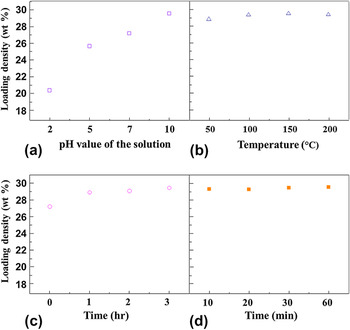
The loading density of the Pt NPs on PAA-w-MWCNTs strongly influences the electrochemical properties. It is clear that more extensive Pt NP loading on the MWCNTs increases the electrochemical performance. A high loading on the MWCNTs is important for the catalytic activity toward methanol oxidation. The Pt NP loading density on the PAA-w-MWCNTs can be controlled by varying the number of anchoring sites, reaction temperature, or incubation time. Figure 8 shows graphs of the sample loading densities calculated by inductive coupled plasma (ICP) emission spectrometry. A 30 wt% Pt precursor is added to the solution for all sample preparation processes. The loading density of Pt NPs onto PAA-w-MWCNTs is strongly influenced by the solution pH. Samples prepared at low pH, below 7, yield low loading densities. In the low pH solution, the concentration of PAA carboxylic groups is high and the concentration of carboxylate anions is low, which limit the number of anchoring sites for Pt ions and result in a low loading density. Most samples prepared at pH 10 under varying conditions have a high loading density above 27.5 wt%, indicating that almost all Pt NPs in the solution are loaded onto the MWCNTs. The loading density increases slightly as the incubation period increases. These results indicate that the catalyst loading density on the MWCNTs is sensitive to the number of anchoring sites and is attributed to the dispersion of Pt ions and MWCNTs.
Loading densities of Pt NPs/PAA-w-MWCNTs prepared under various conditions. [(a) temperature: 150 °C, incubation: 3 h, growth: 10 min; (b) pH: 10, incubation: 3 h, growth: 10 min; (c) pH: 10, temperature: 150 °C, growth: 10 min; and (d) pH: 10, temperature: 150 °C, incubation: 3 h].

B. Correlation between the physical properties of the Pt NPs and the electrochemical performance of Pt NPs/PAA-w-MWCNTs
CV is commonly used in electrochemical studies of fuel cell reactions. EASA and utilization efficiency of the catalyst can be obtained from the CV results. The SSA can be calculated from the average size of the Pt NPs. These factors are significant indices in fuel cell electrochemistry because the catalyst reaction with methanol fuel is a surface phenomenon, and the surface area of the catalyst in contact with the fuel should be maximized. In addition, the utilization efficiency is important due to the high costs of the noble catalyst. To study the relationship between the physical properties, such as the average particle size and size distribution, the degree of dispersion and electrochemical performance of the catalyst, SSA, EASA, and the utilization efficiency are calculated according to the following equations.

where d is the average size of Pt NPs (nm) and  is the density of Pt, 21.4 g/cm3. The SSA is determined by the size of the Pt NPs and is inversely proportional to the size of the Pt NPs.

where Q H is the electric charge associated with the average hydrogen adsorption (Q′) and desorption (Q′′) events, and 210 μC/cm2 is the hydrogen adsorption constant for polycrystalline Pt (calculated from a surface density of 1.3 × 10¹⁵ atom per cm2, a value generally admitted for polycrystalline Pt electrodes). The EASA was calculated by integrating the hydrogen desorption region of the CV curves of the catalysts in a nitrogen-saturated H2SO4 solution at a scan rate of 50 mV/s (see Fig. S1).

Figure 9 illustrates the SSA, EASA, and utilization values of the Pt NPs/PAA-w-MWCNTs prepared under various conditions. These diagrams show that the observed trends agree well with the previously obtained degree of dispersion, as shown in Fig. 3. As the pH of the solution decreases, SSA, EASA, and the utilization efficiency also decrease due to the low concentration of the carboxylate anions on the surface of PAA for dispersant and nucleation of Pt NPs. The sample prepared at 150 °C displays high values, whereas the sample prepared at 200 °C has lower values due to aggregates of the catalyst. The catalyst prepared under the following condition shows the highest SSA, EASA, and utilization values: solution pH of 10; reaction temperature of 150 °C, incubation time of 3 h, growth time 10 min. The samples prepared under other conditions may have yielded poor dispersions, a poor SSA, a poor EASA, and a poor utilization efficiency.
SSA, EASA, and utilization efficiency of Pt/PAA-w-MWCNTs prepared under the various conditions. [(a) temperature: 150 °C, incubation: 3 h, growth: 10 min; (b) pH: 10, incubation: 3 h, growth: 10 min; (c) pH: 10, temperature: 150 °C, growth: 10 min; and (d) pH: 10, temperature: 150 °C, incubation: 3 h].

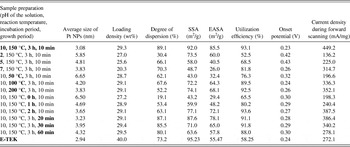
CV curves are obtained in 0.5 M H2SO4 and 1 M CH3OH aqueous solution under half-cell conditions to characterize the electrochemical activities of Pt/PAA-w-MWCNTs prepared under the various conditions (Fig. 10). Typical CV curves with the methanol oxidation current peaks of the samples are shown to measure mass activity, which is for current per unit amount of catalyst. All current densities were normalized with respect to Pt mass loading and area. Higher methanol oxidation reaction currents are observed from catalysts prepared at a higher pH. The catalysts with higher degree of dispersion value have a steeper curves during methanol oxidation. Moreover, peak current density values are in good agreement with the order of the EASA of the catalysts, i.e., the catalytic activity for the methanol oxidation is larger for the sample with higher EASA, SSA, and utilization efficiency. All results from the curves indicate a clear trend that catalysts with higher SSA and EASA values, as shown in Fig. 9, yield higher current density peaks and negatively shifted curves, which indicates better catalytic activity toward methanol oxidation. These results show that Pt NPs with a small average size yield higher SSA and EASA, and the NP surfaces efficiently contacted the fuel methanol. The methanol oxidation rates appear to be more active as the degree of dispersion and loading at the catalyst increases.Reference Joo, Choi, Oh, Kwak, Liu, Terasaki and Ryoo38, Reference Tang, Chen, Nie, Liu, Deng, Kuang and Yao39 The catalyst prepared under conditions (solution pH of 10, reaction temperature of 150 °C, incubation period of 3 h, growth period 10 min) shows higher catalytic activity than the other samples. This condition is considered to be optimal for the synthesis of Pt NPs supported on PAA-w-MWCNTs. Correlations between the sample preparation conditions, the physical properties of the Pt NPs, and the electrochemical performance of the Pt/PAA-w-MWCNTs prepared under various conditions, are summarized in Table I.
CV curves of the Pt/PAA-w-MWCNTs catalysts prepared under various conditions: (a) pH value of the solution, (b) reaction temperature, (c) incubation period, and (d) growth period. (Scan rate = 50 mV/s).

Correlations between the sample preparation conditions, the physical properties of the Pt NPs, and the electrochemical performances of the Pt/PAA-w-MWCNTs prepared under various conditions with E-TEK. The varied conditions are denoted with bold text.

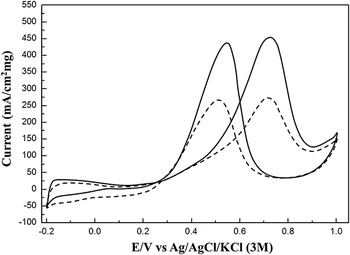
The electrochemical performance of the Pt/PAA-w-MWCNTs (29.3 wt%) catalyst prepared under optimal conditions is measured by CV and compared with the performance of a commercial catalyst (Fig. 11). The commercial E-TEK catalyst (40 wt%) supported on Vulcan XC72 is 2.85 nm in size, the size distribution is 1.63, and the degree of dispersion is 73.2%. The onset potential is the point at which methanol oxidation begins. The lower onset potential indicates better catalytic activity and a lower overpotential. The onset potential was determined by overlapping the CV curves of the catalysts in H2SO4 with and without methanol.Reference Cao, Du, Wang, Mercier, Zhang, Yang and Akins40 The onset potential of Pt/PAA-w-MWCNTs is lower than that of the commercial E-TEK catalyst. Moreover, the catalyst shows a steeper increase in methanol oxidation current, indicating that methanol oxidation rate is more active than E-TEK. These results are attributed to the superior electrical conductivity of supporting material. PAA used as mediating material are considered to make little effect on the electron transfer from the Pt NPs to MWCNTs as electron tunneling barrier. In addition, the methanol oxidation current observed for our sample is ∼165% higher than the peaks corresponding to the commercial E-TEK catalyst. This Pt/PAA-w-MWCNTs catalyst indicates superior catalytic activity toward methanol oxidation due to the higher degree of dispersion and EASA for the Pt NPs deposited on PAA-w-MWCNTs, even though the amount of loading onto the Pt/PAA-w-MWCNTs is 10 wt% lower than that loaded onto E-TEK. Furthermore, PAA-w-MWCNTs, which have a damage-free supporting material, high SSA, and excellent electrical conductivity, attribute to the enhanced electrochemical performance of the catalyst.
CV curves for methanol oxidation in 0.5 M H2SO4 + 1 M CH3OH. (Scan rate = 50 mV/s, solid line—Pt/PAA/MWCNTs, dashed line—E-TEK).

IV. SUMMARY
In summary, we examined the factors that influence catalytic activity to identify possible relationship(s) between the general characteristics of Pt NPs and their electrochemical performance in DMFCs. The physical properties of Pt NPs deposited onto the PAA-w-MWCNTs, such as the average size and size distribution, the loading density, and the dispersion status, were remarkably sensitive to the sample preparation conditions, such as the variable number of pH-dependent anchoring sites for the Pt NPs, the reaction temperature, and the incubation and growth periods. The number of anchoring sites on the surface of the PAA-w-MWCNTs strongly influenced the average size, loading density, and degree of dispersion of the catalyst. In addition, a lower average size and a high dispersion status for the Pt NPs strongly improved the EASA. The enhanced catalytic activity toward methanol oxidation was attributed to a high SSA, EASA, loading density, and degree of dispersion of the Pt NPs. The Pt NPs/PAA-w-MWCNTs catalyst prepared under optimal conditions showed a higher catalytic activity toward methanol oxidation than any other catalysts. The catalyst (29.3 wt%) provided an electrochemical performance that was significantly better than that of the commercial catalyst (E-TEK, 40 wt%) due to the presence of a good dispersion, SSA, EASA, and undamaged MWCNTs.
ACKNOWLEDGMENT
This work was supported by the National Research Foundation of Korea (NRF) Grant funded by the Korea government (MEST) (No. 2011-0029865) and the World Premier Materials Program (Contract No. 10037878) funded by the Ministry of Knowledge Economy (MKE, Korea).