1 Introduction
Gaps in phonological inventories are well known. In particular, for stops, it is not uncommon for languages to lack either /p/ or /g/ (Maddieson Reference Maddieson, Haspelmath, Dryer, Gil and Comrie2005 and references therein). The lack of a /g/ in a segmental inventory is widely held to be due to aerodynamic production forces (e.g. Ohala Reference Ohala and MacNeilage1983), and the widespread geographical distribution of a ‘missing /g/’ pattern supports the idea of this gap having a purely physiological cause (see the map in Maddieson Reference Maddieson, Haspelmath, Dryer, Gil and Comrie2005: 28–29). The lack of /p/ has also been attributed to aerodynamic forces, though this seems less well established; Maddieson notes that ‘missing /p/’ languages are more areally defined, the bulk of them being located in Africa (though the historical cases of Proto-Celtic and its immediate descendants which also lacked *p were of course not included in his data set).
An issue that naturally arises is whether the labial-velar gaps in stop inventories relate to these other, better-known gaps, or whether other factors exhibit greater relevance. One might speculate, for example, that if a language has no /g/, this may relate to a lack of / / as well, and there indeed turns out to be a connection. One might also speculate that that if a language has no /p/, this may relate to a lack of /
 /, but this, in contrast, turns out not to be the case at all. This clearly demonstrates that one must be cautious when tempted to extrapolate typological patterns. Labial-velars exhibit different characteristics than plain stops. Other historical factors are at work, and an examination of these factors is the major theme of this paper.
The labial-velar stops // and // occur in over 700 languages of the world, mostly in central and west Africa, but also in several dozen in Papua New Guinea and Vanuatu and a few elsewhere (personal database). While complete segmental inventories and analyses are lacking for many of these, every sampling thus far suggests that in the vast majority of these languages, both the voiced and voiceless counterparts are contrastively present. However, the consonantal inventory of some languages contains only //, while others have only //. The reasons for these language-specific asymmetries differ, as indicated by their complete segmental inventories. Languages with only // inevitably have additional gaps in the stop inventory, while those with only // have no such gaps. In this paper, I focus on the //-only cases in more detail, proposing that many, perhaps most, of the languages with only // attained that state through a merger of * and * to present-day //, due to phonetic factors that have driven the merger in the direction of voicing. This study thus integrates elements of phonetics, phonological inventories and diachronic development. There are undoubtedly more languages than are listed here with only // or only //, but the ones cited in this paper form a sufficiently rich corpus and show clear enough patterns that certain conclusions can be drawn.Footnote 1
Cross-linguistically, it is not uncommon for a language to have only voiceless stops. In Maddieson's recent sample of 566 languages, 17% of the total sample lacked voiced stops of any kind (Maddieson Reference Maddieson, Haspelmath, Dryer, Gil and Comrie2005), e.g. Mandarin, Nahuatl and Maori. What is highly unusual is to have only voiced stops present in a language's phonological inventory. Maddieson (Reference Maddieson, Haspelmath, Dryer, Gil and Comrie2005) does not mention this pattern at all, and Maddieson (Reference Maddieson1984) lists only two examples of this out of 317 languages: the Australian languages Alawa and Bandjalang.Footnote 2
Stated differently, in sound inventories of languages, a voiced stop generally implies the presence of a voiceless one (in the original 1984 UPSID database 91·8% of languages had a plain voiceless stop series, while only 66·9% had a plain voiced stop series); so languages which have /d/, for example, will almost certainly have /t/ (Maddieson Reference Maddieson1984). For discussion of the phonetic basis for the bias against voiced obstruents, see Ohala (Reference Ohala, Hardcastle and Laver1997), or the more detailed account in Ohala (Reference Ohala and MacNeilage1983).
Applying this principle to labial-velar consonants, we might expect that if only one labial-velar stop of the voiced/voiceless pair is present, it would be //. In fact, this is so only in a minority of cases. Both in Africa and Oceania, the more prevalent pattern is the presence of // but not //. In the online UPSID database,Footnote 3 there are 35 languages with // and 39 with //, while 34 languages have both // and //. One language is listed with only //, while five have only //. Similarly, in the online SALA,Footnote 4 107 languages have both // and //, six are listed with only // and 11 with only //. In Oceania, there is no language I know of with only //, but several with only //, as will be seen below.
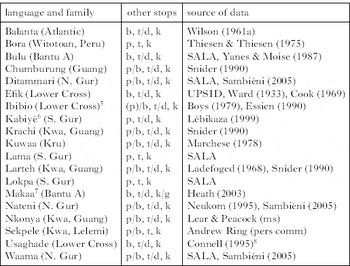
Before focusing on //-only languages, I present data on //-only languages in Table I, all occurring in Africa, except the South American Bora, followed by brief discussion of the patterns shown therein. These //-only languages are not only less common than those with only //, but as seen in Table I, they always have other gaps in the stop inventory. Most obviously, /g/ is missing from all languages except Makaa. But beyond this generalisation, all the languages except Makaa can be grouped into two main categories. First, there are languages with only voiceless stops: Bora, Lama and Lokpa. Kabiyé comes close to this; the only voiced stop is alveolar. A few others – Balanta, Bulu, Efik, Sekpele and Usaghade – are similar, but have /b/ rather than or in addition to /p/ in the labial place.Footnote 9 The second main category is languages which have a full complement of voiced and voiceless stops in all places, with the sole exception that these are missing a /g/. Nine of these 19 languages have this pattern.
Languages with only //

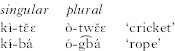
Kisi (Childs Reference Childs, Kaye, Koopman, Sportiche and Dugas1983, 1992–Reference Childs1994) may be added as a borderline case, since synchronically // exists in very few forms, while // is relatively common. Again, /g/ also does not exist presently, but merged historically with /k/.
Proto-languages have also been reconstructed with this pattern. Snider (Reference Snider1990) reconstructs Proto-Guang with a system similar to Chumburung and the other Guang languages Krachi and Larteh above, having only // but no //, and also /k/ but no /g/. Also, in Connell's (Reference Connell1995) reconstruction of the consonants of Proto-Lower Cross, he reconstructs * but not *, and also *k but not *g – the same pattern that exists synchronically in a majority of languages in the table.Footnote 10 In a larger context, Dimmendaal (Reference Dimmendaal1978) reconstructs Proto-Upper Cross as having a full set of voiced and voiceless stops, except again there is * but not *, and also *k but not *g.
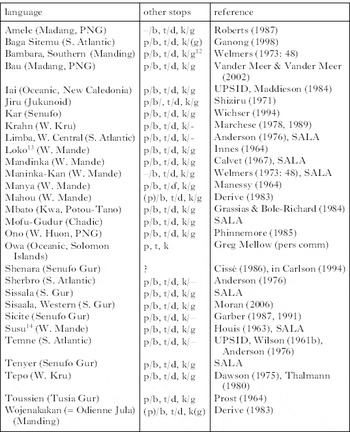
It thus seems that // with no // always correlates with a related gap in the segmental inventory, either a lack of /g/ or, more generally, a lack of voiced stops altogether.Footnote 11 In contrast, most of the languages with // but no // have no such gaps, as will be seen below. Since the languages of Papua New Guinea and other Oceanic languages are not as well known with respect to labial-velars, I will indicate them either by PNG or the name of the country in which the language is spoken.
It is likely that at least five more Mande languages could be added to this list (see §2.2). The clear majority of the languages above (20 out of 29) have a full inventory of voiced and voiceless stops at labial, alveolar and velar places of articulation.
Languages with only //

In comparing Tables I and II,Footnote 15 it is suggestive that while a lack of // in Table I is correlated with other gaps in the segmental inventory (particularly a lack of /g/), the lack of // in Table II has no such systematic correlation. This suggests that the reason for the absence of // relates to factors internal to the characteristics of //, rather than being related to external factors.
In the next section, I summarise historical evidence that * and * have merged to // in some languages. In §3, I discuss three phonetic characteristics that // often has which are usually associated with voiced stops, and in §4, I summarise the obvious conclusion, that it is these phonetic characteristics that drive the sound change that results in a typologically unexpected system, and discuss some related issues.
2 Labial-velar merger
2.1 Senufo
Most Senufo languages, such as Cebaara, have both voiced and voiceless labial-velar stops (Carlson Reference Carlson1994: 8–9). However, the labial-velar stops in northern Senufo languages have merged their voiceless and voiced counterparts into //. Sucite is an example of this merger, having no //, but a // which is quite common, despite the relative uncommonness of other voiced stops relative to voiceless ones (Garber Reference Garber1987). Tenyer (Western Karaboro) and Shenara (Syenara Senoufo), listed in Table II, also belong to this group. Supyire has gone a step further, by changing merged * and *b to current /b/.
(1)


Correspondingly, Supyire /b/ is disproportionately common, the results of combining the frequencies of words with *b, * and *.Footnote 16
2.2 Mande
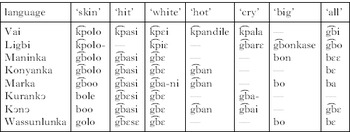
Northern Mande languages apparently followed the same sort of historical path. Long (Reference Long1971), in discussing the challenges of reconstructing labial-velars in northern Mande languages (which have many reflexes), did not discuss the correspondences illustrated here between // and //. In Table III we see the correspondence //~// in the left five columns and the correspondence //~b in the right two columns. Vai and Ligbi alone above have //, and most of the other languages have corresponding //. (Kurankɔ, Kɔnɔ and Wassunlunka also have other correspondences for ‘skin’.) The last two columns show correspondence between // in Vai and Ligbi and /b/ in the other languages, illustrating another common historical process with labial-velars, the loss of the velar articulation, with retention of the labial.Footnote 17
Northern Mande (Long 1971)

Combining these two sets of correspondences, we see that the proto-language had both * and *. Vai and Ligbi have retained both of these. In the others, *>/b/, and this was followed by the additional sound change of *>//. This would imply that the last six languages listed have no //, but only //. I do not have access to the full phonological inventories of all six of these languages, but note that Maninka, one of these, is in fact included in the languages listed in (2) which have only //. It is likely that the other five of these could be added to this list.
2.3 Ono
Labial-velars are found in most of the languages of the Huon Peninsula in Papua New Guinea. An early investigation by McElhanon (Reference McElhanon1967) lists the phonemes of twelve of these languages. Of these, ten have labial-velars – Kâte, Dedua, Mape, Hube, Tobo, Kosorong, Mindik, Burum (the last two now considered to be one language), Komba and Ono.
More generally, of the 21 Huon languages listed in the Ethnologue (Gordon Reference Gordon2005), 16 have both // and // (McElhanon & Voorhoeve Reference McElhanon and Voorhoeve1970). Four have no labial-velars at all, having changed labial-velars to plain labials, e.g. *>/b/ in ‘thunder’, illustrated by Kâte /uŋ/ and Ono /uruŋ/, but Selepet /buŋburuŋ/, and the more extensive set illustrating *>/p/ in the last three languages in (2) (data from McElhanon & Voorhoeve Reference McElhanon and Voorhoeve1970).
(2)

From this, it is safe to conclude that Proto-Huon had both voiced and voiceless labial-velar stops, which have reflexes of // and // today in most of the daughter languages. Four languages have merged labial-velar stops with plain labial stops, as happened in the Senufo case discussed in §2.1. In Ono, however, // and // have merged to //, and we now focus on this.
For Ono, spoken in Papua New Guinea, both comparative and some diachronic data are available. Ono presently has // but no //, though the other Ono stops have voiced/voiceless pairs (Phinnemore Reference Phinnemore1985). However, in the early twentieth century, Ono was reported as having a contrast between // and // (Wacke Reference Wacke1931). Assuming the general accuracy of Wacke's account, early Ono // merged with //. Furthermore, an extensive dictionary is available for present-day Kâte, a related Huon language (Flierl & Strauss Reference Flierl and Strauss1977). Kâte has a robust //–// contrast, and a number of relevant cognates may be identified. These are listed below, along with the few relevant Ono words from Wacke which correspond to Kâte forms, and the more recent Ono data from Phinnemore's fieldnotes and personal communications.
(3)

Comparative studies are not readily available at present for the remainder of the languages listed in Table II which have only //, but in light of those which have been carried out, as well as the phonetic characteristics of // discussed below, it is probable that studies of many of these languages will indicate a similar merger of * and * to //.
3 Why //?
The sound change merging * and * in favour of voicing calls for explanation. As noted before, the fact that the languages in question have full sets of plain voiced and voiceless stops points to internal characteristics of // as the crucial reason, rather than relation to other sounds. The crux of the matter is that voiceless labial-velars have at least three phonetic factors which are largely in common with voiced stops. Though not universal, these characteristics are common enough that it is likely they are connected with the merger to voicing.
3.1 Lack of aspiration
What have been traditionally transcribed in IPA notation as phonetically voiced or voiceless stops have been assumed to vary by the phonological feature [voice], though it has been recognised that in English, for example, a ‘voiced’ stop is in fact a voiceless unaspirated stop, and English ‘voiceless’ stops have very significant aspiration. In other languages, such as Dutch, ‘voiced’ stops do indeed have a significantly negative VOT, and ‘voiceless’ stops are relatively unaspirated (see Iverson & Salmons Reference Iverson and Salmons2007 for English and Dutch). Two types of languages are proposed in what has been termed ‘laryngeal realism’, with ‘aspiration languages’ using the feature [spread glottis] and ‘voice languages’ using [voice] (e.g. see proposals and review of literature in Honeybone Reference Honeybone, Oostendorp and Weijer2005 and Iverson & Salmons Reference Iverson and Salmons2007, among others). This simple binary division of languages does not cover the entire range, of course, with Thai, for example, having voiced, unaspirated voiceless and aspirated voiceless stops, and Hindi adding aspirated voiced stops.
In all the African languages (as well as one from Papua New Guinea) for which I have personal recordings, the laryngeal settings for ‘voiced’ stops indeed have a significantly negative VOT; they are truly voiced. Phonemically voiceless stops in these languages vary in aspiration; in a few languages, all voiceless stops are unaspirated, and in others, such as Kɔnni and Kâte (Papua New Guinea), there is a measure of aspiration, with a typical VOT of about 30 ms, less than a language like English, but still discernable to the linguist's ear. Shryock et al. (Reference Shryock, Ladefoged and Williamson1996–97) note VOTs for Defaka (Nigeria) of approximately 30 ms for /k/ and less for other voiceless stops, but a small negative VOT for //. Demolin (Reference Demolin1991) reports a similar pattern for Mangbetu.
Other examples include Smith (Reference Smith1967), who reports aspiration on all voiceless stops in Nupe except labial-velars, which he specifically states are unaspirated. Similarly, Stuart Showalter (personal communication) mentions that only the labial-velars among the voiceless stops in Kaanse are unaspirated. For Konkomba (Steele & Weed Reference Steele and Weed1966), Vagala (Crouch & Smiles Reference Crouch and Smiles1966), Tampulma (Bergman et al. Reference Bergman, Gray and Gray1969), Kusaal (Spratt & Spratt Reference Spratt and Spratt1968), Nafaara (Jordan Reference Jordan1980), Dilo (Jones Reference Jones1987), Ewe (Maddieson (Reference Maddieson1984), Sisaala-Pasaale (Toupin Reference Toupin1995) and Irigwe (Daniel & Bari Reference Daniel and Bari1983), // alone among the voiceless stops is not listed as aspirated. Kɔnni has an unaspirated //, as seen in waveforms, as opposed to the other voiceless stops (Cahill Reference Cahill2007). Recordings of Kâte show aspiration on /p t k/ but not on //. Bora (Peru) has a phonemic contrast between aspirated and unaspirated voiceless stops (/p t c k/), but only an unaspirated labial-velar stop (Thiesen & Thiesen Reference Thiesen and Thiesen1975), as does Phwin (Kevin Warfel, personal communication). Only one or two sources, such as Kennedy (Reference Kennedy1966) for Dagaare, include aspiration on // as well as other voiceless stops in their phonetic descriptions (though Adams Bodomo (personal communication), a linguist and native speaker of Dagaare, informs me that // in Dagaare is much less aspirated than /p/).Footnote 19
The point here is that even in languages in which all other voiceless stops exhibit aspiration, voiceless labial-velars are almost always either unaspirated or significantly less aspirated than other voiceless stops. This relative lack of aspiration may be interpreted over time as voicing.
3.2 Implosive airstream mechanism
Many labial-velars have an ingressive airstream mechanism as part of their phonetics. Though distinct from true implosives, it is suggestive that there is some similarity, and that most implosives are voiced (Ladefoged & Maddieson Reference Ladefoged and Maddieson1996). Thus there may be a tendency to interpret these as voiced consonants.
Ladefoged (Reference Ladefoged1968), in his phonetic survey of 33 West African languages with labial-velars, notes three mechanisms for producing them.
(4) Mechanisms for producing labial-velars
a. Simple pulmonic airstream (2 languages).
b. Pulmonic egressive and velaric ingressive airstream; dorsum slides back, air flows into oral cavity from both directions (23 languages).
c. Pulmonic egressive, velaric ingressive, glottalic ingressive airstreams; partly voiced (8 languages).
Ladefoged himself notes that these categories are to be treated with caution, in that these are based on few informants from each language, and there is considerable variation in the actual mechanisms. (For example, he puts Ibibio in category (b), while later studies by Garnes Reference Garnes and Herbert1975 and by Connell Reference Connell1991, Reference Connell1994 put Ibibio firmly in category (c).) In spite of this, it is noteworthy that some variety of ingressive airstream is present in the majority of languages studied.
Besides Ladefoged's data, others have noted similar phenomena, though described in a variety of terms, and impressionistically rather than instrumentally. The terms ‘implosive’ and ‘implosion’ as used below must be interpreted as referring to ‘ingressive airstream’ rather to the sounds normally labelled ‘implosives’, e.g. [ɓ ɗ ɠ]. Labial-velars in the Tyebaara dialect of Senufo are pronounced ‘with noticeable suction in the oral cavity, and with a pop upon release’ (Mills Reference Mills1984: 96). Dan (Santa) is described as having ‘bilabial implosion’ for // and ‘strong bilabial implosion’ for // (Bearth & Zemp Reference Bearth and Zemp1967). Kaanse (Stuart Showalter, personal communication) also seems to have some suction associated with labial-velars, sounding somewhat similar to an implosive stop. Moba is another which is described as having a suction or ‘popping’ associated with labial-velars (Jann Russell, personal communication). The Owa labial-velar (Solomon Islands) is also pronounced with an ingressive airstream mechanism (Greg Mellow, personal communication). Engenni // and // are specifically listed as ‘ingressive’, in contrast to the other, ‘egressive’, stops (Thomas Reference Thomas1978). Wilhoit (Reference Wilhoit1999) labels // and // as ‘implosive’ in Loma (Guinea and Liberia). Vogler (Reference Vogler1987: 28) notes about Vata (Lakota Dida) ‘l'on note un bruit de succion caractéristique’ [‘a characteristic sucking noise is noted’]. Bearth (Reference Bearth1971: 18) says of Toura //: ‘à l'ouverture des deux fermetures buccales, une inspiration bilabiale se produit simultanément avec un explosion vélaire. Ce double mouvement d'air en sens opposés est dÛ à un élargissement de la cavité buccale, amorcant l'ouverture de la bouche’.Footnote 20 In Bandi (Grossmann Reference Grossmann1992: 13), // and // are noted as having an implosive character. Wilson (Reference Wilson1961b) notes that the Temne // can be implosive. Puesch (Reference Puesch1989) notes implosion for Bekwil, Demolin (Reference Demolin1991) suction for Mangbetu and Connell (Reference Connell1995) implosion for Ibibio, Obolo, Kalabari and Kana.Footnote 21
Labial-velars are not implosive in all languages, however. Besides Ladefoged's notes above, Painter (Reference Painter1970) specifically notes that Gonja has a simple pulmonic airstream. Kɔnni also has a simple pulmonic airstream for labial-velars (Cahill Reference Cahill2007). And Ega evidently has both; it is reported as having a contrast between implosive and non-implosive voiced labial-velars, symbolised as /&gcurvebcurvefrown;/ and // (Connell et al. Reference Connell, Ahoua and Gibbon2002).
Detailed articulatory studies are not available for the majority of languages discussed here. In particular, an impressionistic description such as ‘sucking’ does not differentiate between Ladefoged's categories (b) and (c). However, it seems that Ladefoged's (Reference Ladefoged1968) survey, in which a majority of languages with labial-velar stops have some sort of ingressive airstream mechanism, does indeed reflect the majority situation. And since most true implosives are voiced, it is a natural interpretation for speakers hearing an ingressive sound to group these together with voiced sounds, especially, as a referee points out, there is quite possibly an articulatory connection between this implosion noted above and the partial voicing discussed below.
3.3 Partial voicing
Finally, in a number of languages, even the ‘voiceless’ labial-velars have some partial voicing – either voicing over the latter part of the closure (pre-voicing) or continuation of voicing from a preceding vowel into the stop (voice-termination time, or ‘voicing tail’) – which simple stops generally lack (Demolin Reference Demolin1991, Connell Reference Connell1994 and references therein, Pettorino & Giannini Reference Pettorino, Giannini, Elenius and Branderud1995, Shryock et al. Reference Shryock, Ladefoged and Williamson1996–97). Over time, this voicing gesture could very well extend through the entire consonant. As Connell (Reference Connell1991: 113) notes for Proto Lower Cross (PLC) languages: ‘it is also possible that the existence of a relatively long voicing tail might have played a role in the development of voiced reflexes [of *kp], particularly where PLC *kp>[gb] has been found’.
Prevoicing is clearly similar to the lack of aspiration discussed above, in that both are related to VOT. However, the languages mentioned in this section go beyond a zero or small positive VOT, actually having a negative value of VOT. Since languages exist that contrast voiceless aspirated stops, unaspirated stops and voiced stops, there is a categorical difference between an essentially zero VOT and a negative VOT. Furthermore, partial voicing, as noted above, can also occur at the left edge of the stop, and I therefore treat lack of aspiration and partial voicing separately.
Connell (Reference Connell1994) reports on voice onset times for phonemically voiceless stops in Ibibio, with average VOTs of +6 ms for /p/ and +21 ms for /k/, but −26 ms for //. The latter is prevoiced. Similarly, Olson (Reference Olson2005: 141) measured VOTs for Mono as +10·2 ms for /p/ and +27·6 ms for /k/, but −10·0 ms for //.
Connell (Reference Connell1995) notes a voiced release for // in Ibibio, Obolo and Kana. Innes (Reference Innes1964) reports that Loko has partial voicing of the voiceless labial-velar, to the point that he transcribes it as /kb/, but that another researcher, Pichl, found the Loko speakers interviewed by him all had //, with no voiceless labial-velar at all. This may be a case of a merger in progress (if it is not simple disagreement in transcription). Ward (Reference Ward1933) also mentions that Efik /kp/ sounds like [kb].
Marquita Klaver (personal communication) mentions the difficulty that beginning literacy students in Ifè have in writing orthographic <kp> vs. <gb>, due to partial voicing of [], even though the airstream mechanism is totally pulmonic.
4 Summary and discussion
Languages which have only // or only // have the respective gap for quite different reasons. A language with only // always has other gaps in the segmental inventory, suggesting strongly that the reason for the lack of // is because it never developed, or that there was a simultaneous historical devoicing of all stops having a velar component. In contrast, the reason for the lack of // is in many cases a demonstrable historical merger of * and *.
I propose that the reason that * and * have often merged to // is because // often has characteristics normally associated with voiced stops. Labial-velar stops have little or no aspiration, often an ingressive airstream mechanism, and sometimes actual partial voicing. Cross-linguistically, lack of aspiration is extremely common for labial-velars. An ingressive airstream mechanism is also more common than not. Partial voicing is reported less frequently. Detailed phonetic studies have not been made of most of the languages alluded to in this paper, so the relative frequencies of these characteristics may change with more complete data available.
The hypothesised change, then, for many, perhaps all, of the languages which have // but no // is that their ancestral languages had both * and *, but that phonetic characteristics of // – i.e. lack of aspiration, implosion, partial voicing – led speakers to identify // as voiced, with subsequent merger with //.
However, as we have seen, the most common state of affairs is that a language will have both // and //. The implication is that for most languages, the perceptual cues present are sufficient to robustly differentiate these two sounds. Although perceptual studies are not available, a few observations can be made. While lack of aspiration is a very common characteristic of //, and an implosive airstream mechanism seems common, though not universal, the partial voicing of // has been less noted and is probably rarer. A typical African language has significant negative VOT for word-initial voiced stops, and this would cue identification in that position. Moreover, intervocalic voicing of // and voicelessness of // is a robust phonetic difference. For the majority of languages, the simple phonetics of voicing is enough to maintain the contrast of these diachronically.
This paper has concentrated on the scenario of //-only languages arising through merger of * and *. Another conceivable way in which a //-only language could have arisen is that *p was missing from the proto-language, while *b was present. On first glance, this appears to be a reasonable hypothesis, since /p/ is not uncommonly absent from a language's segmental inventory (Ohala Reference Ohala and MacNeilage1983, Maddieson Reference Maddieson, Haspelmath, Dryer, Gil and Comrie2005). In this case, another documented origin for //, that is, via *pu>/pw/>//, would be impossible, since the initial segment *p is lacking (while // would develop via *bu>/bw/>//).Footnote 22 If, however, we re-examine the inventories of the specific languages listed in Table II, we see that only two languages – Amele and Maninka-Kan – lack /p/, though it is marginal in Mahou and Wojenakakan. Most languages do in fact have /p/. The idea that // never developed may be entertained as a possibility in these four languages, but for the other 25 languages listed, it is not a likely hypothesis.
It is also noteworthy that in Table II Owa has only //, in spite of the fact that all other stops are voiceless. Comparative data are not yet available, and this of course needs further investigation, but this striking pattern is consistent with the assertion that // has internal characteristics that would push it toward phonemic voicing.
The discussion above highlights the fact that labial-velar stops often behave differently in diachronic situations than do singly articulated stops. When both voiced and voiceless simple stops occur in a proto-language, it is not typical for them to merge into the voiced stop. The reasons for the presence of /b/ and absence of /p/ in a language are phonetic, as mentioned above, but this is entirely unrelated to the labial-velar situation.
A point to be noted here is that a phonetically natural sound change may lead to a total system which appears to be typologically unnatural, or at the least, unusual. Though voiced stops are less common typologically than voiceless ones, the merger of // and // into // has led to the typologically unusual situation in which a specific voiced stop has no voiceless counterpart. The typological tendencies of labial-velars are thus counter to the typological tendencies of plain stops.