Introduction
Population ageing is the process through which the median age of a population increases due to lower birth rates and increased life expectancy. This is increasingly a global phenomenon as the highly populated regions of the world transition to middle- and high-income status (Lutz, Sanderson and Scherbov Reference Lutz, Sanderson and Scherbov2008). Responding to the needs of an older population in these contexts is complicated by under-developed health and social care systems and, frequently, a lack of social protection. Traditionally, care for older people has typically been provided within families. However, increasing economic development has provided greater opportunities for women and others who performed these informal care roles to work outside the home. Furthermore, greater opportunities for employment in urban areas and overseas have been significant pull factors enhancing emigration from home, leaving the older population without resident family support (Antman Reference Antman2010; Lin, Yin and Loubere Reference Lin, Yin and Loubere2014).
Malaysia is a multi-ethnic, middle-income country. It also has an ageing population and a high level of labour-related migration (Bell and Muhidin Reference Bell and Muhidin2009; United Nations 2015). Recent data from the South East Asia Community Observatory (SEACO), a rural/semi-rural demographic and health surveillance site in Segamat District, Johor, Malaysia, revealed a relatively low proportion of people aged 20–40 compared with older groups, such that the proportion of those over 60 is twice the national average (Jahan et al. Reference Jahan, Allotey, Arunachalam, Yasin, Soyiri, Davey and Reidpath2014). The SEACO data also revealed that 4 per cent of all households in Segamat district are occupied by an older person (65 or over) living alone. This corresponds to 9 per cent of people over 65 and is reflective of a nationwide phenomenon; a 2012 study of living arrangements in four areas of peninsular Malaysia reported 9 per cent of people over 60 lived alone (Kooshiar et al. Reference Kooshiar, Yahaya, Hamid, Samah and Jou2012). This finding merits further investigation, particularly because, in Malaysia, family unity and filial piety are strongly emphasised. Moreover, encouraging familial support of older relatives is explicit government policy and there are tax incentives for caring for older relatives at home (Chan Reference Chan2005; Department of Social Welfare Malaysia 1995).
This article explores the social support and care arrangements of older people living alone. The concept of social support is often described in terms of networks of relationships and the emotional, informational and instrumental support provided by these networks (Cohen, Gottlieb and Underwood Reference Cohen, Gottlieb, Underwood, Cohen, Gottlieb and Underwood2000). Emotional support refers to the provision of empathy, love and care, informational support refers to information and advice, whereas instrumental support refers to more tangible assistance. To these aspects of social support, financial support is also included because, in the context of child migration, ‘the responsibility to care may, in practice, be transformed into contributions via financial arrangements’ (original in Chinese (Wu Reference Wu1995), quoted in Ng, Phillips and Lee Reference Ng, Phillips and Lee2002: 140). Care arrangements refer to older people's current and future care plans in case of illness or frailty.
In Malaysia, there are relatively few formal arrangements for financial support or institutionalised care in old age. In 2003, just under half (42%) of Malaysia's labour force was not covered by any pension scheme (Thillainathan Reference Thillainathan2003). Pensions, typically lump sums, can be withdrawn from the age of 55. Those who withdraw lump sums often spend them within a few years, leaving many without social protection in later life (Samad and Mansor Reference Samad and Mansor2013). In rural areas, agricultural income remains important, and some older people receive income from land that was previously allocated by the government. Indeed, land redistribution schemes, of which ethnic Malays are the main beneficiaries, have had a significant role in reducing rural poverty (Fold Reference Fold2000). Welfare and other forms of social protection are limited. Destitute older people, with no income or family support, can apply for a RM300 monthly stipend from the Department of Social Welfare (Purchasing Power Parity (PPP)Footnote 1 2014: US $120) (Samad and Mansor Reference Samad and Mansor2013). The most vulnerable can also apply for a place at a government-run old people's home where they receive a room, cooking and cleaning facilities, and a reduced (for accommodation costs) monthly stipend of RM240 (PPP 2014: US $96).
Many older Malaysians, therefore, rely solely or in part on family, friends and neighbours. Key questions this study seeks to address include: How do some older people come to live alone in old age? What are their social support and care arrangements? What are their future care plans and preferences? Emphasis is placed on the experiences of the two largest ethnic groups: Malay and Chinese Malaysians, comprising 63 and 25 per cent of the population, respectively (Department of Statistics Malaysia 2010).
Methods
The study took a qualitative approach, employing in-depth, semi-structured interviews to explore the individual experiences of social support and care of older people living alone in the SEACO study area of Segamat.
Study site
Data were collected as part of a larger ethnographic study of the population by SEACO. SEACO covers a population of around 40,000 from about 10,400 households (85% response rate) in rural, semi-rural and plantation areas (Allotey et al. Reference Allotey, Reidpath, Devarajan, Rajagobal, Yasin, Arunachalam, Imelda, Soyiri, Davey and Jahan2014). In the SEACO area, the geographic spread of the Malay and Chinese reflects patterns of migration and settlement. Chinese are predominantly semi-urban and live mainly in and around the district's capital. Some rural Chinese communities are found in sub-districts where historically Chinese workers had been employed on plantations. Malay participants reside mostly in the villages around the district capital and in federal land redistribution areas.
Sampling
The sample for the study was drawn from the SEACO census database (2014) from which households consisting of an individual living on their own and over the age of 65 years were identified (details of the survey are described elsewhere; Allotey et al. Reference Allotey, Reidpath, Devarajan, Rajagobal, Yasin, Arunachalam, Imelda, Soyiri, Davey and Jahan2014). Participants were selected from four of the five sub-districts (for logistical reasons) where SEACO operates. Sampling was purposive, based on gender, ethnicity and socio-economic status. Potential participants were initially invited to participate by either a SEACO data collector (recruited from the local community) or a community key informant (village head, nurse or support group co-ordinator). It was not possible to visit all potential respondents; some were uncontactable despite multiple attempts. Recruitment was therefore opportunistic in some instances. Verbal consent was obtained and arrangements for a date and time for the interview were made.
Interview guide and data collection
An explorative pilot was conducted by the third author exploring the wellbeing of ten older people, living alone, from one sub-district. This resulted in detailed case studies. These case studies informed the purposive sampling and the development of the semi-structured interview guide for the present study.
The semi-structured interview guide for the present study was structured around the core components of social support – people's relationships and the emotional, informational and instrumental support they provide – as well as structural barriers to support, such as poor transport links, which had been identified during the pilot interviews. The resulting topic guide included background and life history information (past migrations, family, working life); daily activities; feelings about the area/neighbourhood; social networks; sources of emotional, informational, instrumental and financial support; transport; health and health-seeking behaviour; and feelings about their current and future situation. Furthermore, as the personal concerns and perspectives of participants were explored, new areas of inquiry arose. The topic guide was amended to reflect emergent themes (e.g. distrust of strangers and fears about crime and black magic (ilmu hitam)).
Verbal consent to interview and audio record was obtained at the start of each interview. The study was undertaken under Monash Malaysia Human Research Ethics Committee approval (MUHREC Approval CF11/3663–2011001930). The lead author conducted all interviews with the aid of Malay- or Chinese-speaking members of the SEACO field operations team. Interviews lasted a mean of 61 minutes (standard deviation 18 minutes) and participants were presented with a thank you gift (SEACO face towel and a box of biscuits) at the end of the interview.
Translation
The SEACO field staff provided simultaneous interpretation during most of the interviews; two interviews were conducted in English. As members of the community, field staff also acted as key informants, providing additional context. Chinese and Malay recordings were transcribed and translated into English by a professional translator and a sub-sample was reviewed by a third translator for quality control.
Analysis
The lead author developed preliminary codes based on line by line coding of early transcripts. Coding was inductive and open (Strauss and Corbin Reference Strauss, Corbin, Strauss and Corbin2008). This provided the basis for iterative and reflexive coding of transcripts during the concurrent data collection and analysis. Interview transcripts and field notes were managed and coded using NVivo qualitative data analysis software (QSR International Pty Ltd, 2014). In NVivo, similar phenomena were labelled with codes, described as nodes; these were organised (and reorganised) into sensible hierarchies which formed the basis of emergent themes. The iterative process allowed for deeper exploration of emergent phenomena and themes in subsequent interviews. As the study was comparative in nature, attributes such as participants’ ethnic group, age and gender were linked to transcripts in order to explore similarities and differences within the emergent themes between the two ethnic groups. Codes, emergent themes and comparative analysis were discussed between the lead, second and last author in biweekly meetings.
Results
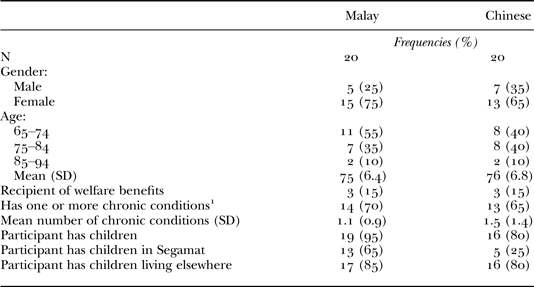
The purposive sampling resulted in a fairly even distribution between the two ethnic groups in gender, age and receipt of benefits (Table 1). Coincidentally, the prevalence of one or more chronic conditions according to participants’ report during the interviews (70% amongst Malay, 65% amongst Chinese) and the mean number of chronic diseases (1.1 amongst Malay, 1.5 amongst Chinese), was also similar between groups. The majority of Malay participants (65%) had adult children living locally, however, compared with just 25 per cent of Chinese participants. Key themes identified from the interviews included: degrees of aloneness; relationships and social support; barriers to social support; and illness, care and death.
Participant characteristics

Notes: 1. Chronic conditions: chronic non-specific lung disease, cardiac disease, hypertension, lipid disorders (e.g. high cholesterol), chronic gastritis, diabetes mellitus, cerebrovascular accident/stroke, arthritis or osteoporosis, cancer. SD: standard deviation.
Degrees of aloneness
All of the participants considered themselves to be living alone. Reasons for living alone included: being widowed, divorced, never married or living apart from spouses. Living arrangements were, however, in reality more complex. Six distinct arrangements were identified. Some participants paid frequent extended visits to their adult children but maintained a permanent rural home. Concerned about night-time supervision, some remained in their homes during the day but slept either in an adult child's or neighbour's house, or had grandchildren who spent the night with them. There were those that lived alone, but had family living in close proximity; this was particularly common amongst Malay participants. Two arrangements were exclusive to Chinese participants. In the first, the participant was alone because the spouse mostly lived elsewhere, usually with adult children, due to ill health or to look after grandchildren. In the second, wealthy Chinese participants, financially supported by emigrant adult children, employed an Indonesian live-in maid. Finally, there were instances of Malay and Chinese households where the participant had no relatives or regular visits from family.
Overwhelmingly, however, participants chose to live alone, turning down offers to reside with adult children, even when they lived nearby. The idea of living with in-laws was particularly undesirable. Participants complained that adult children and grandchildren's noise disturbed their peace or naps. Differences in dietary preferences and television (TV) viewing habits were also important. Participants reported that their own preferences were ignored, or that they were teased for having ‘old’ tastes.
Yes it's fun staying here albeit alone. It is convenient: we eat alone, drink alone, watch TV alone without interruption. If we stay with children, who knows, they will nag ‘mom I want to watch my TV show!’ It will happen. ‘Mom don't keep walking around, sit down at home quietly’. When staying alone we can walk when we want to, meet friends, learn new stuff or activities; freedom … the mind will be rational, the heart will be calm, children can see us without us really disturbing each other. We are free. For a bird, what if we cage it? The same thing applies for humans: humans cannot be caged. (Participant 31, female, 65–74, Malay)
Ageing bodies and associated physical decline were also a source of tension, and participants described the embarrassment their bodily functions caused.
Sometimes when old people like us have a bad stomach, the small one will say ‘Granny, your poop stinks!’ If we cough and accidentally sneezes out they will say it's smelly … Everyone is like that. I am having a good time staying alone. (Participant 17, female, 75–84, Chinese)
Participants also suggested that living with adult children and grandchildren would be detrimental to their physical and psychological wellbeing because it would encourage inactivity. They felt adult children were over-protective and did not even allow them to engage in household activities such as daily chores, or to venture far from the house on their own.
I can hardly work if staying at their house. I can only eat and sleep and repeat (laughs). (Participant 28, male, 65–74, Malay)
When children come home, they will scold if I am not around. ‘Why mom, do you always walk around, like you are afraid of the house? You have your nest, what do you feel scared for? Later you might trip or fall down outside, troubling yourself’. (Participant 27, female, 85–94, Malay)
Participants also feared becoming a burden to their adult children and wanted their children to be ‘free’.
Sometimes they ask me to stay over with them. I told them, I have house, already built. If I stay with them they will not be free. The children ask me to stay over because they are worried about me being lonely, scared or in difficulty. I said never mind, I am only nearby, they can come and see me. (Participant 27, female, 85–94, Malay)
For the minority of participants without children, living alone could still, in some cases, be a choice. Some had the option of living in the old folk's home, but did not like the idea of living with so many other people and leaving friends and neighbours.
Participant: If I wanted, I could move to the houses in Batu Anam [Malay old folk's home], the houses there are far more comfortable. But there are too many living there, I don't want.
Interviewer: Uncle doesn't like the old folk's home?
Participant: If I liked it, I would be there already. (Participant 32, male, 75–84, Malay)
Still, for a few, there were no offers to live with others or the possibility of living in the old folk's home. These participants, however, commented that they had lived alone for so long that they had become accustomed to the situation.
Relationships and social support
The need for companionship was the predominant theme with regards to emotional support. Those with children and grandchildren emphasised the importance of social visits from local children and telephone contact with those living away. Friends of the same age were, however, often the most important source of companionship, accompanying participants during activities outside the home or making home visits to the more functionally limited.
We [older people] are getting very smart. One thing is good, now the old people they go for exercise, after they go for breakfast, then sometimes they go for dancing. (Participant 16, female, 75–84, Chinese)
Participant: Oh, I can't manage that [to visit friends]. Previously I could, but not now. Just sitting at home all day is easier for me. Sometimes I go out at the weekend.
Interviewer: Uncle, do you just watch TV when sitting at home?
Participant: Watch TV with a friend, sometimes have a chat with a friend sitting here. (Participant 32, male, 75–84, Malay)
Civic participation and formal group membership could also provide sources of companionship. Support from places of worship (mosques, temples and churches), patient groups (cancer) and voluntary charitable groups (food distribution and recycling), however, needed to be maintained through regular attendance at group activities.
Yes, if we don't go [to religious activities] we don't have faith. We get to walk around and see people, or we will end up sitting at home with nothing to do … I joined the committee of UMNO [United Malays National Organisation]. I have a role in the mosque too, small role. I must join organisations because I am alone, and people might not know me, so it's better to mix with the crowd. (Participant 22, female 65–74, Malay)
When asked specifically about loneliness, both Malay and Chinese participants often said that loneliness came from ‘thinking too much’, which was to be avoided. If loneliness was experienced then typical strategies included diversionary tactics such as watching TV, listening to the radio and going out with friends. Malay participants also said they would read the Quran. Just two female Malay participants talked about their feelings of loneliness in any depth.
Interviewer: Oh, so it was ten years living with your child and eight years of living alone.
Participant: But I became quite insane when my child left me, you know.
Interviewer: Because you were used to having many people around?
Participant: Yes, I was used to having many people around me. The house became lonely after that and I always felt sick even though I wasn't really sick … I would pray and ask God for my heart to be in peace. You know, I could never keep my child just to myself. Please forgive me, God … She is a grown woman, of course she would leave. There were many people around here before but after that it was just me, so I just asked from God for my heart to be in peace. (Participant 35, female, 65–74, Malay)
Whereas sources of emotional support were mostly based on proximity, sources of informational support were not. When asked specifically about information sources in regard to health, the diverse experiences and knowledge of children living away proved advantageous, with many migrant children suggesting and arranging supplements and treatments outside the community. Recommendations from friends and acquaintances could also be influential:
There was a time I felt uncomfortable, so I consulted my daughter in Muar. She had a Chinese practitioner friend from Singapore who did acupuncture for me. (Participant 2, male, 75–84, Chinese)
Instrumental support came in the form of financial support, provision of meals and goods, help cleaning and maintaining the house, transport to shops and medical appointments and help during emergencies. The availability of instrumental support from local adult children differed between the two groups. For Malay participants, most social support came from nearby adult children and relatives, whereas Chinese participants, who less frequently had adult children living locally (Table 1), emphasised the importance of help from friends and neighbours.
Children working away provided mostly financial support. Many adult children had migrated from rural Segamat to urban areas to find work. Migration patterns varied between the two ethnic groups. Kuala Lumpur and Johor Bahru were popular destinations for both Malay and Chinese. Medium-sized towns, relatively close to Segamat, were also popular amongst Malays. The adult children of Chinese participants’, however, sometimes moved further afield – to Singapore, Australia, Canada, the United States of America and the United Kingdom – where potential earnings and remittances were greater, but the opportunities to visit parents were few. Descriptions of financial support also differed between the two ethnic groups. Often, Chinese participants detailed costs of gifts and payments, which were highly valued and seen as expressions of love and loyalty. Adult children who provided gifts were described as obedient or filial. Strong ideas about hard work and filial support within the Chinese community resulted in a marked expression of pride when adult children fulfilled these obligations.
Participant: My son bought this [the house] for me.
Interviewer: Does your son come back often?
Participant: You know what it's like to work in Singapore. He doesn't have time … My son is very obedient. Everything I need he will buy for me. (Participant 19, female 85–94, Chinese)
Participant: If I was to run out of money I will tell my children, they will send to me. I don't work now, no income.
Interviewer: So your children…
Participant: They support me. In the future you should support your parents and parents in law too. (Participant 18, male, 85–94, Chinese)
Malay participants also received remittances from children living away, either monthly or sporadically. They would not, however, describe adult children's characteristics, or their relationship with them, in terms of gifts and remittances.
They [adult children] rarely give. Sometimes they do. I never asked but I will just take it when they give it and say nothing if they don't. They have a hard life too. (Participant 35, female, 65–74, Malay)
Malay and Chinese adult children of both genders financially supported their parents. Having adult children was not necessarily a guarantee of financial support, however, even when they lived close by. Reasons included adult children's unemployment, low wages or health problems. In other instances, relationships were acrimonious. Participants whose children lived away would sometimes stay with them during periods of ill health. These were the only periods adult children living away provided practical, informal care for their parent.
Instrumental assistance from other relatives, neighbours and friends was particularly important for participants without support from local adult children. Within neighbourhoods they had systems of looking out for each other such as sharing keys or signals to indicate if there was a problem.
I always open up all the doors and windows, so if I don't they [the neighbours] will be worried about me, because I am staying alone. They will ask, and I will open. (Participant 36, female, 65–74, Malay)
Income sources other than from adult children included: welfare benefits for the poorest participants; wages (e.g. from rubber tapping) for those still physically able to work; income from assets such as agricultural land and housing rents; and, for a few, pensions from government or private schemes. Of the participants who received welfare benefits (Table 1), all claimed that they were not able to survive on the RM300 per month alone. Two recipients were long-term disabled (one blind and the other with limited mobility due to nerve damage, conditions that contributed to their state of poverty) and obtained additional help, above all the provision of meals, from a network of friends and neighbours. These networks were maintained through small measures of reciprocity.
The one [neighbour] collecting and selling carton boxes will give me around RM100 every month. Then the neighbour opposite will give me food … Now I don't have work, who will feed me? I can't support myself with RM300, I can only survive with the neighbours’ help … I am not an arrogant person. If I have money I will treat them to coffee. The Malay asked me why I would treat him even though he is not family, but I say ‘it's ok, money is to be traded with happiness’. (Participant 5, male, 75–84, Chinese)
Other participants had tried, and been denied, access to welfare support. Participants reported a lack of transparency in the eligibility screening process and intimated that it was easy to get the fund if you ‘had connections’.
Barriers to social support
A number of the respondents had limited social relations. Reasons included functional decline, limited telephone use, inadequate transportation options, fears of crime and concerns about exposure to ‘black magic’ (ilmu hitam).
Functional decline was an important issue; 70 per cent of Malay and 65 per cent of Chinese had one or more chronic conditions (Table 1). Many participants described adaptations made to routines and homes to remain living alone, ranging from limiting movement outside the home to devising makeshift assistive aids. For Malay participants, an inability, due to functional decline, to attend community Yassin activities – the recitals of Sura Yassin (part of the Quran) and communal prayers, thanks and food – could be particularly isolating.
Phone use, and consequently maintaining contact with emigrant children, was hampered by poor dexterity as a result of disability and concerns about expense and nuisance calls. For these participants, face-to-face contact was particularly important:
I am not good at asking people's help on the phone, but I know how to ask directly. I am not good at pressing the handset, so I can only accept calls, not call others. (Participant 37, female, 75–84, Malay)
Transport problems were a recurrent issue. Public transport in Segamat is largely non-existent; an infrequent bus service covers only the more urbanised areas. The transport needs of older people are pronounced because of their infrequent phone use and because access to pensions, bill payments and prescription renewals must be conducted in person. Participants rarely used taxis, which were considered expensive. A few Chinese participants living in the town benefited from some mobile shops, whereas most participants relied heavily on friends, relatives and neighbours for transportation to shops and appointments.
Interviewer: Do you get regular check-ups [at the clinic]?
Participant: Seldom. Sometimes if nobody can take me there, then I will just forget about it, but my foot is painful. (Participant 30, female, 65–74, Malay)
Security and fear of crime were major concerns. Protection strategies included the use of ventilation shafts to check callers’ identities and keeping mobile phones and makeshift weapons to hand in case of break-ins. Several Malay women expressed fears of a supernatural nature and described metaphysical protection strategies, such as chanting Quranic verses, to prevent burglary. Black magic was said to be used maliciously by jealous community members and/or by strangers with criminal intent. Participants recounted second-hand stories of criminals pretending to carry out health checks and surveys before stealing items through the use of hypnotism and black magic. A fear of black magic inhibited these participants from socialising more widely within the community and created a particular distrust of strangers.
Interviewer: Are there a lot of crimes around here?
Participant: Yes, all kinds of stuff. My child met people that told her it's a health check. They asked her to shut her eyes, and asked her to take off her gold accessories. They didn't check on her head, but said they will be coming back again soon, leaving with her things.
Interviewer: Couldn't they catch them?
Participant: No, they had already left.
Interviewer: Your child wasn't aware of the trick that time?
Participant: No, she was deluded [hypnotised]. All sorts of tricks. (Participant 37, female, 65–74, Malay)
Illness, care and death
Although study participants suffered from a range of chronic illnesses, they avoided thoughts about severe illness and death, which they perceived could make them depressed or even sick. Talking about or arranging future care was rare:
If you don't think so much about death you will live long. (Participant 32, male, 75–84, Malay)
Participant: Yes don't think about it. We old people shouldn't think of those things, or else we might get depressed.
Interviewer: Then get sick?
Participant: Yes, then your children have to take care of you, trouble people in the end. (Participant 22, female 65–74, Malay)
When asked explicitly about what would happen if they did become very ill or frail, there was still, amongst those with children, an expectation of care from adult children. Many, however, expressed a preference for this care to be delivered in their own home rather than that of the adult child. Residing with adult children, particularly in large cities, was considered a last resort.
Interviewer: Have you made an early plan or told your children about it? Such as telling them if you're not healthy which house you will be staying in?
Participant: I did not. I prefer to stay here and let my children come back and take care of me. (Participant 36, female, 65–74, Malay)
Interviewer: Have you considered living with your daughter?
Participant: Maybe that's the last resort, but I really don't like to go there. My daughter in Muar, her house is upstairs, the ground floor is used as an office. Because she's in the timber business, it's not easy to get in or out, a lot of doors to lock and unlock.
Interviewer: Oh … means that's the worst option?
Participant: Yes. Manipulated by others and stuck in a small space! (laughs) (Participant 2, male, 75–84, Chinese)
Those without the support of adult children had planned the most for future illness and care. Plans involved care by extended family, applying for financial support or even, in one case, contemplating suicide.
Interviewer: You are quite healthy now but we don't know what will happen to us right? If you fall seriously ill, will you stay here or…?
Participant: My brother will take care of me.
Interviewer: You already have a plan?
Participant: Yes, he will take care of me. (Participant 30, female, 65–74, Malay)
I think that it's best to commit suicide. I thought of using this electric current to end my own life without thinking much. (Participant 5, male, 75–84, Chinese)
Instead of planning care, participants generally prayed for good health and a quick death. Muslim, Christian, Taoist and Buddhist participants alike, appealed to the appropriate deity for good health (Chinese Buddhists, contrary to some Buddhist teachings, recognised various gods). Taoists and Buddhists attributed a quick death to good conduct, and illness to the karmic effect of bad deeds. A ‘good’ death therefore was characterised as one occurring when still ‘healthy’, without a prolonged period of illness. Indeed, one Chinese woman with breast cancer had stopped her chemotherapy treatment after two of the six proposed doses, in the hope of hastening death, dying ‘still healthy’ and for fear that no-one would look after her if she were very sick.
I pray to die early. Because why? Still healthy, I want to die healthy. Who is going to look after me? You see I've got a son and other [son] will say ‘I'm not free’. So, I say ‘ok, that's enough’, so when someone asks me, ‘you went for chemo?’ I say ‘yes’, then I don't want to tell them ‘twice’. (Participant 17, female, 75–84, Chinese)
Participant: During prayers I always wish that I don't have to trouble my children, if I am sick and old I am willing to let God take me away. Right? We are Muslims.
Interviewer: Don't want to trouble children?
Participant: No. I rather die alone in this small hut. My own house. (Participant 38, female, 75–84, Malay)
Discussion
There is a perception, in some Asian cultures, that the most desirable situation for older people is to live with – and be cared for by – their adult children (Ambigga et al. Reference Ambigga, Ramli, Suthahar, Tauhid, Clearihan and Browning2011; Chan Reference Chan2005; Croll Reference Croll2006; Takagi and Silverstein Reference Takagi and Silverstein2006). Indeed, the ‘Asian cultural preference’ to care for older relatives within families is the cornerstone of ageing and social security policies in many Asian countries (Croll Reference Croll2006), including Malaysia (Ambigga et al. Reference Ambigga, Ramli, Suthahar, Tauhid, Clearihan and Browning2011; Sim Reference Sim, Phillips and Chan2002).
Despite strong cultural expectations surrounding familial care, some older Malaysians live alone. This study aimed to understand why they live alone, their social support and care arrangements, and their future care plans and preferences. The study reveals that, overwhelmingly, those who live alone do so through choice. They valued the comfort of living in their own home over the opportunity to live in a multigenerational household and share a space with others. The preference to live alone was influenced by a desire to avoid conflict, embarrassment and being a burden. The option, for those without adult children living locally, of moving to urban centres to be cared for by emigrant adult children was particularly undesirable. For these participants, fulfilling the ‘ideal’ of living with children in old age would mean leaving familiar surroundings and networks built up over a life-time. Lamb (Reference Lamb2014), in a critique of the concept of ‘successful’ or ‘active’ ageing, suggests that the predominant vision of a successful old age – independence, the ‘busy’ ethic and personal responsibility – reflects a particularly North American neo-liberal ideal. She notes that the older Indians with whom she conducted fieldwork emphasised the need for intimacy and loving care from relatives rather than independence (Lamb Reference Lamb2014). The current study demonstrates, however, that some older Malay and Chinese place a higher value on independence and remaining active and, like their western counterparts (Grimmer et al. Reference Grimmer, Kay, Foot and Pastakia2015; Scharlach, Graham and Lehning Reference Scharlach, Graham and Lehning2012; Stones and Gullifer Reference Stones and Gullifer2016), frequently expressed a preference to age in the comfort of their own home.
The social support available to Malay and Chinese participants to fulfil this goal was, however, different. For Malay participants, nearby adult children and relatives provided most social support, whereas Chinese participants, who less frequently had adult children living locally, more often emphasised the importance of help from friends and neighbours. In fact, for those from either ethnic group without local family support, friends and neighbours were often the only source of support. This suggests alternative networks of support outside the traditional family unit, particularly in the context of high rural–urban migration.
The support expectations of adult children living away were mostly informational and financial, indicating a change in the obligations and relationship between child and parent. Furthermore, both male and female children, from both ethnic groups, supported their parents financially, suggesting a weakening of the patriarchal tradition of the son being responsible for maintaining parents in old age (Hu Reference Hu1995). Financial support was more explicitly arranged in Chinese than Malay families; a consequence perhaps of the greater distances migrated by Chinese adult children, the fewer opportunities to visit and provide informal support, and the fewer adult children living locally, or because of a greater expectation of explicit financial support in old age within the Chinese community. The latter interpretation is supported by the findings of an earlier study from Singapore, where pressure to migrate for work is considerably less, which also found financial support of older relatives to be more explicit amongst Chinese compared with other ethnic groups (Mehta Reference Mehta1999). Indeed, Chinese participants described adult children providing exclusively financial support as obedient and filial. A number of Chinese participants also used remittances to pay for ‘replacement personal care’ in the case of the paid Indonesian maids. This replacement personal support may seem to conflict with the stereotypical view of Chinese people as being family oriented. It is, however, in keeping with previous reports that work rather than family time is often prioritised in Chinese families as an act of ‘self-sacrifice for the benefit of the family’ as a collective (Yang et al. Reference Yang, Chen, Choi and Zou2000: 120). Chinese participants’ expressions of pride, therefore, that their children could support them financially, whilst building a better life for the entire family working in urban centres, is entirely consistent with a more collectivist understanding of the family.
The study's most vulnerable participants received the RM300 monthly welfare benefit. This highlights the need for social assistance and its ability to support poor and disabled citizens to maintain their independence. It is also important to recognise the agency of these, and indeed all, participants in obtaining and maintaining local support. The disabled recipients in particular commented that they would not have survived on welfare alone, and needed the support of friends and neighbours. Lacking any other discernible assets, these participants had managed to develop sufficient social capital (networks of family or friends, group membership or relationships of trust and reciprocity; Woolcock Reference Woolcock2001) to meet their basic needs for food and shelter, and for social interaction and friendship.
The study participants reported diverse health conditions and disabilities. Through their own ingenuity and adaptations, many had managed to continue living alone even with declining health and mobility. There was, however, still an expectation that adult children would provide care in case of serious illness; suggesting that, as people live longer, a preference for a period of independent living during old age may become more common, just as it is in many more developed countries. However, the ‘Asian cultural preference’ for familial care is still a normative expectation in case of serious illness. Cultural death taboos, and the belief that the end of life is the preserve of religion, however, hindered any form of discussion of or planning for future care needs. Whereas participants frequently prayed for a death that was quick and without prolonged illness, few made plans for an end of life that might be otherwise. Furthermore, although there was an unspoken expectation that care in case of serious illness would be provided within families, changes in family structure and rural–urban migration have implications for the fulfilment of these expectations. These expectations could be very high, for example, the preference for adult children living away to come back and look after their parent in the parent's own home is difficult to realise, particularly for the adult children of Chinese participants, who more frequently worked in urban centres far from their parents. The study highlights that, in the context of high out-migration, older people's social support networks may be spread geographically and even change temporally, as health deteriorates and emigrant children return for periods of care or older people themselves are forced to emigrate.
Policy implications
The study's findings bring into question the appropriateness of an over-reliance in government policy on familial old age care (Ambigga et al. Reference Ambigga, Ramli, Suthahar, Tauhid, Clearihan and Browning2011; Chan Reference Chan2005; Department of Social Welfare Malaysia 1995; Sim Reference Sim, Phillips and Chan2002). A preference for at least some period of independent living, particularly in the context of high migration, requires greater focus on supporting the older person as an individual rather than as part of a family unit; for example, policies to improve older people's environment, networks of social support outside the family, and access to social assistance and health and social care services (Beard et al. Reference Beard, Officer, de Carvalho, Sadana, Pot, Michel, Lloyd-Sherlock, Epping-Jordan, Peeters, Mahanani, Thiyagarajan and Chatterji2015). This model of ‘ageing in place’ has influenced a 2011 revision of the National Policy for the Elderly (Department of Social Welfare Malaysia 1995, 2011; Tey et al. Reference Tey, Siraj, Kamaruzzaman, Chin, Tan, Sinnappan and Müller2016). However, its recommendations have been poorly reflected in laws, institutional frameworks and national programmes (Tey et al. Reference Tey, Siraj, Kamaruzzaman, Chin, Tan, Sinnappan and Müller2016).
The reported lack of future care planning and reluctance to talk about future illness, death and dying also have important policy implications. Although conversations about these issues are difficult within the cultural context, there is some evidence that, when conducted sensitively, advance care planning is possible and indeed welcomed by older Malaysians (Htut, Shahrul and Hua Poi Reference Htut, Shahrul and Hua Poi2007). Moreover, a national advanced care planning programme was implemented in Singapore, where the same ethnic and religious groups are represented, after years of careful community engagement and awareness raising (Chung et al. Reference Chung, Wong, Oh and Ho2013).
Strengths and limitations
The study had some considerable strengths. The nature of the health and demographic surveillance conducted by SEACO, in which the whole population of Segamat district is tracked, allowed for the identification of all households in which an older person lived alone. Furthermore, the availability of details about the characteristics of these residents made purposive sampling, aimed at eliciting a diversity of experiences and opinions, feasible. The large investments SEACO has made in community engagement activities also facilitated participation and established trust. Moreover, the longitudinal character of the SEACO community surveillance will allow for any trend in older people living alone to be monitored.
The study was not, however, without its limitations. Participants were interviewed just once; the rapport needed to express less socially acceptable views may not therefore have been established. The so-called ‘South-East Asian courtesy’ or ‘hospitality’ bias, in which participants might express only views they think the interviewer wants to hear, may have suppressed the expression of less socially acceptable views. Although participants were extremely vocal in regard to their preference to live alone, and to disbelieve them would be rather patronising, very few admitted to feelings of loneliness or depression, indicating the difficulty talking about such subjects.
The study did not include the experiences of smaller and more socially deprived groups such as the Indian or Orang Asli communities; the experiences of these groups, however, will be focused on in future SEACO research.
Finally, the study did not explore the perspectives of adult children or older people who did not live alone. Further research into the priorities, preferences and needs of all older Malaysians, and those of their children, is needed to better inform future policies and government programmes.
Conclusions
The findings reveal a preference amongst some older Malay and Chinese for a period of independent living in old age. Malaysian old age policy is currently focused on supporting families to care for their older relatives; child migration and a growing preference for independent living, however, would require policies and resources directed more at older people as individuals to support their own ingenuity and efforts to remain independent, socially active, and age ‘in place’ in their own homes and communities.
Acknowledgements
We, the authors, would like to acknowledge the SEACO field operations team, who work tirelessly to ensure the quality of data collected, and the community of Segamat, for their continued support and participation in data collection. We would like to acknowledge the passion and commitment of interpreters Nurul Izza Binti Azmi and Lim Chyehui, translators Yong How Law and Hani Maldini, and community key informants Madam Kong, Seng Nuan Li, Seng Eng Li, Margaret Wong Suet Mooi and Doreen Bong. We would also like to thank Dr Christopher Pell for advice and critical comments. Last but not least, we would like to thank all of the study participants who offered their time, trust and stories. This study was supported by the Centre for Social Science and Global Health at the University of Amsterdam and SEACO. SEACO is funded by the office of the Vice Provost Research, Monash University Australia; the office of the Deputy Dean Research, Faculty of Medicine, Nursing and Health Sciences, Monash University Australia; the Monash Malaysia School of Medicine and Health Sciences; and the Monash University Malaysia Campus. The authors report no conflicts of interest.