INTRODUCTION
The US Department of Homeland Security defines an active shooter event as “an individual actively engaged in killing or attempting to kill people in a confined and populated area; in most cases, active shooters use firearms(s), and there is no pattern or method to their selection of victims.” 1 The latter lack of intentionality distinguishes active shooter events from mass shooting and mass killings. The Federal Bureau of Investigations (FBI) identified 160 active shooter events in the United States between 2000 and 2013.Reference Blair and Schweit 2 The number of such incidents has increased from an average of 6.4 per year from 2000-2007 to 16.4 per year from 2008-2013. The mean number of victims per active shooter incident was 6.5, of which 3.5 were injured. The majority of these victims would have sustained penetrating trauma, with many likely requiring operative intervention.
Specific events resulted in much larger numbers of casualties than the mean number outlined in the study mentioned previously. The 2012 Cinemark Century 16 Theater shooting in Aurora, CO, resulted in 58 injured victims, whereas the 2009 Fort Hood Soldier Readiness Processing Center, Fort Hood, TX, resulted in 32 injured.Reference Blair and Schweit 2 The 2016 Pulse nightclub shooting in Orlando, FL, resulted in 66 injured; due to the close proximity of the nightclub to the Orlando Regional Medical Center, a large number of patients presented directly for treatment prior to emergency medical services response.Reference Hick 3
As a consequence of increased awareness, health care institutions have begun to prepare for the possibility of such events in their communities. Although the majority of active shooter events occur in either a commercial or educational environment, 2.5% of active shooter incidents in the FBI study occurred in the health care setting.Reference Blair and Schweit 2 Such an incident would not only impact the immediate capability of the facility to respond to an influx of victims (especially if the event itself occurred within an emergency department [ED]), but also would raise ethical issues regarding patient care management under a situation of active threat.
As part of preparedness for such an event, our institution conducted an initial institutional tabletop exercise held in 2015. Based upon identified gaps and action items, the Mayo Clinic Rochester – Saint Marys Campus (MCR-SMC) Department of Emergency Medicine began a series of in situ simulation exercises to improve employee education regarding the appropriate response to these events. An active shooter event within a hospital setting requires quick and deliberate action that may be counterintuitive to a person’s survival instincts as well as a health care provider’s sense of duty toward his or her patients. It is a low frequency, high stakes, and stressful situation with the potential for an intense and perhaps paralyzing emotional response. Providing education on appropriate behaviors during active shooter events may save lives; however, the best means through which to accomplish this goal have not been studied previously. The purpose of the current article is to review our process of developing in situ simulation for a controversial topic and to describe identified staff participant responses to the presence of a simulated active shooter.
Overview of Simulation and In Situ Simulation
Reading assignments, lecture presentations, or dramatized video reenactments on active shooter events provide passive learning but do not allow learners to rehearse and demonstrate an understanding of the educational message. Simulation is an educational method that attempts to immerse the learner in as-authentic-as-possible conditions through the use of trained actors or mannequins, scripted scenarios, and realistic responses to learner behaviors. It has previously been shown to generate physiological stress and therefore be an ideal method of training for low frequency, high stakes events.Reference Keitel, Ringleb and Schwartges 4 - Reference Langhan, Rigby and Walker 6 It provides a safe space for first-time exposure, allowing participants to realistically experience their true reactions and to experiment with behaviors without consequence. Immediate debriefing following simulation allows for optimal learning because it contributes to a shared understanding of transpired events by the learner group. Discussions on what went well during the simulation help reinforce successful behaviors. Input on what the group thought should have gone better during the simulation provides a springboard for education on correct or improved actions in a future circumstance.Reference Wang 7 , Reference Zigmont, Kappus and Sudikoff 8
In situ simulation, which takes place not within a separate educational space but instead in the learner group’s own workplace, has several advantages. In addition to providing psychological fidelity, as with standard simulation, participants are able to learn in context due to an even higher environmental fidelity – during training, they have access to familiar tools and must maneuver within the true footprint of the physical space encountered at work.Reference Spurr, Gatward, Joshi and Carley 9 , Reference Sorenson, Lottrup and van der Vleuten 10 Additionally, in situ simulation contributes to organizational learning, in which unanticipated opportunities for improvement in processes, equipment, or even the physical workspace may arise as a result of the simulation itself.Reference Patterson, Geis and Falcone 11 , Reference Barbeito, Bonifacio and Holtschneider 12 It is also easier for on-duty personnel to attend. Given these benefits, in situ simulation education for active shooter training is particularly useful because the key actions are to RUN away from the active shooter through the nearest egress pathway, HIDE behind physical barriers, and FIGHT using any means possible, including the use of nearby objects as weapons.Reference Blair and Schweit 2
Potential drawbacks of in situ simulation for active shooter education in a hospital setting are delays in patient care while the simulation is taking place and threats to the physical and psychological safety of learners or uninvolved passersby. Further, in situ simulation can only capture a small group of learners with each session. The repetition of sessions to educate the entire cohort is not only costly with regard to time, but also amplifies the aforementioned concerns regarding productivity and cognitive ramifications.
In this study project, we aimed to create an in situ active shooter training model with minimal impact on ED patient care, staff, and patient/family safety, and with maximal educational reach for ED staff.
Simulation Scenario Overview
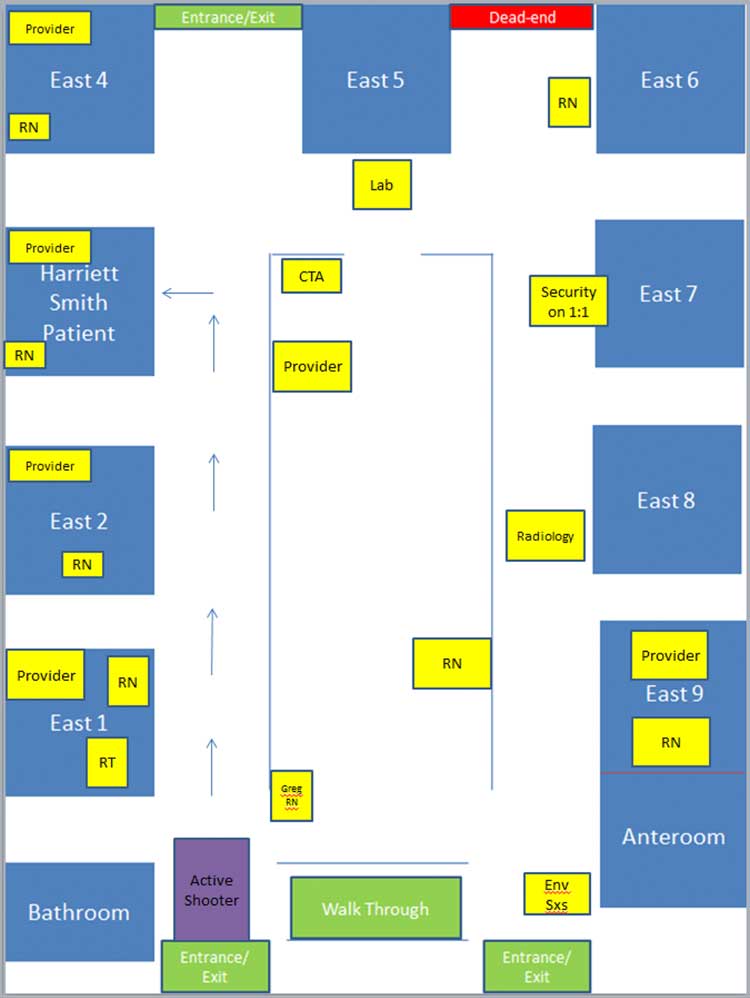
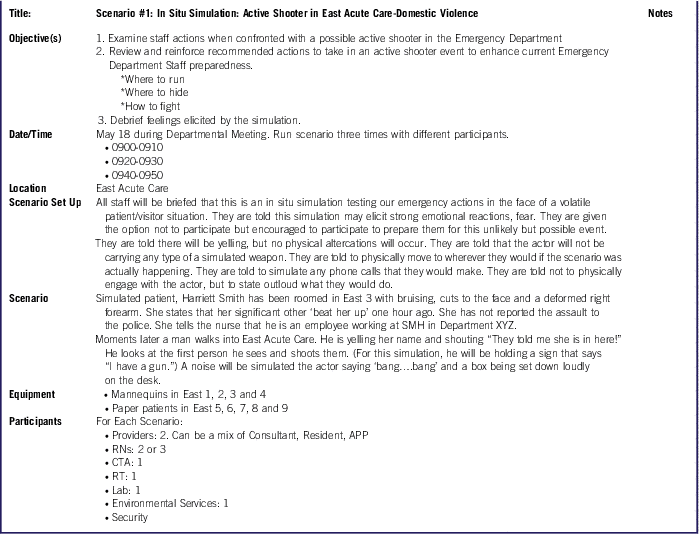
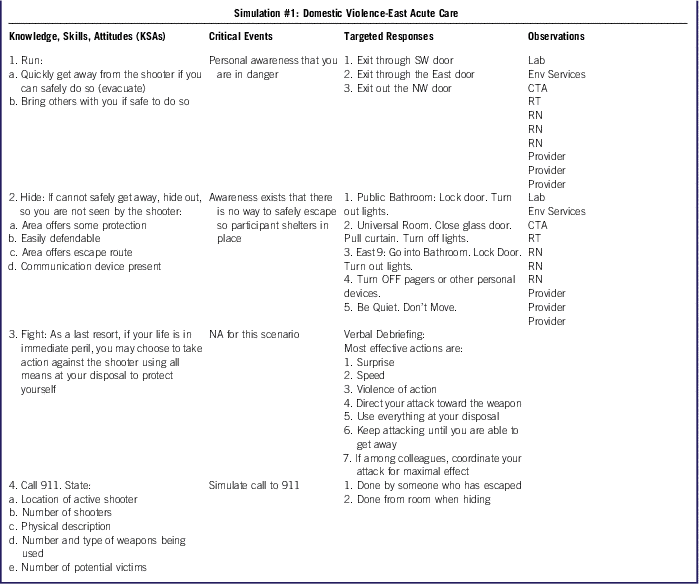
Planning occurred through an initial meeting of our disaster preparedness group followed by several more meetings of key leaders. The disaster preparedness group includes representatives from nursing (staff nurses, nurse education specialist, and nurse manager), physician (staff and resident), social work, security (officers and supervisor), patient registrars, and emergency preparedness (manager and coordinators). The key leaders met several times over the following months and included a nurse education specialist, a disaster management lead physician, a simulation education physician, and an education chair physician. Two different scenarios were created and conducted on separate days in different locations within the ED. No patients were present during the simulation. Patient care areas not in active use were used to ensure no interference with real patient care. Total time, including pre-briefing, scenario, and post-scenario debriefing, was limited to 10 minutes. The first scenario was conducted in a closed adult patient care area and centered on a simulated victim of domestic violence ( Table 1 ; Figure 1 ). In the nine-bed hallway, simulated patients were represented by vignettes involving mannequins playing the part of patients in some rooms and paper descriptions of a patient in others. Employee participants did not know of the topic of the simulation beforehand. Participants were assigned to specific areas at the start of the scenario and instructed to care for patients as normal. The active shooter played the role of an estranged abuser who entered the area shouting the name of the intended victim with demands to see her. He was immediately approached by a confederate staff member who shouted, “Put down the gun, sir. Don’t shoot me.” The confederate staff member was then “shot” and fell to the ground. The shooter then interacted with participants by proceeding to walk down the corridor searching for the victim while shouting her name and looking in various patient rooms shouting the name of the patient. The simulation was stopped when the shooter arrived at the room of the patient. This scenario took approximately 1 minute followed by a 10-minute debrief. This simulation was duplicated with different participant groups three times during a 1-hour time frame, with short breaks in between.
Scripted Plan for First Simulation

Physical Layout for First Simulation

The second scenario was conducted in the 12-bed pediatric patient care area of the ED. Once again, it was conducted during a time when no patients were present. Based upon feedback after the first simulation, actors were used to represent patients rather than mannequins. This more closely simulated a true patient-provider relationship and enhanced the ethical dilemma of possibly needing to run away without taking a patient who is unable to ambulate independently. This scenario centered on the estranged father of a child who was a patient in the pediatric area. An actress played the part of the mother, and a teenage actor played the part of the patient. The remainder of the scenario was unchanged.
Scenario Logistics
For both scenarios, all members from across disciplines were invited to participate. This included physicians, advanced practice providers, nurses, nursing assistants, security personnel, social workers, respiratory therapists, child life specialists, environmental service personnel, phlebotomists, electrocardiogram technicians, radiology technologists, and care team assistants. The simulations were conducted during a departmental faculty meeting when many physician providers were on-site but not involved in patient care. These department meetings occur on the third Wednesday of the month during the morning hours. Other members of the team participants were assigned to attend by supervisors outside of work duties or were simply tapped during their shift and asked to participate in a 10-minute simulation after ensuring that others were providing care for their patients. The brevity of the simulation allowed for high numbers of staff participants.
The scenario was intentionally planned without involvement by local law enforcement or any outside agencies. Our institution does not have on-site representation by local law enforcement. We did not involve local law enforcement or any other outside agencies with this specific educational initiative because we rely upon our internal resources and security for the initial response to an active shooter situation. The focus of each session was the initial minutes of the response; this time frame would not include the involvement of our local law enforcement.
The sessions were announced overhead as only a “drill” and only in the care areas used. We did not want the participants to be aware of what the drill specifically involved. Our goal was to try to create as much realism as possible to evaluate their response without any potential for rehearsal or planning.
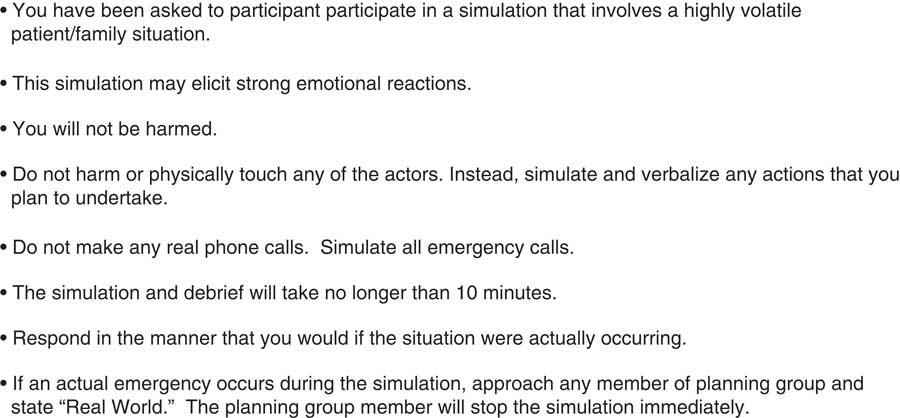
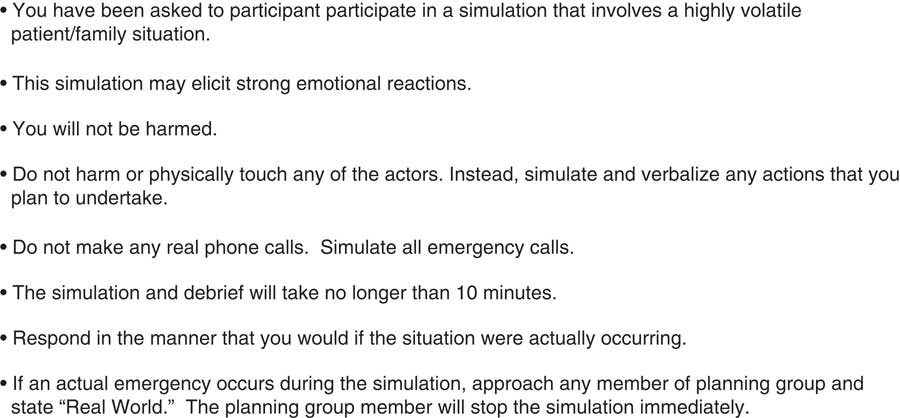
When the team was gathered, the facilitator read a pre-brief script ( Figure 2 ). After the pre-brief was completed, participants were placed strategically throughout the patient care pod in patient rooms, in the center staff work area, or in the corridors. Confederate security workgroup members were placed outside each care pod exit to guard against any participation of bystanders who might come across the simulation and to detain any simulation participants who “ran” out of the area during the scenario. Telephones in the area were unplugged to ensure that the reach of the simulation stayed within the patient care pod. Members of the in situ simulation planning group were also stationed in the area and identified by yellow caution tape worn as a sash/necklace. Once everyone was in place, the simulated active shooter was cued to enter the area, and the simulation began. Members of the planning group were assigned to observe and record participant reactions and were instructed to end the simulation if there were signs of participant duress. No intervention was required during any scenario. The simulation was timed to end after approximately 1 minute, and debriefing occurred immediately within the patient care hallway.
Facilitator Pre-Brief Script
The debriefing was co-lead by the Chief Security Officer and Staff Physician expert. The model of debriefing focused initially on expressing gratitude for the staff participation and allowing participants to freely describe initial emotions and reactions for a short time. This was followed by structured reflective questioning regarding the observation of how the participants reacted to the scenario and an exploration of what prompted them to do so. The final minutes of the debriefing focused on the feelings that were elicited by the simulation (especially in regard to the issue of patient abandonment), a review of “Run-Hide-Fight” instructions, and the pragmatic need to remain close to the hospital to be available after the event to begin victim resuscitation. During the debriefing, members of the planning group again were present to observe for signs of emotional or psychological distress stemming from the simulation. For any staff participant who appeared shaken or unusually affected, a member of the planning group approached them immediately and then again after a few days to assess for any lasting effects.
Firearm Specifics
Varied opinions existed among the planning group on whether the active shooter actor should carry a simulated gun due to concerns about psychological and physical safety for scenario participants and uninvolved bystanders. Our institutional policies also explicitly exclude guns from the hospital and clinic premises. Consensus was reached that the actor would not carry a simulated gun. Instead, participants were alerted that the actor had a gun when a confederate workgroup member would loudly yell through the confederate staff member’s scripted exclamation: “Put down the gun. Don’t shoot me.” Gunshot noise was simulated by striking a hard box against the counter.
Scenario Outcomes
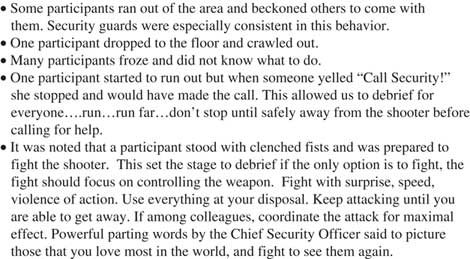
The response from participants was quite varied and included many choices from staying with patients, leaving the department, and engaging the simulated assailant to fight. Several participants did verbalize a plan to call security for immediate help. No confederate staff intervention was required during any of the scenarios, and all simulations were run to completion. No participants reported any lasting traumatic effects as a result of participating in the simulation. In contrast, participants expressed gratitude for the exercise and were given the opportunity to reflect upon their reactions. A scenario evaluation was conducted both through a structured evaluation instrument ( Table 2 ) and through an anonymous online survey conducted within 2 weeks of the simulation. The response rate was 47/93 (50.5%). Results for the overall rating of the activity were positive and are listed in Table 1. Specific participant comments are provided in Figure 2. Observations of participant reactions by planning group members are listed in Figure 3 .
In Situ Simulation Evaluator Observations

Active Shooter Simulation-Structured Observer Evaluation Form

DISCUSSION
Like many EDs, our preparation for the possibility of an active shooter was not borne out of first-hand experience and actually instead began as an institutional mandate in response to recent high-profile events. Our specific approach was the result of deliberate planning of an in situ simulation scenario by a multidisciplinary team. In the process, the planning group uncovered and addressed several potential challenges or barriers to training for this low frequency, highly emotional and even higher stakes event. The group developed an approach to overcome those barriers as much as possible. The final product was felt to be a practical and effective strategy for active shooter education as illustrated by our survey responses and scenario observations.
Our initial approach to the dissemination of active shooter education included an Emergency Department Grand Rounds presentation as well as an online educational module. We did not perceive much in the way of staff appreciation for the issue and felt that additional steps were needed leading to the development of an in situ simulation educational model. Although active shooter experiences have become more common, they are still rare events for any one ED. Many members of our department did not initially appreciate the need for this education until they were faced with the situation in their own workplace. In situ simulation lends itself very well to workplace situations allowing for teams to face the challenges within their own work environment. As demonstrated by other infrequent events such as obstetric emergencies, the in situ approach allows for teams “to gain confidence and efficiency in their responses,”Reference Guise 13 as we discovered after the simulation participants could no longer ignore the need for the staff to develop a personal plan for safety in an active shooter event within their work environment.
Our staff also expressed a keen awareness of both regional and national active shooter events in other EDs. Our institutional leaders and department chair took these concerns very much to heart and charged the department to develop a plan of action to address our preferred response to a similar event in our department.
The scheduling of training events was very challenging, especially when involving multiple participants working around the clock, which is typical of emergency medicine practice. We were intentional in the timing of our training events. The limiting factor for our department training sessions in a team concept has often been staff physician presence. For the active shooter scenario, we used our monthly mandatory department faculty meeting time to optimize the availability of staff physician participation. Over the course of 3 months, we were able to expose the majority of our 40-physician faculty staff to brief training sessions without requiring the additional time commitment for their involvement.
The in situ simulation sessions were planned by a multidisciplinary group to ensure participation from nursing, staff physician, resident physician, respiratory therapy, patient registrants, and security personnel. All members of the department have unique duties, responsibilities, and workflow routines that are best addressed by each group. As part of our intentional debriefing events, we found a greater appreciation of the challenges encountered by specific groups and learned from each other along the way. Much information and learning can be gained across disciplines as a direct result of in situ simulation activities.Reference Paltved, Bjerregaard and Krogh 14
Our non-physician participant scheduling intentionally avoided interference with actual patient care. Feedback from previous in situ simulation sessions was the main driver of this decision. Participants were either not scheduled to work during the sessions or relieved of their work duties. Other members of the staff assumed the duties of their respective disciplines temporarily during the scenario. This limited the amount of distractions and enhanced the learning opportunity for all of the participants.
Although the scenarios were intentionally short to limit the disruption of patient care, this reinforced the split-second decision-making required in an active shooter response. It also limited the duration of participant or bystander exposure to psychological stress.
We do plan to highlight these sessions during credentialing visits by outside agencies. We feel that these sessions went well beyond the traditional or typical tabletop exercises that we have often used in the past. We also feel that these sessions have truly tested our systems and our staff response to a crisis situation as has been suggested on previous site visits of our practice.
We focused on mitigating any unintended exposure of patients, family members, or uninvolved staff members from outside of the department. The sessions were held in care areas of the ED not being actively used for patient care at the time. The monitoring of the areas by security personnel ensured that only participating members were allowed access. Phones in the area were intentionally unplugged to avoid any notification of uninvolved security personnel. With this approach, we were able to mitigate any unintended exposure of patients, family members, or uninvolved staff members from outside of the department.
We did anticipate and plan for untoward effects of the simulation exercise on participants. Rescuing oneself and leaving patients in harm’s way is counterintuitive for health care providers across all disciplines. We used experienced personnel from both security and physician experts to provide support for the acceptable approach of the “Run-Hide-Fight” strategy. Leaving patients in harm’s way is counterintuitive for health care providers across all disciplines. A recent study also highlighted differing perceptions amongst health care providers and the general public in this regard.Reference Jacobs and Burns 15 We used experienced personnel from both security and physician experts to provide support for the acceptable approach of the “Run-Hide-Fight” strategy. Our sessions uncovered many questions and concerns about this approach and provided an opportunity to share the concept of ensuring “scene safety” prior to patient care, which is common among prehospital care providers, but underutilized in the ED setting.Reference Jenkins 16 Those present as evaluators used first-hand observations during the debriefing sessions to allow for teachable moments to guide future responses to active shooter situations.
Post-simulation surveys showed that 96% of participants rated the experience as either “Good” or “Excellent.” Only two of the participants rated their experience as low as “Fair.” No further information is available to understand the rationale for these responses. Although the survey response rate was only 50%, the results were favorable, especially in light of the negative feedback from previous in situ simulation sessions.
Limitations
The work done in our ED may not be generalizable to other facilities. The MCR-SMC ED is an academic department with an annual patient volume of nearly 75,000 patients, including 13,000 pediatric visits. It is a verified Adult and Pediatric Level 1 Trauma Center, a verified Stroke Center, and a training center for medical students as well as resident trainees in emergency medicine as well as other residency programs. Although a direct translation of our approach may not be possible for all EDs, we were intentional in our planning to overcome our unique challenges or barriers to implementation and encourage others to do the same. The approach is more accessible than other in situ approaches that use remodeled and unopened facilities.Reference Wexler and Flamm 17
We did not complete a formal survey before the sessions to evaluate staff awareness of the challenge or their personal response in the event of an active shooter in our department. We developed our program in response to a general sense of the staff members as well as to the direction of the institutional and department chair. In retrospect, we could have quantified the grounds gained with a preprogram survey. We certainly do feel that we made an impact on staff awareness, and we plan to survey the staff in the future to evaluate retention of the lessons learned.
The response to our participant survey was relatively low at approximately 50%. Although this allows for uncertainty regarding the experience by non-respondents, the authors and leaders of the department have not received negative feedback as previously shared and experienced with other in situ simulation sessions conducted in the department. The response from those leading the sessions was very positive and allowed for adaptation of change for subsequent sessions.
CONCLUSIONS
The importance of preparation for the possibility of an active shooter in an ED cannot be overstated. Barriers to preparation can be overcome with deliberate planning and the application of multidisciplinary, in situ simulation training sessions. Other EDs are encouraged to use this approach and adapt the model outlined here to their own practice.
Acknowledgments
The authors wish to acknowledge Brian Rich, MFS, CPP, for his valuable contributions in co-planning and conducting the simulations and debriefs.
Conflict of Interest Statement
The authors report no conflict of interests.