Introduction
Recent evidence suggests that psychotic experiences are not confined to psychotic disorders like schizophrenia and delusional disorder, but are also common, at subthreshold level of severity, in non-psychotic disorders (Hanssen et al. Reference Hanssen, Peeters, Krabbendam, Radstake, Verdoux and van Os2003; Rossler et al. Reference Rossler, Hengartner, Ajdacic-Gross, Haker, Gamma and Angst2011; van Rossum et al. Reference van Rossum, Dominguez, Lieb, Wittchen and van Os2011; Varghese et al. Reference Varghese, Scott, Welham, Bor, Najman, O'Callaghan, Williams and McGrath2011; Kelleher et al. Reference Kelleher, Keeley, Corcoran, Lynch, Fitzpatrick, Devlin, Molloy, Roddy, Clarke, Harley, Arseneault, Wasserman, Carli, Sarchiapone, Hoven, Wasserman and Cannon2012a , Reference Kelleher, Murtagh, Molloy, Roddy, Clarke, Harley and Cannon b ; Wigman et al. Reference Wigman, van Nierop, Vollebergh, Lieb, Beesdo-Baum, Wittchen and van Os2012; DeVylder et al. Reference DeVylder, Burnette and Yang2014). These findings suggest that psychotic experiences can be conceptualized along a dimension of psychosis expression, ranging from no/low to high levels. Research on the incidence and mechanisms of psychosis thus may profit from adopting a transdiagnostic approach applied to both frequent non-psychotic and rare traditional psychotic disorders. A number of findings on the association between psychotic experiences and non-psychotic mental disorder illustrate this issue. First, the risk of co-occurring psychotic experiences in non-psychotic disorder is moderated by proxy environmental and genetic risk factors; second, co-occurring psychotic experiences are associated with greater levels of non-psychotic illness severity and poorer treatment response (Kaymaz et al. Reference Kaymaz, van Os, de Graaf, Ten Have, Nolen and Krabbendam2007, Reference Kaymaz, Drukker, Lieb, Wittchen, Werbeloff, Weiser, Lataster and van Os2012; Craddock & Owen, Reference Craddock and Owen2010; Perlis et al. Reference Perlis, Uher, Ostacher, Goldberg, Trivedi, Rush and Fava2011; Rossler et al. Reference Rossler, Hengartner, Ajdacic-Gross, Haker, Gamma and Angst2011; Wigman et al. Reference Wigman, van Winkel, Raaijmakers, Ormel, Verhulst, Reijneveld, van Os and Vollebergh2011a , Reference Wigman, Vollebergh, Raaijmakers, Iedema, van Dorsselaer, Ormel, Verhulst and van Os b ; Kelleher et al. Reference Kelleher, Keeley, Corcoran, Lynch, Fitzpatrick, Devlin, Molloy, Roddy, Clarke, Harley, Arseneault, Wasserman, Carli, Sarchiapone, Hoven, Wasserman and Cannon2012a , Reference Kelleher, Murtagh, Molloy, Roddy, Clarke, Harley and Cannon b ; Wigman et al. Reference Wigman, van Nierop, Vollebergh, Lieb, Beesdo-Baum, Wittchen and van Os2012; Cross-Disorder Group of the Psychiatric Genomics Consortium, 2013). Third, environmental impact on psychotic experiences is accompanied by increased levels of connectivity between symptoms within, e.g. delusions and hallucinations (Smeets et al. Reference Smeets, Lataster, Dominguez, Hommes, Lieb, Wittchen and van Os2012, Reference Smeets, Lataster, Viechtbauer and Delespaul2014), and across, e.g. affective and psychotic symptoms (Kaymaz et al. Reference Kaymaz, Krabbendam, de Graaf, Nolen, Ten Have and van Os2006; Wigman et al. Reference Wigman, van Nierop, Vollebergh, Lieb, Beesdo-Baum, Wittchen and van Os2012), the domains of psychotic and non-psychotic psychopathology, particularly between psychotic experiences on the one hand and depressive, anxiety and manic symptoms on the other (van Rossum et al. Reference van Rossum, Dominguez, Lieb, Wittchen and van Os2011; Van Nierop et al. in press). Fourth, in those with an at-risk mental state, non-psychotic psychopathology (e.g. mood/anxiety disorders) is common (Fusar-Poli et al. Reference Fusar-Poli, Nelson, Valmaggia, Yung and McGuire2014) and precedes transition to psychotic disorder (Rietdijk et al. Reference Rietdijk, Hogerzeil, van Hemert, Cuijpers, Linszen and van der Gaag2011).
In combination, these findings suggest that in non-psychotic disorder, environmental risk factors make psychopathology more complex, ‘co-morbid’, or connected, resulting in the occurrence of psychotic experiences in addition to non-psychotic symptoms, which in turn make a negative impact on treatment response and prognosis. These results echo findings in neuroscience that increased connectivity in variably defined networks is associated with increased probability of clinical transitions (Treserras et al. Reference Treserras, Boulanouar, Conchou, Simonetta-Moreau, Berry, Celsis, Chollet and Loubinoux2009; Baliki et al. Reference Baliki, Petre, Torbey, Herrmann, Huang, Schnitzer, Fields and Apkarian2012; Varotto et al. Reference Varotto, Visani, Canafoglia, Franceschetti, Avanzini and Panzica2012; Wigman et al. Reference Wigman, van Os, Thiery, Derom, Collip, Jacobs and Wichers2013). There is evidence that psychopathology can be usefully represented as a network of mutually impacting symptoms (Borsboom & Cramer, Reference Borsboom and Cramer2013). In the network, causally linked sets of symptoms reciprocally make an impact on each other over time to progress toward a more distinct syndrome forged through the pattern of the dynamic network. For instance, persecutory delusions may provoke anxiety under certain circumstances (e.g. being in public). Anxiety may in turn lead to misinterpretation of perceptual experience due to increased alertness, giving rise to hallucinatory experiences. Hallucinatory experiences in turn may provoke confusion requiring a cognitive explanation – often odd and delusional–, thus creating a loop reinforcing the primary delusion.
There exists some evidence that suggests that environmental risk factors may make symptoms firmly interconnected, which in turn – depending on the degree and the pattern of connectivity between symptoms – give rise to a more complex, ‘co-morbid’, and distinct clinical syndrome that may further transition to a more severe mental state with a poorer prognosis as the connectedness expands (Wigman et al. Reference Wigman, van Nierop, Vollebergh, Lieb, Beesdo-Baum, Wittchen and van Os2012; van Os, Reference van Os2013; Smeets et al. Reference Smeets, Lataster, Viechtbauer and Delespaul2014; van Os et al. Reference van Os, Lataster, Delespaul, Wichers and Myin-Germeys2014). Although a formal test of this model would require an intensive time series of measures of psychopathology after environmental impact, a more general and practical approach is to test to what degree the association between environmental exposure and the occurrence of subthreshold psychotic experiences in non-psychotic mental disorder is mediated by ‘connected’ non-psychotic psychopathology. Indeed, recent research suggests that the association between environmental risk and psychotic symptoms is mediated by non-psychotic psychopathology (Gracie et al. Reference Gracie, Freeman, Green, Garety, Kuipers, Hardy, Ray, Dunn, Bebbington and Fowler2007; Freeman & Fowler, Reference Freeman and Fowler2009; Reeves et al. Reference Reeves, Anglin, Heimberg, Gibson, Fineberg, Maxwell, Kerns and Ellman2014).
In the current paper, we combined the above evidence to formulate several specific hypotheses. First, we hypothesized that the association between psychotic experiences and non-psychotic disorder would be moderated by exposure to selected known environmental risk factors (i.e. urbanicity, trauma and cannabis use). Second, we hypothesized that subthreshold psychosis admixture in non-psychotic disorder associated with environmental exposure would be mediated by an increase in severity of non-psychotic psychopathology. Third, in order to examine the impact of environment-associated psychosis admixture on clinical severity, we hypothesized that, within the group of individuals diagnosed with non-psychotic disorder, the association between co-occurring psychotic experiences and help-seeking would also be moderated by exposure to known environmental risk factors. To date, these hypotheses have either not been examined before, or not been examined jointly, or not been examined in a sample of individuals with non-psychotic disorders. The aim thus was to examine, in a sample of individuals with non-psychotic disorder, to what degree environmental exposures make psychopathology more ‘psychotic’ – and more likely to result in contact with mental health services – and to what degree this may be driven by an underlying mechanism of increasing severity of general non-psychotic psychopathology.
Method
Data were derived from the Early Developmental Stages of Psychopathology (EDSP) Study, which collected data on the prevalence, incidence, risk factors, co-morbidity and course of mental disorders in a random representative population sample of 3021 adolescents and young adults in the general population. Following ethics committee approval, a representative population sample was randomly drawn from the 1994 German government population registers. The sample consisted of adolescents and young adults living in the Munich area aged 14–24 years at baseline. The overall design of the study was observational, longitudinal and prospective, consisting of a baseline (T0: n = 3021, response rate 71%) and three follow-ups [T1: n = 1228 (younger group only), response rate = 88%; T2: n = 2548, response rate = 84%; T3: n = 2210, response rate = 73%], covering a time period of on average 1.6 years (T0–T1, s.d. = 0.2), 3.5 years (T0–T2, s.d. = 0.3) and 8.4 years (T0–T3, range 7.3–10.5 years, s.d. = 0.7), respectively. The sample at T1 only included the younger members of the cohort; assessments at T0, T2 and T3 were based on the full sample. For the current analyses, data from all waves were used (T0, T1, T2 and T3). A more detailed description of the study, field-work and response rates and characteristics of the respondents has been reported elsewhere (Wittchen et al. Reference Wittchen, Perkonigg, Lachner and Nelson1998b ; Lieb et al. Reference Lieb, Isensee, von Sydow and Wittchen2000; Zimmermann et al. Reference Zimmermann, Bruckl, Lieb, Nocon, Ising, Beesdo and Wittchen2008).
Instruments
Psychopathology
Symptoms, syndromes and disorders were assessed with the computer-assisted version of the Munich-Composite International Diagnostic Interview (DIA-X/M-CIDI) (Wittchen & Pfister, Reference Wittchen and Pfister1997), an updated and expanded version of the World Health Organization's CIDI version 1.2. The DIA-X/M-CIDI is a comprehensive, fully standardized, diagnostic interview, addressing symptoms, syndromes and diagnoses of a wide range of mental disorders in accordance with definitions and criteria of the Diagnostic and Statistical Manual of Mental Disorders (DSM), fourth edition and the International Classification of Diseases, tenth edition. The DIA-X/M-CIDI has been shown to be both reliable and valid (Reed et al. Reference Reed, Gander, Pfister, Steiger, Sonntag, Trenkwalder, Hundt and Wittchen1998; Wittchen et al. Reference Wittchen, Lachner, Wunderlich and Pfister1998a ). Interviews were conducted by fully trained and experienced psychologists, who were allowed to probe with follow-up questions. This interview technique is particularly relevant for the assessment of psychotic symptoms, which are sensitive to false-positive ratings. The EDSP study covers a total observation period of up to 10 years. At T0 (baseline), the lifetime version of the DIA-X/M-CIDI was used; for subsequent waves, the respective DIA-X/M-CIDI interval versions were used.
Consistent with DSM-5 (APA, 2013), we studied psychotic experiences beyond disorders listed in the chapter ‘Schizophrenia spectrum and other psychotic disorders’. Thus, according to DSM-5 (APA, 2013), a number of other disorders can be accompanied by psychotic features, namely: depression spectrum (depressive episode/dysthymia – persistent depressive disorder in DSM-5); mania spectrum (manic episode, hypomanic episode); and obsessive–compulsive disorder. Based on the relevant sections, a dichotomous variable (hereafter: ‘affective spectrum disorder’) for each time point was constructed representing whether an individual had been diagnosed with one or more of these disorders.
At all time points, participants also completed the Self-Report Symptom Checklist-90-R (SCL-90-R), a comprehensive self-report symptom inventory, multidimensional in nature, and oriented to screen for a broad range of psychological problems and psychopathology in community respondents and respondents with somatic and psychiatric disorders. It contains 90 items, scored on a five-point severity scale, measuring nine primary symptom dimensions named ‘somatization’, ‘obsessive–compulsive’, ‘interpersonal sensitivity’, ‘depression’, ‘anxiety’, ‘hostility’, ‘phobic anxiety’, ‘paranoid ideation’ and ‘psychoticism’. Reliability and validity of the SCL-90-R were established previously (Derogatis & Cleary, Reference Derogatis and Cleary1977). The time-frame is the past 2 weeks.
For the purpose of the analyses, a dichotomous psychotic experience variable was created using a cut-off point to define the group of individuals with the highest 10% scores of combined psychosis and paranoia dimensions of the SCL-90-R (hereafter ‘psychosis expression’), consistent with previous analyses in this sample (Henquet et al. Reference Henquet, Krabbendam, Spauwen, Kaplan, Lieb, Wittchen and van Os2005; Cougnard et al. Reference Cougnard, Marcelis, Myin-Germeys, De Graaf, Vollebergh, Krabbendam, Lieb, Wittchen, Henquet, Spauwen and Van Os2007; Dominguez et al. Reference Dominguez, Wichers, Lieb, Wittchen and van Os2011) and congruent with the meta-analytic rate for the prevalence of psychotic symptoms in the general population (Linscott & van Os, Reference Linscott and van Os2013).
A ‘non-psychotic psychopathology load’ variable was created using the total score of the SCL-90-R excluding the psychotic dimensions (‘paranoid ideation’ and ‘psychoticism’). This score thus reflects the number and the severity of SCL-90-R non-psychotic symptoms.
Trauma
Self-reported lifetime (baseline) and interval (follow-up) exposure to trauma was assessed using the N-section of the DIA-X/M-CIDI on trauma and post-traumatic stress disorder comprising nine groups of specific traumatic events (presented by a respondent list) such as ‘experienced physical threat’, ‘experienced serious accident’, or ‘being sexually abused as a child’. Visual presentation of the list allowed respondents and interviewers to avoid speaking about sometimes embarrassing and stigmatizing trauma by simply indicating the number of the event. Consistent with earlier analyses (Spauwen et al. Reference Spauwen, Krabbendam, Lieb, Wittchen and van Os2006; Wigman et al. Reference Wigman, van Nierop, Vollebergh, Lieb, Beesdo-Baum, Wittchen and van Os2012), positive responses to any of the events were coded as ‘self-reported trauma’.
Cannabis use
Cannabis use was assessed with the L-section of the DIA-X/M-CIDI using the question ‘Have you ever used cannabis five times or more?’ to define cannabis exposure. Conforming to previous work (Henquet et al. Reference Henquet, Krabbendam, Spauwen, Kaplan, Lieb, Wittchen and van Os2005; Kuepper et al. Reference Kuepper, van Os, Lieb, Wittchen, Hofler and Henquet2011c ), the DIA-X/M-CIDI cut-off of use of five times or more was used to define a binary variable for cannabis exposure. Therefore, at baseline, cannabis use was defined as lifetime use of cannabis of five times or more. At each consequent time point, cannabis use was defined as interval use of cannabis of five times or more, such that period between baseline and T1 defines cannabis use variable at T1, period between T1 and T2 defines cannabis use at T2, and so on.
Urbanicity
Consistent with previous work (Spauwen et al. Reference Spauwen, Krabbendam, Lieb, Wittchen and van Os2004; Wigman et al. Reference Wigman, van Nierop, Vollebergh, Lieb, Beesdo-Baum, Wittchen and van Os2012), urbanicity was defined as living, at baseline, in the urban region of the German city of Munich versus the surrounding areas of Munich. The urban area, hence defined, had a population density of 4061 persons per square mile; for the rural area, this was 553 persons per square mile.
Help-seeking behaviour
In line with previous analyses reported elsewhere (Wigman et al. Reference Wigman, van Nierop, Vollebergh, Lieb, Beesdo-Baum, Wittchen and van Os2012), help-seeking behaviour was defined as general help-seeking behaviour, which was broadly defined as having visited any mental health institution ever for any mental health problem (based on the Q-section of the DIA-X/M-CIDI), assessed at baseline and each follow-up.
Statistical analysis
All analyses were carried out with Stata 13.1 (StataCorp, 2013). Given the fact that outcome was measured at each time point, in keeping with previous work (Dominguez et al. Reference Dominguez, Wichers, Lieb, Wittchen and van Os2011; Wigman et al. Reference Wigman, van Nierop, Vollebergh, Lieb, Beesdo-Baum, Wittchen and van Os2012), data were analysed cross-sectionally in the ‘long format’ (each individual contributing four observations: T0, T1, T2 and T3). Logistic regression models using the LOGIT command were applied to analyse whether the association between psychosis expression and affective spectrum disorder was greater if there was also evidence of exposure to environmental risk factors (trauma, urbanicity, cannabis use). In order to correct for the clustering of multiple observations within subjects, cluster-robust standard errors were computed, using the CLUSTER option. We tested for departure from additivity using the interaction contrast ratio (ICR) method as suggested by Knol and colleagues (Schwartz & Susser, Reference Schwartz, Susser, Susser, Schwartz, Morabia and Bromet2006; Knol et al. Reference Knol, van der Tweel, Grobbee, Numans and Geerlings2007), using the NLCOM command in Stata.
A convincing case exists for additive models to provide the best representation of synergy (Rothman et al. Reference Rothman, Greenland and Walker1980; Schwartz & Susser, Reference Schwartz, Susser, Susser, Schwartz, Morabia and Bromet2006) and that they are the most useful from a public health perspective (Darroch, Reference Darroch1997; Kendler & Gardner, Reference Kendler and Gardner2010). This approach allows use of odds ratios (ORs) derived from logistic models to estimate the relative excess risk as a result of synergy for combinations of dichotomous, ordinal and continuous exposures (i.e. ICR = ORexposure A & exposure B − ORexposure A only − ORexposure B only + 1). An ICR greater than zero is defined as a positive deviation from additivity.
To test our hypotheses on synergism, we entered the four exposure states occasioned by the combination of each environmental factor (trauma, urbanicity, cannabis use) and psychosis expression as independent variables (three dummy variables with non-exposed state as the reference category), and affective spectrum disorder as the dependent variable in logistic models (Knol et al. Reference Knol, van der Tweel, Grobbee, Numans and Geerlings2007). Using the ORs derived from these models, ICRs (e.g. ICR = ORtrauma & psychosis expression − ORtrauma − ORpsychosis expression + 1) for each model were calculated using the Stata NLCOM command.
In the second part of the analysis, non-psychotic psychopathology load was added as an independent variable in the logistic models to test to what degree synergism between environmental factors and psychosis expression were mediated by the severity of non-psychotic psychopathology. Additionally, using the KHB command in Stata, we formally tested whether non-psychotic psychopathology load mediated the interaction between environmental factors and psychosis expression. The KHB command provides unbiased decomposition of the total effect into direct and indirect effects (Karlson & Holm, Reference Karlson and Holm2011; Kohler et al. Reference Kohler, Karlson and Holm2011).
Logistic regression models using the same strategy were applied to analyse whether the associations between psychosis expression and help-seeking behaviour within the group diagnosed with affective spectrum disorder was greater if there was also evidence of exposure to environmental risk factors (trauma, urbanicity, cannabis use).
Results
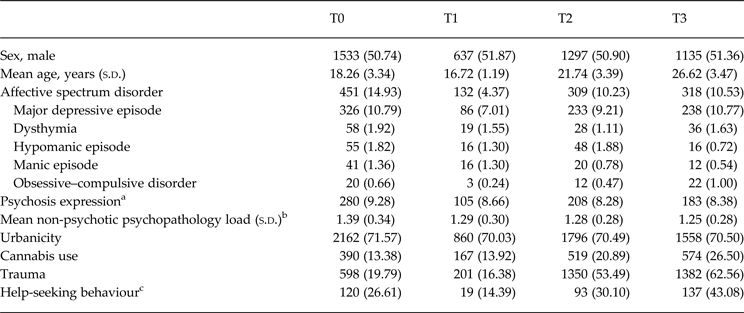
Characteristics of the study sample at different time points are shown in Table 1.
Characteristics of the population at different time points

Data are given as number (percentage) unless otherwise indicated.
T0, Baseline; T1, first follow-up; T2, second follow-up; T3, third follow-up; s.d., standard deviation; SCL, Self-Report Symptom Checklist.
a Individuals with the highest 10% of scores of the SCL-psychosis subscale.
b The total score of the SCL-90-R excluding the psychotic dimensions (‘paranoid ideation’ and ‘psychoticism’).
c In the subsample consisted only of individuals diagnosed with affective spectrum disorder.
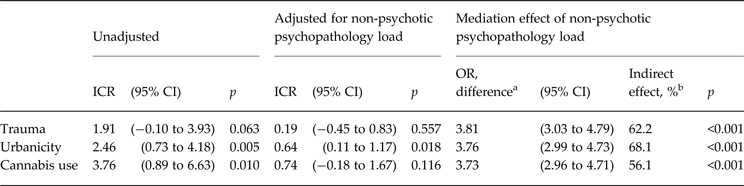
There was a suggestion that the association between psychosis expression and affective spectrum disorder was greater if there was also evidence of trauma exposure (Fig. 1a ). The OR for those with psychosis expression and exposure to trauma was 7.78, in comparison with ORs of 1.56 for those exposed to trauma only, and 5.31 for those with psychosis expression only, yielding an ICR of 1.91 (p = 0.063). The ICR was mediated by non-psychotic psychopathology load: the estimated difference between the full model including non-psychotic psychopathology load and the reduced model without non-psychotic psychopathology load was large [OR difference 3.81, 95% confidence interval (CI) 3.03–4.79] and the percentage of total effect explained by non-psychotic psychopathology load was 62.2% (Table 2).
Association between affective spectrum disorder and psychosis expression as a function of environmental exposures (cannabis, trauma and urbanicity). Unexposed, Exposed to neither environmental risk nor psychosis; ICR, Interaction contrast ratio; OR, odds ratio; CI, confidence interval.

Combined effect size of psychosis expression and environmental exposure in model of affective spectrum disorder

ICR, Interaction contrast ratio; CI, confidence interval; OR, odds ratio.
a Estimated difference between the full model including non-psychotic psychopathology load and the reduced model without non-psychotic psychopathology load.
b Percentage of total effect explained by non-psychotic psychopathology load.
Similarly, the association between psychosis expression and affective spectrum disorder was greater if there was also evidence of exposure to an urban environment (Fig. 1b ). The OR for those living in an urban area along with psychosis expression was 6.55, in comparison with ORs of 1.12 for those living in an urban area only, and 3.97 for those with psychosis expression only, yielding an ICR of 2.46 (p = 0.005). The ICR was mediated by non-psychotic psychopathology load: the estimated difference between the full model including non-psychotic psychopathology load and the reduced model without non-psychotic psychopathology load was large (OR difference 3.76, 95% CI 2.99–4.73) and the percentage of total effect explained by non-psychotic psychopathology load was 68.1% (Table 2).
The association between psychosis expression and affective spectrum disorder was moderated by cannabis use (Fig. 1c ). The ORs for those exposed to cannabis use along with psychosis expression was 9.47, in comparison with ORs of 1.77 for those exposed to cannabis use only, and 4.94 for those with psychosis expression, yielding an ICR of 3.76 (p = 0.010). The ICR was mediated by non-psychotic psychopathology load: the estimated difference between the full model including non-psychotic psychopathology load and the reduced model without non-psychotic psychopathology load was large (OR difference 3.73, 95% CI 2.96–4.71) and the percentage of total effect explained by non-psychotic psychopathology load was 56.1% (Table 2).
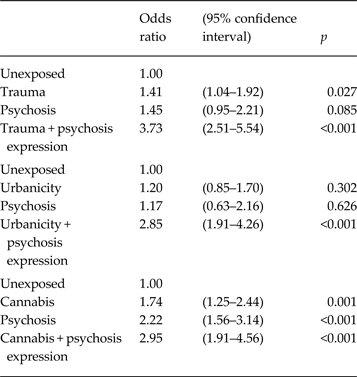
Analysing all environmental factors (cannabis, urbanicity, trauma), combined together as a loading variable, with psychosis expression, revealed a dose–response relationship in the level of association between psychosis expression and affective spectrum disorder as a function of the degree of environmental exposure (Fig. 2).
Cumulative effect size of psychosis expression (PE) and environmental exposure (EE) combination in model of affective spectrum disorder. Unexposed, Exposed to neither environmental risk nor psychosis; OR, odds ratio; CI, confidence interval. * p < 0.001, ** p = 0.01.

In the subsample of individuals with affective spectrum disorder, psychosis expression combined with trauma (ICR = 1.87, 95% CI 0.47–3.27, p = 0.009), and psychosis expression combined with urbanicity (ICR = 1.48, 95% CI 0.45–2.51, p = 0.005) in a synergistic fashion to increase the odds of help-seeking behaviour (Table 3). There was no synergy between psychosis expression and cannabis use in the model of help-seeking behaviour (ICR = −0.01, 95% CI −1.41 to 1.39, p = 0.988).
Combined effect of psychosis expression and environmental exposure on help-seeking behaviour

Discussion
This study investigated to what degree expression of psychotic experiences in affective spectrum disorder (mood disorders and obsessive–compulsive disorder) is contingent on exposure to environmental factors known to be associated with psychotic disorders (trauma, urbanicity, cannabis use) (van Os et al. Reference van Os, Kenis and Rutten2010), using the ICR method, and to what degree expression of psychotic experiences may be mediated by general severity of psychopathology. The principal findings were: (i) psychosis expression in affective spectrum disorder additively increased with exposure to environmental risk factors (trauma, urbanicity, cannabis), and this interaction was largely mediated by general non-psychotic psychopathology load; (ii) environmental effects appeared to make an impact on the same mechanism as evidenced by the dose–response relationship between affective spectrum disorder and psychosis expression, as a function of the extent of environmental exposure; (iii) the likelihood of help-seeking behaviour, as a proxy for severity/suffering, as a function of psychosis expression within the group diagnosed with affective spectrum disorder was moderated by both trauma and urbanicity, but not by cannabis use.
Environment and transdiagnostic expression of psychosis
At the phenomenological level, indicators of reality distortion such as hallucinations and delusions were previously thought to be core symptoms that distinguish schizophrenia from non-psychotic mental disorders per se. However, the findings, combined with previous work, suggest that affective syndromes and reality distortion may not only simply co-occur, but also reciprocally make an impact on each other to predict subsequent clinical outcome (Kaymaz et al. Reference Kaymaz, van Os, de Graaf, Ten Have, Nolen and Krabbendam2007, Reference Kaymaz, Drukker, Lieb, Wittchen, Werbeloff, Weiser, Lataster and van Os2012; Rossler et al. Reference Rossler, Hengartner, Ajdacic-Gross, Haker, Gamma and Angst2011; Wigman et al. Reference Wigman, van Winkel, Raaijmakers, Ormel, Verhulst, Reijneveld, van Os and Vollebergh2011a , Reference Wigman, Vollebergh, Raaijmakers, Iedema, van Dorsselaer, Ormel, Verhulst and van Os b ; Kelleher et al. Reference Kelleher, Keeley, Corcoran, Lynch, Fitzpatrick, Devlin, Molloy, Roddy, Clarke, Harley, Arseneault, Wasserman, Carli, Sarchiapone, Hoven, Wasserman and Cannon2012a , Reference Kelleher, Murtagh, Molloy, Roddy, Clarke, Harley and Cannon b ; M. van Nierop, M Bak, R De Graaf, M Ten Have, S van Dorsselaer, GROUP Investigators and R van Winkel, unpublished observations), across the boundaries of traditional diagnostic constructs.
We provide evidence that the likelihood of psychosis expression in non-psychotic affective spectrum disorder was moderated by environmental exposure in a dose–response fashion. A growing body of evidence indicates that environmental risk factors play a role in the aetiology of psychotic syndromes (van Os et al. Reference van Os, Kenis and Rutten2010). Exposure to an urban environment (Vassos et al. Reference Vassos, Pedersen, Murray, Collier and Lewis2012), early childhood trauma (Varese et al. Reference Varese, Smeets, Drukker, Lieverse, Lataster, Viechtbauer, Read, van Os and Bentall2012) and cannabis use (Minozzi et al. Reference Minozzi, Davoli, Bargagli, Amato, Vecchi and Perucci2010) are consistently associated with psychotic outcome in rigorously designed epidemiological studies, including prospective studies, in both clinical and general populations. Confirming the shared vulnerability theory of psychopathology, environmental factors, particularly cannabis use and trauma, are also associated with affective disorders, albeit less pronounced (Bovasso, Reference Bovasso2001; Moore et al. Reference Moore, Zammit, Lingford-Hughes, Barnes, Jones, Burke and Lewis2007; Breetvelt et al. Reference Breetvelt, Boks, Numans, Selten, Sommer, Grobbee, Kahn and Geerlings2010; Nanni et al. Reference Nanni, Uher and Danese2012; Kedzior & Laeber, Reference Kedzior and Laeber2014). Similarly, a nationwide Swedish follow-up study showed that a higher level of urbanization predicted psychosis and, to a lesser degree, depression (Sundquist et al. Reference Sundquist, Frank and Sundquist2004).
The fact that likelihood of expression of psychosis in affective spectrum disorder was moderated by the amount of environmental exposure in a dose–response fashion may imply that environmental factors make an impact on the same underlying mechanism, reinforcing each other. A similar additive effect across multiple environmental exposures was previously shown on the likelihood of persistence of psychotic experiences in the general population over time (Cougnard et al. Reference Cougnard, Marcelis, Myin-Germeys, De Graaf, Vollebergh, Krabbendam, Lieb, Wittchen, Henquet, Spauwen and Van Os2007). Additionally, we demonstrated that psychosis expression and environmental exposure (urbanicity, trauma, but not cannabis use) synergistically increased odds of help-seeking behaviour, reflecting onset of treatment needs, within the group of individuals diagnosed with affective spectrum disorder. The findings suggest that the cumulative environmental risk load moderated the level of psychosis admixture in non-psychotic disorder, increasing the likelihood of help-seeking behaviour. To date, several studies, with one exception (Kuepper et al. Reference Kuepper, Henquet, Lieb, Wittchen and van Os2011a ), have demonstrated that environmental risk factors may add to each other's effects in the causation of psychotic outcomes (Houston et al. Reference Houston, Murphy, Adamson, Stringer and Shevlin2008; Harley et al. Reference Harley, Kelleher, Clarke, Lynch, Arseneault, Connor, Fitzpatrick and Cannon2010; Kuepper et al. Reference Kuepper, van Os, Lieb, Wittchen and Henquet2011b ; Konings et al. Reference Konings, Stefanis, Kuepper, de Graaf, ten Have, van Os, Bakoula and Henquet2012; Morgan et al. Reference Morgan, Reininghaus, Reichenberg, Frissa, Hotopf and Hatch2014). The cumulative effect of environmental factors predicting worse outcome appears to be evident across diagnostic categories; for example additive effects between childhood trauma and cannabis use on earlier age at onset, increased rapid cycling, and suicide attempts were also demonstrated in bipolar disorder (Aas et al. Reference Aas, Etain, Bellivier, Henry, Lagerberg, Ringen, Agartz, Gard, Kahn, Leboyer, Andreassen and Melle2014).
Environmental impact as increased connectivity spreading through the psychopathology network
It has been suggested that symptoms of psychopathology do not vary in isolation, but rather make an impact on each other over time. For example, there is evidence that affective dysregulation underlies psychosis (Freeman et al. Reference Freeman, Dunn, Fowler, Bebbington, Kuipers, Emsley, Jolley and Garety2013a , Reference Freeman, Startup, Dunn, Cernis, Wingham, Pugh, Cordwell and Kingdon b ; Hartley et al. Reference Hartley, Barrowclough and Haddock2013), that motivational impairments may predict psychosis (Dominguez et al. Reference Dominguez, Saka, Lieb, Wittchen and van Os2010) and that abnormal perceptions may make an impact on risk of delusional ideation (Smeets et al. Reference Smeets, Lataster, Dominguez, Hommes, Lieb, Wittchen and van Os2012). In non-psychotic affective disorder, expression of psychosis is associated with severity of anxiety and depression (Armando et al. Reference Armando, Lin, Girardi, Righetti, Dario, Saba, Decrescenzo, Mazzone, Vicari, Birchwood and Fiori Nastro2013), and there is evidence that the association between environmental risk factors such as cannabis and trauma on the one hand, and psychosis on the other, is mediated by non-psychotic symptoms such as anxiety and depression (Gracie et al. Reference Gracie, Freeman, Green, Garety, Kuipers, Hardy, Ray, Dunn, Bebbington and Fowler2007; Freeman & Fowler, Reference Freeman and Fowler2009; Reeves et al. Reference Reeves, Anglin, Heimberg, Gibson, Fineberg, Maxwell, Kerns and Ellman2014). This literature is compatible with a relational model of psychopathology, with environmental factors making an impact on symptoms, and symptoms making an impact on each other in causal networks (Borsboom & Cramer, Reference Borsboom and Cramer2013; van Os, Reference van Os2013). The current findings are in agreement with the literature, in that environmental risk factors increased the probability of psychosis admixture in non-psychotic disorder, and that non-psychotic psychopathology mediated this relationship. In combination, the data suggest that a relational model of psychopathology in which the environment makes an impact on connectivity and ‘tips’ psychopathology towards increased levels of psychotic experiences may be useful in clinical practice, informing on severity and onset of help-seeking behaviour. However, prospective studies are required in order to examine the temporal relationship between environment and symptoms, as well as between different symptoms connecting with and making an impact on each other.
Methodological issues
One of the major strengths of this study was the standardized assessment of a large, representative population through clinical interviews conducted by psychologists who were allowed to probe with clinical questioning. The sample was followed up over 8 years with three post-baseline assessments, thus facilitating the interpretation of interplay between dimensions of psychopathology and risk factors. Nevertheless, more frequent clinical assessments could model the dynamic trajectory of psychopathology over time. Furthermore, our cross-sectional analyses, combining observations from all four time points in the ‘long format’, positively make an impact on reliability but provide little evidence for causality, with the exception of dose–response relationships. However, to our knowledge, there has been no prospective study with sufficiently intensive repeated assessments of psychopathology and environmental exposures over a long period of time, spanning the period of transition from adolescence to adulthood – the critical period for emerging psychopathology. At this stage, notwithstanding its limitations, a more practical approach – such as the cross-sectional analysis performed in the present study – may be used to test to what degree psychotic experiences and help-seeking behaviour in non-psychotic disorder are contingent on exposure to environmental risks and its impact on the severity of general psychopathology. Individuals with more severe psychopathology may have a tendency to report more exposure to risk factors, such as childhood trauma (van Winkel et al. Reference van Winkel, van Nierop, Myin-Germeys and van Os2013). There are also several other determinants that play critically important roles in mediating the impact of environmental exposure on shaping the subsequent psychopathology, such as the extent and the timing of environmental exposure. Evidence indicates that the more severe the environmental exposure, the more severe the psychopathology. For instance, psychosis may be associated with childhood abuse stronger than neglect (Read et al. Reference Read, van Os, Morrison and Ross2005; Heins et al. Reference Heins, Simons, Lataster, Pfeifer, Versmissen, Lardinois, Marcelis, Delespaul, Krabbendam, van Os and Myin-Germeys2011; van Dam et al. Reference van Dam, van Nierop, Viechtbauer, Velthorst, van Winkel, Genetic, Bruggeman, Cahn, de Haan, Kahn, Meijer, Myin-Germeys, van Os and Wiersma2014); likewise, the risk for psychosis cumulatively increases by the amount and the duration of cannabis exposure (Moore et al. Reference Moore, Zammit, Lingford-Hughes, Barnes, Jones, Burke and Lewis2007; Manrique-Garcia et al. Reference Manrique-Garcia, Zammit, Dalman, Hemmingsson, Andreasson and Allebeck2012). Moreover, any dose–response effect is evident across diagnostic categories, such that both childhood trauma (Leverich et al. Reference Leverich, McElroy, Suppes, Keck, Denicoff, Nolen, Altshuler, Rush, Kupka, Frye, Autio and Post2002; Hammersley et al. Reference Hammersley, Dias, Todd, Bowen-Jones, Reilly and Bentall2003; Hovens et al. Reference Hovens, Wiersma, Giltay, van Oppen, Spinhoven, Penninx and Zitman2010, Reference Hovens, Giltay, Wiersma, Spinhoven, Penninx and Zitman2012; van Dam et al. Reference van Dam, van Nierop, Viechtbauer, Velthorst, van Winkel, Genetic, Bruggeman, Cahn, de Haan, Kahn, Meijer, Myin-Germeys, van Os and Wiersma2014) and cannabis use (Aas et al. Reference Aas, Etain, Bellivier, Henry, Lagerberg, Ringen, Agartz, Gard, Kahn, Leboyer, Andreassen and Melle2014) are associated with more psychotic episodes, poor outcome, and treatment resistance in mood and anxiety disorders. Further, environmental exposures may have the greatest impact on psychopathology during the critically sensitive period from childhood to early adolescence, during which neurodevelopment still continues. The timing of the exposure is an influential factor within this sensitive period (Fisher et al. Reference Fisher, Jones, Fearon, Craig, Dazzan, Morgan, Hutchinson, Doody, McGuffin, Leff, Murray and Morgan2010; Bentall et al. Reference Bentall, Wickham, Shevlin and Varese2012; van Winkel & Kuepper, Reference van Winkel and Kuepper2014). In the present study, we only analysed environmental exposures coded binary as either present or not present; therefore our analysis did not allow us for further interpretation of distinctive impacts of the extent (e.g. sexual abuse v. physical abuse), the timing (e.g. childhood v. adolescence) and the amount of exposure (e.g. heavy cannabis use v. occasional cannabis use) on psychopathology.
We tested models of interaction where the variables making up the interaction (psychosis expression and environmental exposure) were not independent (Linscott & van Os, Reference Linscott and van Os2013), making it difficult to distinguish between mediation (environmental risk causing psychosis expression in affective spectrum disorder) and moderation (environmental risk moderating the strength of the association between psychosis expression and affective spectrum disorder). However, both models, particularly the test of mediation by underlying severity of psychopathology, are conceptually converging (psychotic forms of non-psychotic disorder are more likely in the presence of environmental risks) and of similar clinical interest.
Our findings further reinforce the notion that psychopathology may represent a network of interacting symptom dimensions, which are affected by environmental risk factors across traditional diagnoses, potentially adding to diagnosis using a system of environmental stratification.
Acknowledgements
This work is part of the EDSP Study and is funded by the German Federal Ministry of Education and Research (BMBF) project no. 01EB9405/6, 01EB9910/6, EB10106200, 01EB0140 and 01EB0440. Part of the fieldwork and analyses were also additionally supported by grants of the Deutsche Forschungsgemeinschaft (DFG) LA1148/1-1, WI2246/7-1 and WI709/8-1. Principal investigators of the EDSP Study are H.-U. Wittchen and R. Lieb. Core staff members of the EDSP group are: K. von Sydow, G. Lachner, A. Perkonigg, P. Schuster, M. Höfler, H. Sonntag, T. Brückl, E. Garczynski, B. Isensee, A. Nocon, C. Nelson, H. Pfister, V. Reed, B. Spiegel, A. Schreier, U. Wunderlich, P. Zimmermann, D. Beesdo and A. Bitner. Scientific advisors are J. Angst (Zurich), J. Margraf (Basel), G. Esser (Potsdam), K. Merikangas (National Institute of Mental Health, Bethesda), R. Kessler (Harvard, Boston) and J. van Os (Maastricht). The research leading to these results has received funding from the European Community's Seventh Framework Program under grant agreement no. HEALTH-F2-2009-241909 (project EU-GEI).
Declaration of Interest
None.