


This article focuses on what may very well be the most popular text about cognitive disability in American history. Released in 1953 by the evangelical publishing house Fleming Revell, Angel Unaware told the story of the experiences of the Hollywood stars Dale Evans and Roy Rogers raising a young daughter who had been diagnosed at birth with what her mother referred to as an “appalling handicap.”Footnote 1
Several historians of cognitive disability have discussed this work as an early and especially popular example of a new genre of memoir that emerged in the 1950s: so-called “confessional” accounts penned by the parents of children labeled “mentally retarded.”Footnote 2 While this small group of scholars has noted Angel Unaware’s cultural prominence and its role in shifting discourse surrounding cognitive impairment, the book has largely escaped the attention of scholars of religion. This should surprise, given the nature of its organizing claim. As explained in what follows, Evans believed that Angel Unaware was authored by her child from beyond the grave, revealing her identity to her mother as an “angel” in the wake of her death. The fact that what was at one point the third-best-selling book in the country claimed such otherworldly origins merits comment from the field of US American religious history.Footnote 3
This essay builds upon the limited existing discussion of Angel Unaware to offer an argument about the book’s purchase among midcentury readers. I argue that Angel Unaware’s success—and, thus, its role in reshaping cultural discourses surrounding cognitive impairment—had much to do with its congruity with what scholars of religion in the United States would recognize as positive-thinking Christianity. I suggest that the book’s representation of cognitive disability both as a challenge to families and as a distinctive kind of subjectivity encouraged readers to recognize such forms of difference as resources that could be used in their own pursuits of what scores of midcentury preachers and experts promoted as “happiness” and “peace of mind.” It was this suggested utility that drew many readers to the book and that also fortified its arguments concerning the social value of persons with cognitive disabilities in the face of widespread social stigma.
These claims about Angel Unaware and its uptake are significant because they help to explain how what historians of disability have characterized as the “remaking of intellectual disability” transpired in the postwar United States—how many Americans came to reject existing eugenic scripts about the “menace of the feebleminded” and to regard these forms of difference with affection and interest.Footnote 4 I argue that it was Angel Unaware’s ability to coordinate cognitive disability with ambient religious discourse and sensibilities that made both its popularity possible and its assertions about cognitive impairment plausible. While others have noted that “Americans overwhelmingly responded [to the book and its revelations] with sympathy and devotion,” I try to give an account of why this happened.Footnote 5
In taking up this question, this article also calls for a reconsideration of positive-thinking Christianity within the broader historiography of postwar religion. The absence of this text from existing accounts of postwar religious life—and accounts of positive thinking in particular—has enabled historians to represent religious trends in popular culture in this moment as largely quietist and pacifying: soul-soothing in the service of broader political and economic agendas. As described here, Angel Unaware emerges against these accounts as comparatively disruptive insofar as its claims about cognitive disability were leveraged as explicit attacks on professional authorities of various kinds and on dominant social arrangements surrounding what was known at the time as “mental retardation.” Although it has not registered as such among scholars of midcentury religion, this was a politically catalytic text, one that helped to provoke dramatic changes in the politics and social geography of disability in US history.
To make such an argument is not to praise. Nor is it to inoculate from critique. For some scholars, Angel Unaware has served as a touchstone for a much broader set of tendencies within US American culture that “overwrite [the] very humanity” of people with disabilities via ascriptions of spiritual innocence and piety.Footnote 6 For these critics, the identification and celebration of Robin as an “angel” encapsulates how US American culture has often infantilized people with disabilities, constraining them within scripts of purity, worldly naïveté, and dependence, in the service of non-disabled persons’ beliefs and desires. While I suggest below that there may be more to learn from Angel Unaware’s claims than previous scholars have allowed (particularly with respect to agency and relations of care), my analysis here in no way disputes the fact that the book largely fails to imagine people with cognitive disabilities defining or determining their own interests, feelings, and trajectories within their social worlds. If the object of Angel Unaware was to redeem people with cognitive disabilities from a host of negative associations, the book accomplished this via reduction and circumscription, which people with disabilities and a later disability rights movement have defied in a number of ways. In other words, its accomplishments in relation to that later movement were decidedly partial.
Relatedly, it must be emphasized that the redemption for which Angel Unaware aimed relied upon, and therefore reinforced, a series of racializing tropes and inferences in US American culture. Among other things, the book rescued children like Robin from a racialized otherness. As discussed below, and as was true of broader changes and social activism surrounding cognitive disability in the postwar era, Angel Unaware was a response to extant eugenic logics that had posited cognitive impairment as proof of bad (read: non- or ambiguously white) “stock.”Footnote 7 Insofar as they were understood to be models of mythological American whiteness, the Rogerses’ story furnished proof that such forms of difference could appear—as midcentury advocates constantly repeated—in “any family.”Footnote 8 This whitened or deracialized cognitive disability for some, while leaving broader racist logics largely unchallenged. I demonstrate how Angel Unaware emphasized and intensified this development by representing Robin as an icon of what the performance studies scholar Robin Bernstein has dubbed “racial innocence,” a long-standing set of cultural scripts writing whiteness in terms of vulnerability, blamelessness, and moral goodness. In doing so, the book provided many audiences with a chance to affirm white childhood and, by extension, whiteness as something in need of defense from the modern world’s variously imagined threats. In what follows, while I show how such a protective posture could be mobilized in ways that were not reducible to defenses of whiteness (viz., as ways of insisting upon the social value and rights of people with disabilities), it was certainly the case that, for some readers, this account of the angelic helped to strengthen forcefully particular visions of the American family and its sacredness—as well as to restrict who had access to these revised understandings of cognitive difference.Footnote 9
In the first three sections of the essay, I offer descriptions of the Rogerses’ fame and the experiences that led to Angel Unaware’s publication as they were communicated to midcentury audiences. I underscore how the Rogerses’ story reflected the experiences of their contemporaries and attempted to provide a guide for them. Next, I turn to locating Angel Unaware better in its religious context through a discussion of the book’s representation of the Rogerses as parents, followed by a discussion of their child’s role in the text of Angel Unaware both as a representative of cognitive impairment and as an embodiment of the sensibilities and promises of positive-thinking Christianity. In the article’s final section, I examine the reception of Angel Unaware among readers who were also the parents of children with cognitive disabilities to consider the abovementioned arguments about this text and postwar religion more broadly.
America’s Family
To appreciate the significance of Angel Unaware as a document of US religious history and of the history of disability in the United States first requires recognition of Dale Evans’s and Roy Rogers’s almost unparalleled positions within the landscape of white American popular culture in the middle of the twentieth century. Few celebrities could rival this pair in terms of their salience and ubiquity in entertainment media. They were a postwar power couple avant la lettre. Footnote 10
In the 1940s, Roy Rogers became the face and voice of America’s childhood fascination with all things “Western,” that vast cultural repository of settler colonial desire and myth.Footnote 11 Starring in more than seventy feature-length films, in possession of a score of hit records, a comic book series, and his own radio show, Rogers was christened “the King of the Cowboys” soon after World War II. Thanks to his inventive and entrepreneurial managers, he pioneered practices of transforming one’s stardom into what would later be called a brand. Products featuring Rogers’s likeness ranged from binoculars to “real tin” lanterns, to “teepees,” to folding knives, to leather gloves, to harmonicas, to a “Roy and Trigger [his horse] Snap Shot Camera.” The man was everywhere; it would be far from wild to speculate that Rogers’s likenesses competed with portraits of Jesus for preponderance within the walls of postwar households.Footnote 12
Toys and merchandise did not exhaust the extent of the Rogerses’ presence in midcentury homes and young people’s lives. Beginning in the early 1950s, Rogers’s managers formed “Roy Rogers Riding Clubs,” in addition to an already robust network of fan clubs. Sponsored by the National Safety Council, these clubs would meet in movie theaters for weekend matinees, before which children would view videos of Rogers discussing matters of personal responsibility and accident avoidance. Each meeting began with a recitation of a pledge and Rogers’s “Cowboy Prayer,” artifacts of midcentury popular piety that blended the civic, celebrity, and consumption. These clubs alone claimed upward of two million young members.Footnote 13
What was Rogers’s already impressive fame in the early 1940s multiplied exponentially, making much of the above possible, when his brand incorporated a counterpart “Queen of the West.” Dale Evans, already a film and music star in her own right, first joined Rogers on screen in a series of Western musicals in the mid-1940s; in the wake of the pair’s commercial success, they became a couple and married, making more grist for the Hollywood press’s mills. Their off-screen and off-air partnership helped to spur the success of their ventures into television programming as the 1940s turned to the 1950s. The fact of their partnership in life and in character represented an unmatched melding of the worlds of white popular American fantasy and family life.Footnote 14
Perhaps it goes without saying, then, given the extent of this couple’s fame, that Evans’s announcement that she was expecting a child just a couple of years into her and Rogers’s marriage generated considerable enthusiasm among those inclined to keep tabs on these Hollywood royals. Outlets like the Philadelphia Inquirer’s “Chit-Chat” column kept readers well informed about the family’s plans during Evans’s pregnancy.Footnote 15 And the Rogerses themselves were not shy about letting their fans in on their family life; during rodeo performances across the United States in early 1950, Rogers confided in audiences: “Folks, if you’re wondering why Mama [Evans] is moving along a little ladylike tonight, it’s because we’re expecting a little buckaroo at our house come summer.”Footnote 16
An “Appalling Handicap”
The fact of the Rogerses’ willingness and even keenness to take on the roles that they fashioned with their fans as an ideal American family (look no further than Rogers’s invitation for fans to recognize his partner as “Mama”) surely added bulk to the emotional weight and strategic difficulties that awaited them in the near future. In August of the same year, Evans gave birth to a baby girl and underwent a series of experiences familiar to thousands, if not millions, of postwar parents, a fact which time would eventually disclose.
As Evans would later tell it, in the days after the Rogerses’ daughter, Robin, was born, her mother noted the infrequency with which the hospital’s medical staff allowed her to see her newborn.Footnote 17 When she inquired after Robin, most of the staff deflected or reassured, but her sense of unease soon proved justified. The Rogerses’ physicians had determined that Robin had what Evans later referred to as a “tragic handicap”: “Mongolism,” the set of traits that would soon be reclassified as Down Syndrome.Footnote 18 The doctors initially tried to keep this news from Evans, informing Roy and the couple’s managers first, but it was not long before she demanded explanation and learned of her daughter’s diagnosis.
In the days and months that followed, the Rogerses were subject to the onslaught of reactions and guidance that usually accompanied such news in the midcentury United States—reactions and guidance that countless families would recall in the ensuing decade in letters to editors, memoirs, newsletters, and the like.Footnote 19 Most common among these was the suggestion from physicians and others that the best thing to do for such a child was to “put them away.”Footnote 20 Although the medical consensus around this recommendation was beginning to fray, if only slightly, the vast majority of medical professionals practicing in the postwar US believed that “defective” children like Robin were “hopeless cases,” and that parents ought to surrender their offspring to the care of an institution and—as many would recall—move on with their lives. One parent remembered having been advised: “Just pretend it was a bad dream.”Footnote 21
The Rogerses rejected this advice. It is unclear why they did so, but, as Evans herself later acknowledged, their incredible wealth enabled them to provide things for their child that others obviously could not.Footnote 22 The couple built a separate cottage beside their Southern California ranch property for Robin and for a full-time nurse who would see to her care.Footnote 23 Keeping Robin home was enabled by paying for what many institutions billed themselves as offering (and what they suggested conditions like Robin’s required): distance from the “normal” home, protective confines, and round-the-clock professional care. What was important for the Rogerses was that their ability to provide these things on their own made possible Robin’s inclusion in their family life as a much-doted-on member.
The question of Robin’s inclusion in the public’s image of the domus of the Queen of the West and the King of the Cowboys, however, was apparently a more complicated matter. Robin’s parents opted to be less than forthcoming about their child’s diagnosis. They informed several audiences in the early months of her life that their young daughter had a “congenital heart condition,” but never mentioned or permitted those in their circle to reveal the precise—which is to say, developmental or cognitive—nature of her “handicap.”Footnote 24
It is worth noting here the tenacity and intensity of stigma surrounding so-called “mentally deficient” children within this moment and context. In spite of the shifts in the etiology of cognitive disability that distinguished most of its forms from hereditary causes, it is safe to say that the vast majority of Americans were familiar with the suggestion that a child’s cognitive impairment was reflective of at least some kind of deficiency in or on the part of her parents. Even if a previous generation’s language of “inferior stock” no longer held the power it once did, scores of parents of children with disabilities recounted accusations flung at them in the postwar era suggesting that their loved one’s conditions were evidence of their own defects: biological, moral, or, most likely, some combination of the two. It was this reason—perhaps as much as any suggestion about a child’s “hopelessness” or inability to fit within a “normal” family—that must have encouraged many to put their child “away.”Footnote 25
Up until two months before Robin’s birth, no one of the Rogerses’ social stature had ever identified themselves as the parent or kin of a person with a cognitive disability. However, in the May issue of Ladies’ Home Journal in the year of Robin’s birth, the celebrated author Pearl S. Buck made known the fact that she had a now adult daughter who had spent most of her life as a resident at the Vineland Training School in Vineland, New Jersey. Buck’s article, later expanded as the book The Child Who Never Grew, in many ways initiated popular efforts to detach diagnoses of cognitive impairment from eugenic logics as they resonated in American culture.Footnote 26 In other words, it worked to demonstrate that such forms of difference might appear in families regardless of where parents were located within racist hierarchies of pedigree. But Buck’s revelation also reflected some of the difficulty in changing cultural attitudes. It ought to be noted that she published this article and book after enjoying a long and successful career and after much had already been determined about her daughter’s life. Upon learning of Robin’s diagnosis, it is unlikely that the Rogerses felt similarly secure in either their professional positions or their relationship to their daughter’s future.
This situation, however, did not last long. Shortly before her second birthday, Robin contracted the mumps. Her health worsened rapidly, and within days she died as a result of complications. In late August of 1952, she was buried at Forest Lawn Cemetery in Los Angeles, marking both the end and beginning of a story.
A Messenger, Unmuted
What happened next became the center point of Dale Evans’s efforts to represent herself to the public not only as a celebrity but as a mother and as a Christian. Evans narrated and re-narrated the events that followed Robin’s death as decisive moments in her personal testimony and as decisive means by which to establish her eventual place as a successful author of Christian literature and as an advocate for so-called “exceptional” children.Footnote 27
As she told it, two days after Robin’s funeral, Evans sat beneath a large color etching of her daughter that an acquaintance had made, now placed at the center of the family altar among various photos and keepsakes. Thumbing through letters of sympathy from friends and loved ones, Evans was surprised to find the room becoming “heavy” with what she described as an “unseen Presence.” Staring at the image of her child, she explained, “It suddenly dawned on me that [Robin’s eyes] always seemed as if they were seeing further than we [sic].”Footnote 28
How Evans described what happened in that room varied in different tellings, but, by some combination of events, including the “flash into [her] mind” of a verse from the New Testament’s Book of Hebrews (“Be not forgetful of strangers; for thereby some have entertained angels unawares”; 13:2 [KJV]), Evans became convinced that “Robin had been an angel” and that she was being called to participate in her daughter’s heaven-directed “mission.”Footnote 29
Following familiar scripts of inspiration and its burdens, Evans recalled that her initial efforts to respond to this revelation were stymied. She tried to write down Robin’s story—the truth that her daughter was and had been a “muted messenger of God”—but faltered in her attempts.Footnote 30 “Her mind was weak and dry,” she recalled. She just wasn’t a writer, she thought to herself. But a few days later, while recording lines for her and Rogers’s radio show at a nearby studio, Evans found herself the one muted, like so many would-be divine mouthpieces. While unable to recite her lines, she later explained to others, a disembodied voice seemed to say to her: “Let Robin write it herself.”Footnote 31
So, she did. In the weeks that followed, Evans wrote feverishly under what she understood to be a power other than her own. On “notepads, loose envelopes, the back of scripts,” she committed to something like what scholars of religion might recognize as a practice of automatic writing. She assumed the position of her deceased daughter’s amanuensis, recording Robin’s life story, as she was understood to have relayed it to her “Heavenly Father” upon her arrival “Home.”Footnote 32
The history of religion in the United States is, of course, dense with communicative traffic between parents and their deceased children. From nineteenth-century séances to late twentieth-century bereavement narratives, the genre of the after-death communiqué has proved an enduring medium for expressing and exploring the bonds of kinship and the social worlds that make those bonds both difficult and possible. Evans joined and invoked this tradition but did so, in both the text and her discussions of it, in a way that allowed for various interpretations. She was resolute in her suggestion that this book came from beyond her. But the presentation of the book—for example, Evans’s identification as its author and her recourse to the language of “inspiration”—was ambiguous enough for readers to take claims about its origins (i.e., Robin’s authorship) more or less metaphorically.Footnote 33
The sum of Evans’s envelopes, backs of scripts, and notepads became Angel Unaware, a sixty-three-page volume, published in March of 1953 by Fleming Revell and serialized in newspapers and magazines throughout the United States. While the Rogerses’ fame certainly promised a wide audience for the book, neither Evans nor the press could have predicted the scope of its success. By year’s end, Robin’s story had become one of the best-selling books in the United States, outstripped only by the recently released Revised Standard Bible and the celebrity preacher Norman Vincent Peale’s The Power of Positive Thinking, to whom we will turn in a moment. By March of 1954, Fleming Revell had sold almost half a million copies, with sales proceeding apace for almost a decade. If the Rogerses were already a presence in countless American households at the outset of the 1950s, the publication of Angel Unaware added Robin to their ranks and, with her, “mental retardation” as both a topic of interest and a significant site of moral investment.Footnote 34
In Need of Confidence: Angel Unaware and Postwar Popular Religion
To understand Evans’s reception of her daughter’s message and the spectacular popularity of Angel Unaware, it is necessary to situate both in relation to the religious styles and culture that helped shape Evans’s experiences and that framed the book for American audiences. Doing so helps to illuminate what it was that the readers of Angel Unaware may have found in Robin’s story—what thirsts it satisfied and what longings it piqued—and how those discoveries shaped the meanings of cognitive disability in this moment. By Evans’s own account, it was through an encounter with the writings of Norman Vincent Peale that she was prepared for the reception of her daughter’s message.
Peale was another midcentury figure who could claim something bordering on a ubiquitous presence in much of American popular culture.Footnote 35 The pastor of Manhattan’s Marble Collegiate Church, Peale had transformed this modest Reformed Church of America pulpit in the late 1940s into a platform for a distinctive version—at least distinctively successful—of midcentury popular religion. Blending the idioms of a generic Christian providentialism and an ascendant popular psychology, Peale worked to persuade Americans that their life’s circumstances were merely the consequences of how they thought about them and that, by assuming the proper “thought-techniques,” they might access “peace of mind, improved health, and a never-ceasing flow of energy.”Footnote 36 “Altogether too many people are defeated by the everyday problems of life,” he wrote at the outset of The Power of Positive Thinking. “It is a pity that people should let themselves be defeated by the problems, cares, and difficulties of human existence, and it is also quite unnecessary.”Footnote 37 With unassuming authority, Peale offered audiences something that apparently many people wanted to hear, namely, that their lives were largely under their control.Footnote 38
Peale relayed this message about the unnecessariness of adversity and the accessibility of health and happiness in just about every way he could, with the result being that few could escape his insistence. His words circulated in advice columns in popular newspapers and magazines, via his own radio—and, later, television—programs, in pamphlets, through his American Foundation for Faith and Psychiatry, and, most successfully, via his books. For sympathetic crowds, Peale’s labors represented an attractive antidote to the “misery of a nation rich in things, but poor in spirit.”Footnote 39 For the less receptive, they reflected a dubious attenuation of Christian commitment and a dangerous escape from the world and its problems.Footnote 40 However, all were in agreement that millions of Americans were finding in Peale’s promises a compelling means by which to handle the world around them.
Dale Evans’s encounter with Peale transpired at a moment in which she felt especially in need of a good word. Beset by confusion and feelings of guilt and doubt in the wake of Robin’s birth, Evans turned to Pearl Buck’s abovementioned account of her daughter’s life while browsing magazines during one of her and her husband’s national rodeo tours. The prospect of hearing from another mother struck her as “an astonishment . . . a thought of hope.”Footnote 41 And yet, she soon found herself disappointed. “Down, down, went her heart,” she noted. She later explained, “here was a stark story of how a mother, after years and endless miles of searching for help for her retarded child, had come to accept with finality the bitterness that there was no actual help, not now, for her child.”Footnote 42 In Buck’s account of choosing to institutionalize her daughter, Evans read a confirmation of many of the attitudes and assumptions that surrounded diagnoses of “mental retardation”: that such persons’ situations were without hope. As she told it, having reached for a lifeline, Evans ended up deeper in the waters of her despair.
A few days later, Evans was again walking past a magazine shop, inclined to rush by, when a title “fairly leaped at her.”Footnote 43 It was Peale’s A Guide to Confident Living, the preacher’s most successful book to date.Footnote 44 The author’s name rang a faint bell, she would explain, and, though knowing little of him, she recalled thinking to herself, “[Oh] how I needed to learn about confident living right then.” Buying the book, “almost desperately,” Evans flipped to the chapter titled “How to Meet Sorrow.” As she explained, she immediately “began to feel herself assimilating what had happened [vis-à-vis Robin], [and] began to feel better.”Footnote 45 Having grasped again for a tether, this time she found her way to more stable ground.
In some ways, Evans’s experience of Peale’s writing marked the beginning of Angel Unaware. A Guide to Confident Living provided almost endless examples of individuals encountering circumstances that looked to be dead ends, but that turned out in fact to be new sorts of opportunities, realized through a shift in perspective. Although Evans was unaware at the time that Robin’s death loomed in the near future, Peale’s preaching on loss provided a paradigm that mapped onto both Robin’s disability and her eventual passing, persuading Evans of their spiritual significance. In “How to Meet Sorrow,” Peale affirmed what he described as a “basic fact taught by Christianity . . . what seemed to be death is not death at all.”Footnote 46 Through a host of families’ experiences of their loved one’s endurance beyond the grave and the consequent ability of families to “conquer” feelings of sadness, he provided a language for Evans to accept both that Robin’s condition was not what it seemed (or what others told her it was) and, later, that her death was by no means the conclusion to her life.Footnote 47
Whether or not Evans thought of Peale specifically when she penned her daughter’s words is unknown, but the resonance between Robin’s “message” and Peale’s is unmistakable. This likely explains why Evans approached the pastor for help in securing a publisher for what would be Angel Unaware and why he gladly agreed to write the book’s introduction, announcing his eagerness to “be a part of Robin’s plan.”Footnote 48 It was not, after all, too different from his own.
So, what was Robin’s message?
Proof for Positive Thinking
Angel Unaware took the form of something like a missionary report, with Robin Rogers relaying to God the observations she gleaned while in the field of her assignment. Early in the narrative, like so many other missionaries, Robin the narrator laments the misguided ways of the natives among whom she has dwelled, specifically regarding their attitudes about her diagnosed difference: “They didn’t realize that You provide certain conditions to accomplish some wonderful purpose. A lot of them Down There don’t understand yet, Father . . . You always have a blessing in mind, in everything you plan.”Footnote 49 At its outset, this book coupled cultural responses to cognitive disability and faith (or the absence of faith) in divine intention. Robin lamented to God, “Many mothers with babies like me wouldn’t be so bitter and so heart-broken if they just knew you and your ways better.”Footnote 50
Nowhere was what Robin described as this dearth of trust in providence brought into clearer relief in Angel Unaware than in the attitudes and prescriptions of various medical professionals with whom Robin and her family came into contact. This group functioned in many ways as foils for positive thinking in Angel Unaware, representing the professional tendency, as well as a broader one, toward what Peale often called “defeatism.” Throughout Angel Unaware, readers encounter physicians giving voice to the kind of “hopelessness” that Evans was disappointed to find evinced in Pearl Buck’s account of her daughter. One doctor announced that children like Robin “were no good to themselves or to anybody else.”Footnote 51 Another explained to Robin’s parents, “you have a real problem . . . There’s absolutely nothing we can do . . . There is no help.”Footnote 52 As Angel Unaware represented them, midcentury Americans could think little to nothing positive about “mental retardation” and about persons labeled accordingly.
Robin looked down on these attitudes with gentle pity, readers found. She relayed to God the story of one doctor suggesting that “babies who came into the world in [her] condition should be . . . ‘machine-gunned,’” and requested, “Father, if that remark was really made, forgive him, for he knows not what he’s saying. I wish he could meet You.”Footnote 53 Her story represented these kinds of attitudes, even in their most violent expressions, as failures of imagination—failures to see God’s activity in the world and to find value in individuals like her with cognitive impairments.
Angel Unaware represented its challenge to these failures formally, through a device that marked Robin’s distance from the logics that precluded contemporary Americans’ appreciation of persons like her. By frequently placing words and categories in quotation marks, the text of Angel Unaware suggested that its audience might question what were supposed to be definitive, expert descriptions of human difference. In some instances, this formal device simply invited readers to note Robin’s identity as a non-adult, communicating with charming naïveté. Robin refers to her parents “finishing up a ‘recording’ of a radio broadcast”; she explains how they “put me in a contraption called a ‘bassinet’”; and notes how, on one occasion, her father approached her “with a funny looking thing called a ‘camera.’”Footnote 54
But, in others, Robin’s qualification of words or concepts was more pointed. This was especially the case with categories tied to the arena of medical diagnosis and treatment. Throughout Angel Unaware, terms like “affliction,” “muscle-tone,” “normal,” “Mongoloid symptom,” and “coordination” are all couched in pairs of inverted commas.Footnote 55 Insofar as these categories were devices by which the negative meanings of Robin’s difference were defined, the text’s quotation marks introduced suspicion about their interpretative power, suggesting that they might be products of what Angel Unaware referred to as an “earth-minded” ken.Footnote 56 Placing such categories in quotation marks opened an aperture for readers to ask: What other meanings might be assigned to cognitive disability? How else might one speak of persons like Robin?
One way in which Angel Unaware answered such queries was by illustrating Robin’s capacity to transform and improve the lives of those around her. This contrasted with what were commonly articulated warnings about the threats that children with cognitive disabilities posed to “normal” families.Footnote 57 Evans confronted such warnings in the words of one friend who pleaded with her to place Robin in an institution, insisting, “You must not allow this tragedy to ruin your lives.”Footnote 58 In response to assumptions and assertions of this sort, Angel Unaware demonstrated what it suggested was the cohesive power of children like Robin within their families.
In narrating her story, Angel Unaware’s Robin described the success of her “mission” in terms of how her presence in the Rogerses’ family transformed her kin. She explained that she “saw thoughtfulness developing in all the children in ‘the house of Rogers.’” As a result of her presence, her siblings were developing more concern for “people who were weaker than they were” and were becoming more “unselfish.”Footnote 59 With respect to her parents, Robin described how her presence in their lives augmented their religious faith. She helped her mother to realize that “real success was spiritual” and she emboldened her father to be more forthright about his faith in public, noting that he began to incorporate explicitly Christian elements into his rodeo performances. Over and against assertions about the destabilizing effect of persons with cognitive disability on families, Angel Unaware suggested that children like Robin might, in fact, help to harmonize the Christian home.
What made such possibility visible to the Rogerses was their trust in God and their ability to refuse despair, Angel Unaware explained. This book provided what might register as compelling evidence for the ways in which the adjustment of one’s perspective could radically alter one’s circumstances—the basic creed of the era’s increasingly popular therapeutic Christianity. For audiences familiar with Peale’s preaching, Robin’s narrative provided yet another example of the kind of story that populated the pastor’s publications and sermons (what he called “bone-fide demonstrations in actual human experience”), wherein adversity gets translated into some form of flourishing: a promotion secured; a relationship repaired; or a faith reinvigorated.Footnote 60 Peale recommended Angel Unaware in precisely these terms, inviting audiences to pursue in it an extension of his own teaching. In the book’s introduction, he celebrated how Evans and Rogers “found the very joy of God in what might otherwise have been an overwhelming tragedy.”Footnote 61 The suggestion was, as always with Peale, that so might you.
Responses from some of Angel Unaware’s readers demonstrate the fact that midcentury audiences were ready to receive this text as another parable for positive thinking. In these responses, one finds the familiar fecundity of evangelical testimony, whereby narratives of transformation beget narratives of transformation, demanding more of their kind. The year following Angel Unaware’s publication, the Rogerses’ publicist, Maxine Garrison, produced her own book, The Angel Spreads Her Wings, which documented the story of Angel Unaware’s making and, as the subtitle explained, offered an account of “The Inspiration of Angel Unaware and the Influence of the Roy Rogers Family on the American Home.” The book curated selections from the voluminous quantity of letters that Evans received after the publication of Angel Unaware. It was a testimony of testimonies.Footnote 62
In one of Garrison’s chapters dedicated to readers who “had no immediate personal connection with retardation,” one finds accounts that would have fit just as easily in one of Peale’s volumes.Footnote 63 One businessman confided in another on a commuter train: “That book [Angel Unaware] saved my life . . . I was messing up my job, fighting with my wife . . . It was getting worse every day.” Encountering the Rogerses’ ability to “[stick] by what they believed in”—presumably their conviction that Robin’s life had purpose—“made everything so plain,” he explained. “I didn’t really have problems, I was just making them up . . . I went home, and I asked my wife to forgive me, and we’ve been getting along fine ever since.”Footnote 64 While this response may have been motivated in part by the suggestion that Robin’s disability was a “real problem,” in contrast with this businessman’s marital troubles, what stands out from his reading of Angel Unaware is the lesson that apparent problems dissipate with an adjustment of attitude.
Another reader, an American soldier, wrote to Evans from his post in East Berlin. He conveyed how Angel Unaware assuaged his feelings of despair about his and his fellow soldiers’ situation—his response taking a surprisingly violent turn. “I was so relieved mentally, spiritually, and physically [after having read a serialized selection of Angel Unaware in a newspaper] . . . I could have taken on the whole Chinese army. I’m not joking . . . that article did me more good than a rest leave.”Footnote 65
In Robin and her parents’ story, people like this soldier and the businessman above found themselves persuaded that their woes might be undone with a shift in perspective. The book’s early reviewers promised the same, christening the volume “purely inspired” and guaranteeing, as did Charles Allen of the Atlanta Constitution, “This little book will help all who read it.”Footnote 66 For these audiences, Angel Unaware was immediately recognizable as the kind of inspiration many midcentury readers craved: yet another reminder that happiness was within reach.
Envying Angels
Beyond providing readers with another script of positive thinking’s power as evinced in the Rogerses’ response to Robin’s life, Angel Unaware also addressed the appetites of its readers for inspiration and happiness by positing Robin’s difference—as both angel and child with a disability—as exemplary of the kind of disposition or subjectivity that positive-thinking Christianity prescribed and promised. The book invited audiences to identify Robin, and to identify with her, as embodying the “peace of mind” prescribed by the likes of Peale. She was to serve not only as a messenger but also as a kind of model. In presenting her accordingly, the book furthered its case for the social value of persons like Robin, aiming to interrupt the logics that presented this population as unmitigated tragedies.
Throughout the text of Angel Unaware, Robin offered observations of midcentury Americans’ troubles that demonstrated her distance from and ability to transcend worldly woes. “Humans worry too much,” she noted, before inquiring, “If they could somehow trust more and worry less, they’d have heaven on earth wouldn’t they?”Footnote 67 In other instances, the book conveyed this admirable detachment with slightly more specific commentary. Describing her experience of an air raid warning, Robin opined, “How they do make noise, and how people do scamper around like a lot of frightened ants! I just couldn’t understand it. Maybe you can explain it to me later, Father.” She continued, sharpening the tool of her criticism: “It’s so foolish to go out of your way to get scared . . . I asked myself, ‘What’s wrong Down Here anyway? Why don’t they just get Your peace?’”Footnote 68 In passages like this one, Robin both rehearsed the basic convictions of positive thinking—explaining the problems of a tense political environment in terms of attitude—and modeled the ability not to let such things disturb her contentment. Along these lines, the book prompted its readers to look at things from a similar distance.
In her commentary on and around Angel Unaware, Evans made explicit what the text was meant to illustrate by linking the value of persons like Robin to their supposed immunity from the world’s worries. In a preface added to the paperback edition of the book, she wrote, “To the retarded and handicapped [God] gives a treasure few people can ever attain. He gives them the double blessing of purity of thought and an amazing capacity for love.”Footnote 69 As bearers of this double blessing, this population might be looked upon as emblems of the kind of frictionless freedom that positive thinking promised. Evans continued, “Should we not look with at least some sense of envy on those who will never attain the questionable freedom of knowledge which enables them to say, ‘I’m not sure I believe in God!’?” Here, she interprets incapacity as corresponding with a contentment and credulousness that is contrasted with a world consumed by worry—one that Evans described elsewhere as “tense, frustrated, [and] always rushing.”Footnote 70
To be sure, representations of persons with cognitive impairments that suggested that this population’s social value might be in their apparent distance from the world and its constraints were not unique to Angel Unaware—or to the postwar era. As many scholars have demonstrated, constructions of cognitive difference have long served as instrumentalizing means to describe gaps between authentic moral selves and social encumbrances, between the compromising forces of the worldly and idealized visions of nature, the past, and the holy. In examples ranging from premodern discourse and practices surrounding “holy fools” to representations of “idiots” in Romantic poetry, one finds the manufactured use of such forms of difference for launching various claims about value—in ways that simultaneously exalt and diminish people with disabilities.Footnote 71 What was distinctive about Angel Unaware within this longer representational history was the connections it drew between these forms of difference and the midcentury appetite, informed and stoked by Peale and his peers, for a particularly unflappable combination of faith and happiness—or a kind of faith in happiness. In its representation of Robin and others like her, Angel Unaware recast diagnosed impairment and the faith with which it supposedly resonated as a kind of salvation from psychic stress and, therefore, as a source of desperately needed wisdom in an anxious age.
On the Possible Politics of Positive Thinking
Many of Peale’s contemporaries smeared his gospel and its purchase as a “cult of reassurance,” which, through its insistence upon the accessibility of the individual’s happiness, commanded compliance with powers that governed much of postwar American society. Alongside criticisms that worried that Peale’s and others’ so-called “easy religion” neutralized the moral power and demands of “orthodox” Christianity, midcentury critics like the journalist William A. Miller and the sociologist A. Roy Eckardt wryly described such faith’s compatibility with hierarchy’s maintenance.Footnote 72 In a relentlessly sardonic essay (“Some Negative Thinking About Norman Vincent Peale”), Miller noted how books like The Power of Positive Thinking were pitched to employers and executives as resources for conjuring their employees’ submission, quoting advertisements that promised things like: “EXECUTIVES: Give this book to employees. It pays dividends!” And “Greater efficiency from the office staff. Marked reductions in clock watching[!]”Footnote 73 Eckardt offered similar commentary on how Peale’s promises could occlude power dynamics in ways that were both deceptive and punishing. Of this cult’s “priests,” he suggested, damningly, “[They] are not unlike Red Cross workers in wartime, binding up the wounded so that they can go forth and get shot to pieces all over again.”Footnote 74 While Eckardt left much of the specifics of his metaphor’s battle largely undescribed, it was clear that both he and Miller took such phenomena to be cases of opiates for the masses and then some.
Recent scholarship has lent more substance to these critical salvos. Kevin Kruse and Christopher Lane have offered histories that make explicit Peale’s—and, later, the Rogerses’—investments in promoting an aggressively capitalist economic policy alongside a politically conservative Christian nationalist agenda.Footnote 75 As Lane argues, Peale’s theological assault on “defeat” and “failure” as states of mind takes on a different cast when viewed through the lens of midcentury American imperial ambition and political paranoia. Kathryn Lofton summarizes Lane’s insights with punch: “This [i.e., positive thinking] is not a request to rethink your dark thoughts and switch them into cheerier ones; it was an order from a militarized state to stay on the sunny side of their Cold War surveillance.”Footnote 76 If one listens more closely, these scholars suggest, one hears decidedly ominous chords subtending the proliferating promises of happiness.
Including Angel Unaware in our accounts of this moment in US history, however, demands that we reconsider our sense of the possibilities of positive-thinking Christianity and its analogs. Evans’s book and its reception highlight how the content and style of Peale and his peers’ therapeutic gospel did not necessarily hamstring adherents, making them mere pawns in others’ games, as Miller and Eckardt and some later interpreters have suggested. Angel Unaware shows how, in their optimistic obstinance, such religious repertoires could be fashioned into levers that might pry open space for contending with institutions, social norms, and values.Footnote 77 In the book’s representations of the prescriptions and prognoses of medical professionals, specifically, we saw how an insistence upon positive thinking provided means by which to challenge dominant authorities and the social arrangements and assumptions that extended from them. What the book presents as Robin’s guileless trust in God and sanguineness becomes a vantage from which to envision and experiment with new possibilities for persons with disabilities and their kin.
Many of Angel Unaware’s readers eagerly assumed this point of view. Scores of the letters that Evans received in response to the book from parents of children with disabilities reported both similar encounters with physicians and also their resistance to them. “The doctor advised us to put our child in a home for retarded children . . . but to put her away and hide from the world, I couldn’t do it. We have given her all the love we could, same as a normal child,” wrote one mother.Footnote 78 Another explained, “They told me that I should put my baby in an institution, but we always want to have her at home with us. I know God will give us strength for everything.”Footnote 79 This same parent made explicit how it was Robin’s guidance that left her feeling empowered to refuse others’ prescriptions: “The words of your daughter have given me great strength . . . I shall no longer be coward.”Footnote 80 Such responses sound less like the “yessirs” of Miller’s imagined readers of Peale and more like the echoes of a collective determination.
In their communication with Evans, many parents also affirmed their ability to recognize that which doctors and others had denied with respect to both their children’s capacities and their influence within their homes, echoing the book’s understanding of these capacities as indices of divine presence. As one mother explained,
[Our “little angel”] brought my husband and me closer together. He made our children more tolerant of defects in others. He taught our whole family a lesson I know we will never forget. The children, instead of wondering what other people will say, are proud of the fact that they had a brother like him. They know he was an “Angel Unaware.”Footnote 81
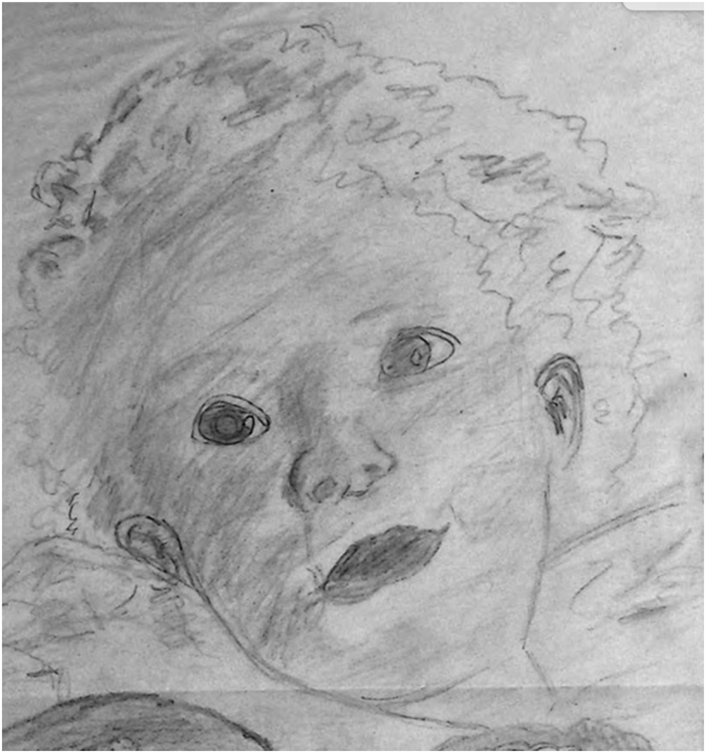
In response to what they experienced as intensely restricted and misguided interpretations of their loved ones’ differences, these readers joined Angel Unaware in elaborating understandings of persons with cognitive impairments that were not reducible to an enumeration of deficits but instead stemmed from a confidence that their loved ones’ apparent limitations might be better understood as distinct, divinely intended forms of value (Figure 1).Footnote 82
Pencil sketch of Robin Rogers, which appeared in a larger piece of fan art memorializing the Rogerses’ children. The image shows a child’s face with wide eyes and curly hair. Representations of Robin, from sketches to dolls, were not uncommon responses to Angel Unaware. Autry Museum of the American West, Los Angeles, MSA.24. Courtesy of the Autry Museum of the American West.

To borrow from the language of disability studies, we can see how, in the case of Angel Unaware, the application of positive thinking helped parents and other readers to marshal a critique of what is often referred to as the “medical model of disability.” While professional discourses clearly located “mental retardation” in the individual bodies of those described accordingly, as that which had to be managed through expert treatment and enclosure, Angel Unaware’s readers drew attention to how the “problem” of “mental retardation” was a matter of social impairment as much as it was a matter of individually measurable limitation. They testified to the ways in which it was cultural attitudes—expressed in, but not limited to, professional medicine—that in part confined what their children might do or be in the world.Footnote 83
And Angel Unaware’s readers linked these claims to efforts to try to transform their communities to better accommodate their loved ones. In addition to challenging prescriptions about institutionalization, readers reported to Evans on their work to lobby political representatives for access to education and to try to form schools and training programs for their kin.Footnote 84 In the years that followed the book’s publication, Angel Unaware became central to the development and growth of the National Association for Retarded Children (NARC), which quickly became one of the most influential disability advocacy organizations in the country, spearheading some of the nation’s first examples of disability rights legislation. This was true because Evans donated the book’s proceeds to the association, an essential injection of cash in its fledgling days, but also because Angel Unaware provided an organizing banner for parent-members to wave. Local chapters of the NARC used the material of Angel Unaware to educate their neighbors about cognitive disability as a social issue, hosting readings, listening parties, and reviews in their homes and in connection with other voluntary organizations. The book served as the theme for floats in local Christmas parades, and organizers, at both the national and local levels, mobilized the Rogerses’ images in their fundraising. Across such examples—as the NARC’s members insisted on their children’s rights to social acceptance, on access to public schools, and on federal funds for research—the message of Angel Unaware helped to frame the absence of these things as failures of will and imagination, as consequences of negative thinking, rather than features of “mental retardation” as such. For many, this emergent arena of activism was an extension of Angel Unaware’s commitment to finding purpose and value where others had deemed it absent.Footnote 85
Angel Unaware also provided a paradigm for advocacy itself in its performance of a mother’s voicing of her child’s thoughts and needs. Large numbers of mothers who wrote to Evans explained how the book offered them new kinds of access to their loved one’s personhood and a vocabulary for describing experiences of their agency. “Your book showed me through your Angel into my Angel’s heart,” wrote one. “By reading it, I understand so much better.” Recognizing that her child was “here to tell us something,” this same individual felt galvanized to serve as a mouthpiece for her son’s “message,” which consisted both of less obvious spiritual meanings (“What [they are], I’ve got to learn”) and of the imperative to try to help other children and families in similar situations.Footnote 86 Another mother explained, in verse, how her “angel” had brought her “heart to sing”: an account both of affection and of how her child could animate her, leading her to activities like writing the very poem in which this language appeared.Footnote 87 Another parent-reader similarly connected what she understood to be her child’s supernatural identity to her own capacitation: “he has given me the very things I lack—patience, courage [and] love for other handicapped children, a need to reach other parents. I too feel that he is one of God’s angels.”Footnote 88
Here we get some sense of how Angel Unaware’s ontological claims about Robin’s identity as an angel pointed up a register in which one’s agency or even voice were not reducible to linguistic abilities or utterances (most of these parents presumed that their children had limited capacities in this respect), but rather that which emerged through specific relations of care. The supposedly firm partitions between mother and child, articulate and “disarticulate,” divine and mundane, thin and blur, with parents endeavoring to both give voice to and, in some sense, speak with their loved ones.Footnote 89
In this respect, Angel Unaware and responses to it resonate loudly with a broader set of phenomena within the archives of American religion, wherein the communication between human and more than human subjects provides a context for contending with and perhaps revising biomedical claims about the body. In his classic study of American Catholic women’s devotionalism, Thank You, St. Jude, Robert Orsi describes how twentieth-century Catholic women’s relationships with Jude, patron saint of hopeless causes, afforded discursive footholds in an increasingly unstable social landscape. As professional medicine arrogated to itself almost total authority to name and narrate the body’s vicissitudes in the twentieth century, Orsi shows how his subjects improvised roles for themselves as characters in alternative stories—defined by desire, submission, and reciprocity—in ways that translated diagnosed ailments into the language of a sacred, relational drama. In doing so, they worked to requisition dimensions of the gendered authority that medicine had wrested from them.Footnote 90
In the case of Angel Unaware, readers’ identification of their children as heaven-sent agents helped them to challenge and expand the sorts of rubrics that determined what their loved one’s diagnosed differences could mean. Reference to God’s will—understood as registering in persons in the forms of positive affect, filial happiness, “courage,” etc.—provided new means to conceive of their kin beyond their apparent limitations. And this language similarly relocated disability’s significance and, by extension, the subjectivity of those deemed “mentally handicapped” beyond the individual, within broader networks of the family and an emergent community of parents in similar situations. While studies like Orsi’s focus on power dynamics on a relatively low scale, in Angel Unaware we see how its role as a text helped to mobilize its audience into a collective effort to transform these specific categories’ meanings and the positions of those they labeled in the midcentury US. In this case, a theological resolution against “defeat” functioned as a kind of incitement.
Conclusion
To recognize how Angel Unaware’s performance of positive-thinking Christianity proved politically catalytic in these respects does not preclude an appreciation, however, of how this very power also functioned in the service of the sorts of political projects that Kruse, Lane, and others have linked to Peale and his allies. In fact, noting how these discursive resources animated challenges to medical authorities and structures extending from their expertise brings into clearer relief how “mental retardation” could be enlisted in the service of broader political and moral claims, as well as how Angel Unaware’s assertions about the value of persons like Robin were dependent upon them.
For one, the sorts of claims we have encountered about the cohesive power of “handicapped” children fit neatly with broader midcentury investments in the healthy, “normal” household. In rebuffing arguments about such persons’ disruptive effects within the family, Angel Unaware and its readers reinforced visions of white, heteronormative reproductive harmony as the locus and definition of personal fulfillment. Through claims that children like Robin enriched rather than hampered the happiness of families, Angel Unaware helped to strengthen particular social forms’ hold on that category’s meaning as that toward which all persons were to orient themselves.Footnote 91 If the presence of children with disabilities within families raised questions about the gendered distribution of care or imperatives surrounding the reproduction of wealth and status, such queries were largely neutralized by a kind of doubling down on ideologies of white domesticity. In this respect, we see how Angel Unaware might have appealed not only in its participation in the suggestion that one might achieve one’s own happiness through positive thinking but also in its affirmation of how that happiness should be defined and to whom it should be available.
Relatedly, the question of obligation with respect to the care of persons with intellectual disabilities could be leveraged in the service of a political economic ideology that was averse to the public provision of social services. One mother, after noting her refusal of her neighbor’s advice to institutionalize her son, wrote to Evans defiantly, “But as long as the Lord gives me life he will always be with us. As he is our responsibility, not the state’s.”Footnote 92 Peale derived a similar imperative from his reading of Angel Unaware. In his “Confident Living” advice column, he instructed readers on “How to Handle a Handicap” not long after the book’s publication. He stated his first piece of guidance plainly: “Resolve to accept the child . . . No institution can substitute for a parent’s love.”Footnote 93 While such a recommendation was of a piece with Angel Unaware’s assertions about the value of children like Robin and their entitlement to “acceptance,” these sorts of juxtapositions—between state and home, institution and parent—no doubt helped to undergird a more fundamental set of distinctions that opposed the instrumentalist realm of the public (defined in terms of competition and economy) with the supposedly apolitical realm of the family (defined by freedom, happiness, and love). The clarity of these distinctions was, of course, essential to someone like Peale’s defense of an anti-New Deal politics and a business-friendly capitalism as described by Kruse. Viewed through this lens, Angel Unaware and its readers’ challenges to medical and institutional authorities can be seen as buttressing a wider suspicion of “the public.”Footnote 94
The point here has not been to try to locate in Angel Unaware and its reception radical texts of “resistance” or to assert once and for all what they were really about. Rather, it has been to underscore the indeterminacy of the effects and objects of the style of positive-thinking Christianity represented in this book and its uptake. Without obscuring its congruence with conservative claims about the family and a racialized social order, I have argued that Angel Unaware illustrates how insistence upon a divinely prescribed optimism and a confidence in the individual’s ability to shape their circumstances through thought could render social formations and scripts both suspect and subject to revision. The book’s role in the reshaping of the politics surrounding cognitive disability at midcentury highlights sequelae of positive thinking that have heretofore escaped the attention of scholars of postwar religion. This escape might, in fact, tell us more about what scholars have been primed to recognize as the political in their accounts of the period than about the significance of a text like Angel Unaware. With our attention turned toward this text and the parents of children with disabilities who read it, we find less a clear case of “easy religion” and instead what looks much more like hard work—the tasks of contending with and trying to remake a world with one’s kin.