I. INTRODUCTION
Recently, relaxor-PT-based ternary single crystals in the Pb(In1/2Nb1/2)O3–Pb(Mg1/3Nb2/3)O3–PbTiO3 (PIN–PMN–PT) system have been extensively studied because of the high-Curie temperature (T C) and high ferroelectric rhombohedral to tetragonal phase transition temperature T R-T. Reference Li, Zhang, Xu, Wei, Luo and Shrout1 It was previously shown that single crystal PIN–PMN–PT exhibits excellent piezoelectric properties with a piezoelectric constant d 33 of 2000 pC/N and a longitudinal electromechanically coupling coefficient k 33 of 0.9, which are comparable to the binary crystal systems Pb(Mg1/3Nb2/3)O3–PbTiO3 (PMN–PT). Reference Zhang, Luo, Hackenberger, Sherlock, Meyer and Shrout2–Reference Wang, Sun, Song, Li, Zhang and Cao5 These results indicate that PIN–PMN–PT single crystals are promising candidates for electromechanical devices used at high temperature. However, there are several drawbacks associated with the single crystals, such as high-production cost, long growth time, poor compositional uniformity, and small size, which limit their applications.
In principle, poled polycrystalline perovskite ceramics oriented in the 〈001〉 direction should possess nearly the same macroscopic symmetry as 〈001〉 poled single crystals. So, if the grains of the polycrystalline ceramics could be made to grow with preferential orientation, then the excellent piezoelectric properties may be comparable to those of the single crystals. Reference Messing, Trolier-Mckinstry, Sabolsky, Duran, Kwon, Brahmaroutu, Park, Yilimaz, Rehrig, Eitel, Suvaci, Seabaugh and Oh6 The use of microstructure texturing to improve the properties of piezoelectric ceramics has been reported by Okazaki et al. Reference Okazaki, Igarashi, Nagata, Yamamoto and Tashiro7 Templated grain growth technique (TGG) is an effective method for producing textured ceramics via a low-cost and feasible route. Reference Horn, Zhang, Selvaraj, Messing and Trolier-Mckinstry8–Reference Poterala, Meyer and Messing19 In this method, the plate-like templates are aligned in the matrix powders with the plate face in parallel to the sheet surface via the shear stresses produced by the doctor-blade. Reference Kim, Krane, Trumble and Bowman20,Reference Watanabe, Kimura and Yamaguchi21 During the thermal treatment, nucleation and epitaxial growth of the desired crystals on well aligned plate-like template particles result in high-grain orientation. Reference Messing, Trolier-Mckinstry, Sabolsky, Duran, Kwon, Brahmaroutu, Park, Yilimaz, Rehrig, Eitel, Suvaci, Seabaugh and Oh6
Until now, most of the studies of PIN–PMN–PT ternary system focused on its phase structure and piezoelectric properties near the MPB, while microstructure texturing is less reported. Reference Yasuharu, Yohachi, Hideya and Noboru22–Reference Wang, Cao and Zhang25 Yasuharu et al. found that the MPB composition in PIN–PMN–PT ternary system is linear between the MPBs of PMN–32PT and PIN–37PT. Reference Yasuharu, Yohachi, Hideya and Noboru22 36PIN–30PMN–34PT ceramics along the mophotropic phase transition (MPB) have been reported to have a high-T C, which is beneficial for the application at high temperature. Reference Wang, Cao and Zhang25 Thus, it is very significant to improve the properties of 36PIN–30PMN–34PT ceramics. In this study, the textured 36PIN–30PMN–34PT ceramics were fabricated for the first time via the TGG method by using plate-like BT particles as templates. The microstructure, dielectric, ferroelectric, and piezoelectric properties of the random and textured samples were investigated. The textured samples with high-Lotgering factor were found to exhibit higher strain and piezoelectric constant d 33 than the random ceramics.
II. EXPERIMENTAL PROCEDURE
BaTiO3 platelets were used as templates for texturing 36PIN–30PMN–34PT ceramics. The templates were prepared by the molten salt synthesis and topochemical microcrystal conversion technique. Reference Ding, Shen, Zhai, Xu, Fu, Zhang and Yao26 In the first step, bismuth layer-structured Bi4Ti3O12 platelets were synthesized by heating Bi2O3 and TiO2 in NaCl molten salt at 1000 °C for 2 h. The product was washed with deionized water for several times to remove NaCl. In the second step, the obtained Bi4Ti3O12 platelets were mixed with BaCO3 and NaCl and heated at 1020 °C for 2 h to produce plate-like BaTiO3 templates. The product was washed with HCl solution and deionized water for several times to remove impurities. In the two reactions, the weight ratio between reacting chemicals and salt was 1:1. The 36PIN–30PMN–34PT matrix powders were synthesized using the two-step columbite precursor method. Reference Lin, Li, Li, Xu and Yao24 MgO, In2O3, and Nb2O5 were used to prepare MgNb2O6 and InNbO4 precursors at 1000 and 1100 °C, respectively. Then PbO, InNbO4, MgNb2O6, and TiO2 were mixed according to the molar ratio of 36PIN–30PMN–34PT. The mixtures were calcined at 850 °C for 4 h followed by ball milling for 4 h with ZrO2 milling media (2 mm diameter).
The preparation of a homogeneous stable slurry for tape casting was a very important step. The calcined 36PIN–30PMN–34PT matrix powders were first ball milled with the solvent (azeotropic mixture of ethyl alcohol and MEK, the weight ratio between solvent and powders was 1:1.35) and dispersant (glycerol trioleate, 2 wt% of the powders) for 12 h. Then, the binder (polyvinyl butyral, 9 wt% of the powders) and plasticizers (PEG200, 3 wt% of the powders and dibutyl phthalate, 3 wt% of the powders) were added to the slurries followed by additional ball milling of 12 h with ZrO2 milling media (2 mm diameter). Finally, 3, 5, and 10 wt% BT platelets were added, and the slurries were ball milled for 2 h slowly to avoid destroying the morphology of the templates. The slurries were cast with a doctor blade at a casting height of 150 μm at 30 cm/min. The dried green tapes were cut, stacked, and laminated into a multilayer sheet under 30 MPa at 55 °C followed by a cold isostatic pressing at 200 MPa. The binder removal process was carried out at 600 °C for 4 h, with a heating rate of 0.3 °C/min, which was slow enough to prevent cracking. Then, the samples were sintered at 1240 °C for 5 h. To compensate for PbO loss, the samples were buried in the calcined powders and placed within a closed environment covered by two layer alumina crucibles. Due to the long duration at high temperature, lead volatilization is unavoidable. Thus, there was 2% weight loss after sintering. The random grain-oriented samples were fabricated by solid state reaction for comparison.
The phase structure was determined using x-ray diffraction (XRD) with Cu Kα radiation (D/MAX-2400 x-ray diffractometer, Rigaku, Tokyo, Japan). The orientation degree of the textured ceramics was calculated by the Lotgering factor f, which is defined as:
 $${f_{\left( {00l} \right)}} = {{{P_{\left( {00l} \right)}} - {P_0}} \over {1 - {P_0}}}\quad ,$$
 $${P_{\left( {00l} \right)}} = {{\sum {{I_{\left( {00l} \right)}}} } \over {{I_{\left( {hkl} \right)}}}}\quad ,$$
 $${P_0} = {{\sum {{I_{0\left( {00l} \right)}}} } \over {{I_{0\left( {hkl} \right)}}}}\quad ,$$
where I (hkl) and I 0(hkl) are the intensities of the (hkl) peaks for the textured and random samples, respectively, and I (00l) and I 0(00l) are the intensities of the (00l) peaks for the textured and random samples, respectively. Scanning electron microcopy (SEM) was used to observe the morphology of the templates and the microstructure of the ceramics. To measure the electrical performance, silver paste was fired on both sides of the samples. The temperature dependence of the dielectric properties was measured with an HP 4980 LCR meter (Agilent, Palo Alto, CA) at 1 kHz. The hysteresis loop and strain were determined with a TF analyzer 2000 (aixACCT, Aachen, Germany) and MTI 2000 (MTI Instruments Inc., Albany, New York), respectively. Prior to the piezoelectric measurement, the samples were poled at 3 kV/mm dc field at 120 °C for 15 min. The piezoelectric constant d 33 was measured with a piezo-d 33 meter (ZJ-3A, Institute of Acoustics, Chinese Academy of Sciences). The electromechanical coupling coefficient k p and the electromechanically quality factor Q m were calculated from the resonance and antiresonance frequencies measured with HP 4294 LCR (Agilent, Palo Alto, CA).
III. RESULTS AND DISCUSSIONS
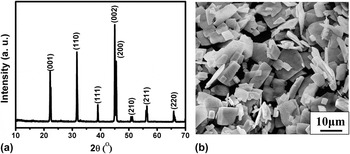
The XRD pattern and SEM image of the BaTiO3 particles are shown in Figs. 1(a) and 1(b), respectively. The particles are single phase perovskite and have a relatively high-aspect ratio with an average edge length of 10 μm and a thickness of about 0.5 μm. For the preparation of textured PIN–PMN–PT ceramics using the TGG method, it was quite important to select suitable templates. The small lattice parameter mismatch (about 0.5%) between BaTiO3 and PIN–PMN–PT ceramics is an advantage of choosing BaTiO3 as templates. In addition, the templates for the TGG process must have a diameter larger than several micrometers as well as plate-like or needle-like morphology to be easily aligned in the green tapes via tape casting. If the size of the template is not larger than the matrix grain size, then there is not a strong enough driving force for templated growth off the oriented BT templates during the thermal treatment. Reference Messing, Trolier-Mckinstry, Sabolsky, Duran, Kwon, Brahmaroutu, Park, Yilimaz, Rehrig, Eitel, Suvaci, Seabaugh and Oh6 High-grain size ratio of template to matrix is beneficial in providing required driving force for template growth. It is obvious that the as-prepared plate-like BaTiO3 particles are good candidate templates in the TGG process for texturing PIN–PMN–PT ceramics, since the average edge length of BaTiO3 templates is 10 μm, and the matrix particle size is less than 0.5 μm (as shown in Fig. 2).
(a) XRD pattern and (b) SEM image of the BT templates.

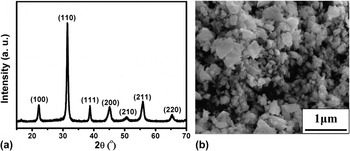
(a) XRD pattern and (b) SEM image of the 36PIN–30PMN–34PT matrix powders.

A well-characterized powder is important for tape casting and texturing ceramics via the TGG method. To achieve a high-Lotgering factor f, the particle size of the matrix powders should not be too large. For example, it was found that the orientation of the plate-like templates was hindered when the size of the matrix powder exceeds 1 μm in the TGG process. Reference Kimura and Miyazaki27 The main purpose of ball milling, the calcined powders, was to reduce the agglomeration and particle size. Figures 2(a) and 2(b) show the XRD pattern and SEM image of the matrix powders. It could be seen that the calcined powders were phase pure perovskite and that the matrix powder had no agglomeration and an average particle size of less than 0.5 μm.
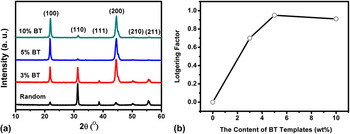
Figure 3(a) shows the XRD patterns of random and textured 36PIN–30PMN–34PT ceramics. For the textured ceramics, the (h00) diffraction peaks were significantly enhanced compared with the random sample. The effect of the BT templates concentration on the Lotgering factor is shown in Fig. 3(b). The degree of grain orientation was up to 95% with 5 wt% BT templates and then slightly decreased for a BT templates concentration of 10 wt%. The decrease was probably caused by the overlap and impingement between the oriented grains. These results indicated that the BT templates were very effective in texturing 36PIN–30PMN–34PT ceramics.
(a) XRD patterns of the random and textured 36PIN–30PMN–34PT ceramics with 3, 5, and 10 wt% BT templates, (b) Lotgering factor as a function of BT templates content.

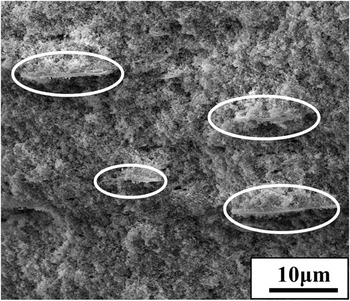
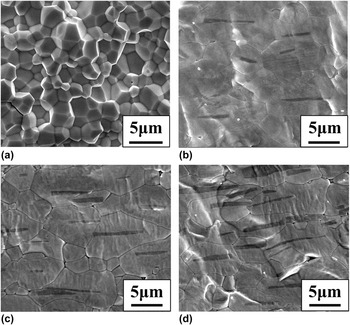
The microstructure of fracture surface of the 36PIN–30PMN–34PT green tapes heating at 600 °C for 4 h is shown in Fig. 4. It can be seen that the BT templates were aligned well in the matrix powders. Figure 5 shows the microstructure of the random and textured samples. Figures 5(b)–5(d) show the formation of a large group of the brick-like grains, suggesting that the grains have a 〈00h〉 preferential orientation. According to the theory of sintering when the compacts were composed of both large and small grains, like the TGG-processed compacts, the grain boundaries were curved and the center of curvature was located in the small grains. Reference Messing, Trolier-Mckinstry, Sabolsky, Duran, Kwon, Brahmaroutu, Park, Yilimaz, Rehrig, Eitel, Suvaci, Seabaugh and Oh6 Grains grew by the migration of grain boundaries toward the center of curvature, resulting in the growth of the large template grains at expense of small grain matrix grains. Thus, the highly textured ceramics were developed. These results agree well with the XRD patterns shown in Fig. 3(a).
SEM image of the samples with 5 wt% BT templates after heating at 600 °C for 4 h.

SEM images of (a) random samples, (b) samples with 3 wt% templates, (c) samples with 5 wt% templates, and (d) samples with 10 wt% templates sintered at 1240 °C for 5 h.

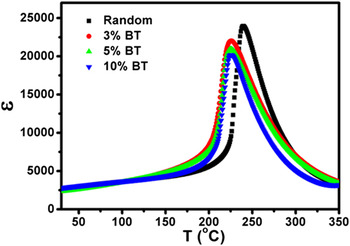
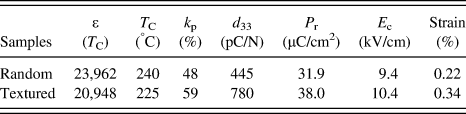
Figure 6 illustrates the temperature dependence of the dielectric constant of the random and textured PIN–PMN–PT ceramics measured at 1 kHz. The T C and the peak permittivity for the random samples were 240 °C and 23,962, respectively. Decreased T C was observed for the textured samples. Although BT templates should have the high chemical stability in the lead-based liquid phase, the minor partial diffusion between the BT templates and matrix could still occur at high temperature during the sintering stage. The distortion of crystal lattice resulted from the diffusion could lead to the lower T C. It is also known for BT-textured PMN–PT and PMN–PZT ceramics that the T C decreased due to the minor diffusion between the template and the matrix. Reference Richter, Denneler and Schuh28 The magnitude of the peak permittivity decreased slightly with the increasing of BT template content. One possible reason for this decrease was also related to the minor diffusion between the BT templates and matrix. Any changes in local order/disorder due to the introduction of the defects created by the minor diffusion will have effect on the transition from the relaxor to normal ferroelectric. Reference Yan, Cho and Priya29 It is well known that the PIN–PMN–PT is a relaxor ferroelectric, while BT is a normal ferroelectric. The switch from the relaxor to normal ferroelectric led to the decrease in the magnitude of the dielectric constant. Also, the pores developed in the sintering stage by sintering constraint or the voids left in the core of the oriented grains would decrease the peak permittivity.
The temperature dependence of the dielectric constant of the random and textured 36PIN–30PMN–34PT samples.

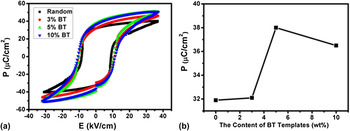
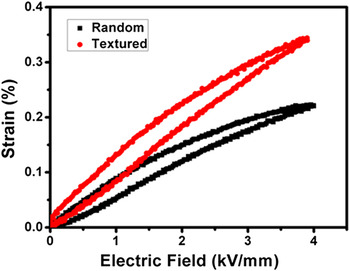
The hysteresis loops of the random and the textured samples measured at 10 Hz are shown in Fig. 7(a). All of them exhibited a well-saturated hysteresis loop. Figure 7(b) shows the remnant polarization with different BT templates content. The remnant polarization of the textured samples was higher than that of the random samples. It increased dramatically first to the maximum value of 38.0 μC/cm2 at 5 wt% BT templates and then decreased slightly at 10 wt% BT templates. The increase in the remnant polarization could be attributed to the minor diffusion between the template and the matrix. When Pb2+ ions were substituted by Ba2+ ions, the crystal lattice was expanded due to the larger radius of Ba2+. Consequently, the internal stress decreased, resulting in the higher remnant polarization. Figure 8 shows the strain-field behavior of the textured and random PIN–PMN–PT ceramics. It is apparent that the strain for the textured sample was 0.34% at an electric field of 4 kV/mm, which is higher than the 0.22% of the random samples. Therefore, it is concluded that the textured PIN–PMN–PT ceramics have improved ferroelectric properties as a result of texturing by TGG method.
(a) The hysteresis loops of the random and textured 36PIN–30PMN–34PT ceramics, (b) the remnant polarization as a function of BT templates content.

Unipolar strain-field curves of the random and textured (with 5 wt% BT) PIN–PMN–PT ceramics.

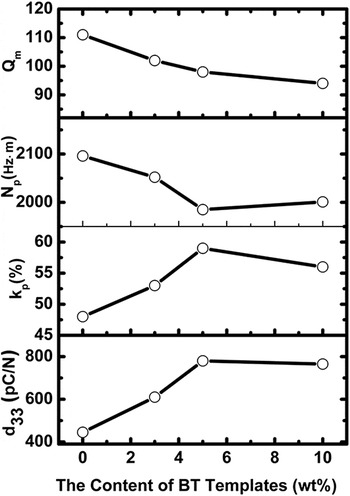
The piezoelectric constant, planar mode electromechanical coupling coefficient k p, radial frequency constant N p, and the mechanical quality factor Q m for the random and textured PIN–PMN–PT ceramics as a function of the BT templates content are shown in the Fig. 9. It is very clear that the textured ceramics display much better piezoelectric performance than the random samples, where d 33, k p, N p, and Q m for the random samples are 445 pC/N, 48%, 2096 Hz·m, and 111, respectively. Q m decreased as the BT template content increased. k p and d 33 increased with the increasing of the BT template content, reached the maximum values at 5 wt% BT templates, and then slightly decreased at 10 wt%. The piezoelectric constant d 33 of the textured ceramics achieved the maximum value of 780 pC/N at 5 wt% BT templates, which was almost 2 times greater than that of the random ceramics. It is well known that the piezoelectric constant of the single crystal is much higher than that of the polycrystalline ceramics. The significant increase in the piezoelectric constant indicated that the grains in the textured ceramics were preferentially orientated. Table I summarizes the piezoelectric and dielectric properties of the random and textured PIN–PMN–PT ceramics. The electrical properties especially the piezoelectric properties of the textured samples were much improved, owing to the changes in the microstructure and the domain structure when the ceramics were textured.
Variations in d 33, k p, N p, and Q m of the ceramics as a function of BT templates content.

Piezoelectric and dielectric properties of the random and textured PIN–PMN–PT ceramics.

IV. CONCLUSIONS
The 〈001〉-textured 36PIN–30PMN–34PT ceramics were synthesized successfully by the TGG method using BT platelets as templates. A Lotgering factor of 95% was obtained in the samples with 5 wt% BT templates sintered at 1240 °C. The dielectric constant (εr) of 2850 for the textured ceramics was also achieved. Compared with the random PIN–PMN–PT ceramics, the textured ceramics showed nearly saturated ferroelectric hysteresis loop with the higher remnant polarization (P r) of 38.0 μC/cm2 and the coercive field (E c) of 10.4 kV/cm. Unipolar strain-field measurements for the textured ceramics exhibited 0.34% strain at 4 kV/mm. The textured 36PIN–30PMN–34PT ceramics also showed excellent piezoelectric performance with the piezoelectric constant d 33 of 780 pC/N, which was almost 2 times higher than random 36PIN–30PMN–34PT ceramics.
ACKNOWLEDGMENTS
This work was supported by Natural Science Foundation of China (Grant No. 61471290) and the China-Swiss science and technology cooperation projects.