It is [. . .] precisely the lack of a really fruitful critical debate that has allowed the ‘history of twentieth-century music’ to solidify so quickly into the form of a mythic picture that depends upon the radical propaganda of a small, if remarkable, coterie of problematic pioneers of the early twentieth century . . . [This] has had the curious effect of awarding other, equally important composers (if for different reasons) within the same tradition merely ancillary roles to the highly esoteric achievements of the Second Viennese School.Footnote 1
Peter Franklin, The Idea of Music: Schoenberg and Others (1985)
Just over thirty years ago, Peter Franklin launched one of the earliest and most powerful critiques of modernist history in musicology. At the centre of his exposition was the idea that supposedly objective histories of the period had originated as propaganda for Schoenberg and the Second Viennese School. ‘Since this propaganda’, he explained, ‘produced a more committed body of literature to which the scholarly historian might refer than the “reactionary” mainstream, the seeds were early sown of a mythic history’, in which ‘it was the misunderstood and isolated innovator who often turned out to be the real torchbearer.’Footnote 2 According to Franklin, modernist composers and polemicists had singlehandedly distorted history, retrospectively canonizing an esoteric group of musical ‘pioneers’ while consigning other significant figures to the marginal, if not downright obscure, status of minor composers:
Thus Mahler may become a ‘precursor’ of expressionism, Strauss a conservative regressive after Elektra, while other figures of great importance in their day have been summarily dispensed with simply because they do not fit into the picture that centres upon Schoenberg and his pupils.Footnote 3
In recent years, such complaints have afforded energy and impetus to much twentieth-century music scholarship. Indeed, critiquing the narrowness and esotericism of the modernist canon has arguably become a common trope in studies of the period, uniting such unlikely bedfellows as Richard Taruskin, Susan McClary, and Georgina Born in the anti-modernist corner, with James Hepokoski, J. P. E. Harper-Scott, and others in the ‘expansionist’ one.Footnote 4 In the case of the former, the hegemony of the Second Viennese School (and their post-war successors) has often provoked a form of ideology critique, a denunciation of modernism itself as narrow and esoteric.Footnote 5 David Hesmondhalgh and Georgina Born, for example, framed their critique of modernist historiography in the language of post-colonial critique, censuring modernism for usurping an otherwise eclectic landscape, creating, oppressing, and excluding a range of musical others: ‘It is postwar musical modernism's attempts to construct aesthetic autarchy and self-enclosure, through the negation or denial of reference to other musics and cultures, that is historically aberrant.’Footnote 6 In the expansionist camp, such exclusivity and esotericism is invoked less to undermine the canon than as a pretext to broaden its scope, to rescue marginalized composers and redeem them as viable forms of modernism in and of themselves.Footnote 7 As recently as 2010, for example, Daniel Grimley complained that the ‘mainstream modernist canon’ had served to marginalize such composers as Carl Nielsen: ‘Though many scholars have sought to dismantle such received models of historical musical development, and stress the contested, multivalent nature of musical modernisms (in their plurality), such fixed patterns . . . remain remarkably resistant to change.’Footnote 8 ‘Nielsen's proper place at the forefront of historical and analytical accounts of twentieth-century music’, Grimley observed expectantly, ‘has yet to be established in the wider scholarly field.’Footnote 9
While few would deny the importance of such historiographical interventions in exposing modernist ideology and broadening our view of twentieth-century music, they are not without drawbacks of their own. For one thing, the expansionist tendency to denounce the narrow modernist canon in one breath, and champion marginalized minors in another, has had the effect of sustaining the very divisions it set out to challenge. Although few commentators today would denigrate Nielsen, Walton, and the like for falling short of Second Viennese standards, it is now the constant ebb and flow of critique and defence that keeps the ‘Schoenberg and others’ story alive. And, in some respects, this may not be an entirely bad thing. For, as I have suggested elsewhere, one of the downsides of pluralist revisionism – the outgrowth and extension of the old new musicology – has been a desire to dispense with these hierarchies altogether, as if the history of twentieth-century music could and necessarily should be wiped clean of the modernist critical tradition.Footnote 10 What seems to underpin these various historiographical critiques is a relatively simplistic understanding of canonicity as the retrospective and unilateral distortion of an elite minority – a model predicated on sharp oppositions between modernist oppressors and their unwitting victims, historiographical distortions and historical truths.
In this article, I want to sketch a different model of modernist canonicity, excavating a more ambivalent and reciprocal relationship between the ‘major’ and ‘minor’ figures of twentieth-century historiography.Footnote 11 I intend to address this point of contention not through theoretical critique but by turning my attention to history. Instead of seeking to dislodge Schoenberg and his disciples from their pre-eminence, I want to understand how they came to occupy their positions, focusing on the role of the ‘minor’ composer in the mid-century process of canon formation. If some scholars have sought to erase distinctions between ‘major’ and ‘minor’ composers from history entirely, I want to revive them: not as descriptions of biographical essence or objective measures of value, but as powerfully performative categories that shaped the way composers, critics, and audiences understood musical culture in their own time.Footnote 12 Using Benjamin Britten as a case study, I will suggest that to be cast as ‘minor’ was not necessarily a bad thing. On the contrary, I will argue that Britten's ambivalent, peripheral, and diminutive relationship with the self-conscious ‘greats’ of musical modernism was central to his mainstream appeal as well as to his position as a minor composer in the modernist canon. After detailing key tropes of Britten's ‘canonical minority’ – to borrow a concept from the literary scholar Margaret Russett – I will illuminate ways in which the composer and his critics fashioned his minority and, in the process, helped to construct the ‘majority’ of his modernist counterparts.Footnote 13 Ultimately, I will suggest that attending to Britten's complex and self-conscious canonical negotiations can teach us a lot, not just about his own place in history, but also about the wider workings of twentieth-century canonicity: about the complex ways in which modernist canons are negotiated, mediated, transmitted, and performed.
Britten Minor
In the context of a discussion of authorial ‘minority’, it would seem appropriate to begin in a thoroughly unoriginal place: with Britten's oft-quoted ‘Aspen Speech’ of Reference Shawe-Taylor1964. For it was here that the famously reticent composer took time to reflect publicly upon his artistic philosophy and his place in the broader landscape of twentieth-century music. After expressing telling – if obligatory – surprise at being chosen over and above the ‘great’ figures working in the arts, he set out his humble, utilitarian aesthetic: ‘I certainly write music for human beings – directly and deliberately.’Footnote 14 According to Britten, this meant forgoing the kind of historical self-consciousness common among modernist composers, an anxiety of influence promoted above all by the music critics of his day. Beware, Britten warned, of ‘critics who are already trying to document today for tomorrow, to be the first to find the correct pigeon-hole definition’.Footnote 15 ‘These people are dangerous’, he continued, ‘not because they are necessarily of any importance in themselves, but because they make the composer . . . self-conscious.’Footnote 16 Drawing a sharp distinction between those who wrote for history, and those who wrote for society – between ‘great’ and ‘minor’ composers, as he put it elsewhere – Britten positioned himself firmly in the latter camp: ‘I want my music to be of use to people, to please them, to “enhance their lives” . . . I do not write for posterity.’Footnote 17 This was an identification that he confirmed just five years later in a reflection on pedagogy, which seems to have said as much about his own position as that of would-be students: ‘the great composers’, Britten insisted, ‘can look after themselves. It's the minor composers, the people who can make our lives so much richer in small ways, that I want to preserve and to help’ (my italics).Footnote 18
As members of the posterity on which Britten apparently turned his back, it is tempting to write off such humble, shrinking, and self-marginalizing gestures as symptoms of what Edward Said has called ‘lateness’: the words of an aging composer anxiously renouncing history in order to pre-empt its judgement.Footnote 19 This reading is made all the more enticing by the fact that these gestures were often followed by precisely the kind of historical soul-searching he had supposedly renounced: ‘at this moment of acute change’, he sighed, ‘I perhaps am not the right person to guide young composers. My methods . . . are founded on a time when the language was not so broken as it is now.’Footnote 20 Yet, far from exclusively ‘late’ concerns, these ideas of humility, servility, and belatedness ran like red threads throughout Britten's career, whether in his own words, those of critics, or in his works.
To a certain extent, the stage was being set for Britten's minority even before he set foot onto the professional platform. By the time he cut his compositional teeth, critics were already declaring the age of revolution over, laying the tracks for a history of twentieth-century music centred around Schoenberg and his disciples. If Ernest Newman could observe, in 1914, that ‘Schoenberg's name is at present a byword among us for calculated and meaningless cacophony’, this was not the case as little as a decade later.Footnote 21 Even a cursory look at interwar criticism reveals that the alleged Viennese iconoclast, with whom Britten was to suffer constant comparison, made steady progress from enfant terrible to ‘official revolution’ (as Constant Lambert mischievously put it).Footnote 22 Throughout this period and beyond, Schoenberg was often cast as the epitome of romantic-modernist genius: introverted, egotistical, and driven by inner necessity – a composer whose radical originality had somehow carried even originality itself as far as possible, fating all future generations to remain in his shadow.
Central to this narrative was Schoenberg's categorical rejection of tonality, frequently presented as a tipping point in the history of music. ‘With the publication of Schönberg's “Klavierstücke,” Op. 11’, one critic noted in 1933, ‘the new language came to birth’: ‘In future . . . any dealings with the old language became acts of inexcusable cowardice or hopeless obscurantism.’Footnote 23 For this critic, as for many others, this music-historical coup was consolidated and sustained by Schoenberg's development of the twelve-tone system after 1920. According to Cecil Gray, the emancipation of the dissonance was to modernists as the proletarian revolution was to Marxists – a revolution to end all revolutions. Constant Lambert likewise warned all those who came in Schoenberg's wake: ‘To the seeker after the new . . . to those who expect a sinister frisson from modern music, it is my melancholy duty to point out that all the bomb throwing and guillotining has already taken place.’Footnote 24
For most critics who helped to fashion this image, however, this was not necessarily to the disadvantage of younger composers. On the contrary, many prepared themselves to welcome the necessary humility of the next generation with open arms. While Gray observed that ‘the present age is tired of individualism and freedom of expression’, Lambert looked forward to music of a more modest stripe: ‘the music of the future, if it is to avoid the many psychological cul-de-sacs which have been examined in this volume, must inevitably be directed towards a new angle of vision rather than a new vocabulary’.Footnote 25 Almost invariably, this implied a ‘return’ to tonality. If Schoenberg lashed out at ‘those who nibble at dissonances, wanting to pass for modern, but who are too cautious to draw the consequences’, most mainstream British critics were rather more positive about composers who stepped back from the atonal brink.Footnote 26 ‘Is it beyond the bounds of possibility’, one critic asked, ‘that composers will sooner or later try to discover what modern skill and resources can do with the fundamentals?’Footnote 27 After praising Vaughan Williams for contenting himself with ‘common chords’ used in a ‘new-old’ way, he singled out the young Britten for comparable humility: ‘See for example what Benjamin Britten does with the chord of C major in his Te Deum, and with a modern use of primitive devices in “A Boy is Born.”’Footnote 28 It is not difficult to understand why Britten's music was often framed in these terms. Like the work of many twentieth-century composers to be accorded minor status (Walton, Nielsen, Vaughan Williams, and so on), Britten's music often evinced a strong sense of tonality, albeit one complicated by a widened harmonic palette and self-conscious gestures towards its own obsolescence.Footnote 29
In much writing on the subject, the generational turn from the mighty to mild was cast as a natural cycle, and soon variations on this idea of a calm after the Schoenbergian storm came to frame many discussions of Britten's music. Writing in 1943, Edward Sackville-West drew on the photographic metaphor of the ‘emerging picture’ to capture this sense of historical posteriority.Footnote 30 Britten and his generation, he explained, existed in the time after the camera had clicked, the moment when the photograph slowly crystallized and its elements slid unobtrusively into position. This sense that the next step, after the modernist revolution, would necessarily be a more modest one of stocktaking and synthesis continued to appear throughout Britten's career, particularly among the most influential of mainstream British music critics.Footnote 31 These narratives persisted throughout the 1940s, 1950s, and 1960s, even as a new generation of self-consciously ‘major’ composers – Boulez, Stockhausen, and others – arrived to pick up the modernist torch.Footnote 32 As Deryck Cooke pointed out, still in 1960, ‘Not having yet absorbed Schoenberg, much less Webern, how can we expect to come to terms with Boulez?’Footnote 33
Such talk of revolution and consolidation, majority and minority, was precisely the kind of historical self-consciousness that Britten would later decry. Yet, in both word and musical deed, the composer often seems to have acquiesced to – even encouraged – his subsumption into the historical ‘space between’. In a 1946 broadcast, Britten performed his minority, speaking – albeit with a playful sense of irony – of his generation's humility with respect to the romantic-modernists who came before: ‘Now today the composer is a much more practical chap; he is less likely to go his own way, less likely to have long hair, and I hope less likely to starve in a garret.’Footnote 34 Had he been born any earlier, Britten insisted still in 1950, he should have been concerned only to express himself, a ‘rot’ that began with Beethoven and culminated with Schoenberg.Footnote 35 Now, thankfully, he could apparently concern himself with more modest tasks.Footnote 36 For Britten, no less than for Lambert, Sackville-West, and others, this sense of posteriority could be grounds for something productive, if necessarily more humble in scope. This tendency both to identify with and to champion musical modesty and belatedness was not limited to the early period of his career. Writing many years later about Schubert – a composer who, in many respects, shared in the symptoms of canonical minority – Britten noted: ‘It is arguable that the richest and most productive eighteen months in our musical history is the time when Beethoven had just died, when the other nineteenth-century giants, Wagner, Verdi and Brahms had not begun.’Footnote 37 As Britten went on to explain, it was not just that Schubert experienced increased productivity in the gap between musical strongmen, but that he managed to translate this historical ‘lack’ into a viable aesthetic ‘spirit’ or ‘magic’: an attention to subtle, almost inexpressible details.
While the details of Schubert's ‘magic’ remain elusive and mysterious, Britten's diction suggests something of what literary theorist Sianne Ngai has recently dubbed ‘minor’ aesthetics – that is, of milder or more equivocal aesthetic experiences than those traditionally allowed by Kantian dualities of the beautiful and the sublime.Footnote 38 As Britten appears to have known only too well, this rhetoric – of smallness, brevity, and subtlety – often surfaced in responses to his own works: ‘Is Curlew River “minor”’, he asked Hans Keller sarcastically, ‘because it is shorter than B[illy] Budd [?]. Are the ’Cello suites “minor” because there are fewer instruments than Sinfonia da Requiem? Is Children's Crusade “minor” because the performers are young?’Footnote 39 While Britten's tongue may have been firmly in his cheek, he had good reason for formulating his satirical shopping list of ‘minor’ attributes as he did. For critics often intimated a remarkably literal equivalence between the ‘smallness’ of certain works and the composer's historical stature. Immediately after describing Les Illuminations as the ‘most satisfying work of Britten's yet heard in this country’, Edwin Evans equivocated: ‘but its value lies in the sureness of his treatment of details’ (my italics).Footnote 40 After championing the same work, Colin Mason was even more equivocal:
It demands no symphonic method, or thematic development on a large scale; only the enchanting moment of sound Britten provides. If its climaxes satisfy aurally, but not in the score, better burn the score . . . It does not try to repeat ‘Winterreise’ or ‘Dichterliebe’; but it is effective and beautiful, and partly held together by its literary basis, and partly by pseudo-symphonic methods that are exactly right for it.Footnote 41
‘Britten’, he concluded with characteristic ambivalence, ‘seems to be essentially a composer of short works, or sectional long ones, for voices, solo or choral, and to have achieved nothing in his purely instrumental music, especially that of symphonic ambition.’Footnote 42 According to Mason, Britten was more miniaturist and melodist than symphonist, even in his longest and grandest works. By themselves, such traits were not necessarily signs of canonical minority, as the contemporary reception of Webern's music makes clear: ‘No composer has written shorter pieces’, Erwin Stein insisted in 1946, ‘No one has created subtler shades or softer sounds.’Footnote 43 Apparently it was setting records that counted, and while Webern's miniaturism and lyricism were almost invariably associated with expressive depth and motivic concentration, Britten's were more often tied to structural humility if not technical inadequacy.Footnote 44 For Mason, Britten's best works were those on a more modest scale, which did not explicitly strive for greatness. On this point, Wilfrid Mellers agreed: ‘it is a part of Britten's cleverness that he knows just how much he is capable of, at a given moment; he knows just how much he has to offer’.Footnote 45
Most frequently, these associations with smallness and minority crystallized around the figure of the child. As Philip Rupprecht has recently noted, the idea of Britten's character as somehow childlike or even childish stuck around throughout the 1950s and even beyond.Footnote 46 It was a commonplace of reviews to introduce Britten as somehow boyish in his appearance.Footnote 47 This is an association that ‘Britten minor’ – as he even styled himself – appears often to have encouraged.Footnote 48 As Erwin Stein put it in 1952, Britten was not just born ‘after’ Schoenberg – in the generational sense discussed earlier – but was, in a more qualitative sense, his child. After casting him as a ‘child of the world, social, genial, even compliant’ – the polar opposite of his lonely, intransigent, truth-seeking, Viennese elder – Stein continued: ‘The messages of the two men come from different regions of the human scene and their language is accordingly different. Britten can hardly be blamed for not continuing Schoenberg's methods, as little as C. P. E. Bach for not following up his father's style.’Footnote 49 As these comments make clear, Britten's childish qualities were often defined against more radically ‘adult’ examples of greatness, among whom Schoenberg was apparently the elder.Footnote 50
As with other tropes of canonical minority, the child imagery was a double-edged sword. For some, it meant technical precocity – a much-needed antidote to the infamous amateurism of British music.Footnote 51 Yet, for many, this precocity threatened to impede the development of mature genius.Footnote 52 At the same time, it signalled a kind of eternal promise, perpetually skirting the fringes of greatness, even if – or precisely because – it never actually got there. If critics were pointing to ‘indications of great things’ early in Britten's career, they were still doing so when he was older and more established.Footnote 53 As one commentator put it in 1949, ‘one of [Britten's] great virtues is that he is forever young, even though he is now approaching the age of forty’.Footnote 54 If, as this same critic noted, ‘a fleet-footed young colt can . . . mature into an excellent steed’, commentators were not always ecstatic about this prospect. ‘One hopes that he will not entirely abandon jest and youthful jollity’, remarked another, for ‘there is precious little humour in contemporary music – always excepting the unconscious kind, of course.’Footnote 55 Here again, Britten's youthful minority was pitted against the solemnity, seriousness, and self-consciousness of musical modernism, against which it was supposed to provide some welcome, if decidedly humble, light relief.
If contemporary commentators saw an overlap between Britten's childish character and certain features of his music, this is another aspect that the composer once again encouraged. Particularly in the many works Britten composed for or ‘about’ children – from Simple Symphony (1933) to Let's Make an Opera (1949) and beyond – he seems to have raised this childlike joviality and humility into an artistic theme. As early as Reference Stein1953, Imogen Holst observed that Britten's music for the young embodied something of the child's ‘insatiable appetite for repetition’.Footnote 56 More recently, Rupprecht has examined this ‘childish’ style or aesthetic in even greater detail: ‘for all their technical resources’, he concludes, the works invoking childhood ‘foreground the playful, the diatonic, the simply tuneful, or the musicalized game’.Footnote 57 Focusing on a number of works of the late 1950s, Rupprecht deftly demonstrates how Britten combined formal complexity with childish simplicity, self-consciously ‘toying’ with serialism and other avant-garde techniques, for reasons both structural and symbolic.
In works scored for child performers – most notably Noye's Fludde (1958) and Children's Crusade (1969) – such self-conscious humility was also thematized in the mode of performance. If Britten's Aspen speech imagined Noye's Fludde as an antidote to the literal and figurative distance between ‘great’ artists and society in general, he elsewhere contrasted its modest performance scale with the self-conscious greatness of Stravinsky's own setting of the biblical tale:
Stravinsky is a great man. He's a great composer and . . . his music was frightfully difficult . . . and it needed the greatest singers and the greatest performers in the world to perform it. I wasn't jealous of Stravinsky; not at all. I was much happier with my performance in Orford church two years ago, sung by Kesgrave boys and girls, than of Stravinsky in Hamburg Opera by famous singers with long names ending in ‘-ovitch and ‘-ousky.’Footnote 58
In this passage, Britten seems to associate his works for children with both a rejection of international fame – an implicit bid, perhaps, for national or even local status – and a renunciation of self-conscious grandeur. It is perhaps not surprising, then, that critics interpreted these works accordingly. Responding to Britten's definition of a ‘minor’ work, Keller called the composer out on his faux-naiveté: ‘I don't believe that you don't know what constitutes a “major” work . . . As for the [works for the] young, the answer is, with full admiration for [Children Crusade’s] greatness, yes. The young performers have something unique to contribute, but . . . children's pieces don't tend to be “major.”’Footnote 59
If Keller viewed recognition by posterity and canonical majority as the highest criteria of artistic value, they were not the only ones: ‘“The Little Sweep” is not a Great Work, but a simple finished little piece of great potential purport. Whether it will receive the necessary support for exerting its therapeutic influence on minds exposed to the corruption of Hollywoodian soundtracks, is part of the question whether our civilization is worth its culture.’Footnote 60 For most commentators, what these children's works lost in stature, they gained not only in modesty but also in pedagogical significance. In writing works designed for children, then, Britten cemented his reputation not only as a child, but also – conversely – as a teacher. If creating ‘great works’ was one way of ‘working for the future’, as Keller put it, teaching children was another: ‘The present is the artist's customer, the future his pupil. Britten is musically aware that the oldest members of posterity are his youngest contemporaries.’Footnote 61 In discussions such as this, Britten's pedagogical pieces often figured as necessary warm-up acts, exposing children to music that was ‘great enough’, priming them for the major works of the future.
This investment in musical pedagogy was part of a broader commitment to utility and professionalism. For Britten, this meant getting his hands dirty in all aspects of musical planning, performance, and distribution. Alongside his shrewd, behind-the-scenes negotiations with publishers, broadcasters, and recording companies – vividly illuminated by the scholarship of Paul Kildea – Britten also played a high-profile role not just as a composer, but also as performer, conductor, recording artist, festival organizer, entrepreneur, arts advocate, and so on.Footnote 62 In composing, his purported aim was apparently modest, ‘to earn [his] bread and butter’, but he conceded: ‘I have from time to time earned myself a little jam and occasionally cake as a pianist.’Footnote 63 At the same time, his other activities aimed at reaching as wide an audience as possible, pitting himself squarely against ‘ivory tower’ modernists: ‘In general I think that “art for art's sake” cannot exist. One of the principal social obligations of the artist consists of the moulding, education, and development of the artistic taste of the people.’Footnote 64 By most standards, this was of course no modest endeavour. Yet, measuring Britten's goals against the aspirations of the romantic-modernist genius, critics returned verdicts that were decidedly more ambivalent, as if such open professionalism risked watering down his status as a composer. While one commentator enthused that Britten's ‘frequent presence in the recording studio is reflected in the long and rapidly growing list of his major and minor works on record’, others were not so positive: Stravinsky's sniffy jibe that ‘nothing fails like success’ was, at least partly, directed towards Britten's lucrative career as a recording artist.Footnote 65
Such images of Britten as a shameless self-promoter, courting celebrity by whatever means he could, were a world away from common representations of Schoenberg as an alienated artist, attracting attention despite himself. Already by 1924, for example, one commentator happily confirmed the rumours already floating around about Schoenberg's character:
There is nothing that suggests the hunter after sensational success or the upstart pining for advertisement. If his name has caused a stir it is certainly in spite of himself. All that I had heard of him, of his solitariness and inaccessibility, of his life far from distractions and wrapped up in his work, was fully confirmed.Footnote 66
Such characterizations only grew louder and more common as Schoenberg's fame and centrality became more entrenched. By the time he died in 1951, critics had graduated to even more hyperbolic images, casting the musical iconoclast as both a ‘lonely emissary from the land of the future’ and a ‘true prophet’ in the wilderness.Footnote 67
If Britten, by contrast, was branded as a natural in the public sphere, some maintained that this professionalism was palpable in his approach to composition and in the works themselves. One important trope in this respect was the common description of his works as practical and resourceful, as if always tailored perfectly to the performing context and forces available. This was an image that Britten was only too happy to promote, once again setting himself apart from his modernist colleagues: ‘Music’, he pointedly insisted, ‘does not exist in a vacuum, it does not exist until it is performed, and performance imposes conditions. It is the easiest thing in the world to write a piece virtually or totally impossible to perform – but oddly enough that is not what I prefer to do.’Footnote 68 After elsewhere insisting that composers should be ‘able to write every kind of music, except bad music’, he described his art in decidedly bourgeois terms: of professionalism, productivity, craft and flexibility, and of the artist as a kind of skilled worker.Footnote 69 No wonder, then, that this image of Britten as a ‘professional’ stuck with no less force than that of the child: ‘Britten’, as William Glock insisted in 1942, ‘is the most professional of all our composers.’Footnote 70 Perhaps almost as common as images of the composer playing cricket and reciting Latin verbs at preparatory school were representations of him rising early and sitting diligently at his desk, with only a short break for lunch.Footnote 71 One of the fruits of such professionalism, critics noted, was an extraordinary productivity in a wide variety of genres. While Keller praised the ‘terrific speed of his production’, Robin Mayhead put a more negative spin on it: ‘to criticize the composer solely on the score of his creative fluency’, he admitted, ‘would be . . . narrow and absurd; but it is impossible not to suspect a correlation between his ease and rapidity of composition and the disappointing, only half-satisfactory impression many of his works make upon even the most well-disposed listener.’Footnote 72 Jack Westrup fell somewhere in between, associating Britten's industriousness with a prodigious, if troubling, technical virtuosity and flexibility. ‘O for a trace of clumsiness somewhere’, he sighed: ‘It is quite obvious that Britten . . . knows his craft as a professional composer should. What troubles his critics is whether the things he is serious about are the things that really matter.’Footnote 73
Like many other tropes associated with canonical minority, Britten's compositional ‘professionalism’ was evidently a source of ambivalence. On the one hand, it was a breath of fresh air with respect to the infamous amateurism of national forebears and contemporaries. On the other, it rubbed up against Schoenbergian standards, according to which truth content was supposed to trump technical virtuosity. While one critic complained that ‘the solving of technical problems seems at times to have occupied Britten's mind to the exclusion of musical ideas’, another worried that he often seemed ‘more concerned with texture than content.’Footnote 74 Mason developed even further these implicit divisions between surface and depth, style and idea, casting Britten's music as ‘entertaining, occasionally amusing, brilliantly scored and ambitious to the point of frugality, but without a soul’.Footnote 75 According to Hans Keller, these anxieties stemmed from British music critics’ Schoenbergian superego, which made them feel guilty about any music that glistened on the surface: ‘[N]either personally nor musically does [Britten] set out to worry anyone, and that is precisely why some feel worried about him. For must not a genius be in some way repulsive, must not his works be so obviously profound that (between ourselves) one cannot make head or tail?’ ‘Britten's sternest critics’, Keller concluded, ‘are those who worry about having nothing to worry about.’Footnote 76
Minor history
While these ideas about Britten as a musical stylist who valued surface over depth and style over idea reinforced tropes of childishness and professionalism, they also played into broader conceptions of his canonical function. For, as Eric Blom pointed out in 1927, a penchant for stylization was apparently central to the minor composer's distinctive historical role.Footnote 77 In Blom's decidedly Nietzschean view of history, it was the task of the minor composer to digest and transmit the major composer's raw genius to present and future generations, to turn his original ideas into mannered styles, and carry forward his language and syntax without necessarily saying anything himself.Footnote 78 Such a conception of minors as passive but skilful mediators of history often figured in discussions of Britten's music, particularly when it came to his stylistic eclecticism. After observing that Britten came of age at a particularly fractured moment, when the composer was forced to ‘invent his own stylization’, Wilfrid Mellers enthused: ‘We have never had a composer of greater virtuosity, or stronger feeling for rhetoric. The notorious eclecticism of his style was a part of a search for a conscious stylization.’Footnote 79 As commentators pointed out, his technical prowess showed itself in a large part as an ability to fashion, consolidate, and deploy an eclectic array of past musical styles.
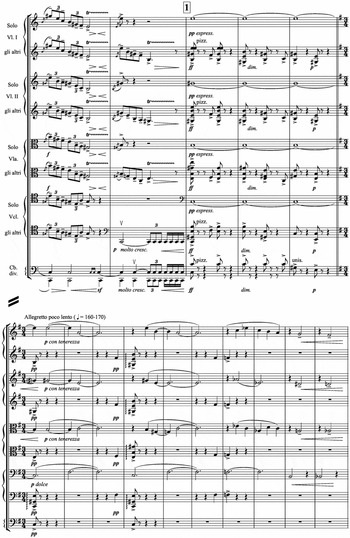
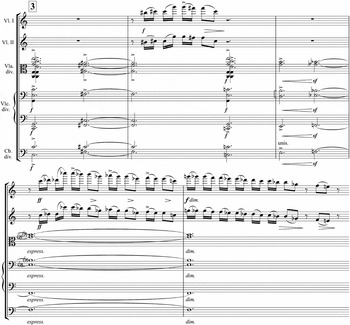
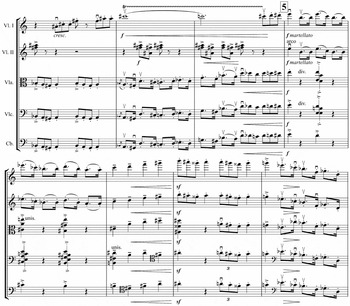
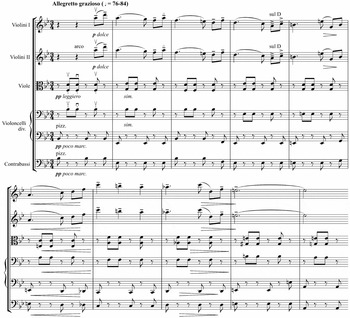
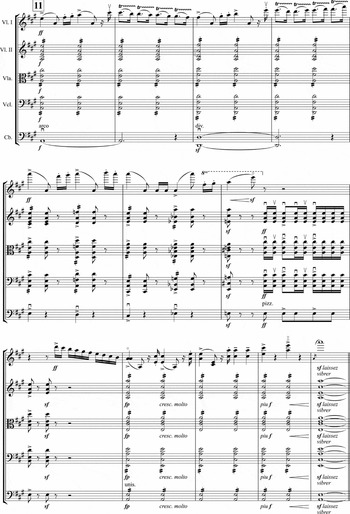
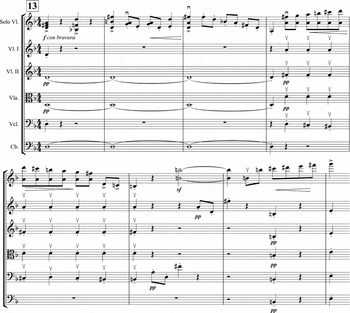
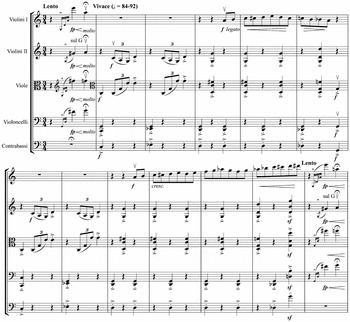
An early and relatively obvious example is the 1937 Variations on a Theme of Frank Bridge (Op. 10), in which Britten seized on the heterogeneity of the variation form to lay on a sequence of music-historical vignettes. At the beginning of the Introduction, we appear to pick up where the Schoenbergian Sinfonietta (Op. 1) left off (Example 1). Bridge's ‘Idyll’ theme comes out sporting an entire wardrobe of ‘modernist’ stylistic garments: bitonality, mediant false relations, virtuosic instrumental effects, and a shifting sense of metre. These gestures were an important way of acknowledging and moving beyond Schoenbergian modernism, even as Britten prepared for a retreat to the pre-modernist past. By the first variation, the style morphs into one more redolent of late-romantic symphonicism, especially as the impressionistic chorale in the low register serves as a backdrop for the wandering, elegiac recitative in the stratospheric strings (Example 2). After the subsequent ‘March’ movement (Example 3), which nods towards Shostakovich and Prokofiev even as it doffs its cap to the Mahlerian scherzo, the Variations begin to stray more widely from the late nineteenth- and early twentieth-century contexts from which they set out.Footnote 80 From the classical poise of the sentimental ‘Romance’ (Variation III) (Example 4), to the Rossinian bravura of the ‘Aria Italiana’ (Variation IV) (Example 5), to the neo-baroquisms of the ‘Bourrée Classique’ (Variation V) (Example 6), to the meandering melodies of the Straussian Waltz (Variation VI) (Example 7), the movements journey backwards and forwards through music-historical time, advertising Britten's characteristic ability to fashion, juxtapose, and confuse a variety of recognizable styles.
Benjamin Britten, Bridge Variations – Introduction and Theme. © 1937 by Hawkes & Son (London), Ltd. Reprinted by permission.

Benjamin Britten, Bridge Variations – Adagio. © 1937 by Hawkes & Son (London), Ltd. Reprinted by permission.

Benjamin Britten, Bridge Variations – March. © 1937 by Hawkes & Son (London), Ltd. Reprinted by permission.

Benjamin Britten, Bridge Variations – Romance. © 1937 by Hawkes & Son (London), Ltd. Reprinted by permission.

Benjamin Britten, Bridge Variations – Aria Italiana. © 1937 by Hawkes & Son (London), Ltd. Reprinted by permission.

Benjamin Britten, Bridge Variations – Bourrée Classique. © 1937 by Hawkes & Son (London), Ltd. Reprinted by permission.

Benjamin Britten, Bridge Variations – Wiener Waltz. © 1937 by Hawkes & Son (London), Ltd. Reprinted by permission.

While this stylistic eclecticism was more pronounced in early works such as the Variations, it figured throughout Britten's career in a variety of genres and contexts. Even in such self-consciously ‘great’ or ‘monumental’ works as the War Requiem (1962), commentators detected historical parasitism, an eclectic dependence on geniuses past. Besides the Requiem’s putatively undigested debts to Mozart, Verdi, and Fauré, some heard more recent stylistic resonances. For Stravinsky, Britten's work shared with Messiaen's Turangalîla ‘some counterfeit “Petrushka”’ and other traces of his former self: ‘I am flattered by this attention’, he jeered, ‘but I would prefer to receive royalties.’Footnote 81 As scholars have often noted, this epigonic eclecticism was a source of much critical complaint. Indeed, Britten's image of music critics as parasites – feasting off, absorbing, and compromising the creations of others, spewing them out into neatly digestible movements and styles – is one that, ironically, attached itself to his own music.Footnote 82 We might think here of Theodor Adorno's attack on Britten and other post-war eclectics in the Philosophy of New Music, but there were comparable examples closer to home.Footnote 83 By 1943, William Glock had cast Britten as a Mahlerian epigone, whose passive consumption of music history seemed to parallel and exacerbate the passivity of the broader, English concert-going public.Footnote 84 ‘We should ask’, Glock concluded, ‘whether English music (of which Britten is not the sole phenomenon) is so defunct that we must continue to be a nation of consumers, or to be placed in that state by business men to whom concert-going is an industry and nothing more.’Footnote 85
When viewed in this light, concerns about eclecticism can be seen to play into long-standing anxieties about English music's parasitic dependence on the Austro-German tradition, and more recent fears about the rising tide of mass consumerism. Perhaps more interesting for our present purposes, however, is that such passivity and openness to history was not always viewed negatively. As Italian music critic Massimo Mila enthused:
Purcell and Monteverdi, Verdi and Wagner, Mahler and Alban Berg, Stravinsky and Schönberg – these and others were the springs from which the musician drank with eager impartiality . . . Britten was undeniably one of the most civilized musical figures of this century . . . Superior historical understanding gave him insight into the motivations of musicians who were different from himself, and he always felt a genuine and unquenchable curiosity about their work. It was the disinterested curiosity of a historian, of a man of culture, not the curiosity of a composer who is willing to investigate other people's work only if it happens to offer something he can use.Footnote 86
This more positive idea of Britten as a model ‘man of culture’, whose music was nourished by a whole range of geniuses past, was not limited to Mila. While early defenders pointed enthusiastically to the many musical ‘greats’ one could access through Britten's music, others argued that its historical sum was greater than its parts.Footnote 87 As Charles Stuart insisted in 1950: ‘[Britten's] technique and imagination are too widely ranging to permit any such pin-pointing. His technical weapons come from the general musical armoury of the Western world, no school or period barred.’Footnote 88 ‘Those who lament this’, he snapped, ‘are themselves subject to be lamented as upholding a shallow and outdated subjectivism.’Footnote 89 In this assessment, Stuart appears to have had the composer's backing, as his summary of Britten's own position makes clear: ‘Do not run away from the Masters. Let the Masters canalize your own genius if you're lucky enough to have any.’Footnote 90 Writing in the wake of the War Requiem almost twenty years later, Britten had not changed his tune: ‘I think that I would be a fool if I didn't take notice of how Mozart, Verdi, Dvorak – whoever you like to name – had written their Masses.’Footnote 91 ‘If I have not absorbed’ these influences, he continued, ‘that's because I'm not a good enough composer, it's not because I'm wrong.’Footnote 92 Elsewhere in the same interview, he expanded this humble posture to address intimations of weakness or passivity even more directly: ‘I'm supported by [tradition]. I couldn't be alone. I couldn't work alone. I can only work really because of the tradition that I am conscious of behind me.’ ‘This may be giving myself away’, he admitted, but ‘if so, I can't help it.’Footnote 93
These visions of Britten and his works as humble possessors, embodiments, and transmitters of what we might, with apologies to Bourdieu, call music-historical capital help to explain part of their appeal. For, despite – or perhaps even because of – all the talk of canonical minority, Britten's repertorial pre-eminence in mid-century Britain is difficult to deny.Footnote 94 Already by 1947, Stephen Williams sneered that ‘everything he touches turns to gold’, while another observed: ‘Britten . . . is indubitably the Golden Boy of contemporary music, immensely successful and immensely fashionable.’Footnote 95 Given the appeals to historical prestige, however, it is not hard to understand why: this was, after all, a time when ‘middlebrow’ institutions, commentators, and critics were championing broad-minded familiarity with the canon – including modern classics as well as more established works – as the benchmark of the ‘cultured’ listener. We might even think of Britten's music as a musical equivalent to the many potted histories or style surveys that were published for the ‘everyday listener’ during this period, a means of reducing music history to its manageable stylistic quintessence.
It is more pertinent to our present concerns, however, that such views of Britten can help to establish and clarify the nature of his canonical minority. It was not just that stylistic passivity was associated with minor composers. It was also that the ability to absorb and stylize history was connected with a spectrum of alternative values. Ernest Bradbury, for example, lauded the eclectic's characteristic ‘curiosity’ as a commendable, though evidently secondary, artistic quality: ‘musical speech is gradually discovered, forced into being, by necessity in great artists and by curiosity in lesser ones’.Footnote 96 Sackville-West, Mellers, and several others re-interpreted Britten's infamous cleverness and virtuosity along similarly ambivalent lines, as a broadminded capacity for thinking across stylistic camps and boundaries: ‘it seems to me folly’, Sackville-West complained, ‘to underrate the proper function of cleverness, which is to discern the more distant connections between things and ideas’.Footnote 97 Others used a range of evocative metaphors to make a similar point: while Mila imagined Britten's ‘highly informed and cultured’ personality as a lukewarm furnace, Stuart cast the composer in the cameo role of an industrious surgeon: ‘a great blender, a great grafter in the surgical sense of the word’.Footnote 98 When it came to grafting the most recent chapters of music history, moreover, it was clearly the composer's powers of compromise and mediation that critics valued above all. For a number of commentators, Britten's music served as a crucial bridge between modernism and the public, digesting, diluting it, and stitching it into familiar historical narratives. ‘Because his style is all-comprehensive’, Keller insisted, ‘it is widely comprehensible.’Footnote 99
The Dialectics of Modernist Canonicity
In casting Britten as minor – a child, professional, surgeon, bridge, moderator, pedagogue, or even historian – commentators evidently sought to champion the special powers his music demonstrated. In many ways, they raised the composer above even the most recent of music-historical strongmen. By including clear nods to Schoenberg, Stravinsky, and other musical greats, in his words and music, Britten seemed to boast the most synoptic vantage point, in both the chronological sense (of going beyond) and the broader sense (of seeing more). According to Mila, the composer's all-encompassing style was ‘eclectic as you please, yet never before heard in its entirety’.Footnote 100 Moreover, as Russett has argued of ‘minor’ authors more generally, such ‘consciousness of inferiority’ was often spun as ‘paradoxical evidence of a real superiority’: ‘deficiency of “imagination” acquire[d] a positive sense of openness and generosity’.Footnote 101 As we have seen throughout this article, when critics set out to extol Britten's virtues, it was often as complement to (or in rejection of) an individualistic and original genius that he was not, or at least not quite. Charles Stuart, for example, defended Britten by lashing out at what he called the cult of the ‘Holy Ego’, parodying romantic-modernist principles of individualism as a quasi-Freudian pathology.Footnote 102 Hans Keller took a similar tack. After citing Britten's own exasperated sigh, ‘I do not see why I should lock myself inside a purely personal idiom’, he added: ‘Modern compositions of the over-personal type often sound unnatural and hurt the ear.’Footnote 103 Here again, such rhetorical strategies represented a double-edged sword. Even as they elevated Britten over the individual geniuses of the past – championing him as a skilful mediator and transmitter of genius in the plural – they clarified that his was a secondary power, which depended on the very greatness he otherwise rejected.
While the composer and his defenders often championed a number of Britten's works over and against major values of greatness, seriousness, and originality, the effect was by no means to undermine their significance or hegemony. On the contrary, such ongoing reference to major values, even as an example of what Britten was not, often served to highlight their centrality. For the minor needs the major, just as the child needs the father: there can obviously be no synthesis without revolution, no transmission without creation.Footnote 104 As Margaret Russett has also pointed out, however, the relationship between minor composers and values, and their major counterparts, works both ways: for ‘precursors are not precursors until they have begotten, just as the fact of a child defines the condition of fatherhood’.Footnote 105 The relationship between major and minor, in other words, is less parasitic than it is dialectical: ‘Neither foil nor mirror’, Russett insisted, ‘the minor produces majority.’Footnote 106
Such dialectical interdependence helps to explain how tropes of Britten's canonical minority – his childishness, professionalism, and so on – coexisted with, depended on, and even produced equal and opposing constructions of his majority, as an original genius to rival even Schoenberg. Indeed, as I have argued elsewhere, critics sought just as often to cast Britten's oeuvre in decidedly major terms: to foreground his originality and downplay his traditionalism, to highlight his ‘depth’ and seriousness, and to explain away his popularity.Footnote 107 For these commentators, Britten's minor works and values were – perhaps surprisingly – often quite useful, serving as powerful complements against which to define his major ones. This strategy was especially pronounced in reference to such self-consciously ‘great’ works as Sinfonia da Requiem (1940) and Peter Grimes (1945), but it was also mobilized in more ambivalent cases.Footnote 108 After describing the Spring Symphony (Reference Tiggers1949) as a ‘work of major importance’, Frank Howes drew a rather precarious line in the sand: ‘The cantata, Saint Nicholas, and the frolic, Let's Make an Opera, both written for young people, belong to the same group of light-hearted pieces. But the Spring Symphony both in intention and effect is more serious, in that it is larger and more comprehensive in emotional appeal.’Footnote 109 While the Spring Symphony might look and sound a lot like Britten's ‘minor’ pieces, Howes insisted, it was most certainly not:
The public need not complain, and no music critic staggering under the unremitting impact of major masterpieces will complain, if a composer forgets for a moment the role of major prophet, forced upon him by Beethoven and the Romantic succession, and relaxes into the eighteenth-century attitude of a paid provider of entertainment by writing works intended not for immortality but for tomorrow's celebration. Britten is fertile enough to be able to spare effort for these lighter purposes. But a certain solemnity still clings to the appellation “symphony” and critics and public must pay serious attention to anything so styled.Footnote 110
According to Howes, Britten had written enough great music that he could comfortably afford a few lighter pieces. Moreover, his rhetorical strategy demonstrates how easily minor works could construct major ones. For Hans Keller, mention of Britten's minority likewise often came as a pretext for discussing artistic majority: ‘You have written magnificent pieces lately – works which could only have come from a great composer. But they are, diagnosably, a major composer's minor works. The time has come for a major one.’Footnote 111 Elsewhere, as in his often-cited comparison between Britten and Mozart, Keller suggested that superficiality and depth, minority and majority, coexisted even within the same works. After insisting that ‘their music is approachable on various levels, each seemingly giving a complete picture in itself’, he added: ‘the exoteric, however, need not exclude but can on the contrary often enclose the esoteric’.Footnote 112 For Keller, in other words, Britten's musical minority and majority existed less in contradiction than as two sides of the same dialectical coin.
If Britten minor helped to construct Britten major, we might go even further to say the same of his relation to other twentieth-century ‘greats’. Particularly in the case of Schoenberg and his disciples – to whom he was constantly compared – Britten's music and the discourse surrounding it helped to fashion, sustain, and reinforce their canonical majority. Through much of Britten's career, Schoenberg's legacy as the epitome of genius was constantly being configured and refined. The impetus came in part from Schoenbergian enthusiasts in the British press – Michel Calvocoressi, Ernest Newman, and others – who translated and transmitted the Second Viennese School's own narratives of history and their place within it to the English public.Footnote 113 Another, perhaps more obvious, impetus came from the post-war serialists, who cemented Schoenberg's legacy in more straightforwardly Bloomian terms.Footnote 114 Yet the Schoenbergian superego was also shaped by the kind of critical discourse we have seen throughout this article, as the pretext for a new stage of historical synthesis, compromise, or moderation. If Hans Keller could observe in 1950 that the attitude of the British music press was more Schoenbergian than Schoenberg himself, he was at least partly responsible.Footnote 115 For, in much of Keller's own writing (and that of other pillars of the mid-century British musical establishment), Schoenberg was cast as both culmination and breaking point of a canonical majority stretched too far, of uncompromising radicalism, which – for all its genius – was in desperate need of mediation by its more down-to-earth offspring. Indeed, we might even argue that in order for Schoenberg's legacy to be meaningful, it needed such minor mediators as Britten, as if to prove the claims that he had driven originality to its limit.
In this sense, it is neither insignificant nor contradictory that many of the strongest proponents and explicators of Schoenberg's legacy in British music criticism – Stein, Keller, Mitchell, and others – were simultaneously champions of Britten and his music. For their visions of twentieth-century music depended on them rooting for both major and minor composers – if for vastly different reasons – while, at the same time, pitting one against the other in agonistic tension. These critical strategies were by no means incidental; if, as scholars have argued, canons are as much a product of transmission and mediation as of the ‘music itself’, these prominent critics and their discursive tropes evidently had an important role to play.Footnote 116 Moreover, as this article has demonstrated, Britten's music not only worked in tandem with criticism to shape and maintain the twentieth-century pantheon, but was also itself a form of criticism – at once a commentator on, constructor of, and fundamental part of modernist history.
To reconceive of twentieth-century music history in these terms has significant implications for the historiographical discussions outlined at the outset, offering alternative ways of understanding the mechanisms of canon formation. For, particularly since new musicological critiques, scholars have tended to represent canonicity as a historiographical distortion, which served ex post facto to promote certain composers, and erase, marginalize and denigrate others. Yet the case sketched out in this article offers glimpses of more subtle canonical contours. For one thing: that Britten himself and his mid-century commentators and audiences were apparently so invested in the tropes and hierarchies of canonical majority and minority suggests that these distinctions were as much a product of contemporary manoeuvres as of retrospective historiographical idealism. While more pluralist strains of musicology today would doubtless have us throw out such value-laden boundaries – between Schoenberg and others, greatness and humility, majority and minority – they are evidently an important part of twentieth-century music history.
At the same time, making space for modernist divisions and hierarchies need not mean endorsing their values or simply telling the same old stories, as J. P. E. Harper-Scott does in his Quilting Points of Musical Modernism. While Harper-Scott advocates turning away from both new musicological critique and his own former expansionism, reinstating a similar centrality to Schoenbergian modernism as seen throughout this article, the story he tells differs markedly from the one recounted here. Drawing on the work of Alain Badiou, Harper-Scott interprets the ‘emancipation of dissonance’ as an Event, a revolutionary rupture and a priori revelation of Truth.Footnote 117 If, in Harper-Scott's theoretical account, Schoenberg's majority exists prior to and independently of the minor ‘reactions’, my historical case study points towards an altogether different conclusion: that canonical majority and minority (Event and response), as functions of criticism, are continually configured and reconfigured in relation to each other, even depending upon each other for their creation. Neither, in other words, is superior to nor precedes the other. Indeed, while Harper-Scott repeatedly stresses the dialectical nature of his framework, he ultimately relies on the same old marked binary, between an originary and faithful modernism on the one hand, and inauthentic, reactive or ‘minor’ formations on the other.Footnote 118 The music of Walton, Britten, and others is, for Harper-Scott, always a reaction to Schoenbergian modernism, but the relation is never reciprocal. By re-examining the critical history of this relationship, I have sought by contrast to sketch a ‘properly dialectical’ model of canonicity – to borrow Harper-Scott's own formulation – in which Schoenberg's canonical position was as much a function of Britten's minority as vice versa.
By looking once again at this familiar story, I have sought finally to unsettle assumptions about the marginalizing effects of this relationship. While both music and discourse set Britten minor apart from his major self, forbears, and contemporaries, the effect was evidently never to obscure him from view. For minority, unlike obscurity, is actually a form of canonical inclusion. As Paul Youngquist points out: ‘The minor writer remains part of the show, never “forgotten” and in no danger of becoming so.’Footnote 119 Indeed, minor composers – and their associated smallness, humility, passivity, and so on – figured consistently in even the most unashamedly canonical histories of music in the twentieth century, even if – or precisely because – they were assigned secondary roles. In his 1924 Survey of Contemporary Music, Cecil Gray, for example, included a long list of minor composers: Puccini in Italy; Da Falla in Spain; d'Indy, Dukas, Satie, Milhaud, and Honegger in France; the later Strauss, Schreker, Korngold, and Hindemith in Germany; Kodàly in Hungary; Szymanovsky in Poland; Prokofiev in Russia; and Holst, Vaughan Williams, and Bax in Britain.Footnote 120 Closer to Britten's generation, we might also usefully think of figures such as Poulenc, Copland, Walton, and Shostakovich as having, in some senses, ceded from history in order to carve out a place in it. Far from undermining their works in the eyes of contemporary audiences, this minority was central to their appeal, allowing audiences to experience canonical majority in a mediated form. In fact, if majors such as Schoenberg got the lion's share of the prestige, it was often ‘minors’ such as Britten that were able to cash it in. Such an understanding can ultimately reshape the way we conceptualize the relationship between twentieth-century majors and minors, musical modernism and its supposedly marginalized others. Where scholars have often seen aesthetic opposition and antagonism, historiographical success and failure, we might begin to rediscover a more complex and ambivalent form of dialectical interdependence.