Introduction
Understanding and measuring the outcomes of participatory research and research partnerships has received considerable attention in research policy (Green & Haines, Reference Green and Haines2002; Jones, Glenna, & Weltzien, Reference Jones, Glenna and Weltzien2014; Minkler & Wallerstein, Reference Minkler, Wallerstein, Minkler and Wallerstein2008; Phillipson, Lowe, Proctor, & Ruto, Reference Phillipson, Lowe, Proctor and Ruto2012). In regions such as the Canadian Arctic, where most of the research is publicly funded by government agencies, universities and researchers face different challenges in responding to local needs while supporting high impact, globally relevant research (Parlee & Furgal, Reference Parlee and Furgal2012). Many research funding programmes in Canada have policies, orientations and requirements in place to promote partnerships and even provide research grants to communities and local organisations, with specific opportunities for indigenous peoples (see Canada's Northern Strategy, http://www.northernstrategy.gc.ca/index-eng.asp; Brunet, Hickey & Humphries, Reference Brunet, Hickey and Humphries2016; Indigenous and Northern Affairs Canada, n.d.; SSHRC, n.d.). As such, there is an interest in furthering our understanding of the outcomes of public investments in Arctic research and associated local partnership activities. To date, the evaluation of research partnerships have typically emphasised the role of project management strategies, such as the co-design of objectives and effective communication techniques, as critical to achieving the most benefits from the research process (Dyer et al., Reference Dyer, Stringer, Dougill, Leventon, Nshimbi, Chama and Muhorro2014; Mercer et al., Reference Mercer, Green, Cargo, Potter, Daniel, Olds, Reed-Gross, Minkler and Wallerstein2008). However, the task of assigning specific benefit to participatory strategies in research has proved to be challenging for a number of reasons.
Some studies have claimed that issues with the evaluation of participatory research initiatives result from the contextual nature of this work (Brunet, Hickey, & Humphries, Reference Brunet, Hickey and Humphries2014b; Rowe & Frewer, Reference Rowe and Frewer2000). As such, achieving the highest levels of local engagement may not yield the highest levels of benefit for both researchers and local stakeholders. For instance, Jagosh et al. (Reference Jagosh, Macaulay, Pluye, Salsberg, Bush, Henderson and Seifer2012) found that the heterogeneous nature of research paradigms and methods as well as the different ways that collaboration occurs can generate complex sets of both short- and long-term outcomes. They claimed that such assessments based on the way research occurred remain weak because they fail to embrace the complexity of pathways leading to outcomes (Jagosh et al., Reference Jagosh, Macaulay, Pluye, Salsberg, Bush, Henderson and Seifer2012). Rowe & Frewer (Reference Rowe and Frewer2000) noted that the principle problem with the evaluation of participation methods was the absence of optimal benchmarks against which they might be compared and measured, arising in part from confusion over what is meant by ‘effectiveness’ or ‘success’ (Abelson et al., Reference Abelson, Forest, Eyles, Smith, Martin and Gauvin2003). As such, although some participatory methods are theoretically beneficial, they may not always be effective and may not adequately account for the heterogeneity of community histories, cultures and capacities that characterise Arctic research (Brunet, Hickey & Humphries, Reference Brunet, Hickey and Humphries2014a).
In this study, we present a capital assets-based approach to assessing the impacts of research on stakeholder development. Focusing on the broad case of Arctic research in Canada, we then surveyed expert stakeholders on the extent to which this approach has the potential to both capture the subtlety of social and cultural interactions while also providing a more generalisable framework through which to better understand research partnerships (Arnstein, Reference Arnstein1969; Rowe & Frewer, Reference Rowe and Frewer2000). Recognising that most research policy frameworks operating in northern contexts overtly require some degree of community–researcher partnership, we argue that a more explicit and nuanced understanding of collaborative research outcomes can help inform research policy and practice.
Conceptual framework – the capital assets approach
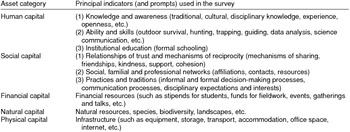
In development studies, the evaluation of programme outcomes has drawn heavily upon the sustainable livelihoods framework which considers five (sometimes seven) capital asset categories as being the foundations for local development (social, human, physical, financial and natural assets) (Carney, Reference Carney1998; Chambers, Reference Chambers1997; Green & Haines Reference Green and Haines2002; Scoones, Reference Scoones1998). These assets, described in Table 1, offer important indicators of capacity and help focus on what different partners may have to offer the research and development process, rather than what they may be lacking (Moser, Reference Moser1998). This more ‘positive’ approach considers not only tangible assets such as finances (financial capital), natural resources (natural capital), education levels (human capital) or existing infrastructure (physical capital), but also the complex and important intangible assets such as culture, knowledge, social relationships, local decision-making and communication processes (elements of social, human and natural capital), which previous studies have found to be critical, although often overlooked, in community–researcher partnership development processes (Brunet et al., Reference Brunet, Hickey and Humphries2014a; Engel, Keijzer, & Land, Reference Engel, Keijzer and Land2007; Garnett et al., Reference Garnett, Crowley, Hunter-Xenie, Kozanayi, Sithole, Palmer, Southgate and Zander2009; Parlee & Furgal, Reference Parlee and Furgal2012; Phillipson et al., Reference Phillipson, Lowe, Proctor and Ruto2012).
The five asset categories with their principal indicators and prompts used in the survey and adapted for Arctic research.

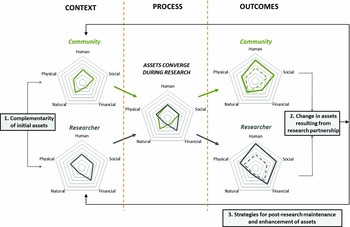
In this paper, we propose that a capital assets-based approach to understanding research partnership processes and outcomes may help to capture the contextual nature of community–researcher relationships in the Arctic. Using changes in capital asset categories as a way to understand research partnerships has the potential to emphasise the development potential of research programmes instead of focusing on the application of specific engagement strategies known to lead to different outcomes in different contexts (Brunet et al., Reference Brunet, Hickey and Humphries2014a). As such, the proposed approach has the potential to uncover relative impacts, acknowledging the importance of the research partners and partnership contexts to success. Here, ‘success’ could be defined as the perceived and/or assessed changes in certain asset categories or sub-categories in relation to pre-agreed objectives, for example between researchers and local partners. Fig. 1 presents this approach, divided into three main sections: context, process and outcomes. The context represents the pre-research programme level of assets. Context capital assets can represent the foundation upon which partnerships are built (Greenfields & Home, Reference Greenfields and Home2006). Jagosh et al. (Reference Jagosh, Macaulay, Pluye, Salsberg, Bush, Henderson and Seifer2012) describe the context as the backdrop of programmes and research, with conditions associated with the development of the research partnership, conditions which change over time as a reflection of the implementation of a research programme.
A visual representation of the proposed framework (hypothetical scenario) with the three research phases (context, process, outcomes) and the three proposed evaluation criteria (numbered 1–3).

The process component represents the research partnership process from initial talks to project end, and is represented by the intersection of initial assets. In Jagosh et al. (Reference Jagosh, Macaulay, Pluye, Salsberg, Bush, Henderson and Seifer2012, p. 317), this research mechanism is ‘the generative force that leads to outcomes’. It denotes the reasoning (cognitive or emotional) of the various actors in relation to the work, challenges and successes of the partnership. The joining of assets in research (process phase) represents an exchange or a contribution of key strengths by both groups to the partnership. Initial assets are represented by the dashed line. Full lines are the final asset levels or outcomes. Outcomes are the intended or unintended consequences of the intersection of context and process and can be final, but in many cases are transient or part of an iterative process of change. This transience of outcomes is represented in Fig. 1 by a feedback loop.
Understanding the research partnership process and outcomes
Our approach is based upon three foundational criteria that structure the capital assets-based assessment in relation to the three research phases mentioned above (see numbered text boxes in Fig. 1 for criteria). These criteria can provide insight to the mechanisms that might allow a research partnership to succeed or fail: complementarity of initial assets (context), change in assets as a result of research (outcomes) and strategies for post-research maintenance and enhancement of assets (post-research pathways). This thinking builds upon the work of Eriksson, Fredriksson, Fröding, Geidne, & Pettersson (Reference Eriksson, Fredriksson, Fröding, Geidne and Pettersson2014) who found that participatory research strategies can generate positive outcomes through beneficial contextual factors, multi-stakeholder collaboration and cumulative partnership synergy. Acknowledging that no two partnerships share exactly the same characteristics, these criteria are conceived as being adaptable, moving beyond early empirical evaluations of engagement and participatory methods (for example, Abelson et al., Reference Abelson, Forest, Eyles, Smith, Martin and Gauvin2003; Fiorino, Reference Fiorino1990; Lynn & Busenberg, Reference Lynn and Busenberg1995; Webler, Reference Webler, Renn, Webler and Wiedemann1995).
Criterion 1: complementarity of initial assets
This first criterion requires the establishment of baseline assets (Eriksson et al., Reference Eriksson, Fredriksson, Fröding, Geidne and Pettersson2014; Greenfields & Home, Reference Greenfields and Home2006). Rowe & Frewer (Reference Rowe and Frewer2000) and others found that contextual factors interact with characteristics of research methods in determining the effectiveness of research partnerships (see Dyer et al., Reference Dyer, Stringer, Dougill, Leventon, Nshimbi, Chama and Muhorro2014). These factors include informal decision-making processes, relationships of trust, local networks, local infrastructure, local governance, mechanisms for participation, academic incentives and funding programmes (Brunet et al., Reference Brunet, Hickey and Humphries2014a; Nelkin & Pollak, Reference Nelkin and Pollak1979). According to Rowe & Frewer (Reference Rowe and Frewer2000), identifying and characterising the context of research is also important in directing the choice of participatory methods used in research partnerships. These contextual factors are critical for partnership success (Brunet et al., Reference Brunet, Hickey and Humphries2014b; Dyer et al., Reference Dyer, Stringer, Dougill, Leventon, Nshimbi, Chama and Muhorro2014; Eriksson et al., Reference Eriksson, Fredriksson, Fröding, Geidne and Pettersson2014).
The complementarity criterion assumes that, when engaging in partnerships, researchers and local stakeholders should be able to achieve objectives that neither could achieve alone (Googins & Rochlin, Reference Googins and Rochlin2000). Googins & Rochlin (Reference Googins and Rochlin2000) suggest that effective partnerships emerge from projects that are designed to both understand the strengths and weaknesses of participating groups and find ways in which the strengths of one can be brought into the partnership to overcome the weaknesses of the other. Recognising and creating mutual gain through the complementarity of assets and liabilities has the potential to help sustain partnerships in a way that is more meaningful to both parties. Lasker, Weiss, & Miller (Reference Lasker, Weiss and Miller2001) support the importance of complementarity in successful research partnerships, which they call ‘synergy’, defined as the combination of perspectives, resources and skills to create new and valuable outcomes.
Criterion 2: change in assets as a result of research
The second criterion requires the assessment to be replicated after a specific project is completed in order to obtain perspectives and assess changes in asset levels. Like in Rowe & Frewer (Reference Rowe and Frewer2000), there is a focus here on assessing outcomes with asset changes as indicators. Positive changes in asset categories are indicators of the level of success or effectiveness of the partnership, although linking asset development to these processes has focused mostly on social dimensions, often neglecting others (Bebbington, Reference Bebbington1999; Bennett, Lemelin, Koster, & Budke, Reference Bennett, Lemelin, Koster and Budke2012; Christopher, Watts, McCormick, & Young, Reference Christopher, Watts, McCormick and Young2008; Klenk & Hickey, Reference Klenk and Hickey2013; Sandler & Lowny, Reference Sandler and Lowny2006; Taylor, Reference Taylor2000; Turpin & Garrett-Jones, Reference Turpin and Garrett-Jones2009). For instance, Eriksson et al. (Reference Eriksson, Fredriksson, Fröding, Geidne and Pettersson2014) found that participatory research strategies can lead to culturally and logistically appropriate research while enhancing recruitment capacity, and generating professional capacity and competence in stakeholder groups. Similarly, Jagosh et al. (Reference Jagosh, Macaulay, Pluye, Salsberg, Bush, Henderson and Seifer2012) found that community stakeholders gained research knowledge and skills, which then transformed into assets for programme planning and implementation. Academic stakeholders gained capacity to work in community contexts by cultivating the attitudes, knowledge and skills required for partnership development (Jagosh et al., Reference Jagosh, Macaulay, Pluye, Salsberg, Bush, Henderson and Seifer2012).
The timing of such assessments need careful consideration. Jagosh et al. (Reference Jagosh, Macaulay, Pluye, Salsberg, Bush, Henderson and Seifer2012), for instance, differentiate between different types of outcomes, stressing the importance of intermediate and long-term outcomes as well as unintended consequences of research partnerships. They subsequently extended project assessments to capture outcomes that lead to enhanced future contexts, the ability to mitigate funding gaps, invoke sustainability and extend programmes, and create new unanticipated projects and activity (Jagosh et al., Reference Jagosh, Macaulay, Pluye, Salsberg, Bush, Henderson and Seifer2012). For this reason, we include a third criterion, which captures strategies that might sustain or enhance the outcomes of research partnerships beyond individual programmes.
Criterion 3: strategies for post-research maintenance and enhancement of assets
Eriksson et al. (Reference Eriksson, Fredriksson, Fröding, Geidne and Pettersson2014) found that the benefits accrued through research partnerships are enhanced through cumulative strategies, enabling research to be more culturally and logistically appropriate while also enhancing recruitment capacity and generating professional capacity and competence. Within current research frameworks, partners often diverge and reduce their level of communication once a research programme has ended (Phillipson et al., Reference Phillipson, Lowe, Proctor and Ruto2012). This is a weakness of competitive research funding mechanisms, often based on 3- to 5-year funding cycles, with partnership benefits often lost when funding ceases, primarily for local partners (Brunet et al., Reference Brunet, Hickey and Humphries2014a; Phillipson et al., Reference Phillipson, Lowe, Proctor and Ruto2012). Previous research has suggested that it is very difficult for community partners to build upon such research experiences to enhance their assets over time (Molas-Gallart, Tang, & Morrow, Reference Molas-Gallart, Tang and Morrow2000). In fact, in many cases, the negative outcomes of poorly planned programmes will affect the context for future work, adding complexity to later partnership development processes (Jagosh et al., Reference Jagosh, Macaulay, Pluye, Salsberg, Bush, Henderson and Seifer2012). Brunet et al. (Reference Brunet, Hickey and Humphries2014a) have suggested that an important contributor to research saturation, research fatigue and cynicism may be a lack of tangible long lasting benefits to local stakeholders that may help bridge research programmes.
The challenge therefore lies in the development of strategies for the maintenance of these benefits over time as well as methods to evaluate their effectiveness. Phillipson et al. (Reference Phillipson, Lowe, Proctor and Ruto2012) found that it is very difficult to assess how enduring the impacts of research partnerships are for stakeholders. In fact, a number of studies have found that longer term impact analysis faces potentially insurmountable difficulties, perhaps none more so than the challenge of attributing effects back to specific research programmes or methods (Molas-Gallart et al., Reference Molas-Gallart, Tang and Morrow2000). Phillipson et al. (Reference Phillipson, Lowe, Proctor and Ruto2012) suggest that an assessment of early effects may be best suited to understanding causality before clear links are lost. This runs counter to the prevailing policy in many countries, such as the UK, which suggests that impact analyses should be left until many years after a research project has ended (Phillipson et al., Reference Phillipson, Lowe, Proctor and Ruto2012). It is also counter to research impact analysis in Canada that, in many cases, has been limited to publication outputs conducted numerous years after the end of a programme (for example, Research Council of Canada, 2007).
In what follows we explore stakeholder perspectives on the potential for such an approach to add value within the Arctic research and policy landscape, and then, drawing on these insights, identify future research needs.
Methods
Study setting: Arctic research in Canada
The Canadian Arctic occupies approximately 50% of the country's landmass and accounts for two-thirds of its coastline, but is home to only one percent of the population, more than half of which are indigenous peoples (Graham & Fortier, Reference Graham and Fortier2005). It is a unique region in Canada, facing important social, physical and environmental challenges (Furgal & Seguin, Reference Furgal and Seguin2006; Pearce et al., Reference Pearce, Ford, Laidler, Smit, Duerden, Allarut and Wandel2009). Numerous studies have found that communities within this region are challenged with issues regarding health amongst young and vulnerable groups, socio-economic inequities, struggling local economies, and land and resource-use conflicts (Abele, Reference Abele, Abele, Courchene, Seidle and St.-Hilaire2009; Andersen & Poppel, Reference Andersen and Poppel2002; Christensen, Reference Christensen2011; Furgal & Seguin, Reference Furgal and Seguin2006; Lyons, Reference Lyons2010; Oosten & Laugrand, Reference Oosten and Laugrand2002; Suluk & Blakney, Reference Suluk and Blakney2009; Young & Mollins, Reference Young and Mollins1996). Government statistics also reveal that many individuals and communities struggle with high levels of unemployment, lack of safe drinking water, limited housing infrastructure and physical health problems conventionally associated with developing areas (Christensen, Reference Christensen2011; Parlee & Furgal, Reference Parlee and Furgal2012; Wootton & Metcalfe, Reference Wootton and Metcalfe2010; Young & Mollins, Reference Young and Mollins1996). Many of these communities are also faced with issues of chronic poverty that are rooted in Canadian histories of colonialism and socio-political marginalisation (Parlee & Furgal, Reference Parlee and Furgal2012).
Arctic communities have long considered the lands and resources around them as key to their well-being (Parlee & Furgal, Reference Parlee and Furgal2012). Scientists, in this context, are being increasingly asked to reconcile the outcomes of research with the socio-economic reality of the Arctic. Parlee & Furgal (Reference Parlee and Furgal2012) argued that this could allow research to contribute to local capacity building and the well-being of residents and research partners. In this context, Arctic science is slowly being recognised as a vehicle for socio-economic development in this region (Bielawski, Reference Bielawski1984; Brunet et al., Reference Brunet, Hickey and Humphries2016; Graham & Fortier, Reference Graham and Fortier2005; ITK, 2002; ITK & NRI, 2007). The engagement of community stakeholders has been a defining feature of Arctic research (Bocking, Reference Bocking2007; Chitty & Elton, Reference Chitty and Elton1937). However, many challenges related to the quality of participatory strategies, the lack of shared benefits being accrued and the lack of formal recognition of the important work done by local partners persist (Brunet et al., Reference Brunet, Hickey and Humphries2014a; Gearheard & Shirley, Reference Gearheard and Shirley2007; ITK, 2002; ITK & NRI, 2007; Pearce et al., Reference Pearce, Ford, Laidler, Smit, Duerden, Allarut and Wandel2009).
There are differing views regarding the benefits of participatory strategies within the scientific community. Stakeholder engagement in knowledge production is sometimes perceived as a distraction or as undermining scientific integrity (Phillipson et al., Reference Phillipson, Lowe, Proctor and Ruto2012). Some studies have found that balancing scientific rigor with relevance to community needs presents many difficulties (Wulfhorst, Eisenhauer, Gripne, & Ward, Reference Wulfhorst, Eisenhauer, Gripne, Ward, Wilmsen, Elmendorf, Fisher, Ross, Sarathy and Wells2008). It has also been argued that the generation and application of knowledge and development are best maintained as separate processes that require different approaches to assess their success or usefulness (Phillipson et al., Reference Phillipson, Lowe, Proctor and Ruto2012). An alternative view is that the generation, diffusion and use of scientific knowledge should be an integrated and iterative process that draws expertise from multiple sources (Phillipson et al., Reference Phillipson, Lowe, Proctor and Ruto2012; Raymond et al., Reference Raymond, Fazey, Reed, Stringer, Robinson and Evely2010). Beyond these views, research in the Canadian Arctic is presented with particular circumstances (including weak local economies, colonial histories and high levels of reliance on local natural resources for subsistence) that warrant greater policy reflection on the role science plays in local development.
Data collection
Data were collected through an online survey of Arctic research stakeholders across Canada. This is the same survey described in Brunet et al. (Reference Brunet, Hickey and Humphries2016) although the data and research focus for the present study are different. Stakeholders included federal, territorial and local government employees, university researchers (professors), local/territorial college professors, university/college doctoral students and post-doctoral fellows, non-government organisation employees, Arctic organisation or association employees, community researchers, field assistants/ guides, funding agency employees, community liaisons, permitting body representatives and Arctic community residents/members. They were identified using online searches and phone calls to key research organisations, governments, agencies and networks, following a snowball sampling strategy. We invited 178 respondents and received 49 partial and 39 full responses for a response rate of 21.9% (for further details see Brunet et al., Reference Brunet, Hickey and Humphries2016). Although coverage bias was limited by selecting for a broad representation from all groups identified in our research and the literature (Sue & Ritter, Reference Sue and Ritter2012), we did not obtain equal representation in all groups. Certain groups were therefore over-represented and we acknowledge this limitation in drawing our conclusions.
The first section of the survey included biographical information that was analysed using descriptive statistics (see also Brunet et al., Reference Brunet, Hickey and Humphries2016). The other section of the survey included two Likert-type scales (Likert, Reference Likert1932) and open-ended questions regarding the approach. Likert scales have previously been found to be effective in measuring questions related to attitudes, beliefs and/or behaviours (Folz, Reference Folz1996; Gerring, Reference Gerring2004). Participants were asked to give a pre-research score from 0 to 5 (5 being a very high level of asset, 0 being no asset) for all five asset categories for each of the community (local) and academic researcher stakeholders based on their own experiences with northern research partnerships. We focused on local (community level) and academic researcher stakeholder groups for this exploratory study in order to simplify data collection, recognising that other actors may also contribute to the partnership development process and also provide or derive benefits. Respondents were asked to give a score from −5 to +5 (−5 being a very high loss of that asset, +5 being a very high gain in that asset) for the five capital asset categories for both researchers and community stakeholders. This enabled us to obtain a relatively simple measure of perceived changes in asset categories as a result of Arctic research partnerships based on the experiences and understandings of our respondents. These numerical scales were combined with detailed prompts from each asset category in order to reduce response bias (Rooney, Steinberg, & Schervish, Reference Rooney, Steinberg and Schervish2004). Response bias was also reduced by providing context for the questions being asked; however, eliminating all forms of bias in rating scales that contain numbers is challenging (Schwarz, Knauper, Hipler, Noelle-Neumann, & Clark, Reference Schwarz, Knauper, Hipler, Noelle-Neumann and Clark1991). Schwarz et al. (Reference Schwarz, Knauper, Hipler, Noelle-Neumann and Clark1991) found that in rating scales containing numbers, numeric values can change the meanings of the scale descriptors. We tested and sought to address these issues via pre-testing of the questionnaire. Open-ended responses provided depth to the ordinal responses, and allowed for comments on the use of capital assets generally (clarity, ease of understanding) and on the potential relevance of this approach in Arctic Canadian contexts.
Because the size of our sample was not equal throughout the study, we also tested for non-response bias in order to assess respondent characteristic changes throughout the study (Sue & Ritter, Reference Sue and Ritter2012). Non-response bias was tested by comparing average results for all socio-geographical indicators from those who responded to the first set of questions on initial asset levels (n = 49) and those who responded to assets change level questions (n = 39). Based on the results of a Welsh two sample t-test in the program R, we found that differences between groups were not statistically significant with a p-value of 0.995 with a confidence level of 95% (see also Brunet et al., Reference Brunet, Hickey and Humphries2016).
Results and discussion
Respondent profile (n = 49)
Our survey respondents were 53% female (47% male) and 45% had more than 16 years of experience in Arctic research. Many respondents identified as university researchers (48%) with 25% being residents of Arctic communities, 20% identifying as community researchers (typically local principal investigators, research collaborators or research assistants) and 30% as university/college students. There was also representation from non-governmental and local organisations (10%). Respondents were engaged in research activities throughout the Canadian Arctic with a large portion working in Nunavut, Northwest Territory (Inuvialuit) and Yukon Territory. There was also representation from provinces with Arctic or sub-Arctic regions including Ontario, Manitoba, Quebec (Nunavik), Newfoundland and Labrador (Nunatsiavut), Alberta (in order from highest to lowest).
Stakeholder responses and perceptions regarding the capital assets-based approach
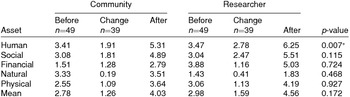
To test our approach, we asked respondents to identify, based on their experience, the general pre-partnership asset levels for each of the five capital asset categories for both researcher and community partners on a scale from 0 to 5. Overall, researchers were rated as having a higher initial asset level (2.98) than their local counterparts (2.78) although these values were not significantly different (p=0.332) (Table 2). In a case study conducted by the authors, it was recognised that this perceived disparity of initial benefits supports uneven relationships of power which permeate the partnership process (Brunet et al., Reference Brunet, Hickey and Humphries2014a). Initial community assets were scored as follows (high to low): human, natural, social, physical and financial. Initial researcher assets were scored as follows (high to low): financial, human, physical, social and natural. Given the nature of the survey tool, it was difficult to determine which elements of each capital asset category (in Table 2) were perceived to be the highest. However, Brunet et al. (Reference Brunet, Hickey and Humphries2014a) also found that elements of local human and social capital were critical to building research partnerships. Furthermore, access to rich natural capital was found to provide a foundation upon which these assets were built. Previous research supports the findings regarding researcher contributions to research partnerships. In particular, numerous studies have suggested that being employed by researchers in the field is critical to achieving local benefits (Gearheard & Shirley, Reference Gearheard and Shirley2007; Korsmo & Graham, Reference Korsmo and Graham2002; Pearce et al., Reference Pearce, Ford, Laidler, Smit, Duerden, Allarut and Wandel2009). Beyond financial gain, employment provides opportunities to be on the land, often perceived as prohibitively expensive and time consuming although fundamental to identity, cultural continuity, intergenerational knowledge transfer and mental health (Brunet et al., Reference Brunet, Hickey and Humphries2014a).
Results of the survey including mean asset scores (before, after, relative change) for the five asset categories for community and researcher partners, including the significance of the difference between community change and researcher change.

*Significant difference with 95% confidence level (n=39)
We then asked respondents to assess the changes in capital asset levels, again based on their experience working on research projects and/or their career in Arctic research. Overall, our results indicated very low to moderate perceived positive changes in all categories for both stakeholder groups. Researchers were perceived to gain more overall (Table 2). Respondents indicated that the highest changes in asset categories resulting from research partnerships were related to human and social assets, followed by financial assets for both groups. The human capital category was the only asset where researchers were seen as gaining significantly more than local partners (p=0.00735), although researchers were perceived to gain considerably more social capital as well (the lack of statistical significance in our results is probably due to the small sample size). Qualitative responses indicated that partnerships were perceived to benefit researchers more because of the potential to develop professional networks and legitimacy within their field of study. Financial gains for local partners were generally associated with short-term employment.
These survey findings are consistent with previous studies regarding the outcomes of research partnerships in Arctic Canada, particularly that effective research partnerships tend to strengthen human and social capital in the long term (Brunet et al., Reference Brunet, Hickey and Humphries2014a; Pearce et al., Reference Pearce, Ford, Laidler, Smit, Duerden, Allarut and Wandel2009). Social capital outcomes can benefit all stakeholders, including legitimising both scientific and indigenous knowledge systems, as well as promoting mutual understanding amongst research partners. Survey respondents generally perceived local partners as gaining more than researchers in terms of financial capital, although some literature suggests this may not be the case in the long term, given that successful research projects will probably lead to more grants and career advancement for the researchers themselves (see Brunet et al., Reference Brunet, Hickey and Humphries2016). A number of our respondents suggested that the benefits of research partnerships were typically and overwhelmingly in favour of researchers ‘who will always win, because they are building their careers on the backs of local partners’ (respondent quote). This dissatisfaction with research partnerships was reported as being more the result of poorly designed research mechanisms and policies where ‘the status quo still reigns’ (respondent quote). Viewed through this lens, stakeholder engagement in Arctic research may not be achieving the desired outcomes because established research practices and policies, such as faculty tenure and promotion processes, graduate programme requirements, publication norms, and data ownership and sharing, as well as reporting practices, may not align well with participatory research strategies.
The capital assets-based approach to understanding research partnerships within the context of Arctic policy and practice
Respondents indicated that an important contribution of the capital assets approach proposed in this study was the value it attributed to the intangible contributions of partners to successful research programmes. They reported that certain components of social and human capitals (for example, local bonds of trust and community cohesion, the strength of traditional decision-making processes and land-based knowledge) that often characterise Arctic communities in Canada tend not to be recognised as formal contributions to research programmes, unlike the availability of research personnel, infrastructure and equipment. While numerous studies have suggested that these intangible contributions are highly valuable to partnership success, their actual contribution to building research relationships amongst diverse partners while facilitating high quality research outputs remains poorly understood (Brunet et al., Reference Brunet, Hickey and Humphries2014b; Dyer et al., Reference Dyer, Stringer, Dougill, Leventon, Nshimbi, Chama and Muhorro2014; Eriksson et al., Reference Eriksson, Fredriksson, Fröding, Geidne and Pettersson2014).
Respondents also identified some important considerations regarding further development of a capital assets approach to understanding partnerships. First, the concept of natural capital was often understood quite differently by our respondents. For example, assigning elements of natural capital to specific stakeholder groups was fairly clear when it came to established indigenous lands (under treaties, land claims, etc.) but lost much of its relevance beyond this, where boundaries of membership and ownership were contested, unclear or non-existent. In the Canadian context, this often occurs when First Nations have recognised rights on small parcels of land, known as reserves, that may represent small fractions of, or be distant from, their traditional territories. Perceptions of natural capital levels may therefore differ locally based on an individual's access to, and knowledge of, lands beyond the reserve. Similarly divergent perceptions concerning natural capital may also be held by non-local research stakeholders. Second, respondents reported that our approach was overly simplistic and would require further field development to adequately capture the subtler aspects of social capital. For instance, one respondent stated:
I'm not sure how I am supposed to quantify how much trust was developed as a result of my work.
This issue is not uncommon in the literature and is an ongoing area of research in various disciplines (see for example, Stern & Coleman, Reference Stern and Coleman2015; Temby, Rastogi, Sandall, Cooksey, & Hickey, Reference Temby, Rastogi, Sandall, Cooksey and Hickey2015). Krishna & Shrader (Reference Krishna and Shrader1999) point to specific issues in the assessment of social capital in their work. In particular, they indicate the need to tailor the specific elements of social capital to diverging cultural contexts and scales, which would otherwise prevent our approach from being a standardised data collection tool. This is not a surprising result and points to the need for further research, refinement and field validation in different research partnership contexts before such a policy tool could become available.
Interestingly, some respondents questioned the relevance of trying to evaluate the impacts of research in isolated Arctic communities, where economic, health and other social issues can be so prominent. For example,
the challenges faced by northerners are so great that research partnerships pale in comparison regardless of how well-conducted they are (respondent quote).
This raises the important question of the extent to which northern research and research policy is tied to northern development objectives – an open question, but one that will be difficult to answer in the absence of more integrative research evaluation frameworks, such as the capital asset-based approach proposed in this paper.
Conclusion
Using stakeholder perceptions, we assessed the potential of a capital assets-based approach to help understanding research partnership outcomes in Arctic Canada. We believed that emphasising the importance of relative outcomes in this context had the potential to address some of the issues that are known to arise when using participatory research methods as proxy measures of partnership success. Although our survey of Arctic research stakeholders has revealed that a capital assets approach could be useful to this end, it also identified important limitations to such a conception, especially as it related to the assessment of more subtle outcomes (such as specific elements of social and natural capital). Given this, further studies and testing will be needed to adequately refine a capital assets-based approach to research partnership evaluation and assess its relevance and policy implications with local and regional collaborators in the Canadian Arctic as well as major funding agencies. Nonetheless, this study offers a step towards developing more nuanced assessments of research relationships and, as such, better recognising the achievements of those who dedicate time and energy to these practices.
Acknowledgments
We would like to thank the participants for completing the survey and providing us with valuable information to test our framework. Nicolas D. Brunet's research is funded by the Fond Québécois de Recherche sur la Science et la Culture and the NSERC Northern Research Chairs Program (M.M. Humphries).