1 Introduction
An interesting case of intra-dialectal variation is the construction be sat/be stood with progressive meaning, which alternates with the standard progressive form in a number of British English dialects. Using a corpus-based approach, this article addresses the question of which factors govern intra-dialectal variation between progressives and so-called ‘pseudo-passives’ (Klemola Reference Klemola1999, Reference Klemola, Kastovsky, Kaltenböck and Reichl2002) in British English. The examples below illustrate the morphosyntactic phenomenon in question:
-
(1)
-
(a) He was sat there and he was going brr brr brr brr brr. (KCE: 4738)
-
(b) Last night [pause] I was sitting er what was I watching? (KCJ: 216)
-
-
(2)
-
(a) Well when you’re stood there you can see the flames. (KD2: 303)
-
(b) Wondered what I was standing on there it's a bit of squashed carrot. (KB8: 11455)Footnote 2
-
Utterances (1a) and (2a) look like passive sentences in that the auxiliary be is followed by a past participle, but their function competes with the standard forms as they appear in (1b) and (2b) (be + present participle). Thus, they are active in terms of their semantics but passive as regards their form – hence the term pseudo-passive. In Standard English, these constructions are deemed incorrect, unless they are proper passive constructions after all (see Wood Reference Wood1962 [1981]: 235, 253), for ‘they could only mean that the person in question was placed there by someone else’ (Wood Reference Wood1962 [1981]: 196). Furthermore, they are a feature of regional usage and ‘very common, even amongst well-spoken people’ (Wood Reference Wood1962 [1981]: 235). Klemola (Reference Klemola1999: 131) views pseudo-passives with sat and stood as ‘a case of relatively recent innovation in the morphosyntax of some Northern dialects of English’. In particular, he argues that this innovation was the result of hypercorrection (see Klemola Reference Klemola1999: 139): In his ‘admittedly somewhat speculative scenario’ (Klemola Reference Klemola1999: 137), the introduction of the past participle sat in the late nineteenth century replaced the old form sitten, which, in Northern dialects of English, was homophonous with the present participle sitting (see Ellis Reference Ellis1981: 292; Klemola Reference Klemola1999: 137). Sat was then also used in cases where sitting would have been appropriate as a result of hypercorrection. An analogical spread concerning the forms stood and standing completes the story (see Klemola Reference Klemola1999: 137). However, more data are needed to verify this claim.
The focal point of the present case study is speakers who alternate between the use of the dialectal variant with sat or stood and the standard form with sitting or standing. This switch may even take the form of a super token, i.e. alternation of variants by the same speaker in the same stretch of discourse (see Tagliamonte Reference Tagliamonte2006: 96), as example (3) below shows:
-
(3) [. . .] and he’s sitting outside and he goes, he's mum goes well he's been out there two weeks and he’s still stood there in the same spot [. . .] (KDA: 7265)
The analyses are based on data drawn from the spoken section of the British National Corpus (BNC), more precisely the subcorpus ‘conversation’ (data recorded in the early nineties of the twentieth century). This article will (a) present an overview on the geographical distribution of the pseudo-passives with sit and stand in Great Britain, mainly confirming previous findings (Cheshire et al. Reference Cheshire, Edwards and White1989, Reference Cheshire, Edwards, White, Milroy and Milroy1993; Klemola Reference Klemola1999), (b) it will show in which dialect areas these constructions occur and (c) how frequently they do so, (d) it will identify variation patterns based on dialectal distributions, and, most importantly, (e) it will test for all of the following factors which potentially have an influence on the variation phenomenon under investigation: age (see Rosenbach Reference Rosenbach2003), gender (see Labov Reference Labov2001), horror aequi (see Rohdenburg Reference Rohdenburg2003) and cognitive complexity (see Rohdenburg Reference Rohdenburg1996, Reference Rohdenburg, Plag and Schneider2000, Reference Rohdenburg2003).
2 Case study: factors governing intra-dialectal variation with pseudo-passives and progressives
2.1 Previous studies
Previous studies on pseudo-passives have focused mainly on their geographical distribution (Cheshire et al. Reference Cheshire, Edwards and White1989; Klemola Reference Klemola1999; Kortmann & Szmrescanyi Reference Kortmann, Szmrecsanyi, Kortmann, Burridge, Mesthrie and Schneider2004) and their recent rise in frequency (Rohdenburg & Schlüter Reference Rohdenburg, Schlüter, Rohdenburg and Schlüter2009).
A questionnaire-based survey on dialect grammar conducted by Cheshire et al. (Reference Cheshire, Edwards and White1989: 200) found that pseudo-passives with sat and stood were reported all over the country, with ‘some regional preferences’ in the north and in the south of England. Even in the East and West Midlands 67 per cent (N = 21) of the schools confirmed their occurrence (see Cheshire et al. Reference Cheshire, Edwards and White1989: 200). As a result, the same survey identified these pseudo-passive constructions as ‘becoming characteristic of a general non-standard or semi-standard variety of English’, with the data indicating ‘a recent diffusion of these features from the north and west of England’ (Cheshire et al. Reference Cheshire, Edwards and White1989: 200, see also Cheshire et al. Reference Cheshire, Edwards, White, Milroy and Milroy1993: 70–1).
Klemola's (Reference Klemola1999) follow-up study was based on the Survey of English Dialects (SED; spoken data recorded 1948–73) and the spoken demographic part of the BNC (spoken data recorded in the early 1990s). He found that pseudo-passives with sat and stood were very rare in both corpora, with 30 occurrences per million words (occ. pmw) in the SED (corrected to 25 occ. pmw in Klemola Reference Klemola, Kastovsky, Kaltenböck and Reichl2002: 53) and 20 occ. pmw in the BNC (Klemola Reference Klemola1999: 134). Furthermore, the instances were concentrated in the Northern and North Midlands counties in the SED data but more diffused in the BNC, with ‘additional areas in the South-West of England and in London’ (Klemola Reference Klemola1999: 134), which points to a spread of pseudo-passive constructions that originated in the north of the country as suggested by Cheshire et al. (Reference Cheshire, Edwards and White1989: 200). Moreover, constructions with sat were considerably more frequent than with stood (see Klemola Reference Klemola1999: 134).
In The Electronic World Atlas of Varieties of English (eWAVE; Kortmann & Lunkenheimer Reference Kortmann and Lunkenheimer2013), the feature ‘be sat/stood with progressive meaning’ (no. 95) is attested as ‘neither pervasive nor extremely rare’ in Welsh English and in English dialects in the North of England, as ‘exist[ing] but extremely rare’ in Irish English, Manx English, English dialects in the Southwest of England, East Anglian English and Scottish English, and as ‘absent’ from Orkney and Shetland English, English dialects in the Southeast of England, Channel Islands English, Maltese English and British Creole (only varieties found in the British Isles are considered here; http://ewave-atlas.org/parameters/95#0/-0/0).
Rohdenburg & Schlüter (Reference Rohdenburg, Schlüter, Rohdenburg and Schlüter2009: 403) analysed a variety of British newspapers, showing that the number of occurrences per million words increased rather drastically for constructions with be sat (from 0.14 to 0.78 occ. pmw) and be stood (from 0.05 to 0.22 occ. pmw) between the early 1990s and 2004/5. The authors also draw attention to other verbs which are relevant in the discussion of pseudo-passives with verbs of posture, viz. laid, headed, sprawled, crouched, huddled, hunched, lolled, perched, squatted, steered and stooped, but restrict their analysis to sit, stand and headed (see Rohdenburg & Schlüter Reference Rohdenburg, Schlüter, Rohdenburg and Schlüter2009: 401–2).
Pseudo-passives with sit and stand also feature as an item of ‘ornamental complexity’ in a survey on simplification and complexification in World Englishes (Kortmann & Szmrecsanyi Reference Kortmann, Szmrecsanyi, Siebers and Hoffmann2009: 273). The term ornamentally complex describes features that ‘complicate the system vis-à-vis the standard system, without clearly yielding an added communicative bonus’ (Kortmann & Szmrecsanyi Reference Kortmann, Szmrecsanyi, Siebers and Hoffmann2009: 272). In the case of pseudo-passives, the complication involves the discrepancy between form (passive) and function (active/progressive).
As to support strategies (viz. the selection of linguistic variants that facilitate processing in cognitively complex environments), recent research has shown that a number of variation phenomena like synthetic vs analytic comparatives (see Mondorf Reference Mondorf2009), sentence end-weight (see Eitelmann, this issue), complementation (see Rohdenburg, this issue) or clause ordering (Wiechmann & Kerz, this issue) can be accounted for by different needs to facilitate processing. The more cognitively complex the linguistic environment is, the more need there seems to be to compensate for the increased processing load. Relevant strategies include Rohdenburg's (Reference Rohdenburg1996) ‘Complexity Principle’, Hawkins’ (Reference Hawkins2004) ‘Minimize Domains’, Wurzel's (Reference Wurzel and Dressler1987) ‘Principle of Uniformity and Transparency’, or Bates & MacWhinney's (Reference Bates, MacWhinney and MacWhinney1987) ‘Competition Model’. For present purposes, only the Complexity Principle plays a role, and it will be explained in the relevant section later on.
2.2 Research questions
In addition to the frequency and the geographical distribution of pseudo-passives within the British Isles, the present case study addresses the following research questions in turn:
-
(a) Do certain dialects show a stronger preference for be sat/stood constructions?
-
(b) Are speakers more likely to use the dialectal variant with sit or with stand?
-
(c) Do speakers display more variation with sit or with stand?
-
(d) Are speakers of a certain age more likely to use the dialectal variant?
-
(e) Are female speakers more likely to use the standard variant?
-
(f) Do speakers favour be sat/stood if there are (near-)adjacent -ing forms?
-
(g) Is this variation phenomenon sensitive to cognitive complexity?
-
(a) Previous studies have shown that, within the British Isles, constructions with be sat and be stood seem mainly confined to certain areas in the North and Southwest of England (see Cheshire et al. Reference Cheshire, Edwards and White1989; Klemola Reference Klemola1999). The present case study will provide a fine-grained analysis of the distribution of pseudo-passives with sit and stand in Great Britain, identifying those dialect areas that favour their use.
-
(b) As the base frequency of sit is higher than that of stand (656 vs 245 occurrences pmw of the respective verb in the BNC, subset ‘conversation’), it is plausible that constructions with be sat are also more frequent than their counterpart with stood.
-
(c) For those dialects that have both the standard form (be sitting/standing) and the dialectal variant (be sat/stood), the aim is to determine which construction is generally preferred and how many speakers (relatively speaking) switch back and forth between them.
-
(d) Rosenbach (Reference Rosenbach2003) has shown that age may be a determinant factor reflecting change-in-progress. More precisely, older speakers (aged forty or older) tend to behave more conservatively in linguistic terms, while younger speakers (aged thirty-nine or younger) are more prone to promote linguistic innovation (2003: 394–5). Including age as a potentially relevant factor in the analysis of the present data will show whether the use of pseudo-passives is a phenomenon linked to innovation (in that it is mainly used by younger speakers) or conservatism (in that it is mainly used by older speakers).
-
(e) Since it has been suggested that female speakers, all other things being equal, ‘show a lower rate of stigmatised variants and a higher rate of prestigious variants than men’ (Linguistic Conformity of Women Principle, Labov Reference Labov2001: 266), the analysis of the data will also include a test for gender-sensitivity. According to this principle, female speakers should favour the use of be sitting/standing, as it represents the standard (and thus ‘prestigious’) form.
-
(f) The horror aequi-principle (see Rohdenburg Reference Rohdenburg2003) predicts that speakers who use be sat/stood and be sitting/standing interchangeably should favour the former construction if it is followed closely by an -ing form (as in we were sat listening to him (KCV: 4926) vs No I don't wanna be sitting messing around with computers freezing my bum off! (KDB: 402)). Thus, this factor will also be considered in the analysis as a potential trigger for intra-dialectal variation.
-
(g) The Complexity Principle states that ‘[i]n the case of more or less explicit grammatical options the more explicit one(s) will tend to be favoured in cognitively more complex environments’ (Rohdenburg Reference Rohdenburg1996: 151). Since be sat/stood-constructions can be viewed as ‘ornamentally complex’ items (Kortmann & Szmrecsanyi Reference Kortmann, Szmrecsanyi, Siebers and Hoffmann2009), exhibiting a discrepancy between form and function, their standard counterpart with the present participle represents the more explicit variant. Consequently, speakers should opt for be sitting/standing in cognitively complex environments to ease the processing load as opposed to adding to it by using a morphosyntactically ambiguous construction.
Both horror aequi and the Complexity Principle will be explained in more detail in the relevant sections below.
2.3 Database and method
The database used for the present analysis is the subset ‘conversation’ of the spoken section in the British National Corpus (BNCweb, CQP-edition). It comprises 153 different texts recorded between the 1980s and 1993 and amounts to 4.2 million words. 26 dialect areas are distinguished in this corpus, 19 of them British ones. They include: East Anglia, Home Counties, Humberside, Lancashire, London, Merseyside, Central/Northeast/South/Northwest Midlands, Central Northern/Northeast/Northern England, Lower/Central/Upper Southwest England as well as the British varieties Irish, Scottish and Welsh English. Two further categories, ‘no accent recorded’ and ‘other or unidentifiable’, complete the picture.
To maximise the number of relevant hits for pseudo-passive constructions with stood and with sat the search string included up to three intervening words between the auxiliary be and the past participle. Thus, negated constructions (4) as well as constructions with additional material (5) were also included in the analysis.
-
(4) I say I weren't sat there like I was with that fella [. . .] (KB7: 3566)
-
(5) And like, Ian was just, cos he's like Barry [gap:name] and Ian was just sort of stood there going [pause] [. . .] (KCE: 1452)
In addition to the lemmatised search, a separate search using the strings ’s *** stood and ’s *** sat was conducted, for not all relevant hits could be found via the lemmatised search.
Any irrelevant hits (6a) or ambiguous ones (6b) were discarded, as were repetitions (6c) and occurrences of be sat and be stood in constructions that are not synonymous with the standard variants be sitting and be standing. Thus, hits like (7a–b) were included in the analysis, but occurrences like (8a–b) were not.
-
(6)
-
(a) Well I, I've gotta be honest in what I'm saying, I sat through two services yesterday [pause] the morning service did a lot for me. (KB0: 3736)
-
(b) You were [unclear] sat down. (KE6: 4005)
-
(c) Oh not all of them, I was sat, I, I was sat there. (KCE: 7311)
-
-
(7)
-
(a) While [. . .] you’re stood up have a second [pause] and [pause] well each [unclear] worship, right? (KB0: 8164)
-
(b) Cos he, he's, he’s only stood about for first hour anyway. (KBD: 72)
-
-
(8)
-
(a) He said I was left stood there with this other mate on me other side [. . .] (KDA: 8678)
-
(b) Well one day you'll be about eighty, dear and you'll be the one sat there and someone saying, bloody hell look at that old codger behind the wheel. (KB7: 11226)
-
In a second step, details about the speakers concerning their age, gender and dialect used were extracted for the relevant utterances. The search for the competing standard constructions (be sitting/standing) was then restricted to those speakers in the subset ‘conversation’ that used any one of the dialects for which the use of be stood and be sat had been recorded, respectively. For reasons of comparability, constructions with intervening material were also considered, and a separate search using the string ’s *** sitting/standing was conducted to obtain optimum results. In short, the search strings {be} *** sat/stood and ’s *** sat/stood were restricted to the subset ‘conversation’ only, while {be} *** sitting/standing and ’s *** sitting/standing were also dialect-specific. As with the dialectal variant, any irrelevant hits and repetitions were excluded from further analysis. In addition, any occurrences of be sitting and be standing within phrasal verbs that allow no variation were also discarded (9).
-
(9) You could write on it any time but then you're just sitting in all day. (KDN: 4101)
Again, occurrences of be sitting and be standing in constructions that do not instantiate progressives were eliminated (10a–b).
-
(10)
-
(a) Yeah, but it's somebody sitting in an office innit [pause] deciding this! (KBD: 8246)
-
(b) Anyway, arrived at the station and there was this great coach standing there waiting to take them all to [unclear]. (KBW: 1469)
-
The remaining data were then checked for speakers using either both or only one of the constructions under investigation. For dialect variation and the variables age and gender the actual number of speakers (as opposed to the number of utterances) forms the basis for making statements about the distribution of pseudo-passives. With regard to horror aequi and cognitive complexity, on the other hand, the number of utterances produced by speakers switching back and forth between the standard and the dialectal variant is relevant. This difference in approaching the data is motivated by the nature of the research questions as outlined above in section 2.2; only for the last two questions do we need the actual number of utterances. For all other research questions it suffices to know whether pseudo-passives are being used by a given speaker or not, no matter the frequency.
2.4 Results
2.4.1 Frequency of be stood and be sat
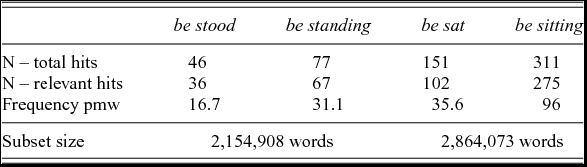
The total number of relevant hits was 36 for be stood and 102 for be sat, which corresponds to 8.5 and 24 occurrences pmw in the BNC subset ‘conversation’, respectively. A total of 27 speakers were found using pseudo-passive constructions with be stood and 54 with be sat (the total number of different speakers was 70). Looking only at frequencies within the dialect areas that make use of these pseudo-passives yielded 16.7 occurrences pmw for be stood and 35.6 for be sat (table 1). The competing standard constructions were nearly two to three times more frequent (31.1 occ. pmw for be standing and 96 occ. pmw for be sitting; table 1).
Frequency of constructions under investigation in the BNC subset ‘conversation’

2.4.2 Geographical distribution of be stood and be sat
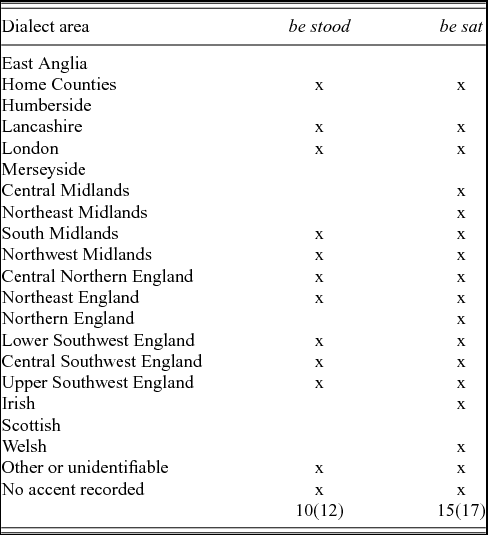
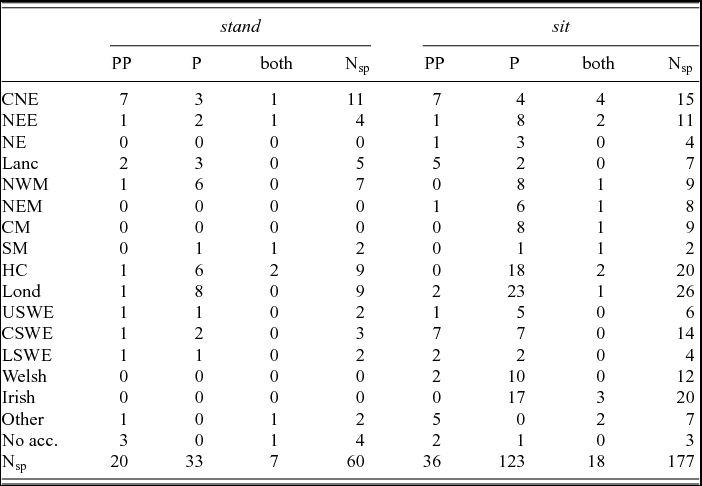
Table 2 shows that the pseudo-passives with be stood and be sat occurred in ten and fifteen of the 19 dialect areas distinguished in the BNC, respectively. Thus, the data indicate that the use of be sat is more widespread in the British Isles. Furthermore, all of the ten dialect areas that make use of constructions with be stood also use be sat. Consequently, there is a common core of dialects that use pseudo-passives with both verbs of posture, and it seems as if the spread of these constructions is spearheaded by be sat. This makes perfect sense considering that, generally speaking, the verb sit is more frequently used than stand (656 vs 245 occ. pmw in the BNC, subset ‘conversation’).
Distribution of pseudo-passives with stood and sat in British dialect areas (BNC, subset ‘conversation’)

Note: Figures in brackets include occurrences for categories ‘other or unidentifiable’ and ‘no accent recorded’.
Interestingly, the use of pseudo-passives was attested in the Midlands and in the Home Counties, even though Klemola (Reference Klemola1999: 134) found that they were entirely absent ‘in the Midlands [and] in the South-East of England in the BNC spoken demographic component’. The dataset used for the present study is identical, so there must have been differences in the settings of the search parameters that account for this discrepancy. Unfortunately, Klemola (Reference Klemola1999) fails to provide the details for the search strings he used, but it is most likely that the approach used for this article cast a wider net and thus obtained more relevant hits (as it allowed intervening material between the auxiliary and the past participle and also included negated forms).
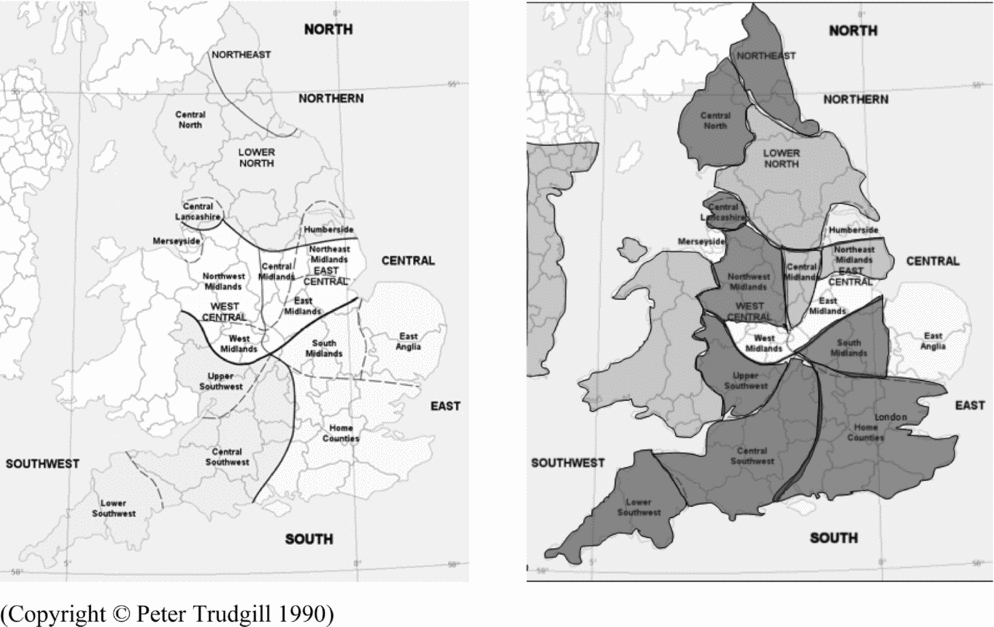
The results confirm once again, however, that the use of pseudo-passives is common and apparently ‘spreads from . . . two discontinuous areas’, namely the North and the Southwest (Kortmann & Wagner Reference Kortmann, Wagner and Pérez-Guerra2007: 293; see also Cheshire et al. Reference Cheshire, Edwards and White1989, Reference Cheshire, Edwards, White, Milroy and Milroy1993; Klemola Reference Klemola1999, Reference Klemola, Kastovsky, Kaltenböck and Reichl2002; figure 1 illustrates the geographical distribution of pseudo-passives in Britain).
Left – English dialect areas (Trudgill Reference Trudgill1990: 63); right – dark areas: be stood and be sat, light areas: be sat only (NSP_be stood = 27, NSP_be sat = 54)

2.4.3 Dialectal preferences for be sat and be stood
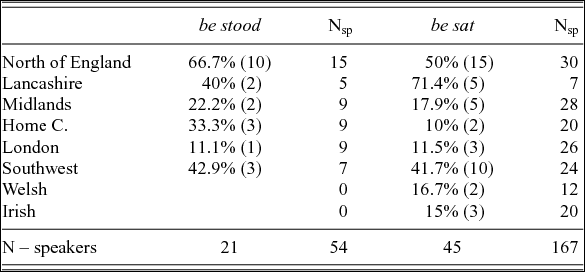
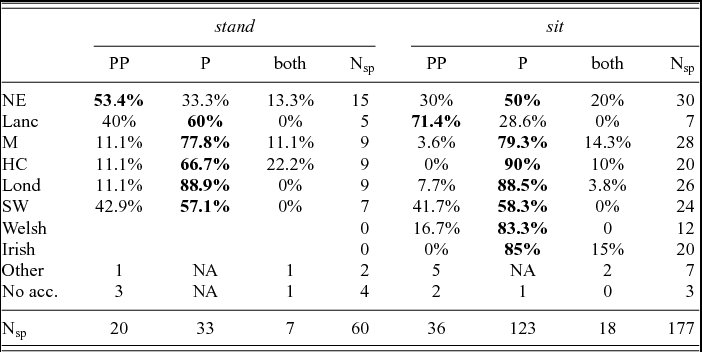
In the data at hand, pseudo-passive constructions with be stood and be sat were most frequently used in dialects of the North of England (66.7 and 50 per cent of all speakers, respectively), the Southwest (42.9 and 41.7 per cent) and Lancashire (40 and 71.4 per cent). In the other dialect areas, they were not commonly used and they were not attested at all for Humberside, East Anglia, Merseyside and Scotland (tables 3 and A1).
Distribution of speakers using pseudo-passives with sat and stood in British dialect areasFootnote 3

2.4.4 Variation patterns for be sat/sitting and be stood/standing
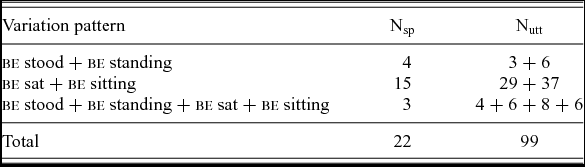
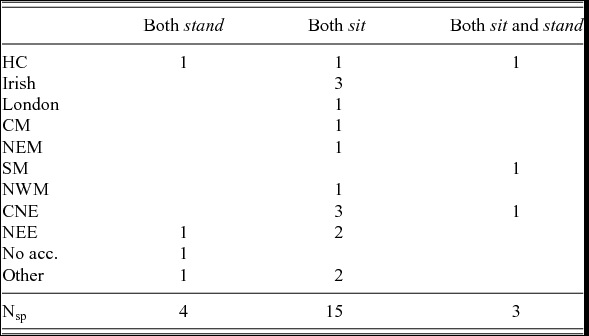
In the data at hand, 22Footnote 4 of the 70 speakers using pseudo-passive constructions displayed variation between the use of pseudo-passives and the standard form with the present participle (table 4). Most of these speakers used a dialect spoken in the North of England (see table A2 in the Appendix). In the BNC, there was no variation as regards the use of pseudo-passives where speakers from Lancashire, the Southwest or Wales were concerned. However, this does not necessarily mean that speakers of these dialects only use one or the other construction. Rather, they might just be underrepresented in the conversational data of the BNC.
Speakers displaying variation in their use of pseudo-passives and progressives (BNC, subcorpus ‘conversation’)

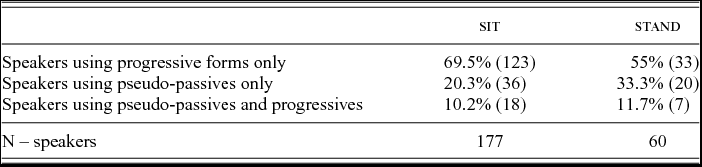
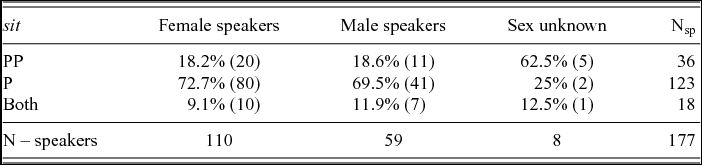
Table 5 shows that, for both sit and stand, one in ten speakers switched back and forth between the pseudo-passive construction and the standard form with the present participle. Thus, there were no notable differences as regards the tendency for variation (chi square test: variation +/–, sit/stand, p = 0.744, df = 1, χ2 = 0.106).
Distribution of pseudo-passives and progressives in the BNC subcorpus ‘conversation’ in the dialect areas considered

Interestingly, although pseudo-passives with sit were considerably more frequent than with stand in the BNC subcorpus ‘conversation’ (35.6 vs16.7 occ. pmw; see table 1), speakers were much more likely to opt for the pseudo-passive construction (as opposed to the progressive form) with stand than with sit (45 vs 30.5 per cent, table 5; chi square test, p = 0.041, df = 1, χ2 = 4.183).
2.4.5 Age
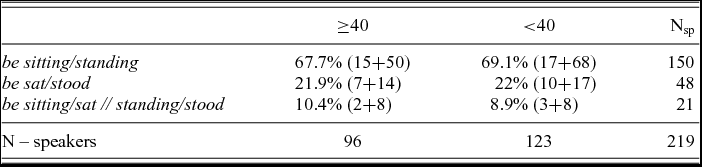
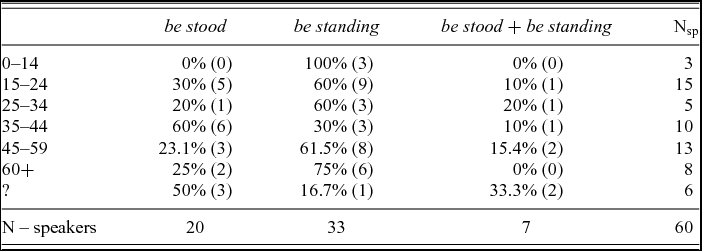
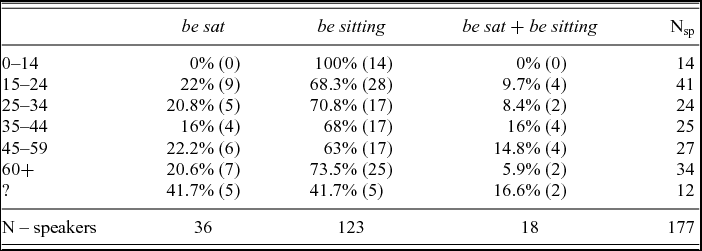
Rosenbach (Reference Rosenbach2003) has shown that age may be a determinant factor reflecting change-in-progress. More precisely, older speakers (aged forty or older) tend to behave more conservatively in linguistic terms, while younger speakers (aged 39 or younger) are more prone to promote linguistic innovation (Reference Rosenbach2003: 394–5). Including age as a potentially relevant factor in the analysis of the present data will show whether the use of pseudo-passives is a phenomenon linked to innovation (in that it is mainly used by younger speakers) or conservatism (in that it is mainly used by older speakers). In the BNC data, both generations behaved virtually alike (see table 7). Looking at the age groups in more detail (by using the BNC categories) revealed that speakers aged 0–14 did not use pseudo-passives at all, but all other speakers again behaved almost identically. Footnote 5 Thus, age turned out to be a non-significant factor with respect to the use of the dialectal variant (chi square test, p = 0.825, df = 1, χ2 = 0.049).
Distribution of pseudo-passives and progressives with sit and stand

2.4.6 Gender
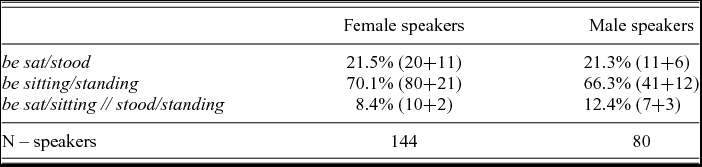
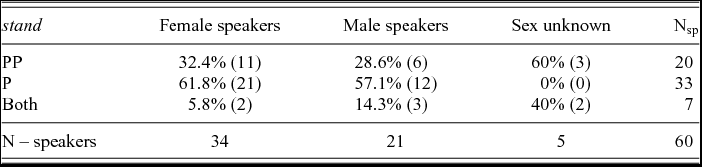
Since it has been suggested that female speakers, all other things being equal, ‘show a lower rate of stigmatised variants and a higher rate of prestigious variants than men’ (Linguistic Conformity of Women Principle, Labov Reference Labov2001: 266), the analysis of the data also included a test for gender-sensitivity. In this scenario, the dialectal variant with be sat/stood is the stigmatised variant, and the standard form be sitting/standing the prestigious one. Table 7 shows that female and male speakers behaved virtually identically as regards the distribution of pseudo-passive and standard constructions. Thus, gender has no effect on the use of be sat/stood and be sitting/standing (chi square test, p = 0.547, df = 1, χ2 = 0.362; pseudo-passive +/–, male/female).
Frequency of dialectal and standard constructions for male and female speakers

2.4.7 Horror aequi
Another factor that could have an influence on intra-dialectal variation is the horror aequi principle, which ‘involves the widespread (and presumably) universal tendency to avoid the use of formally (near-)identical and (near-)adjacent (non-coordinate) grammatical elements and structures’ (Rohdenburg Reference Rohdenburg2003: 236).Footnote 6 In the same vein, the horror aequi principle predicts that speakers who use be sat/stood and be sitting/standing interchangeably should favour the former construction if it is followed closely by an -ing form. Thus, utterances like (11a–b) should be found less frequently in the data than the ones in (12a–b).
Successive -ing forms:
-
(11)
-
(a) [. . .] and we were sitting having a wee drink [. . .] (KE1: 2278)
-
(b) Well we‘re just standing drinking this, [. . .] (KCP: 6271)
-
Horror aequi principle applies:
-
(12)
-
(a) we were sat listening to him the other night (KDV: 4926)
-
(b) And we were stood waiting (KCX: 4160)
-
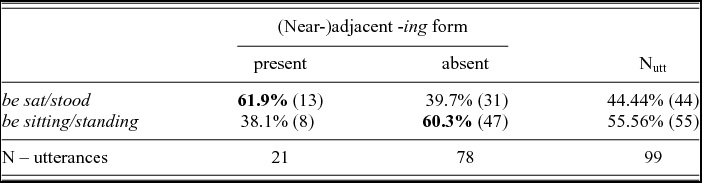
In the data at hand, 22 speakers showed variation in their use of be sat/stood and be sitting/standing. Together, these speakers produced 99 utterances containing the desired constructions. Three different types of instances were considered as relevant for the analysis:
-
a. Immediate succession of ing-form (11 occurrences)
-
(13) when I went round she was sat doing crossword on bed (KB1: 556)
-
b. Intervening material: one unstressed lexical item (8 occurrences)
-
(14) we'll be sat there thinking well it was bloody worth it (KB7: 13692)
-
c. Intervening material: one stressed item (2 occurrences)
-
(15) and it's going to be standing around doing nothing for most of the time [. . .] (KB8: 3864)
In total, in 21 of the 99 utterances relevant here the predicate was (closely) followed by an -ing form. In these particular contexts, the ratio between the dialectal and the standard variant was 6:4, which is indicative of a (slight) preference for pseudo-passive constructions. In the remaining utterances the situation is reversed; if there is no (near-) adjacent (near-)identical form, said ratio is 4:6 (table 8). This distribution failed to prove significant, however (chi square test, p = 0.07, df = 1, χ2 = 3.291).
Effect of horror aequi on distribution of pseudo-passives and progressives

2.4.8 Complexity Principle
The last factor under investigation is the Complexity Principle, which states that ‘[i]n the case of more or less explicit grammatical options the more explicit one(s) will tend to be favoured in cognitively more complex environments’ (Rohdenburg Reference Rohdenburg1996: 151). Since be sat/stood-constructions can be viewed as ‘ornamentally complex’ items (Kortmann & Szmrecsanyi Reference Kortmann, Szmrecsanyi, Siebers and Hoffmann2009: 273) (because of the discord between form and function), they constitute the less explicit option compared to their standard counterpart with the present participle.Footnote 7 Consequently, speakers should opt for be sitting/standing in cognitively complex environments to ease the processing load as opposed to adding to it by using a morphosyntactically ambiguous construction. Indeed, utterances containing the standard form represent the more explicit option: The present participle in and it's going to be standing around doing nothing for most of the time (KB8: 3864) consists of two transparent morphemes ({stand} + {progressive}) and allows an analytic reading (stand + -ing). The pseudo-passive as in we'll be sat there thinking well it was bloody worth it (KB7: 13692), on the other hand, is less explicit: not only is the form that of a passive although its semantics are active and progressive, but it is also synthetic and has been subject to suppletion. Furthermore, it is ambiguous because, after all, it might be a proper passive sentence depending on the context. Weighing the effects on online processing, it makes perfect sense to assume that speakers will favour the standard form in cognitively complex environments.
Examples of cognitively complex environments include the following:Footnote 8
-
a. Hypotactic structures
-
(16) I don't know whether they were actually sitting right [. . .]. (KBD: 3653)
-
b. Non-assertive contexts
-
(17) No, I say I'm not sitting here much longer. (KB7: 16324)
-
c. Infrequent items
-
(18) . . . for hauling stolen meat, and we were sitting and all. . . (KE1: 2290)
For the present purposes, hypotactic structures include any phrases or clauses in a dependent or subordinate relationship as well as subordinate clauses, while negative, interrogative and conditional clauses are subsumed under non-assertive contexts. Infrequent items in the data included, for instance, haul (3.8 occ. pmw in the spoken part of the BNC), horoscope (0.8 occ. pmw) and stiletto (0.2 occ. pmw).
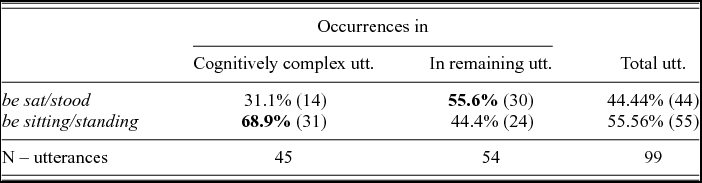
Table 9 indicates that the speakers showed no pronounced preferences for either the standard variant or the pseudo-passive construction in ‘simple’ utterances. However, in cognitively complex environments the scales were tipped in favour of more explicit be sitting/standing. This shift in balance was significant (p = 0.015, χ2 = 5.940, df = 1, chi square test), which confirms that speakers opt for the standard variant when processing becomes more difficult due to the use of hypotactic structures, negations, etc.
Effect of cognitive complexity on variation between dialectal and standard variant

2.5 Discussion
The analysis of the distribution of pseudo-passive constructions with sat and stood and progressives with sitting and standing in the conversational data in the BNC has revealed a number of interesting findings.
First, the dialectal variant with sat and stood is very widespread in the British Isles, being attested in a total of 15 out of 19 dialect areas distinguished in the BNC. Thus, this peculiar construction is far from being a mainly northern phenomenon.
Second, the spread of the pseudo-passive in the British Isles seems to be spearheaded by constructions with sat. These were not only considerably more frequent (16.7 and 35.6 occ. pmw for be stood and be sat, respectively), but their speakers were also more spread out across the area (in that be sat was found in five additional dialect areas).
Next, the result that only horror aequi and cognitive complexity affected how speakers used the dialectal and the standard variantFootnote 9 is in line with a recent change of viewpoint:
It has been argued, in fact, that syntactic variation is conditioned less by social factors than by internal, cognitive and situational constraints (see, for example, Rydén Reference Rydén and Kastovsky1991; Scherre and Naro Reference Scherre and Naro1992), and that syntactic variation may rarely, if ever, serve the function of distinguishing social groups in the way that ‘classic’ phonological and morphological variants do (Winford Reference Winford, Arnold, Blake, Davidson, Schwentner and Solomon1996: 188; Hudson Reference Hudson1996: 45). (Cheshire Reference Cheshire, Britain and Cheshire2003: 245)
The current findings support this assumption in that age and gender made no difference in how the speakers used pseudo-passives, but with the constraints horror aequi and cognitive complexity there was a shift in preference. In horror aequi contexts, the tendency to avoid two successive -ing forms led to speakers favouring pseudo-passive constructions in two out of three cases. However, more data are needed to verify whether this trend is a real effect. Cognitive complexity turned out to have a significant influence on the variation between pseudo-passives and progressives. Supposedly, the choice of the more explicit standard variant compensates for the increased processing load in these particular contexts. Selecting the dialectal variant, which is ambiguous and more difficult to process per se because of its form (passive, irregular verb), would represent the less explicit, less listener-friendly option.
3 Conclusion and outlook
Using conversational data from the BNC, this article has explored a variety of factors that potentially govern intra-dialectal variation as regards the use of pseudo-passives and progressives. The data have revealed that age, gender and horror aequi have no significant influence on the variation phenomenon in question. As to the Complexity Principle, the results suggest that speakers disfavour constructions with be sat/stood in cognitively complex environments. The significant preference for the standard variant in these contexts can be accounted for by its being more explicit. Pseudo-passives are ‘ornamentally complex’ (Kortmann & Szmrecsanyi Reference Kortmann, Szmrecsanyi, Siebers and Hoffmann2009) and thus less explicit because they exhibit a discord between form (passive/simple) and function (active/progressive). Choosing the standard variant over the dialectal variant in cognitively complex environments can thus be classified as an instance of applying a ‘support strategy’, to facilitate processing.
Furthermore, constructions with be sat are more widespread in the British Isles than with be stood. More precisely, all dialect areas for which the use of be stood has been attested also have be sat, but not vice versa. The fact that the verb sit is used more frequently than stand easily accounts for this finding. In the data at hand, pseudo-passives with sit and stand were mostly associated with the dialects found in the North and the Southwest of England as well as Lancashire.
For further research it will be fruitful to investigate the use of pseudo-passive constructions in a variety of (ideally) speech-based historical corporaFootnote 10 also (to validate Klemola's (Reference Klemola1999) claim of their being a recent innovation), as well as compare the current findings to other contemporary data. Looking at more recent data might help to see whether the common use of pseudo-passives in two discontinuous areas in England (viz. the North and the Southwest) has become a truly ‘semi-standard’ English feature (in that it is now being used all over the country). It will also be interesting to investigate and compare the opposing effects of horror aequi and structural priming on the distribution of pseudo-passives and progressive forms.
Moreover, it will certainly be worthwhile to study variation with the forms sat and stood in other constructions where Standard English has an -ing form. To list only a few:
-
(18)
-
(a) Erm they spend lots of afternoons sat [sitting] out there (KE6: 4677)
-
(b) Look at that pigeon sat [sitting] there. (KBP: 4696)
-
(c) he let it out rather than have it stood [standing] there with the option for us to buy it (KB7: 2035)
-
(d) they just left me stood [standing] there (KCG: 55)
-
(e) Then it was the boy stood [standing] on the burning decks. (KBB: 6606)
-
(f) and you'll be the one sat [sitting] there (KB7: 11226)
-
(g) and there was some American sat [sitting] behind and I said [. . .] (KCB: 1743)
-
(h) I said you both look tired, that's sat [sitting] in front of that cinema screen all that time (KD1: 1903)
-
(i) It'll be very uncomfortable sat [sitting] in the back (KE5: 192)
-
These constructions are far from being one-off phenomena in the conversational data of the BNC, and it should be interesting to see which principles govern these occurrences.
AppendixFootnote 11
Dialectal distribution of speakers using pseudo-passives and progressives with sit and stand in the BNC (subset ‘conversation’)

Distribution of speakers using pseudo-passives and progressives with sit and stand in the BNC (subset ‘conversation’) – Northern, Midlands and Southwest dialects collapsed

Distribution of speakers using pseudo-passives and progressives (no speakers found displaying variation for Lancashire, N. English, Southwest England, Wales)

Distribution of speakers using pseudo-passives and progressives with stand based on age (BNC subset ‘conversation’)

Distribution of speakers using pseudo-passives and progressives with sit based on age (BNC subset ‘conversation’)

Distribution of pseudo-passives and standard forms with stand based on gender in the BNC subcorpus conversation for the dialects considered

Distribution of pseudo-passives and standard forms with sit based on gender in the BNC subcorpus ‘conversation' for the dialects considered