

INTRODUCTION
Population growth has been evoked both as a causal variable and inevitable consequence of food production. Especially in seeking to explain the origins and spread of agriculture, many earlier studies assign population stress a primary role in motivating the innovation of food-production technologies as well as decisions to adopt agriculture as a subsistence system (e.g., Boserup Reference Boserup1965; Binford Reference Binford1968; Cohen Reference Cohen1977). It has also long been suggested that the emergence of agricultural economies prompted rapid population growth and displacement, advancing the spread of agricultural resources and technologies across Europe (e.g., Ammerman and Cavalli-Sforza Reference Ammerman and Cavalli-Sforza1971, Reference Ammerman and Cavalli-Sforza1973). More recently, the notion of a Neolithic Demographic Transition, which posits substantial demographic changes on a global scale following the emergence and spread of agriculture, has spurred on investigations into the effects of the transition to agriculture on population change. For example, the abrupt increase in young skeletons from prehistoric cemeteries in several regions following the emergence of agriculture has been put forward as evidence that the transition to agricultural economies led to both increased fertility rates—due to increased food-resource availability—and increased mortality rates, perhaps as farming groups became more exposed to pathogens in increasingly densely populated, sedentary villages (Bocquet-Appel and Naji Reference BocquetAppel, Naji, Armelagos, Maes, Chamberlain, Eshed, Jackes, Mosothwane, Sullivan and Warrick2006; Bocquet-Appel Reference Bocquet-Appel2011). Although the universality of this proposed trend has yet to be demonstrated in every region where agricultural economies have developed, accumulating research has continued to refine understandings of how agriculture has impacted population—and how population may have influenced the development and spread of agriculture—at various temporal and spatial scales.
Korean prehistory can provide another interesting case study to add to this growing body of research. Besides being a secondary setting of agricultural origins (Crawford and Lee G.-A. Reference Crawford and Lee2003; Lee G.-A. Reference Lee2011), economically important cultivars and cultivation techniques are thought to have been introduced into the Korean Peninsula in at least two distinct episodes. The first introduction occurred during the Chulmun Period of Korean prehistory, a period in which a predominately hunting-fishing-foraging economy dominated the peninsula. The second introduction occurred during the subsequent Mumun Period, which was characterized by the introduction of an agricultural economy heavily dependent on grain production (Kim J. Reference Kim2002; Kim J. Reference Kim2003; Ahn Reference Ahn2010; Korean Archaeological Society 2010). The case from prehistoric Korea thus provides an opportunity to investigate population conditions before and after the introduction of food production in two economic contexts: one in which a hunter-foraging economy seems to have persisted following the introduction of food production, and one in which a predominately agricultural economy rapidly developed.
Investigating the relationships between the transition to agricultural economies and population, however, has for many years been restricted by a dearth of methodologies for estimating prehistoric populations. Earlier approaches to prehistoric population estimation relied largely on indirect ethnographic and historic correlates (e.g., Naroll Reference Naroll1962; Cook and Heizer Reference Cook and Heizer1968; Kolb et al. Reference Kolb, Charlton, DeBoer, Fletcher, Healy, Janes, Naroll and Shea1985) that often resulted in disparate absolute population estimations. In recent decades, one novel approach using summed probability distributions (SPDs) of radiocarbon (14C) dates as proxies for changes in population levels has received a great deal of interest. And while this approach has seen increasing application in several regions (e.g., Kuzmin and Keates Reference Kuzmin and Keates2005; Shennan and Edinborough Reference Shennan and Edinborough2007; Whittle et al. Reference Whittle, Bayliss and Healy2008; Collard et al. Reference Collard, Edinborough, Shennan and Thomas2010; Tallavaara et al. Reference Tallavaara, Pesonen and Oinonen2010; Crema et al. Reference Crema, Habu, Kobayashi and Madella2016), there remains some skepticism regarding the methodology’s ability to overcome potential problems resulting from undersampling, natural decay, taphonomic loss, archaeological visibility and sampling methods and distinguishing fluctuations arising from the calibration process (Timpson et al. Reference Timpson, Colledge, Crema, Edinborough, Kerig, Manning, Thomas and Shennan2014, Reference Timpson, Manning and Shennan2015).
Recent applications of SPD analyses have attempted to address many of these issues. One important improvement has been the formulation of a hypothesis-testing method that compares SPDs generated with the observed 14C data with null-model SPDs that simulate population trends (e.g., exponential population growth) and taphonomic loss through time, allowing the detection of statistically significant deviations from the null model (Shennan et al. Reference Shennan, Downey, Timpson, Edinborough, Colledge, Kerig, Manning and Thomas2013; Timpson et al. Reference Timpson, Colledge, Crema, Edinborough, Kerig, Manning, Thomas and Shennan2014; Crema et al. Reference Crema, Habu, Kobayashi and Madella2016). Explicitly testing the SPD against a null model mitigates some of the potential biases associated with qualitative interpretations of SPDs, such as detecting fluctuations possibly arising from the calibration process. Sampling biases, resulting from undersampling, and variability in research objectives and methods, remain an issue that must be acknowledged with the use of 14C dates as a population proxy. However, as Timpson et al. (Reference Timpson, Manning and Shennan2015) point out, although no sample is a perfect representation of a population, the use of larger, inclusive datasets helps to mitigate the effects of sampling error. In this regard, the South Korean 14C data may be amenable to SPD analyses. Development and large-scale construction projects since the mid-1990s led to a rapid increase in rescue excavations well distributed throughout almost all of South Korea’s habitable lowlands. (The remainder of the peninsula is composed of steep hills and uplands that were as hazardous to inhabit in the past as they are now.) Over the last few decades, these excavations have provided the highest density of 14C dates in the world (Kim J. Reference Kim2014), with more than 12,000 14C dates obtained from archaeological sites throughout South Korea as of 2015. While it must be acknowledged that large sample sizes cannot remove all potential biases, we suggest that the prehistoric 14C data from South Korea are adequate to attempt SPD analyses.
In this study, we will borrow the hypothesis-testing methods developed in the previous studies mentioned above to attempt an SPD analysis of 14C data from the Chulmun and Mumun periods. Comparisons with a null-model SPD simulating steady population growth, will allow identification of significant fluctuations in population levels both preceding and following the introduction of millets (in the Chulmun Period) and rice (in the Mumun Period). Two commonly held preconceptions regarding the adoption and proliferation of food production will be evaluated. First, we investigate whether the adoption of cultivars and cultivation techniques leads to sustained population growth. And second, we evaluate whether the shift to an agricultural economy occurred under circumstances of population growth and resultant resource stress in the case of prehistoric Korea.
Background: The Chulmun to Mumun-Period Transition
In Korea, the first introduction of cultivars and cultivation techniques occurred during the Chulmun Period, spanning roughly from the 7th millennium to the mid-2nd millennium BCE. The Chulmun Period is marked by the appearance of new hunting and foraging technologies and comb-patterned pottery (Korean Archaeological Society 2010). By the mid-4th millennium BCE, two domesticated grains, foxtail millet (Setaria italica) and broomcorn millet (Panicum miliaceum), were cultivated in the southern Korean peninsula, evidenced by numerous carbonized foxtail millet and broomcorn millet seeds recovered from pit house floors in Chulmun village sites (Lee G.-A. Reference Lee2011; Ahn Reference Ahn2013a). Wild counterparts of these grains are not found on the peninsula, suggesting that both were introduced from northern China, where they were being cultivated millennia earlier (Crawford Reference Crawford2006), and adopted and cultivated in Korea during the Chulmun Period.
However, despite the presence of millets, these cultivars seem to have contributed minimally to the overall Chulmun diet. Wild plants dominate plant-remains assemblages at many Chulmun sites, and animal remains from shell middens reveal a strong reliance on marine animals as well as land animals such as deer and boar (Kim J. and Yang Reference Kim and Yang2001; Kim J. Reference Kim2003, Reference Kim2010; Lee Y. Reference Lee2011; Kim M. et al. Reference Kim, Shin, Kim, Lim, Jo, Ryu, Won, Oh and Noh2015). Stable isotopes analyses carried out on several human skeletal remains further suggest reliance on wild-food resources, particularly marine animals and wild C3 plant foods such as acorns, various nuts, herbaceous plants, and fruits (Choy and Richards Reference Choy and Richards2010; Lee J.-J. Reference Lee2011; Choy et al. Reference Choy, An and Richards2012).
A second introduction of cultivars and cultivation techniques occurs in the mid-2nd millennium BCE, when comb-patterned Chulmun pottery is replaced with undecorated Mumun pottery, ushering in the Mumun Period. Rice (Oryza sativa) first appears in Korea in the beginning of this period and quickly spreads throughout the peninsula. Breadwheat (Triticum aestivum) and barley (Hordeum vulgare) were also new additions to the cereal assemblage of the Mumun Period, and foxtail millet and broomcorn millet continued to be cultivated along with azuki beans (Vigna angularis) and soybeans (Glycine max), which first appear in Chulmun-period contexts (Crawford Reference Crawford2006; Ahn Reference Ahn2010, Reference Ahn2013b; Lee G.-A. Reference Lee2012; Lee G.-A. et al. Reference Lee, Crawford, Liu, Sasaki and Chen2011).
New stone tool technologies including agricultural tools quickly replace the Chulmun tool assemblage throughout the Korean Peninsula with the arrival of the Mumun Period. Large-scale sedentary villages and agricultural fields were often cleared in zones adjacent to residential areas (Korean Archaeological Society 2010). Human skeletal remains for stable isotopes analyses are extremely rare from the Mumun Period, but the presence of large agricultural fields and the high frequency of harvesting blades, carbonized rice, and other grains recovered from Mumun sites has led to a consensus among researchers that farming was the primary economic activity of this period (Kim J. Reference Kim2003; Crawford Reference Crawford2006; Ahn Reference Ahn2010; Korean Archaeological Society 2010; Ahn et al. Reference Ahn, Kim and Hwang2015).
In short, domesticated grains were introduced into Korea in two distinct periods of Korean prehistory: foxtail millet and broomcorn millet in the Chulmun Period and rice, wheat, and barley in the Mumun Period.
METHODS
In order to observe relative population change in the Chulmun and Mumun periods, a total of 3127 14C dates of samples collected from Chulmun and Mumun-period pit houses were assembled into a database. Because pit houses are residential features occupied by past individuals, these will provide an ideal proxy for estimating relative population change rather than other features such as storage pits and outdoor hearth features. To avoid overestimations in the summed probability distribution resulting from numerous samples taken from a single feature, multiple dates derived from samples taken from the same dwelling feature were combined using OxCal version 4.2.4’s R-Combine function (Bronk Ramsey Reference Bronk Ramsey2009). Besides some plant-seed and waterlogged wood samples, the vast majority of samples used in this study—approximately 94%—were charcoal that likely originated from the wooden superstructure of pit houses. The climatic cycle of warm and humid summers and cold, dry winters in the Korean Peninsula is not amenable to long-term maintenance of wood, and the wooden superstructures of pit houses were not likely maintained for more than a decade (Warrick Reference Warrick1988; Hwang et al. Reference Hwang, Kim, Lee, Lee, Song, Kim, Park, Yang, Yang, Kang, Oh, Ahn, Choi, Seong, Wright, Choi and Hyun2016), therefore charcoal samples taken from a single feature are thought to be coeval and derived from the same 14C reservoir.
Temporal outliers that did not fall within the generally accepted time frame of each period were removed from the database, and samples that showed a standard error greater than 100 years were also removed. Although samples with greater standard error ranges cannot necessarily be regarded as suspect, studies have suggested that dates with standard error ranges greater than 100 years from Korean archaeological contexts tend to deviate far beyond the range of dates derived from samples of the same chronological phase, even when sampled from the same feature or features sharing similar cultural traits (Hwang Reference Hwang2014; Hwang and Yang Reference Hwang and Yang2015).
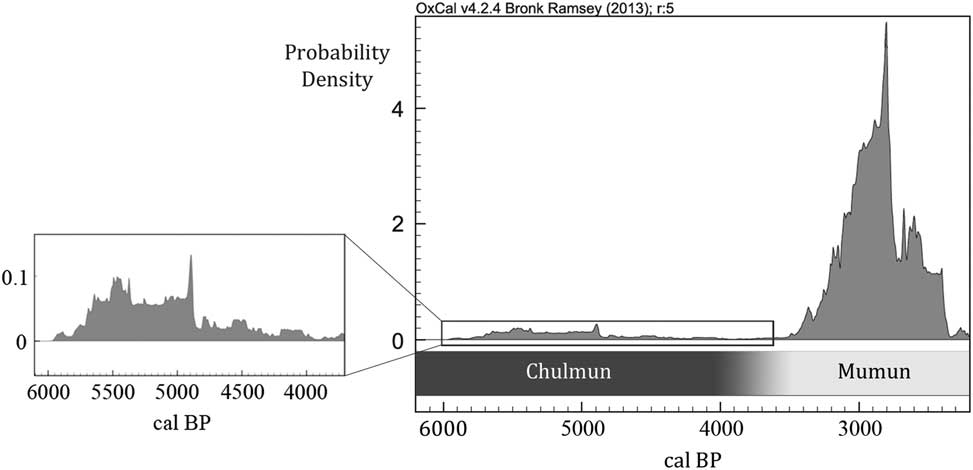
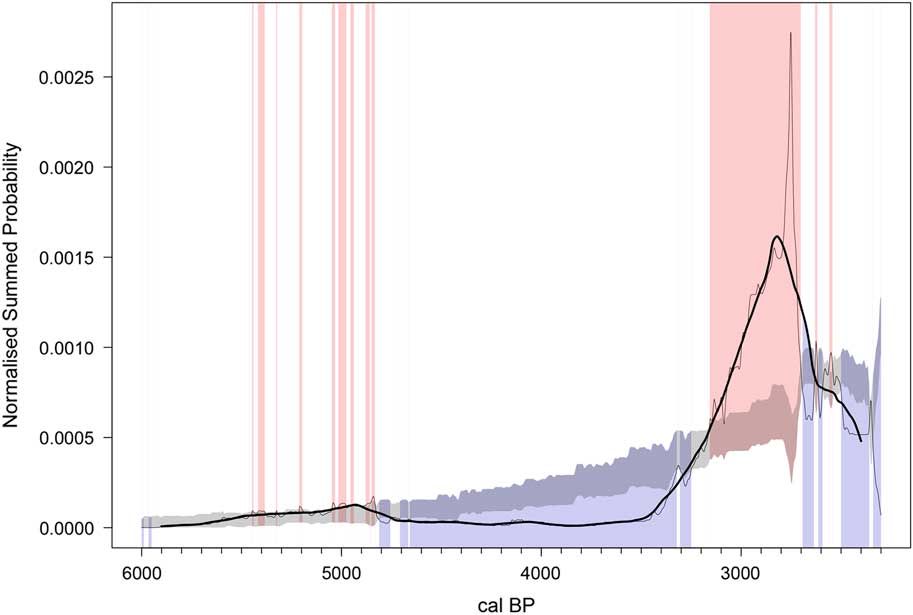
After excluding and combining dates, a total of 2190 dates (160 from Chulmun and 2030 from Mumun pit houses) from 513 settlements were used to produce a summed probability distribution of 14C dates from 5900 to 2200 cal BP, spanning from several centuries before the appearance of foxtail millet and broomcorn millet (ca. 5500 cal BP) in the Chulmun Period to several centuries following the appearance of rice (ca. 3500 cal BP) in the Mumun Period. The SPD generated with the Chulmun and Mumun-period 14C data (the “observed SPD”) was produced using the Oxcal 4.2.4. SUM function (Figure 1). A null model mimicking exponential long-term population growth and taphonomic processes was selected to generate the null-model test using the R codes provided by Crema et al. (Reference Crema, Habu, Kobayashi and Madella2016). The null-model test uses the Monte Carlo (MC) Simulator function to simulate 10,000 14C datasets fitted to the exponential growth model, and a corresponding 95% confidence envelope was calculated to identify significant deviations from the null-model test (Figure 2; see Timpson et al. Reference Timpson, Colledge, Crema, Edinborough, Kerig, Manning, Thomas and Shennan2014 and Crema et al. Reference Crema, Habu, Kobayashi and Madella2016 for details on the generation of the null model). All dates were calibrated using the IntCal 13 calibration curve.
Summed probability distribution of 14C dates from the Chulmun and Mumun periods.
Result of null-model test (exponential model) and SPD from Chulmun and Mumun periods (thin line: observed SPD; thick line: rolling mean of SPD; number of simulations = 10,000; upper shades: observed SPD higher than the highest value of the simulation in 95% confidence envelope; lower shades: observed SPD lower than the lowest value of the simulation in 95% confidence envelope).
Before proceeding with this study, we must acknowledge another issue in interpreting SPDs as reflecting population change. Many of the fluctuations observed in the SPD result from the calibration process, and it is not always apparent whether fluctuations reflect significant shifts in population levels and/or human activities or whether fluctuations reflect peaks and plateaus in the calibration curve. Although using a null model for comparison helps to identify some of the fluctuations in the observed SPD, this method does not provide a means to easily detect “false positives” (Bamforth and Grund Reference Bamforth and Grund2012; Timpson et al. Reference Timpson, Colledge, Crema, Edinborough, Kerig, Manning, Thomas and Shennan2014). Following many preceding studies that have employed SPD analyses, it is our aim to investigate broad trends in population change over an extensive period of time, a goal with which SPD analyses seem amenable.
RESULTS: POPULATION CHANGE IN THE CHULMUN AND MUMUN PERIODS
Although the SPD of 14C dates from 5900 to 3500 cal BP shows minor fluctuations in densities (Figure 1), a comparison of the observed SPD with the null model trend suggests negligible population change throughout the Chulmun Period. Although densities seem to very gradually increase from ca. 5900 to 4900 cal BP, the observed SPD does not significantly deviate from the 95% confidence envelope, revealing that population growth did not exceed expectations for steady, long-term growth (Figure 2).
After 4900 cal BP the observed SPD decreases slightly before deviating below the 95% confidence envelope for the exponential null model. The observed SPD remains below the exponential null model, more or less unchanged, until the beginning of the Mumun Period at ca. 3500 cal BP. This trend suggests a long period of population stagnation in the last millennium of the Chulmun Period.
After 3500 cal BP, there is a pronounced increase in the observed SPD. At approximately 3200 cal BP, the observed SPD deviates above the null model’s 95% confidence envelope, revealing an increase in population levels that exceeds simulated exponential population growth. Within approximately 400 years, the observed SPD reaches a peak at approximately 2800 cal BP, achieving a density that is several magnitudes greater than any observed throughout the Chulmun Period and deviates significantly above the exponential model. This upward trend confirms a population boom almost immediately following the onset of the Mumun Period at 3500 cal BP that appears to be followed by a decline that is almost as rapid. From 2800 cal BP densities quickly decline before falling below the exponential model by ca. 2300 cal BP, suggesting pronounced and abrupt population decline.
DISCUSSION
Cultivars, and presumably their corresponding production techniques, were introduced into southern Korea in at least two distinct episodes, and these introductions seem to have occurred under different population conditions and resulted in different outcomes.
The observed SPD reveals population growth throughout the Chulmun Period (5900–3500 cal BP) that does not significantly exceed the null model simulating long-term, steady population growth. This trend suggests that while the introduction of millet production in the Chulmun Period may have played a role in permitting steady population growth until about 5000 cal BP, millet production did not develop to a degree that led towards rapid growth in population levels. This interpretation compliments studies suggesting that the Chulmun subsistence economy continued to rely heavily on wild food resources even after the introduction of millet production (Choy and Richards Reference Choy and Richards2010; Kim J. Reference Kim2010; Lee J.-J. Reference Lee2011; Choy et. al. Reference Choy, An and Richards2012).
After 4800 cal BP, the observed SPD falls below the simulated null-model SPD and remains largely unchanged until the end of the Chulmun Period. This may suggest that Chulmun population levels remained depressed for more than a millennium before rice agriculture was introduced into southern Korea. However, an alternative explanation of the observed 14C data for this extent of time cannot be ruled out entirely. Increased mobility during this period may have led to the construction of less archaeologically visible dwelling structures or fewer dwelling structures, which would result in lower densities in the observed SPD. Indeed, an increase in sites consisting of outdoor hearths and pit features that lack dwelling features has been put forward as evidence of increasing mobility in the last millennium of the Chulmun Period (Ahn et al. Reference Ahn, Kim and Hwang2015). Further complicating interpretations is the recognition that these two explanations—depressed population growth and increased mobility—are not mutually exclusive, as increased residential mobility can constrain population growth (Kelly Reference Kelly1995:254–9). We believe both explanations are plausible, and further research will be required to clarify if and how mobility strategies affected population levels during the Chulmun Period.
Following the long-term uniform trend observed in the Chulmun Period, the observed SPD indicates that population growth accelerated rapidly within a century of the appearance of rice, harvesting blades, large sedentary settlements, and agricultural fields at approximately 3500 cal BP. This steep incline implies that the adoption of rice farming and the shift towards an agricultural economy interrupted an extended period of population stagnation in the southern Korean peninsula, and within centuries, resulted in considerable population growth incomparable to population levels observed in the previous Chulmun Period.
Many earlier models have emphasized population growth as both a primary causal factor and inevitable outcome of the transition towards an agricultural economy. However, the 14C data from the Chulmun and Mumun periods do not neatly conform to these models. The observed SPD indicates that millet production did not intensify to a degree that supported rapid population growth. The Chulmun peoples seem to have produced millets only on a small scale, as a supplement to a hunting-fishing-foraging economy that allowed long-term population growth for a time, but never resulted in rapid growth. Chulmun-period cultivation, therefore, may be best characterized as an example of low-level food production, in which food-resource production can be stably maintained at low levels for extended periods of time (Smith Reference Smith2001). The 14C data from the Chulmun Period thus imply that the adoption of food production does not inevitably lead towards increasingly intensive agricultural production and sustained population growth.
The observed trend following the adoption of rice farming and the rapid shift towards an agricultural economy immediately following the Chulmun Period may also contradict models that posit population pressure as a primary motivation for intensifying food production. The observed SPD indicates that agricultural intensification began during a period of sustained population stagnation in the southern Korean Peninsula, suggesting that the shift towards an agricultural economy during the Chulmun-Mumun period transition was not motivated by the need to support a rapidly growing population. In the context of the Chulmun hunting-fishing-foraging subsistence economy, it is possible that the long-term population stagnation observed in the Chulmun Period reflects restraints to population growth, including a continued reliance on finite wild resources—the availability of which presumably fluctuated spatially and temporally—and mobility strategies employed to exploit those resources. It should be noted, however, that population growth is not the only indicator of population pressure. Declining resource availability can also lead towards population pressure even in situations in which population levels remain the same or decline (Cohen Reference Cohen1975, Reference Cohen2009), and slow population growth and population stagnation may be symptomatic of population pressure (Bettinger Reference Bettinger2015:40). But because it is beyond the scope of this study to reconstruct changes in resource availability in the region, we tentatively conclude that rice agriculture was not adopted in a context of population pressure resulting from rapid population growth but leave open the possibility that a population-resource imbalance could have arisen as a result of declining resource availability.
Meanwhile, the Mumun-period population boom does appear to agree well with predictions for rapid population growth following the transition to a more fully agricultural economy. Mumun population levels increase swiftly following the appearance of rice and other major cultivars as well as large villages and agricultural fields, reaching a peak before quickly falling below the exponential population-growth trend. The Mumun data suggest that while the shift towards agriculture may indeed contribute to rapid population growth, the population growth that followed this transition was not long-lasting. This may be another example of the “boom-and-bust pattern” suggested by Shennan et al. (Reference Shennan, Downey, Timpson, Edinborough, Colledge, Kerig, Manning and Thomas2013) for several areas in Europe following the Neolithic transition, although it is unclear what factors may have contributed to this decline during the Mumun Period.
Interestingly, the Jomon-Yayoi transition in Japan, which in some respects parallels the Chulmun-Mumun transition in Korea, seems to follow a similar demographic trajectory in the transition towards an agricultural economy. Not unlike Chulmun groups, the predominately hunting-fishing-foraging Jomon groups likely cultivated barnyard millet (Crawford Reference Crawford2006), but relied heavily on foraging chestnuts, horse chestnuts, and walnuts and fishing salmon (Matsui and Kanehara Reference Matsui and Kanehara2006; Habu Reference Habu2008; Bleed and Matsui Reference Bleed and Matsui2010). Population estimates based on simulations (Koyama Reference Koyama1992) and SPD analyses (Crema et al. Reference Crema, Habu, Kobayashi and Madella2016) suggest that Jomon groups achieved population growth, reaching a peak at approximately 5000 cal BP before declining for nearly two millennia before the arrival and spread of the rice-farming Yayoi culture, which has been archaeologically linked to the Mumun-period expansion on the Korean Peninsula. Further research investigating population dynamics before and after the Jomon-Yayoi transition will hopefully shed more light on the conditions that led to population stagnation and decline before the transition to agriculture in Korea and Japan as well as the precise relationships between the transitions in both regions.
CONCLUSION
Many earlier models have emphasized the role of population growth in the transition towards agriculture. However, due to a paucity of methodologies for prehistoric population estimations, such models have been largely left untested. Using 14C dates as a proxy for population change provides a tool that not only allows reconstructions of population change over time but also reevaluations of existing preconceptions with regards to population growth and decline. Population change during the Chulmun-Mumun period transition in Korean prehistory indicates that such models cannot be applied universally and in some cases, may require reassessment. Despite potential drawbacks, we suggest that using radiocarbon data may provide the best approach to estimating relative population change in South Korea and perhaps elsewhere, where data is sufficient. In the future, further research in this area will undoubtedly shed more light on the diverse ways in which population relates to various economic, cultural, and political changes in prehistory.
ACKNOWLEDGMENT
This work was supported by the Ministry of Education of the Republic of Korea and the National Research Foundation of Korea (NRF-2016S1A5B6924370).
Supplementary material
To view supplementary material for this article, please visit https://doi.org/10.1017/RDC.2017.122



