INTRODUCTION
After the founding of the Republic of China, many new professions started to emerge, and one of the first to be fostered by the Chinese government was the law sector. The first set of laws in Chinese history governing lawyers, the “Provisional Ordinances for Lawyers” (Lüshi zanxing zhangcheng 律師暫行章程), was passed in 1912. Soon after, local bar associations, law schools, and modern law courts were established one after another, leading to the development of the lawyer as a profession and the eventual establishment of a new judicial system based primarily on a Westernized model, though this process was never a smooth one. Studies of Republican lawyers over the past decade reveal how lawyers in Shanghai had worked hard to advance themselves against obstacles in the early days of the Republic and eventually managed to establish the lawyer as a profession in the Western sense. They succeeded in monopolizing the right of advocacy in the courts and managed to put themselves on a firm footing in mixed courts side by side with foreign lawyers. However, Beijing in the same era reflected a quite different scene. Although it was the capital and political centre of the newly established Republic and boasted the greatest number of law schools and lawyers after Shanghai (and indeed, at one time lawyers in Beijing and Tianjin together outnumbered those in Shanghai), very few major studies exist on lawyers in Beijing. A considerable body of relevant materials preserved in municipal archives has not been processed for publication. Examination of these materials shows that the lawyers in Beijing were not faring as well as their counterparts in Shanghai, who were moving relatively quickly toward prosperity, blessed both with fame and financial return. The lawyers in Beijing, by contrast, were faced with adversaries that did not exist in Shanghai, namely, the so-called ‘phony lawyers’ (fei lüshi 非律師), a common term around that time denoting people without formal qualifications posing as legitimate lawyers to take up cases in Beijing.Footnote 1
UNDERSTANDING REPUBLICAN LAWYERS
Research on lawyers during the Chinese Republican Era (1912–1949) started in the 1990s as an extension of studies on the legal system of the late Qing and early Republican eras. The books of Wang Shen 王申 and Xu Jiali 徐家力 are pioneer studies on the institutional history of Republican lawyers. These works centre upon the rules and regulations under which the system was established and throw light on how the lawyer as a profession was born and how it began to take shape.Footnote 2 Later, scholars from mainland China, Taiwan, and overseas launched further studies on the topic, approaching it more from a social-historical angle and tackling the topic of Republican lawyers through theories of social development. Chen Tong 陈同 in his recent book makes substantial use of historical archives relating to lawyers in Shanghai and the Shanghai Bar Association to document the Shanghai legal profession's relatively speedy path to fame and prosperity after the establishment of the Republic, despite the fact that society traditionally had despised legal service providers. In addition to his descriptions of professional activities of Chinese lawyers in Shanghai, Chen also undertakes very detailed research on foreign lawyers in Shanghai pre- and post-revolution. He goes further to argue for the roles of Shanghai lawyers in driving social changes in Republican Shanghai, stressing that the connection between the two must not be overlooked.Footnote 3 Zhang Liyan 张丽艳 narrates the operating activities of Chinese lawyers in Shanghai from 1911 to 1937 and the means by which lawyers became more professionalized, which happened partly through interaction with foreign lawyers within the concession areas.Footnote 4 Li Yancheng 李严成 has emphasized archived material about bar associations in Shanghai, Wuhan and Nanjing to understand the role of the newly organized professional bodies.Footnote 5 The discourse itself, however, again dwells more on Shanghai.
Shanghai lawyers have also attracted much attention from scholars outside mainland China. Sun Huimin 孫慧敏 of the Academia Sinica in Taiwan attempts to prove that lawyers in twentieth-century Shanghai, though succeeding in monopolizing legal practice in Shanghai since the 1930s, failed to make this new profession a “distinguished” one in the eyes of ordinary citizens, despite its economic prosperity, owing to a number of reasons, including over-emphasis on political study in professional education, the traditional bias against legal practitioners, political struggles and the outbreak of war.Footnote 6 Alison Conner, drawing on Shanghai Bar Association records, gives a detailed account of the number of lawyers in Shanghai, their backgrounds, and their practising conditions. One particularly conspicuous phenomenon in her study is that lawyers during that period were mostly centred in major cities and that there were tremendous differences between the activities of lawyers in the city and in the countryside. In other words, although a unitary lawyer system was legally established and recognized by the state, the operation and activities of the system displayed local deviations. Whether the system was dormant or active, whether the number of lawyers grew or declined, all was interwoven with various social factors. However, Conner does not elaborate this argument further by comparing the conditions of practice of Shanghai lawyers with those of their counterparts in other cities.Footnote 7 Recently she has published a further study on the depiction of lawyers in Republican movies shown in Shanghai, in which the image of lawyers varied and sometimes could be quite negative. She points out that modern lawyers of the 1930s and 1940s as a whole were depicted as being wealthy middle class, some of them snobbish, looking down on the poor and denying them access to justice, but others as possessing a strong sense of justice and a willingness to help the underprivileged classes.Footnote 8 Xu Xiaoqun 徐小群 studies Republican records from Shanghai and places emphasis on the interaction between state and society as viewed from the activities of various professional associations, including the bar.Footnote 9 By observing the interaction between professional bodies and the government, he gives an account of the relationship between the Republican state and society: mutual exploitation, support and attempts to impose control. In his more recent book Xu puts his focus on how and why legal reform during the Republican period resulted in different outcomes in different places within the same province of Jiangsu. One of his major findings is that legal modernization based on Western formalization, bureaucratization and standardization could result in more injustice in less affluent areas where judicial resources were limited and local power and interests were more influential.Footnote 10
To date, publications in this field cover a wide spectrum. Studies range from general to specific and analysis from simple to profound. The research is fruitful. A comprehensive picture emerges of lawyers in that period: their accomplishments and failures as well as their qualifications, income, legal power and attire. Nevertheless, with the exception of two recent journal articles by Qiu Zhihong 邱志红 which have begun to deal briefly with the educational background, native origin and income level of lawyers in Republican Beijing,Footnote 11 the major object of most of the studies to date has been the archival materials on the Shanghai lawyers and their bar association. From a historical or socio-cultural angle, what is depicted in these works as the characteristic legal culture or development of the lawyer profession actually applies specifically to Shanghai, a city with its individual culture, social changes and economic conditions, a city where the East met the West under a unique treaty port system. Such findings may not be characteristic of the profession in other cities, nor can they be interpreted as a general trend of development relevant to the legal culture of modern China. In my opinion, lawyers in other cities or regions found themselves in rather different circumstances. The cases from archives regarding lawyers in Beijing investigated below indicate unique local characteristics in the development of the profession that were not apparent in Shanghai. I would suggest that in order to shed more light on the lawyer profession and development of legal culture in Republican China, studies on the topic should be city or region-orientated and legal culture should be interpreted against the social and ideological backdrop of that particular city or region. More importantly, the outcomes of other aspects of legal reform may also have differed in various cities, and greater effort should be expended in future scholarship to build up an analytical framework toward a better understanding of how and why these outcomes differed. These are the major arguments that the historical findings presented below are intended to substantiate.
PHONY LAWYERS IN REPUBLICAN BEIJING: CASES AND MATERIALS
The term “phony lawyer” denotes a person posing as a qualified lawyer in Beijing during the Republican Era. Phony lawyers filed legal plaints or even appeared in court on behalf of litigants. The term was repeatedly used in a precise technical sense in official correspondence among the Beijing Bar Association, courts and prosecution bureaux in Beijing, reflecting the general prevalence of the phenomenon and its gravity.
Shanghai, by contrast, sees little documentation of illegal activities by impostor lawyers. In her doctoral dissertation, Sun Huimin mentions that whereas cases of impostor lawyers actually appearing in Shanghai courts in the 1920s and 1930s were rare, there were cases of people misrepresenting themselves to clients as lawyers and making money by referring these clients in turn to real lawyers.Footnote 12 The fact that phony lawyers organized themselves into gangs in Beijing but not in Shanghai is one indication that the development of the lawyer profession and legal culture could differ as a result of the local characteristics of a particular place.
The following cases retrieved from records of the Beijing Bar Association and the courts of Beijing in various years of the Republican period, which are stored in the Beijing Municipal Archives, shed light on how phony lawyers were forming into gangs and setting up business openly, and how the situation was growing beyond control.Footnote 13
You Guixin 游桂馨, a councillor of the Beijing Bar Association, and a few other of his fellow members wrote a joint letter to the Association in May 1927 to complain about the practice of phony lawyers, and requested that the Association work with the courts to enforce a stricter ban on this phenomenon. The complaining members also attached a list of phony lawyers and submitted it to the Association. After a discussion by the Standing Committee of Councillors of the Association on 17 May 1927, the list was sent to the courts in Beijing, and in July 1927 a notice was sent out to all members. Members of the Association were advised to pay attention to the activities of phony lawyers, to help investigate such activities, and to report to the Association whenever they encountered phony lawyers. This clearly reflects the general prevalence of the phenomenon, the attention it aroused and the disturbances it caused among the profession.Footnote 14
Despite an order from the Ministry of Justice requiring lawyers to sign and stamp their seals on all legal plaints written by them, there were phony lawyers who were able to steal the seals and stamp them on the legal plaints they drafted when the lawyers were away from their offices. In November of 1927 the Wuqing County Branch Court of Beijing (Jingshi Difang Shenpanting Wuqingxian Fenting 京師地方審判廳武清縣分庭) wrote a letter to the Beijing Bar Association appealing for assistance in distinguishing legal plaints written by phony lawyers from those written by real ones. The court said it sometimes had to summon a lawyer to verify his signature in person, which cost time and money for the lawyer to make a special trip back to the county for the purpose.Footnote 15 From the fact that even the court could not distinguish a legal plaint written by a phony lawyer from one drafted by a qualified lawyer, we can get a sense of the level of competence of a phony lawyer, which might not be much lower than that of a formally trained and qualified one. In the few months that followed, the Beijing Bar Association presented, in several rounds, a complete list of signatures and seals of members to the court for identification purposes.
In another case from the same year, it was reported in the Police Post (Jingcha gongbao 警察公報), Shuntian Times (Shuntan shibao 順天時報) and other newspapers that a lawyer known as Liu Quan 劉泉 had recently rented an apartment in Tai Ping Lane 太平巷 in Nanheyan 南河沿 District to open a branch office. On the opening day, firecrackers were set off. It was further reported that because the lawyer Liu Quan had apparently put up a commercial sign without permission from the district government and let off celebratory firecrackers in the middle of the night, he was summoned to the local police station, and a penalty imposed on him. When this news report came to the attention of the Beijing Bar Association, it was discovered that the name Liu Quan could not be found among its list of members. The Bar Association therefore wrote to the prosecution bureau on 21 December. In the letter, the Bar Association mentioned that Liu Quan could be a bad element who handled legal cases illegally, and requested that the government take action to investigate him. If the government failed to take appropriate action, the Association further declared, the honour and discipline of the legal profession would be at risk.Footnote 16 From this case we can see that some of the phony lawyers were not operating underground. They called themselves lawyers and operated offices openly in public places. Their practices were thus in direct competition with those qualified under the new legal practice regime. The openness of phony lawyers' activities showed that they did not fear competition from the qualified lawyers. This could be due to the fact that the phony lawyers were able, or at least they believed that they were able, to provide customers with services at a competitive standard and price. From the next case below we can further see that the phony lawyers did not fear protests from or investigation by the qualified lawyers, and that they could even gang up to resist those actions.
On 5 July 1927 a motion was passed by the Beijing Bar Association to request the courts and the prosecution bureau to seek a stricter ban over the activities of phony lawyers. Shortly afterwards, the Association councillor You Guixing had his office disturbed by a group of phony lawyers. The phony lawyers threatened to break You's office nameplate and openly attempted to provoke a fight with him in the street. In a letter of complaint from You to the Bar Association, You maintained that the phony lawyers were seeking revenge against him because of the Bar Association's recent request to ban them. You further said that the phony lawyers had deliberately sought to inflict bodily harm and damage his reputation.Footnote 17 From this, it is clear that the phony lawyers in Beijing were not deterred by the protests from qualified practitioners and were prepared to fight openly for a living space whenever necessary. It also seems that both the government and the Bar Association were unable to find effective measures to curb the existence of the phony lawyers, even though the identities and locations of such illegal practitioners were well known, as we shall see from the following letters.
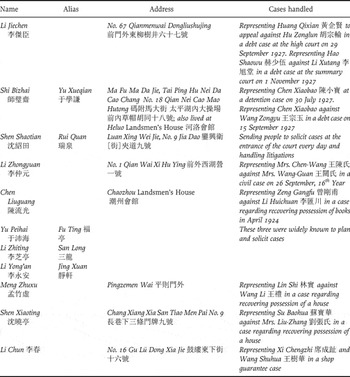
A letter dated 31 July 1927 from Feng Xueyan 馮學顏, a qualified lawyer, to the Beijing Bar Association, provided the names and aliases of three well-known phony lawyers. They were Yu Peihai 于沛海 (alias Yu Futing 于福亭), Li Zhiting 李芝亭 (alias San Long 三龍) and Li Yong'an 李永安 (alias Li Jingxuan 李靜軒). Feng requested the Association to work with the court to investigate and eliminate their practices so that the social order could be restored.Footnote 18 In another letter dated 15 December from the Beijing Bar Association to the prosecution bureau, the Association mentioned that its members had conducted investigations into the activities of phony lawyers and had come up with a list of certain phony lawyers containing names, aliases, addresses and the types of cases handled by them. The Bar Association attached the list to the letter and requested that the prosecution bureau take action to clamp down on phony lawyers' activities in the interest of the public. Their list is shown in Table 1 below.Footnote 19
Beijing Bar Association list of phony lawyers, 15 December 1927

All of the data in Table 1 is derived from a single record of the Beijing Bar Association in 1927. However, phony lawyers cannot have emerged suddenly in that year; in fact they had existed as a problem well before that. From a record of the Beijing Bar Association as early as January 1918, a letter written by a member called Kuai Pude 蒯普德 described the activities of phony lawyers and urged the Association to take action against them.Footnote 20 Kuai declared that people without a lawyer's qualifications falsely assumed the identity of a lawyer in order to handle litigations. He said that phony lawyers chose dilapidated temples or laundry houses in back streets where they hung the nameplate of a law firm to solicit customers and deceive people of their money. Though the law courts were said to be monitoring the situation, Kuai felt that their eyes and ears were inadequate for the task and many victims were suffering as a result. He wrote that the situation had not only substantially affected the business of lawyers, but had also contravened the national government's intention to establish a lawyer profession. He therefore proposed that the police bureau be requested to check the identity of law firms within their respective jurisdictions and ask them to produce valid lawyer certificates issued by the Bar Association.
The above again demonstrates that phony lawyers openly established offices in Beijing. They were noticed by the public, the legal profession and the government over a long period of time, but could not be eliminated. The legal professionals felt that the profession and the public interest were substantially affected by this phenomenon.
The official form issued by the Ministry of Justice for the appointment of attorneys in criminal cases, dated February 1920, which clients were required to fill in, carried a specific warning not to hire phony lawyers to represent them.Footnote 21 This again shows how serious and widespread this phenomenon was in Beijing during that period.
From the above historical data, it can be established that the phony lawyers existed for a considerable period and covered a wide legal domain; their activities ranged from securing clients and dealing with legal matters on clients' behalf, as well as appearing for clients in court. Their business activities included recovery of debts, dealing with real estate and private property, general civil cases and criminal litigation. Phony lawyers were open about their activities. At least two of those listed in Table 1 had addresses in landsmen's houses (hui guan 會館), yet they were never suppressed in any serious way. Rather, they formed into gangs and provided each other with support against outsiders and qualified lawyers, constituting a major obstacle to the growth of the lawyer profession in Beijing.
Who exactly were these phony lawyers? The following possibilities exist. It is stated in the above example concerning the Wuqing District Court that the court had encountered cases in which phony lawyers stole lawyers' chops and stamped them over the legal plaints they drafted while the lawyers were away from their offices. Thus, some phony lawyers could have been employees in lawyers' offices.
Phony lawyers could also have been former ‘litigation masters’ (songshi 訟師), alternatively known as ‘litigation hooligans’ (songgun 訟棍), during the Qing dynasty.Footnote 22 Sun Huimin's doctoral dissertation mentions that the format of legal plaints in the late Qing era and early Republican days was quite similar.Footnote 23 The market for former litigation masters might have persisted well into the 1930s. A police case record from 1915 gives us positive evidence in this regard.Footnote 24
In court records and a police report dated 1915 made by a patrol officer Ma Yongfu 馬永福 about a case involving a phony lawyer, Ma mentioned that he was asked to investigate Li Jiwu 李紀五, alias Li Yunji 李允吉, who lived at door number 31, at Xiao Si Yan Jing Hutong 小四眼井胡同. Li often stayed at the Sunrongxuan Wine Shop 孫蓉軒酒鋪 located at the west entrance of the district courts and was alleged to have instigated litigation. He was reported to have hung out a wooden plate bearing the names of the lawyers Bian Baohai 邊寶海 and Huang Yi 黃翼 and deceived people of their money. Li was arrested on the second day of the month prior to Ma's investigation. To check whether the allegations were true, Ma went to the vicinity of Xiao Si Yan Jing Hutong to interview Li's neighbours. According to a man surnamed Jiang 蔣, Li was a native of Shangdong province and over forty years old. Jiang also mentioned during the interview that Li had made a living during the Qing dynasty by writing legal plaints for others under the cover of a fake stall selling decorations, located at the entrance of the district court.
From the above we know that the phony lawyer Li arrested by the police had formerly worked as a litigation master during the Qing dynasty. He made his living by soliciting customers at the entrances of law courts, whether the court was under the rule of Qing or the Republican government. Unless we assume that the above was a totally isolated case, it is reasonable to conclude that at least some of the litigation masters of imperial Beijing transformed themselves into phony lawyers and were able to continue to make a living from legal services during the Republican period.
PHONY LAWYERS: WHAT WENT WRONG?
From the above historical materials, it can be concluded that phony lawyers (or “legacy litigation masters”) troubled Beijing lawyers over a long period of time. This problem aroused concern amongst the lawyers' community and judicial bureaux and affected the prosperity of the new profession. The great number of phony lawyers points to the fact that this was no isolated matter; rather, an entire profession was involved. From the members' register of Beijing lawyers we know that the number of practising lawyers in Beijing during the 1920s was approximately 400 to 500. If the number of lawyers in Beijing amounted to a few hundred and the number of phony lawyers a few dozen, this is a rather substantial ratio. At least some of the phony lawyers had been litigation masters under the Qing dynasty who were continuing to win the trust of clients by providing traditional plaint-writing services despite the fact that the legal system had changed from a traditional to a modern one. The long persistence of the traditional specialists is striking. What went wrong in implementing the lawyer system in Beijing, such that the phony lawyers could openly handle cases illegally in 1927, even though the Western-style lawyer system and laws had been in place since 1912? Academic studies undertaken over the past few decades have so far not identified problems of a similar extent occurring in Republican Shanghai. If that was really the case, what were the differentiating factors that might have made the Shanghai legal profession less susceptible to such phenomena? I would argue that one of the key reasons was the consumers' choice of legal services.
One question worth considering is: were the consumers aware that the phony lawyers were not real lawyers? Were they interested in finding out whether or not phony lawyers were properly qualified? If they had all been victims of deception, surely the police would have intervened, and it would not have been necessary for the Bar Association to investigate and complain to the Prosecution Bureau. If the above-mentioned cases of openly securing litigation assignments were known to all, it would seem that the litigants hiring these phony lawyers knew the truth but did not mind; they simply did not care where the truth lay. In the same prosecution record of the above-mentioned arrest of ex-litigation master Li Jiwu in 1915, the Capital Prosecution Office reported that Li had been arrested previously under a similar charge but was not prosecuted since no victim had come forward to the prosecution office to file a complaint. So, what did they care about?
Consumers of legal service in China, like consumers in the West, ultimately cared most about whether justice could be sought at a reasonable cost through legal services, whether in the form of having disputes resolved, rights safeguarded, economic interests protected, wrongdoing punished, and so on. However, unlike their counterparts in the West, independent, formally educated and qualified legal professionals were never a necessary foundation for achieving justice in traditional Chinese society. Rather, legal service providers were always an illegal occupation under the law, not necessarily independent (sometimes having good connection with government officials was beneficial), and without any formal qualifications. Consumers were used to hiring legal service providers based on word-of-mouth reputation from actual services rendered; consumers made choices according to, among other things, their own prior experience and knowledge of similar services. The change in the legal system brought about by importing the Western system of a formally regulated legal profession did not change conceptions and practice in society overnight, nor even over a span of many years.
Had consumers switched immediately from traditional conceptions and made a habit of hiring only qualified practitioners for lawsuits, phony lawyers would not have been able to survive for ten years or more after new laws for a Western-style legal profession were enacted in Republican Beijing. What possibly could have driven the choices of consumers in Shanghai and Beijing in different directions as they made their selection from the traditional service and the newly established modern professional service? I would argue that one of the key differentiating factors is a conceptual shift through which mass consumers came to appreciate the merits of the new Western-style professionals in order to achieve their aim of seeking justice, whether it related to economic or other interests. When the consumers of legal services had acquired adequate experience and knowledge of the functionality of using qualified lawyers, and consequentially undergone a corresponding conceptual shift, they would likely be more willing to change their traditional habit of hiring underground legal service providers (be they phony lawyers or litigation masters) to one of retaining qualification-based legal practitioners. In such circumstances it would not be easy for phony lawyers to practise openly. From Chen Tong's well-researched work we can see how such a conceptual shift in Shanghai had occurred decades before the formal system was in place, which I would argue consequentially made the system work better than the one in Beijing.
Despite the fact that legal practitioners were a traditionally despised group in the history of China,Footnote 25 we are told that Shanghai lawyers quickly became a social and economic elite whom the community would look to for assistance in resolving legal and even political matters.Footnote 26 I would argue that one of the possible ways of efficiently implementing foreign systems and practices, including legal reform, while mitigating possible conflicts with the mainstream ideology is to gradually and incrementally diffuse the merits of the new practices into the indigenous value system of mass consumers by education and role modelling. The arrival, development and activities of foreign lawyers in Shanghai from the 1850s gave an effective showcase to the people of Shanghai on how Western legal practitioners could add value by protecting their rights and interests. Chen has described this showcase in detail.Footnote 27 However, I would further elucidate this argument in terms of extraterritoriality. Under this new though unequal and oppressive legal framework, foreign qualified lawyers possessed a greater right of advocacy in the various courts of Shanghai during this period than before. Foreign lawyers' existence and performance boosted the demand for engaging litigators in protecting individual rights in court. Even Qing government officials, even while they continued to ban traditional litigation masters from practising, started to retain legal counsel as an inevitable method of resolving legal disputes with foreigners.Footnote 28 There were also cases in which foreign lawyers acted for Chinese litigants in lawsuits against Westerners.Footnote 29 In this regard, I would suggest that as the consumers of legal services in China have always judged the merits by actual results rather than qualifications or certificates, the effectiveness of foreign lawyers in protecting their commercial interests in the market was diffused into their value system. This made Shanghai a city with more rapid development of the Westernized ideology of legal representation. By contrast, in other major Chinese cities, like Beijing, where foreign courts and lawyers had less presence and importance, the growth and development of modern lawyers was considerably less smooth owing to the legacy of traditional legal culture, one of which was the practice of hiring non-qualified legal service providers.
In Shanghai, prior to the legalization of Republican lawyers, cultural and conceptual changes had already been underway for fifty or sixty years, from the time of the first arrival of foreign lawyers, who had demonstrated economic and social leadership, the practical functionality of legal service and the importance of the right of legal representation to the people of Shanghai. The relatively speedy establishment of the modern legal profession in Shanghai is possibly attributable to the overall conceptual shift brought about by foreign lawyers' participation. From Chen's well-researched historical data, it is sufficient to say that the way Shanghai lawyers emerged as a socially and economically prosperous group in this time of change was closely related to the Shanghai-specific social change and consumers' legal awareness that began to develop in the 1850s. Their success was not only an intended outcome of the legally defined legal practitioners as established under Republican law, but also a product of the acquisition of new experience and knowledge which resulted in the development of a new conceptual basis for the legal profession through the enforcement of extraterritoriality, the practice of foreign lawyers, the demonstration of systematic resolution of business disputes in open courts, the elite lifestyle of foreign lawyers and the Qing government's participation in engaging foreign lawyers over several decades in the late nineteenth century, among other factors. Lawyers' lives in places like Beijing, which lacked or lagged behind similar conceptual changes, would be expected to demonstrate different paths of development as illustrated above. However, I am not trying to concur with the modernization theorists that Westernization must have brought modernity to Chinese judicial reform. In fact the mixed courts under extraterritoriality can hardly have been a system of modernity given the inequality in the right of advocacy, the high degree of political intervention, the lack of judicial independence, and so on. Nevertheless, the effectiveness of foreign lawyers against this backdrop did unintentionally help in developing a new conceptual awareness among Shanghai society that was well suited to the subsequent establishment of a lawyer profession.
Obviously, a conceptual shift is not the only factor shaping the outcomes of legal reform in different cities or regions during the Republican period. Legal reform needs to be understood as an outcome of the interplay between many other socio-cultural factors that are closely bound to local conditions.
Xu described the outcomes of legal reform from 1901 to 1937 in Jiangsu Province as a result of interaction of these various factors. He called such interaction processes “negotiations and compromises”. From archival data in Jiangsu province, Xu tried to understand how the Republican legal reform, including the reform of the court system, prosecution and prisons, was implemented in various cities and counties. One of his main discoveries was the fact that legislative or policy intentions were often compromised by the force of traditional perceptions and practices, gentry interests, limited financial resources and the conflicting roles of judges acting as both the chief executive and chief justice of a county. In consequence, the outcomes of legal reform varied from place to place within Jiangsu according to the results of such “negotiations and compromises” among numerous social sectors.Footnote 30 Sometimes, such compromises might lead to more injustice than there would have been had the new system not been in place. The modernization efforts worked relatively better in processing cases speedily at provincial or district court level where financial resources were relatively more abundant and a separate hierarchy of judicial staff was set up. By contrast, Xu observed that irregularities, abuses, corruption and injustice were familiar stories, especially at lower county levels. Xu did not read them as individual stories of moral failure but rather viewed such behaviour as local reaction to the fact that the legal reform handed down from the central government had not taken into account local geographic, political, economic and socio-cultural conditions.Footnote 31 Xu concluded that the outcome of legal reform during such periods was the net result of negotiations and compromises.Footnote 32 The efforts to comply with the requirement for becoming modern through the implementation of standardization, formalization and bureaucratization led to paradoxical consequences and unsolvable issues in the judicial system and local society.Footnote 33 Even within the same geographical region of Jiangsu, outcomes of the Republican legal reform were different among cities, counties and towns. It should not be surprising then that conspicuous differences in development also existed between Shanghai and Beijing.
CONCLUDING REMARKS: DEFENDING THE DEFENDERS IN CULTURAL TRANSFORMATION
My findings about Republican Beijing, taken together with Xu's and Chen's work, substantiate my view that the effectiveness of legal reform in Republican China varied according to local conditions, which themselves depended on the interplay of various socio-cultural factors. Legal reform during the Republican period, even though handed down by the central government as a unitary policy across the entire nation, took different shapes during implementation in different areas, depending on how the interaction of various factors, obviously including legal ideology or culture, played themselves out. In other words, research findings on legal reform in any given city, treaty port or region in Republican China cannot be seen as representative of the situation in other places where the dynamics of the interplay among various socio-cultural factors were different, not to mention the situation across the entire nation. I would therefore expect further research to describe the activities of legal reform, including modern lawyers' activities, in other cities and regions during the same period of time. It would be reasonable to expect more divergent results to be observed from inland or less affluent cities where local practices, gentry interests and traditional ideologies were more deeply rooted, in comparison with Republican Beijing or Shanghai where culture and values were developed from mixtures in different degrees from the East and the West. Therefore, to make more sense of legal reform in China, one should be prepared to evaluate the development of legal reform in a particular city or region against its social and ideological backdrop.
However, what perhaps has been left undone here is the establishment of an analytical framework to understand and generalize such factors so that one is able to compare and comprehend the processes of interaction in different cities or regions when the same legal reform was being implemented. To understand historical processes of institutional change, Douglass North and economists from the school of thought commonly known as “new institutional economics” have articulated one useful framework that might be taken as a starting point. However, the generalized factors of formal constraints (rules and regulations), informal constraints (norm, values and ideologies), enforcement and organization interests proposed by these economists might not be adequate to explain the differing processes of the change in the legal system in different cities in China during the Republican period, or afterwards.Footnote 34 Such inadequacy nonetheless should not deter scholars from continuing to study the history of legal reform through a localized or regionalized approach to look for key interplaying factors and try to establish some kind of analytical framework, despite the fact that academic debates over common denominators of locality or regionalization have never ceased over the past decades.Footnote 35 Also noteworthy from the above are the thought processes through which the mass consumers of legal services perceived, evaluated and adopted a Western-based legal system. Though the new legal system was founded upon a Western-based ideology of judicial modernity, the users of the new system perceived and assessed the system in a functionalistic manner by firstly comparing practical benefits and costs prior to appreciating its ideological merits.
Bearing in mind the significance of locality, the interplay of social-cultural factors and consumers' functionalistic mindset are crucial steps toward understanding how this important, if not the most important, legal reform in the history of modern China operated. This approach may provide insights not only into the legal reform that took place during the late Qing or Republican period, but also in the Post-Mao era where a modern legal system based on the Western model was once again introduced, this time under a socialist regime.