Introduction
Nasal bone fractures are a common emergency presentation in otorhinolaryngology departments, and account for up to 50 per cent of facial fractures. These fractures are traditionally managed with closed manipulation under general anaesthesia (GA) performed within two weeks of injury, with the aim of restoring nasal anatomy prior to the formation of fracture callus.Reference Hamrang-Yousefi, Kingsley-Smith, Munroe-Gray, Anyanechi and Rollin1,Reference Repanos, Anderson, Earnshaw, Mitchell and Coman2 Nasal deformities associated with poor cosmesis or nasal obstruction can be assessed post-injury, and the need for septoplasty or septorhinoplasty can be determined.Reference Hamrang-Yousefi, Kingsley-Smith, Munroe-Gray, Anyanechi and Rollin1 Outcomes used to assess the success of manipulation under anaesthesia include patient satisfaction and the need for future surgery.Reference Basheeth, Donnelly, David and Munish3,Reference Yi, Kim and Jang4 Previous studies have shown persistent nasal deformities in 14–50 per cent of patients following manipulation under anaesthesia, with 3 per cent requiring further surgery.Reference Taghizadeh, Lewis, Stevenson, Barnard and Erdmann5
In recent years, manipulation under anaesthesia procedures have also been performed in an out-patient clinic setting using local anaesthesia (LA) techniques such as the nasociliary nerve block.Reference Repanos, Anderson, Earnshaw, Mitchell and Coman2 This involves the infiltration of LA bilaterally, between the medial canthus and glabella, down to the periosteum. Some providers also administer topical anaesthetic to each nostril.Reference Repanos, Anderson, Earnshaw, Mitchell and Coman2
The coronavirus disease 2019 (Covid-19) pandemic has forced surgical departments across the country to reduce the number of surgical procedures performed in order to minimise hospital contact, and to reconsider which emergency procedures can be conducted in an out-patient clinic setting.Reference O'Rielly, Ng-Kamstra, Kania-Richmond, Dort, White and Robert6 This has led to the shift to performing manipulation under LA, to reduce the demand on elective operating theatres and limit the number of hospital interactions. This change was most pronounced at the height of the Covid-19 pandemic in the UK in March 2020.Reference Bastianpillai, Khan, Acharya, Tanna and Pal7 At our centre, manipulation under LA has remained the preferred technique following emergence from the Covid-19 pandemic.
As well as reducing costs and operating theatre burden, other benefits of LA include a shorter waiting time between injury and manipulation under anaesthesia, which potentially increases the chance of a successful manipulation procedure. Additionally, as patients are awake during the procedure, they can give immediate feedback as to whether they are satisfied with the appearance of their nose.
Despite the increasing popularity of performing manipulation under LA, data on the long-term benefits of manipulation under LA are limited. Therefore, we aimed to quantify the proportion of patients requiring further surgery after undergoing manipulation under GA or LA at our centre.
Materials and methods
All patients who underwent manipulation under GA or LA for confirmed or suspected nasal bone fracture within the otorhinolaryngology department at Norfolk and Norwich University Hospital were included in the study. Patients who underwent simultaneous septoplasty and manipulation under anaesthesia were excluded. Patients were referred from local urgent care centres or the emergency department, following clinical examination or a computed tomography scan for a head injury that identified a nasal bone fracture. The department aims to see all referrals within 5–14 days following a nasal bone injury if possible.
Data for manipulation under GA were collected over 10 years, from 1 January 2012 to 31 December 2021; these data were identified by obtaining case lists from the electronic Orsos operating theatre management system, using the procedure code ‘V09.2 Reduction Nasal Bones Closed’.
At Norfolk and Norwich University Hospital, manipulation under LA is performed in clinic on the day of first presentation to the otorhinolaryngology department. The preferred technique for LA administration is nasociliary nerve block using external infiltration of 1–5 ml of 2 per cent lidocaine-hydrochloride with 1:80 000 adrenaline. Patients are selected for manipulation under LA or GA based on a combination of patient choice, patient age and practitioner skill level. At the time of writing, almost all otorhinolaryngology clinicians at Norfolk and Norwich University Hospital were comfortable performing manipulation under LA. Follow up is not routinely scheduled following manipulation under anaesthesia unless specific concerns arise.
Procedures performed in the otorhinolaryngology clinic are recorded in a monthly logbook entitled ‘Local Safety Standards for Invasive Procedures’. The first recorded manipulation under LA at Norfolk and Norwich University Hospital was performed in December 2018. Data for manipulation under LA procedures were collected over three years, from 1 December 2018 to 31 December 2021, and compared with GA data over the same time period.
The following anonymised data were collected from patients’ electronic clinic letters and operation notes: patient age and gender; date of injury and date of manipulation under anaesthesia; type of nasal deformity and success of manipulation under anaesthesia determined by the clinician on the day of the procedure; use of additional instruments (i.e. Asch or Walsham's forceps); need and indication for septoplasty or septorhinoplasty; complications or revision procedures; and duration from manipulation under anaesthesia to revision surgery.
Nominal variables were analysed using the chi-square test and continuous variables were assessed using the two-tailed Mann–Whitney U test.
Results
A total of 625 manipulation under GA procedures were included in the 10-year analysis of our centre from 2012 to 2021. From 2019 to 2021, 80 manipulation under GA procedures and 52 manipulation under LA procedures were recorded. The manipulation under GA group comprised a larger proportion of male patients and patients aged less than 18 years. Full demographic characteristics are detailed in Table 1.
Demographic comparison of manipulation under GA and LA procedures

GA = general anaesthesia; LA = local anaesthesia; SD = standard deviation
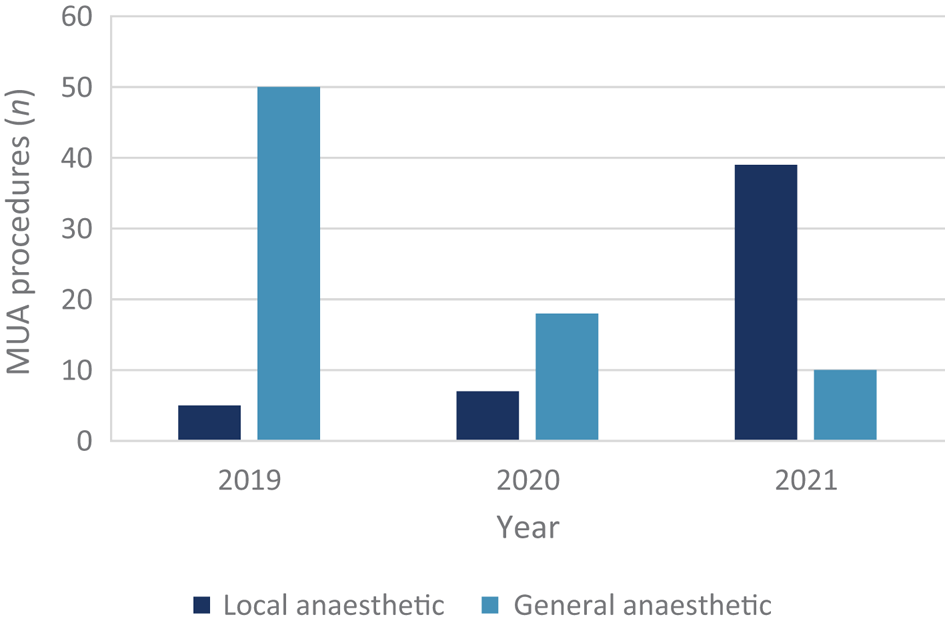
The number of manipulation under LA procedures increased between 2019 and 2021, with an associated decrease in manipulation under GA procedures. In 2019, 9.1 per cent of the manipulation under anaesthesia procedures were performed under LA, compared to 79.6 per cent in 2021 (Figure 1). Two patients undergoing manipulation under LA subsequently underwent manipulation under GA. Among the patients requiring GA, the use of additional instruments such as Walsham's forceps was needed in 58 cases (9.3 per cent). Full operation notes were not available for 17 patients (21 per cent) undergoing manipulation under GA procedures between 2019 and 2021.
Number of manipulation under anaesthesia (MUA) procedures performed by year.

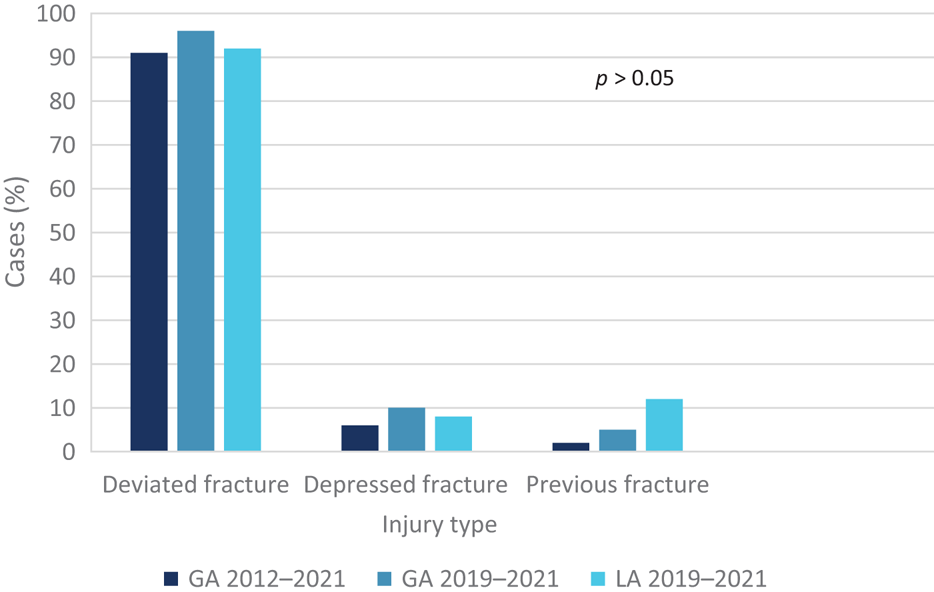
There was no statistically significant difference in the type of nasal bone injury between GA and LA patients. Across all patients, 615 (90.8 per cent) had a deviated nasal bone fracture, 44 (6.5 per cent) had a depressed fracture and 18 (2.7 per cent) had a previously fractured nasal bone (Figure 2).
Type of nasal bone injury. GA = general anaesthesia; LA = local anaesthesia

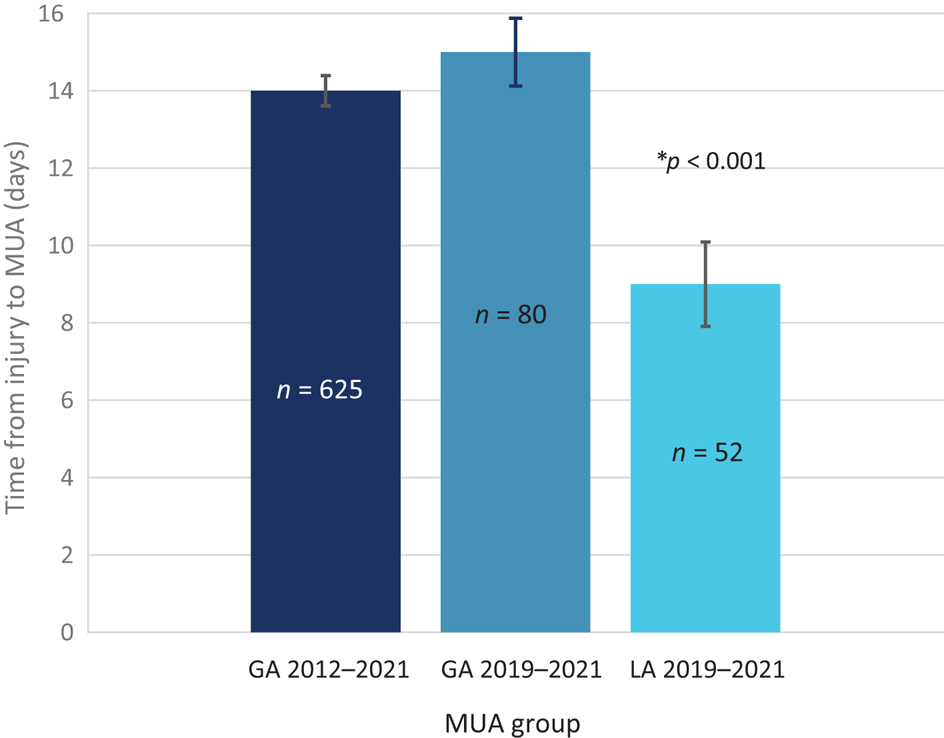
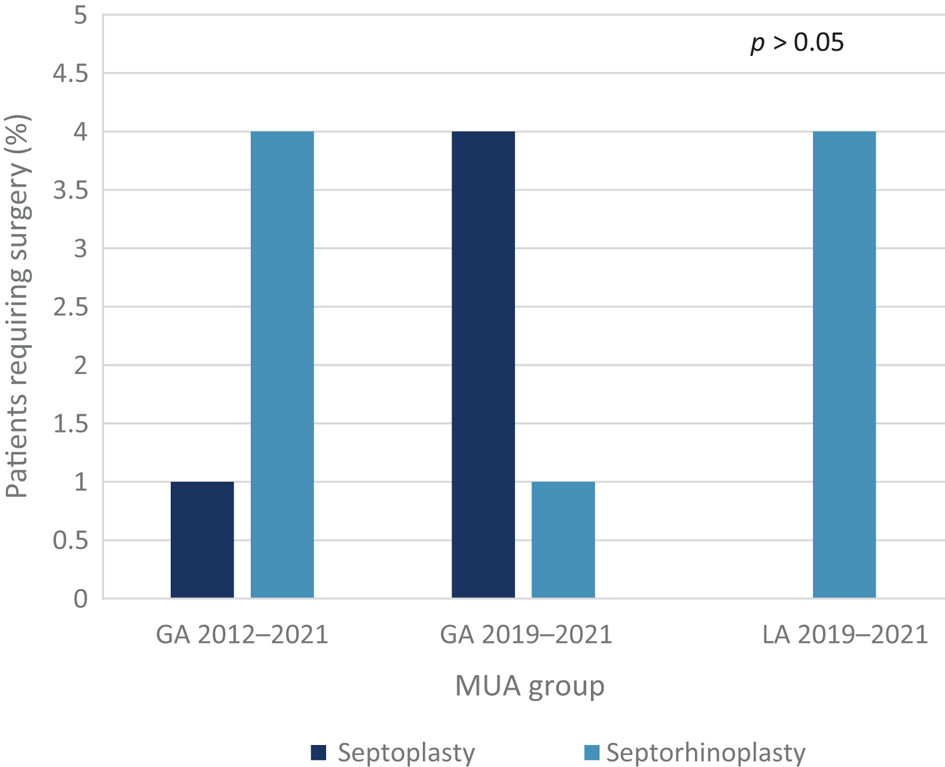
Manipulation under LA procedures were performed sooner after the time of injury than manipulation under GA procedures over the same time period (LA group = 9 days (95 per cent confidence interval (CI) = 7.91–10.1), GA group = 15 days (95 per cent CI = 14.1–15.9)) (Figure 3). There was no statistically significant difference between the LA and GA groups in the percentage of patients requiring further surgery (Figure 4). In total, 4 patients (0.6 per cent) required septoplasty and 29 patients (4.3 per cent) required septorhinoplasty. The median time from manipulation under anaesthesia to septoplasty or septorhinoplasty was 5 months for the LA group and 15 months for the GA group over the same time period (range, 10–28 months). Nasal obstruction was cited as the reason for further surgery in 23 cases (74.2 per cent), following manipulation under GA, whilst poor cosmesis was cited in 24 cases (77.4 per cent). Three patients developed wound infections following septorhinoplasty and two patients required revision surgery.
Time from injury to manipulation under anaesthesia (MUA), with 95 per cent confidence intervals. *Indicates statistical significance. GA = general anaesthesia; LA = local anaesthesia

Proportion of patients requiring further surgery, after manipulation under anaesthesia (MUA). GA = general anaesthesia; LA = local anaesthesia

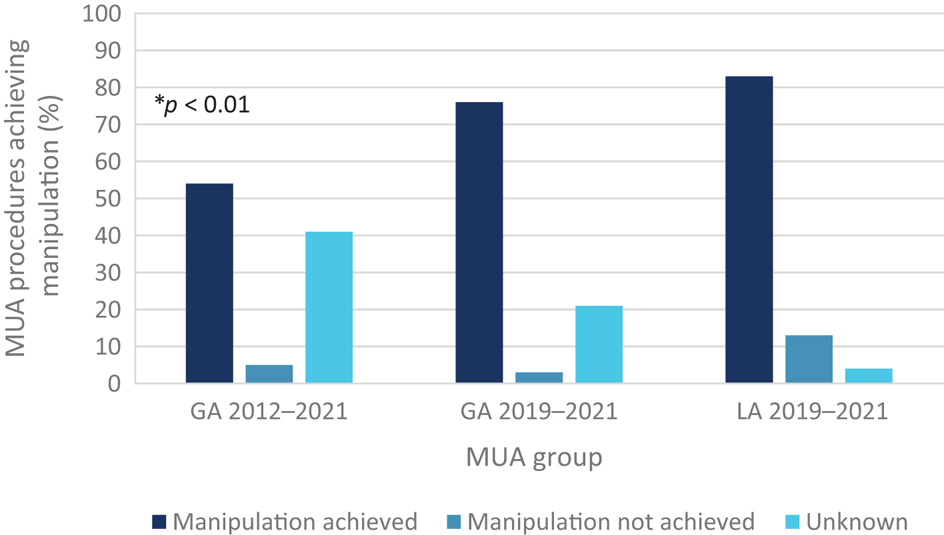
Manipulation was more likely to be achieved under LA (as reported by the surgeon on the day of procedure) than under GA over the same time period (LA group = 83 per cent, GA group = 76 per cent; p < 0.05) (Figure 5).
Proportion of manipulation under anaesthesia (MUA) procedures achieving manipulation. *Indicates statistical significance. GA = general anaesthesia; LA = local anaesthesia

Discussion
This study demonstrates the increasing trend towards manipulation under LA at our centre in the wake of the Covid-19 pandemic. The LA approach enables manipulation to be performed 6 days earlier on average compared to GA. There was no difference between the LA and GA techniques in the rates of patients requiring future septoplasty or septorhinoplasty. Manipulation was more likely to be achieved under LA as reported by the surgeon on the day of the procedure, compared to GA.
The Covid-19 pandemic has placed significant demands on clinicians to reduce hospital interactions, which has resulted in a corresponding increase in manipulation under LA procedures. This technique offers a safe and effective alternative to GA. Patients can undergo a manipulation under LA procedure on the day of their clinic appointment. Our study demonstrates that this is more likely to be within the two-week window following injury, during which nasal bones are most mobile and easily reduced.Reference Hamrang-Yousefi, Kingsley-Smith, Munroe-Gray, Anyanechi and Rollin1
We describe a large cohort of patients compared to other studies of manipulation under LA conducted since the start of the Covid-19 pandemic.Reference Bastianpillai, Khan, Acharya, Tanna and Pal7–Reference Pinto, Wright and Ghosh9 We also present a long review period of up to 10 years for our GA cohort. However, the results are limited by the available data. Operation notes were not available for some cases performed under GA, and manipulation under LA procedures may not have been recorded in our analysis if the clinician did not notify the clinic nurse or complete the ‘Local Safety Standards for Invasive Procedures’ log. No data were available for manipulation under LA procedures prior to December 2018, although this is likely due to a limited number of manipulation under LA procedures being performed prior to this. Additionally, patients may have moved out of the area prior to seeking follow up or may have sought treatment through the private sector, and so some septorhinoplasty procedures may not be included in our analysis.
The LA and GA groups were not matched for age and sex, which may have influenced the results, as children are less likely to undergo septorhinoplasty until their nasal bone has fully matured. We identified fewer children in the LA group, which is expected as young children are less likely to tolerate an LA technique and are at risk of harm if they move during the procedure. This study did not compare outcomes such as pain scores, nasal airway patency, or patient satisfaction with the procedure or with cosmesis. These outcomes have been shown to be similar amongst manipulation under LA and GA procedures in previous studies,Reference Bastianpillai, Khan, Acharya, Tanna and Pal7,Reference Khwaja, Pahade, Luff, Green and Green10 including a systematic review by Chadha et al.Reference Chadha, Repanos and Carswell11
• Local anaesthesia (LA) has benefits over general anaesthesia (GA) in manipulation under anaesthesia procedures for nasal bone fractures
• These benefits include immediate patient feedback, reduced procedure costs and reduced time to treatment
• Use of manipulation under LA has increased since the coronavirus disease 2019 pandemic, to reduce hospital interactions, but long-term benefits are unclear
• This study demonstrated no difference in local rates for septoplasty and septorhinoplasty at 6–36 months following manipulation under LA compared to GA
• Patients undergoing manipulation under LA in this study received treatment on average 6 days earlier than under GA
• Manipulation under LA is a safe and effective alternative to manipulation under GA for nasal bone fractures
Rates of patients requiring future septoplasty or septorhinoplasty procedures in our study are lower compared to previous retrospective studies of manipulation under LA procedures.Reference Courtney, Rajapakse, Duncan and Morrissey12,Reference Rajapakse, Courtney, Bialostocki, Duncan and Morrissey13 Pinto et al. demonstrated an increase in septorhinoplasty rates following the adoption of the LA technique at their centre in Manchester, UK, with 5.4 per cent of 37 patients requiring further surgery over nine months in 2017.Reference Pinto, Wright and Ghosh9 Narang et al. examined a cohort of 10 manipulation under LA cases in Scotland over three months in 2020, of which 2 patients subsequently required septorhinoplasty.Reference Narang, Eswarappa and Calder8 The reduced rates of patients requiring future surgery in our more recent study may have been due to increasing familiarity with the LA technique, as it has gained popularity nationwide.
This study demonstrates that LA is an effective alternative to GA for manipulation under anaesthesia procedures performed for nasal bone fractures at our centre, with no difference in long-term outcomes. Future prospective multicentre studies are required to compare the GA and LA techniques. Further work could investigate the success of manipulation under LA procedures in terms of duration from injury to manipulation under anaesthesia, and type of nasal bone injury (such as depressed, deviated, comminuted or recurrent nasal bone fractures). This study demonstrates a clear need to account for variation in age and sex between groups when comparing GA and LA in the future, because of inherent differences in the demographic characteristics of patients choosing to undergo LA.
Conclusion
This study describes a large cohort of manipulation under anaesthesia patients and includes a long review period of up to 10 years for manipulation under GA procedures. We found that use of manipulation under LA has been increasing since the Covid-19 pandemic at our centre. Results with LA are comparable to those with GA, with the benefit of reduced delays between injury and manipulation. Future prospective multicentre studies could further investigate the success of manipulation under LA procedures by type of nasal bone injury and the duration from injury to manipulation under anaesthesia.
Acknowledgement
Shyam Gokani is funded by a National Institute for Health and Care Research Academic Clinical Fellowship.
Competing interests
None declared