


Introduction
Mental health problems are a major concern internationally. The consequences of untreated or ineffectively treated psychological problems are experienced not only by the individual but reverberate through families and communities. Individuals are affected through unfulfilled potential and miserable day-to-day living. Families and communities see the consequences in disrupted relationships and lost productivity. Provision of effective services for mental health issues is, therefore, a priority.
Recent initiatives in the UK are one example of the prioritizing of government resources to address mental health problems. Currently large amounts of money are being directed towards the provision of increased numbers of clinicians in order to improve access to services for patients and to reduce waiting times. The length of the waiting list in a service is often used as a measure of the adequacy of staffing levels. Long waiting lists can be used to lobby for additional staff.
While we certainly endorse moves to provide additional services and improve patients' access to treatment we wonder if part of the problem is being overlooked. It may be the case that increasing the number of clinicians will only alleviate the patient access problem if current services are being provided as efficiently as possible. However, if current services are plagued with a degree of inefficiency then new staff will become part of this inefficient service delivery and there may not be a commensurate improvement in patient access.
In order to ensure the best value for money it might be prudent to examine the efficiency of service delivery prior to judgements regarding the adequacy of current staffing numbers. By changing the way we organized the service we offered we were able to make dramatic reductions to the waiting list and patient access improved considerably. In some cases patients were seen on the same day they were referred. The changes did not involve any financial outlay, new training, or alterations to the physical workspace. Primarily the change required a reorganizing of our own attitudes regarding how and when appointments should be scheduled. It is these changes that we discuss in this paper.
The work we describe occurred in the adult primary-care section of a large clinical psychology department. First, we describe some of the background information that influenced our thinking. This information comes from varied sources. We will discuss statements in policy documents, sections of the ethical guidelines of the British Psychological Society, and findings from the literature as examples of the support there is for this approach. We also provide theoretical information that suggests this approach may make sense for important reasons. Finally, we provide data that we collected over a 9-month period working at this practice. By providing this information and describing this approach, other clinicians may be interested in implementing this practice in their own work.
Although we provide data from one GP practice, this patient-led work was being conducted by us and two other colleagues in a total of five GP practices and also in secondary care between 2002 and 2008. Not all services were running for all of that time but services became established as staff began working in GP practices or changed the way they were working in the practice they were in. The report we provide of the GP practice within which we worked together is indicative of the results obtained in the other settings where this approach was used. Some of this other work is reported elsewhere (e.g. Carey, Reference Carey2005; Carey & Mullan, Reference Carey and Mullan2007, Reference Carey and Mullan2008; Carey et al. Reference Carey, Mullan and Carey2007).
In this paper we address why it might be useful to structure treatment in this way as well as how one should go about creating and maintaining this structure. In our experience it is the reasoning behind this approach that many clinicians have difficulty with. Once there is clarity about why one should work in this way, how one proceeds becomes much more straightforward.
Without realizing it, this way of working seems to have opened a Pandora's box that challenges some strongly held views about what it means to be a clinician and the capabilities of patients. To some people it is professionally irresponsible to allow patients to make their own appointments. Some clinicians appear to believe that when people experience mental health problems of any kind they are incapable of making appropriate decisions regarding such things as appointment scheduling (see Ethical guidelines section below for further comment). We hope by the end of this paper the reader will have sufficient information to justify the opposite view. A patient's decisions might not always be the same as the clinician's decisions but we do not believe that necessarily makes patient decisions inferior or inappropriate. We believe it is profoundly respectful to recognize and promote the self-determining capacities of individuals. Actually, we do not think of this approach as allowing patients to make decisions. We think this approach simply recognizes the fact that this is what patients are doing anyway and structures treatment to ensure compatibility with these decisions.
What does successful treatment mean?
Perhaps the first issue that needs to be addressed in the context of ‘when is enough enough’ is the issue of deciding when treatment should be concluded. Should this be when the patient has recovered? If so, what does it mean to say that the patient has recovered?
Where the delivery of psychological treatment is concerned, it is probably not contentious to assert that the most common way of determining the effect of treatment is by asking the patient to complete pre- and post-questionnaires. Generally treatment would be considered successful if a patient's score moved from outside the normal pre-treatment range to inside the normal post-treatment range.
Other questionnaires such as the Outcome Questionnaire (OQ; Lambert et al. Reference Lambert, Burlingame, Umphress, Hansen, Vermeersch, Clouse, Christopherson and Burlingame1996) can be completed by patients in each session to provide an indication of the clinical significance of the change. The concept of clinical significance purports to assess the changes due to treatment that are practically meaningful for patients (McGlinchey et al. Reference McGlinchey, Atkins and Jacobson2002). The measure of clinical significance includes an indication that the patient has returned to normal functioning as well as a measure of the size of the change that was made (Jacobsen & Truax, Reference Jacobsen and Truax1991).
Both these types of questionnaires, therefore, implicitly assume that there is a range of ‘normal’ that people will move into when their psychological troubles are over. This is not necessarily a defensible assumption. Robinson et al. (Reference Robinson, Berman and Neimeyer1990), for example, reported that even when psychotherapy brings about a reduction in depression patients who received therapy can still be distinguished from healthy individuals who have not sought treatment. Perhaps some people live their lives satisfactorily (from their perspective) but would never score in the normal range on standardized questionnaires of depression, anxiety, etc.
In order to know the appropriate place for people to return to when psychological treatment is successful it would be necessary to know their level of functioning prior to their psychological distress. However, psychologists and psychotherapists almost never have access to this information. The first information that is available is the patient's level of functioning once they are distressed.
Whereas questionnaires typically indicate the amount of symptom change in psychotherapy Kazdin (Reference Kazdin1999) makes the point that symptom change is not always the issue from the patient's perspective. Kazdin (Reference Kazdin1999) asserts that the number of people who experience symptoms in everyday life is probably quite high; however, most people with symptoms do not access psychotherapy. Later, he reminds us that few patients seek psychotherapy because they have high scores on a questionnaire (Kazdin, Reference Kazdin2001). Patients who change so that their scores are in the normative range may or may not be functioning better in everyday life (Kazdin, Reference Kazdin2001). According to Kazdin, it seems that we have forgotten to ask the patients if they would choose symptom change as indicated by questionnaire scores as the basis to evaluate the benefits of treatment.
The first point then is that patients should be the final judge of whether or not psychological treatments are of benefit. From this line of reasoning it seems obvious that patients should also be the judge of when they have had enough treatment. Enough treatment for the patient will probably be when the problem has changed enough for them, from their perspective.
Good reasons for patients to take charge
When considering both the implicit and explicit support that exists from varied sources for the promotion of patient decision-making it is perhaps surprising that it is not already more widespread. An ethos of collaboration is certainly promoted in cognitive behaviour therapies; however, given the power imbalance that exists between patient and clinician we wonder how legitimately collaboration can occur in this context compared to one in which the client has direct control over specific aspects of the therapy such as frequency and duration. The power imbalance is aptly illustrated in the sentiment of ‘giving patients choices’ since one needs to be in a position of power in order to dispense choices to a less powerful person (Carey et al. Reference Carey, Mullan and Carey2007). Presumably whoever gives can also take away.
With regard to the scheduling of appointments it is to be expected that the patient would defer to the clinician for guidance on how long and how often they should attend. In fact, some patients may even prefer not to have the responsibility for deciding when their next appointment should be. Perhaps this reflects a general difficulty with responsibility in their daily living.
However, it is not the clinician who knows the day-to-day state of the problem the patient is experiencing. Nor is it the clinician who knows the learning styles or abilities of the patients or their motivation and commitment to change. Therefore the clinician is not the best one to judge how quickly treatment should proceed or for how long it should proceed. In this section we provide ethical, policy, empirical, and theoretical information to suggest that clinicians who promote patient decision-making are on solid ground.
Generally, when ethics or policy documents discuss patient choice and control they stipulate that these considerations do not apply when legislation indicates otherwise. The way these guidelines should be applied in situations where the patient is an involuntary recipient of the service is beyond the scope of this paper. In the following sections we only refer to voluntary patients who typically access psychological treatments in primary care.
Ethical guidelines
The ethical guidelines of the British Psychological Society (BPS, 2006) state that psychologists should pay ‘particular regard to people's rights including those of privacy and self-determination’ (BPS, 2006, p. 10). Further on are statements about respecting the ‘knowledge, insight, experience and expertise of clients’ (p. 10); endeavouring to ‘support the self-determination of clients, while at the same time remaining alert to potential limits placed upon self-determination by personal characteristics or by externally imposed circumstances’ (p. 13); and ensuring ‘from the first contact that clients are aware of their right to withdraw at any time from the receipt of professional services or from research participation’ (p. 14).
We found the last two statements particularly interesting when juxtaposed against each other. What might be personal characteristics that limit the self-determination of an individual? We have heard of initiatives such as ‘assertive outreach’ programmes and the reasoning that some people's conditions, such as depression, prevent them from accessing services and so to allow them to choose whether or not they attended appointments would be discriminating against them because of their disorder and denying them access to services. What methods might there be to assist clinicians to discern whether a patient is withdrawing from a service because of some feature of their disorder or because they are exercising their personal right? This would seem to be an important issue to clarify since persistently providing services to reluctant patients could be providing needed support or it could be breaching an ethical code. Our stance was that since every patient referred to our service had accessed their GP in order to obtain the referral, it could therefore be assumed that they did not have difficulties in accessing services per se. We decided, therefore, that there were important ethical reasons for arranging a service to maximize patient choice and decision-making.
Policy guidelines
As with ethical guidelines, policy guidelines are an important aspect in defining the nature of the work that is conducted in particular settings. However, unlike ethical guidelines, which apply to a specific profession, policy guidelines often apply across professions. The guidelines of the NHS are clear in their advocacy for increased patient choice.
NHS Scotland is the branch of the NHS we were most familiar with as this is where we were located when this work was conducted. A document published in 2000 from the Scottish Executive includes statements such as: ‘Too many people wait too long for treatment and care. . . . Too many people feel undervalued by a system where often the interests of providers come before the needs of patients. Too many people find services difficult to access’ (Scottish Executive, 2000, p. 5); ‘We must build an NHS which listens better to patients and responds more effectively to their needs’ (p. 6); and ‘A patient-centred NHS must not just be a slogan: it must become a way of life’ (p. 50).
Also reported in that document were the results of a survey indicating that: 57% of NHS users believed they had little influence over the way the service is run; 93% of respondents believed the public should have influence, and 64% believed the public should have a great deal of influence (p. 93).
In a later document (Scottish Executive, 2003) the importance of the role of the patient was reiterated. ‘Looking at services from a patient's point of view underpins everything that we are seeking to do in the health service’ (p. 7). ‘People now expect to be involved in deciding about their own health care as responsible partners in care. They wish to be treated with dignity and respect, to be treated as individuals and not as cases, and to have the right care in the right place at the right time’ (p. 17). Furthermore, the document pointed at ways in which patient-centred care could be achieved by suggesting that ‘empowerment of individuals and communities, to enable them to increase control over and improve their health’ (p. 18) was important.
Elsewhere in the NHS similar attitudes are expressed. When discussing patient choice it is claimed that the ‘2005 British Social Attitudes survey revealed that 65% of patients said they wanted choice of treatment, 63% wanted a choice of hospital and 53% welcomed a choice of appointment time’ (NHS, 2008a). Indeed, one of the core principles of the NHS is that the ‘NHS will shape its services around the needs and preferences of individual patients, their families and their carers’ (NHS, 2008b). In Northern Ireland ‘Prevention, treatment and care programmes have been established in partnership with communities and many of these support and enable people to take control of their own health and wellbeing’ (Department of Health, Social Services, and Public Safety, 2004, p. 44) and in Wales it is planned that, by March 2009, systems will be in place ‘to ensure that individual service users are fully engaged in the planning and delivery of their own care and are empowered to self-manage where possible’ (NHS Wales, 2006, p. 18).
Perhaps in order to emphasize the importance of patient empowerment and control there is also a section of the NHS website dedicated to clarifying patients' rights. One of the areas in this document is the ‘Right to refuse treatment’ (NHS, 2008c) that stipulates ‘you can refuse any treatment if you wish’ and also clarifies the situations when this would not apply, e.g. when someone is detained under the Mental Health Act, or someone has a notifiable disease. This would seem to be an important proviso to bear in mind. It is relatively easy to endorse principles of patient choice and empowerment when patients agree with the decisions you offer. A more exacting test of how emphatically these principles are embraced comes when there is disagreement. When a patient either implicitly or explicitly disagrees with a decision of treatment, is the patient's right to disagree respected or are attempts made to persuade the patient to adopt the clinician's alternative perspective on the problem?
Thus, as with ethical considerations, there seems to be strong support at policy level for maximizing patient choice and control.
Empirical evidence
A large amount of empirical support exists for the initiative of deferring to the patients' decisions regarding treatment duration and accuracy. For example, there is a well-established finding that patients attend far fewer sessions than treatment is designed for (e.g. Carey, Reference Carey2006). For instance, after reviewing the literature, Hansen et al. (Reference Hansen, Lambert and Forman2002) reported that the average number of appointments on a national database of over 6000 patients was less than five. Talmon (Reference Talmon1990) reported that the modal number of sessions that patients attend treatment for is one. It is also well established that the largest gains in treatment are made within the first few sessions (e.g. Lambert et al. Reference Lambert, Hansen and Finch2001).
For more than 20 years Pekarik and colleagues have demonstrated among other things that: early treatment dropouts are not necessarily treatment failures (Pekarik, Reference Pekarik1983); patients expect and experience far fewer sessions than therapists expect (Pekarik & Wierzbicki, Reference Pekarik and Wierzbicki1986; Wierzbicki & Pekarik, Reference Wierzbicki and Pekarik1993), and patients' expectations about treatment length is the best predictor of actual treatment length (Mueller & Pekarik, Reference Mueller and Pekarik2000).
Mueller and Pekarik's study warrants closer attention because they found that from the patient's perspective, treatment satisfaction was not necessarily linked with treatment outcome. In general, patients ‘who attended fewer visits than anticipated were about twice as likely as others to be classified as dropouts, tended to be less satisfied, and achieved greater change than other groups on two of the six outcome measures’ (p. 122). The other four measures were not significantly different between the groups. Mueller and Pekarik describe this as something of a ‘paradox’ (p. 122) but also report that it is not uncommon in the literature for early terminators to describe problem abatement as a reason for terminating and for a large percentage of early terminators to report dissatisfaction with treatment. It appears that treatment satisfaction and treatment effectiveness are not necessarily synonymous.
Carey (Reference Carey2005) reviewed the literature regarding treatment duration and reported that treatments of different durations are widely reported in the literature and studies comparing the same treatment of different durations are common. However, an important point to state explicitly is that a study that demonstrates a particular therapy is effective in 12 sessions is not a study demonstrating that 12 sessions are necessary for treatment effectiveness. Carey & Mullan (Reference Carey and Mullan2007) reported a small number of average appointments when a system was introduced in which patients determined the number of sessions they attended. In this system the average number of cancelled or missed appointments was zero. The higher number of average cancelled or missed appointments that ordinarily exist in clinical practice may indicate that patients are already making choices. From this perspective, the organizational approach we are suggesting may not be the introduction of something new as much as recognizing what is currently occurring.
Carey & Kemp (Reference Carey and Kemp2007) compared a 7-month trial that invited patients to book their own first appointment with a 7-month period of standard procedure of issuing first appointments. The percentage of non-attended first appointments was 2% in the invited group and 21% in the issued group. Moreover, when appointments were issued, 62 first appointments were scheduled over the period. When appointments were invited, 164 first appointments were offered. Of the 164, 60 did not schedule an appointment. Did these 60 people find alternative remedies or experience symptom relief due to the passage of time in the months between when they were referred and when they were invited to make an appointment? What clinicians feel should be done about those 60 patients perhaps reflects attitudes towards those differences of opinion between clinician and patient mentioned earlier.
Given this empirical information, should we continue to attempt to persuade patients to attend for the number of sessions we have decided is ‘right’ or should we design treatments that fit into the attendance pattern that patients think is right? There are sound theoretical reasons for selecting the latter option.
Theoretical support
Numerous theories attest to the positive benefits of providing increased choice across a variety of situations. The theory that we subscribe to because of its rigour, precision, and accuracy is Perceptual Control Theory (PCT; Powers, Reference Powers2005). From a PCT perspective, people are most satisfied when they are able to control outcomes that are important to them and become disgruntled, irritated, and distressed when their efforts to control are thwarted.
Given the very large proportion of a person's life that is spent outside psychotherapy it is perhaps important to recognize how much control is already occurring. Psychotherapy will be fitted in to the lives people are already living. Pre-arranged appointments will be changed or missed depending upon what else is happening for the patient at the time. Attempts to try and eliminate or minimize this seemingly haphazard approach to appointment attendance would interfere with other aspects of a person's life. A more parsimonious solution would be to organize treatment flexibly and to adaptively cater for this variability. It is a description of this practice to which we now turn.
The how and what of putting patients in charge
In this section we describe the procedure at one GP practice. In many ways this is a replication of previous work (Carey & Mullan, Reference Carey and Mullan2007) with a difference being that a service already existed at this practice when a patient-led approach to appointment booking was introduced. The second author (M.B.S.) had been working at the practice for about 2 years but was working with another clinician who preferred a different approach so a practice-wide patient-led system was not possible. Due to organizational changes it transpired that the first author (T.A.C.) had the opportunity to join M.B.S. at the practice. When this occurred we introduced a patient-led approach throughout the practice and collected data on our work.
How we put patients in charge
We began this system by explaining to the GPs the way in which we would like to work and they enthusiastically endorsed its introduction. There was a 7-month waiting list when we started this system and so, first, the office manager called the patients on the existing waiting list to offer them appointments.
Both of us worked at the practice for one session a week which was entered into the computer with the appropriate booking times. Patients on the waiting list were provided with appointments first and then new appointments were scheduled as required. GPs entered new appointments directly into a vacant appointment time. Sometimes this meant that patients were offered an appointment on the same day that they had their GP appointment.
At the first appointment time was spent discussing the patient's problem. Details of the problem from the GP's perspective could be obtained from patients' medical notes on the computer. At the end of the first appointment the system was routinely explained to patients. Patients were informed when our sessions were available and that, from now on, they could schedule appointments the same way they would if they wanted to see their GP. We let them know that they could make appointments as often as they liked, for as long as they liked, and that they could see either one of us or both of us. We also checked that patients would feel comfortable making appointments this way. The reason for checking this was because some of our colleagues had expressed concern that patients might feel dismissed or undervalued if we did not tell them or suggest to them when to come back or that patients might not have the skills to phone for appointments. Because of these concerns and because we like to base our work on data, we decided to investigate this at every appointment. Invariably patients told us that they would have no problems making appointments this way.
Therefore, at the first appointment, while explaining the system to the patients we also explained the limitations of the service. We did not offer after hours or weekend appointments, for example. Thus, we are not suggesting every aspect of the service was completely unlimited. Any service will always be constrained by financial or other resources which will restrict the variables that patients are able to control. The patients we worked with did not have access to 24-hour psychological care, although they could choose the gender of the clinician they worked with as well as the professional affiliation of the clinician (T.A.C. is a clinical psychologist and M.B.S. is a cognitive behaviour therapist). While some variables might be difficult for a service to organize, treatment frequency and duration are features of any psychological treatment a service provides. Thus, within whatever constraints a service is bound by we suggest that enabling patients to make their own decisions regarding treatment frequency and duration is a simple and cost-effective way of improving patients' access to services and promoting patients' control over their health care.
After the first appointment subsequent appointments were entirely at the patient's discretion. Sometimes, patients would ask us for our opinion about when we thought they should return or how often they should attend. On each occasion we advised them that they were really the only ones who knew what the experience of their problem was and only they knew how much help they needed and how often they needed it. We explained that people work through problems in different ways and in different time-frames and our system acknowledged and respected that.
At the end of each appointment we typed a brief (perhaps three or four lines) summary of our session into the patient's medical notes on the computer. The GPs told us that they found this extremely helpful because when they next saw the patient they had up-to-date information about their psychological treatment. Because we were also required to keep patient files for the clinical psychology department within which we worked, we printed these notes and placed them in the patient's file.
We closed the files of any patients we had not seen for 3 months, although this action was only an administrative convenience. The patients were not restricted from attending our service. If these patients decided to return after 3 months they telephoned the receptionist and scheduled an appointment as they had done previously and we re-opened their file in our department. They did not need to go back to their GP to be re-referred.
While operating this system we collected data. At every appointment we provided the Depression Anxiety and Stress Scale – 21-item version (DASS-21; Lovibond & Lovibond, Reference Lovibond and Lovibond1995) by leaving it in a folder at the reception desk. The receptionist gave the DASS-21 to the patients when they arrived for them to complete while they waited for their appointment. We also collected data on how often patients attended and how long they attended for. From their medical records we were able to obtain data about their problems as well as characteristics such as their age.
What happens when patients lead?
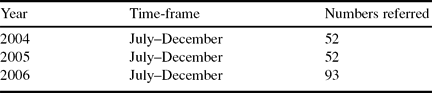
We collected data over nine calendar months (34 weeks). At the end of the first 6 months we were interested in conducting a preliminary check on the referral rate since the commencement of the system. Table 1 shows the numbers referred for the first 6-month period of the patient-led system compared with the numbers referred in the same 6-month period from the two previous years. The difference in numbers being referred is perhaps more pronounced when one considers that at the start of the system there was a 7-month waiting list but by the end of this 6-month period (December) there was no waiting list. Increasing referral rates while simultaneously reducing waiting lists might be a feature that would be of interest to people who consider patient waiting times and patient access to services as priority areas.
Comparison of referral information after commencing patient-led system

Appointments typically lasted for 30 minutes and two sessions a week were scheduled at the practice making 14 sessions available per week. Due to staff absences on various occasions, e.g. holidays or illness, fewer than the maximum number of sessions was available. Moreover, the average number of appointments booked was slightly greater than the average number of appointments available (see Table 2). This is a feature of the patient-led system. If a patient phoned to cancel their appointment another patient could be booked into that time slot. Sometimes this occurred on the same day that the session was occurring.
Summary information for sessions provided

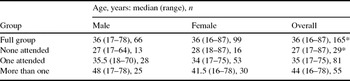
The age range of patients seen was outside the standard age range of 18–65 years for the adult speciality (see Table 3). Because there was no waiting list with this service but there were waiting lists in the Child and Adolescent Speciality and the Older Adults Speciality and also because the problems these patients were experiencing were standard primary-care problems such as depression and anxiety, the GPs referred them to our service. If issues had arisen that may have been more appropriately addressed by the expertise of colleagues in other specialities we had the option of referring these patients to our colleagues or obtaining specialist supervision from them.
Age averages for groups of patients attending different numbers of appointments

*Gender was not recorded for two patients.
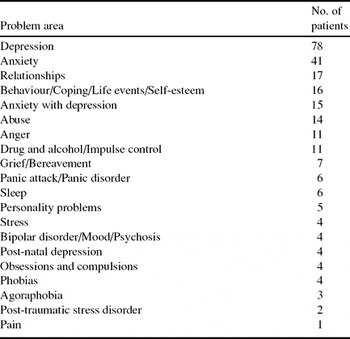
Table 4 lists the psychological problem areas that were contained in the patient records of those patients who were referred to our service. The problems were not necessarily the specific problem the patient was referred for at the time they saw us but were the general problems in the patient's life.
Summary of psychological problem areas from medical records

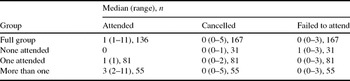
Medians were used to quantify the average number of appointments scheduled as well as cancelled and non-attended because of the highly skewed nature of the distributions (see Table 5). These data depict the pattern of results over a 9-month period but they do not equate to particular programmes of treatment commencing and finishing. In a sense an arbitrary line was drawn beyond which no more data were collected. However, the patients who were being seen, could still continue to schedule appointments. If the data were collected for longer there may be some differences in the figures. For example, in an earlier study of a similar kind of system (Carey & Mullan, Reference Carey and Mullan2007), data were collected over a 6-month period and the range of appointments for patients attending more than one appointment was 2–6; however, the average was 2. With longer data-collection periods it may be that more patients are seen (e.g. n = 101 for the Carey & Mullan, Reference Carey and Mullan2007 study; n = 167 in the present study) but the average might be expected to remain fairly similar [e.g. median = 2 in Carey & Mullan study (more than one attended group), and median = 3 in present study]. These figures are within the range of what is generally found in the literature with a large number of patients attending a small number of sessions and a small number of patients attending a large number of sessions (e.g. Shapiro et al. Reference Shapiro, Barkham, Stiles, Hardy, Rees, Reynolds and Startup2003). The difference with this system is that because patients are not being persuaded to attend for a specified number of sessions there is the capacity to provide more appointments to those patients who need it without affecting access to the service for other patients.
Attended and cancelled appointment averages for different groups of patients

While improving access to services, reducing waiting times, and increasing patient control are important outcomes to achieve, it is also important to know what effect this new way of working has on reported symptomatology. Average DASS-21 scores were available for those patients attending one appointment only and those patients attending more than one appointment (see Table 6). For those patients attending more than one appointment the average DASS-21 scores for the first appointment and the most recent appointment are included.
DASS-21 averages for those patients who attended one appointment only and the first and most recent averages for those patients attending more than one appointment

DASS-21, Depression Anxiety and Stress Scale – 21-item version.
The time 1 and time 2 scores for the ‘more than one’ group are not typical pre- and post-scores (see Table 6). Because patients can make appointments whenever they require them there is, in essence, no ‘post’-score. Time 1, therefore, represents the scores reported at the first appointment. Time 2 scores are those reported at the most recent appointment prior to cessation of data collection. Nevertheless, it was useful to note that there was a decrease in scores, indicating a reduction in self-reported symptomatology, from time 1 to time 2. It was also of interest to observe that the scores at time 2 were very similar to the scores of the group who attended only once. Perhaps this illustrates the point made earlier that it is not the clinician's expectation of amount of change that is important. Perhaps patients stop scheduling appointments when they have made the amount of change they are satisfied with. By improving patient access to the service it might be that patients achieved an amount of change that gave them relief from their distress and enabled them to engage better in their daily activities with the knowledge that they could return for additional sessions whenever they required them. It might be that the level of symptomatology reported by the ‘one face-to-face’ group and the ‘more than one’ group at time 2 is a level at which day-to-day living is satisfactory even though it might be higher than the level which clinicians think is ideal. Did the patients within this service receive enough treatment? We believe the evidence indicates that they received as much as they required within the 9-month data collection period. ‘When patients have received as much treatment as they require from their perspective’ is surely a sensible answer to the question ‘When is enough enough?’
Caveats and conclusions
From ethical, policy, empirical, and theoretical perspectives, there are compelling reasons to improve the extent to which patients control the duration and frequency of their appointments for psychological treatment. In this paper we have described an approach we implemented at one GP practice to promote patient choice and control.
One approach to improving patient access to psychological services and reducing waiting times is to increase the number of clinicians available to provide the services. It would seem that another, more cost-effective alternative, would be to change the way that the service is organized so that patients are able to schedule appointments as they require them. Paradoxically, it appears that when a service is made more available to patients, many patients utilize it less which means there is available capacity to provide greater amounts of time to those patients who require more.
While this approach seems simple, effective and well justified, it is not without its problems. Keijsers et al. (Reference Keijsers, Schaap and Hoogduin2000) point out that some patients expect therapists to take all the responsibility for treatment. This might be expected in a health-care system where recent national policies indicate that patients do not take as much control over their health care as is ideal and where, in many cases, GPs have been seen to be the ones responsible for patients' health-care plans. While many patients will appreciate a more flexible and available service not all patients will be comfortable with the requirement that they take responsibility for the scheduling of their appointments. The routine statistics of cancelled and non-attended appointments would attest to the fact that patients implicitly already schedule their own appointments. However, a period of adjustment, might be anticipated for some patients as this implicit process is recognized and utilized explicitly for a more efficient service.
Patient feedback can be seen as an important aspect of the service. Within this system of greater patient choice and control patients may feel even more inclined to voice their opinions about the service. These opinions can be used in a positive way to indicate those aspects of the service that perhaps need modifying, or what education and information needs to be provided to the patients.
Colleagues and managers might also find difficulty adjusting to this system. It appears that, for some clinicians, there is a sense of certainty and security in knowing at one appointment when the next appointment is scheduled. It is certainly the case that patient-led appointment scheduling can seem ‘messy’ and a reorganization of attitudes regarding the planning and preparation of sessions may be required. However, for us the advantages of spending far fewer sessions sitting in an empty clinic room because another patient had not attended and being able to provide an increased service to more patients was worth the change in perspective. However, this is ultimately a decision that can only be made by individual clinicians. How clinicians respond when patients make decisions that are at odds with the decisions the clinicians think the patients should make may well be a measure of how wholeheartedly clinicians have embraced the notions of patient empowerment and control.
Knowing how to begin this approach can appear daunting even when the ethical, policy, empirical, and theoretical, reasons are understood and accepted. Because of the concerns we expressed earlier about how legitimately collaboration can occur in a relationship with the power differential between clinician and patient we do not advocate a graded or composite approach. Perhaps this is because we cannot conceptualize the way in which one would grade the change from clinician decision-making to patient decision-making. Our strategy has been to make the change, collect data, and evaluate the change. This approach does not preclude clinicians giving advice to patients about how often to attend for treatment if the clinician has some defensible reason for doing so. However, in our experience we have not found that necessary.
While many managers seem to be enthusiastic about this way of working (Carey et al. Reference Carey, Mullan and Carey2007) this might not be a universal reaction. For example, managers who view increasing numbers of staff as a sign of the success of the service and their negotiating abilities might not be interested in an idea that suggests that perhaps more could be done for less. As with clinicians, this will be an individual decision for each manager to reconcile.
The generalizability of this approach has also not been fully explored. Although we have used this approach in different primary-care settings as well as a secondary-care setting over a number of years we have certainly not explored all possible areas where this approach could be utilized. Furthermore, we were not faced with the problem of what to do with patients who over-use the service. In fact, our experience was that patients felt less need to make regular use of the service because they knew it would be there when they needed it. However, under-use of the service, was another concern expressed by some colleagues.
The approach we have described does not explore why patients attend or do not attend for treatment nor does it address why they achieve a certain amount of change and no more. The reasons why patients attend as they do are likely to be multiplicitous. Patients might be ambivalent about treatment, they might be conflicted about attending, or circumstances might occur which require their attention. Or they might attend when and as they need to. What should be done about people who might benefit from treatment but who do not access a service is an issue involving philosophical and theoretical perspectives that is beyond the scope of this paper. The focus of the patient-led approach is on making psychological treatment as accessible as possible for patients. What to do with patients who are not accessing the service in the way the clinician thinks they should is an issue that might be influenced by the ethical, policy, and theoretical rationales we have already provided; however, ultimately this is an issue that will need to be reconciled individually by each clinician.
This paper has described the justification for, and procedure of, one approach to improving patient access to service. The method involves doing less, rather than more in terms of the scheduling of patient appointments and recognizing and honouring the patient decision-making that is already occurring regarding this aspect of treatment delivery. Organizing a service so that appointments are available when patients need them: What could be simpler or more defensible than that?
Declaration of Interest
None.
Learning objectives
After reading this paper people will be able to:
• Justify the decision of placing patients in control of their own treatment schedule.
• Plan a service organized around the concept of patient control over treatment schedules.
• Collect data about this service.





Comments
No Comments have been published for this article.