Developmental theory and research characterize the pubertal transition as a challenging stage, characterized by a confluence of biological, psychological, and social disruptions (Alsaker, Reference Alsaker and Rutter1995; Angold, Worthman, & Costello, Reference Angold, Worthman, Costello and Hayward2003; Paikoff & Brooks-Gunn, Reference Paikoff and Brooks-Gunn1991; Petersen & Taylor, Reference Petersen, Taylor and Adelson1980; Susman & Rogol, Reference Susman, Rogol, Lerner and Steinberg2004). Moreover, this transition serves as a developmental context of risk for the onset of depression, especially in girls (Angold, Erkanli, Silberg, Eaves, & Costello, Reference Angold, Erkanli, Silberg, Eaves and Costello2002; Costello, Mustillo, Erklani, Keeler, & Angold, Reference Costello, Mustillo, Erklani, Keeler and Angold2003; Hankin et al., Reference Hankin, Abramson, Moffitt, Silva, McGee and Angell1998; for a review, see Rudolph, Hammen, & Daley, Reference Rudolph, Hammen, Daley, Wolfe and Mash2006). Progressing through puberty early relative to one's peers poses a particularly strong risk for depression, especially in girls (for reviews, see Alsaker, Reference Alsaker and Rutter1995; Graber, Reference Graber and Hayward2003). Yet, many adolescents negotiate this stage with few ill effects (Graber, Reference Graber and Hayward2003). Despite this variation, surprisingly little is known about what determines individual differences in depressive reactions to puberty. The goal of this research was to examine two models of pubertal timing—a personal-accentuation model and a contextual-amplification model—that explain these individual differences. According to these models, characteristics of youths and their contexts either magnify or temper the adverse emotional consequences of earlier pubertal maturation.Footnote 1
Pubertal Development and Depression
Biopsychosocial perspectives on puberty focus on the interacting biological, physical, psychological, and social changes that mark this transition (DeRose, Wright, & Brooks-Gunn, Reference DeRose, Wright, Brooks-Gunn, Keyes and Goodman2006; Graber, Reference Graber and Hayward2003; Lerner, Reference Lerner and Damon1998; Magnusson, Reference Magnusson1988; Petersen & Taylor, Reference Petersen, Taylor and Adelson1980; Susman & Rogol, Reference Susman, Rogol, Lerner and Steinberg2004). These changes have the potential to confer both advantages and risks. Whereas adolescence may be a time of increasing competence and resilience, as reflected in heightened cognitive and emotional capacities, it may also be a time of increasing risk for vulnerable youths (Gunnar, Wewerka, Frenn, Long, & Griggs, Reference Gunnar, Wewerka, Frenn, Long and Griggs2009). With regard to risk, a growing body of research suggests that both biological (e.g., hormonal variation) and physical (e.g., morphological and other somatic changes) aspects of puberty contribute to depression and associated psychological distress (for reviews, see DeRose et al., Reference DeRose, Wright, Brooks-Gunn, Keyes and Goodman2006; Susman & Rogol, Reference Susman, Rogol, Lerner and Steinberg2004). Several models have been proposed to explain these effects (for reviews, see Brooks-Gunn, Graber, & Paikoff, Reference Brooks-Gunn, Graber and Paikoff1994; DeRose et al., Reference DeRose, Wright, Brooks-Gunn, Keyes and Goodman2006; Paikoff & Brooks-Gunn, Reference Paikoff and Brooks-Gunn1991; Petersen & Taylor, Reference Petersen, Taylor and Adelson1980), including direct pathways (hormonal changes directly influence negative emotions and depression; Angold, Costello, Erkanli, & Worthman, Reference Angold, Costello, Erkanli and Worthman1999; Angold et al., Reference Angold, Worthman, Costello and Hayward2003; Susman, Dorn, & Chrousos, Reference Susman, Dorn and Chrousos1991), indirect pathways (biological and physical changes stimulate psychological disruption and social reorganization, which then heighten risk for depression; Graber, Brooks-Gunn, & Warren, Reference Graber, Brooks-Gunn and Warren2006), and interactive pathways (biological and physical changes interact with psychological and social challenges to predict depression; Conley & Rudolph, Reference Conley and Rudolph2009; Graber, Reference Graber and Hayward2003; Magnusson, Reference Magnusson1988).
Beyond the independent or interactive effects of various components of puberty, biopsychosocial perspectives increasingly implicate youths' timing of puberty (i.e., pubertal status relative to age; Graber et al., Reference Graber, Brooks-Gunn and Warren2006; Susman & Rogol, Reference Susman, Rogol, Lerner and Steinberg2004; Weichold, Silbereisen, & Schmitt-Rodermund, Reference Weichold, Silbereisen, Schmitt-Rodermund and Hayward2003) as a key determinant of risk for depression and associated distress (for reviews, see Alsaker, Reference Alsaker and Rutter1995; Weichold et al., Reference Weichold, Silbereisen, Schmitt-Rodermund and Hayward2003). According to the stage-termination hypothesis, earlier maturation presents a particular risk for maladjustment. Earlier-maturing youths face the adolescent transition before they have successfully completed prior developmental tasks and developed the skills necessary to cope with the challenges of adolescence (Peskin, Reference Peskin1973; Petersen & Taylor, Reference Petersen, Taylor and Adelson1980). Thus, earlier-maturing youths are faced with a great deal of novelty and ambiguity that they are required to negotiate prior to many of their peers (Caspi & Moffitt, Reference Caspi and Moffitt1991). Moreover, earlier-maturing youths tend to be exposed to riskier social contexts (e.g., affiliation with older and norm-breaking peers; Weichold et al., Reference Weichold, Silbereisen, Schmitt-Rodermund and Hayward2003) and thus may face even greater challenges than their on-time and later-maturing peers.
In support of this hypothesis, earlier-maturing girls show heightened risk for depression and associated emotional difficulties relative to their on-time and later-maturing peers (Brooks-Gunn & Warren, Reference Brooks-Gunn and Warren1985; Ge, Conger, & Elder, Reference Ge, Conger and Elder1996, 2001a; Hayward et al., Reference Hayward, Killen, Wilson, Hammer, Litt and Kraemer1997; Kaltiala-Heino, Kosunen, & Rimpela, Reference Kaltiala-Heino, Kosunen and Rimpela2003; Siegel, Aneshensel, Taub, Cantwell, & Driscoll, Reference Siegel, Aneshensel, Taub, Cantwell and Driscoll1998; Stattin & Magnusson, Reference Stattin and Magnusson1990), although some research does not support this effect (Angold, Costello, & Worthman, Reference Angold, Costello and Worthman1998). Findings among boys are mixed (for a review, see Huddleston & Ge, Reference Huddleston, Ge and Hayward2003). Whereas some research links elevated depression and internalizing symptoms with earlier maturation (Alsaker, Reference Alsaker1992; Ge, Brody, Conger, & Simons, Reference Ge, Brody, Conger and Simons2006; Ge, Conger, & Elder, Reference Ge, Conger and Elder2001b; Kaltiala-Heino et al., Reference Kaltiala-Heino, Kosunen and Rimpela2003; Susman et al., Reference Susman, Nottelmann, Inoff-Germain, Dorn, Cutler and Loriaux1985, Reference Susman, Dorn and Chrousos1991), other research links these symptoms with later maturation (Benjet & Hernández-Guzmán, Reference Benjet and Hernández-Guzmán2002; Crockett & Petersen, Reference Crockett, Petersen, Lerner and Foch1987; Dorn, Susman, & Ponirakis, Reference Dorn, Susman and Ponirakis2003; Huddleston & Ge, Reference Huddleston, Ge and Hayward2003; Weichold et al., Reference Weichold, Silbereisen, Schmitt-Rodermund and Hayward2003). These inconsistencies are likely partly accounted for by methodological discrepancies across studies, but they may also stem from individual differences in youths' emotional reactions to earlier maturation, suggesting the need for more complex models of pubertal timing effects.
Integrative Models of Pubertal Timing Effects
Developmental psychopathology perspectives highlight the complex interactions among personal characteristics of youths, their contexts, and developmental factors in shaping trajectories of psychological health or ill being (Cicchetti & Cohen, Reference Cicchetti and Cohen2006; Sameroff, Reference Sameroff and Eisenberg1987). In this vein, developmental scientists emphasize the need to view puberty in context (Caspi & Moffitt, Reference Caspi and Moffitt1991; Conley & Rudolph, Reference Conley and Rudolph2009; Ge et al., Reference Ge, Conger and Elder1996; Graber, Reference Graber and Hayward2003; Paikoff & Brooks-Gunn, Reference Paikoff and Brooks-Gunn1991). According to Caspi and Moffitt's (Reference Caspi and Moffitt1991) accentuation model, earlier pubertal timing accentuates preexisting individual differences in vulnerability. More specifically, this model proposes that dispositional characteristics of youths are most likely to be expressed during periods of social change, when youths are faced with novelty, ambiguity, and challenge. During these times, youths with strong internal resources will cope effectively, thereby buffering them from distress, whereas youths with vulnerabilities will show ineffective coping, thereby accentuating their vulnerabilities. Consistent with this model, earlier menarche magnifies aggression and delinquent behavior in girls who show childhood behavioral problems (Caspi & Moffitt, Reference Caspi and Moffitt1991) and who engage in maladaptive responses to stress (Sontag, Graber, Brooks-Gunn, & Warren, Reference Sontag, Graber, Brooks-Gunn and Warren2008). Similarly, earlier maturation magnifies psychological distress (i.e., internalizing symptoms and depression) in girls with prior elevated distress (Ge et al., Reference Ge, Conger and Elder1996).Footnote 2
Researchers have also proposed that the adverse effects of earlier maturation are amplified by contextual factors (Caspi, Lynam, Moffitt, & Silva, Reference Caspi, Lynam, Moffitt and Silva1993; Ge et al., Reference Ge, Conger and Elder1996; Graber, Reference Graber and Hayward2003; Magnusson, Reference Magnusson1988; Rudolph, Reference Rudolph, Nolen-Hoeksema and Hilt2009; Simmons & Blyth, Reference Simmons and Blyth1987). Findings across a few studies suggest that earlier maturation interacts with various aspects of youths' contexts, including the sex (Ge et al., Reference Ge, Conger and Elder1996) and age (Stattin & Magnusson, Reference Stattin and Magnusson1990) composition of their peer groups, the quality of their peer relationships (Conley & Rudolph, Reference Conley and Rudolph2009), their engagement in romantic relationships (Natsuaki, Biehl, & Ge, Reference Natsuaki, Biehl and Ge2009), and their exposure to life stress (Ge et al., Reference Ge, Conger and Elder2001a; Silberg et al., Reference Silberg, Pickles, Rutter, Hewitt, Simonoff and Maes1999) to predict depression and associated distress. Of interest, one study revealed that pubertal status (based on hormonal assessment) did not interact with life stress to predict depression (Angold et al., Reference Angold, Worthman, Costello and Hayward2003). Given that pubertal timing, particularly when assessed in terms of visible somatic changes, has significant psychological and social implications, its effects may be more susceptible than hormonal status to moderation by social context.
The present research was designed to extend these personal-accentuation and contextual-amplification models to identify other characteristics of youths and their contexts that magnify or temper the adverse influence of earlier pubertal maturation on depression. In particular, this study focused on (a) three types of personal risks—prior depression (i.e., lifetime history and recent symptoms), personality attributes of youths (i.e., depressive personality traits and negative self-focus), and maladaptive responses to stress; and (b) two types of contextual risk—exposure to lifetime and recent maternal depression and exposure to lifetime and recent family adversity.
Personal risk
Prior depression
According to a personal-accentuation model (Caspi & Moffitt, Reference Caspi and Moffitt1991), depressed youths would be particularly ill equipped to cope with the challenges of earlier maturation. Depressive symptoms may directly interfere with youths' negotiation of this developmental challenge. For example, symptoms such as anhedonia and fatigue may undermine motivation and energy that are needed to deal with the many changes that youths encounter during this transition; symptoms such as low self-worth may intensify the potential negative self-evaluative consequences of earlier maturation. Recent depressive symptoms may also indirectly intensify subsequent depressive reactions to earlier maturation. Research shows that earlier-maturing depressed youths generate more stress in their relationships (Rudolph, Reference Rudolph2008) and show greater affiliation with deviant peers (Ge et al., Reference Ge, Conger and Elder1996) than on-time and later-maturing depressed youths, suggesting that these youths actually face more challenging contexts that could exacerbate their risk for subsequent depression. Beyond recent depressive symptoms, an earlier history of depression may magnify the depressive consequences of earlier maturation. Depression may lead to long-term deficits in a variety of competencies (Rohde, Lewinsohn, & Seeley, Reference Rohde, Lewinsohn and Seeley1990), and may undermine the development of supportive social networks (Stice, Ragan, & Randall, Reference Stice, Ragan and Randall2004), thereby compromising youths' ability to successfully negotiate the pubertal transition. Thus, the adverse effects of earlier maturation on subsequent depression may reflect, in part, continuity or exacerbation of prior disorder and associated impairment (Caspi & Moffitt, Reference Caspi and Moffitt1991).
Personality attributes
Earlier maturation may also present difficulties for youths with certain personality attributes. The adolescent transition is marked by a heightened focus on self-evaluation, social comparison, and self-consciousness (Harter, Reference Harter, Montemayor, Adams and Gullotta1990; Tobin-Richard, Boxer, & Petersen, Reference Tobin-Richards, Boxer, Petersen, Brooks-Gunn and Petersen1983), stemming in part from the “social-stimulus value” (Brooks-Gunn & Warren, Reference Brooks-Gunn and Warren1989, p. 41) linked to the somatic manifestations of puberty. Because earlier-maturing youths and others in their social contexts are likely to be acutely aware of their differing physical and social status, this self- and social scrutiny may be intensified. Although earlier-maturing youths with a positive sense of self and an optimistic outlook on the world may emerge relatively unscathed from this scrutiny, those with a negative view of the self and a pessimistic outlook on the world may be emotionally vulnerable, resulting in heightened depression. The present study examined the hypothesis that personality traits characterized by a negative preoccupation with the self and the world, namely, depressive personality traits and negative self-focus, would heighten earlier-maturing youths' susceptibility to depression.
Depressive personality traits and negative self-focus are conceptualized as relatively stable individual differences in personality. Negative self-focus reflects a tendency to engage in negative self-evaluation, social comparison, and excessive concern about social evaluation. Depressive personality reflects a tendency toward self-criticism, pessimism, brooding, passivity, and negative preoccupations (Klein, Reference Klein1990; Rudolph & Klein, Reference Rudolph and Klein2009). Although depressed individuals often express such tendencies, these personality attributes are viewed as stable characteristics that exist even in the absence of symptoms. Consistent with this view, research indicates that such characteristics are distinct from depressive disorders (Klein, Reference Klein1990; Klein & Shih, Reference Klein and Shih1998). Moreover, they predict depression over time after adjusting for earlier depression (Rudolph & Klein, Reference Rudolph and Klein2009), supporting the idea that these personality attributes serve as a risk factor rather than merely an indicator of depression. It was expected that these personality traits would accentuate the depressogenic effects of earlier maturation.
Coping and responses to stress
Earlier-maturing youths face significant reorganization in their peer relationships (e.g., affiliation with older peers, entrance into deviant peer groups, early onset of romantic and sexual relationships) and heightened interpersonal stress (Ge et al., Reference Ge, Conger and Elder1996; Rudolph, Reference Rudolph2008; Stattin & Magnusson, Reference Stattin and Magnusson1990; for reviews, see Silbereisen & Kracke, Reference Silbereisen, Kracke, Jackson and Rodriguez-Tomee1993; Weichold et al., Reference Weichold, Silbereisen, Schmitt-Rodermund and Hayward2003). Internal resources for coping with these relationship challenges likely play a large role in determining individual differences in depressive reactions to earlier maturation. Specifically, youths who engage in goal-directed efforts to cope with interpersonal stress (e.g., problem solving, emotion regulation) are likely to be successful at negotiating these complex social changes, and may therefore be buffered from the depressogenic effects of earlier maturation. In contrast, youths who show involuntary, dysregulated responses to interpersonal stress (e.g., rumination, physiological arousal, denial, inaction) are likely to be more susceptible to the depressogenic effects of earlier maturation.
Contextual risk
Maternal depression
Youths with depressed mothers may be at a disadvantage when negotiating the challenges of earlier maturation. Depressive symptoms deplete maternal resources for engaging in warm and nurturing parenting (for a review, see Goodman & Gotlib, Reference Goodman and Gotlib1999), thereby interfering with efforts to provide scaffolding and support during this stressful time. Even youths whose mothers have a prior history of depression may be ill prepared to deal with earlier maturation. Maternal depression is linked to a range of difficulties in youths, including interpersonal deficits and heightened stress (Hammen, Shih, & Brennan, Reference Hammen, Shih and Brennan2004), which may compromise youths' efforts to cope with earlier maturation. Of course, maternal depression may also represent a genetic marker of risk; in this case, onset of depression during the pubertal transition may reflect the developmental expression of a genetic liability rather than a functional association between maternal and youth depression. In either case, earlier maturation would be more strongly linked to depression in youths of currently or formerly depressed mothers than in youths of nondepressed mothers.
Family adversity
Exposure to family adversity may also moderate the depressogenic effects of earlier maturation. Earlier-maturing youths who are exposed to stressful family contexts face simultaneous challenges that may overwhelm their psychological resources (Simmons & Blyth, Reference Simmons and Blyth1987). Moreover, puberty in general, and earlier maturation in particular, stimulates changes and challenges in family relationships (Paikoff & Brooks-Gunn, Reference Paikoff and Brooks-Gunn1991; Steinberg, Reference Steinberg1987). Whereas healthy families can likely mobilize the necessary resources to deal effectively with these challenges, unhealthy families (e.g., those with high levels of disruption, conflict, or stress) typically lack these resources (Paikoff & Brooks-Gunn, Reference Paikoff and Brooks-Gunn1991). Finally, youths exposed to severe adversity may suffer from a host of difficulties (e.g., insecure sense of self, interpersonal deficits, emotion regulation deficits; for reviews, see Geiger & Crick, Reference Geiger, Crick, Ingram and Price2001; Rudolph, Reference Rudolph, Nolen-Hoeksema and Hilt2009) that interfere with their ability to deal effectively with earlier maturation. Thus, earlier-maturing youths exposed to a history of family adversity and recent family stress may be more susceptible to depression than those in healthy family contexts.
Sex Differences in the Personal-Accentuation and Contextual-Amplification Effects of Earlier Maturation
As discussed earlier, research provides a mixed picture of sex differences in the contribution of earlier maturation to depression. Whereas some research suggests that these effects are specific to girls, other research notes a similar pattern in boys (for reviews, see DeRose et al., Reference DeRose, Wright, Brooks-Gunn, Keyes and Goodman2006; Huddleston & Ge, Reference Huddleston, Ge and Hayward2003). In general, there are sex-differentiated implications of puberty that often favor boys (e.g., a gain in status; increases in desirable somatic characteristics such as muscularity and strength that confer social value; Alsaker, Reference Alsaker and Rutter1995; Weisfeld, Reference Weisfeld1999). Moreover, earlier-maturing girls and boys may differ in their susceptibility to personal-accentuation and contextual-amplification effects; thus, examining sex differences in these effects may provide insight into the contribution of earlier maturation to depression in girls versus boys.
Both personal and contextual risks may magnify the depressogenic effects of earlier maturation to a greater extent in girls than in boys. First, some research suggests that depression generates more problems in girls' than boys' relationships (Prinstein, Borelli, Cheah, Simon, & Aikins, Reference Prinstein, Borelli, Cheah, Simon and Aikins2005; Rudolph, Ladd, & Dinella, Reference Rudolph, Ladd and Dinella2007). Depressed girls may therefore face more difficulty than depressed boys navigating the social challenges of earlier maturation. Second, because many of the puberty-induced somatic changes are socially undesirable in girls but socially desirable in boys (Alsaker, Reference Alsaker and Rutter1995; Petersen, Silbereisen, & Sorensen, Reference Petersen, Silbereisen, Sorensen, Hurrelmann and Hamilton1996; Tobin-Richards et al., Reference Tobin-Richards, Boxer, Petersen, Brooks-Gunn and Petersen1983), a tendency toward negative preoccupation and brooding, as reflected in depressive personality traits and negative self-focus, is more likely to magnify the depressogenic effects of earlier maturation in girls than in boys. Third, compared to boys, girls place more emphasis on maintaining intimate relationships and resolving interpersonal problems, and show more dependency (Rose & Rudolph, Reference Rose and Rudolph2006). Thus, girls with maladaptive styles of responding to stress may have more trouble than boys negotiating the challenging interpersonal dynamics associated with earlier maturation. Fourth, because maternal depression (Sheeber, Davis, & Hops, Reference Sheeber, Davis, Hops, Goodman and Gotlib2002) and interpersonal stress (Hankin, Mermelstein, & Roesch, Reference Hankin, Mermelstein and Roesch2007) predict depression more strongly in girls than in boys, earlier-maturing girls may be more vulnerable than boys to the amplifying effects of maternal depression and family adversity on depression.
Overview of the Present Study
In sum, this study examined the proposal that preexisting personal and contextual risks would magnify the contribution of earlier maturation to subsequent depression. Moreover, girls were expected to be especially sensitive to these effects. These hypotheses were examined in the context of a longitudinal study investigating the emergence of depression over a 1-year period. Youths and their maternal caregivers completed semistructured interviews to assess youth and maternal depression, depressive personality traits, and family adversity (i.e., lifetime history and recent stress). Participants also completed questionnaire-based measures of puberty, negative self-focus, and responses to interpersonal stress. Because the present study focused on the psychological and social implications and context of puberty, morphological development and other somatic manifestations of puberty were the target of assessment.
Method
Participants
Participants were 167 youths (86 girls, 81 boys; M age = 12.41 years, SD = 1.19; 77.8% White, 22.2% minority) and their maternal caregivers (88.6% biological mothers; 1.8% stepmothers; 4.2% adoptive mothers; 5.4% other) recruited from several Midwestern towns. Families represented a range of socioeconomic classes as reflected in income level (16.7% below 30,000; 48.7% $30–59,999; 21.6% $60,000–89,999; 13.0% over $90,000). Youths were selected for the longitudinal study based on school-wide screenings with the Children's Depression Inventory (CDI; Kovacs, Reference Kovacs1992). Youths with a range of CDI scores were recruited, oversampling slightly for youths with severe symptoms (15.8% of the screening sample, 20.3% of targeted youths, and 24.1% of recruited youths had scores >18). Participants were recruited based on CDI scores, having a maternal caregiver in the home, and proximity (within 1 hr) to the university. Exclusion criteria included having a non-English-speaking maternal caregiver or having a severe developmental disability that interfered with the assessment.
Youths whose families did and did not consent to participate in the study did not differ in sex, χ2 (N = 468, df = 1) = 0.39, ns, ethnicity (White vs. minority), χ2 (N = 468, df = 1) = 0.02, ns, or CDI scores, t (280) = 1.11, ns. Participants (M = 12.41, SD = 1.19) were slightly, but not meaningfully, younger than nonparticipants (M = 12.65, SD = 0.89), t (275) = 2.28, p < .05. Relevant data (i.e., depression scores) were available for 151 (96%) of the original sample at Wave 2 (W2). Youths without data at W2 did not differ from those with complete data in sex, χ2 (N = 158, df = 1) = .08, ns, age, t (156) = .20, ns, ethnicity (White versus minority), χ2 (N = 158, df = 1) = 1.54, ns, or any of the Wave 1 (W1) variables, ts (134–156) ≤ 1.50, ns, with the exception of depressive personality, t (137) = 3.63, p < .001. Specifically, youths who dropped out of the study had significantly higher scores on depressive personality (M = 1.98, SD = 0.62) than did youths who remained in the study (M = 1.41, SD = 0.26). Multiple imputation procedures were used to deal with missing data (see Results).
Procedures
Families were recruited through phone calls to the primary maternal caregivers. Interested families completed an in-person, 3- to 4-hr initial assessment. Caregivers provided written informed consent, and youths provided written assent. Youths and their caregivers were then interviewed separately. A follow-up interview was completed one year later. To compensate families for their time, caregivers were given a monetary reimbursement and youths were given a gift certificate at each assessment.
To avoid contamination of the diagnostic and life stress information, two different staff members conducted these interviews. Diagnostic interviews were conducted by a faculty member in clinical psychology, a postdoctoral fellow in clinical psychology, psychology graduate students, or a post BA-level research assistant. All diagnoses were made through consultation with a clinical psychology faculty member or a postdoctoral student in clinical psychology. Life stress interviews were conducted by a postdoctoral student in clinical psychology, psychology graduate students, a post BA-level research assistant, or advanced undergraduate students. Interviewers underwent extensive preliminary training with the first author (or, for the life stress interview, a highly trained experienced interviewer) that involved (a) reviewing the interview protocols and diagnostic criteria, (b) listening to prior audiotaped interviews and making independent diagnoses, and (c) role playing and feedback. They also received extensive feedback based on audiotapes of their interviews, as well as during consensual coding sessions.
Measures
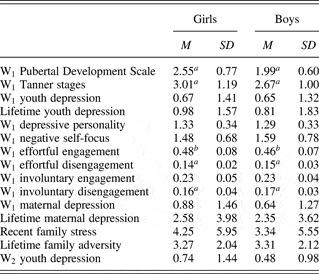
Table 1 presents descriptive data on the measures for girls and boys.
Descriptive statistics

Note: W1, Wave 1; W2, Wave 2.
aMeans differ at p < .05 or lower.
bMeans differ at p < .10.
Assessment of pubertal timing
Pubertal maturation
Two measures of pubertal status were administered. First, youths and caregivers completed the Pubertal Development Scale (PDS; Petersen, Crockett, Richards, & Boxer, Reference Petersen, Crockett, Richards and Boxer1988). This measure includes five questions that assess stage of growth spurt, body hair, skin changes, voice changes and facial hair (boys), and breast development and menarcheal status (girls) using a 4-point scale (1 = no development to 4 = development is complete). Onset of menarche is rated using a dichotomous response (1 = no, 4 = yes). Reliability and validity of the PDS are well established (Brooks-Gunn, Warren, Rosso, & Gargiulo, Reference Brooks-Gunn, Warren, Rosso and Gargiulo1987). Data were available for 132 youths and 140 caregivers. Because strong correlations were found between youth and caregiver reports (r = .88, p < .001, for girls, and r = .72, p < .001 for boys), composites were formed for each item by averaging across informants (α = 0.86 for girls and boys). When information was available from only one informant, this information was used.
Second, youths and caregivers rated youths' stage of development based on line drawings of the five Tanner stages (Morris & Udry, Reference Morris and Udry1980). Girls were rated on breast development and pubic hair growth; boys were rated on genital development and pubic hair growth. Participants checked which of the drawings most closely matched the youth's current stage of development. Data were available for 118 youths and 140 caregivers. Validity of this measure has been established through significant associations with physician ratings based on physical exams (Morris & Udry, Reference Morris and Udry1980; Schlossberger, Turner, & Irwin, Reference Schlossberger, Turner and Irwin1992). In the present sample, strong correlations were found between girls' and caregivers' reports (r = .83, p < .001, for breast development; r = .69, p < .001, for pubic hair development). Moderate correlations were found between boys' and caregivers' reports (r = .47, p < .01, for genital development; r = .65, p < .001, for pubic hair development). Composites were formed for each of the two items by averaging across informants. When information was available from only one informant, this information was used.
Confirmatory factor analyses in this data set yielded well-fitting measurement models using the seven items (five PDS and two Tanner) as indicators for a latent variable (Conley & Rudolph, Reference Conley and Rudolph2009). Thus, a composite score was created by standardizing the scores for each measure within sex and averaging the scores across the two measures. Higher scores reflected more advanced pubertal status. To create an index of pubertal timing, residualized scores were computed separately for girls and boys by regressing pubertal status onto chronological age. Higher scores reflected earlier maturation relative to one's agemates. This conceptualization and operationalization of pubertal timing (i.e., level of maturation relative to age) is consistent with a large body of theory and research on pubertal timing (e.g., Dorn et al., Reference Dorn, Susman and Ponirakis2003; Ge et al., Reference Ge, Conger and Elder2001b, Reference Ge, Brody, Conger, Simons and Murry2002; Steinberg, Reference Steinberg1987; Susman & Rogol, Reference Susman, Rogol, Lerner and Steinberg2004; Weichold et al., Reference Weichold, Silbereisen, Schmitt-Rodermund and Hayward2003).
Assessment and coding of depression
Interviewers individually administered the Schedule for Affective Disorders and Schizophrenia for School-Age Children—Epidemiologic Version 5 (Orvaschel, Reference Orvaschel1995) to youths and their caregivers to assess youth depression. Consensual diagnoses were assigned using a best-estimate approach (Klein, Ouimette, Kelly, Ferro, & Riso, Reference Klein, Ouimette, Kelly, Ferro and Riso1994) to integrate information across youth and caregiver report.
For each period and type (e.g., major depression, dysthymia) of depression (both diagnosable episodes and subclinical symptoms), interviewers used Diagnostic and Statistical Manual of Mental Disorders, Fourth Edition—Text Revision (DSM-IV-TR) criteria (American Psychiatric Association, 2000) to assign ratings of depressive symptoms on a 5-point scale: 0 = no symptoms, 1 = mild symptoms, 2 = moderate symptoms, 3 = diagnosis with mild to moderate impairment, and 4 = diagnosis with severe impairment. Based on DSM-IV criteria, these ratings considered the number, severity, frequency, duration, and resulting impairment of the reported symptoms. Thus, subclinical symptoms (i.e., mild or moderate) reflected the presence of symptoms that failed to meet one or more of the DSM-IV criteria (e.g., the youths had fewer than the required number of symptoms or had the required number of symptoms for less than the required duration). These ratings were then summed to create separate continuous depression scores for (a) youths' lifetime history of depression (up until 1 year prior to the W1 interview) and (b) youths' level of depression at the time of each assessment (i.e., during the past month). Higher ratings reflect more severe symptoms within a single diagnostic category, the presence of symptoms from multiple categories, and/or multiple periods of depression (for similar rating approaches, see Davila, Hammen, Burge, Paley, & Daley, Reference Davila, Hammen, Burge, Paley and Daley1995; Hammen, Shih, Altman, & Brennan, Reference Hammen, Shih, Altman and Brennan2003; Hammen et al., Reference Hammen, Shih and Brennan2004; Rudolph et al., Reference Rudolph, Hammen, Burge, Lindberg, Herzberg and Daley2000). Thus, these scores represent composite indexes of several different markers of depression severity. Validity of these scores was established through significant correlations with self-report measures of depressive symptoms (rs = .53–.58, ps < .001). Moreover, this continuous index of depression is consistent with contemporary conceptualizations, derived in part from taxometric analyses, that view depression as best represented by a dimensional continuum rather than a discrete category (Fergusson, Horwood, Ridder, & Beautrais, Reference Fergusson, Horwood, Ridder and Beautrais2005; Hankin, Fraley, Lahey, & Waldman, Reference Hankin, Fraley, Lahey and Waldman2005; Shih, Eberhart, Hammen, & Brennan, Reference Shih, Eberhart, Hammen and Brennan2006). Based on independent coding of audiotapes of 42 interviews, strong interrater reliability was found for the depression ratings (one-way random-effects intraclass correlation coefficient [ICCs] = .95–.97).
Of the 167 youths, 12.6% had a lifetime history of clinical depression (a rating of 3 or 4 for at least one episode) prior to the year before the W1 interview; an additional 18.0% had a lifetime history of subclinical symptoms (i.e., a rating of 1 or 2 for at least one episode). At W1, 11.4% met diagnostic criteria for clinical depression; an additional 13.2% experienced subclinical symptoms. At W2, 8.8% met diagnostic criteria for clinical depression; an additional 18.2% experienced subclinical symptoms.
Assessment of personality attributes
Depressive personality traits
Interviewers individually administered a 16-item assessment of depressive personality traits to youths and caregivers (Klein, Reference Klein1990). Based on conceptualizations of depressive personality described by Klein and colleagues (Klein, Reference Klein1990; Klein & Shih, Reference Klein and Shih1998), this measure was intended to capture stable personality traits of youths rather than acute symptoms of depression. Interviewers first provided a general probe that indicated an interest in youths' traits throughout their lives. To avoid confounding acute symptoms of depression with depressive personality traits, this probe specified that youths and caregivers should consider traits expressed during nonsymptomatic periods. Interviewers then asked participants to indicate the extent to which they would describe a youth as someone who generally displayed a variety of traits (e.g., “Critical of yourself. Hard on yourself. Feels like you could or should do better than you do.” “Puts yourself down a lot.” “Thinks about things all the time that make you feel bad, unhappy, tense, or upset.” “Thinks a lot about bad things that have happened, things that you haven't done well, or feel like you're not as good as other kids.” “Gloomy, as if everything goes wrong, and things won't work out very well in your life.” “Complains a lot.”). Interviewers read each question aloud and asked follow-up questions with specific probes (e.g., requests for examples, clarifications). After gathering information from both youths and their caregivers, interviewers provided consensual ratings of how typical each trait was of youths on a scale of 1 (not at all) to 3 (definite).
A reliability analysis revealed that three items (quiet-introverted, extremely conscientious, and self-disciplining) showed low item-total correlations (average = 0.09; average for other items = 0.49). Moreover, deletion of these three items from the scale increased the alpha value. Thus, these three items were omitted. Scores were computed as the average of the 13 remaining items, with higher scores reflecting more depressive personality traits. The measure had adequate internal consistency (αs = 0.85 and 0.81 at W1 and W2, respectively) and was moderately stable over time (r = .56, p < .001). Research has established strong concurrent and discriminant validity of the construct of depressive personality (Klein, Reference Klein1990; Klein & Shih, Reference Klein and Shih1998).
Negative self-focus
Youths completed an eight-item questionnaire assessing negative judgments about their abilities or worth, a focus on social comparison, and concerns about social evaluation (e.g., “I was disappointed in myself.” “I felt like other kids were better than me.” “I worried about what other people thought of me.”). They rated how much each item described them on a 5-point scale (1 = not at all to 5 = very much). Scores were computed as the average of the eight items, with higher scores reflecting more negative self-focus. The measure had high internal consistency (αs = 0.90 and 0.91 at W1 and W2, respectively) and was relatively stable over time (r = .57, p < .001). Providing evidence of validity, the negative self-focus measure correlates significantly with a variety of associated constructs tapping negative self-appraisals, including heightened social-evaluative concerns, negative relational self-views, lower levels of perceived control, and a negative attributional style (|r|s = .39–.57, ps < .001).
Assessment of responses to stress
The Responses to Stress Questionnaire (Connor-Smith, Compas, Wadsworth, Thoomsen, & Saltzman, Reference Connor-Smith, Compas, Wadsworth, Thomsen and Saltzman2000) was used to assess youths' effortful coping versus involuntary, dysregulated responses to stress. This measure distinguishes engagement with, and disengagement from, stressors. It includes four subscales, which demonstrated high internal consistency in the present sample: effortful engagement coping (efforts to resolve stressors or one's response to stressors, such as problem solving and emotion regulation, or to adapt to stressors, such as cognitive restructuring; 21 items; α = 0.86), effortful disengagement coping (e.g., denial, avoidance, wishful thinking; 12 items; α = 0.78), involuntary engagement (e.g., rumination, emotional, and physiological arousal; 15 items; α = 0.93), and involuntary disengagement (e.g., inaction, emotional numbing; 12 items; α = 0.89).
Youths reported how much they engaged in each type of response to peer stressors (e.g., fighting with other kids, having problems with a friend) on a 4-point scale (1 = not at all to 4 = a lot). Consistent with previous research (Connor-Smith et al., Reference Connor-Smith, Compas, Wadsworth, Thomsen and Saltzman2000; Flynn & Rudolph, Reference Flynn and Rudolph2007) and to correct for base-rate differences in the endorsement of responses to stress (Compas, Connor-Smith, Saltzman, Thomsen, & Wadsworth, Reference Compas, Connor-Smith, Saltzman, Thomsen and Wadsworth2001), proportion scores were calculated as the total score for each subscale divided by the total score on the Responses to Stress Questionnaire. Higher scores reflect higher levels of each type of response to stress. The four subscales were relatively stable over time (average r = .54, ps < .001).
Confirmatory factor analyses across multiple samples during the original measure development supported the proposed distinctions between effortful engagement and disengagement, and between involuntary engagement and disengagement. Moreover, despite a large correlation between the involuntary engagement and disengagement factors, a two-factor model was found to fit significantly better than a one-factor model (Connor-Smith et al., Reference Connor-Smith, Compas, Wadsworth, Thomsen and Saltzman2000). Correlations with another well-validated measure of coping established strong convergent and discriminant validity of the individual subscales, supporting the use of separate subscales (Connor-Smith et al., Reference Connor-Smith, Compas, Wadsworth, Thomsen and Saltzman2000).
Assessment of family context
Maternal depression
Interviewers individually administered the nonpatient version of the Structured Clinical Interview for the DSM (First, Spitzer, Gibbon, & Williams, Reference First, Spitzer, Gibbon and Williams1996) to caregivers to assess maternal depression. Each period and type of depression was coded using the same procedures as used for the Schedule for Affective Disorders and Schizophrenia for School-Age Children. Thus, two separate depression ratings were calculated for (a) mothers' lifetime history of depression (up until 1 year prior to the W1 interview) and (b) mothers' level of depression at the time of each assessment (i.e., during the past month). Strong interrater reliability was found for the depression ratings (one-way random-effects ICCs = .94–.98).
Of the 167 maternal caregivers, 35.3% had a lifetime history of clinical depression (a rating of 3 or 4 for at least one episode) prior to the year before the W1 interview; an additional 10.8% had a lifetime history of subclinical symptoms (i.e., a rating of 1 or 2 for at least one episode). At W1, 14.4% met diagnostic criteria for clinical depression; an additional 13.2% experienced subclinical symptoms. At W2, 17.3% met diagnostic criteria for clinical depression; an additional 14.8% experienced subclinical symptoms.
Recent family stress
To assess recent family stress, interviewers administered the Youth Life Stress Interview (Rudolph & Flynn, Reference Rudolph and Flynn2007) separately to youths and their caregivers. This semistructured interview uses the contextual threat method to determine the nature and intensity of episodic life stress experienced by youths during the preceding year (Brown & Harris, Reference Brown and Harris1978; Rudolph & Hammen, Reference Rudolph and Hammen1999). The present focus was on episodic stress experienced within the family (e.g., parent–child, marital, and sibling relationships) during the interval between the W1 and W2 assessments. Interviewers first asked a general open-ended question about the occurrence of stressful events within the family, and then provided prompts about specific types of events (e.g., argument with a parent, argument between parents, parental remarriage, change in household composition). Follow-up questions were asked to elicit detailed information about each event, the timing and duration of the event, and objective consequences. Based on this information, interviewers presented a narrative summary of each event to a team of coders with no knowledge of the youth's diagnosis or subjective response to the event.
Integrating information from youths and caregivers, coders rated the stressfulness or negative impact of each event, from 1 (no negative stress) to 5 (severe negative stress), reflecting how stressful the event would be for a typical child in those circumstances. If only the youth or the caregiver reported an event, that information was used for coding. Episodic family stress scores were calculated as the total of the objective stress ratings for each family event with a stress rating above 1. To assess reliability, 160 life events were coded by two independent teams. High reliability was found for the objective episodic stress rating (one-way random-effects ICC = .90) as well as for the categorization of events as family-related (Cohen ĸ = 0.91).
Lifetime family adversity
The lifetime adversity section of the Youth Life Stress Interview (Rudolph & Flynn, Reference Rudolph and Flynn2007) was administered to youths and their caregivers. This interview assesses youths' exposure to severe negative family life events and circumstances across their lifetime (up until 1 year prior to the W1 interview) using the same type of contextual threat method as the assessment of recent episodic stress. First, a general probe was used to assess exposure to particularly stressful events and circumstances, emphasizing that the focus was on very serious rather than everyday problems. Second, specific probes were used to assess the occurrence of the following types of adversity: death of a close family member, extended separation from parents, parental separation or divorce, exposure to severe marital conflict, and severe chronic illness of a close family member. Follow-up questions were asked as needed to assess the context of the event. An independent rating team provided a consensual rating on a 10-point scale that reflected the overall level of adversity experienced by youths, considering the likely impact of the events for a typical child in the same circumstances. For reliability purposes, two independent teams of raters coded a subset of 40 interviews. High reliability was found for ratings of adversity (ICC = .99).
Results
Data imputation
To account for missing data, multiple imputation was used (Graham & Hofer, Reference Graham, Hofer, Little, Schnabel and Baumert2000; Rubjn, 1987; Schafer, Reference Schafer1997). Multiple imputation yields more valid parameter estimates and standard errors than traditional methods of handling missing data (e.g., listwise deletion; Jeličić, Phelps, & Lerner, Reference Jeličić, Phelps and Lerner2009). Schafer's (Reference Schafer1999) NORM program was used to compute five imputed data sets. All analyses (e.g., computation of descriptive statistics, t tests, bivariate correlations, regression equations, simple slopes) were conducted separately for the five imputed data sets, and results were combined in NORM, which uses Rubin's (Reference Rubin1987) formulas to calculate parameter estimates, their standard errors, and the appropriate degrees of freedom for statistical tests. It should be noted that the degrees of freedom varied substantially as a function of the between- and within-imputation variance of the parameter estimates.
Preliminary analysis of sex differences
A series of t tests was conducted to provide descriptive information about sex differences in the variables (see Table 1). Based on the Pubertal Development Scale, girls were significantly more developed than were boys, t (2,761) = 5.15, p < .001. Likewise, based on self- and caregiver-reported Tanner stages, girls were significantly more developed than were boys, t (10,045) = 1.98, p < .05. These differences, along with the absence of a sex difference in age, are consistent with pubertal maturation occurring earlier in girls than in boys. Girls reported somewhat higher levels of effortful engagement than did boys, t (389,548) = 1.79, p < .10. Boys reported significantly higher levels of effortful disengagement, t (396,175) = 2.56, p < .05, and involuntary disengagement, t (91,922) = 2.08, p < .05, than did girls. The absence of sex differences in depression and family stress is likely because these sex differences tend to emerge during middle adolescence (about age 13; e.g., Costello et al., Reference Costello, Mustillo, Erklani, Keeler and Angold2003; Ge, Lorenz, Conger, Elder, & Simons, Reference Ge, Lorenz, Conger, Elder and Simons1994; Rudolph & Hammen, Reference Rudolph and Hammen1999) and more than half of the present sample was younger than 13 years old.
Correlational analyses
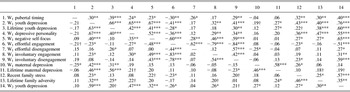
Table 2 presents intercorrelations among the variables for girls and boys. These correlations provide information about the general pattern of associations among the variables. In girls, earlier pubertal maturation was significantly associated with higher levels of depression (W1, lifetime, and W2). In boys, earlier pubertal maturation was nonsignificantly associated with lower levels of W1 and lifetime depression, and with higher levels of W2 depression. A comparison of the correlations using Fisher r to Z transformations revealed that the correlations of pubertal timing with W1 lifetime and W2 depression were significantly different between girls and boys (Zs ≥ 2.05, ps < .05). In girls, each of the risks was significantly associated in the expected direction with subsequent depression, with the exception of a nonsignificant association with W1 maternal depression and a marginally significant association with maternal lifetime depression. In boys, W1 depression, depressive personality traits, negative self-focus, effortful engagement, involuntary engagement, W1 maternal depression, recent family stress, and lifetime family adversity were significantly associated in the expected direction with subsequent depression; lifetime depression and involuntary disengagement were marginally associated with subsequent depression. Comparison of the correlations using Fisher r to Z transformations revealed that the following variables were significantly more strongly correlated with W2 depression in girls than in boys: W1 depression, lifetime depression, negative self-focus, involuntary disengagement, and recent family stress (Zs ≥ 2.02, ps < .05). Effortful engagement was marginally more strongly correlated with W2 depression in girls than in boys (Z = 1.88, p < .10).
Correlations among pubertal timing, personal vulnerability, contextual risk, and depression for girls and boys
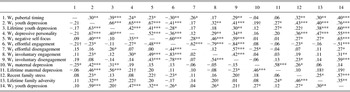
Note: W1, Wave 1; W2, Wave 2. Correlations above the diagonal are for girls, and correlations below the diagonal are for boys.
†p < .10. *p < .05. **p < .01. ***p < .001.
Overview of hierarchical multiple regression analyses
A series of hierarchical multiple regression analyses was conducted to examine whether personal and contextual risks magnified the contribution of earlier maturation to subsequent depression. For each analysis, the moderating effect of sex was first examined. The three main effects (pubertal timing, moderator, and sex) were entered at the first step, all two-way interactions were entered at the second step, and the three-way interaction was entered at the third step. Analyses predicted W2 depression, adjusting for W1 depression (also entered at the first step). Consistent with procedures outlined by Aiken and West (Reference Aiken and West1991; see also Friedrich, Reference Friedrich1982), all predictors were standardized prior to creating interaction terms and inclusion in the regression analyses. Standardized W2 depression scores were regressed on predictors, and unstandardized regression coefficients were interpreted. When the three-way interaction with sex was significant, the Pubertal Timing × Moderator interaction was examined separately for girls and boys. When the three-way interaction with sex was nonsignificant, analyses were rerun without sex in the model. Significant interactions were interpreted by solving the unstandardized regression equation to predict depression from pubertal timing at low (−1 SD), moderate (mean), and high (+1 SD) levels of the moderating variable (Aiken & West, Reference Aiken and West1991).
Moderating effects of personal risks
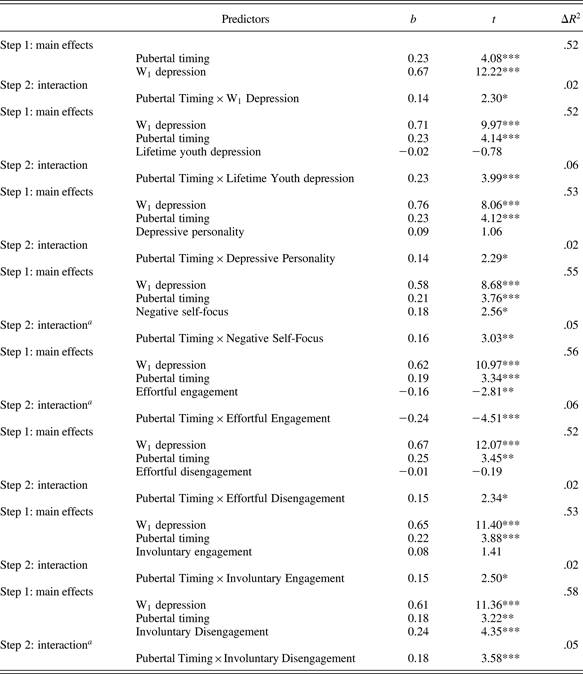
Table 3 displays the two-way interactions between pubertal timing and personal risks in predicting depression. Of the eight moderators that were examined, significant three-way interactions (i.e., moderation by sex) were found for two variables and a marginally significant three-way interaction was found for one variable. Results for these three-way interactions are elaborated in the text and figures.
Predicting Wave 2 (W2) depression from Wave 1 (W1) depression, pubertal timing, personal vulnerability, and Pubertal Timing × Personal Vulnerability interactions
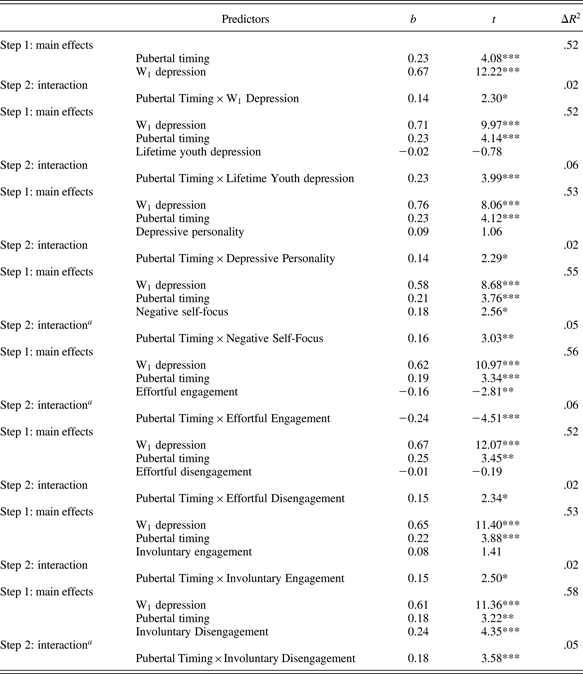
Note: The values represent statistics at each step of the regression equation.
aInteraction was moderated by sex.
*p < .05. **p < .01. ***p < .001.
Depression
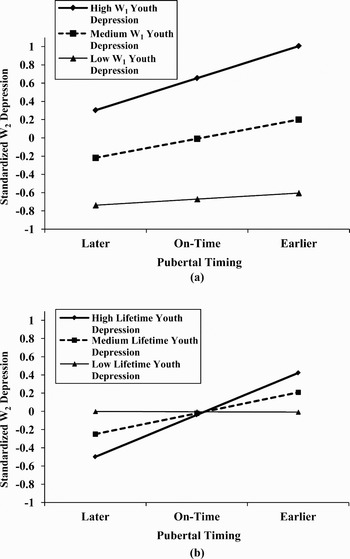
Analyses revealed significant Pubertal Timing × Youth Depression interactions for both W1 (i.e., current) levels of depression and lifetime history of depression (see Table 3). For W1 depression, earlier maturation predicted heightened subsequent depression in youths experiencing high, b = 0.35, t (60) = 4.38, p < .001, and moderate, b = 0.21, t (482) = 3.64, p < .001, but not low, b = 0.07, t (65) = 0.78, ns, levels of depression (see Figure 1a). Likewise, for lifetime history of depression, earlier maturation predicted heightened subsequent depression in youths experiencing high, b = 0.46, t (34) = 5.33, p < .001, and moderate, b = 0.23, t (207) = 4.01, p < .001, but not low, b = 0.00, t (2, 717) = −0.04, ns, levels of lifetime depression (see Figure 1b).
Pubertal Timing × Depression interactions for (a) W1 youth depression and (b) lifetime youth depression; W1, Wave 1; W2, Wave 2.

Personality attributes
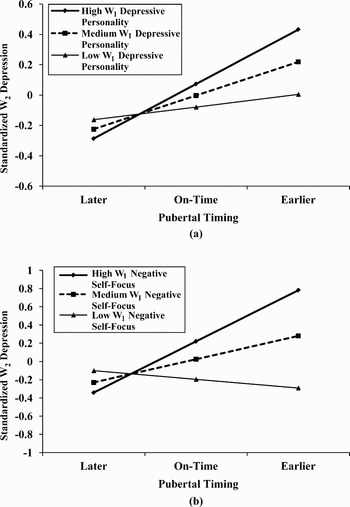
Analyses revealed significant Pubertal Timing × Personality interactions for both depressive personality traits and negative self-focus (see Table 3). For depressive personality, earlier maturation predicted heightened subsequent depression in youths with high, b = 0.36, t (75) = 4.21, p < .001, and moderate, b = 0.22, t (339) = 3.81, p < .001, but not low, b = 0.08, t (180) = 1.03, ns, levels of these traits (see Figure 2a). For negative self-focus, a significant moderating effect of sex was found: b = 0.15, t (40) = 2.62, p < .05. Analyses were therefore conducted separately for girls and boys. These analyses revealed a significant Pubertal Timing × Negative Self-Focus interaction for girls, b = 0.31, t (93) = 3.97, p < .001, ΔR 2 = .07, but not for boys, b = 0.05, t (45) = 0.06, ns, ΔR 2 = .00. Specifically, earlier maturation predicted heightened subsequent depression in girls with high, b = 0.56, t (436) = 5.06, p < .001, and moderate, b = 0.25, t (8, 566) = 3.47, p < .001, but not low, b = –0.09, t (288) = –0.88, ns, levels of negative self-focus (see Figure 2b). In boys, analyses revealed a significant main effect of earlier maturation, b = 0.17, t (690) = 2.31, p < .05, and a nonsignificant main effect of negative self-focus, b = 0.05, t (667) = 0.57, ns.
Pubertal Timing × Personality interactions for (a) depressive personality traits and (b) negative self-focus (girls); W1, Wave 1; W2, Wave 2.

Responses to stress
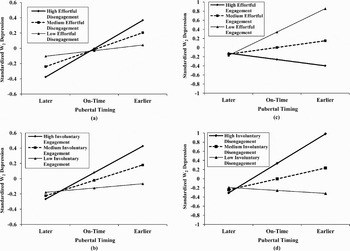
Analyses revealed significant Pubertal Timing × Responses to Stress interactions for all four subscales (see Table 3). As displayed in Figures 3a and 3b, earlier maturation predicted heightened subsequent depression in youths who reported high, b = 0.37, t (2812) = 4.35, p < .001, and moderate, b = 0.22, t (471) = 3.87, p < .001, but not low, b = 0.07, t (1010) = 0.85, ns, levels of effortful disengagement, and those who reported high, b = 0.35, t (338) = 4.53, p < .001, and moderate, b = 0.20, t (593) = 3.52, p < .001, but not low, b = 0.06, t (958) = 0.66, ns, levels of involuntary engagement.
Pubertal Timing × Responses to Stress interactions for (a) effortful disengagement, (b) involuntary engagement, (c) effortful engagement (girls), and (d) involuntary disengagement (girls); W2, Wave 2.

Two of the two-way interactions were further moderated by sex, significantly for involuntary disengagement, b = 0.18, t (2, 772) = 3.70, p < .001, and marginally for effortful engagement, b = –0.09, t (7, 406) = −1.70, p < .10. Analyses were therefore conducted separately for girls and boys. For effortful engagement, the two-way interaction was significant for girls, b = –0.30, t (8, 654) = −4.41, p < .001, ΔR 2 = .07, but not for boys, β = –0.13, t (1, 971) = −1.62, ns, ΔR 2 = .02. Specifically, earlier maturation predicted heightened subsequent depression in girls who reported low, b = 0.51, t (3206) = 4.72, p < .001, and moderate, b = 0.15, t (502) = 1.89, p < .10, but not high, b = –0.14, t (672) = −1.29, ns, levels of effortful engagement (see Figure 3c). In boys, analyses revealed a significant main effect of earlier maturation, b = 0.17, t (309) = 2.14, p < .05, and a nonsignificant main effect of effortful engagement, β = –0.06, t (42, 127) = −0.70, ns.
For involuntary disengagement, the two-way interaction was also significant for girls, b = 0.34, t (5, 008) = 5.42, p < .001, ΔR 2 = .09, but not for boys, b = –0.01, t (3, 378) = −0.09, ns, ΔR 2 = .00. Specifically, earlier maturation predicted heightened subsequent depression in girls who reported high, b = 0.64, t (113, 258) = 5.58, p < .001, and moderate, b = 0.24, t (6193) = 3.49, p < .001, but not low, b = –0.06, t (918) = –0.82, ns, levels of involuntary disengagement (see Figure 3d). In boys, analyses revealed a significant main effect of earlier maturation, b = 0.16, t (370) = 2.14, p < .05, and a nonsignificant main effect of involuntary disengagement, b = 0.10, t (13, 493) = 1.31, ns.
Summary
In sum, results supported the idea that prior depression, personality traits, and maladaptive responses to stress accentuated the depressogenic effect of earlier maturation. Effects were specific to girls for a tendency toward negative self-focus and certain types of responses to stress; effects generalized across sex for recent and past symptoms of depression, depressive personality traits, and other types of responses to stress.
Moderating effects of contextual risks
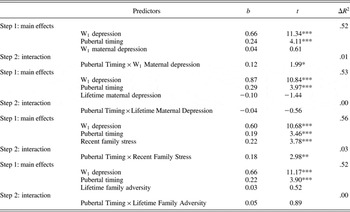
Table 4 displays the two-way interactions between pubertal timing and contextual risk in predicting depression. Of the four moderators that were examined, no significant three-way interactions (i.e., moderation by sex) were found.
Predicting Wave 2 (W2) depression from Wave 1 (W1) depression, pubertal timing, family risk, and Pubertal Timing × Family Risk Interactions

Note: The values represent statistics at each step of the regression equation.
*p < .05. **p < .01. ***p < .001.
Maternal depression
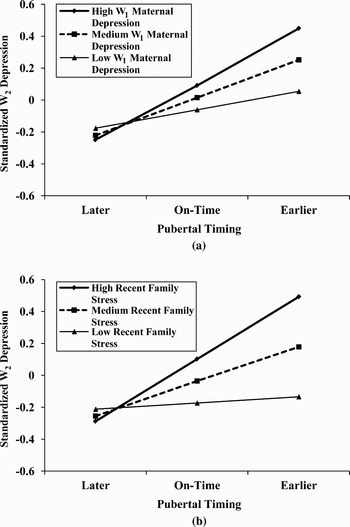
Analyses revealed a significant Pubertal Timing × Maternal Depression interaction for W1 (i.e., current) levels of maternal depression but not for lifetime history of depression. Specifically, earlier maturation predicted heightened subsequent depression in youths whose mothers were experiencing high, b = 0.36, t (98) = 4.06, p < .001, and moderate, b = 0.24, t (529) = 4.12, p < .001, but not low, b = 0.12, t (315) = 1.38, ns, levels of W1 depression (see Figure 4a). Past history of maternal depression did not significantly predict youth depression over time.
Pubertal Timing × Family Risk interactions for (a) W1 maternal depression and (b) recent family stress; W1, Wave 1; W2, Wave 2.

Family adversity
Analyses revealed a significant Pubertal Timing × Family Adversity interaction for recent family stress but not for lifetime family adversity. Specifically, earlier maturation predicted heightened subsequent depression in youths exposed to high, b = 0.39, t (343) = 4.67, p < .001, and moderate, b = 0.21, t (447) = 3.72, p < .001, but not low, b = 0.04, t (607) = 0.47, ns, levels of recent family stress (see Figure 4b). Lifetime family adversity did not significantly predict youth depression over time.
Summary
The results supported the idea that recent maternal depression and family adversity amplified the depressogenic effect of earlier maturation for both girls and boys.
Discussion
Puberty represents a challenging developmental transition that has been implicated in rising rates of depression during adolescence, yet many youths successfully traverse this stage with few adverse emotional consequences. Understanding how puberty contributes to trajectories of development and psychopathology therefore requires elucidating individual differences in youths' reactions (Graber, Reference Graber and Hayward2003). Guided by personal-accentuation and contextual-amplification models, the present study makes substantive contributions to both theory and empirical research by identifying specific personal and contextual risks that magnify or temper the contribution of earlier maturation to subsequent depression.
Evidence for personal-accentuation models of earlier maturation
Several personal vulnerabilities of youths accentuated the depressogenic effects of earlier maturation. As anticipated, earlier-maturing youths who experienced recent depressive symptoms were more vulnerable to heightened levels of subsequent depression than those with few recent depressive symptoms. This pattern is consistent with the idea that earlier maturation presents a particular challenge to youths with a predisposition toward psychological difficulties prior to this transition (Caspi & Moffitt, Reference Caspi and Moffitt1991). Thus, the heightened depression associated with earlier maturation may reflect continuity of prior dysfunction rather than the onset of new disorder; that is, earlier maturation does not necessarily confer risk for depression in previously healthy youths.
Earlier maturation was also associated with subsequent depression in youths with a lifetime history of depression but not those without such a history. That a history of depression accentuated the effects of earlier maturation even after adjusting for recent depression suggests that youths with a history of depression suffer some core, lasting deficits that contribute to their emotional vulnerability in the face of earlier maturation. Perhaps a history of depression interferes with youths' development of adaptive relationships with family and peers and thus deprives them of social support networks that would help them to negotiate this challenging transition. Alternatively, it is possible that a history of depression reflects a genetic predisposition toward depression that is expressed during the adolescent transition. It is interesting that youths with high lifetime depression had particularly low levels of depression when they experienced later maturation. Although this pattern was unexpected and must be interpreted with caution, it is consistent with the biological sensitivity to context theory (Boyce & Ellis, Reference Boyce and Ellis2005). According to this theory, certain youths possess attributes that foster maladaptive outcomes (i.e., health risk) under conditions of adversity but positive outcomes (i.e., health benefits) under conditions of support. It is possible that youths with a lifetime history of depression are especially attuned to their social contexts, such that they are at particular risk when faced with challenges in the context of earlier maturation but receive particular benefits from support received in the context of later maturation.
Extending personal-accentuation models, this research also identified personality attributes that magnified the depressogenic effects of earlier maturation. Specifically, earlier maturation predicted heightened levels of subsequent depression in youths with depressive personality traits and in girls with a negative self-focus but not in youths without these personality attributes. The heightened self- and social scrutiny that often accompanies the pubertal transition (Harter, Reference Harter, Montemayor, Adams and Gullotta1990; Zimmerman, Copeland, Shope, & Dielman, Reference Zimmerman, Copeland, Shope and Dielman1997), particularly for earlier-maturing youths, may trigger a preoccupation with negative self-perceptions and downward social comparison in youths who are predisposed to a pessimistic outlook on the self and the world. Such youths may be acutely sensitive to their discrepant physical and social status and thus may react to the pubertal transition with negative emotions, low self-worth, and others symptoms of depression. A negative self-focus may accentuate these effects in earlier-maturing girls but not boys because earlier maturation tends to promote a negative body image in girls but a positive body image in boys (Tobin-Richards et al., Reference Tobin-Richards, Boxer, Petersen, Brooks-Gunn and Petersen1983); this negative body image may, in turn, act as a source of more global self-preoccupation for girls. Moreover, because girls, on average, mature earlier than boys (Tanner, Reference Tanner and Gardner1969), earlier-maturing girls are more deviant than boys in their timing relative to the entire peer group, potentially intensifying the adverse effects of self-evaluative and social-comparison processes. Of course, it is important to consider that depressive personality traits and negative self-focus may themselves reflect early precursors or symptoms of depression rather than entirely discrete personality traits. Although research suggests that such traits are distinguishable from depressive disorders, are relatively stable over time, and do not fluctuate significantly with mood states (Klein, Reference Klein1990; Klein & Shih, Reference Klein and Shih1998), the present research cannot determine the precise role of these traits in the emergence of depression.
Youths' coping styles also moderated the contribution of earlier maturation to subsequent depression. Specifically, earlier maturation predicted heightened levels of depression in youths who showed low levels of effortful engagement coping and high levels of effortful disengagement coping and involuntary responses to stress but not in youths with the opposite response styles. Youths who engage in goal-directed efforts to resolve peer stressors and to manage the associated negative emotions appear to be buffered from the adverse effects of earlier maturation. These youths are likely more adept at navigating the complex social landscape that emerges during the pubertal transition. In contrast, youths who react to peer stress through either disengagement (e.g., denial, avoidance) or involuntary, dysregulated responses (e.g., rumination, arousal, inaction) are likely less effective at handling the social challenges of puberty. For two types of stress responses, effortful engagement and involuntary disengagement, these protective and exacerbating effects were specific to girls. Because of girls' greater emphasis on connection-oriented social goals and their greater emotional reactivity to relationship problems relative to boys (Rose & Rudolph, Reference Rose and Rudolph2006), earlier-maturing girls who have difficulty managing peer stress may be more susceptible than boys to depression.
It was unexpected that youths who showed high levels of effortful disengagement actually had particularly low levels of depression when they experienced later maturation. Later-maturing youths likely face milder interpersonal challenges than earlier-maturing youths. It may be that disengaging from such stressors is actually an adaptive strategy that prevents youths from overreacting to minor hassles (e.g., ruminating about a minor problem with a friend) and, consequently, protects them from depression. This idea is consistent with other research suggesting that disengagement may be adaptive in the context of mild stressors (Abaied & Rudolph, in press).
To summarize, several types of personal risk accentuated the contribution of earlier maturation to subsequent levels of depression; earlier-maturing youths without these vulnerabilities were no more likely to become depressed than were on-time and later-maturing youths. It is interesting that sex did not moderate the overall effect of earlier maturation on subsequent depression. This finding is consistent with a growing body of research showing that, contrary to original beliefs, earlier-maturing boys are also at risk for depression (Ge et al., Reference Ge, Conger and Elder2001b; Kaltiala-Heino et al., Reference Kaltiala-Heino, Kosunen and Rimpela2003). Several researchers recently have emphasized the need to reassess the role of earlier maturation in boys' development (Alsaker, Reference Alsaker and Rutter1995; Graber, Reference Graber and Hayward2003). However, several personal risks did accentuate the effect of earlier maturation on levels of depression in girls but not in boys, such that this link was particularly strong in subgroups of girls with heightened risk. Thus, although earlier maturation may, on average, increase the likelihood of depression in girls and boys, more girls may express these effects because of predisposing vulnerabilities. These findings provide a more nuanced picture of the emerging sex difference in depression during adolescence, suggesting that this difference may be accounted for by a subgroup of highly vulnerable girls.
Evidence for contextual-amplification models of earlier maturation
Evidence also emerged for contextual amplification of pubertal timing effects. Specifically, earlier maturation predicted heightened levels of subsequent depression in youths exposed to recent maternal depression and family stress but not in youths without these contextual risks. Maternal depression and family stress likely erode the emotional support and scaffolding on which earlier-maturing youths typically rely to negotiate the challenges of this stage. Moreover, these family risks serve as additional stressors to earlier-maturing youths at a time when they need to direct their internal resources toward dealing with developmental changes. Preexisting family risks may also intensify problems and conflict associated with the normative reorganization of family relationships during puberty, such that unhealthy families experience greater difficulty dealing with youths' changing status (Paikoff & Brooks-Gunn, Reference Paikoff and Brooks-Gunn1991). Collectively, these consequences of family risk may serve to amplify the depressogenic effects of earlier maturation.
Amplification effects of maternal depression and family stress could also be accounted for by a genetic liability to depression; that is, family risk could reflect a family loading for depression that is expressed during adolescence. Contrary to this explanation, however, lifetime history of maternal depression and family adversity did not exert an amplification effect, suggesting that recent maternal symptoms and family stress exert functional effects on the nature of family relationships that amplify risk for depression in earlier-maturing youths. This absence of a moderation effect for a lifetime history of maternal depression and family adversity may be because our analyses adjusted for W1 levels of depression; it may be that the effects of these distal risks already had been expressed earlier in youths' lives and thus did not amplify risk for heightened depression during the pubertal transition.
It is interesting that no sex differences in contextual amplification were found. Because maternal depression (Sheeber et al., Reference Sheeber, Davis, Hops, Goodman and Gotlib2002) and interpersonal stress (Hankin et al., 1997) are linked more strongly to depression in adolescent girls than in boys, it was expected that earlier-maturing girls would be more vulnerable to the effects of family risk than would earlier-maturing boys. However, earlier-maturing boys do experience heightened tension in mother–child relationships (Steinberg, Reference Steinberg1987); thus, those who enter the pubertal transition with compromised family relationships may have difficulty negotiating this normative increase in parent–child conflict.
Theoretical and practical contributions and caveats
Consistent with developmental psychopathology perspectives that emphasize complex Person × Environment × Development interactions (Cicchetti & Cohen, Reference Cicchetti and Cohen2006; Sameroff, Reference Sameroff and Eisenberg1987), as well as developmental models that emphasize the social context of puberty (Caspi & Moffitt, Reference Caspi and Moffitt1991; Graber, Reference Graber and Hayward2003), the present research reveals important personal and contextual variation in the contribution of pubertal timing to depression. Whereas youths with prior personal and contextual risks were susceptible to the depression-inducing effects of earlier maturation, youths without these risks were buffered from these effects. Although the size of the interaction effects tended to be small, the consistency in the pattern of effects was quite notable.
Continuing to elaborate and refine integrative models of puberty and depression will require building on these findings in several ways. First, given the present focus on understanding the psychological and social context of puberty, this study conceptualized pubertal timing in terms of youths' expression of secondary sexual characteristics and other somatic markers of maturation. Hormonal and morphological changes represent related, yet distinct, indexes of pubertal development. Future research in this area needs to examine whether similar personal-accentuation and contextual-amplification effects hold with hormonal assessments of puberty.
Second, this study focused on the independent contributions of several risk factors, which represented a reasonable first step toward identifying characteristics of youths and their contexts that moderate the effects of earlier maturation. However, it is likely that these characteristics reflect, at least in part, an interrelated network of factors that jointly magnify or temper risk for depression in earlier-maturing youths. For example, maternal depression was presumed to amplify risk in part by eroding family relationships and heightening family stress. Exploratory analyses in the present study did reveal that pubertal timing interacted with maternal depression to predict family stress, and the Pubertal Timing × Family Stress interaction accounted for the contribution of the Pubertal Timing × Maternal Depression interaction to subsequent depression. Similarly, the amplifying effects of family risk may operate in part by heightening personal risks, such as fostering depressive personality traits or undermining youths' coping resources. Because of limited power, the present study could not incorporate tests of these complex, multidetermined pathways, but further development of comprehensive models of pubertal timing and depression will require a more thorough understanding of distinct versus shared mechanisms underlying the personal-accentuation and contextual-amplification effects that emerged in this study.
Third, this research could not distinguish between two possible explanations for the observed interactions. On the one hand, these interactions could reflect synergistic effects of two independent risk factors, such that experiencing personal or contextual risks compounded the adverse effects of earlier maturation. On the other hand, these interactions could reflect a meaningful change in the association between earlier maturation and depression in the context of the risk factors. For example, earlier maturation may heighten risk for depression in youths with depressive personality traits because these youths have dual risk factors or specifically because they perceive pubertal changes in a particularly negative light. Likewise, earlier maturation may heighten risk for depression in youths with high levels of family stress because these youths face simultaneous challenges or specifically because high-stress families show a negative response to pubertal changes. Disentangling these alternative explanations will require more focused measurement of personal and contextual risks specifically in the context of puberty.
Fourth, although this study benefited from the use of a longitudinal design to examine the contribution of earlier maturation to depression over time, the 1-year follow-up period provided a relatively short time frame for examining these effects. It will be fascinating to examine whether preexisting personal and contextual risks foreshadow long-term differences in depression and associated difficulties in earlier-maturing youths. Moreover, this study focused on the measurement of puberty at a single point in time; because puberty is a dynamic process, the rate of maturation may have an influence on adjustment beyond the timing at any one particular point in development (e.g., Ge et al., Reference Ge, Kim, Brody, Conger, Simons and Gibbons2003). Thus, future research should examine how changes in puberty over time interact with risks to predict trajectories of depression.
Fifth, in light of evidence for ethnic differences in the timing, meaning, and effects of puberty (Hayward, Gotlib, Schraedley, & Litt, Reference Hayward, Gotlib, Schraedley and Litt1999; Michael & Eccles, Reference Michael, Eccles and Hayward2003), it is important to determine the generalizability versus specificity of these effects across ethnic groups. Although the present sample included some ethnic diversity, the sample size was insufficient for examining such ethnic differences. Whether or not the same risks serve as exacerbating or protective factors across ethnic groups remains an open question. More broadly, the progression through puberty has significantly different implications across cultures, with many cultures having positive views of this transition (Weisfeld, Reference Weisfeld1999); thus, the perspective of puberty as a high-risk period may better apply to Western than non-Western cultures.
Beyond these theoretical contributions and questions, the present study suggests important directions for depression prevention efforts. Given limited resources and the impracticality of targeting all earlier-maturing youths for prevention programs, this research provides specific information that can be used to identify earlier-maturing youths who are at particularly high risk for depression. Moreover, these findings point to potential targets of intervention. Specifically, strategies aimed at bolstering high-risk youths' self-appraisals and coping resources and at reducing stress associated with family risks may promote healthy development in earlier-maturing youths. Finally, broad psychoeducational efforts can address misconceptions in youths, families, and educators about the inevitable turmoil emerging from the pubertal transition, and encourage more realistic assessments regarding whether particular youths are at risk during this developmental stage.
Conclusion
Early perspectives on adolescence and the pubertal transition as a universal period of “storm and stress” are gradually transforming into more nuanced theories that consider individual and contextual variation in youths' negotiation of this developmental stage. Despite this growing sophistication in contemporary theories, relatively few theoretical models or empirical studies have elucidated which earlier-maturing youths are more or less susceptible to depression. The present study identifies several personal and contextual characteristics that explain these individual differences, and provides a basis on which to develop prevention and intervention efforts for depressed youths.