


Introduction
The term “socialization to the model” is commonly used to describe a process that occurs in the early stages of psychological therapy, particularly in therapies deriving from a cognitive-behavioural framework. Although the term is frequently referred to within academic research and clinical practice, a specific definition of the term is not presented.
Orne and Wender (Reference Orne and Wender1968) first suggested that an important factor in the success or failure of therapy is the degree to which patients understand what they called “the rules of the game”. They suggested that “anticipatory socialization” would increase the likely benefit from therapeutic input, and defined “anticipatory socialization” as follows:
Knowledge about the process, beliefs about its effectiveness, shared values about its importance and very specific role expectancies which allow [the patient] to understand the psychiatrists behaviour and provide appropriate responses”
Orne and Wender (Reference Orne and Wender1968) suggested that “anticipatory socialization” would be an important condition for success in any type of “psychotherapy”. A study by Walitzer, Dermen and Connors (Reference Walitzer, Dermen and Connors1999) reviewed the use of preparatory techniques such as anticipatory socialization in relation to attrition rates in psychotherapy. However there has been no specific research to date exploring whether socialization is a predictor of outcome. Walitzer et al. (Reference Walitzer, Dermen and Connors1999) suggest that cognitive behavioural therapists would benefit from the systematic use of these strategies to enhance engagement and promote positive outcome.
Beck (Reference Beck1995) recognized the importance of socialization in maintaining the structure of therapy and patient engagement, outlining that therapists need to “sharpen their skills at socialization”. Beck offered a 27-point checklist of how to socialize the patient to cognitive therapy without providing a definition of the term. The checklist, reflecting earlier work by Orne and Wender (Reference Orne and Wender1968), covers four domains of socialization (cognitive model; patient and therapist expectations; problem solving orientation; homework). The therapist can use the checklist to determine whether the patient is sufficiently socialized. Wells (Reference Wells1997) referred to socialization as “selling the cognitive model and providing a basic mental set for understanding the nature of treatment”. However, Wells (Reference Wells1997) did not provide a definition that could be utilized in research or clinical practice. This lack of a definition is particularly pertinent in the field of CBT where socialization is frequently referred to as an integral part of therapy, both in general CBT texts (Westbrook, Kennerley and Kirk, Reference Westbrook, Kennerley and Kirk2007; Beck, Reference Beck1995) and more specific clinician manuals (Lam, Jones, Hayward and Bright, Reference Lam, Jones, Hayward and Bright1999; Wells, Reference Wells1997).
The purpose of the present study was to try to develop an up-to-date consensus definition of “socialization to the model” by drawing on the expertise and knowledge of professionals currently delivering psychological therapies. The Delphi technique was employed to achieve this aim. This method is used to systematically obtain the views and insights of a panel of experts in a group communication (Adler and Ziglio, Reference Adler and Ziglio1996). Questioning of experts proceeds iteratively, in stages or rounds. The initial questions posed to the panels in our study were designed to elicit and develop individual responses. In further rounds, the experts had the opportunity to anonymously refine their views as the group's work progressed (Adler and Ziglio, Reference Adler and Ziglio1996). This was deemed the most appropriate method to achieve the objective of operationally defining the term.
Method
E-mail was used to conduct a three-round Delphi study.
Participants
Clinical psychologists with at least 2 years post-doctoral clinical experience who were either conducting research or teaching/lecturing at doctoral level, and who had either published on relevant clinical theory or interventions, were invited to participate. Sixteen potential participants were identified by the first author, and contacted via e-mail. Nine of these agreed to participate by responding to the first round. All nine of these participants then completed all three rounds.
When the participants were asked to state their therapeutic orientation, eight of the nine participants considered their main therapeutic approach to be cognitively based (CBT, purely cognitive, cognitive analytical therapy). The remaining clinician identified his/her main approach as social constructionist.
Participants worked in all core clinical areas except the field of learning disability.
Procedure and data collection
In the first round, participants were asked for their free responses to two questions: 1. “What is socialization to the model” and 2. “How do you know when a service-user is socialized to the model?”. The responses received were analysed by the first author and a peer. For question 1, 11 statements deemed to be in common to all 9 responses were extracted and collapsed down to 4 elements of “socialization to the model”. For question 2, 27 statements in common to all 9 responses were extracted, and collapsed down into 11 elements representing indicators that a service-user is socialized to the model. In the second round of the Delphi study, the 15 elements derived from round 1 were presented to participants in the form of statements, each to be rated on a 5-point Likert scale ranging from “essential” = 5 to “irrelevant” = 1. Additionally, at each round, participants were invited to suggest further elements or edit the elements. In response to round two, a participant suggested an additional element, which was incorporated into the third round. In round three of the Delphi study, participants were presented with information derived from round two. They were given the median score from all 9 participants for each of the elements. They were then asked to rate the elements for a second time, and to state their reasons for any rating that was more than one point different from the round two median rating.
Data analysis
The median and inter-quartile range for each element was calculated for the round three responses. Based on previous research, elements with an Inter-Quartile Range (IQR) of ≤1 were defined as having consensus, with an IQR of 0 indicating perfect consensus. A median value of 5 indicated agreement that the element is “essential”, and a value of 4 indicated agreement that the element is “important” to the development of the definition.
What is socialization to the model?
To develop a working definition we included all elements rated as “essential” and “important” with an IQR ≤1. This included all elements derived from the Delphi technique in response to the question “What is socialization to the model?”:
“Socialization to the model” is the process by which a service user and clinician negotiate a shared understanding of the presenting difficulty. During the process, the clinician presents hypotheses and a formulation of the service-user's symptoms and experience in terms of the model to be used for intervention. The therapist provides information concerning the practical implications of the chosen model of therapeutic intervention, to allow the service-user to fully engage with and understand both the therapeutic process and the rationale for intervention.
How do you know when a service-user is socialized to the model?
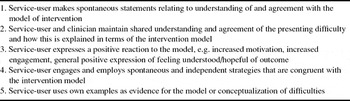
Five of the 11 indicators relating to question 2 of the Delphi questionnaire were rated as “important” indicators of socialization (see Table 1), and also had IQRs of ≤1. Statements 1 and 2 had IQRs of 0, indicating perfect agreement. Participants reached consensus agreement (IQR ≤1) that “topic digression during sessions” and “non-verbal behaviour” were not indicators of socialization (or non-socialization) to the model. The remaining four elements achieved a median rating of 3 = unsure (2 elements) and 4 = important (2 elements). The inter-quartile ranges for these elements were >1 and therefore these elements were withdrawn in the present study.
Key indicators of socialization to the model

Discussion
The high level of overlap of data generated by each participant in response to the first round question 1 led to the development of a small number of elements. This indicates that although previously undefined, clinicians held a shared understanding of what constitutes “socialization to the model”. The suggestion that there is already an extant shared understanding of this concept is further supported by the high level of consensus across each of the four elements of the definition by the end of the third Delphi round. There was a high level of agreement for question 2, “How do you know a patient is socialized?”, although there were no elements that were considered “essential” by all.
Clinical implications
The present operational definition can be used to clarify a concept in frequent use in clinical psychology and, more specifically, cognitive behavioural therapy. Moreover, the definition may influence clinical practice by defining the main components that can guide clinicians to socializing the patient adequately, complementing Beck's (Reference Beck1995) checklist of “socializing the patient to cognitive therapy” and Wells' (Reference Wells1997) overview of socialization. This operational definition can be used further for research purposes to identify whether socialization to the treatment model is a predictor of outcome, particularly within a CBT framework.
One of the participants in the study identified their orientation as social constructionist whereas the others adopted a predominantly CBT approach. In spite of this, there was a high level of agreement in the final round. While our study cannot claim to have a representative sample, it does suggest that there may be a shared understanding of the concept of socialization that extends to therapeutic approaches beyond the realm of CBT.
Strengths and limitations
Whilst our sample of experts was small, this is not necessarily a problem for a study of this nature. Rowe and Wright (Reference Rowe, Wright and Armstrong2001) suggest that the use of a small sample with the Delphi method is appropriate when the study aim is to generate new information on a topic that is generally understood but not specifically defined. Through the Delphi method, participants were able to give a considered and anonymous response to the research question whilst being offered the opportunity to review peer responses in latter rounds, allowing a natural evolution and development of understanding of a concept that was previously undefined. It is hoped that this may provide a basis of the beginnings of a knowledge base that both informs therapeutic interventions and indeed provides a basis for more extensive clinically relevant research.
A limitation of the Delphi technique is that the concept of socialization developed here can only reflect the participants who were approached and participated; other “experts” may have influenced the development of the definition in a dissimilar way. Furthermore, it is observed that the Delphi technique relies heavily on the underlying assumption that participant responses are shaped through the Delphi process whilst genuine beliefs are retained, while critics suggest that the pressure of conformity could unduly influence participant responses. This supports the view that the Delphi process is most suitable for preliminary investigations into areas of interest as yet unchartered.
In summary, a three-round electronic Delphi technique was successfully used to develop a working definition of “socialization to the model”, which may prove useful for both research and clinical practice.
Acknowledgement
This research was carried out as part of the first author's training for the degree of ClinPsy D. Thanks are extended to Ceri Woodrow for her contribution to analysis in the first round.




Comments
No Comments have been published for this article.