Introduction
In Stone Age research, the geochemical and mineralogical composition of rocks can be analysed down to the isotopic and atomic levels. This enables provenance studies, visualizing distribution and relations between a source and the end point of particular rock types. Identified patterns then support discussions of cultural affinity, mobility and trade networks (e.g. Olsen and Alsaker Reference Olsen and Alsaker1984; Cooney and Mandal Reference Cooney and Mandal1995; Bradley Reference Bradley2000; Davis and Edmonds Reference Davis, Edmonds, Davis and Edmonds2011; Aubry et al. Reference Aubry, Luís, Llach and Matias2012; Pétrequin et al. Reference Pétrequin, Cassen, Errera, Klassen, Pétrequin, Sheridan, Kerig and Zimmermann2013). Hence geochemistry is utilized to establish distribution patterns that indicate that the type of rock mattered to people making stone tools in the Stone Age. As many rock types look similar on the surface, applying geochemical methods may be the only way to distinguish between similar-looking tools from different sources or quarries. But if stone adzes looked similar, how can we argue that the Stone Age population differentiated between the axes’ source of origin? Was there an acknowledged difference between sources’ social significance? Omitting arguments for fixed essential qualities in materials, can we still use the concept of authenticity to understand Mesolithic peoples’ attachment to and utilization of specific rock types?
To support this argument, I consider how rock becomes stone through conscious consideration, engagement and appropriation. That is, whereas ‘rock refers to a raw, mineral state, stone conjures up associations of a cultural and mineral mix’ (Ferraby Reference Ferraby2015, 15). Jesse Ferguson (Reference Ferguson2009, 181–182) explains this as a division where ‘rock is a mineral substance in its natural, untouched state, involved in cycles of erosion, [and] stone is rock put to use, appropriated by the mind, thought-thickened’ (ibid., 183). This, together with the notion that meaning is created through the constant gathering and numerous possible combinations of the material and immaterial through meetings between individuals and the world (cf. Heidegger Reference Heidegger1971; Ingold 2011; Reference Ingold2013), is my interpretive premise. Rock can become stone to someone even when untouched by human hands, but rock also becomes stone through procurement, knapping, grinding, polishing and use. Pertaining to the latter, craft theory eloquently demonstrates how ‘making things changes our understanding of the things that we make’ (Elliot Reference Elliot2019, 164). In other words, recognition and deep understanding of things are both formal and conceptual enterprises (Risatti Reference Risatti2007). The following paper explores a similar recognition of the social significance of adzes and rock by members of a Mesolithic society. Stone adzes are suggested as affective assemblages, gatherings – or knots in a meshwork (Delanda Reference Delanda2006; Ingold 2011; Reference Ingold2013) – of associations and social memories in line with Paul Connerton’s work (Reference Connerton1989) on how societies remember. Thus stone adzes were items assembling knowledgeability, affinity, perhaps identity, and, as such, some may even have been considered more authentic than others.
The concept of ‘authentic’ has roots in Greek antiquity, where the word autos denotes a relation of a thing’s identity with itself (Holtdorf and Schadla-Hall Reference Holtdorf and Schadla-Hall1999, 231). To be considered authentic, an object must have a specific condition, a valued origin, an aura; it must be genuine and real, as opposed to a fake, a copy or mass-produced (Benjamin Reference Benjamin, Benjamin, Mjennings, Doherty and Levyn2008; Marila Reference Marila2011; Thomas Reference Thomas2004; Holtdorf Reference Holtdorf2013). The application of this concept in archaeology has been criticized for compartmentalizing time and for strengthening the separation of mind and matter (e.g. Thomas Reference Thomas2004; Olsen Reference Olsen2010; Ingold Reference Ingold2013). However, arguing for differentiating between stones, where one type is perceived as more valuable than another, does not have to involve an essentialist view of materials (see critique in Conneller Reference Conneller, Alberti, Jones and Pollard2013, 121). Instead, authenticity (aura, distance, pastness) can be perceived as a convention, as semiosis, as a habit of acting and meaning-making practice (Marila Reference Marila2011, 56, 75). Regarding aura, according to Walter Benjamin (Reference Benjamin, Benjamin, Mjennings, Doherty and Levyn2008, 22–24), the aura of an object is its perceived history. Although a modern concept, the conventions, connotations and associations of authenticity can facilitate an understanding of specific distribution patterns. Stone triggers a recognition of, or a response to, assembled or contextual value. Subjective feelings, sentiments and individual and social memories are thus recognized as real influences on choices and thus behaviour, a point I will return to later.
To support this claim, I will present the main results from a recent pXRF pilot study of Middle and Late Mesolithic adzes distributed along the south-west coast of south Norway (Nyland, Gebremariam and With Reference Nyland, Gebremariam, With, Olsen and Granadosin press). The paper is thus an attempt to combine knowledge of variations in rock provenance through geo-chemistry, which goes beyond demarcations of areas of use and connections between sources and archaeological contexts. However, instead of going into technical or chemical details, I will focus on the social significance of these stone objects and their sources, as indicated by the results. In the study, 80 greenstone adzes were analysed for their provenance, all of which were previously assumed to originate from two quarries within the small coastal municipality of Bømlo on the south-west coast of Norway, based on their visual appearance. Nevertheless, eight adzes proved to be from other sources (Nyland, Gebremariam and With Reference Nyland, Gebremariam, With, Olsen and Granadosin press). In the paper, I consider whether these anomalies in fact reflect the social value and perceived authenticity of Mesolithic adzes from the majority deposit. Before presenting the results from the pXRF study for discussion, I commence by outlining and clarifying the theoretical foundation for the following explorations into how people used stone to create meaningful worlds.
When rock becomes stone
New scientific methods have enabled archaeologists to ask new questions about familiar material. The recent generation of so-called big data has led to many top-down studies, where applied statistical methods weed out the extremes, eliminating anomalies or masking them with the sheer quantity of data following the main curve. As the methods based in the natural sciences are increasingly employed in archaeological research, the current dominance of big data also calls for awareness of how we mediate between the identified material properties as proxies and the omnipresent relativity that lies in human choices. The natural world sets climatic, topographic or geological limitations, yet human creativity, the will and ability to explore and modify one’s surroundings to relate to new impulses or resources, is always present. When it comes to aspects of the mineral world, ‘Science can tell us that our bodies share common elements with the mineral crust, but it cannot tell us the ethical or aesthetic significance of that fact’ (Ferguson Reference Ferguson2009, 182).
Contrasting the top-down studies are bottom-up investigations that emphasize the results that show a lesser degree of conformity. Anomalies are embraced; they represent unexplainable or at least unpredictable choices, or perhaps, to us, irrational behaviour. Such studies, as well as the last two decades’ wide range of archaeological studies of more ephemeral and subjective qualities of life, and indeed stone, are important and in my opinion have enriched the emerging picture of being human in the past as well as the present (e.g. Edmonds Reference Edmonds2004; Fahlander and Kjellström Reference Fahlander and Kjellström2010; Day Reference Day and Day2013; Hamilakis Reference Hamilakis2016; Ferraby Reference Ferraby2015). In anthropology, human geography and aesthetic and sensorial research, there is a growing focus on, and new understanding of, how the world influences or affects us. Indeed, Beth Greenhough’s (Reference Greenhough, Anderson and Harrison2010, 38) call out to geography to embrace the new vitalism, to ‘pay attention to the liveliness of material beings [through] non-representational theory’s focus on practice’, could be paralleled in archaeology. In archaeology, a similar tendency is visible in the increased attentiveness to practice, movement and processes in the expanding application of, for example, chaîne opératoire analyses of a variety of practices and technologies, or the methodology of antropologie de terrain in mortuary archaeology (e.g. Dobres Reference Dobres, Barndon, Engevik and Øye2010; Bille and Sørensen Reference Bille and Sørensen2016; Stutz Reference Stutz, Fleisher and Norman2016; Sørensen Reference Sørensen, Bjerregaard, Rasmussen and Sørensen2016). Hence various phenomena are investigated as verbs or processes, such as building, knapping or burying, not as buildings, tools or graves. Moreover, equally important to the tangible and visual attributes of objects are sensory experiences of esoteric elements such as light, sound, moods, energy and atmosphere (e.g. Bille and Sørensen Reference Bille and Sørensen2007; Reference Bille and Sørensen2016; Ingold Reference Ingold, Bille and Sørensen2016). Adding the recognition of the importance of cultural appropriation and contextual transformation of raw materials gives us new tools to capture the cultural aspects of, for example, stone as a dynamic ‘flow between natural processes and human endeavours’ (Ferraby Reference Ferraby2015, 37). However, to establish or refute claims of social or symbolic values or aspects of objects with any certainty is admittedly a major challenge.
Another fundamental premise for interpreting the constitution of social life is the acknowledgement of how people are affected by the spaces and places we experience. The physical environment, a city, a medieval church square or, as pertains to this paper, a Stone Age quarry, are all places, or indeed assemblages, created over time by people and natural processes. They combine elements from different times and places and become temporal palimpsests, interlocking people’s lives and their physical surroundings (Edensor Reference Edensor2012). Lithic assemblages comprising tools of lithic raw materials from different places or specific quarries can be similarly perceived (Nyland Reference Nyland2020a). That is, meaning is ascribed to different raw materials and tools, and our understanding changes as we engage with them, work with them – procuring the stone, making the object (see also Risatti Reference Risatti2007; Elliot Reference Elliot2019).
During the 1990s, a new acknowledgement of the term ‘aesthetic’ in anthropology, and in turn archaeology, emerged (Skeates Reference Skeates2017). The concept was no longer dismissed as an idea too subjective and ethnocentric for scientific studies of the past. Anthropologist Howard Morphy (Reference Morphy1994, 258) defined it as ‘the effect of the physical properties of objects on the senses and the qualitative evaluation of those properties’. Aesthetic, immaterial as well as tactile, qualities of the physical world link mind, body, materials and practice. The concept, as an element of any object, including art, is contextual, thus intertwined in relations and hence engagement (Risatti Reference Risatti2007; Jones Reference Jones2020). Similar premises are found within sensory archaeology, where the effects of specific engagements with materials have been addressed. Because of human dependency on our senses, impressions are also open to strategic manipulation and can be directly employed to heighten or confuse the senses with the aim of securing a specific impression or social goal. Appearances may thus be used strategically, in the shape, style or type of objects, or the chosen rock for a tool. A recent study emphasizes the deliberate enhancing of appearance when transforming originally dull rock and amber into brilliant objects through surface polishing in the Finnish Neolithic (Herva et al. Reference Herva, Nordquist, Lahelma and Ikãheimo2014). This transformation of rock intentionally cultivated perception and thus conceptualized a new way of life. The act of polishing has also been suggested as an ongoing process that was part of ascribing social significance to stone axes over generations (Davis and Edmonds Reference Davis, Edmonds, Davis and Edmonds2011; Pétrequin et al. Reference Pétrequin, Cassen, Errera, Klassen, Pétrequin, Sheridan, Kerig and Zimmermann2013).
In the following, the green surface colour of the discussed adzes is suggested as being an important quality of the adzes in Mesolithic western Norway. To extend cultural geographer Tim Edensor’s (Reference Edensor2012, 449) argument of places to stone adzes, colour, visual appearance and surface finish in the form of a crushed surface, ground and/or polished finish, can all be argued to be part of stone’s capacities, utilized to affect and be affected by other entities, such as other people. Knowledgeable members of a community, knappers and consumers of a specific type of stone adze, may have recognized ascribed value or the social significance of an adze, or indeed a specific type of stone from a familiar source, through its visual and haptic qualities. That is, people could recognize it because of prior familiarity with making similar objects (see also Elliot Reference Elliot2019) or quarrying a specific rock source. This might have imbued the object with value based in its authenticity, i.e. the quality of being real or true. As such, stone resonates with the places, people or myths with which it was associated.
Tying it together, the transformation of rock to stone through appropriation, the ascribed cultural meaning through engagement and the gathering of associations and elements aligns with the transformation of space into place (Heidegger Reference Heidegger1971; Casey Reference Casey, Feld and Basso1996; Ingold Reference Ingold2011):
The primacy of perception does not entail the priority of perception to the givens of culture or society, as if the latter were separable contents of our being and experience: these givens become infusions into the infrastructures of perception itself. The primacy of perception is ultimately a primacy of the lived body that … is a creature of habitual cultural and social processes (Casey Reference Casey, Feld and Basso1996: 17).
As space becomes place, the body is active in perceiving, meeting and engaging with the world. In light of this, familiarity with stone also exposes someone’s relationship with land (Ferraby Reference Ferraby2015, 15). It follows that neither a quarry site, rock sources, nor rock’s geological properties can be studied in isolation. Meaning is relational, as local identity is not intrinsic but something that emerges over time (Edensor Reference Edensor2012). It is thus the combination of knowledge of the source of origin, a stone’s visual appearance, haptic qualities and symbolic or conceptual capabilities that gives objects, raw materials and places meaning. In turn, shared knowledge of such aspects within a community influences people’s activities and social practices. Understanding contemporary procurement practices and use are thus the key to understanding a specific group’s social appropriation of a specific rock or source (Nyland Reference Nyland, Pereira and Terradas2017b). That is, sometimes the specific patterns of material engagement we identify in the archaeological record are indications of the sheer force of the immaterial (Latham and McCormack Reference Latham and Mccormack2004, 704; Edensor Reference Edensor2012; 450).
The greenstone sources of Bømlo, western Norway
Ground stone adzes appear cross-regionally in the archaeological record in Norway at the start of the Middle Mesolithic (after 8000 B.C.). In the Middle and Late Mesolithic, adze morphology does not change much, so the chronology is rather coarse (Olsen and Alsaker Reference Olsen and Alsaker1984; Bjerck Reference Bjerck, Bailey and Spikins2008, 102). It seems that adze morphology is somewhat standardized, but not to the degree that they are identical: they have more or less rounded cross sections, and surfaces are more or less pecked and/or ground, yet they all have a finely ground adze edge (Figure 1a). So-called Sigersvold adzes (Figure 1b) – long ground specimens with pointed necks – are generally regarded to be amongst the oldest, yet short but pecked adzes are also found at Middle Mesolithic sites. There is an impression among researchers that the Late Mesolithic ground adzes are shorter (Skjelstad Reference Skjelstad2011), but there are no viable criteria for when they should be considered Middle or Late Mesolithic.
1a. Adzes from the Middle and Late Mesolithic made of Bømlo greenstone and other sources of greenstone (museum ID nos. from top left: S4697, S5795, S6863, S3685a; from bottom left: S6978, S7429, S8501, S8502). Photograph: Annette Græsli Øvrelid, AM, UiS. See more information on the museum ID nos. in the open museum database at www.musit.uio.no/arkeologi/forskning/index.php. 1b. S1532: an unusually long Sigersvold-type adze made of Bømlo greenstone (most adzes are shorter). Photograph: Annette Græsli Øvrelid, AM, UiS.

In the county of Rogaland, Norway, there are around 1,000 recorded Middle and Late Mesolithic ground stone adzes.Footnote 1 They are predominantly found at shore-bound coastal and fjord sites and are rarely deposited inland and in montane regions. This pattern is mirrored across Norway. The adzes are made of a variety of rock types, such as greenstone, diabases, sandstones, mudstones, amphibolite and other non-flint types; most are probably rock collected or quarried locally. As of July 2020, approximately one-third of the Mesolithic adzes (420 adzes) are recorded in the museum database as greenstone.
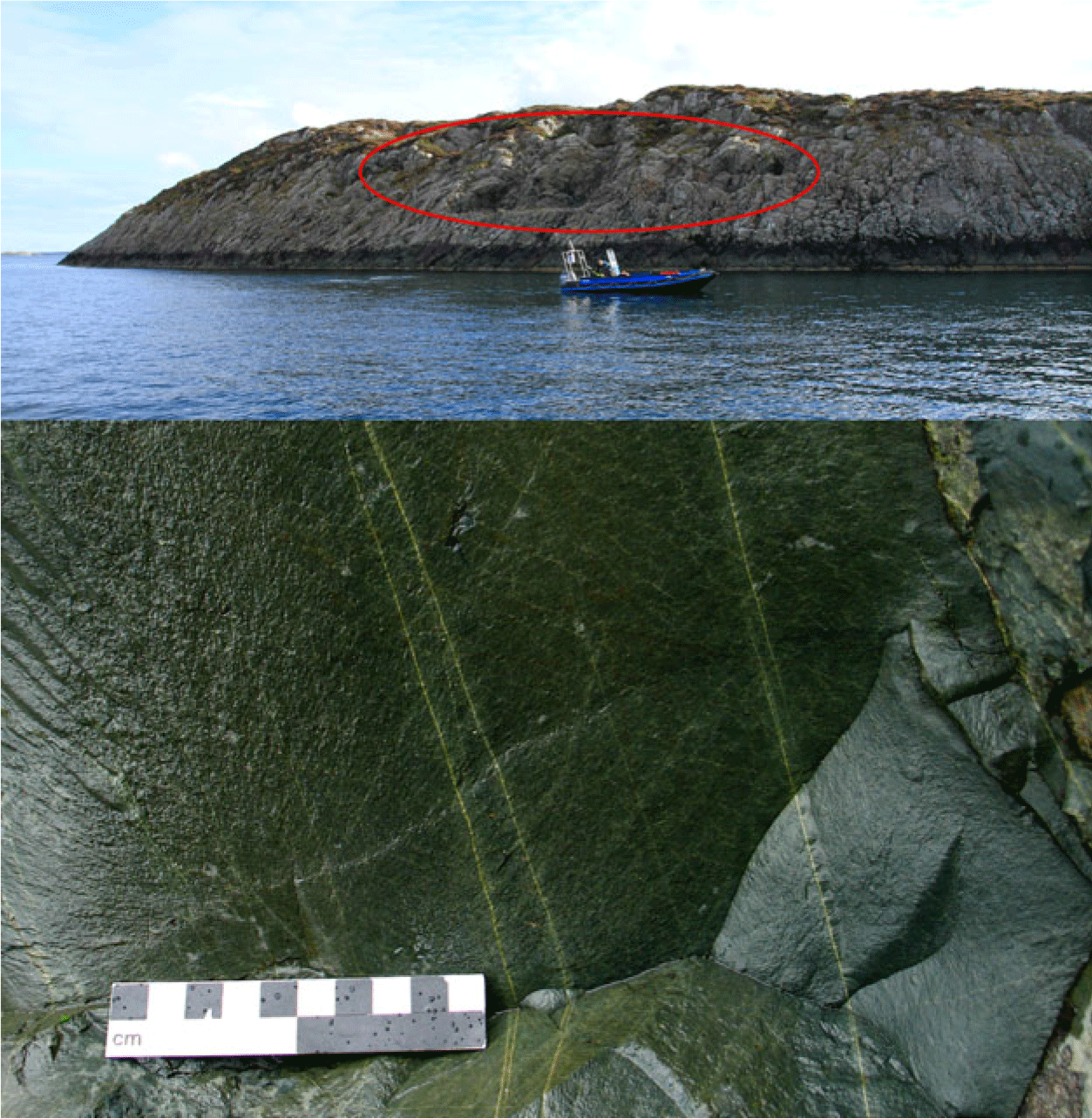
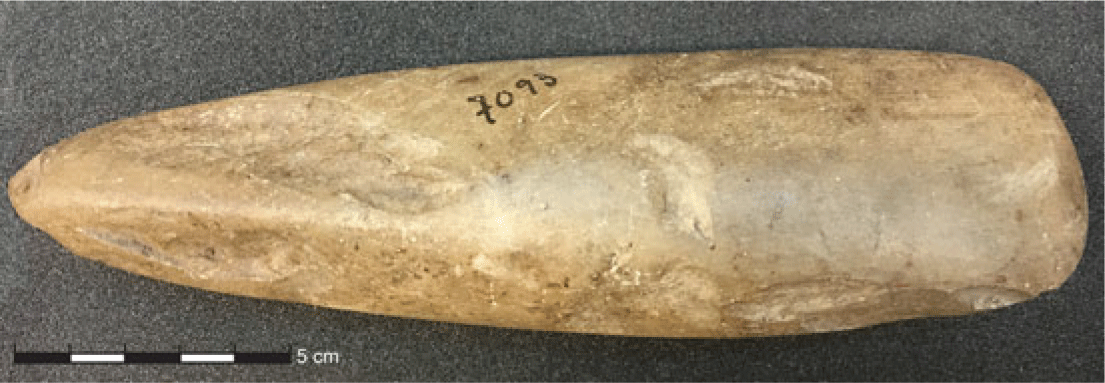
Greenstone deposits surface in the upper allochthon layer in two main regions in south Norway, in Hordaland and Trøndelag (Figure 2). Greenstone is a basaltic rock, vividly green when freshly quarried (Figure 3). However, over time and when weathered, the rock can turn brownish-grey or olive-coloured (Figure 4). At Bømlo, a municipality comprising several islands and a myriad of islets off the south-west coast, the greenstone deposit surfaces in several places. Many of the greenstone deposits were examined by geologist Niels Kolderup (Reference Kolderup1925) but the matrix was found to be too coarse-grained for ground adze production. Only two quarries have been identified (Kolderup Reference Kolderup1925; Olsen and Alsaker Reference Olsen and Alsaker1984; Alsaker Reference Alsaker1987). Both are thought to have been established in the Middle Mesolithic (ca 8000–6500 B.C.), at the time the first ground stone adzes appear in the Norwegian archaeological record. The quarries persisted into the Norwegian Middle Neolithic (to around 2500 B.C.) (Olsen and Alsaker Reference Olsen and Alsaker1984; Bergsvik and Olsen Reference Bergsvik, Olsen, Larsson, Knutsson, Loeffler and Åkerlund2003). The largest quarry is found at Hespriholmen, at an islet two or three kilometres west of the main island of Bømlo, with an estimated extracted volume of 400 cubic metres (Figure 3, top). A second greenstone quarry, Stegahaugen, is located on the side of a low mountain on the main island of Bømlo, with an estimated extracted volume around 10 cubic metres (Nyland Reference Nyland, Pereira and Terradas2017b).Footnote 2 The greenstone surfacing in both quarries was created during the same geological event (Ramberg et al. Reference Ramberg, Bryhni, Nøttvedt and Rangnes2007); they thus portray a very similar geochemical and isotopic signature (Alsaker Reference Alsaker1987; Bergsvik Reference Bergsvik2006; Nyland, Gebremariam and With Reference Nyland, Gebremariam, With, Olsen and Granadosin press), and physical properties. Hence it is not clear which of these quarries the rock came from, so the greenstone debated in this paper is referred to as Bømlo greenstone.
Top: Hespriholmen greenstone quarry on an islet west of Bømlo on the coast of south-western Norway. Bottom: the vivid green greenstone with hair-thin epidote lines visible at Hespriholmen quarry. Photograph: Astrid J. Nyland.

A typical Bømlo greenstone adze with weathered, brownish-grey patina (S7093). Photograph: Astrid J. Nyland.

There have been debates whether there were other exploited greenstone sources within the southern social territory (Kolderup 1925, Gjerland Reference Gjerland1984; Alsaker Reference Alsaker1987), but no other quarries have been discovered. Besides some hair-thin fault lines of more yellow epidote, the greenstone’s matrix is homogeneous and fine-grained. The rock seems to be hard yet flexible, and the numerous large workshop sites on islands surrounding the quarry (Alsaker Reference Alsaker1987) attest to its acknowledged and valued knapping properties in the Mesolithic. There are no other know exploited deposits for adze material in Rogaland County or the rest of the southern territory. The further south-south-east in Rogaland you come along the coast, adzes of diabase and other rock types increase in numbers. East of the county border, in Agder County, there are numerous diabase dikes, and a few small quarries have been recorded (Nyland Reference Nyland, Pereira and Terradas2017b). Still, a few greenstone adzes are also recorded there (Alsaker Reference Alsaker1987).
The wide distribution of greenstone from Bømlo and its potential for generating new knowledge of Stone Age societies were recognized in the mid-1900s (Fægri Reference Fægri1944; Clark Reference Clark, Hartwell and Wilson1965). The first Norwegian large-scale provenance study of adzes was conducted in the late 1970s (Olsen and Alsaker Reference Olsen and Alsaker1984; Alsaker Reference Alsaker1987). The study claimed that about one-third of all Mesolithic adzes circulating within a 300-kilometre stretch came from the Bømlo area (Figure 2). The distinct distribution patterns of adzes made of Bømlo greenstone mirrored a second distribution area of adzes further north. However, the adzes of the northern territory were made of a fine-grained diabase with phenochrysts from a specific quarry located at Stakalleneset in Sogn og Fjordane County, more than 200 kilometres further north. The patterns were interpreted as demarcating two social territories on the west coast (Olsen and Alsaker Reference Olsen and Alsaker1984). Later studies have investigated other types of material culture (e.g. decorated soapstone sinkers), raw-material distribution for blade and flake tools (mylonite, drift flint) and grinding stones (Devonian sandstone) (Skjelstad Reference Skjelstad2003; Reference Skjelstad2011) (see Figure 2), finding distinct distribution patterns underlining the difference between the two social territories. Moreover, whereas two of the largest Late Mesolithic rock art sites in Norway and several other smaller sites are located in the north, only two rock art sites – each with only a few animal figures – are known in the southern territory (see site maps in e.g. Fuglestvedt Reference Fuglestvedt2017). Hence the impression of two socially defined regions has been strengthened since the 1980s.
However, around 1980, when the large-scale provenance study was carried out, the applied XRF analyses required major intrusive sampling in the archaeological objects. As a result, 40 adzes in total, and only nine adzes from Rogaland, were sampled for geochemical measurements, whereas most of the adzes were visually or macroscopically determined. Thus, in 2017, a pilot study was undertaken with the objective of testing the validity of previous primarily visual analyses and to potentially identify other greenstone quarries in Rogaland. This time a pXRF (portable X-ray fluorescence instrument) could be used, offering a non-intrusive analysis of elemental mineral composition (Nyland, Gebremariam and With Reference Nyland, Gebremariam, With, Olsen and Granadosin press). From the corpus of 420 adzes that had previously been visually classified as greenstone, 80 adzes were selected for trace-elemental composition analyses. There were both Middle and Late Mesolithic types among the selected adzes. Some originate from archaeological excavations and thus C14-dated sites, but the majority were stray finds. Many of the sampled adzes were fragmented, but based on their location in the terrain and height above sea level, a majority are thought to be Late Mesolithic. Out of the 80 adzes, approximately 70 were more or less completely ground, and ten had a systematically pecked and unground surface (see Figure 1a).
Based on several measurements of both weathered and non-weathered samples from the two quarries, as well as a workshop site in their vicinity, a geochemical frame of reference for Bømlo greenstone was established. Selction criteria were then consistently followed to ensure reliable measuring of the adzes. For example, the adzes should show little weathering and have a remaining patch of ground and polished edge or surface. The measurements were undertaken with a Bruker Tracer III SD pXRF fitted with a silicon drift detector (SDD). No filters or vacuums were used, as calibrated by Bruker (Duplex 2205 sample). To further ensure high-quality measurements and to mitigate variation arising from any heterogeneity in the rocks’ matrices, five to six measurements per adze were taken. Each measurement lasted 120 seconds with the settings of 40 kV and 30 µA. Furthermore, to allow for replicability, the places of measurements were all marked on photographs. The generated quantitative results were then subjected to multivariate analysis (principal-component analysis (PCA)) using the Statistical Package for the Social Sciences (SPSS) software, version 25.
To sum up our results, they confirmed that the greenstone from Bømlo was indeed widely distributed in Rogaland throughout the Middle and Late Mesolithic (Nyland, Gebremariam and With Reference Nyland, Gebremariam, With, Olsen and Granadosin press) (Figure 5). Results also confirmed that Bømlo greenstone was utilized in districts where other suitable high-quality raw-material sources were even more accessible, especially diabase in the most south-eastern coastal region of Rogaland. But the investigation also demonstrated that, out of the 80 measured adzes, at least eight fell outside the Bømlo greenstone reference area; their chemical composition reveals that they were made of green rock from several other outcrops across Rogaland (Figure 6).
Map marking the two social territories defined by lithic distribution in western Norway, and the place, county and quarry names appearing in the text. Circles mark the location of the main quarries in the northern and southern social territories. The underlying map displays the geology of south Norway, traced from maps downloaded from ngu.no. The colours are adjusted to highlight the diagonal belt, including greenstone from the Bømlo area and resurfacing in Trøndelag County. Illustration: Astrid J. Nyland.

Scatter plot: pXRF analyses of 80 adzes. Each dot represents four measurements per sample (sample name is the museum number of the artefact). The Bømlo greenstone reference frame is within the circle (incl. both weathered and unweathered). The outliers reinforce the impression of Bømlo greenstone’s importance. Plot: Kidane Fanta Gebremariam.

Map with distribution of pXRF-measured adzes. Black dots: Bømlo greenstone; white dots: probably local sources. Illustration: Astrid J. Nyland.

In order to provide new understanding of the Mesolithic societies on the west coast of Norway, I will focus on the anomalies of the majority result, the outliers of the main cluster. The eight adzes had the visual appearance of Bømlo greenstone and were made in the same style. With the idea of the cultural appropriation of stone and place in mind, the question is whether people in the Mesolithic recognized that they were indeed not Bømlo greenstone. Were they attributed with the same social qualities, or were they recognized as not originating from Bømlo and thus considered inferior, because they were not authentic?
The establishment of a social node and ideas of authentic rock
The identified distribution demonstrates that both Bømlo greenstone and stone adzes had been distributed relatively long distances and into areas where other rock sources were equally available and suitable. Although the society was considered to be mobile, the persistence of the indicated social territories implies that people kept their travels and contacts to defined areas. This indicates a developing idea of returning to places (Nyland Reference Nyland, Rajala and Mills2017a). At the quarries, the initial reduction of the blanks was done before transportation to specialized workshop sites that are scattered across the Bømlo area. At the workshops, further reduction and production of preforms was undertaken before distribution. Asle Bruen Olsen and Sigmund Alsaker (1984, 93) suggested that the two identified social territories comprised regional social networks within which the adzes from the two sources circulated. The extensive distribution was argued to indicate a highly mobile population where everyone had access to the quarries and the rock. What we know is that the final stages, adjustments and final preparation, grinding and polishing, appear to have been conducted at settlement sites across the region. At most Mesolithic settlement sites, there is not as much waste material from adze production as at the workshop sites, and there are grinding slabs (see description of the organization of the quarrying process in Nyland Reference Nyland, Pereira and Terradas2017b). Whether the preforms were acquired at the quarries themselves or via an exchange network within a social territory is hard to say based on the archaeological record; no gathering sites have been identified, but based on the widely shared technology and traditions related to rock art, land use and quarrying, one can assume regular contact between groups of people.
Pertaining to the latter, we also need to carefully consider what makes a social territory. Opinion is divided on whether to equate the term ‘social territory’ with culture, tribe, ethnic group or another anthropologically defined entity (summarized by Bergsvik Reference Bergsvik, Larsson, Knutsson, Loefler and Åkerlund2003; Reference Bergsvik2006). In accordance with Fredrik Barth (Reference Barth1969), material differences and delimited distribution can indicate inhabitants of two neighbouring areas considering themselves conceptually different from each other. Although we cannot be certain whether the groups themselves travelled to the quarry or adze preforms were traded, their distribution across the region reflects an evident desire to possess stone from a specific place or source. The persisting distribution of stone from the sources at Bømlo indicates that this source was socially significant to the inhabitants living within the southern territory. Evidently, a group of people found it worthwhile to travel long distances to obtain and/or circulate the greenstone from Bømlo and to trade to get rock from one particular place even when other fine-grained rock was closer. The persistence of the wide distribution signals communication and interaction within a group as well as between generations, and it seems reasonable to presume that the inhabitants in the region considered themselves part of a community, sharing traditions, values and world view. A challenge is, though, to explain why Bømlo greenstone came to be so significant to people.
To procure high-quality raw material may well have been the primary incentive for establishing the quarries in the first place. Based on the continual use of Hespriholmen greenstone, it was apparently highly regarded for adze production. As mentioned, the Bømlo greenstone has valuable properties for adze production, which may be one explanation for its continual use through the millennia. However, particularities of the greenstone procurement practice – the character of the exploitation – do not reflect pure pragmatism (Nyland Reference Nyland, Rajala and Mills2017a). Due to isostatic rebound and eustacy after the last (Weichselian) Ice Age in Norway, the western coastline was not stable. Following the establishment and incipient extraction of greenstone from the quarry on the islet of Hespriholmen after 8000 B.C., the sea level declined, but then started to rise again around 7000 B.C. Hence the sea was slowly encroaching on the quarry face, threatening to submerge the islet completely. As the sea rose, and during tapes maximum around 6000 B.C., a safer and more accessible site for obtaining greenstone was needed. Perhaps this was the reason for establishing the greenstone quarry at Stegahaugen on the mainland of Bømlo, 135 metres above sea level.
The rising sea levels suggest that the Stegahaugen quarry was established in a location where it was safer to access the desired stone (Nyland Reference Nyland and Schülke2020b). Nevertheless, radiocarbon dates from the waste piles atop Hespriholmen demonstrate that people went there to quarry also when the water was still partly covering the oldest levels (see Olsen and Alsaker Reference Olsen and Alsaker1984; Bergsvik and Olsen Reference Bergsvik, Olsen, Larsson, Knutsson, Loeffler and Åkerlund2003). The Stegahaugen quarry continued to be in use as the sea level declined once more, despite the fact the greenstone from Stegahaugen has been suggested as being of lower quality (Alsaker Reference Alsaker1987). Considering that there were two quarries in use within the Bømlo area in the Mesolithic, what seems to have been imperative was to make sure that there was always Bømlo greenstone in circulation. In the Late Mesolithic, there was even an increase in the use of greenstone on the western coast (Olsen and Alsaker Reference Olsen and Alsaker1984; Bergsvik and Olsen Reference Bergsvik, Olsen, Larsson, Knutsson, Loeffler and Åkerlund2003). It is in this context that the eight green adzes visually similar to Bømlo greenstone, but not originating from the Bømlo area, are considered.
Different rock types have different mechanical properties, such as hardness and flexibility, influencing their knapability or suitability for grinding and edge durability, which can be tested and documented (e.g. Bradley et al. Reference Bradley, Meredith, Smith and Edmonds1992). Such properties obviously influenced peoples’ choice of rock source. Nevertheless, even mechanically defined lower-quality rock may have been desired, as illustrated already in the 1990s with the instance of a particular kind of Neolithic axe from Britain being transported across the Irish Sea, even as high-quality rock circulated in the same area (Bradley et al. Reference Bradley, Meredith, Smith and Edmonds1992). Mechanical properties of rock may be tested, but this will not necessarily give the answer as to why a type of rock was desirable. Moreover, colours can be defined with reference to colour charts, such as Munsell’s, to ensure that the described colour is possible to identify and replicate. With regard to the latter, as archaeologists, we rarely analyse or characterize tools made of freshly cut rock (see Figure 3 versus Figure 4). The adzes we encounter are primarily weathered or have been given various types of surface finish, pecking, grinding and polishing, making it harder to decipher uniform colours or markings. Rock surfaces can also change according to whether the rock is wet or dry, and the quality of the light when observing it, or the rock matrix can vary within the same source area or stratigraphic layer. As such, can colour still be regarded as a significant quality, or could the finish or patina be regarded as more important? Hence, rock can possess qualities that are hard to quantify, measure or even verbalize. The parallel exploitation of the two greenstone sources indicates that knapping properties were not necessarily people’s primary focus, and the contemporary desire for green adzes testified by the anomalies in Figure 5 adds to the complexity and challenges of interpreting distribution patterns based only on rocks’ physical attributes.
Even if colours and surfaces may vary and be challenging to document, visual appearance is still significant. The surfaces of objects can be seen as the ‘sites of generations of meaning’ (Ingold Reference Ingold2017, 100). Our senses are open to deliberate strategic manipulation, but not in isolation. Appearances mean something to someone and may be regarded as one of things’ competences and capacities, which are ‘not intrinsic but derive from associations’ (Bakker and Bridge Reference Bakker and Bridge2006, 16) and relations. In the continuous appropriation of items affiliated with specific places or cultures, both immaterial and spatial components are involved, human engagement and interconnectedness across distances (Heidegger Reference Heidegger1971; Ferguson Reference Ferguson2009). In the particular social setting of the Mesolithic coastal landscape, the persisting Bømlo greenstone procurement and distribution were undertaken within a framework of social knowledge and a recognition of the source’s significance. The greenstone seems to have been imbued with a power which then persuaded people to procure something that looked similar, even if it was not from the right place. Hence the recognition, or appreciation, of the authenticity of rock from a specific source appears to have become socially significant. Authenticity can also be closely tied to authority and power (Marila Reference Marila2011,16). It is connected to notions of distance in both time and place to whatever one is referring to (Sherry Reference Sherry2007, 484). That is, debating whether something is authentic builds on a recognition of a now, of one’s existence at a specific moment in time and place different to where and when one is referring to. If the green adzes gained agency or the capacity to affect the world because of the character and persistence of the exploitation of greenstone at Bømlo, then perhaps ownership of a green adze became necessary for a person to claim or gain social acceptance and access to a certain social group on the west coast of Norway in the Mesolithic.
Stone adzes as gatherings of physical and immaterial associations
Transformation of rock to stone is both immaterial and material. Embedded social significance in objects such as adzes can be influenced by a group’s ontological perspective on rock (Conneller Reference Conneller2011). For example, for some ancient Americans, light was perceived as a powerful quality, a fertilizing energy that contained the mysteries of life (Saunders Reference Saunders1999; Reference Saunders, Boivin and Owoc2004). This quality was not confined to one type of material but could be found in materials that, to a modern Western researcher, are essentially different, such as metal, pearls and rock crystals. To these ancient Americans, though, all these materials could, if they were transformed within the right mythological framework and rituals, transfer their charismatic and powerful properties to the made object. Objects with agency have also been named charismatic objects, defined as an object’s ability to arouse awe and to transfer acknowledged qualities to its user, owner or wearer (cf. Weber Reference Weber1968; Gell Reference Gell, Coote and Shelton1992). Recalling the process of appropriation as flow between natural processes and human endeavours described by Ferraby (Reference Ferraby2015, 37), Andrew Pickering (Reference Pickering, Hicks and Beaudry2010, 195) calls a similar process ‘the dance of agency’, emphasizing the importance of the performative relations necessary for both humans and non-humans to act on each other. Also, the term ‘intra-action’ is applied in arguments where agency and affect are intrinsically bound to relations, social practice and context (e.g. Jones Reference Jones2020). The point is that agencies respond to each other through engagement (Jones Reference Jones, Cochrane and Jones2012). Embedded social aspects of adzes are acknowledged through substantial transformation of rock (Conneller Reference Conneller2011). In other words, rock becomes stone when one makes an object; that is, how one understands it changes and it becomes embedded in a meaningful narrative (Elliot Reference Elliot2019, 172). As pertains to the greenstone adzes discussed in this paper, the adzes were agents in as much as they were embedded in such social meaningful engagements through every aspect of tool production and use, including raw-material procurement. Moreover, as the adzes were finished at the settlement sites, where the owners decided whether to peck, grind or polish the surface, other associations latched onto the adze through this intra-action too. This gave the adzes a certain visual appearance, and when implemented within the right social context and recognized by the onlookers, they became meaningful, affective and influential.
Although there are anthropological or ethnological references to people associating specific colours with ancestors, fertility, courage or death (e.g. Barth Reference Barth1975; Jacobson-Widding Reference Jacobson-Widding1979), it is difficult to prove any prehistoric cultural or social significance of the documented phenomenon (Arsenault Reference Arsenault, Chippindale and Nash2004). However, as for the greenstone adzes of the west coast of Norway, colour appears to both matter and not matter. That the colour happened to be green is probably not the significant point; the source could have been bluish-grey or brown. Instead, in this territory, the green colour distinguishes a specific source of stone – a source persistently exploited for several thousand years – which seems to give green adzes social value. The Bømlo greenstone and hence adzes made from that stone were acknowledged as originating from a valued place, a place people knew, as well as with what – or whom – the rock was associated. Living social memory, people’s capacity for gathering or assembling material and immaterial elements, as well as any sensory experience, and association and evoked memories of past activities and relations (Edmonds Reference Edmonds2004; DeLanda Reference Delanda2006; Ingold Reference Ingold2007; Hamilakis Reference Hamilakis2016), make artefacts and places socially significant.
Within this frame of reference, the green adzes were meaningful because of all the elements they assembled: as the persisting utilization of the quarries demonstrates, the activity linked traces of activities to previous generations. The journey from the shore of Bømlo to the quarry on Hespriholmen is rough, sometimes dangerous even today. To get to the Bømlo area from the south also involves crossing treacherous coastal stretches. Hence procuring Bømlo greenstone might have represented risk, which was perhaps an ambition acknowledged by those who ventured the journey and by those who waited behind. To quarry at Bømlo also involved planning to some degree. Hammerstones and dry firewood needed to complete the task of quarrying had to be acquired and carried to the quarries, especially to the Hespriholmen quarry. Planning indicates that the task of quarrying and the quarries lived in people’s minds. The sound of hammering on rock or the cracks as the rock yielded when quarried, the smell of smoke and fire aiding quarrying, were also part of the whole experience, perhaps something to be evoked by similar sounds or smells elsewhere. Whether someone had access to the quarries, or was in contact with people who did, was displayed through the adze they carried. Hence the task of procuring rock and appropriating stone through quarrying – the monumental quarry on the islet and the back-up quarry onshore – tied together knowledge, social memories, ideas of affinity and social belonging. All this was gathered and embedded in a small green adze.
Whether the source, production and associated relations were what made the adzes socially important, their green colour expressed this. If people wanted to evoke shared values or a sense of belonging, or adherence to particular social identities, they needed a green adze. At one point, to own a green adze could even have represented the possession of stone from a ‘drowning site’ as the sea level was rising (Nyland Reference Nyland and Schülke2020b). This knowledge was perhaps thought so extraordinary that it empowered the stone to the degree that people went to lengths to parade a green adze. Did this in turn give all green adzes the same associations and affinity? If so, this might be the portal to understanding the identified anomalies in the pXRF diagram as signifiers of the recognition and appreciation of authenticity. A green adze, visually similar to Bømlo greenstone, could support acceptance, in turn enhancing the value embedded in rock originating from a particular source. Consequently, if possessing an adze made of Bømlo greenstone signalled social affinity, of being an inhabitant of the southern social territory, the lack of a green adze could have revealed the opposite. Those who did not possess an adze revealed perhaps an unwanted status or could even have been socially sanctioned. Presuming that a green stone adze was an important signal of cultural affiliation, the anomalies, the lookalikes, may therefore represent a deliberate visual manipulation undertaken in order to gain access to a particular social group in Rogaland in the Mesolithic.
Recognizing authenticity of place and stone in the Mesolithic
The phenomena of human motivations for investing in authentic objects as compared to generic ones have been studied in cognitive psychology, as well as in philosophy and sociology. In psychology, objects with specific associations are perceived as contagions, while in sociology, in a similar manner, objects are regarded as charismatic (Weber Reference Weber1968). Both disciplines stress people’s willingness to accept the idea of essence transference via an object to the person owning or wearing it. Although undertaken on modern subjects, cognitive studies of the need to belong for understanding human motivation, behaviour and outcomes (valuation) (Baumeister and Leary Reference Baumeister and Leary1995; Newman and Smith Reference Newman and Smith2016: 132) can explain the Mesolithic insistence on obtaining rock from one particular source and rock resembling it. The greenstone adzes found not to be from the Bømlo area imply that, in the Mesolithic society, there was a strong need to belong to a social group. Being part of a group, having a social safety net, is a way of mediating the hazards of living along an unstable coast, demonstrated by the sea encroaching on the Hespriholmen quarry. To belong is ‘a fundamental, powerful, and extremely pervasive motivation’, and it involves frequent interaction and persistent caring (Baumeister and Leary Reference Baumeister and Leary1995, 497). Furthermore, one interpretation of the persisting and demarcated distribution pattern of rock and adzes originating from a special source or area is a Mesolithic society with widespread interpersonal connectedness, with people recognizing power, achievement and social affinity extending to the immediate group. Moreover, the specific utilization of green adzes may both have triggered and expressed a sense of unity with, identity or belonging to, local and inter-regional communities, social groups and networks.
In some situations, distribution patterns are indications of geological accessibility. In others, they signal the range of a group’s everyday or seasonal mobility. The recent pXRF analyses scientifically document a relationship between the area of Bømlo and mobile hunter-gatherers living within the region of Rogaland, through their use of greenstone over more than 4,000 years. The persisting use of greenstone also reflects a widespread idea of the concept of Bømlo greenstone, a recognition of the totality of all associated elements in this rock source. The adzes tied together knowledge of what it meant to belong to the southern social territory, to have access the quarries of Hespriholmen and Stegahaugen or to be connected to the specific group that accessed these sites. Hence seeing someone carry a green adze may have evoked a variety of associations, making displaying a green adze imperative. Recognizing that stones and tools might embed immaterial qualities such as these indicates that it mattered to a certain degree whether one possessed an adze from a specific source. However, would there be consequences if someone were caught displaying an inauthentic green adze? If so, who would know that the adze was a fake? Was it an intentional deception? Recalling the discussion about the convention of authenticity, did the fake adze deliver the same aura as true Bømlo greenstone did?
To be able to distinguish between sources required knowledgeable persons handling or observing the adzes. Researchers working with contemporary quarry workers describe how these specialists can instantly know the quarry area or stratigraphy from which a stone has been taken (Ferraby Reference Ferraby2015). Similar tacit knowledge of local sources or often-used stones must have been common in prehistory too. Another prerequisite of this is that the social organization involved contact between people, leading to a dispersal of knowledge and acknowledgement of the significance of rock from the Bømlo area versus other sources. Even as the Hespriholmen source was being ‘drowned’ by the transgressing sea level, its continued use and the establishment of Stegahaugen indicate that the quarries, and indeed Bømlo, were social nodes in the Mesolithic landscape (Nyland Reference Nyland and Schülke2020b). The quarries at Bømlo materialized activities of past generations. They may have been regarded as places of ancestral presence, territorial affinity and claims to resources (Nyland Reference Nyland, Rajala and Mills2017a). In turn, the area’s charisma, aura, authority or other monumental qualities producing a notion of a shared past latched onto the Bømlo greenstone adzes, hence their desirability. This impression is augmented by the distribution of the few lookalike greenstone adzes. That is, the anomalies support the interpretation that authenticity indeed mattered in this Mesolithic society.
In the Mesolithic in Rogaland, it seems validated that knowledge of Bømlo and its sources of greenstone circulated. We can also assume that the place and the rock had social significance. But who among the inhabitants of the west coast had the knowledgeability to identify an authentic adze? That is, could everyone or only a few specialists distinguish rock from different sources, and hence reveal an inauthentic green adze? Was the utilization of green rock in any way an intentionally deceptive practice? The character of exploitation of the source area and the existence of the inauthentic adzes indicate social organization and interaction involving people meeting and looking at each other’s adzes up close. This, then, leads to new questions: would one be able to visually distinguish between a Bømlo greenstone adze and another green rock? Did a Bømlo greenstone adze have a special haptic quality that only someone familiar with the surface of a complete adze would recognize? It is easy to distinguish between a ground and polished adze and one covered in peck and crushing marks by touch. The surface treatment may also have had an important identifying function, made in accordance with contemporary social guidelines or cultural traditions. As pointed out by Tim Ingold (Reference Ingold2017, 101–102), surface finish is both visual and haptic. However, investigating the spatial or temporal distribution of adzes with different surface finishes must be a subject for another study.
Final remarks
Current archaeology has taken an empirical turn, where methods and analyses from the natural sciences are increasingly integrated into archaeological research. However, with this turn comes a need to reflect on what we accept as evidence to support Stone Age narratives and how to combine knowledge from several scientific fields. In a way, when differentiating between rock sources based on elemental composition, we maintain the Western essentialist view on material perceived as discrete substances (Conneller Reference Conneller, Alberti, Jones and Pollard2013). None of the generated or inferred knowledge and interpretations offered in this article are immediately accessible to us from simply investigating rock or looking at adze distribution. Perhaps this was the point? As Chantal Conneller (Reference Conneller, Alberti, Jones and Pollard2013, 129) argues concerning the production of skeuomorphs, here, all greenstone could have been regarded as the same because of a common idea of a shared quality: that of acknowledged origin from a place that had come to matter to the group.
In this article, I have operated at the interface where different sciences meet, and it is the combination of the micro- and macroscopic perspectives that adds new insight. Moreover, while aesthetic or sensory attributes of rock or associations may not always be quantifiable, they are still highly relevant to help us explore an archaeological phenomenon. The past was a place filled with a multitude of experiences from all aspects of human life, all of which were and still are important for gaining understanding. The combination of geochemical data from rock and the more elusive and ephemeral qualities of stone have thus great potential to open up new questions and rich interpretations of Mesolithic societies.
Acknowledgements
The idea for this paper was originally presented at EAA 2018, Barcelona. Participation was funded by the ICORE research programme at the Museum of Archaeology, University of Stavanger, Norway. The pXRF measurement and data interpretation were undertaken by Dr Kidane Fanta Gebremariam and Ruben With, both conservators at the Museum of Archaeology, University of Stavanger. Finally, I thank Rose Ferraby, the editorial board of Archaeological dialogues and the peer reviewers for all their valuable insight and comments.