“Like others of its type, the Yale School has always been a Male School.”Footnote 1 So Barbara Johnson wittily observed in her talk “Gender Theory and the Yale School,” an ironic twist on the title and theme of the Contemporary Genre Theory and the Yale School conference held in Norman, Oklahoma from 31 May to 1 June 1984. (“Gender” in French is “Genre.”) The “Yale School” was shorthand for a group of literary critics, theorists, and philosophers of literature who practiced deconstructive criticism during the 1970s and early 1980s on the Old Campus in New Haven. “Deconstruction” was a style of reading that identified moments of linguistic undecidablity and interpretive deadlock in a text in order to show that what was once overlooked or deemed marginal in the text rested at its center and shaped the text's form and/or content. As Johnson suggested, the “Yale School” was often portrayed as a male province. A much-cited 1981 Newsweek article, for example, praised these “formidable men of letters who have bent deconstruction to their own individual—and practical—purposes.”Footnote 2 Popular publications outright ignored the women of the Yale school, and academics placed them at the margins of their territory. Jonathan Culler, whose On Deconstruction (1982) won generations of anglophone readers, described Shoshana Felman's La folie et la chose littéraire (1978) as “a wide-ranging collection of essays by a member of the ‘école de Yale.’”Footnote 3 Felman was perhaps a Yale daughter, or maybe, as Johnson remarked in her 1984 talk, a “member of the Yale School, but only in French.” As far as Johnson was concerned, Culler had sidelined Felman for “no reason other than gender.”Footnote 4
Considered second string to the all-star lineup known as the Yale school were “The Brides of Deconstruction and Criticism,” the title of Johnson and her colleagues’ proposed female countermanifesto. With distinctive yet overlapping approaches to texts and teaching, this informal group of literary critics was central to the institutional intellectual story of deconstruction. Beginning in earnest during the late 1970s at Yale, these feminists moved deconstructive reading away from a focus on the self-subversiveness of French and English prose and poetry—as exemplified by the “Male School”—and toward the contradictions of gender, sexual difference, psychoanalysis, and race. While intervening into patterns of female effacement and marginalization in an array of intellectual and cultural works, the Brides of Deconstruction helped transform Mary Shelley studies, Romantic studies, and Lacanian studies, as well as helping establish trauma studies, queer theory, and gender studies.
Significantly, it was not so much the importation of so-called French theory or the national climate, but local and contingent conditions, that shaped Yale's feminist deconstructive moment. During the early to mid-1970s, Yale professors and administrators pulled energy and ideas from feminist curricula and thought as well as the politics of the women's and gay liberation movements. Feminists’ efforts, to which the feminist wing of deconstruction contributed, helped launch Yale's Women's Studies Program in 1979. Not simply the 1960s, then, but the turn of the early to mid-1970s era influenced humanists’ commitment to exploring the limits of identity.Footnote 5 By offering critiques of and alternatives to social-structural approaches to feminism, however, Barbara Johnson and company did more than participate in this post-1960s enlargement of the demographic and cognitive boundaries of the humanities at Yale.Footnote 6 More generally, feminist deconstructionists’ projects were also implicated in the loss of disciplinary authority in literary studies during the late 1970s. This erosion resulted partly due to the merging of increased stress placed on professionalism and the loss of institutionally suitable standards for the professionalized study of literature.Footnote 7 Though the deconstructive style of reading associated with the Male School epitomized this dead end for literary studies, Johnson and company offered paths out of the cul-de-sac, as their works represented social and political acts that helped pave a way for the success of cultural studies in the United States academy.
SECOND-WAVE FEMINISM AND THE STRUGGLE FOR WOMEN'S STUDIES AT YALE UNIVERSITY
While higher education in North America dramatically expanded after World War II, women's slice of the academic pie—full-time positions in the humanities and sciences as well as numbers of the undergraduate population—shrank. This was partially the result of the much-celebrated G.I. Bill; passed in 1944, 98 percent of recipients of the bill's funding were men, and it was these men who largely shaped higher education during the 1950s. There were other reasons for the decrease in the presence of women in academe, including the postwar celebration of domesticity that placed the burden of family obligations, especially childcare, on women. The burden of caregiving, combined with the challenges of an academic career that, thanks to what Christopher Jencks and David Riesman called the “academic revolution,” increasingly stressed research, made it onerous for women to pursue and then secure permanent faculty positions.Footnote 8 By mid-century, the confluence of professional pressures and cultural obstacles facilitated the decline in women's academic prospects, thus enabling a “more scientific, more mathematical, more male-centered approach to scholarship” to emerge.Footnote 9
Nevertheless, there were reasons to believe that equal participation in higher education would develop in the foreseeable future. The situation for women in academe improved slightly after the passage, in 1958, of the National Defense Education Act. By making federal funds available for training in languages, a traditionally “feminine” field, the NDEA helped slow the downward slide. In addition, forecasters predicted that the current supply of faculty would soon be unable to meet the growing student demand due to the postwar demographic bubble. Such demand, they envisioned, would offer women the opportunity to earn a spot in the expanding corps of professors. Optimism was misplaced, though. Due to the financial stressors that the Vietnam War placed on budgets, the welfare state that had earlier funneled massive resources into higher education began to redirect monies elsewhere by 1969. Colleges and universities found themselves suddenly financially constrained; hiring ground to a halt.Footnote 10
Meanwhile, activist scholars intensified their efforts, fueled by frustration with the continued relegation of women to the sidelines and inspired by a range of second-wave feminists’ efforts to expand women's sexual, familial, work, and reproductive rights. In colleges and universities, these efforts eventually fashioned not only “the research of female scholars in the humanities more than any other factor in the 1970s and 1980s,” but pedagogical programs as well.Footnote 11 Most notable was the designing and offering of women's studies courses, which, by furthering feminists’ second-wave goals to achieve individual autonomy and equality between the sexes, nourished the postwar trend to expand the humanities’ demographic and cognitive boundaries. By the end of the 1970s, a startling number of colleges and universities had institutionalized such feminist curricula. While in September 1970 an anthology of women's courses contained merely seventeen syllabi, by 1974 a virtual explosion had occurred, with 4,658 women's courses at 885 colleges and universities. Women's studies programs, in turn, sprang up, following a similar trajectory. The first two were established at San Diego State College and Cornell University in 1970; five years later, there were 270 programs; and a half-decade after that, in 1981, there were 350 programs nationwide.Footnote 12
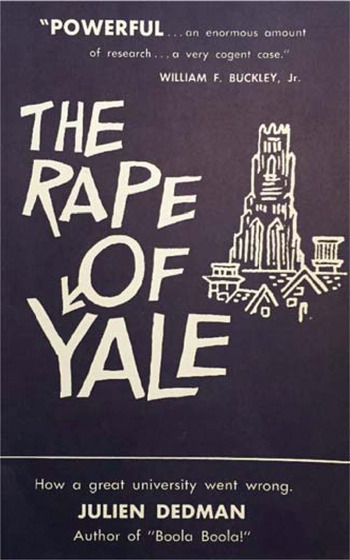
Though Dedman criticized what he considered to be a number of anti-American, often communist, threats to Yale University, the choice to reverse the direction of the arrow of the standard symbol denoting the male sex on his 1969 pamphlet's front cover is rather telling. This reversal shows the extent to which Dedman believed the presence of women and feminism at his alma mater overturned the school's mission and prestige. Julien Dedman, The Rape of Yale: How a Great University Went Wrong (Southport, CT, 1969), author's collection.

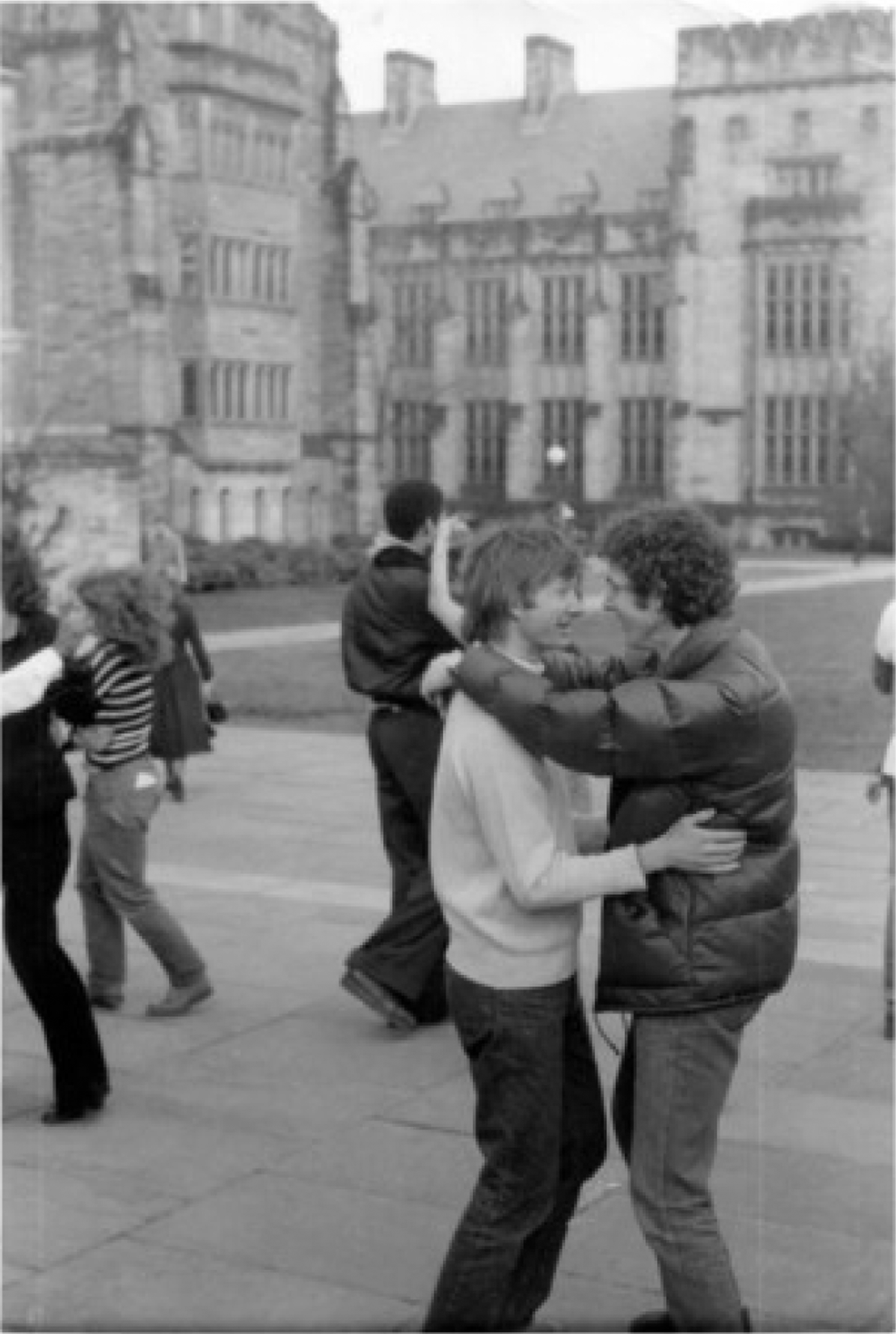
(1977) Jack Winkler at Yale's first Gay Rights Week (April 4–8, 1977), which he helped organize. Here, Winkler participates in the dance in front of Sterling Memorial Library that concluded the momentous week. Source: http://yamp.org/Profiles/JackWinkler.

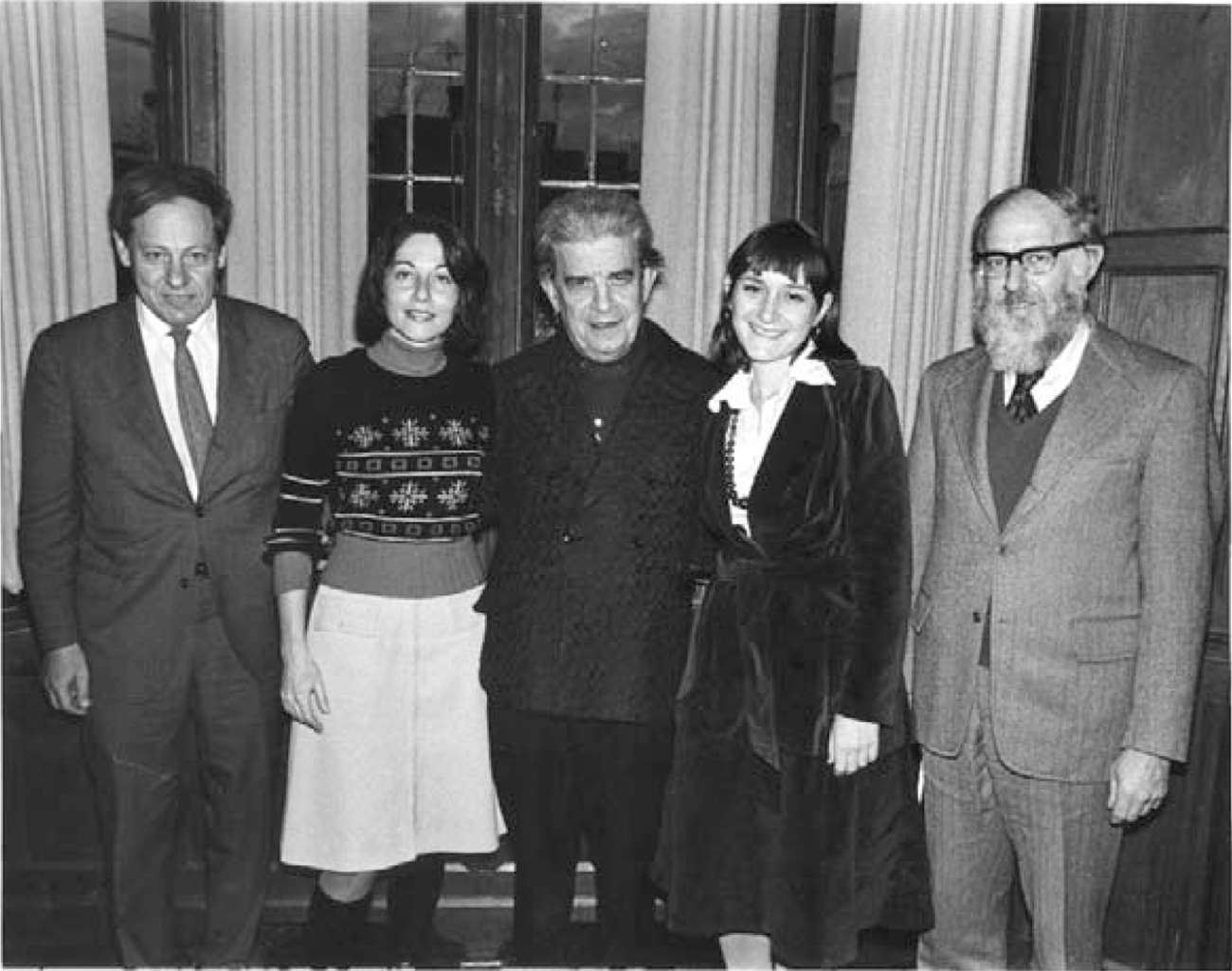
(1975) Left to Right: Paul de Man, Shoshana Felman, Jacques Lacan, (unidentified), Geoffrey Hartman. Source: personal papers of Patricia de Man.

The founding of the first women's studies courses and programs on the East and West Coasts coincided with 1960s-inspired unrest and transformation at Yale. In 1969, the university's governing body, at the urging of the school's president, Kingman Brewster, decided to admit 588 women—“the female versions of Nietzsche's Uebermensch,” according to an article in the April 1969 issue of the New York Times Magazine—to undergraduate ranks.Footnote 13 Though the homogeneous “Yale College experience” was a thing of the past—administration accelerated recruitment of minority and scholarship students in the mid-1960s—alumni resisted.Footnote 14 A fair number of undergraduates opposed coeducation as well, with some organizing a “Keep Yale Male” campaign. In the pamphlet The Rape of Yale, circulated during the August 1969 matriculation ceremony and endorsed by William F. Buckley Jr., whose God and Man at Yale (1951) aided the launching of the contemporary American conservative movement, Julien Dedman, ’49, sarcastically bemoaned how President Brewster, “ravished by the sirens of ‘Change,’” “emasculated Yale's most time-honored tradition—its 267 years of maleness.”Footnote 15
For Dr Elga Wasserman, chair of the Planning Committee on Coeducation, and her colleagues, however, the only viable option was to continue increasing the number of women faculty, administrators, and students. Following their recommendations, Yale faculty began to plan for a Women's Studies Program, drawing inspiration and vitality from the work of feminist activists on campus. Shortly after the arrival of the university's first female Übermenschen, feminists had created a space especially for women and the study of women's issues. In the fall of 1970, Yale offered the Women in Male Society course, and in December, undergraduates established a Women's Center that encouraged discussions about “women's issues.” These issues included sexual harassment (an unfamiliar concept in the early 1970s), anorexia, and abortion (illegal until Roe v. Wade in 1973). Also, the Women's Center hosted a chapter of the National Organization for Women. By the mid-1970s, a Women's Caucus report noted, there were panel discussions on campus, consciousness-raising groups, a women's studies discussion table, a faculty women's lunch table, and publications such as Freshwomen's Booklet, in the fall of 1975, and Women's Words, in spring 1976.Footnote 16
But in contrast to a number of state-run institutions, perhaps because these schools were bound less to unwritten traditions than to state and federal statutes, the founding of a women's studies program at Yale was neither smooth nor quick. A 1971 report to Yale's president explained that, in “a school dominated by men of the Old Blue tradition where women are tolerated only,” professional pressures and obstacles—which included serving on more committees than male colleagues and accepting an imprecise policy for maternity leave—were compounded by open harassment.Footnote 17 Consider the English Department, long deemed a bastion of Anglo-Saxon racial (and sexual) purity. According to an Undergraduate Women's Caucus report, in the fall of 1976, a professor commenced English 29—“a survey course, spanning the whole European literary tradition”—with “a slide portraying a man about to be raped by the Sphinx for his attempt to enter Thebes.” “After a brief discussion of the slide, [the professor] turned to the class and remarked: ‘All men face the same threat of a hungry, gaping vagina.’”Footnote 18 Such hostile discursive and physical acts produced the androcentric and misogynist environment at Yale that women scholars and students aimed to combat.
Feminists’ efforts resulted in the expansion of the number and scope of women's studies courses at Yale. By 1971, Wasserman had helped organize eight such classes. In the fall of 1974, visiting instructor Betty Friedan used her class The Sex-Role Revolution: Stage II to rethink her by-then famous critique of the confinements and frustrations of women, arguing that the first stage of second-wave feminism would soon conclude with the ratification of the Equal Rights Amendment. Feminism, Friedan suggested, would now enter a new phase in which women and men should work together to address the double enslavement of women—in the home and in the workplace.Footnote 19 While radical feminists viewed Friedan's new argument as reactionary—she abandoned political issues solely related to women, they charged—those sympathetic probably saw her thesis as pointing to what might lie beyond second-wave feminists’ aims to, as expressed by the Friedan co-founded NOW, “bring women into full participation in the mainstream of American society.” Regardless of where Yalies stood on Friedan's feminism, though, Friedan's class signaled how the shift of a number of feminists away from a second-wave emphasis on rights and equality was brought into lecture halls in New Haven.
Feminists at Yale in the early to mid-1970s certainly were not devoid of contact with the efforts of activists off the Old Campus. In fact, the bulk of formulations of feminism date from this period: Ms. magazine was founded in 1971; Florence Howe founded the Feminist Press in 1970; the interdisciplinary journal Signs—central to the development of women's studies—followed in 1973.Footnote 20 And by the mid-1970s in the Elm City, women's organizations and groups—Belladonna Publishing, the Connecticut Feminist Federal Credit Union, and the New Haven Women's Liberation Rock Band, to name but a few—advanced feminist goals in and around campus. Meanwhile, Yale faculty and graduate students continued to further feminists’ sexual politics.Footnote 21 For Catherine MacKinnon, a Yale graduate student in political science who received her law degree from Yale in 1977, and her socialist–feminist allies, truth was defined by this questioning outside the academy of the sexual politics that organized institutions and knowledge, and the university should communicate, decode, and assess this truth in and with its curricula. “A curriculum is a map of reality,” MacKinnon wrote in a 1978 memo. “It presents a categorical series of unities of life, world and thought divided by time, place and manner of investigation, and united into disciplines according to people's experience of truth. As changes in disciplinary boundaries illustrate, the experience of truth is a social experience.”Footnote 22
MacKinnon's sexual politics were reflected not only in her courses but also in her legal advocacy. Most notably, MacKinnon saw the possibility to expand the reach of Title IX of the 1972 Education Amendments, federal legislation that required schools that received federal funding to provide equal opportunities such as scholarships and financial support to women and men. Hitherto, Title IX cases focused on whether male and female athletic teams received equal funding and opportunities. But in 1977, MacKinnon advised attorneys who represented five female Yale undergraduates to test her new legal theory, formulated while a Yale law student and later published as Sexual Harassment of Working Women (1979). She theorized that sexual discrimination occurred more frequently in subtle than overt forms, that “the unwanted imposition of sexual requirements in the context of a relationship of unequal power” comprised illegal sex discrimination.Footnote 23 Specifically, MacKinnon urged students to sue the university for doing nothing to halt the “quid pro quo” sexual harassment (sex in exchange for better grades) by male professors; Yale thus denied women the right, guaranteed under Title IX, to an equal education. Brought against Yale by the New Haven Law Collective feminist law firm, founded by MacKinnon and several lawyers, the subsequent 1979 case, Alexander v. Yale, was the first to use Title IX in charges of sexual harassment against an educational institution, and, though the federal appeals court dismissed charges in 1980, Yale eventually instituted a grievance mechanism for students to report sexual harassment. Not only playing a pivotal moment in Title IX history, MacKinnon and the women of Alexander v. Yale contributed to the then emerging concept of sexual harassment and protected the gains of feminists at Yale and elsewhere.Footnote 24
MacKinnon's work to combat discrimination roughly coincided with the experimental session for the Yale's Women's Studies Program during the 1978 summer term.Footnote 25 Professor of Classics Jack Winkler's summer course, in particular, offers a window into the synergy between the nascent program and the kinds of feminist work then being done in Yale's departments of literature. Joining the burgeoning number of lit classes that drew from the new field of feminist literary-criticism scholarship—pioneered by Mary Ellman's 1968 identification of “phallic criticism” and Kate Millet's 1970 exploration of sexual relations in literature—Winkler's summer class placed the question of sexual politics front and center.Footnote 26 In the 1976 iteration of his class, for example, Winkler assigned The World Split Open: Four Centuries of Women Poets in England and America.Footnote 27 This landmark anthology, the title of which signals its second-wave world-shattering aims, was taken from Muriel Rukeyser's 1968 poem “Käthe Kollwitz,” which asks the question, “What would happen if one woman told the truth about her life?” The answer: “The world would split open.” Students enthusiastically embraced Winkler's class, reporting that it explored “literature as a patriarchal institution; male authors’ versus female authors’ conception of women; and the question of male and female literary style.” And yet the Undergraduate Women's Caucus warned in 1977, “Yale's fulfillment of her own potential demands a confrontation with the question posed by the presence of women—which was just begun.”Footnote 28
FEMINIST DECONSTRUCTIONISTS AND THE FOUNDING OF A WOMEN'S STUDIES PROGRAM
It was in and around Yale's undergraduate Literature major, an experimental pedagogical program that aimed to cultivate a kind of subject who speculatively engaged humanity's need for and use of fictions, that such a notable confrontation with the question of women would occur. Though many students flocked to the exciting major's offerings in the 1970s, as early as 1973, the inaugural year of the program, a number of female Übermenschen protested the androcentrism of the major's core course: Literature X: Man and His Fictions. As Alvin Kernan, one of Lit X's architects, recalled, “The indignant letters poured: ‘Where do you hegemonic males get off trying to claim fiction for the phallocracy?’”Footnote 29 Seven years later, Barbara Johnson was busy intervening into the Lit major's androcentrism, and, by helping open ways out of the intellectual and institutional dead end of the deconstructive style of reading associated with the Yale school, she played a central role in the feminist deconstructive moment in New Haven.
Barbara Johnson arrived at Yale in 1969 as a twenty-two-year-old graduate student in French literature. In 1977, she earned her Ph.D., with Paul de Man, the so-called capo di tutti capi of the Hermeneutical Mafia—or Yale school—serving as her dissertation adviser. The same year as her graduation, Yale's French Department, in an unusual move due to the constricted academic job market and the school's tradition of looking outside the department for candidates, hired Johnson as a tenure-track assistant professor. Initially, Johnson made her name on the United States literary-critical scene by providing, in “American English,” succinct deconstructive readings. In a paper at the 1977 Modern Language Association Convention on Barthes's S/Z, for example, Johnson explained that the “de-construction of a text” teases out the “warring forces of signification within the text itself.” “If anything is destroyed in a deconstructive reading, it is not the text, but the claim to unequivocal domination of one mode of signifying over another. A deconstructive reading is a reading that analyzes the specificity of a text's critical difference from itself.”Footnote 30 Echoing de Man, who would, in 1979, define a “literary text” as a text that “simultaneously asserts and denies the authority of its own rhetorical mode,” Johnson's deconstructive reading affirmed and concurrently undermined any notion of literature possessing a stable content or form.Footnote 31 Johnson's deconstructive reading superseded the New Critical, structuralist, and phenomenological approaches, as each claimed to have isolated the shape or meaning of literature, literature's form, and what literature was “about.” Still, for Johnson, deconstructive reading, while often taken by traditional literary scholars to subvert, even destroy, disciplinary boundaries, in fact did not. Rather, like earlier approaches, Johnson's way of reading did not require any alteration to the institutional structure precisely because it remained focused on the literary text itself.
Hewing to the interpretive procedures of her teachers meant that Johnson was at first committed to tracing self-subversive moments of literature in her publications as well. These publications also reinforced the traditional disciplinary boundaries of literary studies. In her first book, on Baudelaire and published in 1979 by the Parisian publishing house Flammarion, then linked with Derrida, Johnson suggested that the Icarian fall “recounted in the Petits Poèmes en prose is not that of a subject who falls from poetic paradise into the prosaic world, but rather that of the paradise itself, which differentiates itself from itself.”Footnote 32 The self-differentiation of paradise narrated in Petits poèmes en prose, Johnson maintained, was what produced the dialogue occurring in Baudelaire's writings between genres—between prose and poetry—and his texts. This peculiar genre's way of self-consciously questioning itself generated the uncertainty that undermined not only the standing of poetry, but any classification of genre as well: “Neither antithesis nor synthesis, the prose poem is the place from where the polarity—and therefore the symmetry—between presence and absence, between prose and poetry, disfunctions. The description of the prose poem is only possible when one departs from the principle that any attempt to describe it ends up subverting itself.”Footnote 33 For Johnson, Baudelaire's prose poems undermined critics’ assumptions of an organic fusion between poetic shape and meaning; and therefore any reading, no matter its rigor, of his prose poems was self-undermining. Still, Johnson's work at the time reinforced the disciplinary boundary of literary studies in that her focus was confined to literature itself.
Soon after the publication of her book, however, Johnson began to extend her readings beyond literature, highlighting the political and social implications of her work in ways that neither de Man nor Derrida had done. Johnson presented her first paper in the field of feminist literary criticism, “Le dernier homme,” at a July–August 1980 colloquium held in Cerisy, France, organized around Derrida's work. Rather than gripe, like many other colloquium participants, about “the mechanical application of Derridean deconstruction, in America, to literary studies,” an institutionalization that divested it “of its original radical force,” as one contributor recalled, Johnson provocatively implemented a feminist deconstructive style of reading with the universal and metaphysical pretensions of Western humanism and Romanticism—all achieved by way of Mary Shelley.Footnote 34 While Derrida employed his 1968 essay “The Ends of Man” to uncover how, by universalizing “Man,” humanists anthropologized “man,” objectifying the human and speaking for others in “Western” vocabularies, Johnson used her 1980 Cerisy paper to expose the humanist project as a destructive male fantasy. “[T]o speak of Mary Shelley's Frankenstein,” Johnson argued, “is immediately to approach the question of man indirectly through what has always been at once excluded and comprehended by its definition, namely, the woman and the monster.”Footnote 35 It was with his monster that Johnson's Dr Frankenstein aimed to fulfill Enlightenment philosophes’ humanist project—a human being at once Western and rational, and implicitly masculine. However, because his ostensibly universal “Man” was gendered, Dr Frankenstein—the humanist–creator par excellence—was unable to complete his project, which required a female monster that equaled his male. Dr Frankenstein could conceive, but not birth, his plan for a female monster: his frightful vision of a new Eve in fact led him to destroy his rough draft. For Johnson, Shelley's story was thus a meditation on the violent exclusion of the feminine presence that constructed Western “Man.” “Le dernier homme” helped raise the profile of Shelley, who had only recently received literary scholars’ attention, and facilitated the reorganization of the canon—until then, all men—of the British Romantics.Footnote 36
Johnson's Cerisy paper was also implicated in the swift feminist turn her teaching took. Likely thanks to Johnson, the fall 1980 iteration of the aforementioned Man and His Fictions, the core course of Yale's Literature major, was retitled to the gender-neutral “Narrative Forms,” and expanded to include a key lecture on Shelley's Frankenstein (which Johnson delivered) and a seminar discussion that compared Frankenstein with Jean-Jacques Rousseau's The Confessions.Footnote 37 What's more, in a 5 November 1980 exercise, Johnson and her co-teachers asked students to write a four- to five-page essay that investigated—first—how the narratives of “Frankenstein, Rousseau's Confessions, and Great Expectations … [were] implicitly or explicitly addressed to a listener/reader,” and—second—how this “affects the narration.”Footnote 38 How, in other words, did Shelley's, Rousseau's, and Dickens's respective texts’ hidden or open aims to speak to addressees shape the text's form or physical structure, such as the length of the lines, rhythms, or systems of rhymes and repetitions? It was not simply that, unlike the previous iterations, fall 1980 Narrative Forms pupils used Shelley in equal proportion to Dickens and Rousseau. Even if only for a class or two, while teasing out how these authors’ reflexive narratives oriented the reader—in this case the pupil—students considered a female presence and feminist affirmation.
Not only Johnson, but other feminists in Yale's literature departments helped realize the institution's distinctive feminist deconstructive moment. Looking back on her time as an undergraduate, Margaret Homans, a 1974 graduate of Yale College who later earned her Ph.D. in English literature from the university in 1978, reflected that, as an undergraduate, she longed for an education that examined standards of gender and sexuality in literature and culture. Homans's yearning was partially sated by the research and writing that culminated in her graduate education. In her dissertation, she explored the ways Dorothy Wordsworth, Emily Brontë, and Emily Dickinson, “textually conscious of their femininity, responded to a literary tradition that depended on and reinforced the masculine orientation of language of the poet.” The Romantic Wordsworth's awareness of her femininity, Homans argued, resulted in a division of poetic identity, while Victorian Brontë’s response was to portray poetic power as a masculine figure who was only partially integrated into her own identity. But for Homans it was the modernist Dickinson, by using her eccentric position outside the masculine tradition, who “discover[ed] that all language is figurative, and therefore that the traditions of Romantic writing that hinder Wordsworth and Brontë need not be taken as necessary truths.”Footnote 39 It was not just that masculine habits of writing could be broken and rewritten, but that the masculine orientation obscured the metaphorical—and feminine—nature of language. Wordsworth thus demonstrated that feminine metaphors were the constitutive part of language, basic to understanding and living.
Homans's graduate work shaped her subsequent Bearing the Word (1986). Therein, she charted a path between an American feminist criticism that held there to be “a realm outside language called life or experience” and a French feminist criticism that saw “all experience” as occurring “within a system of representation, usually identified as [Jacques] Lacan's symbolic order.” Passing between American and French feminist criticisms, Homans believed, permitted the reader to analyze the Western myth that women were somehow linked to literal, direct, and unembroidered language, particularly regarding the issue of reproduction whereby language copied and/or literalized figures, whereas men were somehow allied with or maintained a power for figurative or symbolic language, whereby language, rather than unswervingly presenting the material world, deferred referents. Focusing on “four recurrent literary situations,” which she called the experience of “bearing the word,” Homans explored “the thematics of female experience” and “women's special relation to language” in nineteenth-century texts by women writers, including George Eliot's Adam Bede (1859), wherein Hetty Sorrel's “figurative concealment of a newborn but dead passion” for Arthur Donnithorne was literalized in her “actual concealment of a newborn but dead baby.”Footnote 40
Homans's suggestion in the late 1970s that women writers subverted a masculine tradition that obscured the feminine orientation of the metaphoricity of language stood in sharp contrast to the views of a number of male English professors at Yale, notably Harold Bloom. Bloom, for example, remarked in a 1965 Partisan Review essay that it was because Shelley's Frankenstein “lacks the sophistication and imaginative complexity of such works” as William Blake's Book of Urizen and Lord Byron's Manfred that it “affords a unique introduction to the archetypal world of the Romantics.”Footnote 41 Similar to the pattern Homans identified as a graduate student, Bloom's Shelley as a supplement—at most an introduction—to her husband, Percy Bysshe Shelley, and other male Romantics, depended on and reinforced his disdain for the female Übermenschen in English departments. In a 1975 letter to his colleague Hillis Miller, Bloom grumbled, “I don't believe the level[ing]-down process can be halted, at Yale or elsewhere. A majority of the voting members in the Yale Eng. Dept., 5–7 years hence, will be made up of a coalition between housekeeping women (younger + already on the scene) and safe professional men (older + to be brought in from outside starting now).”Footnote 42 To be sure, during the 1960s, Bloom was a literary-critical revolutionary, who, alongside M. H. Abrams and Northrop Frye, helped overturn the New Critics’ and their modernist allies’ portrayals of British Romantics as puerile and unsophisticated. But Bloom's views on female writers were very much a product of the repressive masculine tradition upheld by colleagues—Howard Felperin, a Shakespearean at Yale, saw the new “feminist way of thinking” at Yale and elsewhere as merely “a new politics of unearned entitlement” that banished “an older politics of unearned preferment”—that Homans challenged and upended in her scholarship.Footnote 43
While Bloom and Felperin (the former stayed at Yale for his entire career; the latter left in 1974 after failing to earn tenure) resisted, more feminists who joined “The Best English Department in the World” during the 1970s continued to subvert the canon of British Romanticism. Before earning her Ph.D. from the University of Virginia in 1976, Mary Poovey became a member of Yale's English Department. Though Poovey never viewed herself as part of a specific school of thought, she audited enough classes taught by Paul de Man and his deconstructionist company to warrant, as she has reflected, a “second graduate degree” and admitted that she “was close enough to [the Yale school] to take from it what I wanted.” Yet she believed that she learned as much from “the high theoretical textuality” of de Man and company as from the “historicism” of Fredric Jameson, who, then in the French Department, was increasingly interested in “the way in which language was part of culture as opposed to being all of culture.”Footnote 44 After teaching a class during the 1978 summer term test run for Yale's Women's Studies Program, Poovey used her reading of Frankenstein in a 1980 PMLA essay to rewrite Shelley's place in the canon of British Romanticism. Instead of being a primer for her male counterparts, Poovey's Shelley “feminizes … Percy's version of the Romantic aesthetic,” interrogating the Romantic dream of self-assertion and self-sovereignty from within the artistic tradition out of which she emerged. In contrast to Percy's faith in the “comprehensiveness and power” of the symbol, Mary Shelley's “symbol” accommodated “different, even contradictory meanings.”Footnote 45 For example, though Shelley portrayed Dr Frankenstein's monster as the fulfillment of Dr Frankenstein's imagination—and in this regard supported Romantics’ fantasy of self-creation—she also rendered the monster mute, incapable of pursuing his own creative endeavors. Poovey's Shelley sympathized with Dr Frankenstein's Romantic undertaking, but also implicitly chastised his Romantic masculine dream of self-assertion. This subversive Romanticism of Poovey's Shelley also destabilized political projects rooted in the vision of an autonomous subject capable of agency and self-direction.
Yale's English Department was certainly a rich intellectual and institutional setting for various feminist deconstructive interventions during the 1970s, but so was the university's Comparative Literature Department. Take Margaret Ferguson, who, after earning a Ph.D. in Yale's Comp Lit in 1974 and serving on the Women's Studies Task Force throughout most the 1970s, became known by colleagues as a member of “the Yale School of Renaissance criticism.”Footnote 46 However, unlike Johnson, Homans, and Poovey, who, by the late 1970s, had begun to explicitly use their scholarship as social and political acts, Ferguson more subtly moved deconstructive reading techniques away from emphasizing literature's self-subversive aims. In a 1978 MLA article that later formed the basis for a 1983 book, Ferguson argued that French poet and critic Joachim Du Bellay's defense of the French language in his La Deffense (1549) must be considered in light of Du Bellay's milieu. His use of the word “deffense,” Ferguson argued, “Like any good defense … hides an offense,” and performed a self-undermining tension: “La Deffence does not offer a unified poetic theory at all; rather, it presents a significant pattern of contradictions.”Footnote 47 This patterned pressure was legible in the paradoxes and conflicts that Du Bellay identified in the relationships between la langue françoyse and antiquity, contemporary Italy, contemporary French writing, even Du Bellay himself. The result of such different ways of self-subversion in La Deffense was that Du Bellay placed himself in a state of suspense, exiled between present and past. As Ferguson's colleague in English, Thomas M. Greene, summarized, this “movement back and forth between a nourishing, overshadowing tradition and a groping, miraculous invention is precisely the movement of the Deffence, which needs to be read synecdochically as the fissured crystallization of an era.”Footnote 48 Conventional literary scholars emphasized the importance of an author's biography and cultural background for understanding a work, but the kinds of “unstable vacillations” that Ferguson read in Du Bellay's Deffense—as paradigmatic for Renaissance literature—offered a variant of deconstructive reading linked to the social and historical world.
While Johnson, Homans, Poovey, and Ferguson supported the establishment of a Women's Studies Program at Yale, the retrenchment that followed the 1973–5 recession, which marked the end of the post-World War II economic expansion, constrained such feminist efforts, including the hiring of permanent women faculty. From 1975 to 1980, women held only 5 to 1.6 percent of tenure-track positions in Yale's Arts and Sciences. Johnson was hired as a tenure-track assistant professor in the French Department in 1977, but it was Shoshana Felman, who, after earning her Ph.D. at the Université Grenoble Alpes, joined French in 1970 and, in 1973, partly because of Paul de Man's strong support, became the department's first tenured woman, despite some faculty resistance.Footnote 49 Comporting with the postwar undertaking to expand the limits of humanistic study, Felman's intellectual and pedagogical projects explored the power of language in describing, signifying, and repressing “the feminine,” and did so by combining Lacan's psychoanalytic theories with interpretive tactics derived from de Man's deconstructive reading. At Yale during the fall of 1975, only a year after British psychoanalyst and feminist Juliet Mitchell had introduced Lacanian ideas to Anglo-American feminist thought, Felman ran a graduate seminar on Lacan, and worked to bring Lacan to campus for a widely attended lecture, hosted by the Kanzer Seminar for Psychoanalysis in the Humanities, in late November that year.Footnote 50
Lacan presented the political implications of his work as uncertain. At the reception for Lacan held at Felman's home after his 1975 lecture at Yale, a student asked, “What are the political implications of your psychoanalytic research?” “It's like a tablecloth. What you gain on one side, you lose on the other,” Lacan replied.Footnote 51 Felman thought otherwise, however. In an important winter 1975 diacritics review essay, Felman, via American second-wave feminist and psychotherapist Phyllis Chesler's 1972 Women and Madness (which argued, in a empirical/pragmatic way, that women were pathologized because society was sexist) and French feminist philosopher and psychoanalyst Luce Irigaray's 1974 Speculum de l'autre femme (a critique of women's linguistic exclusion in philosophy and Lacanian psychoanalytic theory), examined woman's place in American and European critical discourse and Western culture's gendered imposition of madness.Footnote 52 Felman's, Chesler's and Irigaray's works, despite their differences, revealed that if, “in our culture, the woman is by definition associated with madness, her problem is how to break out of this (cultural) imposition of madness without taking up the critical and therapeutic positions of [masculine] reason: how to avoid speaking both as mad and as not mad.”Footnote 53 For Felman, a woman's challenge was to fashion a style of thinking that navigated between the opposition of madness (woman) and reason (man). By doing so, women, speaking “not only against, but outside of the specular phallogocentric structure,” could “establish a discourse the status of which would no longer be defined by the phallacy of masculine meaning.”Footnote 54 Exercising such a feminist deconstructive way of reading enabled Felman's “woman” to reject the kinds of essentialism common in Anglo-American second-wave feminisms and subvert the tradition that equated reason with man.
Felman's 1975 Kanzer Seminar would influence a number of her trailblazing publications, including the 1977 Yale French Studies special issue on Literature and Psychoanalysis. In the issue's introduction, Felman described the YFS essays as contemplating “the relationship between psychoanalysis and literature from the literary point of view.”Footnote 55 “[The] intention is to disrupt altogether the position of mastery as such, to try and avoid both terms of the alternative, to deconstruct the very structure of the opposition, mastery/slavery.”Footnote 56 Psychoanalysis, in other words, yielded literary insights as much as literature yielded psychoanalytic insights, such as those Felman explored in her YFS essay on The Turn of the Screw (1898). Subverting the scientific and objective pretensions of psychoanalytically inspired critics, Felman argued that when a critic declared themselves exterior to and reporting the essence of a story, they became trapped by the story, repeating a role performed in the story itself. Felman pointed to how American literary critic Edmund Wilson, in a 1934 essay, aimed to “exclude,” “from the place of meaning and of truth,” the narrator of Henry James's story “as mad” but “precisely … repeat[ed] her very gesture of exclusion, [thereby] includ[ing] oneself, in other words, within her very gesture of madness.”Footnote 57 Like James's narrator, Wilson's strenuous attempt to assume a position of objectivity inadvertently became an act of psychosis, unintentionally deconstructing the structure inherent in the opposition between psychoanalysis and literature, science and fantasy.
Though published several years before her feminist turn at Cerisy, Johnson, too, contributed to the 1977 YFS special issue, laying groundwork for the social and political substance of her later work. In her essay, Johnson argued that Derrida's provocative reading of Lacan's 1966 reading of Poe's short story “The Purloined Letter” (1844) repeated “precisely the crimes of which [Derrida] accuses [Lacan].”Footnote 58 Derrida's repetition of the interpretive offenses that he charged Lacan with committing, Johnson maintained, illustrated the transfer of the repetition compulsion from the original text—Poe's “The Purloined Letter”—to the scene of its reading—Lacan's interpretation of Poe and Derrida's reading of Lacan's reading of Poe. Johnson was particularly attentive to two of Derrida's charges: (1) Lacan made the lack of the purloined letter's meaning into “the truth of lack-as-castration-as-truth,” and (2) Lacan neglected “to consider ‘The Purloined Letter’ in connection with the other two stories of Poe's ‘Dupin's Trilogy.’”Footnote 59 Johnson stressed, however, that Lacan neither “use[d] the word ‘castration’” in his reading of Poe nor failed to develop “the relation between symbolic determination and random series” in his other works.Footnote 60 “[B]y filling in what Lacan left blank” and “by dismiss[ing] Lacan's ‘style’ as a mere ornament, veiling, for a time, an unequivocal message,” Johnson read Derrida as repeating “precisely the gesture of blank-filling” for which he had criticized Lacan.Footnote 61 By performing a chain of interpretive moves shaped by Western metaphysics in order to claim to have identified the truth of Lacan's reading of Poe, Derrida, according to Johnson, ignored the intertextuality and absences at work in Lacan's writings. With her YFS essay, Johnson masterfully showed that Poe's story—and literature more broadly—already knew, content-wise, and hid more, formally, than Lacan and Derrida did. Johnson, in a certain sense, succeeded in bending deconstructive reading—and implicitly encouraged others to do so—to the social and political world, for what if not social is psychoanalysis?
Though Johnson, Homans, Poovey, and Ferguson undertook their diverse but overlapping feminist deconstructive works in fits and starts in the 1970s, all were members of the “Core Faculty Committee” whose goal was the establishment of Yale's Women's Studies Program.Footnote 62 The work of this committee culminated in a May 1979 vote of Yale College faculty to establish such a program. While recollections differ as to whether the adoption of the fall 1981 proposal for a Women’ Studies major was inevitable or not, faculty do recall the distribution of an anonymous memo to the mailboxes of all faculty members that exemplified “Male Yale”—this was, after all, approximately two months before the MacKinnon-led feminist law firm, the New Haven Law Collective, brought their Title IX case against Yale—as the memo aggressively satirized the application for the Women’ Studies major three days before the 5 November meeting of the faculty. The memo was ostensibly from “the Committee for the Ruination of Academic Programs,” which proposed a major in “Grossness.” Appalled by CRAP's Grossness, faculty from across fields and disciplines rallied behind the Women's Studies major proposal, which, eventually, passed by wide margins. With that, Yale approved its BA in women's studies, only the second in the Ivy League to approve such a major. The new Yale degree, which, because of the prestige and cultural capital that the university enjoyed, legitimated women's studies in a way that many state colleges and universities could not, debuted in the spring term of 1982, just as the ratification deadline of the ERA passed due to states’ legislatures failure to ratify the law. Yale's bringing of women's studies “out of the academic ghetto,” as a Newsweek contemporary article unartfully described the achievement, thus contrasted starkly with the successful political agenda advanced by New Right and family values’ proponents to neutralize feminists’ agenda.Footnote 63 Though second-wave feminism's “broadest common plank” buckled in the public arena, feminists at Yale, of which deconstructionists formed a subset, achieved a significant institutional victory.Footnote 64
AFTER THE BRIDES OF DECONSTRUCTION AND CRITICISM AT YALE
John Money was the first to employ the term “gender” in American academia in his studies of hermaphroditic patients during the mid-1950s, and Robert Stoller and sociologist Ann Oakley used it in the late 1960s and early 1970s. But scholarship in the 1980s that explored gender as a critical classification from which the idea of sex itself must be questioned developed partly thanks to the mid- to late 1970s feminist deconstructive moment at Yale. Consider the trailblazing scholarship undertaken by Eve Kosofsky Sedgwick, who, after earning her BA from Cornell University, entered Yale's Ph.D. program in English literature in 1971. Notwithstanding Sedgwick's recollection that there was no “feminism” at Yale, her 1975 dissertation, written under the direction of “Male School” member Hillis Miller, provided the foundation for her later groundbreaking writings in gender studies.Footnote 65 In the 1980 revision of her dissertation, for example, Sedgwick argued that the trope of the veil—often worn by women in Gothic novels—did not conceal and provide depth to the body over which it was draped, but had the “function of spreading, of extending by contiguity, a particular chain of attributes among the novel's characters.”Footnote 66 Sedgwick's Gothic veil was the exposed surface where the body was scripted, the node through which exterior and interior were substituted for each other. After assuming a non-tenure-track professorship at Hamilton College, where, Sedgwick later reflected, she “learned feminism” while fighting to improve the situation of women faculty and students at the college, which had only switched to coeducation in 1978, she also immersed herself in feminist scholarship, such as Susan Gubar and Sandra Gilbert's Mad Woman in the Attic (1979) and Kate Millet's Sexual Politics (1970). In the process, Sedgwick expanded her interpretation of Gothic veils to Gothic facades in a major article, published in a 1981 issue of Publications of the Modern Language Association. Instead of suppressing a hidden self or aspects of a hidden self and thus in distinction to much psychoanalytic literary criticism and scholarship, Sedgwick's Gothic facade—such as the blood-soaked sheets in the bandit's house in Mathew Gregory Lewis's The Monk (1796)—did not mask a hidden meaning or form of identity, but rather showed that “individual identity, including sexual identity, [was] social and relational rather than original or private.”Footnote 67 With her Gothic facade/veil, which publicly, contingently, and constantly negotiated the attributes and moral qualities of the individual, Sedgwick rethought the limits of identity.
Sedgwick's 1981 PMLA article was one of a growing chorus that inscribed feminist protest and affirmation, often in a deconstructive mode, into prestigious academic publications. The PLMA published Sedgwick's 1981 paper, she believed, because of “its newly implemented policy of sending out articles for review without identifying the name or the institution of the author, [thereby] hindering the functioning of the ‘old-boys’ club that had dominated its pages.”Footnote 68 But though the PLMA opened its gates to women by default, other journals did so intentionally. With the help of Felman, Homans, and Ferguson, Yale French Studies, for example, published “a collaborative project” undertaken by “a seven-headed monster from Dartmouth” whose “gender is feminine,” “training … academic,” and “orientation … feminist.” This “unusual issue of Yale French Studies,” the guest editors wrote, emerged from a history of collaboration begun at Dartmouth in 1972 when the school started admitting women students and recruiting and hiring women faculty, a commitment which “culminated in 1978 in the creation of an interdisciplinary Women Studies program, the first among the previously all-male Ivy League schools.”Footnote 69 Collected in the 1981 issue of YFS, these Dartmoutians’ interventions implored readers to recognize that it is “a mistake to overemphasize the distance separating French feminists from their more pragmatic American counterparts.” American academics’ emphasis on the “Franco-American disconnection,” the Dartmoutians argued, in fact counterintuitively signaled “a developing connection between French and American feminists” performed “not only in our volume” but in recent collections such as “issues of Signs, Feminist Studies and Critical Inquiry.”Footnote 70 And one might have added: in the writings and teachings of Felman, Homans, Ferguson, and Johnson.
Indeed, the essays of Critical Inquiry’s feminist 1981 issue—guest-edited by Elizabeth Abel, the only women of the journal's six coeditors—engaged none other than Johnson's feminist deconstructive argument in a 1981 essay positing that “literature … inhabits the very heart of what makes sexuality problematic for us speaking animals.”Footnote 71 Specifically, CI’s articles explored the ways in which complications of sexual difference—the difference between the sexes as much as the difference within sex—were, though hitherto limited to the margins of literary-critical debate, inescapably engrained in culture. Looking back on a decade of feminists’ successes in theory-scene studies, Jane Gallop observed in 1992 that this 1981 feminist issue of CI was in fact exceptional, because in it “an American woman”—Johnson—was portrayed as exemplifying deconstruction, then habitually “seen as French male thought.” “Such a choice,” Gallop continued, “avoids the usual gendering and nationalizing of the encounter between feminism and deconstruction, transposing what is usually represented as a difference between nationalities or between the sexes into a difference within American women critics.”Footnote 72 By emphasizing the variance in both interpretive styles and contents within the works of American feminist literary critics, the 1981 CI special issue thus, if one may, “deconstructed” popular depictions of “deconstruction” as a Gallic male domain and mode of reading prose and poetry. Such an image was prominently projected in a Newsweek article published the very same year as the CI special issue on writing and sexual difference.
While popular representations of deconstruction were being gendered as male and nationalized as French, Johnson and company continued their rapid modulation of deconstructive reading to social and political topics. In a 1982 feminist special issue of diacritics, Johnson reviewed second-wave American feminist and popular author Nancy Friday's 1977 My Mother/My Self: The Daughter's Search for Identity—the first study to explore the unique interpretation between mother and daughter—and American second-wave feminist academic Dorothy Dinnerstein's 1976 The Mermaid and the Minotaur: Sexual Arrangements and Human Malaise by way of Frankenstein.Footnote 73 Friday's “woman” could love if she accepted her identity as separate from her mother; Dinnerstein's “woman” could lead a fulfilling life if men strove for equality, by doing such things as childrearing, then female-dominated and which, Dinnerstein argued, resulted in enduring resentment and infantilization of women. But Johnson's “woman”—Shelley—led her life by exercising her “hideous” and textual progeny: Frankenstein. Unlike second-wave feminists’ political goals of equality and autonomy, however, Johnson's Shelley recognized (like Dr Frankenstein) that this project was imperfect from its very beginnings, as it aimed to appropriate a fragment of her own real existence and identity via her fictional offspring: Frankenstein. Shelley's Frankenstein was in a fashion Shelley's “Frankenstein Monster,” a part of who she was (not) that exposed and decentered (her) identity.
Toward the mid-1980s, in Reagan's America, as non-socio-structural feminist theories of reading captivated the academic world, the feminist deconstructive moment at Yale dissipated. Though Felman, Homans, and Ferguson remained at the university—Felman would join Cathy Caruth (another of de Man's graduate students) and Dori Laub to publish trailblazing works during the late 1980s and early 1990s that explored the relationship between trauma and literature—Johnson left for Harvard, a watershed moment, since until then Harvard had been largely resistant to “Theory.”Footnote 74 In Boston, Johnson helped, like she had at Yale, establish a women's studies program, and, in the fall of 1983, taught her first course, Black Women Writers, which pioneered the teaching of black women writers at Harvard. In her scholarship, Johnson joined the burgeoning rediscovery of African American Zora Neale Hurston's life and work by offering a feminist deconstructive reading in 1984 of Hurston's Their Eyes Were Watching God (1937). Hurston's novel parodied white, middle-class sensibilities, and became, after Alice Walker revived interest in the work with a 1975 Ms. magazine article, a favorite in English literature and women's studies courses. In Hurston's text, Johnson argued, the main character Janie Crawford's acquisition of a voice “grows not out of her identity but out of her division into outside and inside.”Footnote 75 Hurston's epistemology showed that the female voice must be recognized as divided in multiple ways. By focusing on the question of the deconstructive connections between race and gender, Johnson's essay joined feminist activist scholars’ expansions of the demographic and cognitive limits of the humanities.
By the mid-1980s, due to the somewhat fragmentary nature of the female academic presence at Yale as well as the hostile atmosphere toward women there, and the fact that Johnson, a leading light, had left for Harvard, the opportune moment for Yale's feminist deconstructionists to issue a manifesto seemed to have passed. Looking back in 1984 on the intellectual upheaval of the late 1970s, Johnson recalled, “At the time of the publication of Deconstruction and Criticism, several of us—Shoshana Felman, Gayatri Spivak, Margaret Ferguson, and I—discussed the possibility of writing a companion volume inscribing female deconstructive protest and affirmation centering not [like Paul de Man and company's 1978 manifesto] on Shelley's ‘The Triumph of Life’ … but on Mary Shelley's Frankenstein.” Though this “Bride of Deconstruction and Criticism never quite got off the ground,” Johnson explained, it “is surely no accident that the project was centered around monstrosity.”Footnote 76 Monstrous, scandalous, practically obscene in the late 1970s, this project, half a decade later, was accepted as legitimate and reasonable, at least in certain corners of the academy. The National Endowment for the Humanities, for example, awarded a multiyear grant to Yale's Women's Studies Program that allowed the fledgling program to forge collaborations with colleagues across the disciplines; several prominent professors welcomed this opportunity, and incorporated new research on women into their popular lecture classes. A second NEH grant also supported bringing in guest lecturers and a women's studies lunchtime series, the latter of which provided “ways for colleagues and students to engage with an expanding community of feminist scholars.”Footnote 77
Such inroads at Yale, however, hardly meant that the entire North American literary-critical community enthusiastically incorporated Johnson and company's perspectives. In January 1984 Johnson was asked to replace “de Man in a conference [at the University of Oklahoma] in which Geoffrey Hartman, Hillis Miller, and Paul de Man had been asked to speak about genre theory in relation to their own work.”Footnote 78 In what must have been read as a startling approach to her topic—genre theory and the Yale school—Johnson argued that the question of gender as a question of language was—intentionally or otherwise—broached in essays by her former Yale teachers and colleagues. In a 1978 essay, Johnson maintained, Harold Bloom, “perhaps without knowing it,” showed that “reading” was a “gendered activity.” Bloom read Keats's ballad “La Belle Dame sans Merci” less as “a love story” between the knight-at-arms and the Belle Dame than as “a story of failed translation,” as the woman's name “can only be expressed in another tongue.” Miller too apparently opened the issue of gender as a question of language. In a 1978 essay, Miller sexualized the “image of deconstructive criticism as ‘parasitical,’” fashioning his “vegetal metaphor” as “both feminine and parricidal.” Miller also saw these “gender codes of literature, or of criticism,” at work in Shelley's “The Triumph of Life,” a poem, Johnson argued, that told “again and again … the story of the failure of the attempt to abolish difference,” or, rather, the failure to abolish the “parasitical,” the “cancerous femininity.” Even de Man, in a late 1970s essay, suggested that, though Locke tried to contain the problems that “[m]etaphors, tropes, and figural language” caused for establishing philosophic truth, he “eloquent[ly]” denounced “eloquence,” suggesting that, “[l]ike a women [sic], which [rhetoric] resembles, it is a fine thing as long as it is kept in its proper place.”
In fact, no literary deconstructionist was immune to Johnson's argument that the question of gender (genre) was really a question of language. She even turned her critical sights on her own The Critical Difference (1980), a collection of essays, mostly written during the late 1970s. As Johnson stated to her audience, it was a “book produced by the Yale School” that was “haunt[ed]” by “the question of sexual difference … from the beginning.” “Johnson,” Johnson glossed, “concludes her preface with some remarks about ignorance that apply ironically to her book's own demonstration of an ignorance that pervades Western discourse as a whole.” According to Johnson in 1984, the Johnson of 1980 adopted an Olympian bearing that seemed to remove literary texts from gendered language and cultural forms. Though it “would be no easy task,” Johnson explained to her audience, not only to oppose the “naturalness of female effacement in the subtly male pseudogenderlessness of language,” but also to retrieve the “existence and knowledge of the female subject” and “answer … the question of gender and sexual difference” in “existing patterns of culture and language,” such was in fact the massive undertaking, however unintentionally, pointed to in Bloom's, Miller's, de Man's, and even Johnson's own earlier writings. In the second half of the 1980s, likely jolting those in Johnson's audience not au courant with the teachings and works of the Brides of Deconstruction and Criticism, Johnson's talk clearly announced the existence and aims of the feminist wing of the deconstructive movement.Footnote 79
YALE CONCLUSIONS AND CONNECTIONS
Maya Lin's Women's Table, dedicated in 1993 on Rose Walk at the heart of Yale's Old Campus, is a massive green granite circle with a timeline of female enrollment from each year, inscribed as an inward spiral widening along the way toward the center. By excavating the traces of women at Yale hidden within the university's androcentric self-representations, Lin's memorial performs a feminist reading of the historical record and memorial culture in general. Yet Women's Table can also be profitably interpreted as a belated response to Johnson's question in her 1984 talk in Oklahoma: “Would it have been possible for there to have been a female presence in the Yale School?”Footnote 80Women's Table yields an affirmative reply. But, as the forgoing institutional intellectual history aimed to show, Johnson and company pushed answers like Lin's even further, beyond issues of representation. Their feminist deconstructions developed, not solely because of the importation of French theory, but because of local and contingent reasons at Yale during not the 1960s, but the 1970s, including the influence and activities of second-wave feminists and the women's and gay liberation advocates, the efforts to establish Yale's Women's Studies Program, the existence of the Male School, and the hostility of the academic environment. In the midst of these homegrown developments, the Brides of Deconstruction and Criticism helped destabilize the discipline of literary studies while offering ways out of the Male School's circular focus on the self-subversive and thus insular, arch-formalist literary-critical textual analysis of French, German, or English prose and poetry, making deconstructive reading more into a mode of cultural analysis, and thereby more relevant to contemporary social and political questions. Eventually, Johnson and company's deconstructive readings facilitated the future victories of cultural studies in the North American academy.
The Brides of Deconstruction and Criticism may have disbanded by the mid-1980s, but their feminist deconstructionists’ ways of reading dovetailed with other feminists’ endeavors to establish women's studies programs in colleges and universities throughout the United States. In fact, at the end of the twentieth century, more than six hundred such programs had been established in North America, collectively enrolling more undergraduates than any other interdisciplinary program nationwide. At Yale, the legacy of the Brides’ and others’ efforts to found Women's Studies continued, as when the decision was made in 1998 to add “gender” to Yale's Women's Studies Program, retitling it Women's and Gender Studies. In 2004, the program expanded again, to take its current shape as Women's, Gender, and Sexuality Studies. Though the ways to deconstructively question gender and sex were made more obvious to Johnson and company during the 1970s and early 1980s at Yale—without room to maneuver inside the established boundaries of the field, they were motivated to move outside it—feminist deconstructionist ways of living and thinking have become a part of our contemporary intellectual and institutional landscape.