


There is scholarly agreement that statehood is a necessary condition for democracy: Before we can have democracy, we have to have a state.Footnote 1 Yet what happens once we have a state—is the process of state building somehow conducive to the development of democracy? If one uses the history of early modern Europe as a reference, many scholars would answer in the positive (e.g., Bates Reference Bates1991, 25; Finer Reference Finer1997, 19; North Reference North1990, 49; Tilly Reference Tilly and Tilly1975): In the process of state building, asset-owning citizens were convened such that rulers could bargain with them for revenues, and the origins of representative assemblies in early modern Europe can thus be seen as an unintended consequence of that process (Tilly Reference Tilly and Tilly1975, 633).
This article documents that—outside the European continent—the historical consequence of an early development of statehood has been autocracy, not democracy. This occurred because indigenous state institutions constrained the European colonial endeavor and limited the diffusion of institutions and ideas from Europe. Some countries were strong enough to resist colonization; others had enough state infrastructure that the colonial powers would rule to a considerable degree through existing institutions. Neither group therefore experienced institutional transplantation nor European settlement. As a result, in societies with more precolonial state development it was more likely that the traditional mode of rule—autocracy—was preserved. In countries with less precolonial state development, the indigenous state was not an obstacle to European settlement and institutional transplantation. These countries were more likely therefore to embark on a democratic regime trajectory.
Consistent with the overall argument, I present statistical evidence of an autocratic legacy of early statehood for 111 countries outside Europe and document its mechanism: (1) Early statehood was an impediment to colonization, and if colonized, earlier states were more likely to be colonized without European settlement and with an indirect form of colonial rule; and (2) countries that did not experience massive European settlement or were colonized with indirect rule are significantly less democratic today. I document the findings using both OLS and instrumental variable (IV) estimation. Under the exclusion restriction, I argue that not only is early statehood negatively associated with current levels of democracy, it seems to have caused a substantial and significant democratic deficit outside Europe.
Many factors have been claimed to mediate the effect of state-building processes on national regime trajectories. In the literature that sees regime developments as the outcome of a fiscal bargaining game between revenue-seeking rulers and asset-owning citizens, it is commonly argued that if citizens are strong relative to the ruler, it is more likely that the ruler will have to concede control over (fiscal) legislation to a representative assembly. To take but a few examples, Bates and Lien (Reference Bates and Lien1985) argue that the strength of the citizens (and the prospects for democracy) is an increasing function of the elasticity of the tax base. Ertman (Reference Ertman1997) claims that territorially based representative assemblies were stronger vis-à-vis the ruler than status-based assemblies and that, consequently, parliamentarism was more likely to arise in the former. Hoffman and Rosenthal (Reference Hoffman and Rosenthal2000) argue that, when the penalty for rulers who lose wars is relatively high, rulers are more likely to surrender power to a representative assembly. Using a somewhat different logic, Tilly (Reference Tilly, Evans, Rueschemeyer and Skocpol1985) and Downing (Reference Downing1992) argued earlier that if state revenue is easily appropriable, domestic resource mobilization need not require a large bureaucratic state apparatus nor lead to absolutism.
To the set of domestic factors that have been proposed to mediate the effect of statehood on subsequent regime developments, this article adds an external one—the diffusion of European influence during the colonial period. Outside Europe, early state development affected national regime trajectories not only via a domestic bargaining game but also through its effect on whether and how countries were colonized. Although it focuses on an external factor, this analysis is not wholly silent on the domestic dynamics of the state-regime nexus. First, it suggests that a long history of statehood might have shifted the bargaining power toward the ruler in control of the state apparatus: Just as indigenous state development allowed rulers to fend off Europeans, it must have also facilitated the repression of internal opposition.Footnote 2 Second, it shows that even if state building can create a long-run impetus to parliamentarism by unleashing a fiscal bargaining game, this effect cannot be very strong outside Europe.Footnote 3 Specifically, it is dominated by the negative effect of having kept Europeans away or having been colonized with indirect rule. Third, this analysis shows that even if statehood is a necessary condition for democracy, outside the European continent, early statehood has not been conducive to democracy.
The purpose of this study is not to explain regime variation outside Europe. It has a more modest aim: to identify the importance of a factor that has been overlooked in the literature and is of central importance to political science: state development up to 1500. The negative association between early state development and contemporary democracy outside Europe is a stylized fact that, to my knowledge, is new to the social sciences.Footnote 4 The finding is tangent to the important result that European colonialism caused a reversal in levels of development among former colonies (Acemoglu, Johnson, and Robinson Reference Acemoglu, Johnson and Robinson2001; Reference Acemoglu, Johnson and Robinson2002; Engerman and Sokoloff Reference Engerman and Sokoloff2002): Prosperous territories generally experienced an extractive form of colonization, whereas less prosperous territories were colonized with massive European settlement. The institutional legacies of these distinct forms of colonization caused a reversal of economic fortune among the former European colonies (Acemoglu, Johnson, and Robinson 2002, 1244ff.). Although the argument made here is clearly related, there are important differences. Our sample is not limited to former colonies, so the argument speaks not only to the institutional legacies of European colonization but also to the persistence of authoritarianism in the old states where the traditional authority structures were not upset by colonization. Moreover, I emphasize the importance of a distinctly political factor, state development, in shaping the pattern of European colonization and settlement. Engerman and Sokoloff (Reference Engerman and Sokoloff2002) focus on factor endowments, and Acemoglu, Johnson, and Robinson (Reference Acemoglu, Johnson and Robinson2001) focus on the disease environment.
Examining the effect of early statehood on subsequent regime developments is complicated by the endogeneity of statehood. The way a state is governed affects the probability that it will survive as a state. In addition, unobserved cultural and historical factors as well as the influence of important individuals might plausibly affect both a country's state history and its regime trajectory. To alleviate endogeneity concerns I use instrumental variable (IV) estimation. The timing of the Neolithic Revolution (the historical transition from foraging to farming) is used as a source of exogenous variation in precolonial state development. This identification strategy is based on the simple idea that an early transition from hunting-gathering to settled agriculture predicts an early development of state institutions. I find very similar results using both OLS and IV estimation, which strengthens the conclusions. I examine the validity of the instrumental variable by controlling for a host of factors that might affect the exclusion restriction and also do three-stage least squares (instrumenting the onset of the Neolithic Revolution with indicators of climate volatility, inspired by Ashraf and Michalopoulos [Reference Ashraf and Michalopoulos2010]). None of these tests changes the conclusions. I also control for income per capita, education, fractionalization, natural resources, and other factors to document that the negative effect of early statehood on democracy cannot be attributed to alternative theories on the causes of democracy.
The remainder of the article proceeds as follows. After outlining the argument from historical observation, I present OLS and IV results that document the autocratic legacy of early statehood. The following section presents the two steps of the overall argument separately. I then corroborate the results by showing that the reduced-form effect of early statehood on democracy is very close to the estimate implied by the proposed causal channel and that the negative association between statehood and democracy disappears once I condition on the causal channel. In the penultimate section I show that our findings are robust to alternative theories of democracy, and the last section concludes.
THE ARGUMENT
The argument comes in two parts. First, I argue that the pattern of statehood outside Europe affected the pattern of European colonization and settlement. I then argue that European settlement affected the spread of early representative institutions and that traditional forms of authority were more likely to persist in countries where Europeans did not settle in large numbers. The argument is historical institutionalist in nature (e.g., Pierson Reference Pierson2000; Thelen and Steinmo Reference Thelen, Steinmo, Steinmo, Thelen and Longstreth1992) with its focus on authoritarian persistence and institutional path dependence more generally, interrupted at the critical juncture of European colonization and settlement.
Indigenous State Development, Colonization, and Settlement
Outside Europe, the world of the late 15th century was not a tabula rasa. Europeans could not go where they wanted, colonize whom they wanted, or settle where they wanted. They were constrained by the pattern of indigenous state organization outside the continent (e.g., Ferro Reference Ferro1997, 195).
Territories governed by state-like institutions were harder to colonize because centralized authority under a single ruler enabled polities to respond decisively and mount coordinated resistance (cf. Crone Reference Crone and Hall1986, 71). Also, because defense is a public good, autonomous polities or tribes had an incentive to free-ride on the defensive efforts of others. Free-riding is harder when authority is centralized in a single polity. Moreover, one-body polities are likely to be less fraught with disunity and internal strife (Spruyt Reference Spruyt1994, 166) for colonists to exploit in divide-and-conquer strategies.
In North Africa and the Middle East, the Europeans encountered comparatively organized state institutions, which they were unable to colonize (Abernethy Reference Abernethy2000, 258; Finer Reference Finer1997, 1203). Not that they did not try: In the early 16th century, Charles V of Spain repeatedly fought the Ottomans over territory in North Africa, but he never succeeded in dislodging the Ottoman stronghold. In 1578, the last Portuguese settlement in Morocco was abandoned after the disastrous defeat at Ksar El Kebir, which cost the lives of King Sebastian and 8,000 soliders.
Things were easier in the New World. In the Aztec and Inca empires, Europeans also encountered state-like organizations, but they were relatively young and did not present a unified front against the colonists. On the contrary, conflict between the people of Tlaxcala and the rulers in Tenochtitlán was an important factor in Hernan Cortés’ conquest of the Aztec capital.Footnote 5 The Spanish conquests in Peru similarly enjoyed the active support of many tribes subject to Inca rule (Scammell Reference Scammell1989, 65). In Brazil, the Portuguese found tribal societies that were seen at the time as particularly bellicose and fought the colonizers ferociously,Footnote 6 but their resistance lacked the coordination of a centralized state. The tribes were autonomous polities that fought as much among themselves as they fought the Europeans (Metcalf Reference Metcalf2005, 202f). Internal strife and an inability to coordinate resistance also facilitated European penetration in North America, where “settlers paired with the Narrangansetts against the Pequots, then with the Mohegans against the Narrangansetts” (Abernethy Reference Abernethy2000, 266).
In sub-Saharan Africa, it is suggestive of the importance of state development that Ethiopia, the oldest kingdom-state on the continent, was the only country strong enough to avoid colonization. In the account of historian Sven Rubenson, it was precisely because of its long history of statehood that Ethiopia could retain independence: “[Ethiopia] was [a] one body polity aware of one common identity and there was a greater political cohesion and awareness of the issues involved than the enemies of Ethiopia foresaw.” (quoted in Ram 1977, 54). In Asia, similar stories happened in mainland China and Japan. The Tokugawa shogunate in Japan was strong enough to evict European merchants, missionaries, and settlers; prohibit Christianity; and persecute indigenous converts. For two centuries, Japan was almost hermetically sealed off from European influence under the Sakoku policy (Storry Reference Storry1960, 54ff.). In China, the authorities greatly restricted the presence of European merchants, and trade was allowed only with a government-authorized merchant guild.
In short, the colonial ambitions of the Europeans were restricted by the military, political, and administrative capabilities—the state-likeness—of the non-European territories. Yet precolonial state development not only affected which territories were colonized but also shaped the colonization strategy. Where state-like institutions and authority structures were already in place, metropolitan rule could superimpose itself on the existing framework and govern through the established channels in a system of indirect rule.Footnote 7 Thus, Gerring et al. (Reference Gerring, Ziblatt, Van Gorp and Arevalo2011, 382) argue that the colonial power needed to identify an agent to whom authority could be delegated, and “[t]he capacity of [state] B to serve as an agent of [state] A is a function of how state-like the polity, B, is.” It was simply easier for a colonial power to use existing authority and state infrastructure than to destroy and rebuild from scratch (385). In summary, territories with more developed precolonial state institutions were less likely to be colonized, but if they were, they were more likely to be colonized with an indirect form of rule.
To be sure, state development was only one among a large set of factors shaping the pattern of European colonialism: The colonial endeavor was driven importantly, but not exlusively, by a mercantilist search for precious metals and trade monopolies in the 16th century and, in the late 19th century, partly by an element of rivalry among the European great powers.Footnote 8 In my argument, European colonization and settlement serve as the intervening variable that mediates the effect of early state development on subsequent regime developments. Of the litany of factors that shaped European colonialism, in the analyses that follow, I control for those that could potentially exert an independent influence on countries’ regime trajectories (i.e., those that are potentially endogenous to the research question at hand). These include the precolonial disease environment, which not only shaped the pattern of European settlement (Acemoglu, Johnson, and Robinson Reference Acemoglu, Johnson and Robinson2001) but might also affect a country's long-run regime development (e.g., via economic development), and a country's natural resource endowments, distance from Europe, soil quality, and topographic characteristics (e.g., Nunn and Puga Reference Nunn and Puga2012). In later sections, I document a very strong negative effect of precolonial state development on three measures of European colonization (colonization, colonial duration, and European settlement), even conditional on these other factors.
Colonization, Settlement, and Regime Development
European colonization and settlement did not export democracy, but European settlers did bring institutional forms of governance from their countries of origin, as well as their identity as Europeans. Both factors facilitated the spread of early representative institutions.
Consider, for example, the Recopilación de las leyes de Indias, the body of laws issued by the Spanish Crown for its overseas possessions in the 16th and 17th centuries: “Inasmuch as the Kingdoms of Castile and of the Indies are under one Crown, the laws and manner of government of one should conform as nearly as possible to those of the other. Our Royal council . . . must ensure that those Kingdoms [the Indies] are administered according to the same form and order as Castile and Léon” (Finer Reference Finer1997, 1394). By 1776, about a century later, Adam Smith observed that there was a close correspondence between metropolitan political institutions and overseas political institutions not only in the Spanish Empire but also in all colonial empires (quoted in Greene Reference Greene and Jansson2007, 171).
Institutional transplantation was not an export of democracy because none of the colonial powers were democratic at the time. In the Spanish Empire, for example, laws and important appointments descended from the Crown. In the Americas, the town councils (the cabildos) did involve popular participation, but meetings were monitored by the king's representative, the corregidor: “As a repository of the people's liberty, a training school for the democratic system, the cabildo possessed no potency at all.”Footnote 9 Even so, it was a system of comprehensive checks and balances where lower local officials, the Council of the Indies, and the relatively independent audencias all checked the power of the Spanish viceroys in America. To Samuel Finer (Reference Finer1997, 1389), the countries of the Spanish American Empire represented “the supreme examples of the legalistic character of the nascent modern European state.” The North American territories were no democracies either. The representative of the English Crown had extensive prerogatory powers over the colonial assemblies—more extensive, in fact, than the king's power vis-à-vis the House of Commons in England (1401).
Yet the authority of the European courts was three thousand miles away; the settlers were empowered by the easy availability of land and their status as propertied men; and they took with them their identities as English, Spaniards, and Portuguese. Whatever political right was granted in their motherlands, they felt the same right should apply overseas as well (Finer Reference Finer1997, 1385–6, 1403). The settlers were in “communication and communion” with their countries of origin and were influenced by events there. Bernard Bailyn (Reference Bailyn1967, 43) shows how opposition thought in the North American settler colonies was inspired primarily by the political writings of the Whig opposition in England in the late 17th and early 18th centuries. European ideals transmitted to European settlers underlay the American Revolution and the first democracy in the New World. In fact, everywhere in the New World—except Haiti—nationalist leaders who rejected the monarchical principle and the titled aristocracy and who advocated the creation of republican forms of government were from the European settler community (Abernethy Reference Abernethy2000, 73).Footnote 10 In short, European settlement and influence were among the important factors that helped shape the international distribution of political regimes.
Thus far I have argued that traditional forms of authority were less likely to survive in countries that experienced mass European settlement and, by implication, were more likely to survive in old states that were strong enough to resist colonization.Footnote 11 There is an intermediate category—countries that were colonized without settlement and with a relatively indirect form of colonial rule. Here, metropolitan powers ruled through the existing pattern of political authority and allowed substantial local political discretion. This meant that colonial rulers would often reinforce traditional forms of authority (e.g., Linz Reference Linz2000, 147) and suspend local regime dynamics (e.g., Berman Reference Berman1984, 187). Indirect colonial rule was not conducive to the subsequent development of democracy because (a) there was only limited institutional diffusion, (b) there was limited European settlement and ideational diffusion, and (c) the incorporation of indigenous political institutions would often reinforce the existing authoritarian authority structures.
Later sections present statistical evidence in support of the claim that European settlement facilitated the spread of democratic institutions and that territories that were not colonized or were colonized with indirect rule are relatively autocratic today.
From Historical Observation to Large-N Analyses
The preceding sections used historical observation to build an argument for why precolonial state development has left an autocratic legacy outside the European continent. Before proceeding with the econometric evidence, I state my empirical predictions.
A.1 Countries with more developed precolonial statehood were less likely to be colonized and to experience European settlement.
A.2 Countries that were not colonized and experienced little European settlement are more likely to have remained autocratic.
B.1 Conditional on being colonized, more developed precolonial states were likely to be colonized with an indirect form of colonial rule and without settlement.
B.2 Conditional on being colonized, countries that experienced indirect colonial rule and little settlement are more likely to have remained autocratic.
Together, these hypotheses explain why an early development of statehood outside Europe was an historical impediment to the development of democracy.
DATA DESCRIPTION
I measured early state development using the State Antiquity Index (Version 3) developed by Bockstette and Putterman (Reference Bockstette and Putterman2007).Footnote 12 The index uses the borders of present-day countries to identify observations, and it is constructed by scoring each of the 39 half-centuries from year 1 to 1950 by answering three questions (scores in parentheses): (a) Is there a government above the tribal/chiefdom level? (1 if yes, 0.75 if chiefdom, 0 if tribe); (b) Is the government locally based? (1 if yes, 0.75 if there is a local government with substantial foreign oversight, 0.5 if foreign based); (c) How much of the present-day country's territory was ruled by the historical government? (1 if more than 50%; 0.75 if between 25% and 50%, 0.5 if between 10% and 25%, 0.3 if less than 10%). Scores from the three questions are multiplied for each half-century, and the index of state history is computed by summing the discounted value of the scores for the 39 half-centuries (see Bockstette and Putterman 2007).
Overall, this measure of state development captures reasonably well the ability of non-European territories to resist colonization and limit European settlement. First, the definition of statehood as government above a tribal or chiefdom level implies a concentration of decision-making authority and resources at the level of the state instead of in a number of autonomous tribes. This is consistent with the idea of state development as an impediment to European colonization, because states, relative to tribes or chiefdoms, were better able to raise the resources neccesary to resist colonization and mount a coordinated defense. Second, in political units that historically comprised more than one contemporaneous country (the Ottoman empire, for example), the country from where power emanated (Turkey) scores higher than the “occupied territories” (Tunisìa, say). This coding procedure seems meaningful, because it is probably true that, during the Ottoman years, it would have been easier to colonize Tunisìa than Turkey. Third, the cumulative nature of the index is appealing, because there is ample historical evidence to suggest that cleavages within indigenous political units facilitated European penetration. If a shared history within a single polity reduces such cleavages, then European colonization should depend on the history of state development up to the time of European arrival and not just on the level of statehood at that particular moment.Footnote 13
The State Antiquity Index is bounded above A.D., which in some countries excludes millennia of state history. This is a source of measurement error in the independent variable, which biases toward zero estimates of the coefficient on state development in OLS regressions. In addition to the endogeneity concerns discussed later, this motivates the use of IV estimation (the instrumental variable is temporally unbounded such that IV estimation alleviates this source of measurement error).
From the State Antiquity Index, I constructed the main independent variable, early state development, as the index value up to the year 1500. The focus is on statehood up to 1500, because index values thereafter reflect European colonization rather than indigenous state development.Footnote 14 To gauge the external validity of the independent variable, I examined the correlation between early state development (up to 1500) and population density in 1500 for the 107 countries for which data are available for both variables. This revealed a very significant (t = 8.48) positive correlation of 0.57 between the two. This correlation provides some validation of our measure of early state development, because more densely populated territories were likely to have had more developed state institutions.Footnote 15
The dependent variable is democracy, which is measured using Polity IV's composite democracy index (polity2); the binary ACLP indicator, originally constructed by Przeworski et al. (Reference Przeworski, Alvarez, Cheibub and Limongi2000) and recently updated by Cheibub, Gandhi, and Vreeland (Reference Cheibub, Gandhi and Vreeland2009); and the accumulated democratic experience since 1900 (“Democracy stock”) that Gerring et al. (Reference Gerring, Bond, Barndt and Moreno2005) constructed from polity2. The main measure of democracy is polity2 averaged over the post–Cold War period (1991 to 2007) to avoid having short spells of regime instability affect the results. Yet identical conclusions are reached using all three democracy measures, and the results are very robust to measuring levels of democracy for other years.Footnote 16
I argue that older states are relatively autocratic because these states were comparatively good at limiting European influence and settlement. To test this claim, I used three proxies for settler penetration and influence: (1) the fraction of the population speaking as their first language the language of one of the main European colonial powers—English, French, German, Portuguese, or Spanish; (2) the fraction of the population of European descent; and (3) the duration of colonial rule. I preferred measuring settler influence by language instead of descendancy because the former is likely to be measured with less error.Footnote 17 The crudest measure is colonial duration, because it substitutes length for penetration and influence. All three measures, however, yield the same conclusions.
As suggested by Matthew Lange (Reference Lange2004, Appendix A), a proxy for indirect colonial rule is the number of colonially recognized customary court cases divided by the total number of court cases. This is based on the idea that under direct rule, colonial powers would not recognize customary courts but would instead implement a uniform legal system based on metropolitan laws. Under indirect rule, on the contrary, the colonial legal system would incorporate the indigenous legal structure. Unfortunately, this measure of indirect rule only exists for 33 former British colonies. However, because the form of colonial rule varied very systematically with the number of settlers (Gerring et al. 2011, 388; Lange Reference Lange2004, 908),Footnote 18 I used the measures of settlement to predict the extent of indirect rule for the countries with missing values. Although this is obviously a very crude measure of indirect rule, the qualitative conclusions reached with this measure (namely that precolonial state development favored an indirect form of colonial rule and indirect rule was not conducive to the development of democracy) confirm what other scholars have found and for non-British colonies as well; see, e.g., Gerring et al. (Reference Gerring, Ziblatt, Van Gorp and Arevalo2011, 400–4) and Lange (Reference Lange2005, 135) for references.
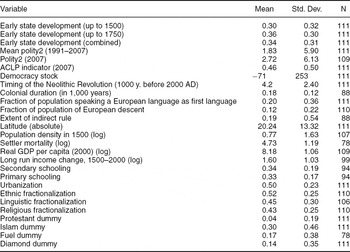
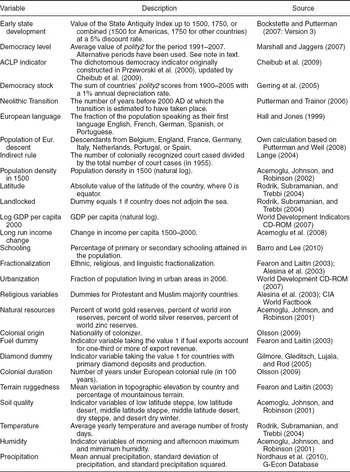
The sample consists of all 111 countries outside Europe for which State Antiquity Index scores are available. It is not restricted to former colonies because it is an integral part of the argument that the countries that were strong enough to avoid colonization are likely to have remained autocratic. In the Appendix, Table A1 provides descriptive statistics for the variables of interest, and Table A2 lists all the variables and sources used.
OLS RESULTS
Table 1 reports coefficients from OLS regressions of democracy on early state development, corresponding to equation (1):

where D i is democracy in country i, S i is early state development in country i, and X i is a vector of controls. The coefficient of interest is δS, which measures the association between state development up to 1500 and current levels of democracy.
OLS Regressions of Democracy on Early State Development

Notes: All model specifications include a constant term (not reported to save space). Robust standard errors in parentheses.
***, **, and * indicate significance at the 1, 5, and 10% levels.
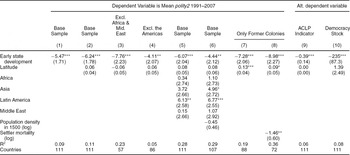
Column (1) documents a highly significant unconditional correlation between democracy and precolonial state development outside Europe of –5.47. The estimate implies that if the United States (precolonial state development of zero) had had the same precolonial state development as China (0.91), we should expect the U.S. level of democracy to be lower by 0.91 × (−5.47) = –4.98 polity2 units, all else equal. The R2 shows that as much as one-tenth of the variation in contemporary levels of democracy outside Europe is associated with variation in state development more than five centuries ago. This attests to the importance of history in constraining national regime trajectories (e.g., Downing Reference Downing1992; Ertman Reference Ertman1997; Tilly Reference Tilly and Tilly1975).
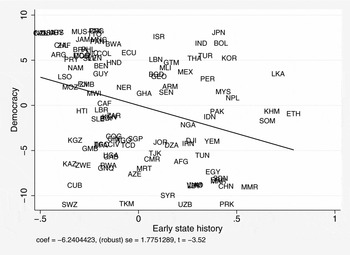
Column (2) controls for the (absolute) value of latitude. This is informed by Jared Diamond's argument that throughout history technologies and institutions have traveled more easily at similar latitudes where the length of the day and climate were not drastically different (Diamond Reference Diamond1997, ch. 10). This specification compares countries along the historically important East–West axis rather than the disparate experiences of the North to the South. The absolute value of the coefficient increases to −6.24 and the estimate remains highly significant. Figure 1 shows the graphical representation of the model in column (2).
Democracy and Early Statehood outside Europe

As can be seen from the plot, the result does not seem to be driven only by a few countries. On the contrary, excluding high-leverage or high DFBETA-observations increases both the numerical magnitude and the significance of the coefficients.Footnote 19
Column (3) shows the coefficient from a restricted sample that excludes all countries in the Middle East and on the African continent. Ancient civilizations existed in the Middle East and Eastern Africa, and most countries in the region are autocracies today. Column (3) shows that these countries are not driving the overall pattern of association: The coefficient on early state development remains negative and significant.Footnote 20 Column (4) excludes all countries on the American continents. State development was relatively recent in the Americas, and the region is relatively democratic today. It is possible therefore that the relatively young democratic states in the Americas in fact underlie the pattern found in the broader sample. Excluding the two continents lowers the absolute value of the coefficient from 6.24 to 4.11, but it remains sizable and statistically significant at a 5% level.Footnote 21 It should be mentioned, also, that these results are not driven by the four European offshoots (Australia, Canada, New Zealand, and the United States). Excluding this group of countries yields a highly significant coefficient of −5.09 (robust s.e. = 1.83) (results not reported in Table 1 to save space). In column (5) regional dummies are included to account for most of the idiosyncratic regional variation. The coefficient of interest remains significantly negative.
The model in column (6) includes population density in 1500. Acemoglu, Johnson, and Robinson et al. (2002) found that territories with relatively high population densities in 1500 are less economically developed today because they experienced an extractive form of colonial rule. Although early state development and early population density are clearly related, the specification is not gravely plagued by collinearity.Footnote 22 As shown, the coefficient on early state development remains sizable and significant while population density is indistinguishable from zero. To further examine the relative importance of early statehood versus early population density, I reestimated Table 1 with population density in 1500 as the independent variable, which revealed that this variable is less strongly and much less robustly associated with democracy than is early state development (results available on request).Footnote 23
Columns (7) and (8) show the results from a sample restricted to former European colonies. Overall, these columns support B.1 and B.2 in showing that, even conditional on being colonized, early state development is negatively associated with democracy. The columns also show that old states such as China, Ethiopia, or Iran that resisted Western European colonization and are autocracies today do not drive the overall result. The estimated effect of early statehood on democracy remains negative and significant even after excluding this group. Controlling for settler mortality in column (8) also leaves the conclusion unchanged.
The models in columns (9) and (10) use different measures of democracy. The model in column (9) repeats the basic regression to examine the effect of early state development on the likelihood of being a democracy in 2007 (as measured by the ACLP indicator). The coefficient of −0.39 implies that if the United States had had the same state history as China, the likelihood that it would be a democracy today would be lower by 0.91 × (−0.39) = −0.35.Footnote 24 In column (10), the dependent variable is the accumulated democratic experience from 1900–2005 as coded by Gerring et al. (Reference Gerring, Bond, Barndt and Moreno2005). The negative coefficient of 235 implies that had the United States had China's state history, we would expect the U.S. stock of democracy to be lower by 0.91× (−235) = −214. Roughly speaking, this corresponds to the elimination of two decades of high-quality democracy (polity2 = 10) in the United States.
The results in Table 1 thus document a very robust negative association between precolonial state development and democracy outside Europe. However, one should be cautious in interpreting the coefficients as causal estimates. Past state history is likely to be endogenous to democracy, because the way a state is governed—its political regime—affects the probability that it survives as a state. More broadly, it is likely that unobserved factors affect both a country's state history and its regime trajectory. Before addressing this issue, I pause to make sense of a few of the countries that fit less well with the overall argument.
A Note on a Few Outliers
Far from the fitted line in Figure 1 are Japan, India, and Swaziland. In this section, I briefly discuss these cases that fit less well with the general pattern. Japan was strong enough to resist colonization, but regime developments in the country were not historically immune to Western influence. This influence was felt twice: once by example, during the Meiji Restoration when Japan took it on itself to emulate Western industrialization (in the process of which Japan also emulated elected parliaments with some executive control; e.g., Jansen Reference Jansen2000, 377ff.), and once by imposition when General MacArthur drafted the country's democratic post–World War II constitution (Smith Reference Smith and Skocpol1998, 201). Thus Japan experienced Western influence without colonization, which is part of the reason why Japan today is more democratic than we would expect given its level of precolonial state development.
In India, in contrast, there occurred colonization and European influence despite an early development of state structures. Civilization is ancient on the Indian subcontinent, but it was not until the Mughal Empire in the 16th century that it came under one crown (Finer Reference Finer1997, 1210). Even then, a unified, centrally controlled state apparatus was never imposed (Abernethy Reference Abernethy2000, 256; Spear 1965, 70). In contrast to China, then, where the emperor was able to limit the European presence to the port of Canton and allow Europeans to trade only with one authorized merchant guild, and in contrast to Japan, where the shogun simply expelled Europeans, Europeans found room to maneuver in India. Decentralization and local disunity facilitated the penetration of merchants from Portugal, the Netherlands, and eventually the British East Indian Company (Scammell Reference Scammell1989, 66), whose practices gradually expanded to include attributes of statehood (e.g., the right of taxation in parts of the country). When colonization ended in 1947 (administration had passed from the East Indian Company to the Crown in 1858), the British left an administrative basis and a framework for local representative government that, it has been argued, facilitated institutionalization of the democratic norms under Nehru (Manor 1990; McMillan Reference McMillan2008).Footnote 25
The opposite applies in Swaziland: Despite extensive European settlement in a young state, the country has remained steadfastly autocratic. Christian Potholm (Reference Potholm1972) attributes this trajectory partly to the country's geography: Swaziland was surrounded by white minority governments in South Africa and Mozambique, which insulated the country from external influence during decolonization. Therefore, the traditional tribal authorities could contest British and local reformers’ attempts to introduce parliamentarism “far more easily than if they had been struggling in a more open, less controlled context.” (6).
ENDOGENEITY CONCERNS AND CAUSAL IDENTIFICATION
The way a state is governed affects its viability. If centralized authority was historically better at ensuring the survival of the polity, this could be driving our findings: It is possible that older states are relatively autocratic because an early development of effective (autocratic) decision-making structures allowed them to survive more consistently as polities, rather than—as postulated here—because early state development constrained the development of democracy.Footnote 26 If early centralization of power was an efficient means to secure a relatively uninterrupted state history, this would bias our estimates away from zero (such that the estimated negative effect of early statehood on democracy reported in Table 1 would be exaggerated). The direction of the bias could also be the opposite, however: Representative political institutions are often described as a factor conducive to state survival because they allowed rulers to raise more taxes and facilitated the access to credit.Footnote 27 This would bias our results toward zero (such that the estimated negative effect of early statehood on democracy would be underestimated). Whatever the direction of the bias, that the characteristics of the political regime affect the viability of the state is a source of endogeneity.
Political regime development can be a path-dependent process with deep historical roots. In some countries, scholars have traced the institutional origins of modern political regimes back several centuries (even before 1500).Footnote 28 If the historical roots of the contemporary regime were shaped at the same time or by the same forces that shaped the development of state structures, this also constitutes a source of endogeneity in the analyses presented earlier. Other sources of endogeneity come from influential actors who shape state history through conquest or a struggle for independence while, simultaneously, leaving a lasting impact on the regime trajectory. Also, one can imagine that cultural variation in the degree to which hierarchy and centralized authority are accepted might relate both to the livelihood of the state and regime development.
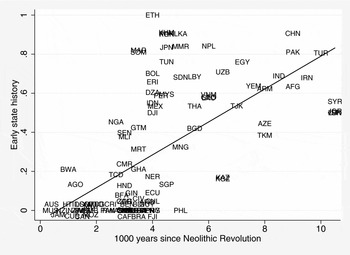
To account for these sources of potential endogeneity, I used the timing of the Neolithic Revolution as a source of exogenous variation in early state development. The Neolithic Revolution denotes the transition from foraging to farming some 10,000 years ago when hunter-gatherers took up plant and animal domestication and created settlements (Balter Reference Balter2007).Footnote 29 The identification strategy is based on the simple idea that an early transition to sedentary agriculture predicts an early development of state institutions: The Neolithic Revolution paved the way for statehood because settlement led to denser populations through increased food production and, by permitting a shortened birth interval (Ashraf and Michalopoulos 2010; Diamond Reference Diamond1997). With food surpluses came a non-food-producing sector, which together with increased populations led to specialization, social stratification, and political organization (Diamond Reference Diamond1997, 92). Figure 2 illustrates the unconditional relationship between the timing of the Neolithic Revolution and early state development for our base sample of non-European countries.Footnote 30
Timing of the Neolithic Revolution and Early State Development

As argued, there is a clear positive association; territories that made an earlier transition to agriculture also developed statehood earlier. This is described by equation (2):

where T i is the timing of the Neolithic transition in country i, S i is the early state development of country i, and X i is a vector of controls.Footnote 31 Together, equations (1) and (2) constitute our two-stage least squares (2SLS) approach, where T i is used as a source of exogenous variation in S i in the first stage (equation (2)). This approach yields a consistent estimate of the causal effect of precolonial state development on current levels of democracy under the exclusion restriction that T i is uncorrelated with εDi in equation (1) (Wooldridge Reference Wooldridge2002, 92f.). In words, this means that the timing of the transition to sedentary agriculture affects contemporary levels of democracy only through its effect on early statehood (that is, through S i). Certainly, the timing of the Neolithic Revolution is not the only determinant of the development of state institutions, but because the first stage estimates a reduced-form equation we do not need a full structural model of the determinants of early state development (e.g., Wooldridge Reference Wooldridge2002, 84). The next subsection presents 2SLS results and discusses the validity of the instrumental variable estimator.
Two-stage Least Squares Results
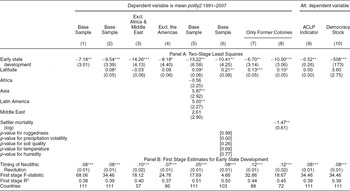
Panel A of Table 2 shows 2SLS estimates of the effect of precolonial state development on democracy (δS in equation (1)). Panel (B) shows corresponding first-stage results.Footnote 32 Throughout, there is a very strong first-stage association between the timing of the Neolithic Revolution and early state development, and the F-test is well above the standard threshold of 10 for the 2SLS estimator to produce unbiased results.
IV Regressions of Democracy on Early State Development

Notes: Panels A and B report coefficients from the second and first stage of the two-stage least squares estimation. Column (6) controls for (i) terrain ruggedness, measured as percentage estimated mountainous terrain (log) and the difference in elevation between the highest and lowest point in a country; (ii) climate volatility measured as the standard deviation of yearly precipitation and the squared standard deviation of yearly precipitation; (iii) soil quality, measured as a set of indicator variables of steppe (low latitude), desert (low latitude), steppe (middle latitude), desert (middle latitude), dry steppe, and desert dry winter; (iv) temperature, measured as average number of frosty days; and (v) humidity, measured as morning min. and max., and afternoon min. and max. humidity.
All model specifications include a constant term (not reported to save space). Robust standard errors in parentheses. ***, **, and * indicate significance at the 1, 5, and 10% levels.
The unconditional effect of precolonial state development on current levels of democracy is −7.18 in column (1), and controlling for latitude in column (2), the estimate becomes −9.54. Both are very significant. The coefficient of −9.54 implies that increasing the length of early state development by 0.91 (corresponding to the difference between China and the United States) will cause an average change of 0.91×(−9.54)=−8.7 polity2-units.
The models in columns (1)–(5) and (7)–(10) do the same sample manipulations and include the same control variables as in Table 1, this time using the 2SLS approach. All of these model specifications confirm the conclusion that an early development of state institutions was an impediment to democracy outside the European continent. Comparing Tables 1 and 2 shows that the IV estimates are numerically larger than the coefficients from identical OLS regressions. This result is consistent with the idea that representative political institutions have been conducive to state survival.Footnote 33
The validity of the 2SLS approach depends on the assumption that, conditional on the controls included in the analyses, the timing of the Neolithic Revolution has no effect on democracy other than through its effect on early state development. To account for the possibility that geographic, topographic, or climatic factors that affected the timing of the Neolithic Revolution might also influence countries’ regime trajectories through other channels, I included measures of ruggedness, precipitation and precipitation volatility, soil quality, temperature, and humidity as controls in column (6). As it turns out, they do not affect the results.
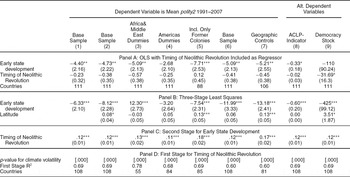
Table A3 in the Appendix presents further evidence in favor of the exclusion restriction. In Panel A, I included the timing of the Neolithic Revolution as a regressor alongside early state development in OLS regressions. If there were an independent effect of the onset of the agricultural revolution, one would expect this variable to be significant in these analyses. However, it is insignificant in almost all models.Footnote 34
The theories for why societies made the transition from foraging to farming can be grouped into those focusing on cultural factors, such as “an innate ability to civilize nature,” and those focusing on geographic and climatic factors (e.g., Olsson and Hibbs Reference Olsson and Hibbs2005). Column (6) in Table 2 shows that the 2SLS approach was robust to controlling for the geographic and climatic factors. To purge the estimates of the potentially confounding influence of cultural factors, I did three-stage least squares (3SLS) where measures of climate volatility instrument for the timing of the Neolithic Revolution (panels B–D in Table A3). By doing 3SLS, I use only the variation in the onset of the Neolithic Revolution that can be explained by climatic and geographic factors and thereby remove the potentially confounding influence of cultural factors. This was inspired by Ashraf and Michalopoulos (2010), who derive a hump-shaped relationship between climate volatility and the onset of the agricultural transition. These authors show that climate volatility and geographic factors explain as much as 90% of the cross-country variation in the timing of the Neolithic Revolution, which already suggests that cultural factors might not be confounding the identification strategy used here. As shown in the Appendix, our 3SLS estimates are practically indistinguishable from the 2SLS results.
Overall, the results in Table A3 in the Appendix, as well as the models that control for geographic and climatic factors that have been shown to affect the timing of the Neolithic Transition, support the validity of the instrumental variable approach.
UNPACKING THE CAUSAL CHANNEL
Having documented the negative causal effect of early statehood on contemporaneous democracy, we ask “Why?” The overall explanation comes in two parts: First, the pattern of early statehood outside Europe influenced the pattern of European colonization and settlement, and second, that in turn influenced contemporaneous regime patterns. This section briefly provides evidence in support of each of these claims. In addition to equations (1) and (2), we can therefore add


C i represents measures of colonization (colonization, colonial duration, and European settlement) as well as the form of colonial governance (the extent of indirect rule). S i, again, is the early state development of country i. As before, D i is the measure of democracy in country i. Equation (3) thus describes the relationship between early state development and the pattern of European colonization and settlement, whereas equation (4) describes the relationship between patterns of European colonization and contemporaneous democracy. Following the earlier discussion, I hypothesize that δC < 0 and δ4 > 0.
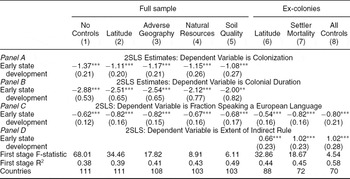
Table 3 reports 2SLS estimates of δC in (3), where the timing of the Neolithic Revolution has again been used as a source of exogenous variation in early state development. Only coefficients from the second-stage regressions are reported. The four panels correspond to four different measures of European colonization and settlement. In Panel A, the dependent variable, Ci, is a dummy taking the value 1 for countries that were colonies and zero otherwise. In Panel B, Ci is colonial duration in 100 years; in Panel C, Ci is the fraction of the population speaking a European language as their first language; and in Panel D, Ci is the extent of indirect rule. Columns (1) through (5) present evidence in support of prediction A.1 (precolonial state development was an impediment to European colonization and settlement), whereas columns (6)–(8) present evidence in support of prediction B.1 (conditional on being colonized, more developed states were less likely to experience direct colonial rule and European settlement).
IV Regressions of Colonization and Settlement on Early State Development

Notes: The timing of the Neolitihic Revolution is used as IV for early state development in all four panels. Each model adds a set of controls to the existing set of controls. For example, the model in column (3) controls for both latitude and geography. The model in column (4) adds controls for natural resources. Adverse geographic characteristics in column (3) are average topographic elevation differences and an indicator for landlocked countries. Natural resources in column (4) are percent of world reserves of gold, iron, silver, and zinc. Soil quality in column (5) is measured as a set of indicator variables of steppe (low latitude), desert (low latitude), steppe (middle latitude), desert (middle latitude), dry steppe, and desert dry winter Robust standard errors in parentheses. ***, **, and * indicate significance at the 1, 5, and 10% levels.
The vector of controls XCi includes the set of factors in addition to indigenous state development that might affect the decision, duration, and form of colonization. In column (2), latitude is included as a rough measure of both the geographic distance and climatic difference from Europe.Footnote 35 Column (3) adds a dummy for landlocked countries and controls also for the average variation in topographic elevation. Landlocked countries are difficult to reach and offer less attractive opportunities for trade. The average variation in elevation is included because rugged terrain is inhospitable to farming and to conquest. In column (4), controls for countries’ endowment of natural resources have been added. Lastly, in column (5), I add controls for the quality of soil.
In all cases, the coefficient on early state development is negative and significant. The implication is that countries with earlier state histories were less likely to be colonized (Panel A), would experience colonization of a relatively short duration (Panel B), and would experience less European settlement (Panel C).Footnote 36 In columns (6)–(8) the sample is restricted to former colonies. Whether controlling for latitude (column (6)), settler mortality (column (7)), or settler mortality plus the full set of controls from columns (2)–(5) (column (8)), the analyses in the last three columns support prediction B.1: Conditional on being colonized, more developed states are significantly less likely to be colonized with settlement and also more likely to experience indirect colonial rule.
In summary, the large-N analyses confirm the claim that early state organization served as a bulwark against European colonization and also shaped the form of colonial rule chosen by the European colonial powers.Footnote 37
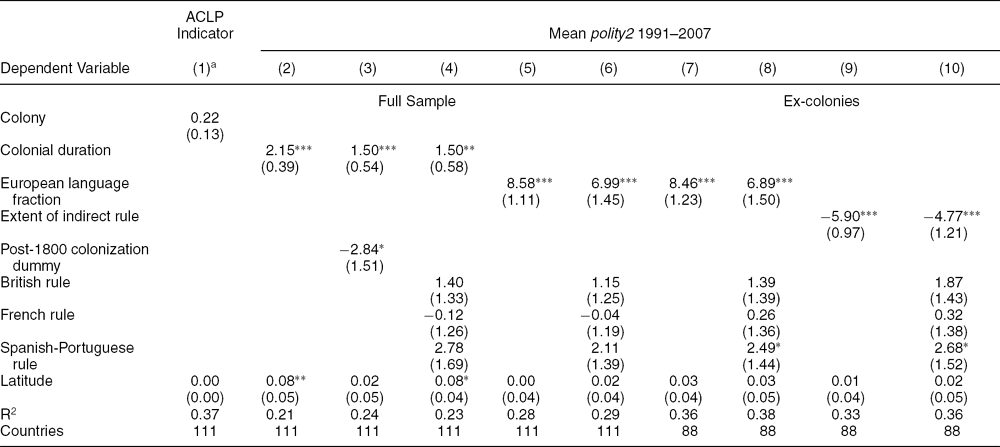
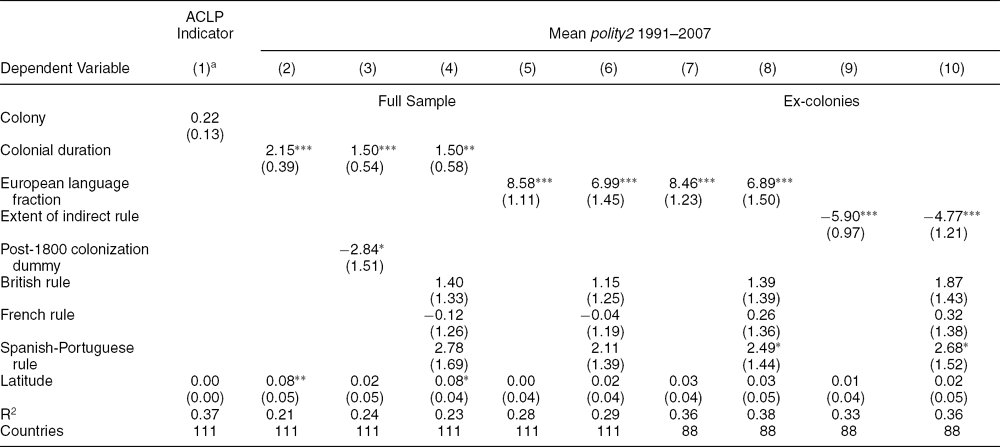
We turn now to an assessment of the claim that European settlement is positively associated with modern levels of democracy. To that end, OLS estimates of equation (4) are presented in Table 4. Columns (1) through (6) show evidence in support of hypothesis A.2 (colonization, colonial duration, and European settlement are positively associated with democracy), whereas columns (7)–(10) show evidence in support of hypothesis B.2: Conditional on being colonized, colonies with less settlement and a more indirect form of colonial rule are more likely to have remained autocratic.
Probit and OLS Regressions of Democracy on Colonization and Settlement
Notes: aColumn (1) reports marginal probit estimates and Pseudo-R2. All models include a constant term (not reported to save space). Robust standard errors in parentheses. ***, **, and * indicate significance at the 1, 5, and 10% levels.
Column (1) reports the discrete difference in the probability of being a democracy between countries that were colonized and countries that were not: Former European colonies are on average 22% more likely to be democracies than noncolonies outside Europe. Although the estimate is not significant at conventional levels, it is close (the p-value is 0.112) and this is largely a result of the sample. When the sample is not restricted to the set of countries for which State Antiquity data are available, the estimated coefficient (of similar size) is significant with a p-value of 0.067. Column (2) shows that the duration of European colonization (in 100 years) is strongly associated with democracy. Under a causal interpretation, the coefficient suggests that an additional hundred years under European colonial rule translates into a 2.15 increase in the polity2 measure of democracy. The coefficient is highly significant.
Column (3) includes a dummy for countries that were colonized after 1800. This accounts for the different colonial experiences of countries that were colonized during the Great Discoveries in the 16th century and those that were colonized during the imperialist scramble in the 19th century. Controlling for different colonial experiences, the coefficient on colonial duration is reduced slightly, but remains highly significant. Column (4) adds indicator variables to account for the identity of the colonizer: Focusing on socio-economic outcomes, Landes (Reference Landes1998) argues that British colonialism had comparatively positive effects, whereas the consequences of Spanish colonialism were largely negative. The coefficient in column (4) documents that colonial duration remains positively associated with modern levels of democracy even when the different characteristics of the colonial power have been accounted for.Footnote 38 Columns (5) and (6) use the fraction of the population speaking a European language as an indicator of the extent of European settlement during colonization. Whether controlling for latitude or also including indicators for the identity of the colonists, this measure of settlement is very significantly correlated with contemporaneous levels of democracy.
Columns (7)–(10) zoom in on former colonies to examine prediction B.2. Columns (7)–(8) show that, also conditional on being colonized, European settlement is very strongly associated with contemporary levels of democracy. This conclusion holds also when controlling for the nationality of the colonizer as in column (8). Columns (9)–(10) show that, conditional on being colonized, indirect rule is negatively associated with current levels of democracy, even when controlling for the identity of the colonizer (cf. column (10)).
In summary, then, Table 4 presents ample evidence that δ4 > 0: European colonization and settlement are positively associated with modern levels of democracy.
Controlling for the Causal Channel
The preceding section provided econometric evidence in support of each of the two steps of the overall argument separately. In this subsection I show that the proposed causal channel accounts for the autocratic legacy of early statehood. If this argument is correct, then once the pattern of European colonization or settlement is controlled for, the autocratic legacy of early statehood outside Europe should disappear. We can examine this claim by testing if the 2SLS estimate of the coefficient on S in regressions with democracy as the dependent variable is indistinguishable from zero once C is controlled for.
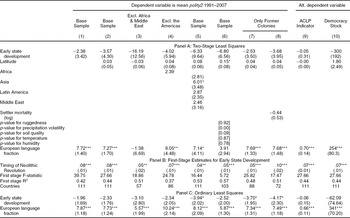
Table 5 reports the results using again the timing of the agricultural transition as an instrument for early state development. It uses the same set of exogenous geographic controls as were used in Table 2, with the same sample manipulations. Panel A reports second-stage results from the 2SLS regressions where the fraction of the population speaking as a first language one of the five colonial power languages is included as a first- and second-stage regressor. Panel B shows first-stage results. Panel C shows the coefficients of interest from identical OLS regressions.
OLS and IV Regressions of Democracy on Early State Development

Notes: Panels A and B report coefficients from the second and first stage of the two-stage-least-squares. Panel C reports coefficients from OLS regressions of identical models. Column (6) controls for (i) terrain ruggedness, measured as percentage of estimated mountainous terrain (log) and the difference in elevation between the highest and lowest point in a country; (ii) climate volatility measured as the standard deviation of yearly precipitation and the squared standard deviation of yearly precipitation; (iii) soil quality measured as a set of indicator variables of steppe (low latitude), desert (low latitude), steppe (middle latitude), desert (middle atitude), dry steppe, and desert dry winter; (iv) temperature, measured as average number of frosty days; and (v) humidity, measured as morning min. and max., and afternoon min. and max. humidity.
All models include a constant term (not reported to save space). Robust standard errors in parentheses. ***, **, and * indicate significance at the 1, 5, and 10 percent levels.
The results are consistent with the hypothesis that the autocratic legacy of early statehood works through the adverse effect of early statehood on European settlement patterns. Once the pattern of European settlement is controlled for, in all columns we never reject the hypothesis that early state development has no effect on democracy. Although the coefficients remain negative throughout, they are never statistically different from zero. Moreover, the size of the coefficient is generally cut in half compared to Table 2.Footnote 39
As a further check that the causal channel is the one hypothesized, I compared the estimated coefficients from Table 3 and 4 with the reduced-form estimate from Table 2. As hypothesized by the causal argument, increasing early state development one standard deviation (0.32) should reduce democracy by (0.32) × δC × δ4, where δC is the effect of statehood on settlement and δ4 is the effect of settlement on democracy. Using the model specifications from column (2) in Table 3 and column (5) in Table 4 (i.e., controlling for latitude only), the estimated effect of early state development on democracy that runs through European influence (settlement) is 0.32×(−0.82)×8.58=−2.25. This is relatively close to the reduced-form estimate of 0.32×(−9.54)=−3.05 from column (2) in Table 2. This provides additional confirmation that the reduced-form effect of precolonial state development on contemporary levels of democracy does work through the effect of precolonial state development on the pattern of European colonization and settlement.
ROBUSTNESS TO ALTERNATIVE EXPLANATIONS
There is a large literature on the causes, correlates, and necessary conditions for democracy. In this section, I document that the negative effect of precolonial state development on democracy cannot be attributed to alternative theories. Most of the factors included here are “bad controls” in the sense that they are also affected by early state development (e.g., Angrist and Pischke Reference Angrist and Pischke2009, 64ff.). This creates bias, and one should not interpret the coefficients as causal estimates. Even so, it is reassuring that the overall finding and the proposed causal story are robust to comparing countries at, for example, similar levels of economic development or societal heterogeneity.
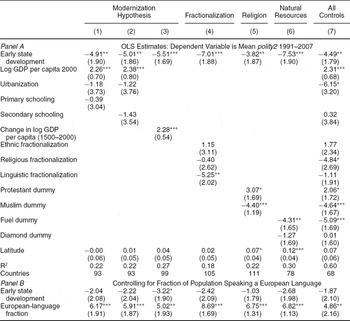
Panel A in Table 6 shows coefficients from models that successively control for clusters of indicators, which en groupe represent alternative theories of the correlates of democracy. Specifically, I controlled for indicators of modernization (columns (1)–(3)), fractionalization (4), religion (5), natural resources (6), as well as the full set of indicators (7). Panel B shows the coefficient of interest from identical models except that the measure of European settlement has been added.
OLS Regressions Controlling for Alternative Drivers of Democracy

Notes: All models include a constant term (not reported to save space). Robust standard errors in parentheses.
***, **, and * indicate significance at the 1, 5, and 10% levels.
Consistent with the claim that the negative effect of early statehood works through the hypothesized channel and not the alternative theories, the coefficients on early state development in Panel A are all significant, whereas in Panel B they are insignificant.Footnote 40
Seymour Martin Lipset (Reference Lipset1959, 80) popularized the idea that “the factors subsumed under economic development carry with it the political correlate of democracy.” This is commonly referred to as modernization theory. Columns (1) and (2) show that the significantly negative effect of precolonial statehood on democracy is robust to comparing countries at identical levels of development (measured as income per capita, education, and urbanization). Acemoglu et al. (Reference Acemoglu, Johnson, Robinson and Yared2008) showed that over relatively short time frames (50 or 100 years), economic growth is not associated with democratic improvements. The current income-democracy nexus has deeper historical roots and must be traced back five centuries.Footnote 41 In column (3), we examine if our story works through such a long-run association between economic development and democracy: Is European settlement associated with democracy because Europeans brought economic development (such that our story would be one of modernization)? To test this hypothesis, I controlled for economic growth from 1500 to 2000 (data from Acemoglu et al. 2008). In Panel A, precolonial state development remains significant, and so does European settlement in Panel B. Together with columns (1) and (2), this provides preliminary evidence to suggest that our story does not work through economic development or modernization.
Column (4) controls for societal heterogeneity. Heterogeneity has always been seen as inimical to democracy (e.g., Przeworski Reference Przeworski2010, 20), and societal heterogeneity is clearly associated with state history: The composition of subjects within borders depends on the history and strength of the state, and rulers can actively shape the ethnic, cultural, and linguistic diversity of their subjects (through means ranging from homogenization through public schooling to deportation or ethnic cleansing). Column (4) controls for ethnic, religious, and linguistic fractionalization to remove any effect of state history that works through population heterogeneity. Doing so leaves the coefficient highly significant.Footnote 42
Protestant and Reformed Christianity have been claimed to be particularly conducive to democracy (e.g., Bruce Reference Bruce2006), and Western ideas of individualism and democracy have been argued to find little resonance in Islamic cultures (e.g., Huntington Reference Huntington1993, 40). To account for this religious-culturalist perspective, I added dummies for countries in which the majority of the population is Protestant or Muslim in column (5). The relevant coefficient remains significant and negative. Column (6) controls for natural resources in the form of either fuel exports or diamonds. The availability of natural resource rents that are easily appropriable raises the pay-off to kleptocracy and thereby increases the cost to the ruler of democratization. Conditional on indicators of natural resource richness, the coefficient on early state development remains significant. In column (7) the full set of factors that might confound the effect of early state development on democracy has been included as controls, but the coefficient of interest remains negative and significant.
Panel A in Table 6 documents that, conditional on a host of alternative theories of the causes and correlates of democracy, there is still a negative effect of precolonial statehood on democracy, and Panel B shows that it works through the pattern of European colonization and settlement.
CONCLUSION
National regime trajectories are shaped by many factors. This study has documented the importance of one such factor that has so far been overlooked in the social science literature, namely precolonial state development outside Europe. In his monumental work on the history of government, Samuel Finer explained his interest in the history of statehood and state formation by observing that “the way [states] were built usually has the most important consequences for the way they came to be governed” (Finer Reference Finer1997, 4). The evidence presented in this article supports this observation: Precolonial state development was a significant impediment to the development of democracy outside the European continent, because it limited the extent of European settlement and, in the countries that were colonized, favored a more indirect form of colonial rule. Older states were therefore less likely to have European institutions transplanted and to have an influx of settlers carrying the ideals of parliamentarism. Older states, therefore, were more likely to have persistent forms of traditional, authoritarian rule. This conclusion was documented for the 111 countries outside the European continent for which data were available. The results proved very robust to both OLS and IV estimation, to different samples, to different democracy indices, and to a host of exogenous controls. Controlling for other correlates and potential causes of democracy did not alter the conclusion. Neither did stressing the instrumental variable approach or using 3SLS.
A methodological advantage of historical comparative analysis is that it might alleviate some of the problems of endogeneity and simultaneity that plague ahistorical approaches (e.g., Capoccia and Ziblatt Reference Capoccia and Ziblatt2010, 4). In much of the developing world today, processes of state building and regime formation happen simultaneously, and at the time of writing, the world society is engaged in efforts to monopolize violence and build statehood in Afghanistan and Iraq while also promoting democracy. Historically, the sequence was clearer. Statehood preceded democracy, and the evidence presented earlier clearly documents that parliamentary institutions have not been a corollary of state building outside Europe. At the most practical level, this underscores that state building and democratization are distinct processes, and it reminds practitioners that the latter does not follow automatically from the former. But this is a minimal insight and there lies a challenge of practical and theoretical relevance in understanding more fully how the development of state structures affects the way states come to be governed. The micro-dynamics of how a long history of state institutions translates into authoritarian regime persistence is an important area for future study.
APPENDIX

Note: Number of observations varies across rows due to missing data.
Variable Descriptions and Sources

On the Validity of the Instrument

Notes: Panel A reports the coefficients from OLS regressions of democracy on Early state development and the timing of the Neolithic Revolution. Panel B reports the coefficient of early state development in 3SLS-models, where the timing of the Neolithic Revolution instruments for early state development (Panel C), and climate volatility instruments for the timing of the Neolithic Revolution (Panel D). Climate volatility is measured by the standard deviation of precipitation, the square of the standard deviation of precipitation, and mean precipitation. Included also are continent dummies and. latitude. All columns except column (1) control for latitude. Column (6) includes continent dummies (Africa, Asia, Latin America, and the Middle East). Column (7) includes dummies for soil quality: steppe (low latitude), desert (low latitude), steppe (middle latitude), desert (middle latitude), dry steppe, and desert dry winter; and measures of ruggednes: percentage of mountainous terrain and the difference in elevation between the highest and the lowest point in a country. All model specifications include a constant term (not reported to save space).
Robust standard errors in parentheses. ***, **, and * indicate significance at the 1, 5, and 10% levels.




Comments
No Comments have been published for this article.