Introduction
The soybean aphid (Aphis glycines Matsumura) is arguably the most important insect pest of soybean (Glycine max (L.)) in North America (Ragsdale et al., Reference Ragsdale, McCornack, Venette, Potter, MacRae, Hodgson, O'Neal, Johnson, O'Neil, DiFonzo, Hunt, Glogoza and Cullen2007). This invasive species was first detected in 2001 and currently infests at least 80% of the total US soybean crop (Vennette & Ragsdale, Reference Vennette and Ragsdale2004), causing significant effects to various plant characteristics, including seed quality and size, pod number and plant height (Hill et al., Reference Hill, Li and Hartman2004). Most importantly, dramatic yield losses of up to 50% have been reported under heavy soybean aphid infestations (Wang et al., Reference Wang, Fang, Lin, Zhang and Wang1994), and evidence suggests even small infestations can lead to disruptions in normal soybean physiology (Macedo et al., Reference Macedo, Bastos, Higley, Ostlie and Madhavan2003). The soybean aphid also poses a potentially large threat to soybeans because of its ability to vector viruses, such as Alfalfa mosaic virus, Soybean mosaic virus, Cucumber mosaic virus and possibly Soybean dwarf virus to soybean and other crops (Iwaki et al., Reference Iwaki, Roechan, Hibino, Tochihara and Tantera1980; Clark & Perry, Reference Clark and Perry2002; Wang et al., Reference Wang, Kritzman, Hershman and Ghabrial2006), adding to the economic importance of this pest.
Despite the recent invasion, studies in host-plant resistance and soybean aphid-soybean interactions suggest recent regional adaptations. Through intense screenings, host-plant resistance in the form of both antibiosis (reduced survival/fecundity) and antixenosis (non-attractive) to the soybean aphid has been found (Hill et al., Reference Hill, Li and Hartman2004; Chen et al., Reference Chen, Gu, Mensah, Nelson and Wang2007; Mian et al., Reference Mian, Hammond and St. Martin2008a; Zhang et al., Reference Zhang, Gu and Wang2009). At least four independent soybean aphid resistance quantitative trait loci have been named (Rag1–4, resistance to Aphis glycines) and molecularly mapped (Hill et al., Reference Hill, Li and Hartman2006a,Reference Hill, Li and Hartmanb; Mian et al., Reference Mian, Kang, Beil and Hammond2008b; Zhang et al., Reference Zhang, Gu and Wang2009). However, the host plant resistance strategy has been compromised by the discovery of soybean aphids with differential survivability and virulence to host-plant resistance genes, termed soybean aphid biotypes. The presence of at least two SBA-biotypes, provisionally named Biotype-I (Illinois) and Biotype-II (Ohio), has been confirmed in North America (Kim et al., Reference Kim, Hill, Hartman, Mian and Diers2008). Biotype-I is controlled by Rag1 (i.e. avirulent) whereas Biotype-II survives and reproduces on Rag1 (i.e. virulent). Other soybean aphid resistant lines have been developed that offer control of Biotype-II (Mian et al., Reference Mian, Kang, Beil and Hammond2008b).
To date, most published soybean aphid host-plant resistance screening has been performed using soybean aphid laboratory populations, mainly because the large number of initial soybean accessions limits controlled field trials. However, the genetic composition of these soybean aphid laboratory populations is unknown. Comparisons of laboratory and field populations in other systems have documented less genetic diversity and higher levels of genetic divergence among laboratory and field populations (Lanzaro et al., Reference Lanzaro, Alexander, Mutebi, Montoya-Lerma and Warbug1998; Fuller et al., Reference Fuller, Chavigny, Lapchin and Vanlerberghe-Masutti1999; Arias et al., Reference Arias, Bejarano, Márquez, Moncada, Vélez and Uribe2005; Kim et al., Reference Kim, French, Sumerford and Sappington2007). This is expected, since laboratory populations likely contain lower effective population sizes, increased inbreeding pressures and may suffer from founder effects, depending on the initial population size. For aphids in general, the evolutionary effects leading to decreased genetic diversity are confounded because of tendencies towards parthenogenesis within laboratory populations, even if a sexual generation is required in wild populations (Fuller et al., Reference Fuller, Chavigny, Lapchin and Vanlerberghe-Masutti1999; Hodgson, Reference Hodgson2001; Loxdale, Reference Loxdale2008). The genetic consequence of parthenogenesis in an isolated laboratory population is twofold. First, new genetic variation and genotypes can only be introduced through mutation. These new genotypes persist within the population due to the absence of recombination and, if mutation rates are high and not severely deleterious, may actually increase genotypic and phenotypic diversity – a process known as Müller's Ratchet (Müller, Reference Müller1964; Loxdale, & Lushai, Reference Loxdale and Lushai2003; Loxdale, Reference Loxdale2008). Second, as a consequence of no recombination, once genetic variation or a particular genotype is lost through genetic drift, it can only re-appear through back mutation, which is especially rare across short time scales, or through the active re-introduction of wild genetic material (but see Loxdale, Reference Loxdale2008). The interplay between these two evolutionary forces is responsible for the maintenance of genetic variation within asexual laboratory populations.
For the soybean aphid in particular, most laboratory populations are in a state of perpetual parthenogenesis. This reproductive mode substantially differs from natural populations where the soybean aphid follows a holocyclic life cycle, undergoing parthenogenesis on soybean and sexual reproduction on its overwintering host, buckthorn (Ragsdale et al., Reference Ragsdale, Voegtlin and O'Neil2004). Sexual reproduction is obligatory in North America; apart from laboratory populations there is no evidence of the evolution of asexually reproducing populations. Soybean aphid laboratory populations may also differ in the year collected, time of the year collected, number of founding individuals and geographical location, all of which can alter the starting genetic material in each population. Thus, laboratory populations may not accurately represent the totality of genetic variation, adaptation potential and selection responses that can occur in natural populations. For example, the loss of genetic variation within laboratory populations may underestimate the level and geographic distribution of the virulence response to resistant soybean lines, if, by chance, genetic variation for virulence is not captured during laboratory population formation. On the other hand, substantial genetic drift may also occur in laboratory populations, such that virulent aphids can occur at high frequencies even though they may be rare and less fit than avirulent aphids in field populations. The former case may not reveal the total extent of virulence adaptation and decrease the effectiveness of the host-plant resistance strategy, whereas the latter case may actually lead to overestimates of virulence and delay the deployment of a beneficial and environmentally benign insect management strategy.
Characterizing the level of genetic variation within soybean aphid laboratory populations and comparisons to natural populations is critical for the further understanding of soybean aphid virulence mechanisms, adaptation potential and the overall usefulness of host-plant resistance. In this study, we used microsatellite markers (Michel et al., Reference Michel, Zhang, Jung, Kang and Mian2009a) to analyze the level of genetic variation present within five laboratory populations. We first compared genetic variation among laboratory populations in South Dakota, Michigan, Illinois and two separate Ohio populations collected from the same location four years apart. Second, a comparison was made between laboratory and field populations, providing important insights into genetic differences and implications of soybean aphid virulence and host-plant resistance.
Materials and methods
Soybean aphid samples and DNA extraction
We used individual aphids from five laboratory populations maintained in the Laboratory for Soybean Disease Research, University of Illinois, USDA-ARS Corn and Soybean Research Lab (IL-L); Ohio Agricultural Research and Development Center, The Ohio State University (two collections, OH-05-L and OH-09-L); the Department of Entomology, Michigan State University (MI-L); and the Plant Science Department at South Dakota State University (SD-L). The IL-L (N=32, N, number of individuals genotyped) individuals were collected from a laboratory population established in 2000 (Hill et al., Reference Hill, Li and Hartman2004). The OH-05-L (N=30) and OH-09-L (N=47) laboratory populations were established from field collected aphids in Wooster, OH during the summers of 2005 and 2009, respectively, but were kept in separate cages. The MI-L laboratory population (N=32) was established with soybean aphids from two fields in Ingham County, MI in 2000. The SD-L laboratory population (N=33) was established from a field collected sample in 2009. IL-L and OH-05-L represent Biotype-I (avirulent to Rag1) and Biotype-II (virulent to Rag1), respectively (Kim et al., Reference Kim, Hill, Hartman, Mian and Diers2008). All laboratory populations were established using a large number of randomly collected individuals from soybean fields. Laboratory populations were continuously maintained, and DNA samples were stored at −80°C in the lead author's laboratory to serve as vouchers.
For comparison purposes, we also included a larger data set from ten North American field collected samples in 2008 (Michel et al., Reference Michel, Zhang, Jung, Kang and Mian2009b), and two collections in 2009 from the same field populations that established the OH-09-L and SD-L laboratory populations. Soybean aphids were collected in North Dakota (N=37), Nebraska (N=37), Kansas (N=40), Minnesota (N=33), Iowa (N=26), Illinois (N=32), Wisconsin (N=36), Michigan (N=29), Ohio (in 2008, N=36; and 2009, N=30), Ontario (N=22) and South Dakota (N=27). To limit collecting clones, we collected only one aphid per plant from multiple plants scattered throughout a soybean field or in a laboratory colony. All aphids were transported or collected under USDA/APHIS permit number P526P-08-00872 granted to the lead author and stored at −80°C until genetic analysis. DNA was extracted from one individual aphid using the OMEGA EZNA DNA tissue kit (Doraville, GA) following manufacturer's instructions.
Microsatellite genotyping
The seven microsatellites used in this study were originally developed from related species Aphis fabae and Aphis gossypii (Coeur d'acier et al., Reference Coeur d'acier, Sembène, Audiot and Rasplus2004; Gauffre & Coeur d'acier, Reference Gauffre and Coeur d'acier2006; Vanlerberghe-Masutti et al., Reference Vanlerberghe-Masutti, Chavigny and Fuller1999, respectively). Full details of microsatellite testing are published elsewhere (Michel et al., Reference Michel, Zhang, Jung, Kang and Mian2009a), but these seven markers were found to be most polymorphic from an initial screen of 18 markers. Microsatellites were amplified in 20 μl reactions with 10 μl of 10× reaction buffer (Failsafe PCR premix, Epicentre Technologies, Madison, WI, USA), 4 pmol of each fluorescently labeled forward and unlabelled reverse primer, 1 U of Taq Polymerase (Genscript Corp, Piscataway, NJ, USA) and 1 μl of DNA template. Aliquots of PCR reactions (10 μl) were electrophoresed on a 1% agarose gel stained with ethidium bromide to check for amplification and negative control contamination. Genotyping was performed using a CEQ8800 (Beckman Coulter, Fullerton, CA, USA) at the Molecular Cellular and Imaging Center at OARDC. Samples were diluted according to manufacturer's instructions, and all seven loci were pooled in the same genotyping reaction. Loci were scored using the provided CEQ Fragment Analysis software followed by manual inspection of allele determinations. Null alleles were estimated using the program MicroChecker (Van Oosterhout et al., Reference Van Oosterhout, Hutchinson, Wills and Shipley2004).
Genetic data analysis
General genetic diversity statistics per population included allelic richness (R s), observed (H o) and expected (H e) heterozygosity, and were calculated using FSTAT 2.9.3.2 (Goudet, Reference Goudet1995, Reference Goudet2001). We also used FSTAT to calculate Hardy-Weinberg equilibrium (HWE, as measured by F is) and linkage disequilibrium. Significance for all statistics and comparisons were determined through 10,000 random permutations with Bonferroni corrected P-values. We used the program GenClone 2.0 (Arnaud-Haond & Belkhir, Reference Arnaud-Haond and Belkhir2007) to compare the number of distinct, multi-locus genotypes, i.e. clones, among populations, as well as genotypic diversity, GD (GD=(G−1)/(N−1), where G is the number of distinct clones and N is the total number of samples (Dorken & Eckert, Reference Dorken and Eckert2001)). GenClone was also used to calculate the Shannon index of genotypic diversity (H″) and its evenness index, V′H″. These two statistics take into account the number of clones in the entire data set and the relative abundance of the different clones (Vanoverbeke & De Meester, Reference Vanoverbeke and De Meester1997; Arnaud-Haond & Belkhir, Reference Arnaud-Haond and Belkhir2007). Comparisons to the field collections were made using FSTAT, which allows random permutations for R s, H o, H e and F is, or the non-parametric Mann-Whitney (MW) U test for GD, H″ and V′H″.
Genetic differentiation among populations was calculated using pairwise and global F st, as performed in MSA (Dieringer & Schlotterer, Reference Dieringer and Schlotterer2003), using 10,000 random permutations to determine statistical significance and Bonferroni corrected P-values. We also used principal component analysis (PCA) using Nei's genetic distance (Nei, Reference Nei1972, Reference Nei1978). PCA is considered a more robust approach to analyze population level genetic differentiation than current assignment-based clustering methods for aphid populations undergoing asexual reproduction (Peccoud et al., Reference Peccoud, Figueroa, Silva, Ramirez, Mieuzet, Bonhomme, Stoeckel, Plantegenest and Simon2008). For both F st analyses and PCA, we included calculations from our 2008 and 2009 field samples. All population genetic analyses were repeated using only distinct genotypes, as suggested for aphid population genetic studies (Sunnucks et al., Reference Sunnucks, De Barro, Lushai, Maclean and Hales1997). No significant differences occurred among analyses unless otherwise stated.
Results
Polymorphism and genetic diversity in laboratory populations
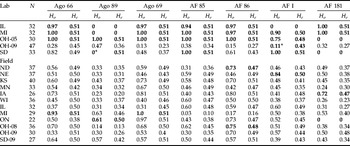
Allele frequencies per locus and per population were dramatically different among laboratory populations. Allelic richness was extremely low in all samples; no more than two alleles were found at each locus. A few loci showed extreme differences in allele frequencies. Indeed, a very conspicuous pattern emerged with Ago 89, where IL-L was fixed for the 156 allele, OH-05-L was fixed for the 156/158 genotype, and MI-L was fixed for the 158 allele. In addition, the 305 allele for locus AF 181 was fixed in OH-05-L, and the 245 allele for locus AF I was fixed in IL-L. Re-amplification of eight individuals at this locus in each population confirmed correct allele determination. The laboratory populations collected in 2009 showed overall less fixation of alleles and genotypes. No alleles were fixed in OH-09-L and SD-L showed homozygosity fixation with Ago 89 and AF 181 and heterozygosity fixation with AF 85 and AF I.
Average observed heterozygosity was high (H o=0.63±0.07; table 1) although this value was significantly skewed by the fixation of heterozygote genotypes in laboratory populations at one locus in IL-L, four loci in MI-L, five loci in OH-05-L and two loci in SD-L. Average expected heterozygosity was much lower (H e=0.39±0.03; table 1). Significant deviations from HWE occurred in all tests employed with laboratory populations collected before 2009, and all deviations were due to heterozygote excess. (Note: an additional four tests were not performed due to fixation of a homozygous genotype.) The laboratory populations collected in 2009 appeared to still be in HWE; only five out 14 tests deviated from HWE, with two tests showing an excess of homozygotes. However, after removing repeated genotypes, no test showed significant deviations from HWE in any population. Linkage disequilibrium tests could only be performed on a subset of samples, due to the fixation of genotypes at certain loci. Linkage disequilibrium was detected in OH-09-L (ten tests) and SD-L (one test, data not shown). No significant linkage disequilibrium was detected in samples collected before 2009, but this analysis suffered from a lack of power due to the reduction of the number of genotypes. Indeed, genotypic fixation itself is a signal of linkage disequilibrium, as alleles are non-randomly associated. There was no indication of null alleles (data not shown).
Hardy-Weinberg equilibrium in laboratory and field populations of A. glycines.

N, sample size; H o, observed heterozygosity; H e, expected heterozygosity.
Values in bold represent significant deviations from HWE (P<0.001) in the direction of excess heterozygosity (except for
* excess homozygosity).
Genotypic and genetic differentiation among laboratory populations
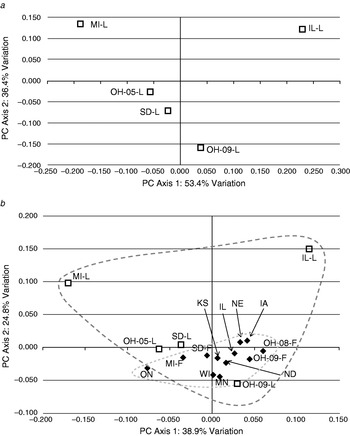
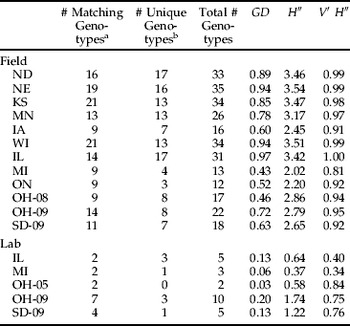
The total number of genotypes equaled five in IL-L, three in MI-L, two in OH-05-L, ten in OH-09-L and five in SD-L (table 2). In all three laboratory populations, samples were heavily dominated by one or two genotypes. However, no genotype was found in more than one laboratory population, suggesting substantial genetic differentiation among all laboratory populations. Although the 2009 laboratory populations contained a higher average number of genotypes (7.5), this was not significantly different from the earlier established laboratory populations (3.3, P=0.18). Average pairwise F st estimates among all laboratory populations were extremely high (0.14±0.01), and only one pairwise F st value was insignificant after Bonferroni corrections (OH-05-L and SD-L; F st=0.04). PCA correlated with the F st estimates and reflected a high level of divergence among the five laboratory populations (fig. 1a).
PCA among laboratory and field populations using Nei's unbiased genetic distance: (a) laboratory populations only; (b), laboratory (□) and field (◆) populations. Dashed gray line represents area occupied by laboratory populations; dotted gray line represents area occupied by field populations.

Number of clones and genotypic diversities per population.

GD, genotypic diversity; H″, Shannon diversity; V′H″, evenness index.
a Genotypes that are found at least twice within the sample.
b Genotypes that are found only once within the sample.
Polymorphism and diversity among laboratory and field populations
Based on comparisons in FSTAT, field populations contained a higher allelic richness (P=0.002). Allelic fixation only occurred within the laboratory populations, whereas all field populations exhibited at least two alleles. In addition, F is was significantly greater within laboratory populations (P=0.001) although no significant differences were found in H o or H e among the laboratory and field samples.
Estimates of genotypic diversity were much higher in field than laboratory populations. The genotypic diversity in field populations was almost 7× greater, averaging 0.73±0.06 versus only 0.11±0.03 for laboratory (MW statistic=60.0; P=0.003; table 2). Other genotypic estimates, H″ and V′ H″, were equally as divergent and significantly different (table 2). Only ten laboratory genotypes were found in the field populations, and they did not appear to be associated by geography. For example, the most common genotype found at 84% frequency in the IL-L laboratory population, was found with only one other individual from ND. The second most common genotype, which had only 6% frequency, was found an additional nine more times in field populations: four individuals in IA and five in OH-08. None of the genotypes within the MI-L population were found in any of the field populations. Surprisingly, the OH-09 and SD laboratory and field populations did not share any clones, even though aphids were collected from the same field.
Genetic differentiation among laboratory and field populations
The lack of shared genotypes among laboratory and among field populations was reflected in estimates of genetic divergence. Average pairwise F st was significantly higher among laboratory (F st=0.14±0.01) than among field populations (F st=0.04±0.01; MW statistic=3856; P<0.001). Furthermore, pairwise F st among laboratory and field populations was very high, averaging 0.13±0.01, with all but four pairwise tests being significant. PCA using Nei's unbiased genetic distance supported genetic differentiation levels grouping the field populations in a tighter cluster than the laboratory populations (fig. 1b).
Discussion
As most published studies on soybean aphid host plant resistance initially rely on laboratory populations for screening (Hill et al., Reference Hill, Li and Hartman2004; Kim et al., Reference Kim, Hill, Hartman, Mian and Diers2008; Mian et al., Reference Mian, Hammond and St. Martin2008a), understanding the genetic differences between soybean aphids in laboratory and natural populations is critically important in evaluating and predicting the success of soybean aphid host-plant resistance. In this study, we measured genetic diversity within five laboratory populations – two of which represent previously described ‘biotypes’ – and compared these laboratory populations to field populations. We found substantial differences in genotypic diversity and genetic variation not only among laboratory populations, but also among laboratory and field populations.
Our five laboratory populations exhibited substantial differences in GD and significant genetic differentiation among each other (table 2, fig. 1a). Differences among GD among the laboratory populations could be explained by time since establishment, as OH-09-L and SD-L contained the highest level of genotypic diversity. The differences in GD and genetic differentiation are also a result of both genetic drift and clonal selection. Each laboratory population is at the mercy of independent and non-standardized rearing protocols, different personnel, as well as possible periodic crashes from greenhouse pest infestations, accidental pesticide applications or other common vagaries of greenhouse conditions. These random factors can all increase the amount of genetic drift among laboratory populations, thereby resulting in lower overall GD and increased genetic differentiation. Clonal selection – where the most fit genotypes are preferentially amplified (Haak et al., Reference Haak, Simon, Gauthier, Plantegenest and Dedryver2000; Llewellyn et al., Reference Llewellyn, Loxdale, Harrington, Clark and Sunnucks2004) – likely played a significant role in shaping genotypic diversity in the OH-05-L population, as it was established after being reared on a resistant host-plant. How much clonal selection influenced the other colonies without an intense selection pressure is unknown, but suggests future studies investigating the interplay between drift and selection for adaptation to resistant hosts.
Diagnostic allelic differences were found among our IL-L and OH-05-L, which represent the avirulent Biotype-I and virulent Biotype-II, respectively. It is unknown if these differences among biotypes are consistent within natural populations. Based on our data, combined with obligatory sexual reproduction in nature makes this prospect unlikely as genotypes are shuffled by recombination. Therefore, more research will be needed on virulence responses of field aphids, as well as an expansion of molecular markers.
We included collections (SD and OH-09) that allowed an estimate of how quickly genotypic diversity is lost in laboratory populations. The field samples were collected at the same time the laboratory populations were established. Surprisingly, the SD-L and OH-09-L lost more than 50% of the total genotypic diversity (table 2) from the time of laboratory population establishment (late June 2009) and when individuals were genotyped (November 2009). Assuming the more conservative generation time of 13 days (McCornack et al., Reference McCornack, Ragsdale and Venette2004), this represents a dramatic loss in only ten generations. In addition, no genotype was shared among these four laboratory or field populations. Thus, even in short time spans, genetic diversity can be severely altered in laboratory populations.
It is well established that asexual populations of aphids have decreased genetic diversities, whether in field or laboratory populations (Fuller et al., Reference Fuller, Chavigny, Lapchin and Vanlerberghe-Masutti1999; Halkett et al., Reference Halkett, Plantegenest, Prunier-Leterme, Mieuzet, Delmotte and Simon2005; Vialette et al., Reference Vialette, Dedryver, Simon, Galman and Plantegenest2005; Kanbe & Akimoto, Reference Kanbe and Akimoto2009). In natural settings, asexual populations are able to share migrants which may counteract the loss of genotypic diversity. Aphids in the laboratory or other isolated populations may suffer more because of the lack of immigration. However, studies offering direct comparisons among laboratory and field populations of holocyclic, heteroecious aphids are rare. In glasshouses, clonal diversity of Aphis gossypii is significantly reduced from spring to fall, driven by clonal amplification and the limitation of migrant individuals (Fuller et al., Reference Fuller, Chavigny, Lapchin and Vanlerberghe-Masutti1999). These results correlate with our A. glycines study, where more than half of the genotype diversity found in the field was lost in the laboratory within only five months. Although the rate that diversity decreases is likely to be different for each laboratory and beyond the scope of this study, the problem of decreasing diversity can be avoided by periodically adding field-collected individuals. This is perhaps easiest with continuously asexually reproducing aphid species. Unfortunately, the soybean aphid has an obligatory sexual stage, wherein adult aphids cannot be collected in the field from November until adult emergence the following April. Soybean aphid laboratory populations should either be replenished each spring to ensure high levels of genotypic diversity, or discarded after one year in isolation. Laboratory populations older than one year have lost much genetic diversity and may not be useful for most studies, especially for estimating virulence responses. In addition, collecting a large number of soybean aphids from separate plants and locations will help counteract genetic drift, either when establishing new or replenishing old laboratory populations. The availability of microsatellite markers will also enable genetic testing of laboratory populations to ensure adequate levels of genetic diversity is present. Some studies suggest that mutations can overcome loss of genetic diversity (Vorwerk & Forneck, Reference Vorwerk and Forneck2007; Loxdale, Reference Loxdale2008). This was not suggested by our data, as no distinct alleles were found in laboratory populations. Current molecular markers for the soybean aphid are limited, and we likely underestimated the presence of mutation with our data set. Using additional markers being developed in our laboratory may yet reveal the presence of mutation.
Soybean aphid laboratory populations clearly do not accurately represent the level or type of genetic variation present in natural populations. Relying on these laboratory populations for host-plant resistance studies could lead to underestimations in survivability and virulence on newly developed host-plant resistant lines. While the isolation and maintenance of certain laboratory populations expressing virulence is extremely important (e.g. the OH-05-L population representing Biotype-II), laboratory populations used for initial screening of host-plant resistant lines, response to insecticides or other studies should either be recently established with a large number of individuals or periodically replenished with field collected samples.
Acknowledgements
The authors would like to thank Nelson Davila-Olivas and Nikhil Vasudeva for help with data generation. IL-L population was provided by C. Hill, the MI-L population was provided by C. DiFonzo and SD samples were provided by K. Tillmon. Field collected samples were sent by D. Ragsdale, J. Knodel, M. Rice, E. Lindroth, B. McCornack, E. Cullen, K. Steffey, M. Gardiner and T. Baute. We thank M. Elena and T. Joobeur at Molecular and Cellular Imaging Center at OARDC for technical support. Funding was provided by OARDC, The Ohio State University, and the Ohio Soybean Council (OSC 08-2-08).