Introduction
Lowbush blueberry is an economically important fruit crop in Canada that contributed $47.4 million CAD to farmgate value in 2017 (Anonymous 2019). The plant is a native rhizomatous perennial shrub (Hall and Alders Reference Hall and Alders1961; Hall et al. Reference Hall, Alders, Nickerson and Vander Kloet1979; Pritts and Hancock Reference Pritts and Hancock1984), and commercial fields are developed from natural populations on cleared woodland or abandoned farmland (Hall Reference Hall1959). Commercial fields are managed under a 2-yr production cycle in which plants are pruned to ground level by flail mowing or burning in the first year (nonbearing year) to promote vegetative growth and emergence of new shoots from the rhizomes (Barker et al. Reference Barker, Hall, Aalders and Wood1964; Eaton et al. Reference Eaton, Glen and Wyllie2004). Emerged shoots flower and produce berries in the second year (bearing year) (Jensen and Specht Reference Jensen and Specht2002; Wood Reference Wood2004).
Weed management in lowbush blueberry fields is made difficult by the inability to utilize tillage or crop rotation as part of weed management programs in the no-till monoculture that is created by the 2-yr production cycle. The weed flora is dominated by perennial plants (McCully et al. Reference McCully, Sampson and Watson1991), and many species of perennial grasses are of concern because of their potential resistance to commonly used herbicides (Anonymous 2017; Burgess Reference Burgess2002; Jensen et al. Reference Jensen, Benjamin and Hainstock2003; Yarborough and Cote Reference Yarborough and Cote2014) and ability to compete with lowbush blueberry plants and reduce yields (Boyd et al. Reference Boyd, White and Rao2014; Jensen and Yarborough Reference Jensen and Yarborough2004; Marty et al. Reference Marty, Levesque, Bradley, Lafond and Pare2019; White Reference White2019). Hair fescue is a tuft-forming perennial grass of concern in lowbush blueberry, as seeds readily germinate following dispersal (White Reference White2018) and tufts rapidly form dense sods that reduce lowbush blueberry yield (White Reference White2019; Zhang Reference Zhang2017) and inhibit mechanical harvest. Hair fescue seeds are also common contaminants on lowbush blueberry harvesting equipment (Boyd and White Reference Boyd and White2009), further facilitating dispersal and establishment of this weed species both within and between fields.
Hair fescue was traditionally controlled by spring nonbearing-year hexazinone and terbacil applications (Jensen Reference Jensen1985; Jensen et al. Reference Jensen, Benjamin and Hainstock2003; Sampson et al. Reference Sampson, McCully and Sampson1990; Smagula and Ismail Reference Smagula and Ismail1981). Hexazinone, however, no longer controls this weed species (White Reference White2019; Yarborough and Cote Reference Yarborough and Cote2014; Zhang Reference Zhang2017), and evolved resistance to hexazinone has been suspected since the early 2000s (Jensen and Yarborough Reference Jensen and Yarborough2004). Hair fescue seedlings are susceptible to terbacil (White Reference White2018), but control of established tufts under field conditions is variable (White Reference White2019; Zhang et al. Reference Zhang, White, Olson and Pruski2018). Terbacil tends to cause high levels of visible injury to hair fescue (Zhang Reference Zhang2017), and flowering-tuft density and flowering-tuft inflorescence number are often reduced (White Reference White2019; Zhang et al. Reference Zhang, White, Olson and Pruski2018). Reductions in living-tuft density, however, are less consistent across sites, and tufts damaged by nonbearing-year terbacil applications generally recover in the bearing year (White Reference White2019). Collectively, these results suggest that terbacil suppresses established hair fescue tufts but does not provide complete control. Terbacil may, therefore, be best used in conjunction with other herbicides to improve control.
Currently registered herbicides that may contribute to increased hair fescue control if used in conjunction with terbacil are pronamide, foramsulfuron, and glufosinate. Pronamide can be applied in fall of the bearing or nonbearing year and provides effective control of hair fescue (White Reference White2019; Yarborough and Cote Reference Yarborough and Cote2014; Zhang et al. Reference Zhang, White, Olson and Pruski2018). Fall nonbearing-year pronamide applications are also the only currently registered treatment for bearing-year hair fescue control (White Reference White2019), but exclusive reliance on pronamide raises concerns for herbicide resistance. Foramsulfuron was recently registered for POST nonbearing-year applications to suppress hair fescue (Anonymous 2017). POST applications generally reduce hair fescue flowering-tuft density and flowering-tuft inflorescence number but do not kill established tufts (White and Kumar Reference White and Kumar2017). POST applications following early-spring applications of other herbicides, however, may improve the level of suppression obtained (White Reference White2019; White and Kumar Reference White and Kumar2017), particularly if used in conjunction with fall nonbearing-year pronamide applications (White Reference White2019). Glufosinate is routinely used for general weed burndown in fall and spring in lowbush blueberry and causes a high level of injury to hair fescue (White and Kumar Reference White and Kumar2017). Although hair fescue tufts recover (White Reference White2019), glufosinate has the potential to be applied in tank mixture with other herbicides (White Reference White2018), including photosystem II inhibitors (Culpepper and York Reference Culpepper and York1999; Ritter and Menbere Reference Ritter and Menbere2001). Glufosinate tank mixtures with terbacil, however, have not been evaluated for hair fescue management in lowbush blueberry. The objective of this research was to evaluate a range of terbacil-based herbicide treatments for management of hair fescue in lowbush blueberry fields.
Materials and Methods
Study Sites and Experimental Design
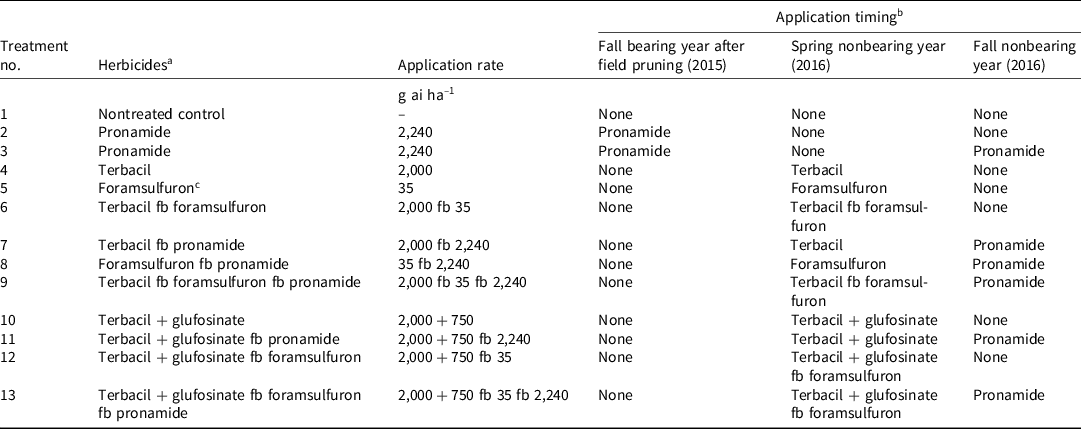
Field experiments were conducted to evaluate a range of potential terbacil-based herbicide treatments for hair fescue management in lowbush blueberry (Table 1). The experiment was established in fall of the bearing year after field pruning in lowbush blueberry fields located at Parrsboro (45.23°N, 64.48°W), Portapique (45.41°N, 63.72°W), and Stewiacke (45.27°N, 63.07°W), NS, Canada. Soil at the Parrsboro site was a sandy loam (59% sand, 35% silt, 6% clay) with a pH of 4.4 and 8% organic matter (OM). Soil at the Portapique site was a sandy loam (70% sand, 21% silt, 9% clay) with a pH of 4.4 and 9% OM. Soil at the Stewiacke site was a sandy loam (74% sand, 18% silt, 8% clay) with a pH of 4.6 and 6% OM. The experiment was arranged as a randomized complete block design with 13 treatments (Table 1) and five blocks at Portapique and four blocks at Stewiacke and Parrsboro. Treatments consisted of various combinations of pronamide (Kerb SC herbicide; Dow AgroSciences Canada Inc., Calgary, AB), terbacil (Sinbar 80WDG herbicide; Tessenderlo Kerley Inc., Phoenix, AZ), foramsulfuron (Option® 2.25 OD herbicide; Bayer CropScience Inc., Calgary, Alberta), and glufosinate (Ignite herbicide; Bayer CropScience, Durham, NC). Plot size at Parrsboro and Portapique was 2 m by 6 m, and plot size at Stewiacke was 2 m by 5 m. Herbicides were applied with a CO2-pressurized research plot sprayer outfitted with four Teejet 11002 XR nozzles (TeeJet Technologies, Spraying Systems Co., Springfield, PA 19064) and calibrated to deliver a water volume of 200 L ha–1 (terbacil, foramsulfuron, and glufosinate) or 300 L ha–1 (pronamide) at a pressure of 276 kPa.
Terbacil-based herbicide treatments evaluated for hair fescue management in lowbush blueberry at Parrsboro, Portapique, and Stewiacke, NS, Canada.

a Abbreviations: fb, followed by.
b Fall bearing-year pronamide applications were applied on November 10, 2015 at Parrsboro and Portapique and on November 11, 2015 at Stewiacke. Spring nonbearing-year terbacil and glufosinate applications, as well as foramsulfuron applications for treatments 5 and 8, were applied on May 12, 2016, May 10, 2016, and May 4, 2016 at Parrsboro, Portapique, and Stewiacke, respectively. Spring nonbearing-year foramsulfuron applications in all other treatments were applied on May 29, 2016 at Parrsboro and Portapique and on May 29, 2016 at Stewiacke. Fall nonbearing-year pronamide applications were applied on November 25, 2016 at each site.
c Foramsulfuron was applied in conjunction with 28% UAN liquid nitrogen fertilizer at a rate of 2.5 L ha–1.
Data Collection
Data collection included hair fescue tuft density prior to treatment applications, vegetative and flowering hair fescue tuft density in summer of the nonbearing and bearing year, hair fescue flowering-tuft inflorescence number in summer of the nonbearing-year, lowbush blueberry stem density, stem height, and flower bud number per stem at the end of the nonbearing year, and lowbush blueberry yield in late summer of the bearing year. Hair fescue tuft densities were determined in two 1-m by 1-m quadrats per plot. Hair fescue inflorescence number and height were determined on 10 randomly selected tufts per plot using a line transect method previously described (White and Kumar Reference White and Kumar2017). Initial hair fescue tuft densities were determined on April 26, 2016 at Stewiacke and April 27, 2016 at Parrsboro and Portapique. Nonbearing-year hair fescue vegetative and flowering-tuft density were determined on June 19, 2016, June 28, 2016, and June 27, 2016 at Stewiacke, Parrsboro, and Portapique, respectively. Nonbearing-year flowering hair fescue tuft inflorescence number was determined on July 07, 2016, July 11, 2016, and July 08, 2016 at Stewiacke, Parrsboro, and Portapique, respectively. Bearing-year hair fescue flowering and total tuft densities were determined on July 07, 2017, July 10, 2017, and July 29, 2017 at Stewiacke, Parrsboro, and Portapique, respectively.
Lowbush blueberry stem density was determined in two 30-cm by 30-cm quadrats per plot. Lowbush blueberry stem height and flower bud number per stem were determined on 30 randomly selected blueberry stems per plot. Stems were clipped at ground level, bagged in the field, and brought back to the lab for data collection. Lowbush blueberry yield was determined in two 1-m by 1-m quadrats per plot, and fruit was harvested using hand rakes in mid-August of the crop year. Lowbush blueberry stem density was determined on October 05, 2016, September 22, 2016, and October 20, 2016 at Stewiacke, Parrsboro, and Portapique, respectively. Stem collections for height and flower bud assessment at each date occurred on these dates as well. Lowbush blueberry yield was determined on August 03, 2017, August 14, 2017, and August 02, 2017 at Stewiacke, Parrsboro, and Portapique, respectively.
Statistical Analysis
Sites were analyzed separately in the analysis. The effect of herbicide treatment on the various response variables was determined using ANOVA in PROC MIXED in SAS for Windows (Statistical Analysis System, version 9.4; SAS Institute, Cary, NC). Herbicide treatment was modeled as a fixed effect in the analysis, and blocks were modeled as a random effect. Assumptions of normality and constant variance for all analyses were assessed using PROC UNIVARIATE in SAS, and data were LOG(Y) or SQRT(Y) transformed where necessary to achieve normality and constant variance. Means separation, where necessary, was conducted using a Tukey’s test at α = 0.05.
Results and Discussion
Treatment Effects on Hair Fescue
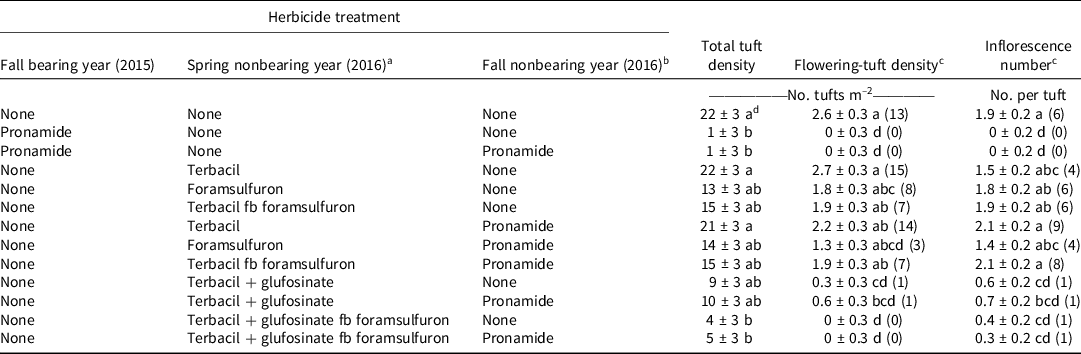
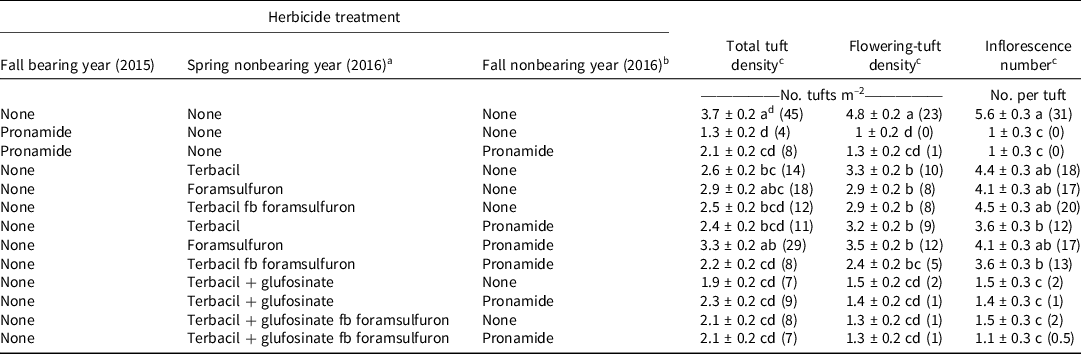
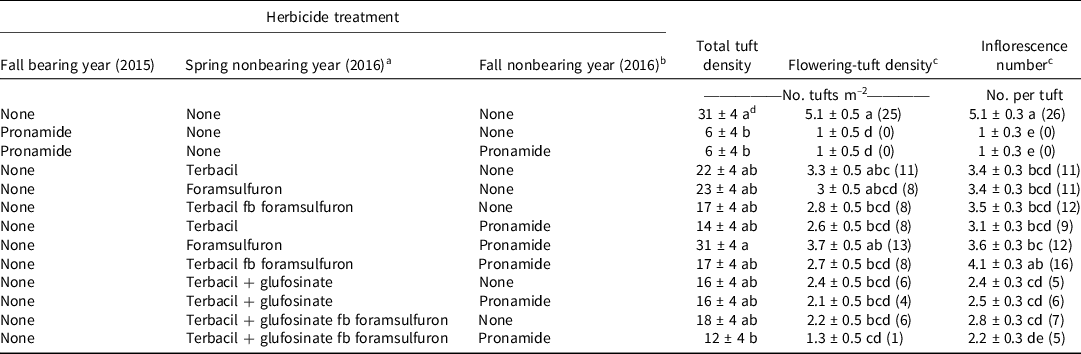
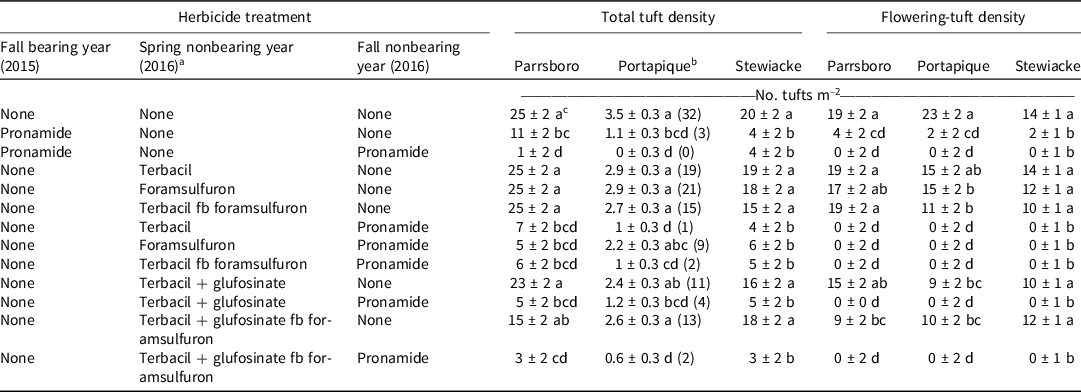
Initial hair fescue tuft densities at Parrsboro, Portapique, and Stewiacke were 43 ± 11, 18 ± 7, and 32 ± 10 tufts m–2, respectively. Fall bearing-year pronamide applications reduced nonbearing-year total tuft density, flowering-tuft density, and flowering-tuft inflorescence number at each site (Tables 2, 3, and 4). Total tuft density and flowering-tuft density remained low in the bearing year at each site (Table 5), though sequential fall bearing-year and fall nonbearing-year pronamide applications provided additional reductions in total tuft density at Parrsboro (Table 5). A single fall bearing-year pronamide application generally provides control of hair fescue for the entire 2-yr lowbush blueberry production cycle (Yarborough and Cote Reference Yarborough and Cote2014; Zhang et al. Reference Zhang, White, Olson and Pruski2018), though sequential fall bearing-year and fall nonbearing-year pronamide applications do contribute to additional control at some sites (White Reference White2019). Given the cost of pronamide (˜$500 CAD ha–1), growers should monitor nonbearing-year fields for hair fescue regrowth and only consider an additional pronamide application if sufficient surviving tufts are present.
Effect of terbacil-based herbicide treatments on nonbearing-year hair fescue total tuft density, flowering-tuft density, and flowering-tuft inflorescence number at Parrsboro, NS, Canada, in 2016.

a Abbreviations: fb, followed by.
b Fall nonbearing pronamide applications were not made before collection of data presented.
c Flowering-tuft density data and inflorescence number data were LOG(Y) transformed to meet the assumptions of the variance analysis. Transformed means are presented for variance estimates and means comparison purposes, and back-transformed means are presented in parentheses.
d Means within the same column followed by the same letter are not significantly different according to a Tukey’s multiple means comparison test at P < 0.05.
Effect of terbacil-based herbicide treatments on nonbearing-year hair fescue total tuft density, flowering-tuft density, and flowering-tuft inflorescence number at Portapique, NS, Canada, in 2016.

a Abbreviations: fb, followed by.
b Fall nonbearing pronamide applications were not made before collection of data presented.
c Total tuft density data were LOG(Y) transformed to meet the assumptions of the variance analysis. Flowering-tuft density data and flowering-tuft inflorescence data were SQRT(Y) transformed to meet the assumptions of the variance analysis. Transformed means are presented for variance estimates and means comparison purposes, and back-transformed means are presented in parentheses.
d Means within the same column followed by the same letter are not significantly different according to a Tukey’s multiple means comparison test at P < 0.05.
Effect of terbacil-based herbicide treatments on nonbearing-year hair fescue total tuft density, flowering-tuft density, and flowering-tuft inflorescence number at Stewiacke, NS, Canada, in 2016.

a Abbreviations: fb, followed by.
b Fall nonbearing pronamide applications were not made before collection of data presented.
c Flowering-tuft density and inflorescence number data were SQRT(Y) transformed to meet the assumptions of the variance analysis. Transformed means are presented for variance estimates and means comparison purposes, and back-transformed means are presented in parentheses.
d Means within the same column followed by the same letter are not significantly different according to a Tukey’s multiple means comparison test at P < 0.05.
Effect of terbacil-based herbicide treatments on bearing-year hair fescue total tuft density and flowering-tuft density at Parrsboro, Portapique, and Stewiacke NS, Canada, in 2017.

a Abbreviations: fb, followed by.
b Total tuft density data at Portapique were LOG(Y) transformed to meet the assumptions of the variance analysis. Transformed means are presented for variance estimates and means comparison purposes, and back-transformed means are presented in parentheses.
c Means within the same column followed by the same letter are not significantly different according to a Tukey’s multiple means comparison test at P < 0.05.
Spring nonbearing-year foramsulfuron applications were generally ineffective in this experiment, though flowering-tuft density was reduced at Portapique (Table 3), and flowering-tuft inflorescence number was reduced at Stewiacke (Table 4). Foramsulfuron does not kill established hair fescue plants (White and Kumar Reference White and Kumar2017) but does generally reduce flowering-tuft density and flowering-tuft inflorescence number (White Reference White2019; White and Kumar Reference White and Kumar2017; Zhang et al. Reference Zhang, White, Olson and Pruski2018). Suppression is, however, inconsistent across sites (White Reference White2019; Zhang et al. Reference Zhang, White, Olson and Pruski2018) and potentially related to undocumented variability in hair fescue tuft size and stage of development (vegetative vs bolting) at the time of spring foramsulfuron applications (S.N. White, personal observation). Similar to previous studies, we also found that any suppression obtained from foramsulfuron was limited to the year of application only, as bearing-year tuft densities were generally unaffected by spring nonbearing-year foramsulfuron applications at each site (Table 5).
Spring nonbearing-year terbacil applications exhibited variable efficacy within and between sites. Terbacil was ineffective at Parrsboro (Table 2). Spring nonbearing-year terbacil applications, however, reduced hair fescue total tuft density and flowering-tuft density at Portapique (Table 3), and flowering-tuft inflorescence number was also reduced in the terbacil treatment receiving a fall nonbearing-year pronamide application at this site (Table 3). Similarly, flowering-tuft inflorescence number was reduced by terbacil at Stewiacke, and both flowering-tuft density and flowering-tuft inflorescence number were reduced in the terbacil treatment receiving a fall nonbearing-year pronamide application at this site (Table 4). Terbacil kills hair fescue seedlings (White Reference White2018), but efficacy on established tufts in lowbush blueberry fields is variable (Zhang et al. Reference Zhang, White, Olson and Pruski2018) and generally limited to single-season suppression (White Reference White2019; Zhang et al. Reference Zhang, White, Olson and Pruski2018). Terbacil efficacy is affected by plant size, which may contribute to variability in efficacy on hair fescue in lowbush blueberry fields. Large (12-leaf) field violet (Viola arvensis L.) plants, for example, absorbed and translocated less terbacil than small (3-leaf) plants (Doohan et al. Reference Doohan, Monaco and Sheets1992). Large plants also metabolized more terbacil than small plants, and Doohan et al. (Reference Doohan, Monaco and Sheets1992) indicated that field rates of terbacil commonly controlled field violet seedlings but not established plants. Established hair fescue tufts have hundreds of leaves under field conditions, and a similar size effect on terbacil efficacy could occur with hair fescue in lowbush blueberry fields and should be investigated in future research. Bearing-year total tuft density and flowering-tuft density were not reduced by terbacil at any site (Table 5), again indicating that damage to hair fescue from spring nonbearing-year terbacil applications is limited to the year of application only.
Spring nonbearing-year terbacil applications fb spring foramsulfuron applications did not improve hair fescue suppression relative to terbacil or foramsulfuron applications alone at any site (Tables 2, 3, and 4). Spring nonbearing-year terbacil + glufosinate applications, however, gave greater reductions in hair fescue flowering-tuft density and flowering-tuft inflorescence number than terbacil applications alone at Parrsboro and Portapique (Tables 2 and 3) and also reduced hair fescue total tuft density at Portapique (Table 3). With the exception of pronamide, spring nonbearing-year terbacil + glufosinate applications also provided the most consistent reductions in flowering-tuft density and flowering-tuft inflorescence number relative to the nontreated control at each site (Tables 2, 3, and 4). These results suggest that terbacil may be more effective on hair fescue when applied in tank mixture with glufosinate. We do, however, acknowledge that our experimental design did not include a spring nonbearing-year glufosinate application for comparison purposes. Previous research has shown that spring nonbearing-year glufosinate applications reduce hair fescue flowering-tuft inflorescence number but do not consistently reduce total or flowering-tuft density (White Reference White2019; White and Kumar Reference White and Kumar2017; Zhang Reference Zhang2017). Our results therefore suggest that terbacil + glufosinate is more effective than terbacil alone and, based on previous research, seems to be more effective than glufosinate applications alone as well. Glufosinate tank mixtures with other photosystem II–inhibiting herbicides, such as atrazine and metribuzin, also improved control of some annual weed species (Culpepper and York Reference Culpepper and York1999; Jones et al. Reference Jones, Chandler, Morrison, Senseman and Tingle2001). Additional research should therefore be conducted to verify differences in efficacy between terbacil, glufosinate, and the tank mixture of these herbicides. Similar to other non-pronamide treatments, however, hair fescue suppression by spring nonbearing-year terbacil + glufosinate applications was limited primarily to the nonbearing year at Parrsboro and Stewiacke (Table 5), though bearing-year flowering-tuft density was reduced by this treatment at Portapique (Table 5). Spring nonbearing-year terbacil + glufosinate applications fb foramsulfuron also reduced bearing-year flowering-tuft density at Parrsboro and Portapique (Table 5). Although nonbearing-year suppression in this treatment was similar to terbacil + glufosinate applications (Tables 2, 3, and 4), results indicate that nonbearing-year terbacil use in conjunction with glufosinate and foramsulfuron can potentially improve bearing-year suppressing relative to these herbicides applied alone.
Bearing-year total and flowering-tuft density were reduced in all treatments receiving a fall nonbearing-year pronamide application (Table 5). Reductions in total and flowering-tuft density, however, were generally similar to that achieved with a single fall bearing-year pronamide application (Table 5). These results indicate limited additional control from the various nonbearing-year treatments evaluated relative to a single pronamide application. Pronamide cost is cited by growers as the main reason for reluctance to use this product, but our results show that one application provides 2 yr of control. This is consistent with previous research with pronamide (White Reference White2019; Zhang et al. Reference Zhang, White, Olson and Pruski2018), and growers should consider the cumulative costs of inferior treatments given that hair fescue can reduce yield by >50% (White Reference White2019). Our results also identify terbacil + glufosinate or terbacil + glufosinate fb foramsulfuron as potentially effective nonbearing-year treatments for growers who miss the opportunity for fall bearing-year pronamide applications or for growers looking to diversify the herbicide modes of action used for hair fescue management. These treatments could also be rotated with pronamide use in subsequent production cycles to prevent re-establishment of hair fescue from seed, as both terbacil and glufosinate kill hair fescue seedlings (White Reference White2018; White and Kumar Reference White and Kumar2017), and hair fescue seed is routinely moved within and between fields by equipment (Boyd and White Reference Boyd and White2009).
Treatment Effects on Lowbush Blueberry
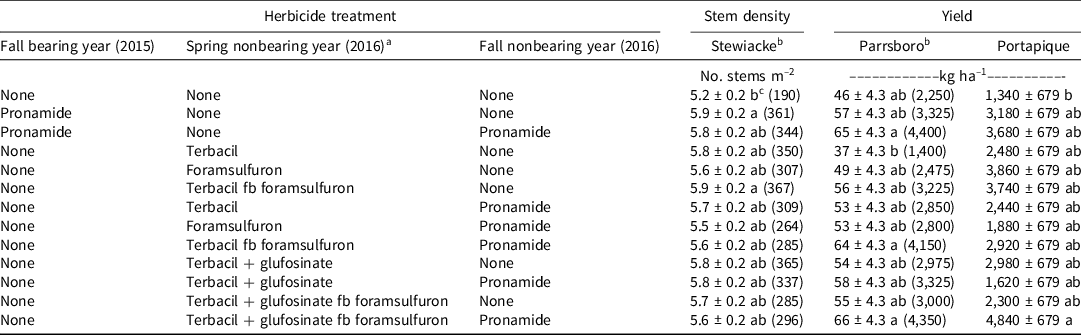
There was no significant herbicide treatment effect on lowbush blueberry stem height (P ≥ 0.1474) or flower bud number per stem (P ≥ 0.6125) at any site. Lowbush blueberry stem height averaged 18 ± 1, 14 ± 1, and 16 ± 1 cm at Parrsboro, Portapique, and Stewiacke, respectively. Lowbush blueberry flower bud number averaged 8.3 ± 0.3, 7 ± 0.4, and 4.6 ± 0.2 buds per stem at Parrsboro, Portapique, and Stewiacke, respectively. There was a significant herbicide treatment effect on lowbush blueberry stem density at Stewiacke (P = 0.0418) but not at Portapique (P = 0.6377) or Parrsboro (P = 0.1624). Stem density averaged 239 ± 12 and 516 ± 11 stems m–2 at Portapique and Parrsboro, respectively. Lowbush blueberry stem density was increased in the pronamide and the terbacil-fb-foramsulfuron treatments relative to the nontreated control at Stewiacke (Table 6), indicating that hair fescue suppression may increase lowbush blueberry stem density. There was a significant herbicide treatment effect on lowbush blueberry yield at Parrsboro (P = 0.0021) and Portapique (P = 0.0222) but not Stewiacke (P = 0.1004). Average lowbush blueberry yield at Stewiacke was 2,930 ± 196 kg ha–1. Yield was consistently highest at Parrsboro and Portapique in the terbacil + glufosinate-fb-foramsulfuron-fb-pronamide treatment (Table 6). Yield was also increased relative to the terbacil treatment in the pronamide-fb-pronamide and the terbacil-fb-foramsulfuron-fb-pronamide treatments (Table 6). Results indicate that hair fescue suppression or control can increase lowbush blueberry yield, though this weed must be suppressed in both the nonbearing and bearing year to achieve yield increases. Similar results were reported by White (Reference White2019).
Effect of terbacil-based herbicide treatments on lowbush blueberry stem density at Stewiacke, NS, Canada, in 2016 and lowbush blueberry yield at Parrsboro and Portapique, NS, Canada, in 2017.

a fb, followed by.
b Lowbush blueberry stem density data at Stewiacke were LOG(Y) transformed to meet the assumptions of the variance analysis. Lowbush blueberry yield data at Parrsboro were SQRT(Y) transformed to meet the assumptions of the variance analysis. Transformed means are presented for variance estimates and means comparison purposes, and back-transformed means are presented in parentheses.
c Means within the same column followed by the same letter are not significantly different according to a Tukey’s multiple means comparison test at P < 0.05.
In conclusion, a single fall bearing-year pronamide application provided good control of hair fescue, though control was improved at one site through use of sequential fall bearing-year and fall nonbearing-year pronamide applications. Spring nonbearing-year foramsulfuron and terbacil applications, alone or as sequential treatments, provided variable or limited hair fescue suppression. Terbacil + glufosinate provided greater nonbearing-year suppression than terbacil alone at two sites, and terbacil + glufosinate fb foramsulfuron gave good nonbearing-year suppression and reduced bearing-year flowering-tuft density at two sites. Terbacil + glufosinate or terbacil + glufosinate fb foramsulfuron may therefore provide an alternative to pronamide for nonbearing-year hair fescue suppression or could be used in rotation with pronamide in subsequent lowbush blueberry production cycles. All spring nonbearing-year herbicide treatments required fall nonbearing-year pronamide applications to maintain adequate bearing-year hair fescue control. Bearing-year control was, however, similar to a single pronamide application, indicating that growers should consider the cumulative costs of inferior treatments before discounting pronamide use based on product cost alone.
Acknowledgments
We acknowledge field assistance from Hugh Lyu, Cody Webb, Lienna Hoeg, and Tyler Jollimore. Field sites for this research were provided by Milford Welton, Bragg Lumber Company, and Joe Slack. Funding for this research was provided by the Wild Blueberry Producers Association of Nova Scotia, Dalhousie University, and the Nova Scotia Department of Agriculture through a Research Acceleration Grant (grant no. RA15-0009) to S.N.W. No conflicts of interest have been declared.